
| REPORT ATTRIBUTE | DETAILS |
|---|---|
| Historical Period | 2019-2022 |
| Base Year | 2023 |
| Forecast Period | 2024-2032 |
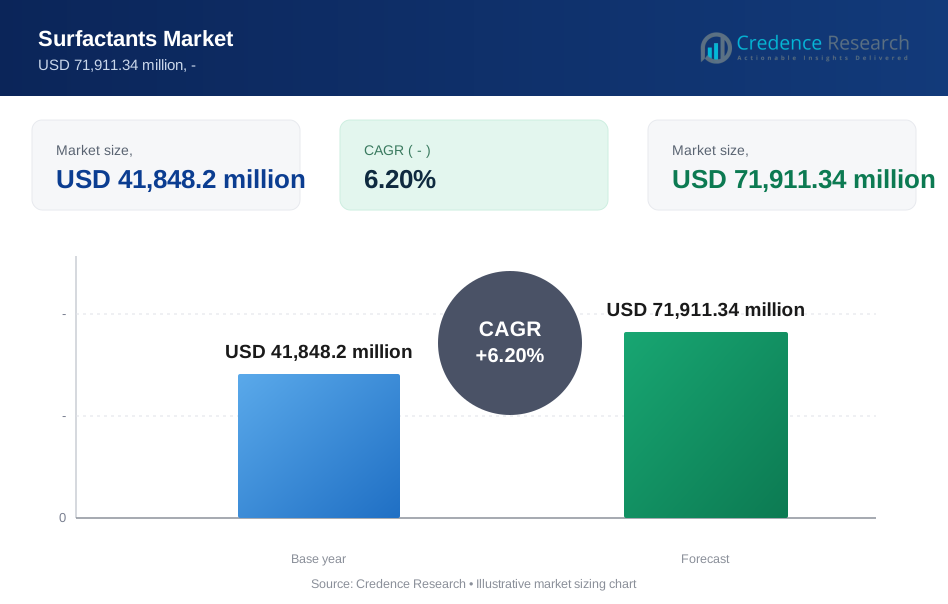
| Surfactants Market Size 2024 | USD 41848.2 Million |
| Surfactants Market, CAGR | 6.20% |
| Surfactants Market Size 2032 | USD 71911.34 Million |
Market Insights
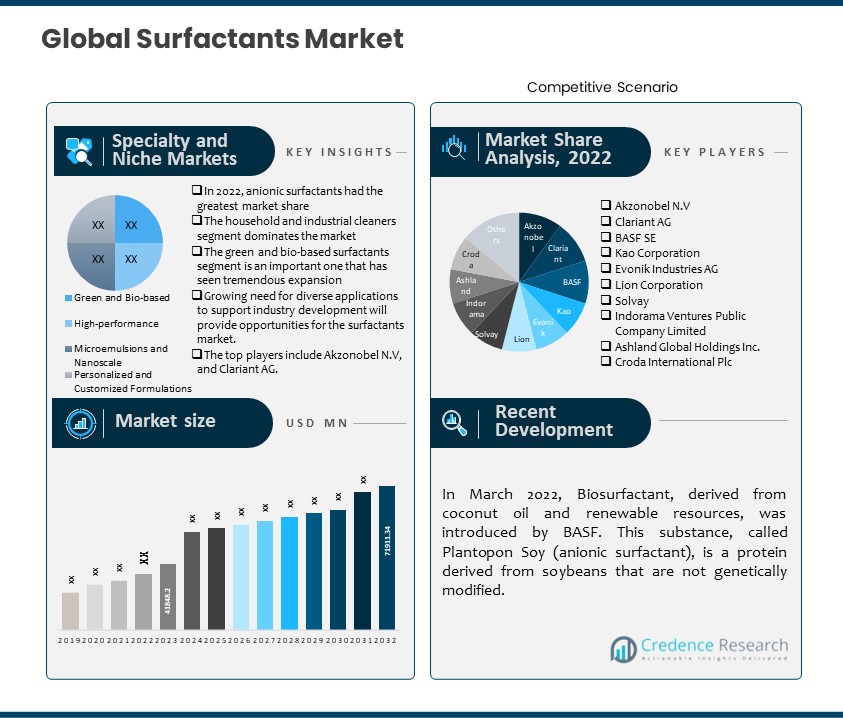
- The global market for surfactants is expected to develop at a compound annual growth rate (CAGR) of 6.20% between 2024 and 2032, from its estimated USD 41848.2 million in 2023 to USD 71911.34 million in 2032.
- The largest category is anionic surfactants. Cationic surfactants, on the other hand, are expected to grow at a strong CAGR.
- The household and industrial cleaners category will expand at a rapid rate of growth.
- The CAGR for the green and bio-based surfactants is expected to be the highest during the projection period.
- North America dominated the surfactants market.
- Regarding the market share of surfactants, Europe is expected to come second.
- In the surfactants market, Asia Pacific is anticipated to grow fastest.
- Surfactants are in high demand because they are utilized in shampoos, body washes, and other personal care products as consumers become more conscious about their cleanliness and grooming.
- New and improved surfactants with increased performance characteristics are developed as a result of developments in surfactant chemistry and production techniques.
Executive Summary
Market Definition
The global industry that produces, distributes, and sells surfactants is referred to as the surfactants market. Surface-active agents, also referred to as surfactants, are compounds that lessen the surface tension between two liquids, a liquid and a solid, or a gas and a liquid. They are essential for many different uses, including oil recovery, agriculture, detergents, personal care items, and pharmaceuticals. Anionic, cationic, nonionic, and amphoteric surfactant types are among the many varieties available in the market, which serve a variety of global end-user industries.
Market Overview
The surfactants sector is estimated to develop at a 6.20% compound annual growth rate (CAGR) between 2024 and 2032, maintaining its current upward trend. The market will continue to develop, rising from its estimated USD 41848.2 million in 2023 to USD 71911.34 million in 2032.
Several businesses and institutions, including healthcare, retail, hospitality, and others, deal directly with customers; as a result, cleanliness is important to these sectors and organizations. Furthermore, surfactants are crucial to cleaning products because they are frequently used in a wide range of formulations and products to increase the cleaning solutions' efficacy. Consequently, there is an increasing need for surfactants in end-use industries.
The number of older persons over 60 was 962 million in 2017, and the United Nations projects that by 2050, that number will have doubled. These elderly individuals experience typical geriatric ailments such as hair loss, which drives the hair care industry, and skin degeneration, which boosts sales of skin care goods. In addition, people's disposable income in both developed and developing nations is rising, which contributes to the demand for personal care products. These days, a large surfactant industry is being created by the usage of surfactants in these personal care products since they are effective surface active agents.
Segmentation by Type of Surfactants
- Anionic surfactants are the market leader in terms of type. They are extensively used in various industries, including home care, textiles, personal hygiene, and pharmaceuticals. This is because of their availability, affordability, low toxicity, and compatibility. As a result, the market for surfactants is dominated by anionic surfactants.
- The cationic surfactants category will exhibit a sizable CAGR during the projected period. Cationic surfactants are compounds with positive charges that can effectively adsorbed on substrates with negative charges via strong charge-charge or electrostatic interactions.
- Other types of surfactants influence the need for surfactants, including nonionic surfactants and amphoteric surfactants.
Segmentation by Application
- Household and industrial cleaners are considered the best application category. Industrial cleaners frequently use surfactants because of their solvent-cleaning and degreasing capabilities. Surfactants emulsify and break down oils, greases, and other hydrophobic materials, facilitating their removal from surfaces.
- The personal care and cosmetics category will likely register a significant CAGR during forecasting. Many personal care products contain surfactants as foaming agents to produce lather and foam, which improves the washing sensation viscerally. Foaming agents aid in the product's equal distribution and provide the impression that it has been thoroughly cleaned.
- Other Application, such as food and beverage processing, oil and gas, agrochemicals, textiles and leather, paints and coatings, pharmaceuticals, and construction, also contribute to the demand for surfactants.
Segmentation by Specialty and Niche Markets
- The green and bio-based surfactants category is projected to grow faster over the projection period. One of their key benefits is their greater biodegradability compared to traditional surfactants. This implies a lower chance of long-term contamination and damage to aquatic ecosystems because they decompose more quickly in the environment.
- Other specialty and niche markets influence the need for surfactants, including high-performance surfactants, microemulsions and nanoscale surfactants, and personalized and customized formulations.
Segmentation by Region
- North America leads the surfactant industry. The market is being driven by the growing number of manufacturers of bio-based surfactants, which are a result of the region's economically viable countries.
- Europe is estimated to rank second in market size for surfactants.
- The surfactant industry is predicted to flourish rapidly in Asia Pacific.
- The remaining need for surfactants is met by regions like Latin America, Africa, and the Middle East.
Europe has one of the biggest and richest economies, and the most developed countries in the world, like the UK, France, Italy, and Spain, are found there. The increased demand from end-user sectors like construction, personal care products, food additives, textiles, and agriculture are the main factors driving the surfactant market in Europe.
Based on projections, North America is anticipated to control the surfactants market. There is a greater need for hygiene items such as liquid soap and hand sanitizers as a result of the COVID-19 pandemic. The North American market for surfactants is driven by the expansion of hygiene products, including liquid soap, hand sanitizers, detergents, and personal care items; additionally, the market is driven by the rise of paints and coatings, agriculture, textiles, and bio-based products. Surfactant demand in North America has grown significantly due to a number of factors, including increased biobased goods, growing need for personal care and home care products, and growing demand from various applications.
Moreover, Asia Pacific is anticipated to increase at a high rate over the projection period. In Asia-Pacific, there is a considerable need for surfactants due to factors like the rapid development of cities, increasing financial resources, and increased industrialization in the food, cosmetics, textile, electronics, and agriculture sectors of manufacturing. Additionally, the market is benefiting from the low cost of labor and raw materials. The biggest investment markets over the last few years have been China, India, Japan, and Singapore, and they will remain so. The region's market has grown mainly because of rising disposable incomes, robust economic growth, expanding building activity, and the dominance of agricultural industries.
Key Highlights of the Report
The global surfactants market is segmented by type of surfactants, Application, specialty and niche markets, and region. As far as the type of surfactants is concerned, anionic surfactants are the market spearhead. Household and industrial cleaners are the top application category. Over the forecast period, the category of green and bio-based surfactants is expected to grow at the highest CAGR. The surfactants market is expanding mostly in North America.
The market for surfactants, which are used as a wetting agent in herbicides, is being supported by the agriculture sector even while the insecticide market is being pounded. Farmers all over the world utilize herbicides to eradicate weeds from their crops, which results in a continuous demand for surfactants in the agriculture industry. This, in turn, opens up new revenue streams for vendors in the surfactants market.
North America is expected to account for the largest surfactant market globally. Surfactant demand will be driven by the US's robust economic growth, the growing demand for green housing, and the significant investments made by the federal and state governments to support residential building projects. These factors also support the development of construction, chemicals, paints, and coatings in the US. The Asia Pacific region is also assumed to have the market's sharpest growth. In the Asia Pacific, India is becoming a more significant market for domestic and foreign investors due to its robust agrochemical, dyes and pigments, detergents, sanitation products, soap, and personal care product manufacturing hub, as well as its cost-effective labor and reduced production expenses. This is particularly true considering that the Asia-Pacific region's two biggest surfactant markets are China and Japan. Furthermore, it is anticipated that the "Make in India" program and the recently introduced "Vocal for Local" campaign will accelerate India's rise to prominence in the surfactant industry.
Which Key Factors Are Driving The Global Surfactants Market?
The demand for high-performance surfactants, growing emphasis on sustainability, technical developments, and innovative formulations are some of the reasons propelling the surfactants market's expansion.
What Are The Main Challenges Confronting The Global Surfactants Market?
The most significant obstacles to the sector's growth are the complexity of formulation development, pressure on product prices, and consumers' and businesses' lack of knowledge about the advantages of green and bio-based surfactants.
What Market Opportunities Exist For Surfactants Globally?
The need for mild surfactants in personal care products, the need for specialist surfactants, and shifting consumer preferences all point to the surfactants sector's potential growth.
Market Drivers
Multiple factors propel the surfactants industry across the globe. The primary factors propelling the global surfactants market are as follows:
Growing Need for Diverse Applications to Support Industry Development
The global surfactants market will be supported by the increasing demand for the product from a variety of applications, including food and beverage, textiles, and home care. The expanding awareness of hygiene among consumers is one of the primary factors driving the home care applications sector. The product stops the sickness from spreading and provides good infection protection. Growing consumer demand for cleaning supplies, shampoo, hand wash, sanitizers, and detergents will contribute to market expansion. Moreover, different chemical components are utilized in industrial cleaning to remove different kinds of dirt and waste products released during production. The demand for food and beverages has surged due to the growing population. Due to the product's usage as an additive, which further expands market growth prospects, the manufacturers have raised their output to meet the rising demand.
Market Restraints
There are several obstacles that the global surfactants market must overcome to continue growing. Among them are the following:
Raw Material Price Volatility Could Impede Market Expansion
Growing crude oil costs and environmental issues have led to severe volatility in raw material pricing. Raw material prices are impacted by surfactants' negative environmental consequences, including toxicity and degradability. Regulations pertaining to resource utilization and environmental preservation have been enforced by multiple regional administrations. The commercial production of petroleum products is anticipated to have technological limitations and low raw material prices, which will impede market expansion over the projection period.
Opportunities
There are plenty of potential prospects in the global surfactants industry. Among these are the following:
Growing Consumer Preference for Bio- and Green-Based Surfactant Products Will Support Market Expansion
The increasing need for environmentally friendly technologies has resulted in the replacement of petroleum-based synthetic products with alternatives. Biosurfactants exhibit several potential applications in various products, including, but not limited to, emulsifying agents, biocides (which reduce sulfate-producing bacteria), anticorrosive agents, and numerous more inventive uses. Their effectiveness and versatility make them useful in many different areas, such as residential care, industrial cleaning, food and beverage, and others.
Multifunctional compounds derived from hydrophilic, oily/hydrocarbon type carbon sources in the culture medium and miscible microbe substrates are expected to be identified as bio-based agents. Biotechnology plays a major part in the creation of bio-based products that can replace petroleum-based goods while also being better for the environment. Growing environmental and resource preservation concerns are driving up demand for products.
Competitive Landscape
Key Players
Several major competitors exist in the fiercely competitive global surfactants market. The following are a few of the leading market participants and their market shares:
- Akzonobel N.V (Arnhem, Netherlands)
- Clariant AG (Muttenz, Switzerland)
- BASF SE (Ludwigshafen, Germany)
- Kao Corporation (Tokyo, Japan)
- Evonik Industries AG (Essen, Germany)
- Lion Corporation (Tokyo, Japan)
- Solvay (Brussels, Belgium)
- Indorama Ventures Public Company Limited (Bangkok, Thailand)
- Ashland Global Holdings Inc. (Delaware, U.S.)
- Croda International Plc (Snaith, U.K.)
- Stepan Company (Illinois, U.S.)
- Dow Chemical Company (Michigan, U.S.)
- Others
These companies prioritize product innovation, distribution channel expansion, mergers, and acquisitions to remain competitive.
The major providers in the global surfactants market are always developing new ideas and products to stay one step ahead of the competition.
In December 2022, Evonik Industries AG introduced REWOFERM RL 100, a novel biosurfactant. It is completely biodegradable and derived from renewable feedstocks.
In October 2022, A joint venture for the commercial manufacture of non-ionic surfactants in Asia Pacific was planned by Hannong Chemicals, Inc. and BASF.
In May 2022, The Stepan Company began building and operating a new alkoxylation plant at its current Pasadena, Texas, location.
Summary of Key Findings
- The expansion of the automobile industry has led to the use of surfactants in car wash detergents and degreasers, among other cleaning solutions. The need for drug delivery systems and excipients in the pharmaceutical industry is driven by surfactants, which are essential to pharmaceutical formulations.
- The market is segmented by type of surfactants, Application, specialty and niche markets, and region.
- In the market, anionic surfactants are the most widely used type of surfactants.
- Household and industrial cleaners are the foremost category.
- The green and bio-based surfactants are expected to grow fastest in terms of CAGR during the forecast period.
- North America is leading market development; the market is highly competitive with key players including Akzonobel N.V (Arnhem, Netherlands), Clariant AG (Muttenz, Switzerland), BASF SE (Ludwigshafen, Germany), Kao Corporation (Tokyo, Japan), Evonik Industries AG (Essen, Germany), Lion Corporation (Tokyo, Japan), Solvay (Brussels, Belgium), Indorama Ventures Public Company Limited (Bangkok, Thailand), Ashland Global Holdings Inc. (Delaware, U.S.), Croda International Plc (Snaith, U.K.), Stepan Company (Illinois, U.S.), Dow Chemical Company (Michigan, U.S.), and Others.
Future Outlook
- The surfactants industry is expected to increase significantly in North America, and its outlook is positive worldwide.
- The expansion of the food service sector has led to the usage of surfactants for cleaning and sanitation in commercial kitchens and food processing industries.
- Prices of raw materials, including vegetable oils and petrochemicals, can fluctuate, which can affect surfactant manufacturing costs and pricing competitiveness.
- To stay ahead of the competition, key enterprises must develop new products, expand their market reach, and keep their prices competitive.
How CXOs Can Benefit from the Credence Research Surfactants Market Report
CXOs may get a detailed picture of the market in the Credence Research Surfactants Market Report, which includes:
- Market size and growth forecast: The report provides detailed estimates of the global surfactants market size, segmented by type of surfactants, Application, specialty and niche markets, and region. It also includes forecasts for the market through 2032 based on key trends and drivers.
- Market segmentation: The research report breaks down the market for surfactants into segments based on the type of surfactants, Application, specialty and niche markets, and region. This segmentation provides CXOs with a granular understanding of the market and the opportunities in each segment.
- Competitive landscape: The research report offers a detailed analysis of the major companies in the surfactants industry, including information on their business plans, product lines, and earnings. CXOs can use this information to evaluate and identify their competitors.
- Key trends and drivers: The research report identifies and evaluates the main trends and factors influencing the surfactants market. CXOs can use this information to make well-informed choices regarding their plans and investments.
CXOs can use the insights from the Credence Research Surfactants Market Report to:
- Identify growth opportunities: This analysis may help CXOs identify new growth opportunities in the surfactants sector. For example, the report identifies the growing demand for surfactants from the personal care and cosmetics industry as a key opportunity.
- Make informed investment decisions: The report helps CXOs make wise choices regarding surfactants. For example, the research study provides information on the critical factors to consider when selecting surfactant solutions and evaluating suppliers.
- Develop competitive strategies: CXOs can use the research report to develop competitive strategies for their surfactant businesses. For example, the research paper outlines the main strategies that surfactant suppliers utilize to differentiate themselves from competitors.
- Track market developments: This research report may help CXOs stay ahead of the curve by tracking market developments. For instance, it offers insights into the most recent developments and trends in the surfactant market.
CXOs seeking to expand their industry knowledge and spot growth prospects will find the Credence Research Surfactants Market Report useful.
Segmentation
- By Type of Surfactants
- Anionic Surfactants
- Linear Alkylbenzene Sulfonates (LAS)
- Alkyl Sulfates (AS)
- Alpha Olefin Sulfonates (AOS)
- Sulfosuccinates
- Cationic Surfactants
- Quaternary Ammonium Compounds (Quats)
- Alkyl Amine Ethoxylates
- Nonionic Surfactants
- Alcohol Ethoxylates (AE)
- Alkylphenol Ethoxylates (APE)
- Polyethylene Glycols (PEG)
- Fatty Amine Ethoxylates
- Amphoteric Surfactants
- Betaines
- Sulfobetaines
- Amphoterics
- By Application
- Household and Industrial Cleaners
- Personal Care and Cosmetics
- Food and Beverage Processing
- Oil and Gas
- Agrochemicals
- Textiles and Leather
- Paints and Coatings
- Pharmaceuticals
- Construction
- By Specialty and Niche Markets
- Green and Bio-based Surfactants
- High-performance Surfactants
- Microemulsions and Nanoscale Surfactants
- Personalized and Customized Formulations
- By Region
- North America
- The U.S.
- Canada
- Mexico
- Europe
- Germany
- France
- The U.K.
- Italy
- Spain
- Rest of Europe
- Asia Pacific
- China
- Japan
- India
- South Korea
- South-east Asia
- Rest of Asia Pacific
- Latin America
- Brazil
- Argentina
- Rest of Latin America
- Middle East & Africa
- GCC Countries
- South Africa
- The Rest of the Middle East and Africa
- North America
- Anionic Surfactants
Request a Free Sample
Fill in your details and we'll send you a free sample report.
- Sample data tables & charts
- Research methodology
Need a Custom Version of This Report?
Tailor the scope, geography, or segments to your exact requirements.
- Custom geography or segment scope
- Direct access to our analyst team
Frequently Asked Questions
How much does the global market currently hold for surfactants?
What is the surfactants market's projected growth rate between 2024 and 2032?
In terms of the type of surfactants, which market category is leading?
Which specialty and niche market segment is estimated to have the highest CAGR throughout the forecast period?
Who are the main players in the global surfactants industry?
Table of Content
Chapter 1. Report Introduction
- 1.1 Report Description & Purpose
- 1.1.1 Report Title & Market Definition
- 1.1.2 Unique Selling Propositions (USP) & Key Differentiators
- 1.1.3 Value Proposition for Stakeholders
- 1.2 Research Objectives
- 1.2.1 Market Sizing Objectives (Volume & Revenue)
- 1.2.2 Segmentation Objectives
- 1.2.3 Competitive Intelligence Objectives
- 1.2.4 Forecast & Scenario Objectives
- 1.3 Report Scope
- 1.3.1 Surfactants Scope – Types & Subtypes Covered
- 1.3.2 Geographic Scope – Regions & Countries Covered
- 1.3.3 Historical Period, Base Year & Forecast Period (the historical period; forecast to the forecast period)
- 1.3.4 Inclusions & Exclusions
- 1.4 HS Code & Classification Framework
- 1.5 Currency, Units & Pricing Basis
- 1.6 Target Stakeholders
- 1.7 Limitations & Assumptions
Chapter 2. Executive Summary
- 2.1 Global Surfactants Market Snapshot
- 2.1.1 Market Size – Historical (the historical period) & Forecast (the forecast period) (base year: USD 41,848.2 million → forecast year: USD 71,911.34 million)
- 2.1.2 Volume & Revenue – Global Totals
- 2.1.3 Key Market Highlights – Top Five Facts
- 2.2 Surfactants Market Segmentation Snapshot
- 2.2.1 Market Split by Region – vs.
- 2.3 Competitive Snapshot
- 2.3.1 Top 10 Players by Revenue Share –
- 2.3.2 Top 10 Players by Volume Share –
- 2.3.3 Recent Strategic Developments (18-Month Summary)
- 2.4 Key Investment Highlights & Strategic Conclusions
Chapter 3. Surfactants Market Dynamics & Industry Analysis
- 3.1 Market Overview & Context
- 3.1.1 Surfactants Market Position in the Broader Automotive Value Chain
- 3.1.2 OEM vs. Replacement Market Dynamics
- 3.1.3 Market Maturity & Development Stage by Region
- 3.2 Surfactants Market Drivers
- 3.3 Surfactants Market Restraints & Challenges
- 3.4 Surfactants Market Opportunities
- 3.5 Porter's Five Forces Analysis
- 3.5.1 Threat of New Entrants
- 3.5.2 Bargaining Power of Suppliers
- 3.5.3 Bargaining Power of Buyers
- 3.5.4 Threat of Substitutes
- 3.5.5 Competitive Rivalry – Intensity Assessment
- 3.6 Surfactants Value Chain Analysis
- 3.6.1 Upstream – Raw Material/Input Suppliers
- 3.6.1.1 Raw Material/Input 1
- 3.6.1.2 Raw Material/Input 2
- 3.6.1.3 Raw Material/Input 3
- 3.6.2 Midstream – Production/Manufacturing/Service Delivery
- 3.6.2.1 Production/Process Overview
- 3.6.2.2 Key Facility Locations & Capacity by Manufacturer
- 3.6.3 Downstream – Distribution & End Consumer
- 3.6.3.1 Primary Channel – B2B/OEM
- 3.6.3.2 Secondary Channels – Dealer, Retail, Online, Direct
- 3.6.4 Value Chain Profitability Analysis
- 3.6.1 Upstream – Raw Material/Input Suppliers
- 3.7 PESTEL Analysis
- 3.7.1 Political Factors
- 3.7.2 Economic Factors
- 3.7.3 Social Factors
- 3.7.4 Technological Factors
- 3.7.5 Environmental Factors
- 3.7.6 Legal Factors
- 3.8 Surfactants Supply Chain Analysis
- 3.8.1 Raw Material/Input Supply Risk Assessment
- 3.8.2 Manufacturing Concentration Risk (Geographic Exposure)
- 3.8.3 Trade Disruption Impact Analysis
- 3.9 Regulatory & Policy Landscape
Note: The regulatory and policy landscape section covers regulations based on their applicability to the market, Surfactants category, geography, and scope of the study. Only regulatory frameworks with a material impact on operations, compliance, trade, sustainability, or market access are analyzed in detail.
Chapter 4. Key Investment Pockets & Opportunity Analysis
- 4.1 Surfactants Market Attractiveness Analysis
- 4.1.1 By Region – Investment Attractiveness Matrix (Volume × CAGR)
- 4.2 Absolute Revenue Growth Opportunity
- 4.2.1 By Region – Absolute USD Growth Through the forecast period
- 4.3 Incremental Volume Opportunity
- 4.3.1 By Region – Incremental Volume Through the forecast period
- 4.3.2 Segment – Incremental Volume
- 4.4 Emerging Submarket Opportunity Deep Dive (Subject to Applicability)
- 4.5 Emerging Market Opportunity Scorecards
- 4.5.1 United States
- 4.5.2 Europe
- 4.5.3 Asia
- 4.5.4 Middle East & Africa
Note: Emerging Market Opportunity Scorecards will be included based on relevance and strategic importance. Regions listed are indicative and may vary depending on data availability and market dynamics.
Chapter 5. Surfactants Import-Export Analysis & Trade Flows
- 5.1 Global Trade Overview
- 5.1.1 Global Export Value by Country (the historical period)
- 5.1.2 Global Export Volume by Country (the historical period)
- 5.1.3 Global Import Value by Country (the historical period)
- 5.1.4 Global Import Volume by Country (the historical period)
- 5.1.5 Net Trade Balance by Country (the historical period)
- 5.2 Export Analysis – Segment
- 5.2.1 Type 1 (HS Code)
- 5.2.2 Type 2 (HS Code)
- 5.2.3 Type 3 (HS Code)
- 5.2.4 Type 4 (HS Code)
- 5.2.5 Type 5 (HS Code)
- 5.3 Import Analysis – Segment
- 5.3.1 Type 1 (HS Code)
- 5.3.2 Type 2 (HS Code)
- 5.3.3 Type 3 (HS Code)
- 5.3.4 Type 4 (HS Code)
- 5.3.5 Type 5 (HS Code)
- 5.4 Average Unit Trade Prices
- 5.4.1 Average Export Price – Segment & Country
- 5.4.2 Average Import Price – Segment & Source Country
- 5.4.3 Price Trends (the historical period)
- 5.5 Key Trade Route Analysis
- 5.5.1 Trade Route 1
- 5.5.2 Trade Route 2
- 5.5.3 Trade Route 3
- 5.5.4 Trade Route 4
- 5.5.5 Trade Route 5
- 5.6 Trade Policy Impact Assessment
- 5.6.1 US Anti-Dumping & Section 301 Tariffs
- 5.6.2 EU Customs Union Impact
- 5.6.3 Major Free Trade Agreements
- 5.6.4 USMCA Rules of Origin
Note: Trade policy analysis will be included only where relevant to the Surfactants market.
Chapter 6. Competitive Landscape & Company Benchmarking
- 6.1 Surfactants Market Concentration & Structure
- 6.1.1 Herfindahl-Hirschman Index (HHI) – vs.
- 6.1.2 Tier 1, Tier 2 & Tier 3 Market Structure
- 6.1.3 Global, Regional & Local Player Dynamics
- 6.2 Surfactants Market Share Analysis –
- 6.2.1 Global Revenue Share by Company
- 6.2.2 Global Volume Share by Company
- 6.2.3 Regional Revenue Share
- 6.2.4 Market Share Evolution ( vs. )
- 6.2.5 OEM Segment Share by Company
- 6.2.6 Replacement Segment Share by Company
- 6.3 Production/Delivery Capacity & Facility Analysis
- 6.3.1 Global Installed Capacity
- 6.3.2 Capacity Utilization Rates
- 6.3.3 Production/Output Volume
- 6.3.4 Facility Locations & Capacity Map
- 6.3.5 Planned Capacity Additions
- 6.4 Surfactants Competitive Benchmarking Matrix
- 6.4.1 Revenue, Volume, CAGR & Profitability Comparison
- 6.4.2 Channel Revenue Mix
- 6.4.3 Geographic Revenue Exposure
- 6.4.4 R&D Intensity
- 6.4.5 Sustainability Maturity
- 6.5 Strategic Developments in Surfactants (Last 24 Months)
- 6.5.1 Mergers, Acquisitions & Divestments
- 6.5.2 New Surfactants Launches
- 6.5.3 Facility Expansions
- 6.5.4 Strategic Alliances, Joint Ventures & Partnerships
- 6.5.5 Distribution Expansion & Market Entry
- 6.5.6 Sustainability & ESG Initiatives
- 6.6 Competitive Strategy Mapping
- 6.6.1 Leader, Challenger, Follower & Niche Classification
- 6.6.2 Pricing Strategy Comparison
- 6.6.3 Channel Strategy Matrix
Note: Strategic developments are included based on their materiality and the availability of reliable information.
Chapter 7. Global Surfactants Market – By Distribution Channel
- 7.1 Segment Overview
- 7.1.1 Volume & Revenue Split by Channel ( & )
- 7.1.2 Channel Mix Evolution (the forecast period)
Chapter 8. Regional Market Analysis – Global Overview
- 8.1 Global Regional Overview
- 8.1.1 Regional Volume Share
- 8.1.2 Regional Revenue Share
- 8.1.3 Regional Volume by Region
- 8.1.4 Regional Revenue by Region
- 8.1.5 Regional Forecast Through the forecast period
- 8.2 Cross-Regional Segment Analysis
- 8.2.1 By Distribution Channel
- 8.2.2 By Brand/Price Tier
Chapter 9. North America Surfactants Market
- 9.1 United States
- 9.2 Canada
- 9.3 Mexico
Chapter 10. Europe Surfactants Market
- 10.1 Germany
- 10.2 France
- 10.3 Italy
- 10.4 United Kingdom
- 10.5 Spain
- 10.6 Poland
- 10.7 Russia
- 10.8 Netherlands
- 10.9 Belgium
- 10.10 Sweden
- 10.11 Denmark
- 10.12 Norway
- 10.13 Rest of Europe
Chapter 11. Asia Pacific Surfactants Market
- 11.1 China
- 11.2 India
- 11.3 Japan
- 11.4 South Korea
- 11.5 Thailand
- 11.6 Indonesia
- 11.7 Vietnam
- 11.8 Malaysia
- 11.9 Australia
- 11.10 Rest of Asia Pacific
Chapter 12. Latin America Surfactants Market
- 12.1 Brazil
- 12.2 Argentina
- 12.3 Colombia
- 12.4 Chile
- 12.5 Rest of Latin America
Chapter 13. Middle East Surfactants Market
- 13.1 Saudi Arabia
- 13.2 United Arab Emirates
- 13.3 Turkey
- 13.4 Israel
- 13.5 Iran
- 13.6 Rest of the Middle East
Chapter 14. Africa Surfactants Market
- 14.1 South Africa
- 14.2 Egypt
- 14.3 Nigeria
- 14.4 Morocco
- 14.5 Rest of Africa
Chapter 15. Surfactants Company Profiles
- 15.1 [Company 01]
- 15.1.1 Company Overview
- 15.1.2 Key Management Personnel
- 15.1.3 Products & Services Portfolio
- 15.1.4 Financial Performance
- 15.1.5 Key Market Focus & Geographic Presence
- 15.1.6 Recent Developments & Strategic Initiatives
Note: The company profile list is preliminary and may change based on research findings, market developments, data availability, and client requirements.
Chapter 16. Appendices
- Appendix A – List of Abbreviations & Acronyms
- Appendix B – Industry Classification Code Reference – Full Series
- Appendix C – Production & Capacity Data Tables
- Appendix D – End-Use & Demand Base Tables
- Appendix E – Consumption & Replacement Rate Assumptions
- Appendix F – ASP Reference Tables
- Appendix G – Manufacturing & Facility Database
- Appendix H – Import-Export Data Tables
- Appendix I – Regulatory Summary Tables
- Appendix J – Primary Research Participant List (Anonymized)
- Appendix K – Primary Research Questionnaire Framework
- Appendix L – Data Sources & Bibliography
- Appendix M – Market Size Divergence & Source Comparison
Chapter 17. Research Methodology
- 17.1 Research Framework & Philosophy
- 17.2 Secondary Research – Sources, Hierarchy & Data Extraction
- 17.3 Data Modeling – Bottom-Up & Top-Down Market Sizing
- 17.4 Primary Research – Stakeholder Framework, LOI & Sample Sizes
- 17.5 Forecast Methodology – Regression, Scenario & Sensitivity Analysis
- 17.6 Quality Control – Four-Layer Validation Framework
- 17.7 Limitations & Standard Assumptions
- 17.8 Disclaimer
