| REPORT ATTRIBUTE |
DETAILS |
| Historical Period |
2020-2023 |
| Base Year |
2024 |
| Forecast Period |
2025-2032 |
| Pediatric Gait Trainers Market Size 2024 |
USD 1,422.79 Million |
| Pediatric Gait Trainers Market, CAGR |
9.67% |
| Pediatric Gait Trainers Market Size 2032 |
USD 3,135.23 Million |
Market Overview
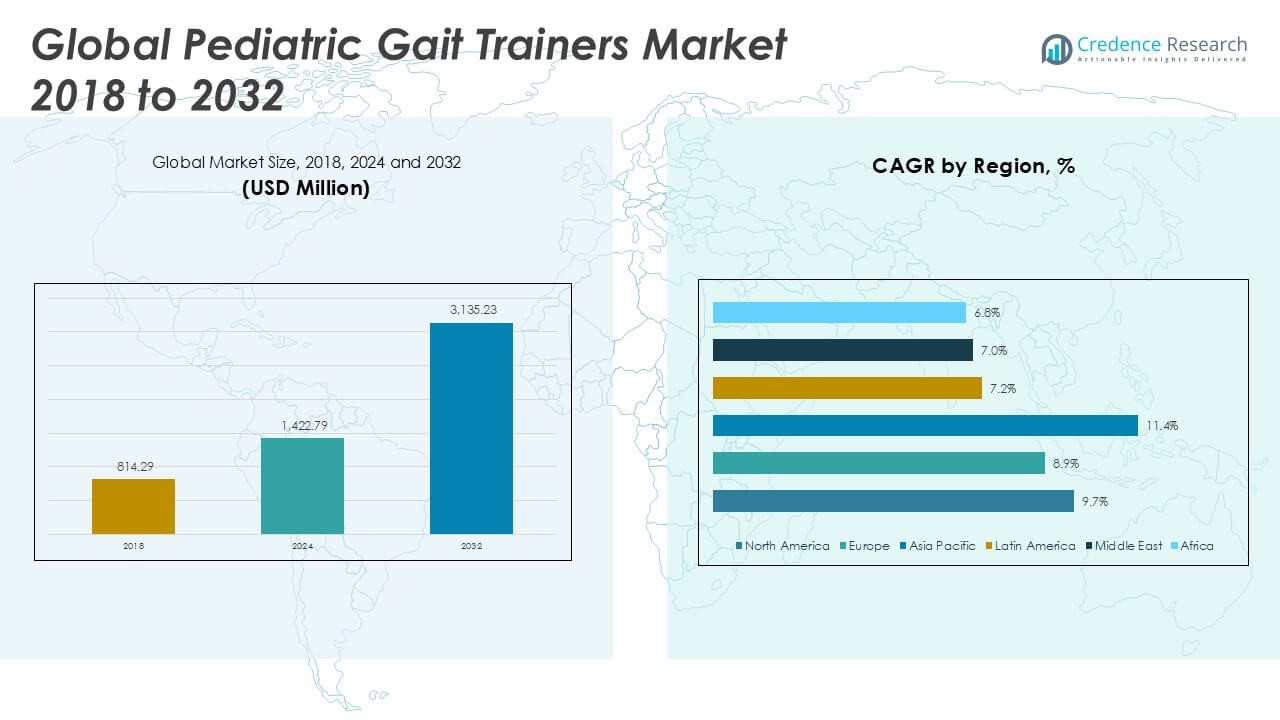
The Pediatric Gait Trainers Market was valued at USD 814.29 million in 2018, grew to USD 1,422.79 million in 2024, and is anticipated to reach USD 3,135.23 million by 2032, at a compound annual growth rate (CAGR) of 9.67% during the forecast period.
The Pediatric Gait Trainers Market is driven by the rising incidence of neuromuscular and developmental disorders such as cerebral palsy and spina bifida, which necessitate early mobility interventions. Increasing awareness among healthcare providers and parents regarding the benefits of pediatric rehabilitation supports the demand for advanced gait training solutions. Technological advancements in assistive mobility devices, including adjustable frame designs, sensor-based feedback systems, and robotic-assisted gait trainers, further enhance therapeutic outcomes. Favorable government policies and rehabilitation programs for children with physical disabilities are encouraging the adoption of these devices across hospitals, pediatric clinics, and rehabilitation centers. Additionally, trends such as the integration of virtual reality for interactive training and the development of lightweight, customizable devices are gaining traction. The market also benefits from a growing focus on home-based rehabilitation, which is expanding access and convenience for patients and caregivers. These factors collectively contribute to the sustained growth of the pediatric gait trainers market.
The geographical analysis of the Pediatric Gait Trainers Market highlights robust demand across North America, Europe, and Asia Pacific, driven by strong healthcare infrastructure, early adoption of advanced rehabilitation technologies, and increasing awareness about pediatric mobility disorders. North America leads with extensive hospital networks and specialized pediatric centers, while Europe follows with a focus on innovative therapy protocols and universal healthcare support. Asia Pacific shows rapid growth, fueled by expanding healthcare investment and rising incidence of neuromuscular conditions in children. Key players shaping the market include Leckey, known for its comprehensive pediatric mobility solutions, Stryker, recognized for technological innovation in rehabilitation devices, and Sunrise Medical LLC, which offers a broad portfolio of gait trainers and mobility aids. These companies leverage research and development capabilities, global distribution channels, and clinical partnerships to address the evolving needs of pediatric patients and healthcare providers worldwide.
Access crucial information at unmatched prices!
Request your sample report today & start making informed decisions powered by Credence Research Inc.!
Download Sample
Market Insights
- The Pediatric Gait Trainers Market was valued at USD 814.29 million in 2018, reached USD 1,422.79 million in 2024, and is projected to grow to USD 3,135.23 million by 2032, with a CAGR of 9.67%.
- Rising incidence of cerebral palsy, muscular dystrophy, and spina bifida in children is driving the demand for pediatric gait trainers across healthcare and home settings.
- Increasing awareness among parents and healthcare professionals about early rehabilitation and mobility interventions is fueling market growth.
- Integration of robotic technology, sensor-based feedback, and lightweight, portable designs represents a key trend, supporting therapy precision and patient comfort.
- High costs of advanced gait trainers and limited access in low- and middle-income regions act as major restraints for broader adoption.
- North America and Europe dominate the market due to established healthcare infrastructure and strong reimbursement systems, while Asia Pacific is witnessing the fastest growth.
- The competitive landscape features leading players such as Leckey, Stryker, and Sunrise Medical LLC, who focus on innovation, product differentiation, and expanding their global distribution networks to maintain their market positions.
Market Drivers
Rising Prevalence of Pediatric Neurological and Musculoskeletal Disorders Increases Demand for Gait Trainers
The Pediatric Gait Trainers Market is witnessing strong demand due to the increasing prevalence of conditions such as cerebral palsy, muscular dystrophy, spina bifida, and traumatic brain injuries in children. These disorders impair motor function and mobility, creating a need for early and continuous rehabilitation support. Healthcare providers are prioritizing interventions that promote independent movement and muscle strengthening. Gait trainers play a critical role in helping children improve posture, balance, and walking capabilities. The growing diagnosis rate and awareness among parents and caregivers drive adoption. It reinforces the importance of pediatric rehabilitation equipment in clinical and home settings.
- For instance, Leckey reported over 25,000 units of its MyWay gait trainer in use across pediatric clinics globally, supporting both clinical and home-based therapy environments.
Government Initiatives and Reimbursement Support Drive Accessibility and Adoption Rates
Public health policies and government-backed programs supporting pediatric rehabilitation are driving the market forward. Reimbursement coverage for assistive mobility devices in countries such as the U.S., Germany, and Japan has helped reduce the financial burden on families. Pediatric gait trainers are now included in many insurance plans, making them more accessible to a wider patient population. Public and private initiatives are funding rehabilitation infrastructure across hospitals and special education schools. It promotes the inclusion of advanced gait training solutions in institutional care models. These developments increase the visibility and uptake of pediatric gait trainers in both developed and emerging regions.
- For instance, the U.S. Medicaid program approved reimbursement for pediatric gait trainers in over 35 states in 2023, directly increasing accessibility for thousands of children annually.
Technological Innovations Enhance Functionality and Therapy Outcomes in Pediatric Rehabilitation
The market benefits from continuous technological improvements in gait training devices. Innovations such as robotic-assisted movement, adjustable frames, and biofeedback systems improve therapeutic outcomes and patient engagement. Smart sensors provide real-time performance data, helping therapists personalize treatment plans and track progress. Some manufacturers are introducing lightweight, foldable designs for greater portability and home use. It enhances the practicality and appeal of these devices in everyday environments. Technology-driven differentiation is emerging as a key factor influencing purchasing decisions among hospitals and rehabilitation centers.
Growing Preference for Home-Based Rehabilitation Expands Market Opportunities
The shift toward home-based rehabilitation is creating new growth avenues for the Pediatric Gait Trainers Market. Parents seek convenient, consistent therapy options that reduce the need for hospital visits. Manufacturers are responding with compact, user-friendly models suited for residential environments. The ability to continue gait training at home supports faster recovery and long-term mobility improvement. It aligns with broader healthcare trends favoring decentralized care delivery. This change is expanding the customer base to include individual households alongside institutional buyers.
Market Trends
Integration of Robotic and Sensor-Based Technologies Enhances Device Precision and Patient Monitoring
One of the most significant trends in the Pediatric Gait Trainers Market is the integration of robotic systems and sensor-based feedback technologies. These features enable real-time tracking of gait patterns, muscle activity, and postural alignment. Advanced models now offer programmable resistance, adaptive support levels, and motion-triggered adjustments. It allows therapists to fine-tune rehabilitation protocols for each child’s needs. Robotic-assisted gait trainers are becoming more prevalent in specialized pediatric rehabilitation centers. The trend reflects a broader shift toward precision therapy supported by intelligent device capabilities.
- For instance, Stryker’s robotic gait trainer line, launched in 2022, is deployed in over 400 pediatric rehabilitation facilities worldwide, each equipped with multi-sensor platforms capturing more than 15 data points per gait cycle.
Increased Focus on Lightweight, Customizable, and Portable Designs for Home Use
Manufacturers are developing lighter, foldable, and modular gait trainer models to meet the rising demand for home-based rehabilitation solutions. Parents and caregivers prefer equipment that offers easy setup, simple controls, and minimal space requirements. The Pediatric Gait Trainers Market is seeing a transition toward designs that are adjustable to fit children of varying sizes and conditions. It supports long-term use across different stages of growth. Customization features such as interchangeable components and dynamic harness systems improve usability and comfort. This trend supports the growing importance of at-home therapy and patient-centered device design.
- For instance, Sunrise Medical’s MyWay+ system folds to approximately 30 % of its operational size, includes six harness options and three frame sizes, and weighs between 6.5 and 12 kg per frame.
Collaboration Between Rehabilitation Centers and Technology Firms Fuels Innovation
Healthcare institutions are partnering with medical device companies and research organizations to co-develop innovative gait training solutions. These collaborations often lead to pilot testing of new models, joint development of therapy protocols, and data-driven outcome assessments. The Pediatric Gait Trainers Market benefits from this cross-sector integration, which accelerates the commercialization of advanced products. It creates feedback loops that help improve design, functionality, and clinical effectiveness. Technology partnerships also help introduce features such as cloud-based progress tracking and gamified therapy modules. These joint efforts are redefining how gait trainers support pediatric rehabilitation.
Adoption of Digital Platforms for Therapy Management and Progress Evaluation
Digital health tools are becoming integral to pediatric rehabilitation workflows. Therapists use mobile apps, cloud software, and connected devices to monitor patient activity and update therapy plans. The Pediatric Gait Trainers Market is aligning with this trend by offering systems with data export functions and compatibility with digital health records. It enhances transparency and communication between families and care providers. Digital integration also supports remote monitoring and tele-rehabilitation, helping maintain therapy consistency across settings. The use of analytics tools in therapy planning continues to rise across pediatric rehab centers.
Market Challenges Analysis
High Cost of Advanced Gait Trainers Limits Accessibility for Middle- and Low-Income Families
One of the primary challenges in the Pediatric Gait Trainers Market is the high cost associated with advanced and robotic-assisted models. Many families, particularly in low- and middle-income regions, find it difficult to afford these devices without comprehensive insurance coverage. It restricts access to cutting-edge rehabilitation technologies for a significant portion of the population. Public healthcare systems in several countries lack funding to equip every pediatric rehabilitation unit with high-end gait trainers. This cost barrier slows adoption in underserved areas and limits market penetration. Manufacturers must balance innovation with affordability to expand reach across diverse economic settings.
Lack of Skilled Pediatric Therapists and Standardized Training Protocols Hinders Optimal Use
Another critical challenge is the shortage of trained pediatric rehabilitation professionals who can effectively operate and monitor gait trainer therapy. Proper use of these devices requires specialized knowledge in biomechanics, child physiology, and equipment calibration. The Pediatric Gait Trainers Market faces difficulty in regions where training infrastructure is underdeveloped or inconsistent. It reduces the therapeutic value of the devices and increases the risk of misuse or underutilization. Variability in clinical protocols across facilities also leads to inconsistent therapy outcomes. Building capacity through structured training programs is essential for ensuring proper integration of gait trainers into pediatric care.
Market Opportunities
Expansion into Emerging Markets Presents Untapped Growth Potential for Manufacturers
Emerging economies in Asia, Latin America, and the Middle East offer significant opportunities for the Pediatric Gait Trainers Market. Rising healthcare investment, improving awareness about pediatric rehabilitation, and expanding hospital infrastructure support long-term demand. Governments in these regions are allocating funds toward disability care and inclusive education programs. It creates a favorable environment for introducing assistive mobility devices tailored to local needs. Manufacturers entering these markets with cost-effective, durable models can gain first-mover advantage. Localization of production and distribution channels will further support competitive positioning.
Innovation in Modular and Tele-Rehabilitation Gait Trainers Creates New Revenue Streams
There is growing opportunity in the development of modular gait trainers equipped with tele-rehabilitation capabilities. These devices allow therapists to remotely monitor and guide patient progress, which is particularly valuable in rural or under-resourced areas. The Pediatric Gait Trainers Market is beginning to reflect this shift with smart devices that connect to mobile platforms and digital health systems. It opens pathways for subscription-based service models and extended customer support. Demand for hybrid rehabilitation combining in-clinic and home-based care is increasing. Companies that offer flexible, connected solutions can unlock recurring revenue and improve care continuity.
Market Segmentation Analysis:
By Product Type:
The market is divided into manual and electric gait trainers. Manual gait trainers hold a significant share due to their affordability, durability, and ease of use in various care settings. They are widely used in early-stage therapy and low-resource facilities. Electric gait trainers, while more expensive, are gaining traction for their advanced features, such as programmable motion control and robotic assistance. The Pediatric Gait Trainers Market benefits from growing demand for electric models in specialized rehabilitation centers seeking improved therapy outcomes and reduced therapist fatigue. Both segments serve different needs, with electric models driving innovation and manual trainers supporting widespread adoption.
- For instance, Invacare’s electric gait trainer series features lithium-ion batteries supporting up to 8 hours of continuous use, now installed in over 500 rehabilitation clinics across Europe.
By Application:
The market is segmented into cerebral palsy, muscular dystrophy, spina bifida, and others. Cerebral palsy accounts for the largest share due to the high prevalence of mobility impairment associated with the condition. Gait trainers help manage muscle stiffness, promote independent movement, and support neuromuscular development in affected children. Muscular dystrophy and spina bifida segments also show steady growth, supported by early intervention programs and increased diagnosis rates. The “others” category includes cases such as traumatic brain injury or post-operative rehabilitation in children, reflecting expanding use beyond congenital disorders. It positions the market to serve a broad spectrum of pediatric mobility needs.
- For instance, Cardinal Health distributed over 7,000 specialized gait trainers for pediatric traumatic brain injury rehabilitation programs across North American hospitals in 2023, highlighting the broadening application scope.
By Distribution Channel:
Hospitals remain the dominant segment, supported by integrated rehabilitation units and established therapy protocols. Hospitals rely on gait trainers to provide consistent, supervised therapy during inpatient and outpatient care. Specialty clinics also play a vital role, offering focused, condition-specific rehabilitation programs for children. Online stores are emerging as a convenient channel, especially for home-use models favored by parents and caregivers. Retail pharmacies contribute marginally but help improve accessibility in local markets. It reflects a multi-channel strategy where institutional and personal use continue to shape purchasing behavior across the Pediatric Gait Trainers Market.
Segments:
Based on Product Type:
- Manual Gait Trainers
- Electric Gait Trainers
Based on Application:
- Cerebral Palsy
- Muscular Dystrophy
- Spina Bifida
- Others
Based on Distribution Channel:
- Hospitals
- Specialty Clinics
- Online Stores
- Retail Pharmacies
Based on the Geography:
- North America
- Europe
- UK
- France
- Germany
- Italy
- Spain
- Russia
- Belgium
- Netherlands
- Austria
- Sweden
- Poland
- Denmark
- Switzerland
- Rest of Europe
- Asia Pacific
- China
- Japan
- South Korea
- India
- Australia
- Thailand
- Indonesia
- Vietnam
- Malaysia
- Philippines
- Taiwan
- Rest of Asia Pacific
- Latin America
- Brazil
- Argentina
- Peru
- Chile
- Colombia
- Rest of Latin America
- Middle East
- UAE
- KSA
- Israel
- Turkey
- Iran
- Rest of Middle East
- Africa
- Egypt
- Nigeria
- Algeria
- Morocco
- Rest of Africa
Regional Analysis
North America Pediatric Gait Trainers Market
North America Pediatric Gait Trainers Market grew from USD 349.12 million in 2018 to USD 603.56 million in 2024 and is projected to reach USD 1,333.76 million by 2032, reflecting a compound annual growth rate (CAGR) of 9.7%. North America is holding a 42% market share. The United States and Canada lead the region due to advanced pediatric rehabilitation infrastructure, high healthcare spending, and strong reimbursement frameworks. Hospitals and specialized therapy centers widely adopt both manual and electric gait trainers. Government-supported early intervention programs for children with mobility impairments support market expansion. It benefits from continuous innovation and the presence of major medical device manufacturers.
Europe Pediatric Gait Trainers Market
Europe Pediatric Gait Trainers Market grew from USD 254.15 million in 2018 to USD 429.52 million in 2024 and is projected to reach USD 896.32 million by 2032, with a CAGR of 8.9%. Europe accounts for a 29% market share, with key countries including Germany, the United Kingdom, and France. The region emphasizes early-stage rehabilitation, driven by universal healthcare systems and well-developed therapy protocols. Clinics and hospitals across Europe increasingly deploy electric gait trainers equipped with robotic technology. National health insurance policies support access to assistive mobility devices. It continues to evolve through collaboration between healthcare providers and academic research institutions.
Asia Pacific Pediatric Gait Trainers Market
Asia Pacific Pediatric Gait Trainers Market grew from USD 149.60 million in 2018 to USD 284.35 million in 2024 and is expected to reach USD 713.25 million by 2032, recording the highest CAGR of 11.4%. The region holds a 22% market share, with strong growth in China, Japan, South Korea, and India. Rising awareness about pediatric rehabilitation and expanding healthcare infrastructure drive demand. Public and private initiatives are improving access to mobility aids in urban and semi-urban centers. Manufacturers are localizing production to meet regional pricing needs. It shows strong potential due to favorable demographic trends and increasing prevalence of pediatric disabilities.
Latin America Pediatric Gait Trainers Market
Latin America Pediatric Gait Trainers Market grew from USD 27.37 million in 2018 to USD 46.98 million in 2024 and is projected to reach USD 86.72 million by 2032, with a CAGR of 7.2%. Latin America contributes 3% to the global market, led by Brazil, Mexico, and Argentina. Government investments in pediatric rehabilitation and community-based therapy programs help increase adoption. Hospitals and regional clinics are incorporating manual gait trainers into treatment plans. It faces challenges in terms of cost constraints and limited access in rural areas. Growth remains steady with expanding public healthcare initiatives.
Middle East Pediatric Gait Trainers Market
Middle East Pediatric Gait Trainers Market grew from USD 20.40 million in 2018 to USD 32.22 million in 2024 and is expected to reach USD 58.45 million by 2032, registering a CAGR of 7.0%. The region holds a 2% market share, with the United Arab Emirates and Saudi Arabia as major contributors. Increasing focus on pediatric care within multispecialty hospitals supports demand for gait trainers. Governments are investing in specialized rehabilitation services as part of healthcare modernization programs. It benefits from rising awareness and access to advanced devices in urban centers. Market expansion depends on policy support and infrastructure development.
Africa Pediatric Gait Trainers Market
Africa Pediatric Gait Trainers Market grew from USD 13.65 million in 2018 to USD 26.16 million in 2024 and is forecasted to reach USD 46.74 million by 2032, with a CAGR of 6.8%. Africa represents a 2% share of the global market, with South Africa, Egypt, and Nigeria leading adoption. The region faces infrastructure and affordability challenges but is gradually expanding access to pediatric rehabilitation. Non-profit organizations and aid-funded programs play a critical role in providing gait trainers. Manual devices dominate due to their lower cost and simpler maintenance requirements. It shows gradual growth potential with targeted outreach and training programs.
Key Player Analysis
- Leckey
- Motion Concepts, Inc.
- Patterson Medical
- HillRom Holdings, Inc.
- Cardinal Health
- GF Health Products, Inc.
- Invacare Corporation
- Stryker
- Meyra Orthopedics AG
- Lutronic Corporation
- Briggs Healthcare
- Sunrise Medical LLC
- Smith & Nephew PLC
Competitive Analysis
The competitive landscape of the Pediatric Gait Trainers Market features several leading players, including Leckey, Stryker, Sunrise Medical LLC, GF Health Products, Inc., Invacare Corporation, HillRom Holdings, Inc., Cardinal Health, and Motion Concepts, Inc. These companies maintain a strong market presence through continuous investment in research and development, focusing on the integration of advanced technologies such as robotic assistance, sensor-driven feedback, and user-friendly designs. Companies expand their global reach by adapting product portfolios for different regional needs and regulatory environments. Strategic partnerships with rehabilitation centers and healthcare providers support the development of specialized solutions that address specific clinical requirements. Firms also prioritize after-sales support and training services to enhance user experience and build customer loyalty. The market remains dynamic, with ongoing efforts to balance high-performance device functionality and affordability. Competitive positioning increasingly depends on technological leadership, distribution network expansion, and the ability to respond swiftly to emerging trends in pediatric rehabilitation.
Recent Developments
- In Jan 2024, Ekso Bionics Holdings, Inc., a prominent innovator in exoskeleton technology for both medical and industrial applications, recently introduced GaitCoach™, its next-generation gait therapy software designed for the EksoNR device.
- In Oct 2022, Trexo Robotics has collaborated with Keystone Education Group to introduce robotic gait trainers for children with autism spectrum disorder. This partnership focuses on delivering advanced rehabilitation solutions specifically tailored for children, broadening the scope of gait trainer technology applications.
- In August 2022, Naboso Technology introduced the Naboso TrueForm Runner treadmill, integrating their proprietary textured material into its design. This innovation enhances foot and neuro activation during walking and running, distinguishing it in the Gait Trainer Market. The Naboso TrueForm Runner revolutionizes treadmill technology, offering superior functionality for improving gait and motor skills in users.
- In January 2022, THERA-Trainer expanded its presence in the Gulf and Middle East by launching the Lyra gait trainer after specialist training and certification at Jaber Al Ahmad Hospital. This strategic move strengthens THERA-Trainer’s foothold in the competitive Gait Trainer Market, offering advanced rehabilitation solutions tailored to the region’s needs.

Market Concentration & Characteristics
The Pediatric Gait Trainers Market exhibits a moderate to high level of market concentration, with a few established companies holding a significant share due to their extensive product portfolios, global distribution channels, and longstanding expertise in pediatric rehabilitation solutions. It is characterized by rapid technological innovation, as manufacturers focus on integrating robotic systems, smart sensors, and data-driven feedback mechanisms into their devices. The market emphasizes safety, durability, and ease of use, catering to both clinical settings and home-based rehabilitation environments. High entry barriers exist due to strict regulatory requirements and the need for clinical validation, which limit the presence of smaller or new entrants. It maintains a diverse range of product offerings, from basic manual trainers to sophisticated, programmable electric models. Buyers prioritize clinical outcomes, product reliability, and after-sales support when selecting gait training equipment. The market continues to evolve with increasing demand for customization, portability, and integration with digital health platforms.
Shape Your Report to Specific Countries or Regions & Enjoy 30% Off!
Report Coverage
The research report offers an in-depth analysis based on Product Type, Application, Distribution Channel and Geography. It details leading market players, providing an overview of their business, product offerings, investments, revenue streams, and key applications. Additionally, the report includes insights into the competitive environment, SWOT analysis, current market trends, as well as the primary drivers and constraints. Furthermore, it discusses various factors that have driven market expansion in recent years. The report also explores market dynamics, regulatory scenarios, and technological advancements that are shaping the industry. It assesses the impact of external factors and global economic changes on market growth. Lastly, it provides strategic recommendations for new entrants and established companies to navigate the complexities of the market.
Future Outlook
- The pediatric gait trainers market is expected to witness steady growth due to increasing awareness of early mobility intervention.
- Rising incidences of neuromuscular disorders in children will continue to drive product demand.
- Technological advancements in lightweight and customizable gait trainers will improve patient outcomes.
- Expanding pediatric rehabilitation centers across developed and emerging countries will support market expansion.
- Favorable government initiatives and reimbursement policies will encourage adoption of assistive mobility devices.
- Growing emphasis on home-based rehabilitation will increase the demand for compact and user-friendly gait trainers.
- Collaborations between healthcare institutions and manufacturers will boost innovation in pediatric gait training solutions.
- Increasing investments in pediatric physiotherapy and rehabilitation programs will positively influence market growth.
- Rising focus on inclusive education and physical development will lead to greater utilization of gait trainers in schools.
- Manufacturers are likely to explore eco-friendly and durable materials to enhance product appeal and sustainability.



