Market Overview
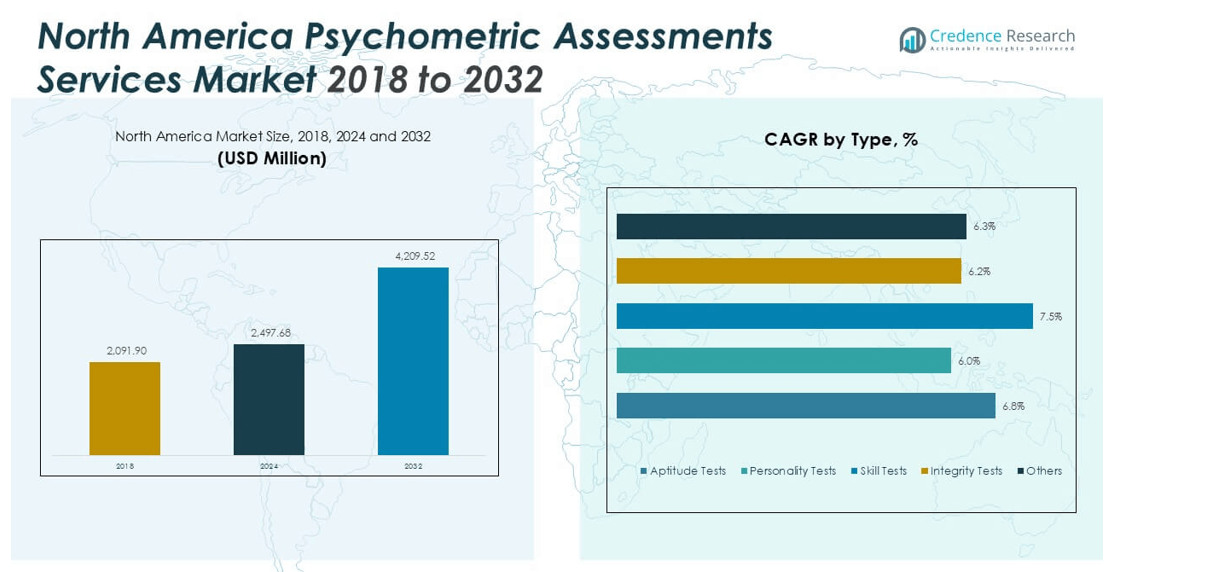
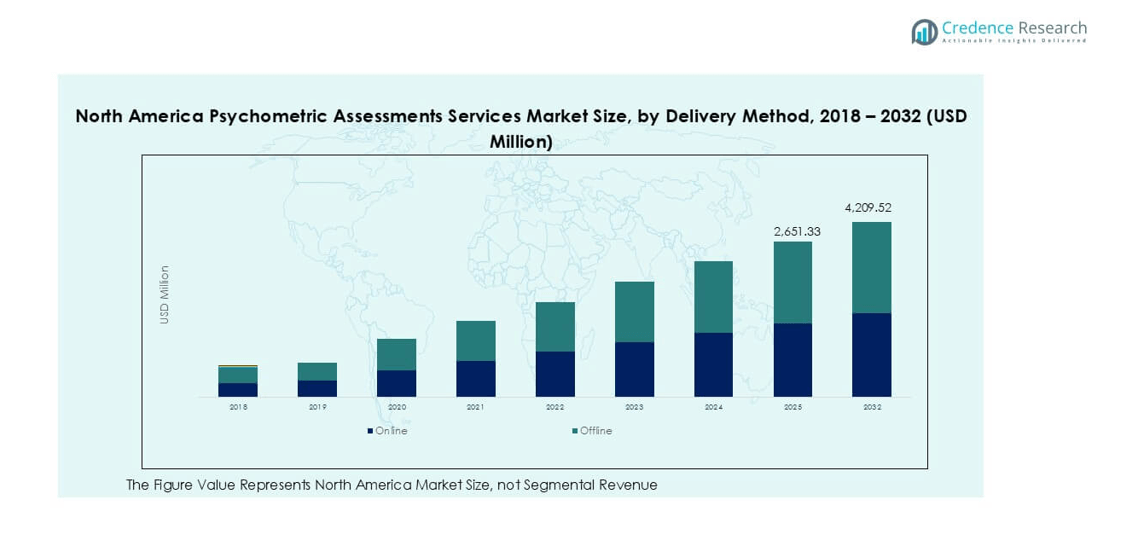
The North America Psychometric Assessments Services Market size was valued at USD 2,091.90 million in 2018, increased to USD 2,497.68 million in 2024, and is projected to reach USD 4,209.52 million by 2032, registering a CAGR of 6.6% during the forecast period (2025–2032).
| REPORT ATTRIBUTE |
DETAILS |
| Historical Period |
2020-2023 |
| Base Year |
2024 |
| Forecast Period |
2025-2032 |
| North America Psychometric Assessments Services Market Size 2024 |
UUSD 2,497.68 million |
| North America Psychometric Assessments Services Market, CAGR |
6.6% |
| North America Psychometric Assessments Services Market Size 2032 |
USD 4,209.52 million |
The North America psychometric assessments services market is led by key players including SHL, Hogan Assessments, Aon Assessment Solutions, Korn Ferry, and PSI Services LLC. These companies dominate through extensive test portfolios, AI-driven analytics, and cloud-based delivery models that enhance assessment precision and accessibility. The United States remains the leading regional market, accounting for 72% of the total share in 2024, driven by strong corporate adoption and advanced HR digitalization. Canada and Mexico follow, supported by growing demand in education and government sectors. Continuous innovation in personality, aptitude, and cognitive testing sustains market leadership across the region.
Market Insights
- The North America Psychometric Assessments Services market was valued at USD 2,497.68 million in 2024 and is projected to reach USD 4,209.52 million by 2032, growing at a CAGR of 6.6%.
- Growth is driven by rising demand for data-driven recruitment and employee evaluation, with aptitude tests leading the type segment with a 36% share.
- Increasing integration of AI, predictive analytics, and cloud-based platforms enhances assessment efficiency and personalization across corporate and educational sectors.
- The market is moderately consolidated, with SHL, Hogan Assessments, Aon Assessment Solutions, and Korn Ferry dominating through digital innovations and product diversification.
- The United States holds 72% of the regional share, followed by Canada with 19% and Mexico with 9%, supported by expanding corporate adoption and growing use in training, development, and academic applications.
Access crucial information at unmatched prices!
Request your sample report today & start making informed decisions powered by Credence Research Inc.!
Download Sample
Market Segmentation Analysis:
By Type
The aptitude tests segment dominated the North America psychometric assessments services market in 2024, holding a 36% share. This segment leads due to its widespread use in measuring logical reasoning, problem-solving ability, and quantitative skills during recruitment. Organizations across technology, finance, and manufacturing sectors rely on standardized aptitude tests to improve hiring accuracy and reduce turnover rates. The growing demand for data-driven talent evaluation and AI-based test analytics further enhances adoption. Increased corporate emphasis on competency benchmarking continues to strengthen the segment’s position.
- For instance, SHL’s Verify numerical reasoning test gives 18 questions to be solved in 25 minutes.
By Application
Recruitment and selection represented the largest application segment, accounting for 49% of the market share in 2024. Companies increasingly integrate psychometric tools to identify high-potential candidates and streamline hiring decisions. Automated test platforms and remote assessment capabilities support large-scale hiring and remote workforce evaluation. The strong link between psychometric evaluations and improved employee performance drives adoption across enterprise HR functions. Continuous digital transformation in hiring processes and the shift toward predictive talent analytics remain key growth drivers for this segment.
- For instance, SHL administers around 35 million assessments globally per year, many used in recruitment workflows.
By End-User
The corporate sector dominated the market with a 58% share in 2024, driven by growing use of psychometric tools in employee screening, development, and leadership training. Businesses use these assessments to enhance workforce efficiency, align skills with organizational goals, and foster inclusive hiring. Increasing adoption of AI-based evaluation systems and gamified testing platforms also boosts corporate usage. Companies across IT, BFSI, and healthcare sectors prioritize such tools to improve team dynamics and reduce recruitment biases. The expanding focus on workforce analytics sustains strong demand within this segment.
Key Growth Drivers
Rising Demand for Data-Driven Recruitment Decisions
The growing emphasis on evidence-based hiring is a key growth driver in the North America psychometric assessments services market. Organizations across sectors increasingly use psychometric tools to evaluate cognitive ability, personality traits, and cultural fit before onboarding. Data analytics helps companies minimize hiring errors and improve employee retention. The use of psychometric insights in recruitment enables predictive modeling of performance and behavioral outcomes. As corporate HR teams move toward data-driven strategies, demand for scientifically validated assessments continues to rise. This trend strengthens the market’s role in supporting merit-based, bias-free hiring across industries.
- For instance, Aon’s Global Assessment Solutions platform has delivered over 48 million candidate assessments worldwide through its data-driven analytics system.
Expansion of E-Learning and Digital Assessment Platforms
Digital transformation in learning and development has accelerated the adoption of online psychometric testing. Educational institutions and corporate training programs increasingly rely on digital platforms to evaluate competencies and learning outcomes. Cloud-based delivery models allow flexible access, instant feedback, and large-scale deployment of assessments. AI-driven test analytics enhance personalization and adaptive learning paths for participants. These capabilities improve efficiency while reducing administrative costs. The integration of psychometric tools into e-learning systems supports continuous skill evaluation and aligns training objectives with measurable outcomes, reinforcing digital transformation in the education and corporate sectors.
- For instance, SHL’s cloud platform integrates with over 90 applicant tracking systems globally.
Growing Focus on Employee Retention and Leadership Development
Companies are prioritizing psychometric tools to identify leadership potential and improve retention strategies. These assessments help organizations understand employee motivations, stress tolerance, and interpersonal skills, forming the basis for effective succession planning. In sectors like IT, healthcare, and finance, firms use behavioral profiling to design leadership pipelines and targeted learning modules. The insights enable customized development programs that enhance engagement and productivity. As workforce mobility increases, psychometric evaluations play a critical role in retaining top talent by aligning career growth opportunities with individual strengths and organizational goals.
Key Trends & Opportunities
Increasing Use in Mental Health and Counseling Services
Psychometric assessments are expanding beyond corporate and academic applications into clinical and counseling domains. Healthcare providers and mental health professionals use validated tests to evaluate emotional well-being, cognitive functioning, and behavioral patterns. Growing awareness of mental health in workplaces and schools drives adoption of standardized tools for diagnosis and therapy planning. Digital delivery enables remote psychological evaluations, improving accessibility for patients. This expanding use case enhances the scope of service providers and supports cross-sector collaboration between psychology, healthcare, and corporate wellness programs across North America.
- For instance, the Beck Depression Inventory (BDI-II) uses 21 self-report items to gauge depression severity.
Integration of AI and Predictive Analytics
Artificial intelligence is transforming psychometric assessments by improving test accuracy, scalability, and interpretation speed. AI algorithms analyze response patterns to predict behavioral traits and job suitability with greater precision. Predictive analytics allows HR teams to forecast performance outcomes and identify future leaders. Automation reduces manual evaluation bias and shortens recruitment cycles. Companies integrating AI-driven psychometrics gain deeper workforce insights and better alignment between individual competencies and business objectives. The rise of hybrid workforce models creates new opportunities for predictive assessment tools that optimize distributed team performance.
Key Challenges
Data Privacy and Compliance Concerns
The widespread use of online psychometric assessments raises data privacy and compliance challenges. Sensitive personal information collected during evaluations must be handled under strict data protection frameworks such as GDPR and CCPA. Breaches or misuse can lead to legal penalties and loss of stakeholder trust. Companies face increasing pressure to ensure transparent data management, secure storage, and ethical use of assessment results. Maintaining compliance while offering user-friendly digital solutions remains a complex task, especially for multinational organizations managing cross-border employee data.
Limited Awareness and Misinterpretation of Results
A major barrier to market growth is the lack of understanding regarding psychometric assessments’ purpose and interpretation. Many organizations misuse or misread test outcomes, leading to flawed hiring or development decisions. In smaller enterprises and educational settings, limited expertise in administering and analyzing assessments reduces their effectiveness. Misconceptions about test validity and fairness further hinder adoption. To overcome this, service providers must invest in user education, standardized reporting, and professional training to ensure accurate implementation and meaningful use of psychometric insights.
Regional Analysis
United States
The United States dominated the North America psychometric assessments services market with a 72% share in 2024. The country’s strong adoption of data-driven HR analytics and digital recruitment platforms drives demand for psychometric tools. Corporate sectors such as IT, finance, and healthcare actively use these assessments for hiring, training, and leadership development. The growing emphasis on diversity, inclusion, and evidence-based hiring strengthens adoption among large enterprises. Moreover, U.S.-based service providers continue to innovate through AI-driven assessment technologies, supporting deeper behavioral analysis and customized workforce evaluations across industries.
Canada
Canada accounted for 19% of the regional market share in 2024, supported by its growing focus on organizational efficiency and skill-based recruitment. Educational institutions and government agencies increasingly integrate psychometric tools into academic testing, public service exams, and workforce evaluations. The rising popularity of remote assessment platforms and the need for employee well-being analytics have further boosted adoption. Companies are investing in scientifically validated tests to improve retention and performance. Collaborative initiatives between HR tech firms and universities continue to expand Canada’s role in advancing evidence-based workforce assessment practices.
Mexico
Mexico held a 9% share of the North America psychometric assessments services market in 2024, with adoption accelerating in manufacturing, logistics, and service industries. The growing presence of multinational companies and rising awareness of structured recruitment are key contributors to market expansion. Psychometric testing is gaining traction among HR departments for evaluating personality traits, leadership potential, and integrity in applicants. Local firms increasingly partner with global assessment providers to improve hiring accuracy and training effectiveness. The development of Spanish-language assessment tools and cloud-based delivery platforms is enhancing accessibility across Mexico’s corporate and education sectors.
Market Segmentations:
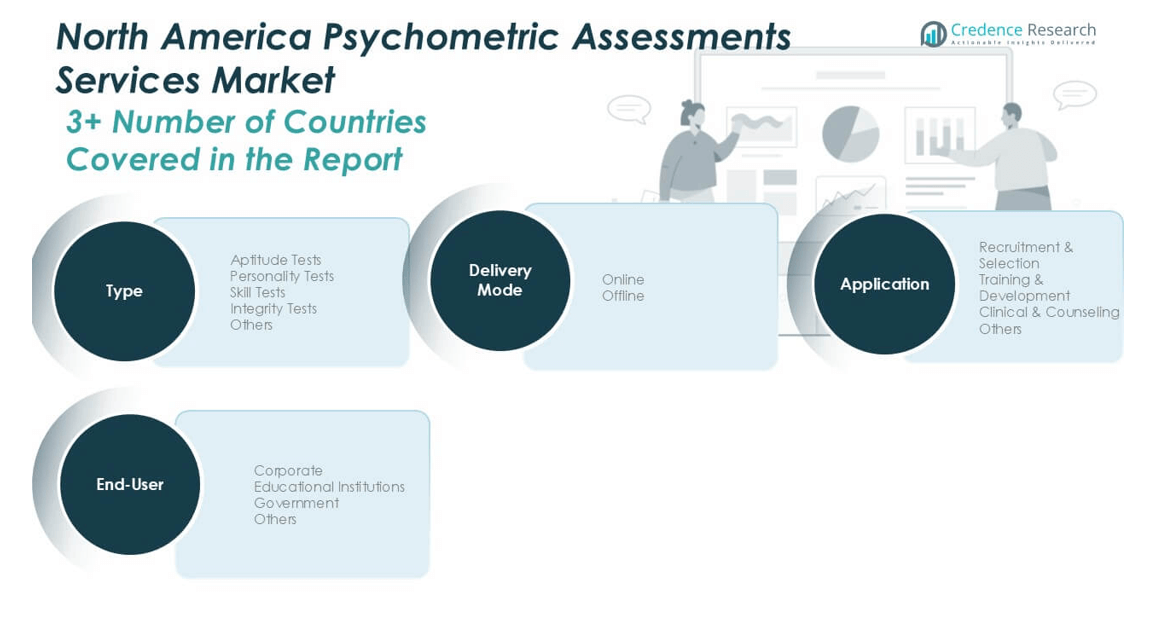
By Type
- Aptitude Tests
- Personality Tests
- Skill Tests
- Integrity Tests
- Others
By Application
- Recruitment & Selection
- Training & Development
- Clinical & Counselling
- Others
By End-User
- Corporate
- Educational Institutions
- Government
- Others
By Delivery Mode
By Geography
- United States
- Canada
- Mexico
Competitive Landscape
The North America psychometric assessments services market is moderately consolidated, with leading players such as SHL, Hogan Assessments, Korn Ferry, Aon Assessment Solutions, and PSI Services LLC driving competition through advanced analytics and AI-enabled platforms. These companies focus on enhancing assessment accuracy, scalability, and customization to meet diverse organizational needs across recruitment, leadership development, and employee engagement. Strategic partnerships with HR software providers and cloud integration remain central to expanding client reach. Firms like The Myers-Briggs Company and Pearson TalentLens continue to strengthen their psychometric tool portfolios through digital upgrades and neuroscience-based frameworks. Meanwhile, emerging players such as Mettl, Berke, and AssessFirst emphasize data visualization and machine learning to deliver predictive hiring insights. Ongoing investments in multilingual assessment tools, remote testing technologies, and compliance-ready data management further intensify market competitiveness across North America.
Shape Your Report to Specific Countries or Regions & Enjoy 30% Off!
Key Player Analysis
- SHL
- Hogan Assessments
- TalentSmart
- Criteria Corp
- Thomas International
- Cubiks
- PSI Services LLC
- Aon Assessment Solutions
- Pearson TalentLens
- Korn Ferry
- The Myers-Briggs Company
- Mettl
- Berke
- AssessFirst
- Psytech International
- Mindmill
- Saville Assessment
Recent Developments
- In October 2025, SHL introduced a new Personality and Ability Assessment Training Program in Czechia, focusing on professional development for HR teams to increase self-sufficiency in test interpretation and talent evaluation. This initiative forms part of SHL’s updated global training calendar for advanced psychometric assessment methodologies.
- In April 2025, TalentSmartEQ launched its 2025 State of EQ Report, analyzing data from over 37,000 Emotional Intelligence Appraisal participants. The report highlighted a shift toward people-first leadership and the growing use of emotional intelligence training to support employee well-being and adaptability in dynamic workplaces.
- In 2025, Hogan Assessments focused on leveraging AI for deeper behavioral insights in its predictive personality assessments, as presented at the IPAC 2025 conference. This aligns with Hogan’s emphasis on ethical AI and enhanced cross-cultural validity, a priority highlighted in their April 2025 Top Trends in Personality Assessment report. Hogan was also a platinum sponsor of the IPAC conference, which was held from July 27–30 in Atlanta.
- In March 2023, Talent Select AI, a Milwaukee-based company, announced the official launch of its ground-breaking, self-titled psychometric assessment tool.
Report Coverage
The research report offers an in-depth analysis based on Type, Application, End-User, Delivery Mode and Geography. It details leading market players, providing an overview of their business, product offerings, investments, revenue streams, and key applications. Additionally, the report includes insights into the competitive environment, SWOT analysis, current market trends, as well as the primary drivers and constraints. Furthermore, it discusses various factors that have driven market expansion in recent years. The report also explores market dynamics, regulatory scenarios, and technological advancements that are shaping the industry. It assesses the impact of external factors and global economic changes on market growth. Lastly, it provides strategic recommendations for new entrants and established companies to navigate the complexities of the market.
Future Outlook
- Demand for AI-integrated psychometric tools will grow to support predictive hiring and talent analytics.
- Cloud-based assessment platforms will expand, enabling remote and large-scale testing.
- Corporates will increasingly use psychometrics for leadership identification and employee retention.
- Educational institutions will adopt adaptive learning assessments for student evaluation.
- Integration of gamification and virtual simulations will enhance engagement and test accuracy.
- Mental health and behavioral analytics applications will rise across clinical and workplace environments.
- Data privacy compliance will become a major priority for assessment providers.
- Customizable and multilingual assessments will see higher demand across multinational organizations.
- Partnerships between HR tech companies and academic institutions will strengthen innovation.
- AI-driven reporting and real-time analytics will redefine psychometric data interpretation and usability.



