Market Overview:
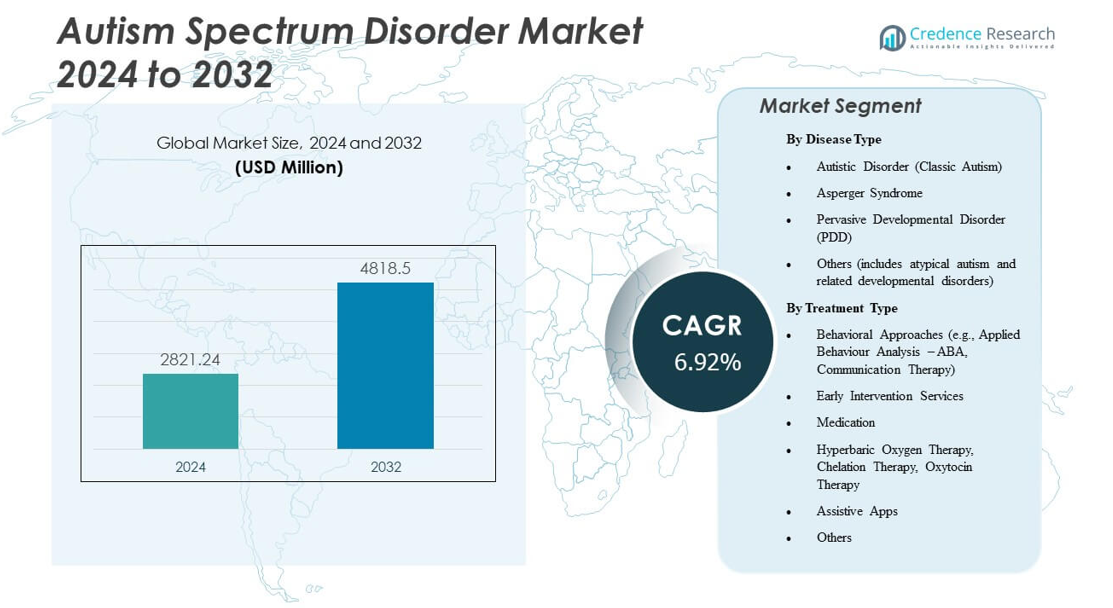
The Autism Spectrum Disorder Market is projected to grow from USD 2,821.24 million in 2024 to an estimated USD 4,818.5 million by 2032, with a compound annual growth rate (CAGR) of 6.92% from 2024 to 2032.
| REPORT ATTRIBUTE |
DETAILS |
| Historical Period |
2020-2023 |
| Base Year |
2024 |
| Forecast Period |
2025-2032 |
| Autism Spectrum Disorder Market Size 2024 |
USD 2,821.24 million |
| Autism Spectrum Disorder Market, CAGR |
6.92% |
| Autism Spectrum Disorder Market Size 2032 |
USD 4,818.5 million |
Growing research investment in targeted therapies and behavioral treatment advancements drives market momentum. Healthcare providers are adopting personalized therapeutic models integrating medication, behavioral therapy, and digital solutions to enhance treatment outcomes. Pharmaceutical innovation, combined with multidisciplinary care frameworks, supports better management of developmental and behavioral challenges associated with autism. Expanding clinical trials and the introduction of novel drug candidates further accelerate market development across key regions.
North America remains the leading region due to its established diagnostic infrastructure, strong funding base, and early adoption of advanced therapies. Europe maintains steady growth through policy-driven initiatives and enhanced access to integrated care programs. The Asia-Pacific region is emerging rapidly with improved healthcare access, expanding awareness campaigns, and increased public investment in child developmental health. Latin America and the Middle East & Africa show rising potential supported by growing screening initiatives and community-based therapy centers.
Market Insights:
- The Autism Spectrum Disorder Market is projected to grow from USD 2,821.24 million in 2024 to USD 4,818.5 million by 2032, registering a CAGR of 6.92%.
- Rising prevalence of autism spectrum disorder and early diagnosis initiatives are driving demand for therapy and medication.
- Increased research funding and innovation in behavioral and pharmacological treatments support strong market expansion.
- High treatment costs and shortage of trained professionals remain key restraints affecting access to specialized care.
- North America leads due to advanced healthcare systems and robust awareness campaigns supporting early intervention.
- Europe follows with well-established policies and increasing government funding for autism programs.
- Asia-Pacific shows the fastest growth, supported by improving healthcare infrastructure and rapid adoption of digital therapy solutions.
Access crucial information at unmatched prices!
Request your sample report today & start making informed decisions powered by Credence Research Inc.!
Download Sample
Market Drivers
Growing Awareness and Early Diagnosis Driving Market Expansion
Rising global awareness about autism spectrum disorder is encouraging early screening and intervention. Governments and healthcare organizations run awareness programs to educate parents and caregivers. Early diagnosis helps initiate therapy and behavioral treatments sooner, improving patient outcomes. The Autism Spectrum Disorder Market benefits from campaigns led by advocacy groups and medical bodies. Hospitals and clinics increasingly adopt advanced screening tools to identify developmental delays at a young age. It strengthens long-term treatment adoption and supports ongoing therapy compliance. Educational institutions and pediatric networks are expanding collaboration with diagnostic centers. These developments help standardize autism detection and boost demand for clinical and therapeutic services.
- For instance, in 2025, technology company Burble Creativity sponsored Autism New Jersey’s Spectrum 360 Walk for a Lifetime in New Jersey an event that brought together thousands of families and advocates and deployed its StoryTent multisensory technology to support neurodivergent children with proven audio-visual tools supporting emotional regulation.
Advancements in Therapeutic Approaches and Behavioral Interventions
Innovations in behavioral therapy and speech therapy programs create growth opportunities for the market. Therapists employ personalized care models supported by digital platforms and teletherapy services. The Autism Spectrum Disorder Market experiences steady adoption of AI-based training and adaptive learning solutions. New evidence-based treatments improve social and communication skills for children and adults. Healthcare providers increasingly integrate multidisciplinary methods combining psychological, occupational, and educational therapies. This evolution encourages more comprehensive patient care frameworks. Pharmaceutical firms invest in targeted drug pipelines addressing associated symptoms like anxiety and irritability. Broader access to these therapies reinforces market expansion through improved patient quality of life.
- For instance, AlsoLife, a Chinese healthtech startup, launched an AI-powered teaching robot for autistic children in October 2024. Within the subsequent year, the robot gained 5,000 users, and over 86% of families rated the technology at least 4 out of 5 for engagement and improvement in social interaction skills.
Rising Prevalence and Growing Diagnostic Capabilities Worldwide
Global autism prevalence continues to rise due to enhanced recognition and better diagnostic precision. Improved reporting mechanisms and refined assessment tools raise recorded case numbers. The Autism Spectrum Disorder Market grows as healthcare systems invest in specialized diagnostic equipment and training programs. Many nations are integrating ASD screening into routine pediatric health checkups. Parents show increased willingness to pursue early evaluation and ongoing behavioral management. Private and public sectors focus on community-based programs to reach underserved populations. It promotes equitable access to care and improves data accuracy in population studies. Continuous technological development in diagnostic imaging and genetic testing further strengthens early intervention initiatives.
Government Support and Policy Frameworks Strengthening Treatment Access
Governments introduce favorable reimbursement policies and healthcare funding to improve autism care infrastructure. National health systems expand coverage for therapy and medication costs to reduce family burdens. The Autism Spectrum Disorder Market benefits from legal mandates supporting educational inclusion and social rehabilitation. Funding grants promote innovation in therapy research and assistive technologies. International collaborations help unify diagnostic standards and treatment guidelines. This policy-driven support accelerates adoption of structured intervention models across regions. Nonprofit organizations and advocacy groups collaborate with government agencies for patient outreach. It fosters long-term sustainability and improves access to multidisciplinary care.
Market Trends
Integration of Digital Health Technologies and Teletherapy Platforms
Digital transformation is reshaping autism care delivery worldwide. Teletherapy enables remote diagnosis, counseling, and continuous monitoring of patients. The Autism Spectrum Disorder Market observes growing use of mobile apps and virtual tools for behavioral training. Digital health platforms enhance therapy reach in rural or underserved areas. AI-driven analytics help tailor interventions based on individual progress data. Hospitals adopt cloud-based therapy management systems to track treatment outcomes effectively. Wearable technologies also monitor behavioral responses and attention levels. It promotes continuous learning and consistent therapy engagement among patients.
- For instance, Cognoa’s Canvas Dx became the first FDA-authorized diagnostic aid for autism in children aged 18 months to 72 months, following a pivotal study confirming high diagnostic accuracy. The AI-based tool demonstrated strong predictive values and reduced time to diagnosis in real-world clinical use.
Increasing Role of Precision Medicine and Genetic Research
Genetic research plays a major role in identifying biological patterns linked to autism. Precision medicine aims to deliver customized treatments targeting specific genetic markers. The Autism Spectrum Disorder Market gains traction as research institutions explore neurogenetic pathways influencing ASD. Pharmacological innovations now focus on neurotransmitter modulation and neurodevelopmental regulation. Advances in molecular diagnostics enhance early risk identification among newborns. Global biotech firms invest in clinical trials testing candidate molecules for behavioral and cognitive outcomes. Personalized therapeutic regimens improve symptom management efficiency. It strengthens clinical evidence and expands the potential for novel treatment approvals.
- For instance, Swiss biotech Stalicla developed a machine-learning platform to biologically subtype idiopathic autism and advanced its lead candidate STP1 into early-phase clinical trials. Published 2024 data confirmed the treatment’s safety and showed encouraging trends in behavioral and biological response markers.
Growing Investment in Educational and Social Inclusion Programs
Governments and NGOs support educational integration for individuals with autism. Schools implement adaptive learning technologies and sensory-friendly classroom designs. The Autism Spectrum Disorder Market sees growth from partnerships promoting inclusive education models. Social programs enhance vocational training and employability among adults with ASD. Employers embrace neurodiversity initiatives to build inclusive workplaces. Community-based projects provide mentorship and peer interaction opportunities. It builds awareness and acceptance while reducing stigma in society. Expansion of educational infrastructure strengthens early skill development and independent living capabilities.
Emergence of Multidisciplinary Care Models and Collaborative Networks
Healthcare systems increasingly adopt integrated care models combining multiple disciplines. Autism management now includes behavioral therapists, neurologists, speech pathologists, and educators. The Autism Spectrum Disorder Market benefits from such collaborative treatment ecosystems. Interdisciplinary centers provide seamless therapy coordination for complex cases. Data sharing among professionals improves patient tracking and outcome measurement. These networks support holistic care and reduce fragmentation in treatment delivery. Partnerships between hospitals and research bodies enhance innovation and service quality. It ensures consistent therapy outcomes and long-term patient stability.
Market Challenges Analysis
Limited Accessibility and High Treatment Costs Restricting Adoption
The cost of long-term autism care remains high in many regions. Therapy programs, special education, and medications often exceed family budgets. The Autism Spectrum Disorder Market faces slow adoption in low-income nations due to affordability barriers. Limited insurance coverage further restricts therapy continuity. Shortages of trained professionals hinder service availability in rural areas. It reduces early intervention opportunities and delays clinical progress. Disparities in healthcare infrastructure lead to inconsistent diagnostic and treatment quality. High costs discourage sustained therapy participation among middle-income families.
Variability in Diagnosis and Lack of Unified Clinical Standards
Autism symptoms vary widely, making consistent diagnosis difficult. Clinicians rely on subjective evaluation tools rather than standardized protocols. The Autism Spectrum Disorder Market experiences diagnostic discrepancies between regions due to inconsistent criteria. Cultural and linguistic diversity complicates symptom interpretation. Limited global consensus on treatment frameworks affects therapy alignment. It also impacts insurance reimbursement and clinical validation. Fragmented data collection weakens long-term epidemiological research. The absence of harmonized diagnostic systems slows progress in global autism management.
Market Opportunities
Expansion of AI-Driven Diagnostic Tools and Digital Therapeutics
Emerging AI technologies offer faster, more precise autism detection capabilities. Machine learning models analyze facial expressions, speech, and behavioral cues for early identification. The Autism Spectrum Disorder Market gains from rising adoption of digital therapeutics to support cognitive development. Remote assessment platforms help clinicians reach broader populations efficiently. Software-based training programs enhance self-learning and social interaction skills. It drives accessibility in countries with limited clinical infrastructure. Collaborations between health-tech firms and research institutes accelerate AI innovation. These advancements are creating scalable and cost-effective diagnostic ecosystems.
Growing Investment in Global Awareness and Therapy Innovation
Public and private investments are expanding autism-focused research and therapy infrastructure. Funding supports clinical trials, therapy center expansion, and skill development initiatives. The Autism Spectrum Disorder Market benefits from philanthropic foundations promoting awareness and inclusivity. Governments encourage community health partnerships to strengthen local intervention programs. Biotech firms explore new drug molecules aimed at behavioral symptom management. It enhances treatment diversity and fosters clinical progress. Awareness campaigns also encourage early screening among underserved groups. Continued funding ensures steady innovation and improved quality of life for affected individuals.
Market Segmentation Analysis:
By Disease Type
Autistic disorder, also known as classic autism, dominates the Autism Spectrum Disorder Market due to high prevalence and established diagnostic protocols. The segment benefits from widespread screening and early behavioral therapy adoption. Asperger syndrome follows with steady growth, driven by increased adult diagnosis and workplace awareness programs. Pervasive developmental disorder (PDD) represents a smaller yet significant segment, supported by specialized intervention programs targeting communication and learning challenges. It attracts ongoing clinical research focused on genetic and neurodevelopmental links. The “Others” category, including atypical autism, records rising recognition through improved classification and inclusive diagnostic models. Growing awareness campaigns and education reforms strengthen detection accuracy. This segmentation supports better patient-specific therapeutic planning and resource allocation across healthcare systems.
- For instance, a study at the Duke Autism Genetics Clinic evaluated chromosomal microarray analysis (CMA) in 115 patients referred for autism and developmental delay assessment. Researchers confirmed a primary ASD diagnosis in 57.4% of cases and identified pathogenic copy number variants in 18.3% of individuals, highlighting the diagnostic value of genomic testing in autism evaluation.
By Treatment Type
Behavioral approaches, such as Applied Behaviour Analysis (ABA) and communication therapy, lead the Autism Spectrum Disorder Market due to proven clinical outcomes. These interventions improve social and cognitive skills, forming the foundation of long-term treatment frameworks. Early intervention services hold the next largest share, fueled by public health programs promoting preschool screening and therapy. Medication plays a key role in managing comorbid symptoms like irritability and hyperactivity, supported by strong pharmaceutical development pipelines. Hyperbaric oxygen, chelation, and oxytocin therapies remain niche but attract interest in research-driven centers. Assistive apps record rising adoption as digital platforms enhance engagement and personalized learning. It drives accessibility among children and adults through remote and self-guided support tools. The “Others” category includes emerging therapy models that broaden clinical options and encourage holistic care integration.
- For instance, Otsuka Pharmaceutical Co., Ltd.’s Aripiprazole demonstrated a mean reduction of −5.7 (± 6.8) in the Aberrant Behavior Checklist-Japanese Version (ABC-J) Irritability subscale by Week 4 and −6.8 (± 8.3) at endpoint in a 52-week post-marketing surveillance in Japanese children and adolescents with Autism Spectrum Disorder.
Segmentation:
By Disease Type
- Autistic Disorder (Classic Autism)
- Asperger Syndrome
- Pervasive Developmental Disorder (PDD)
- Others (includes atypical autism and related developmental disorders)
By Treatment Type
- Behavioral Approaches (e.g., Applied Behaviour Analysis – ABA, Communication Therapy)
- Early Intervention Services
- Medication
- Hyperbaric Oxygen Therapy, Chelation Therapy, Oxytocin Therapy
- Assistive Apps
- Others
By Region
- North America
- Europe
- Germany
- France
- U.K.
- Italy
- Spain
- Rest of Europe
- Asia Pacific
- China
- Japan
- India
- South Korea
- South-east Asia
- Rest of Asia Pacific
- Latin America
- Brazil
- Argentina
- Rest of Latin America
- Middle East & Africa
- GCC Countries
- South Africa
- Rest of the Middle East and Africa
Regional Analysis:
North America Leading with Strong Healthcare Infrastructure and 42.6% Market Share
North America dominates the Autism Spectrum Disorder Market with a 42.6% share, supported by advanced healthcare systems and strong awareness initiatives. The United States drives growth with widespread access to diagnostic tools and early intervention programs. High investment in behavioral therapy, genetic testing, and educational integration strengthens the regional position. Canada follows with expanding autism research funding and inclusive education policies. It benefits from robust reimbursement models and national healthcare support. Large-scale awareness campaigns by nonprofits and government agencies continue to expand diagnosis rates. Continuous innovation and early adoption of digital health tools reinforce market leadership.
Europe Holding 30.4% Market Share with Strong Policy and Research Support
Europe holds a 30.4% market share due to established healthcare frameworks and consistent government backing. The United Kingdom, Germany, and France invest heavily in therapy services and community inclusion programs. The Autism Spectrum Disorder Market in Europe benefits from the European Commission’s support for research collaborations and policy harmonization. Strong diagnostic infrastructure and trained professional networks improve patient outcomes. Countries like Sweden and the Netherlands focus on digital monitoring and neurodevelopmental research. It gains momentum from cross-border partnerships between hospitals, universities, and advocacy groups. Expansion of early intervention centers further enhances regional accessibility and awareness.
Asia-Pacific Emerging Rapidly with 19.7% Share Driven by Awareness and Healthcare Growth
Asia-Pacific is emerging as the fastest-growing region, holding a 19.7% market share, fueled by growing autism awareness and expanding healthcare infrastructure. Japan, China, and India show rapid improvements in screening and behavioral therapy adoption. The Autism Spectrum Disorder Market in this region benefits from government-led initiatives aimed at early detection and public education. Rising income levels enable better access to diagnostic services and specialized therapies. Telehealth platforms extend autism care to rural areas, bridging infrastructure gaps. Private hospitals and NGOs collaborate to increase training for therapists and caregivers. It positions Asia-Pacific as a key growth engine for future market expansion.
Shape Your Report to Specific Countries or Regions & Enjoy 30% Off!
Key Player Analysis:
Competitive Analysis:
The Autism Spectrum Disorder Market features moderate concentration with key players focusing on therapeutic innovation and digital health solutions. Leading companies include Pfizer Inc., Otsuka Holdings Co. Ltd., Eli Lilly and Company, Curemark LLC, and Neurogene Inc. These firms prioritize research in targeted drug development and precision therapies addressing behavioral and cognitive symptoms. It experiences growing competition from startups offering AI-powered diagnostic and teletherapy platforms. Companies strengthen their presence through strategic collaborations with healthcare institutions and advocacy groups. Partnerships focus on advancing early detection tools, behavioral management systems, and personalized interventions. Continuous innovation, strong R&D pipelines, and government-supported research funding define the competitive landscape and sustain long-term market evolution.
Recent Developments:
- In November 2025, Artisan Therapeutics and Tulex Pharmaceuticals announced positive Phase 2a clinical trial results for their investigational drug ART-501, developed for the treatment of Autism Spectrum Disorder (ASD). This promising update marks a significant step forward in the development of novel therapeutics for autism, as both companies reported meaningful clinical improvements in the targeted population.
- In May 2025, Yamo Pharmaceuticals announced positive Phase II clinical trial results for their ASD treatment candidate L1-79, showing clinically meaningful improvements in socialization measures and a favorable safety profile in adolescents and young adults, presented at the International Society for Autism Research annual meeting.
- In February 2025, DeFloria received FDA clearance to advance Phase II clinical trials for its botanical drug AJA001, specifically designed for the autism spectrum disorder market. This regulatory progress validates the potential of AJA001, further strengthening the outlook for innovative ASD treatments.
Report Coverage:
The research report offers an in-depth analysis based on Disease Type and Treatment Type. It details leading market players, providing an overview of their business, product offerings, investments, revenue streams, and key applications. Additionally, the report includes insights into the competitive environment, SWOT analysis, current market trends, as well as the primary drivers and constraints. Furthermore, it discusses various factors that have driven market expansion in recent years. The report also explores market dynamics, regulatory scenarios, and technological advancements that are shaping the industry. It assesses the impact of external factors and global economic changes on market growth. Lastly, it provides strategic recommendations for new entrants and established companies to navigate the complexities of the market.
Future Outlook:
- Growing global awareness and improved screening will expand early intervention adoption across healthcare systems.
- Increased R&D in behavioral and drug-based therapies will enhance treatment precision and patient outcomes.
- Integration of AI and digital health tools will strengthen diagnosis accuracy and therapy monitoring efficiency.
- Governments will continue to fund inclusive education and therapy reimbursement programs to widen accessibility.
- Rising telehealth adoption will extend treatment reach in rural and underserved regions worldwide.
- Pharmaceutical innovation targeting behavioral and neurological symptoms will diversify the therapy portfolio.
- Collaboration among research institutions, NGOs, and health-tech firms will drive multidisciplinary care delivery.
- Expanding pediatric population awareness will sustain long-term therapy demand and clinical capacity building.
- Asia-Pacific will emerge as a key growth hub driven by expanding healthcare infrastructure and awareness initiatives.
- Global emphasis on neurodiversity and social inclusion will encourage workplace integration and lifelong care support.



