Home » Semiconductor & Electronics » Electric Traction Motor Market

Electric Traction Motor Market By Type (AC Traction Motors, DC Traction Motors); By Application (Railways, Electric Vehicles (EVs and Hybrid Vehicles), Industrial Machinery, Others); By Power Rating (Below 200 kW, 200–400 kW, Above 400 kW); By Region – Growth, Share, Opportunities & Competitive Analysis, 2024 – 2032

Report ID: 5106 | Report Format : Excel, PDF

Market Overview:

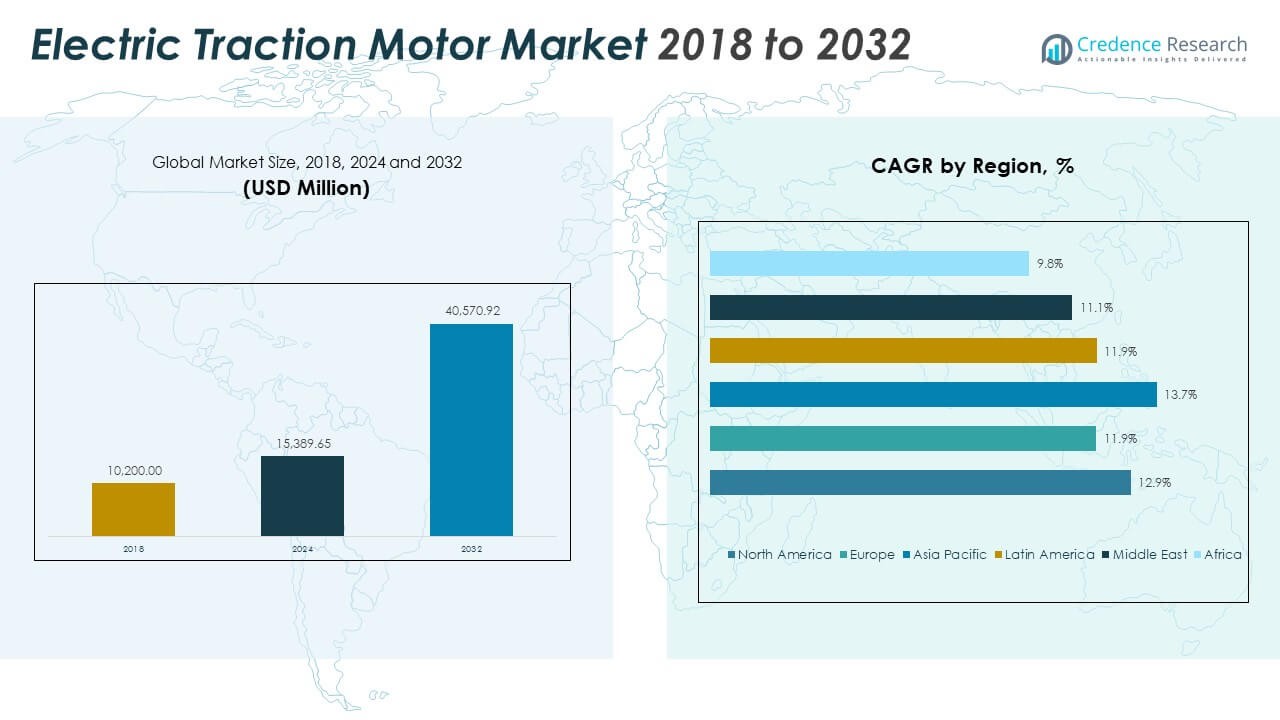
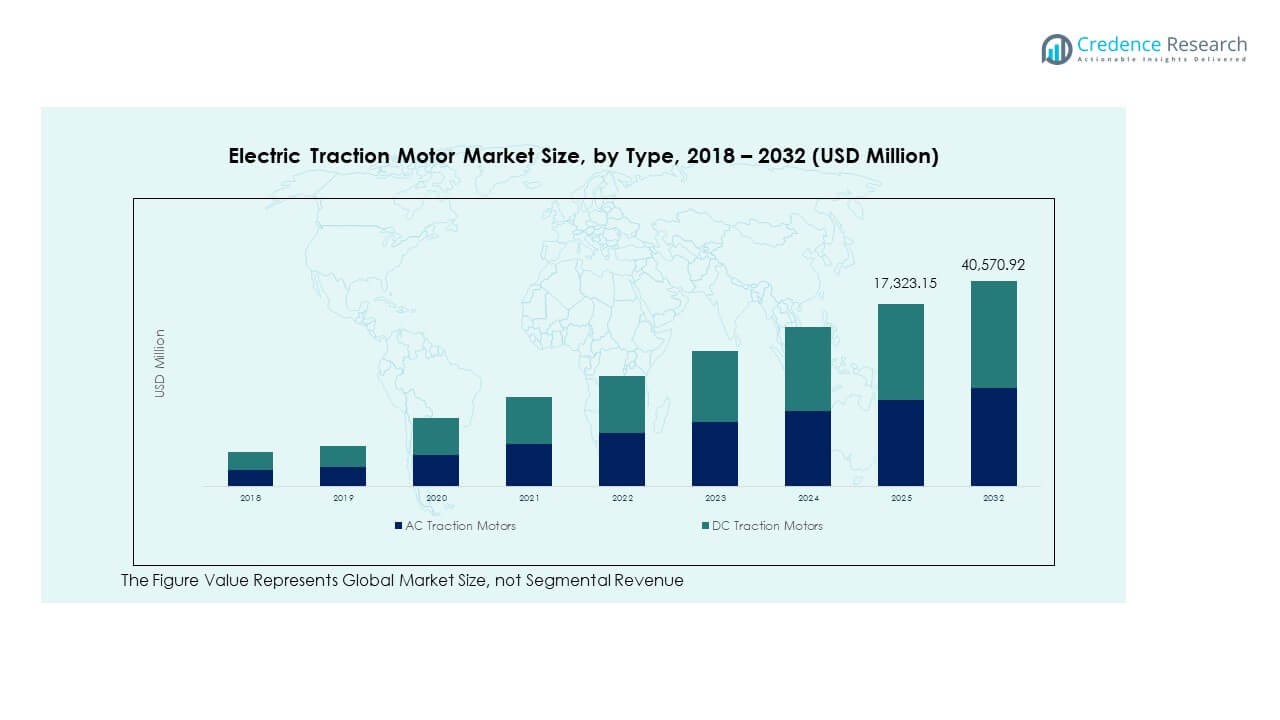
The Electric Traction Motor Market size was valued at USD 10,200.00 million in 2018 to USD 15,389.65 million in 2024 and is anticipated to reach USD 40,570.92 million by 2032, at a CAGR of 12.93% during the forecast period.

REPORT ATTRIBUTE DETAILS
Historical Period 2020-2023
Base Year 2024
Forecast Period 2025-2032
Electric Traction Motor Market Size 2024 USD 15,389.65 Million
Electric Traction Motor Market, CAGR 12.93%
Electric Traction Motor Market Size 2032 USD 40,570.92 Million


Rising electric vehicle production and supportive government policies accelerate industry growth. Automakers prioritize advanced traction systems to meet emission standards and enhance driving performance. Integration of digital control, regenerative braking, and efficient power conversion elevates operational reliability. Manufacturers invest heavily in R&D to develop compact, lightweight motors suited for varied platforms. Growing public transport electrification and adoption of hybrid systems further boost industry expansion. It continues to evolve as a core enabler of global electrification efforts.

Asia Pacific leads the Electric Traction Motor Market, driven by large-scale EV manufacturing and public transport electrification in China, Japan, and South Korea. Europe follows with strong regulatory frameworks promoting zero-emission mobility and railway modernization. North America demonstrates steady adoption backed by EV infrastructure development and industrial automation. Emerging regions such as Latin America, the Middle East, and Africa show growing potential through government-backed electrification and renewable integration projects. It reflects global transition toward sustainable and efficient mobility ecosystems.

Access crucial information at unmatched prices!

Request your sample report today & start making informed decisions powered by Credence Research Inc.!

Download Sample

Market Insights:

  • The Electric Traction Motor Market was valued at USD 10,200.00 million in 2018, reached USD 15,389.65 million in 2024, and is projected to hit USD 40,570.92 million by 2032, growing at a CAGR of 12.93%.
  • Asia Pacific dominates with 4% share, driven by large-scale EV production, metro network electrification, and robust manufacturing in China, Japan, and South Korea.
  • North America holds 9% share, supported by strong EV adoption in the U.S. and advancements in charging infrastructure, while Europe follows with 17.7% share, led by clean transport policies and rail modernization.
  • The fastest-growing region is Asia Pacific with a 7% CAGR, attributed to aggressive government incentives, cost-efficient production, and rapid industrial electrification.
  • By type, AC traction motors account for around 68%, favored for efficiency and low maintenance, while DC traction motors hold 32%, mainly used in legacy rail and industrial applications.

Electric Traction Motor Market Size

Market Drivers

Rising Adoption of Electric and Hybrid Vehicles Across Global Markets

The Electric Traction Motor Market expands rapidly with strong growth in electric and hybrid vehicle manufacturing. Governments enforce stricter emission laws, encouraging automakers to switch to electric powertrains. Consumer demand for sustainable mobility options continues to strengthen across major economies. Companies develop motors with higher power density and energy efficiency to enhance performance. The integration of regenerative braking systems further increases vehicle range and efficiency. Automakers form strategic alliances with motor producers to ensure steady component supply. Battery cost reduction supports large-scale adoption across all segments. It remains a central enabler for next-generation mobility transformation.

  • For instance, Tesla Model 3 systems recover braking energy to extend range by up to 10-20% in urban driving. Automakers form strategic alliances with motor producers to ensure steady component supply.

Advancements in Motor Design and Material Efficiency for Enhanced Performance

Ongoing technological developments focus on improving motor efficiency, torque output, and power-to-weight ratio. Engineers incorporate advanced materials such as silicon carbide and rare-earth magnets to enhance energy conversion. The Electric Traction Motor Market benefits from innovations in stator winding and rotor design. Compact architectures support lightweight vehicles and efficient cooling systems. Precision manufacturing techniques ensure reduced friction and energy loss during operation. Automotive OEMs prioritize low-noise and vibration-free performance for improved comfort. R&D investments push innovations that balance cost, durability, and environmental standards. It continues to shape engineering strategies across major motor developers.

  • The Electric Traction Motor Market benefits from innovations in stator winding and rotor design, for instance, Tesla Model 3 rear motor delivers 193 kW power and 431 Nm torque at peak.

Government Incentives and Regulatory Push for Electrification Programs

Global governments implement policies promoting the shift toward cleaner transportation systems. Subsidies, tax rebates, and purchase incentives increase the affordability of electric mobility. The Electric Traction Motor Market gains from national emission-reduction plans and stricter fuel-efficiency norms. Public investment in charging networks supports long-term consumer confidence. Zero-emission mandates accelerate automaker compliance and production goals. Nations like China, Germany, and the U.S. invest in electrified public transport systems. These programs stimulate component suppliers and OEMs to scale production efficiently. It aligns industrial priorities with global sustainability goals.

Rising Demand for Efficient Public Transportation and Industrial Mobility

Urbanization and population density drive expansion in electric buses, trams, and locomotives. Transit authorities seek reliable traction solutions that lower lifecycle costs and maintenance needs. The Electric Traction Motor Market benefits from adoption in rail networks and mining vehicles. Energy recovery technologies improve system performance in metro and high-speed rail networks. Operators focus on cutting operating expenses through electric propulsion. Rapid electrification of logistics fleets further strengthens market penetration. Infrastructure modernization ensures consistent motor performance under heavy-duty applications. It establishes a critical role in building sustainable transport systems worldwide.

Market Trends

Integration of Digital Control Systems and Smart Monitoring Technologies

Manufacturers integrate digital sensors and AI-based diagnostics to improve operational reliability. Intelligent control units manage torque distribution and optimize current flow in real time. The Electric Traction Motor Market evolves toward connected systems that predict faults before failure. Predictive maintenance enhances efficiency and reduces downtime for electric vehicles. Firms employ cloud-linked platforms to track energy consumption and temperature profiles. Data analytics help engineers enhance performance through adaptive algorithms. Software-defined components become essential for next-generation EV architectures. It supports smarter, safer, and more efficient electric propulsion networks.

  • For instance, Bosch develops AI-driven motor control and predictive maintenance systems that use real-time sensor data to enhance efficiency and minimize downtime in electric vehicles. These solutions improve reliability by enabling early fault detection and optimized energy management.

Shift Toward Rare-Earth-Free and Sustainable Motor Production Technologies

Concerns over material supply push firms to develop motors without rare-earth magnets. Research emphasizes recyclable materials and sustainable manufacturing practices. The Electric Traction Motor Market reflects this shift by promoting alternative magnetic alloys. Companies explore ferrite-based magnets that reduce dependency on critical minerals. Supply chain disruptions encourage local sourcing and innovation in magnet-free design. Environmental policies reinforce eco-friendly approaches across all production stages. Industrial collaborations target carbon-neutral manufacturing of electric drive systems. It accelerates progress toward a more resilient and green value chain.

Growing Focus on High-Voltage Systems and Compact Powertrain Integration

EV makers design platforms that support high-voltage motor architectures for superior power output. Advanced insulation and cooling methods manage increased heat during operation. The Electric Traction Motor Market embraces compact units that integrate with transmission systems. Engineers reduce wiring complexity while improving torque transfer. Innovations in inverter compatibility enhance energy distribution and acceleration response. OEMs deploy 800V systems in luxury and performance EVs for faster charging. The trend supports extended range and lighter vehicle weight. It sets new efficiency benchmarks for electric mobility platforms.

  • For instance, Porsche’s Taycan uses an 800V electrical architecture that supports charging power up to 320 kW, enabling a 10–80% charge in around 18 minutes. This setup delivers faster charging performance than traditional 400V systems while improving overall energy efficiency.

Expansion of Manufacturing Hubs and Regional Supply Chain Optimization

Global automakers localize production to minimize logistics costs and ensure stable supply. Regional motor assembly facilities strengthen national EV production ecosystems. The Electric Traction Motor Market benefits from Asia-Pacific’s growing manufacturing capabilities. Europe and North America expand local partnerships to reduce import dependency. Investment in automation and digital twins enhances precision in motor fabrication. Supply diversification minimizes risks from raw material price fluctuations. Governments back infrastructure zones supporting component exports. It ensures long-term resilience and competitiveness for global suppliers.

Market Challenges Analysis

Fluctuating Raw Material Costs and Supply Chain Constraints

Unpredictable prices for copper, steel, and rare-earth materials impact production costs. Manufacturers struggle to maintain profit margins while meeting design standards. The Electric Traction Motor Market faces constraints in rare-earth magnet sourcing. Geopolitical instability further disrupts material availability and transportation networks. Delays in semiconductor supply affect motor control unit manufacturing schedules. OEMs adopt dual sourcing to manage long lead times and cost uncertainty. Suppliers invest in recycling processes to recover valuable metals from used components. It requires constant monitoring of trade policies to maintain consistent output.

Thermal Management, Design Complexity, and Efficiency Limitations

High-performance traction systems generate excessive heat during continuous operation. Inadequate thermal management reduces motor lifespan and efficiency. The Electric Traction Motor Market confronts challenges in balancing compactness with cooling efficiency. Engineers develop advanced liquid and air cooling systems for optimal durability. Overheating risks rise with increased torque density in compact designs. Manufacturers must also ensure electromagnetic compatibility with electronic systems. Research in better insulation and advanced winding materials remains ongoing. It demands constant innovation to overcome engineering and performance barriers.

Market Opportunities

Rising Electrification of Commercial Fleets and Public Transit Networks

Fleet operators adopt electric solutions to reduce fuel costs and emissions. Governments introduce mandates encouraging zero-emission logistics and passenger transport. The Electric Traction Motor Market gains traction in buses, trucks, and delivery vans. Charging infrastructure investments support large-scale fleet deployment. Collaborations between motor producers and fleet operators speed adoption. Energy storage and power electronics improvements further strengthen system reliability. Regional markets with urban air quality goals show higher fleet electrification. It opens consistent long-term contracts for component suppliers.

Technological Collaboration and Expansion into Emerging Economies

Motor manufacturers form partnerships with EV startups to expand innovation pipelines. Emerging economies invest in localized production and R&D facilities. The Electric Traction Motor Market benefits from rising industrialization and mobility reforms. Cost-efficient manufacturing in Asia, Africa, and Latin America attracts investors. International firms explore joint ventures for knowledge transfer and training programs. Adoption of Industry 4.0 practices improves productivity and precision in assembly. Nations offering clean transport incentives emerge as key destinations for expansion. It strengthens future growth prospects through inclusive technology adoption.

Electric Traction Motor Market Seg

Market Segmentation Analysis:

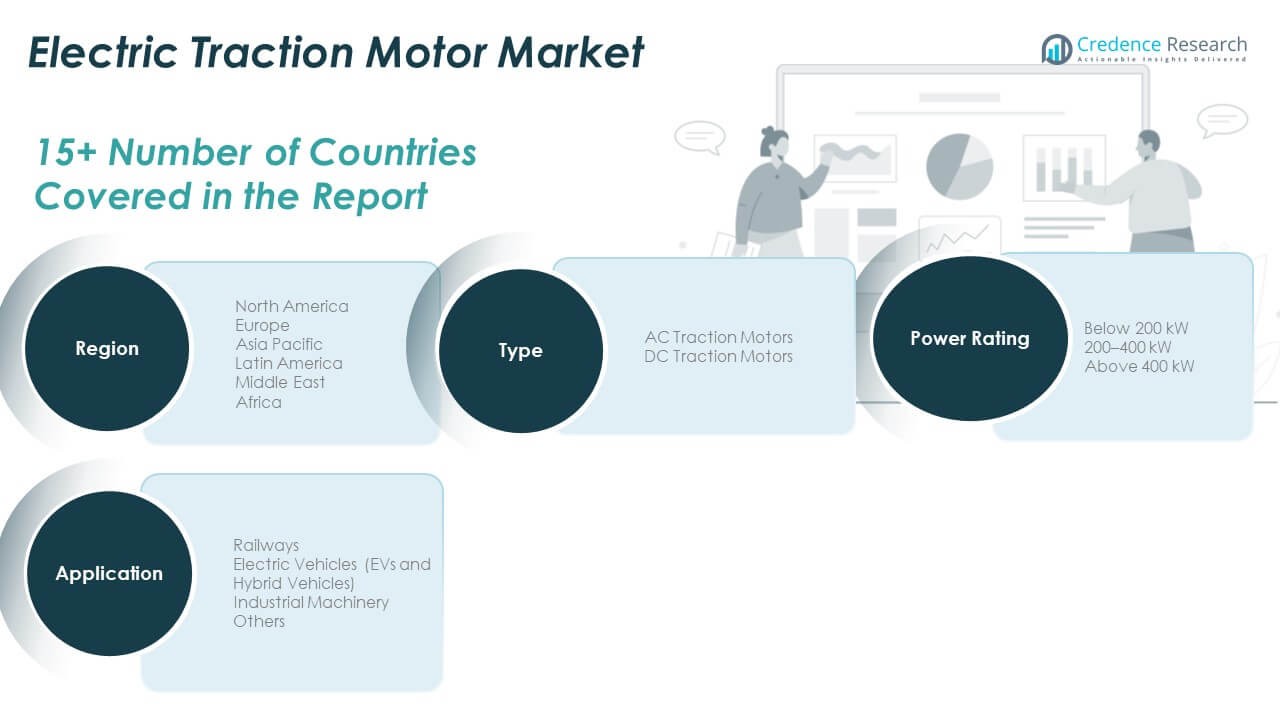
The Electric Traction Motor Market is categorized by type, application, and power rating,

By type, reflecting diverse industrial and transportation needs. AC traction motors dominate due to higher efficiency, lower maintenance, and compatibility with modern control systems. DC traction motors maintain relevance in legacy rail systems and heavy-duty vehicles requiring constant torque. Continuous innovation in inverter technology enhances AC motor performance and reliability across mobility platforms. It continues to support evolving transport systems that demand higher energy efficiency and durability in long-duty operations.

  • For instance, Siemens MoComp traction motors deliver rated power from 50 to 190 kW at speeds of 1,580 to 2,500 rpm, with maximal operating speeds up to 5,250 rpm and rated torque of 210 to 730 Nm, supporting high-speed rail applications.

By application, electric vehicles lead with growing adoption across passenger and commercial fleets. Railways remain a critical segment, using traction systems for metro, tram, and high-speed networks. Industrial machinery applications expand in automation and material handling sectors requiring precise torque control. The “Others” category covers mining trucks, construction vehicles, and marine transport where electrification improves cost and emission efficiency. It strengthens its role in decarbonizing both passenger and industrial mobility systems.

By power rating, motors below 200 kW dominate smaller electric cars and light-duty equipment. The 200–400 kW segment supports medium and heavy commercial vehicles demanding high torque output. Above 400 kW motors gain traction in rail and large transport applications requiring sustained load performance. Manufacturers refine thermal management and design compact layouts to handle higher power density effectively. It aligns with the industry’s focus on balancing energy output, efficiency, and lifecycle sustainability across electric mobility infrastructure.

  • For instance, Siemens SIMOTICS GP/SD/XP/DP motors are certified to IE3 premium efficiency standards, delivering up to 95% efficiency in higher power ranges around 37 kW and above. These motors cover frame sizes from 63 to 355 and power outputs up to 500 kW, ensuring reliable and energy-efficient performance across industrial applications.

Electric Traction Motor Market Seg1

Segmentation:

By Type

  • AC Traction Motors
  • DC Traction Motors

By Application

  • Railways
  • Electric Vehicles (EVs and Hybrid Vehicles)
  • Industrial Machinery
  • Others

By Power Rating

  • Below 200 kW
  • 200–400 kW
  • Above 400 kW

By Region

  • North America
    • U.S.
    • Canada
    • Mexico
  • Europe
    • Germany
    • France
    • U.K.
    • Italy
    • Spain
    • Rest of Europe
  • Asia Pacific
    • China
    • Japan
    • India
    • South Korea
    • South-east Asia
    • Rest of Asia Pacific
  • Latin America
    • Brazil
    • Argentina
    • Rest of Latin America
  • Middle East & Africa
    • GCC Countries
    • South Africa
    • Rest of the Middle East and Africa

Regional Analysis:

North America

The North America Electric Traction Motor Market size was valued at USD 2,590.80 million in 2018 to USD 3,841.16 million in 2024 and is anticipated to reach USD 10,106.29 million by 2032, at a CAGR of 12.9% during the forecast period. North America holds nearly 24.9% of the global market share driven by strong electric vehicle adoption and technological advancements. The U.S. leads with robust investments in EV production and charging infrastructure. Canada expands electrified transit systems to meet emission-reduction goals, while Mexico develops new assembly facilities for EV components. Manufacturers introduce high-performance traction motors for light-duty and commercial vehicles. Partnerships between automakers and motor suppliers accelerate production capacity. It strengthens its position as a hub for innovation and sustainable transport solutions.

Europe

The Europe Electric Traction Motor Market size was valued at USD 2,052.24 million in 2018 to USD 2,939.00 million in 2024 and is anticipated to reach USD 7,179.13 million by 2032, at a CAGR of 11.9% during the forecast period. Europe accounts for nearly 17.7% of the global market share, driven by strict emission norms and advanced automotive technologies. Germany, France, and the UK dominate with leading EV production and rail electrification projects. EU policies promoting carbon neutrality push manufacturers toward efficient traction solutions. High-speed rail networks in France and Spain integrate energy-efficient drive systems. European firms emphasize rare-earth-free and recyclable materials to reduce environmental impact. Governments continue expanding incentives for EV adoption. It reinforces leadership in sustainable industrial electrification.

Asia Pacific

The Asia Pacific Electric Traction Motor Market size was valued at USD 4,439.04 million in 2018 to USD 6,864.49 million in 2024 and is anticipated to reach USD 19,169.79 million by 2032, at a CAGR of 13.7% during the forecast period. Asia Pacific commands about 47.4% of the global market share, supported by rapid EV expansion and large-scale infrastructure projects. China leads global traction motor manufacturing and deployment across automotive and rail sectors. Japan and South Korea invest in high-efficiency motor technologies for hybrid and fuel-cell vehicles. India expands metro and electric bus projects under urban modernization programs. Regional suppliers scale up localized production to reduce import dependence. High demand for cost-effective, high-performance motors drives continuous innovation. It remains the fastest-growing regional contributor to global traction motor demand.

Latin America

The Latin America Electric Traction Motor Market size was valued at USD 632.40 million in 2018 to USD 944.77 million in 2024 and is anticipated to reach USD 2,307.27 million by 2032, at a CAGR of 11.9% during the forecast period. Latin America captures around 5.7% of the global share, with growth led by Brazil and Mexico. Government initiatives to promote EV adoption and improve railway systems strengthen market development. Manufacturers target urban mobility and industrial automation sectors for traction deployment. Regional investments in renewable energy enhance the sustainability of electric drives. Electric buses gain popularity in cities like São Paulo and Santiago. Production alliances with international firms boost local manufacturing capacity. It continues to evolve as an emerging hub for electric mobility in the Western Hemisphere.

Middle East

The Middle East Electric Traction Motor Market size was valued at USD 316.20 million in 2018 to USD 440.04 million in 2024 and is anticipated to reach USD 1,018.55 million by 2032, at a CAGR of 11.1% during the forecast period. The region holds roughly 2.5% of the global market share, driven by diversification efforts beyond oil-based industries. UAE and Saudi Arabia lead with smart mobility programs integrating electric public transport systems. Infrastructure projects incorporate energy-efficient rail and metro expansions. Partnerships with European and Asian suppliers improve traction motor technology transfer. Manufacturers focus on adapting systems to harsh climatic conditions. Rising renewable power generation supports grid-connected transport initiatives. It builds regional momentum toward clean transport infrastructure.

Africa

The Africa Electric Traction Motor Market size was valued at USD 169.32 million in 2018 to USD 360.18 million in 2024 and is anticipated to reach USD 789.89 million by 2032, at a CAGR of 9.8% during the forecast period. Africa contributes nearly 1.8% of the global market share, with South Africa dominating regional adoption. Electrification of mining and industrial vehicles drives early traction motor integration. Nations like Egypt and Kenya invest in urban rail systems and e-mobility programs. Limited infrastructure slows adoption, yet local assembly projects begin to emerge. Partnerships with global players promote technology transfer and workforce development. Rising demand for sustainable industrial solutions enhances market potential. It demonstrates gradual but steady progress toward modernized electric transportation ecosystems.

Shape Your Report to Specific Countries or Regions & Enjoy 30% Off!

Key Player Analysis:

  • ABB Ltd.
  • Mitsubishi Electric Corporation
  • Toshiba Corporation
  • General Electric (GE)
  • Siemens AG
  • CG Power and Industrial Solutions Ltd.
  • CRRC Corporation Limited
  • Robert Bosch GmbH
  • NIDEC Corporation
  • WEG S.A.

Competitive Analysis:

The Electric Traction Motor Market features strong competition among global and regional manufacturers focused on innovation, efficiency, and scalability. Leading players such as ABB, Siemens, Mitsubishi Electric, Toshiba, General Electric, and Nidec invest heavily in R&D to improve torque density, energy conversion, and reliability. Companies expand portfolios with high-voltage and magnet-free motor designs to reduce rare-earth dependency. Strategic mergers and partnerships strengthen production networks and supply stability. Emerging firms focus on localized manufacturing and customized propulsion systems for EV and rail applications. Competitive advantage depends on technology integration, cost optimization, and after-sales service quality. It continues to evolve through digitalization, sustainability commitments, and strategic collaboration across automotive and industrial sectors.

Recent Developments:

  • In June 2025, ABB Ltd introduced the AMXE Marine Motor, a next-generation electric propulsion system designed to advance energy-efficient mobility and strengthen its traction motor portfolio across marine and heavy transport applications.
  • In December 2024, ABB Ltd signed an agreement to acquire the power conversion business of Gamesa Electric from Siemens Gamesa in Spain, enhancing its expertise in high-power renewable and industrial electrification technologies supporting the electric traction motor market

Report Coverage:

The research report offers an in-depth analysis based on type, application, and power rating, It details leading market players, providing an overview of their business, product offerings, investments, revenue streams, and key applications. Additionally, the report includes insights into the competitive environment, SWOT analysis, current market trends, as well as the primary drivers and constraints. Furthermore, it discusses various factors that have driven market expansion in recent years. The report also explores market dynamics, regulatory scenarios, and technological advancements that are shaping the industry. It assesses the impact of external factors and global economic changes on market growth. Lastly, it provides strategic recommendations for new entrants and established companies to navigate the complexities of the market.

Future Outlook:

  • Growing electrification across transportation sectors will drive widespread adoption of high-performance traction motors.
  • Continuous R&D investment will enhance motor efficiency, torque density, and lightweight design.
  • Integration of AI-based diagnostics and smart control systems will improve operational reliability.
  • Manufacturers will focus on magnet-free and rare-earth-alternative materials to ensure supply security.
  • Regional production hubs in Asia Pacific and Europe will expand to support large-scale EV manufacturing.
  • Public and private investments in EV charging and rail electrification will sustain long-term demand.
  • Hybrid and hydrogen-powered vehicles will create new opportunities for advanced traction motor designs.
  • Thermal management and compact motor integration will remain key design priorities for OEMs.
  • Strategic collaborations among automakers, component suppliers, and energy firms will shape market consolidation.
  • Sustainability goals will push the Electric Traction Motor Market toward recyclable, energy-efficient manufacturing standards.

CHAPTER NO. 1 : GENESIS OF THE MARKET

1.1 Market Prelude – Introduction & Scope

1.2 The Big Picture – Objectives & Vision

1.3 Strategic Edge – Unique Value Proposition

1.4 Stakeholder Compass – Key Beneficiaries

CHAPTER NO. 2 : EXECUTIVE LENS

2.1 Pulse of the Industry – Market Snapshot

2.2 Growth Arc – Revenue Projections (USD Million)

2.3. Premium Insights – Based on Primary Interviews

CHAPTER NO. 3 : ELECTRIC TRACTION MOTOR MARKET FORCES & INDUSTRY PULSE

3.1 Foundations of Change – Market Overview

3.2 Catalysts of Expansion – Key Market Drivers

3.2.1 Momentum Boosters – Growth Triggers

3.2.2 Innovation Fuel – Disruptive Technologies

3.3 Headwinds & Crosswinds – Market Restraints

3.3.1 Regulatory Tides – Compliance Challenges

3.3.2 Economic Frictions – Inflationary Pressures

3.4 Untapped Horizons – Growth Potential & Opportunities

3.5 Strategic Navigation – Industry Frameworks

3.5.1 Market Equilibrium – Porter’s Five Forces

3.5.2 Ecosystem Dynamics – Value Chain Analysis

3.5.3 Macro Forces – PESTEL Breakdown

3.6 Price Trend Analysis

3.6.1 Regional Price Trend

3.6.2 Price Trend by product

CHAPTER NO. 4 : KEY INVESTMENT EPICENTER

4.1 Regional Goldmines – High-Growth Geographies

4.2 Product Frontiers – Lucrative Product Categories

4.3 Application Sweet Spots – Emerging Demand Segments

CHAPTER NO. 5: REVENUE TRAJECTORY & WEALTH MAPPING

5.1 Momentum Metrics – Forecast & Growth Curves

5.2 Regional Revenue Footprint – Market Share Insights

5.3 Segmental Wealth Flow – Type & Application Revenue

CHAPTER NO. 6 : TRADE & COMMERCE ANALYSIS

6.1. Import Analysis by Region

6.1.1. Global Electric Traction Motor Market Import Revenue By Region

6.2. Export Analysis by Region

6.2.1. Global Electric Traction Motor Market Export Revenue By Region

CHAPTER NO. 7 : COMPETITION ANALYSIS

7.1. Company Market Share Analysis

7.1.1. Global Electric Traction Motor Market: Company Market Share

7.2. Global Electric Traction Motor Market Company Revenue Market Share

7.3. Strategic Developments

7.3.1. Acquisitions & Mergers

7.3.2. New Product Launch

7.3.3. Regional Expansion

7.4. Competitive Dashboard

7.5. Company Assessment Metrics, 2024

CHAPTER NO. 8 : ELECTRIC TRACTION MOTOR MARKET – BY TYPE SEGMENT ANALYSIS

8.1. Electric Traction Motor Market Overview by Type Segment

8.1.1. Electric Traction Motor Market Revenue Share By Type

8.2. AC Traction Motors

8.3. DC Traction Motors

CHAPTER NO. 9 : ELECTRIC TRACTION MOTOR MARKET – BY APPLICATION SEGMENT ANALYSIS

9.1. Electric Traction Motor Market Overview by Application Segment

9.1.1. Electric Traction Motor Market Revenue Share By Application

9.2. Railways

9.3. Electric Vehicles (EVs and Hybrid Vehicles)

9.4. Industrial Machinery

9.5. Others

CHAPTER NO. 10 : ELECTRIC TRACTION MOTOR MARKET – BY POWER RATING SEGMENT ANALYSIS

10.1. Electric Traction Motor Market Overview by Power Rating Segment

10.1.1. Electric Traction Motor Market Revenue Share By Power Rating

10.2. Below 200 kW

10.3. 200–400 kW

10.4. Above 400 kW

CHAPTER NO. 11 : ELECTRIC TRACTION MOTOR MARKET – REGIONAL ANALYSIS

11.1. Electric Traction Motor Market Overview by Region Segment

11.1.1. Global Electric Traction Motor Market Revenue Share By Region

11.1.3. Regions

11.1.4. Global Electric Traction Motor Market Revenue By Region

.1.6. Type

11.1.7. Global Electric Traction Motor Market Revenue By Type

11.1.9. Application

11.1.10. Global Electric Traction Motor Market Revenue By Application

11.1.12. Power Rating

11.1.13. Global Electric Traction Motor Market Revenue By Power Rating

CHAPTER NO. 12 : NORTH AMERICA ELECTRIC TRACTION MOTOR MARKET – COUNTRY ANALYSIS

12.1. North America Electric Traction Motor Market Overview by Country Segment

12.1.1. North America Electric Traction Motor Market Revenue Share By Region

12.2. North America

12.2.1. North America Electric Traction Motor Market Revenue By Country

12.2.2. Type

12.2.3. North America Electric Traction Motor Market Revenue By Type

12.2.4. Application

12.2.5. North America Electric Traction Motor Market Revenue By Application

2.2.6. Power Rating

12.2.7. North America Electric Traction Motor Market Revenue By Power Rating

2.3. U.S.

12.4. Canada

12.5. Mexico

CHAPTER NO. 13 : EUROPE ELECTRIC TRACTION MOTOR MARKET – COUNTRY ANALYSIS

13.1. Europe Electric Traction Motor Market Overview by Country Segment

13.1.1. Europe Electric Traction Motor Market Revenue Share By Region

13.2. Europe

13.2.1. Europe Electric Traction Motor Market Revenue By Country

13.2.2. Type

13.2.3. Europe Electric Traction Motor Market Revenue By Type

13.2.4. Application

13.2.5. Europe Electric Traction Motor Market Revenue By Application

13.2.6. Power Rating

13.2.7. Europe Electric Traction Motor Market Revenue By Power Rating

13.3. UK

13.4. France

13.5. Germany

13.6. Italy

13.7. Spain

13.8. Russia

13.9. Rest of Europe

CHAPTER NO. 14 : ASIA PACIFIC ELECTRIC TRACTION MOTOR MARKET – COUNTRY ANALYSIS

14.1. Asia Pacific Electric Traction Motor Market Overview by Country Segment

14.1.1. Asia Pacific Electric Traction Motor Market Revenue Share By Region

14.2. Asia Pacific

14.2.1. Asia Pacific Electric Traction Motor Market Revenue By Country

14.2.2. Type

14.2.3. Asia Pacific Electric Traction Motor Market Revenue By Type

14.2.4. Application

14.2.5. Asia Pacific Electric Traction Motor Market Revenue By Application

14.2.5. Power Rating

14.2.7. Asia Pacific Electric Traction Motor Market Revenue By Power Rating

14.3. China

14.4. Japan

14.5. South Korea

14.6. India

14.7. Australia

14.8. Southeast Asia

14.9. Rest of Asia Pacific

CHAPTER NO. 15 : LATIN AMERICA ELECTRIC TRACTION MOTOR MARKET – COUNTRY ANALYSIS

15.1. Latin America Electric Traction Motor Market Overview by Country Segment

15.1.1. Latin America Electric Traction Motor Market Revenue Share By Region

15.2. Latin America

15.2.1. Latin America Electric Traction Motor Market Revenue By Country

15.2.2. Type

15.2.3. Latin America Electric Traction Motor Market Revenue By Type

15.2.4. Application

15.2.5. Latin America Electric Traction Motor Market Revenue By Application

15.2.6. Power Rating

15.2.7. Latin America Electric Traction Motor Market Revenue By Power Rating

15.3. Brazil

15.4. Argentina

15.5. Rest of Latin America

CHAPTER NO. 16 : MIDDLE EAST ELECTRIC TRACTION MOTOR MARKET – COUNTRY ANALYSIS

16.1. Middle East Electric Traction Motor Market Overview by Country Segment

16.1.1. Middle East Electric Traction Motor Market Revenue Share By Region

16.2. Middle East

16.2.1. Middle East Electric Traction Motor Market Revenue By Country

16.2.2. Type

16.2.3. Middle East Electric Traction Motor Market Revenue By Type

16.2.4. Application

16.2.5. Middle East Electric Traction Motor Market Revenue By Application

16.2.6. Power Rating

16.2.7. Middle East Electric Traction Motor Market Revenue By Power Rating

16.3. GCC Countries

16.4. Israel

16.5. Turkey

16.6. Rest of Middle East

CHAPTER NO. 17 : AFRICA ELECTRIC TRACTION MOTOR MARKET – COUNTRY ANALYSIS

17.1. Africa Electric Traction Motor Market Overview by Country Segment

17.1.1. Africa Electric Traction Motor Market Revenue Share By Region

17.2. Africa

17.2.1. Africa Electric Traction Motor Market Revenue By Country

17.2.2. Type

17.2.3. Africa Electric Traction Motor Market Revenue By Type

17.2.4. Application

17.2.5. Africa Electric Traction Motor Market Revenue By Application

17.2.6. Power Rating

17.2.7. Africa Electric Traction Motor Market Revenue By Power Rating

17.3. South Africa

17.4. Egypt

17.5. Rest of Africa

CHAPTER NO. 18 : COMPANY PROFILES

18.1. ABB

18.1.1. Company Overview

18.1.2. Product Portfolio

18.1.3. Financial Overview

18.1.4. Recent Developments

18.1.5. Growth Strategy

18.1.6. SWOT Analysis

18.2. Mitsubishi Electric Corporation

18.3. Toshiba Corporation

18.4. General Electric (GE)

18.5. Siemens

18.6. CG Power and Industrial Solutions Ltd

18.7. CRRC Corporation Limited

18.8. Robert Bosch GmbH

18.9. NIDEC Corporation

18.10. WEG S.A.

Request Free Sample

We prioritize the confidentiality and security of your data. Our promise: your information remains private.

Ready to Transform Data into Decisions?

Request Your Sample Report and Start Your Journey of Informed Choices


Providing the strategic compass for industry titans.

cr-clients-logos

Frequently Asked Questions

What is the current market size for Electric Traction Motor Market, and what is its projected size in 2032?

The Electric Traction Motor Market was valued at USD 15,389.65 million in 2024 and is projected to reach USD 40,570.92 million by 2032, reflecting strong expansion across transport and industrial applications.

At what Compound Annual Growth Rate is the Electric Traction Motor Market projected to grow between 2024 and 2032?

The Electric Traction Motor Market is projected to grow at a CAGR of 12.93% from 2024 to 2032, driven by rapid EV adoption and modernization of rail infrastructure.

Which Electric Traction Motor Market segment held the largest share in 2024?

AC traction motors held the largest share of the Electric Traction Motor Market in 2024 due to superior efficiency, lower maintenance, and compatibility with modern control systems.

What are the primary factors fueling the growth of the Electric Traction Motor Market?

The Electric Traction Motor Market grows through rising electric vehicle demand, stricter emission norms, public transport electrification, and ongoing innovation in energy-efficient motor design.

Who are the leading companies in the Electric Traction Motor Market?

Key players in the Electric Traction Motor Market include ABB, Siemens, Mitsubishi Electric, Toshiba, General Electric, Nidec, and CRRC Corporation, each focusing on advanced motor technologies and global expansion.

Which region commanded the largest share of the Electric Traction Motor Market in 2024?

Asia Pacific dominated the Electric Traction Motor Market in 2024 due to large-scale EV manufacturing, extensive railway electrification, and strong regional investment in energy-efficient mobility systems.

About Author

Sushant Phapale

Sushant Phapale

ICT & Automation Expert

Sushant is an expert in ICT, automation, and electronics with a passion for innovation and market trends.

View Profile


Related Reports

Retail Sourcing and Procurement Market

Retail Sourcing and Procurement Market size was valued at USD 5,820 million in 2024 and is anticipated to reach USD 19,080.37 million by 2032, at a CAGR of 16% during the forecast period.

Retail Logistics Market

Retail Logistics Market size was valued at USD 283,520 million in 2024 and is anticipated to reach USD 743,115.8 million by 2032, at a CAGR of 12.8% during the forecast period.

Intelligent Motor Control Market

The Intelligent Motor Control Market size was valued at USD 5,537.67 million in 2024 and is anticipated to reach USD 12,761.78 million by 2032, expanding at a CAGR of 11% during the forecast period.

Low Power Transformers Market

The Low Power Transformers Market size was valued at USD 10,468 million in 2024 and is anticipated to reach USD 18,934.7 million by 2032, growing at a CAGR of 7.69% during the forecast period.

LED Phosphor Materials Market

The LED phosphor materials market size was valued at USD 7,354.5 million in 2024 and is anticipated to reach USD 13,542.24 million by 2032, growing at a CAGR of 7.93% during the forecast period.

Industrial Robot Controllers Market

The Industrial Robot Controllers market size was valued at USD 1,096.88 million in 2024 and is anticipated to reach USD 2,169.61 million by 2032, expanding at a CAGR of 8.9% during the forecast period.

Touch Panel Market

Touch Panel Market size was valued at USD 82,240.42 million in 2024 and is anticipated to reach USD 228,093.01 million by 2032, growing at a CAGR of 13.6% during the forecast period.

Touchscreen Controller Market

Touch Screen Controller Market size was valued at USD 10,049.6 Million in 2024 and is anticipated to reach USD 29,855.15 Million by 2032, growing at a CAGR of 14.58% during the forecast period.

Temperature Sensor Market

The Temperature Sensor Market size was valued at USD 10,446 million in 2024 and is anticipated to reach USD 17,947.67 million by 2032, growing at a CAGR of 7% during the forecast period.

Surface Inspection Market

Surface Inspection Market size was valued at USD 4,858 million in 2024 and is anticipated to reach USD 8,998.11 million by 2032, at a CAGR of 8.01% during the forecast period.

Semiconductor and Electronic Component Market

Semiconductor and Electronic Component Market size was valued at USD 1,396,598 million in 2024 and is anticipated to reach USD 2,682,312 million by 2032, at a CAGR of 8.5% during the forecast period.

Steering Tie Rod Market

The Steering Tie Rod Market size was valued at USD 18,361.19 million in 2024 and is anticipated to reach USD 29,044.81 million by 2032, at a CAGR of 5.9% during the forecast period.

Licence Option

The report comes as a view-only PDF document, optimized for individual clients. This version is recommended for personal digital use and does not allow printing. Use restricted to one purchaser only.
$4999

To meet the needs of modern corporate teams, our report comes in two formats: a printable PDF and a data-rich Excel sheet. This package is optimized for internal analysis. Unlimited users allowed within one corporate location (e.g., regional office).
$6999

The report will be delivered in printable PDF format along with the report’s data Excel sheet. This license offers 100 Free Analyst hours where the client can utilize Credence Research Inc. research team. Permitted for unlimited global use by all users within the purchasing corporation, such as all employees of a single company.
$12999

Report delivery within 24 to 48 hours

Europe

North America

Email

Smallform of Sample request
User Review

Thank you for the data! The numbers are exactly what we asked for and what we need to build our business case.

Materials Scientist
(privacy requested)

User Review

The report was an excellent overview of the Industrial Burners market. This report does a great job of breaking everything down into manageable chunks.

Imre Hof
Management Assistant, Bekaert

cr-clients-logos

Request Sample