Home » Semiconductor & Electronics » Mechanical Testing Equipment Market

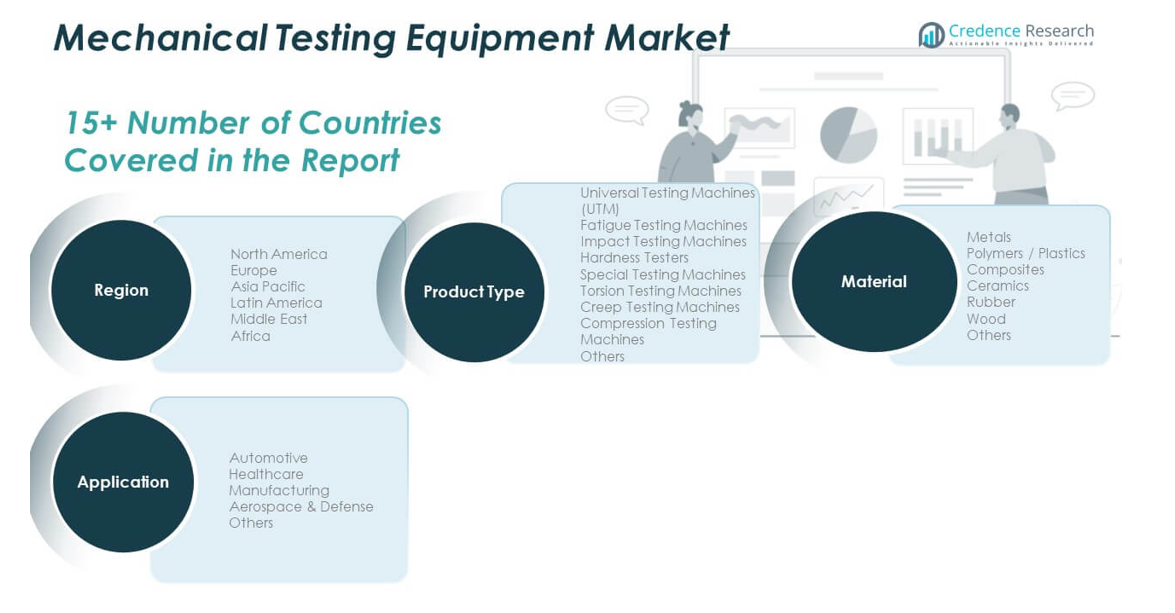
Mechanical Testing Equipment Market By Product Type (Universal Testing Machines (UTM), Fatigue Testing Machines, Impact Testing Machines, Hardness Testers, Special Testing Machines, Torsion Testing Machines, Creep Testing Machines, Compression Testing Machines, Others); By Material (Metals, Polymers / Plastics, Composites, Ceramics, Rubber, Wood, Others); By Application (Automotive, Healthcare, Manufacturing, Aerospace & Defense, Others) – Growth, Share, Opportunities & Competitive Analysis, 2024 – 2032

Report ID: 71347 | Report Format : Excel, PDF

Market Overview:

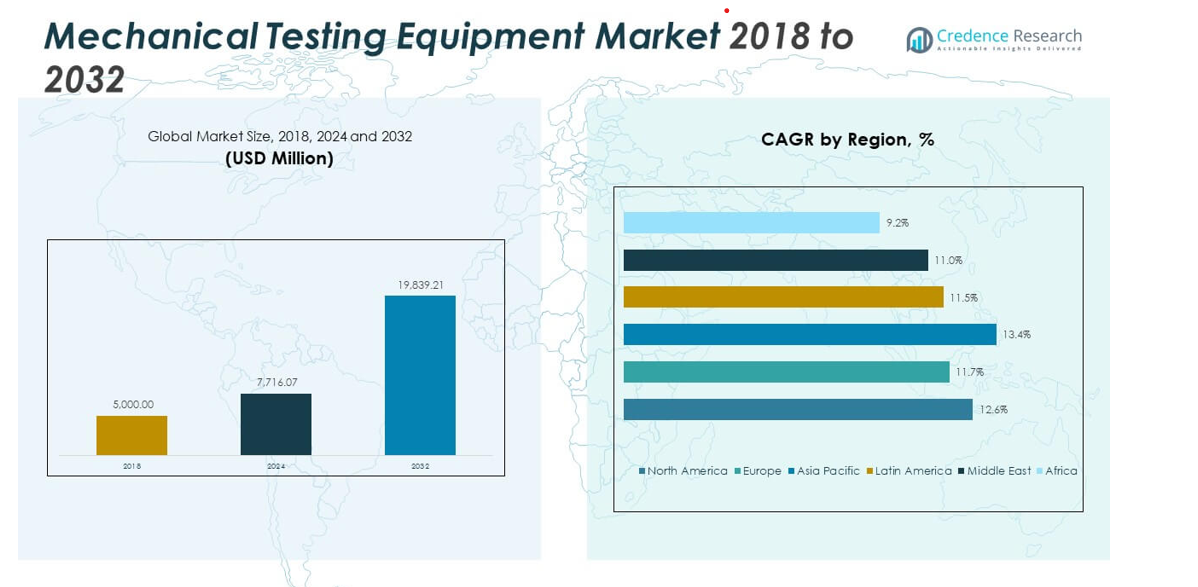
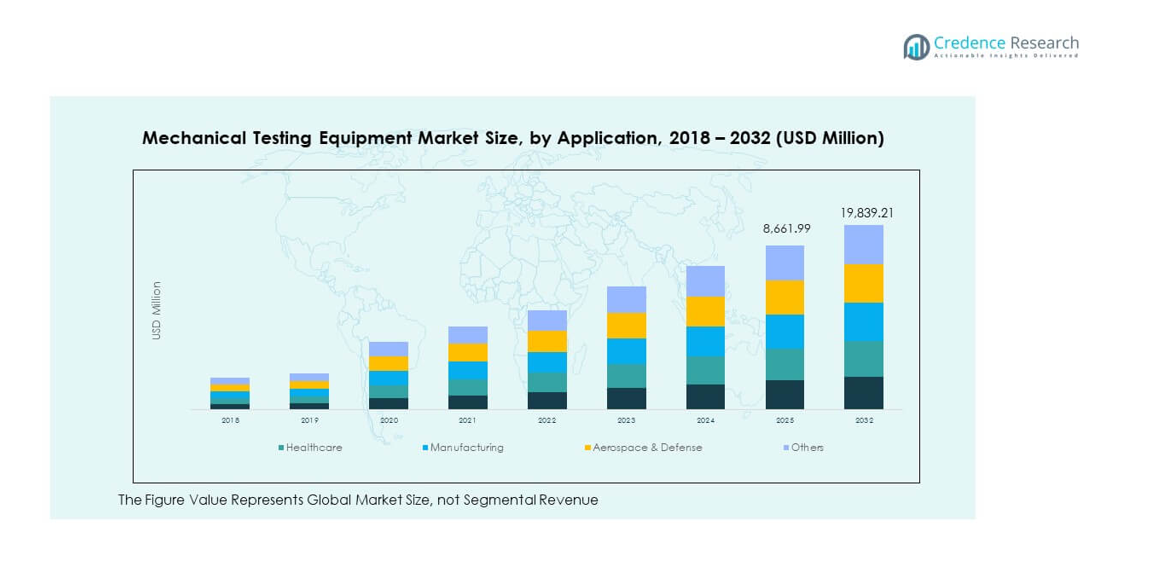
The Mechanical Testing Equipment Market size was valued at USD 5,000.00 million in 2018 to USD 7,716.07 million in 2024 and is anticipated to reach USD 19,839.21 million by 2032, at a CAGR of 12.57% during the forecast period.

REPORT ATTRIBUTE DETAILS
Historical Period 2020-2023
Base Year 2024
Forecast Period 2025-2032
Mechanical Testing Equipment Market Size 2024 USD 7,716.07 million
Mechanical Testing Equipment Market, CAGR 12.57%
Mechanical Testing Equipment Market Size 2032 USD 19,839.21 million


Growth in this market is driven by rising quality assurance requirements across manufacturing, automotive, and aerospace sectors. Industries demand advanced testing solutions to ensure safety, durability, and compliance with international standards. Continuous material innovation involving composites, polymers, and alloys fuels adoption of modern testing systems. Automation, sensor integration, and digital data tracking further enhance precision, enabling faster validation and streamlined production control across testing applications.

Regionally, North America and Europe dominate due to strong industrial bases, strict safety regulations, and ongoing R&D investments. Asia Pacific emerges as the fastest-growing region supported by rapid industrialization and expanding automotive and electronics manufacturing in China, India, and Japan. Latin America, the Middle East, and Africa display steady progress through infrastructure growth, new industrial setups, and adoption of modern testing practices

Mechanical Testing Equipment Market size

Market Insights:

  • The Mechanical Testing Equipment Market was valued at USD 5,000.00 million in 2018, USD 7,716.07 million in 2024, and is anticipated to reach USD 19,839.21 million by 2032, growing at a CAGR of 12.57%.
  • North America (22.4%), Europe (22.3%), and Asia Pacific (45.4%) together capture the majority share due to advanced industrial infrastructure, strong R&D focus, and established regulatory frameworks supporting precision testing.
  • Asia Pacific remains the fastest-growing region with 45.4% share, driven by accelerating manufacturing activity, infrastructure growth, and increased investments in testing automation and material innovation.
  • The manufacturing segment holds approximately 35% share of the Mechanical Testing Equipment Market, supported by its vital role in process validation, quality assurance, and component certification across diverse industries.
  • The aerospace & defense segment accounts for around 25% share, propelled by high demand for lightweight materials, safety testing, and compliance verification within aircraft and defense equipment production.

Access crucial information at unmatched prices!

Request your sample report today & start making informed decisions powered by Credence Research Inc.!

Download Sample

Market Drivers

Rising Demand for Material Validation Across Safety-Critical Industries

The Mechanical Testing Equipment Market expands through rising focus on material validation and safety assurance. Industries such as automotive, aerospace, and energy adopt advanced testing systems to ensure compliance with global quality standards. Manufacturers integrate tensile, fatigue, and hardness testing to confirm durability before product deployment. It supports improved reliability and performance in end-use applications. Governments enforce stricter regulations on material safety and product lifecycle testing. This encourages firms to invest in precision instruments. Continuous innovation in automation and data analytics improves efficiency in test processes. Demand rises further from manufacturers producing advanced alloys, polymers, and composites.

  • For example, GS Engineering provides comprehensive vehicle durability and validation testing using advanced sensor arrays, proprietary software and extensive real-time data acquisition. It conducts both static and dynamic tests to support automotive and aerospace manufacturers, following international standards such as ISO, SAE and NATO.

Expanding Use of Advanced Materials Across Manufacturing and Engineering Sectors

Growing utilization of composite and hybrid materials drives market penetration. These materials require precise mechanical characterization for tensile strength, impact resistance, and fatigue life. It encourages manufacturers to invest in technologically advanced test equipment with high accuracy. Aerospace and defense projects rely on structural integrity validation under extreme conditions. Automotive industries test lighter components to meet emission reduction targets. Construction and infrastructure sectors also adopt these systems for quality control in concrete and steel testing. Manufacturers develop high-speed universal testing machines for multiple load profiles. Continuous material innovation supports new product development and enhances quality consistency.

Technological Advancements in Automation, Sensing, and Data Integration

Integration of automation and digital control systems enhances test accuracy and reproducibility. The shift toward smart laboratories accelerates demand for connected testing solutions. IoT-enabled sensors capture real-time stress, strain, and deformation data. Artificial intelligence supports predictive maintenance and error detection during testing. It helps reduce manual supervision and operational downtime. Robotics-based test benches improve throughput across high-volume industrial plants. Digital dashboards allow engineers to compare performance trends across test cycles. Rising adoption of Industry 4.0 technologies strengthens investment in intelligent and adaptive test systems.

Stringent Regulatory Standards and Quality Certification Mandates

Manufacturers comply with international testing standards to secure product certifications and market access. The Mechanical Testing Equipment Market benefits from policies enforcing material traceability and performance benchmarking. Aerospace and automotive suppliers must meet ISO, ASTM, and DIN standards before large-scale production. Compliance tests ensure end-user safety and minimize liability risks. Testing equipment plays a vital role in obtaining type approvals and structural certifications. National laboratories upgrade facilities to meet advanced calibration needs. Industry collaborations promote knowledge sharing and uniform testing protocols. Growing emphasis on sustainable and safe products fuels continuous adoption of precision testing instruments.

  • For instance, SGS provides ISO/IEC 17025-accredited mechanical testing services that comply with international standards such as ISO, ASTM, and DIN. The company supports automotive and aerospace manufacturers with certification testing, ensuring material traceability and product safety across global supply chains.

Market Trends

Adoption of Digital Testing Platforms and Real-Time Analytics

Digital transformation reshapes traditional testing environments across multiple sectors. Testing systems now include cloud-based data storage and automated result interpretation. Engineers analyze material behavior through real-time dashboards and AI-assisted insights. It improves decision-making speed and reliability. Automated data logging minimizes human errors and enhances audit transparency. Cloud-based systems also allow remote test monitoring. The trend supports traceability and compliance for global manufacturers. Integration with digital twins supports simulation-driven development and faster material validation.

Growing Popularity of Non-Destructive Testing and Hybrid Methods

Manufacturers increasingly favor non-destructive testing (NDT) to preserve sample integrity. NDT techniques such as ultrasonic, X-ray, and magnetic particle testing offer fast diagnostics. It enables early fault detection without structural damage. Industries such as aerospace, oil and gas, and nuclear energy lead adoption due to strict safety needs. Hybrid systems that combine destructive and non-destructive testing improve testing precision. Portable and automated NDT devices gain traction for field operations. Integration with robotics ensures accessibility in difficult environments. This shift toward hybrid validation methods defines modern testing frameworks.

Integration of Automation and Robotics in Testing Workflows

Automation revolutionizes test workflows by reducing manual intervention. Robotic systems deliver consistent loading conditions and accurate specimen alignment. Automated grips and load frames shorten testing cycles in production lines. It improves throughput and repeatability across industrial plants. Smart robotics support adaptive control during stress testing and deformation analysis. Automated calibration minimizes downtime and ensures long-term stability. Firms adopt robotic manipulators for high-frequency fatigue and wear testing. This trend strengthens efficiency and aligns with industrial digitalization goals.

  • For example, MTS Systems Corporation supplies test and simulation systems that cover tensile, compression, durability and fatigue testing of metals, plastics, ceramics and composites for automotive, aerospace and industrial applications.

Shift Toward Sustainability and Eco-Friendly Testing Systems

Manufacturers adopt energy-efficient and recyclable testing solutions to reduce operational footprint. The Mechanical Testing Equipment Market moves toward green design and reduced waste generation. Test laboratories replace hydraulic systems with electromechanical drives for cleaner operation. It supports sustainability targets across global industries. Developers integrate low-power sensors and digital controls to cut energy use. Environmentally responsible testing promotes material reuse and life-cycle assessment. Laboratories seek certification under green building norms. Sustainable practices gain importance in government-funded infrastructure and automotive R&D programs.

  • For example, Shimadzu Corporation develops electromechanical testing machines that operate without hydraulic oil, reducing environmental impact and maintenance needs. These systems support tensile, compression, and bending tests while promoting cleaner, energy-efficient testing in automotive and manufacturing laboratories

Mechanical Testing Equipment Market share

Market Challenges Analysis

High Equipment Costs and Complex Calibration Requirements

The high initial cost of precision test machines limits adoption among small and mid-scale manufacturers. Complex calibration procedures demand skilled technicians and frequent maintenance. It creates additional operational expenses and slows production schedules. Sensitive instruments require controlled environments, increasing facility costs. Limited interoperability between legacy and modern systems adds integration challenges. Downtime due to calibration errors impacts productivity levels. Manufacturers face difficulty maintaining uniform standards across global test sites. The need for certified operators further complicates scaling in resource-constrained regions.

Lack of Skilled Workforce and Technical Training Infrastructure

Shortage of trained professionals in material science and testing technology affects performance consistency. The Mechanical Testing Equipment Market experiences a skill gap in system setup, data interpretation, and maintenance. Rapid technological evolution increases the need for continuous training. Universities and training centers lag in providing updated laboratory experience. It limits workforce readiness to handle digital and AI-based testing solutions. Inaccurate data analysis can lead to non-compliance in certification tests. Manufacturers must invest heavily in workforce upskilling. This challenge slows equipment adoption in developing markets with limited technical education access.

Market Opportunities

Rising Industrial Modernization and Infrastructure Growth Across Emerging Regions

Industrial modernization creates strong opportunities for expansion across developing economies. Countries such as India, Vietnam, and Indonesia boost investment in heavy manufacturing, automotive, and aerospace sectors. The Mechanical Testing Equipment Market gains from increased demand for product validation facilities. Governments fund metrology centers and testing laboratories to improve export standards. Local manufacturers adopt modern testing tools to meet international benchmarks. It enhances competitiveness and technology transfer from global players. Growth in infrastructure projects accelerates equipment sales across construction materials and structural applications.

Innovation in Smart Testing and Predictive Maintenance Technologies

Advances in machine learning, IoT, and automation open new prospects for intelligent testing systems. Smart sensors and adaptive algorithms deliver continuous equipment monitoring. It reduces unplanned downtime and optimizes calibration schedules. Predictive maintenance models extend machine life and improve operational efficiency. Real-time feedback systems ensure error-free testing environments. Integration with digital twins supports virtual prototyping and accelerates R&D cycles. Market players focusing on connected ecosystems gain early advantage through service-based revenue streams.

Market Segmentation Analysis:

By Product Type
The Mechanical Testing Equipment Market includes a broad range of machines that ensure precision and reliability across diverse testing conditions. Universal Testing Machines (UTM) lead demand due to their ability to perform tensile, compression, and flexural tests on multiple materials. Fatigue Testing Machines are vital for assessing endurance in aerospace, defense, and automotive components. Impact Testing Machines measure toughness and failure thresholds for metals and polymers. Hardness Testers verify surface durability and wear resistance in industrial production lines. Specialized systems such as torsion, creep, and compression testers meet complex testing needs for high-performance materials. It grows stronger through the integration of automation, digital monitoring, and high-precision sensors that improve accuracy and test efficiency.

  • For instance, the ZwickRoell Z010 model features a maximum force capacity of 10 kN with load measurement accuracy of ±0.05% and position measurement accuracy of ±0.0115 µm, supporting tensile, compression, and bending tests on various materials. Its test speeds have accuracy of ±0.05%, and the integrated testXpert III software ensures accurate data acquisition.

By Material
By material, metals dominate testing requirements owing to their structural role in automotive, aerospace, and heavy engineering sectors. Testing ensures strength, ductility, and fatigue resistance of alloys and metal composites. Polymers and plastics witness steady growth as industries focus on lightweight and sustainable materials. Composites gain attention for their increasing use in wind energy, aviation, and automotive parts. Ceramics and rubber are tested for performance reliability under extreme conditions, particularly in medical and industrial settings. Wood testing maintains niche applications in construction and furniture manufacturing. It reflects a balanced demand pattern across traditional and emerging material categories supported by evolving material standards.

By Application
By application, automotive and aerospace sectors hold a significant share driven by the need for safety validation and component reliability. Manufacturers rely on extensive fatigue and tensile testing to meet regulatory standards. The manufacturing segment maintains strong adoption through continuous quality control and production certification. Healthcare industries expand usage in testing surgical instruments, prosthetics, and implant materials to ensure precision and compliance. Defense applications utilize testing to evaluate structural integrity and operational resilience. It benefits from growing cross-sector demand for mechanical validation as industries innovate with advanced materials and production techniques.

  • For instance, Instron’s tensile testing machines, like the model 5969, support highly accurate mechanical testing with variable speeds from 0.001 to 500 mm/min and high-resolution load cells, widely used in automotive and aerospace sectors to ensure component reliability and safety compliance with precise force and elongation measurements.

Mechanical Testing Equipment Market segmentation

Segmentation:

By Product Type:

  • Universal Testing Machines (UTM)
  • Fatigue Testing Machines
  • Impact Testing Machines
  • Hardness Testers
  • Special Testing Machines
  • Torsion Testing Machines
  • Creep Testing Machines
  • Compression Testing Machines
  • Others

By Material:

  • Metals
  • Polymers / Plastics
  • Composites
  • Ceramics
  • Rubber
  • Wood
  • Others

By Application:

  • Automotive
  • Healthcare
  • Manufacturing
  • Aerospace & Defense
  • Others

By Region:

  • North America
    • U.S.
    • Canada
    • Mexico
  • Europe
    • Germany
    • France
    • U.K.
    • Italy
    • Spain
    • Rest of Europe
  • Asia Pacific
    • China
    • Japan
    • India
    • South Korea
    • South-east Asia
    • Rest of Asia Pacific
  • Latin America
    • Brazil
    • Argentina
    • Rest of Latin America
  • Middle East & Africa
    • GCC Countries
    • South Africa
    • Rest of the Middle East and Africa

Regional Analysis:

North America

The North America Mechanical Testing Equipment Market size was valued at USD 1,142.50 million in 2018 to USD 1,729.12 million in 2024 and is anticipated to reach USD 4,436.08 million by 2032, at a CAGR of 12.6% during the forecast period. It holds around 22.4% of the global share, driven by high investments in aerospace, defense, and automotive manufacturing. The region benefits from advanced R&D infrastructure and early adoption of precision testing technologies. Major industries rely on mechanical testing for product certification and compliance with strict quality regulations. The U.S. dominates due to the presence of leading manufacturers and strong government standards for safety and reliability. Canada and Mexico contribute through expanding industrial bases and growing export-oriented manufacturing. Technological upgrades in digital testing, automation, and AI-driven analytics enhance the competitive landscape. It maintains its leadership through constant innovation and strong institutional support for material research and product validation.

Europe

The Europe Mechanical Testing Equipment Market size was valued at USD 1,232.50 million in 2018 to USD 1,823.10 million in 2024 and is anticipated to reach USD 4,409.32 million by 2032, at a CAGR of 11.7%. Europe commands around 22.3% market share with strong industrial and regulatory ecosystems. Countries such as Germany, France, and the U.K. lead in material testing innovation for automotive, aerospace, and industrial machinery. It benefits from high-quality manufacturing standards, supported by stringent ISO and EN compliance norms. The region shows strong adoption of automation and sustainability-focused testing systems. Technological collaborations between testing laboratories and universities drive continuous product refinement. Expansion of electric vehicle and renewable energy sectors creates new testing requirements for advanced composites and light alloys. Europe’s mature industrial base ensures steady growth supported by modernization of existing testing infrastructure.

Asia Pacific

The Asia Pacific Mechanical Testing Equipment Market size was valued at USD 2,070.00 million in 2018 to USD 3,278.14 million in 2024 and is anticipated to reach USD 8,953.45 million by 2032, at a CAGR of 13.4%. It dominates the global market with a share of 45.4%, driven by rapid industrialization, infrastructure growth, and manufacturing expansion in China, Japan, India, and South Korea. High demand from automotive, electronics, and aerospace manufacturing boosts equipment deployment. The region benefits from government investments in material research and product certification programs. Emerging economies build advanced laboratories to support international quality standards. It witnesses growing integration of automated and AI-enabled testing systems across production sites. Rising exports of industrial components require enhanced reliability validation. Expanding regional supply chains further strengthen Asia Pacific’s position as the fastest-growing hub for testing solutions.

Latin America

The Latin America Mechanical Testing Equipment Market size was valued at USD 310.00 million in 2018 to USD 473.69 million in 2024 and is anticipated to reach USD 1,128.26 million by 2032, at a CAGR of 11.5%. It accounts for 5.7% of the global market share, with Brazil and Mexico leading growth. Industrial modernization in automotive, construction, and mining sectors supports demand for reliable material testing systems. Regional manufacturers focus on improving export quality and structural integrity in critical components. Government investments in research centers encourage testing standardization across industries. The market gains traction from expanding infrastructure projects requiring mechanical validation for concrete, metals, and composites. It benefits from growing collaborations with international equipment providers. Continued economic reforms and industrial diversification enhance technology adoption and testing capacity in major economies.

Middle East

The Middle East Mechanical Testing Equipment Market size was valued at USD 170.00 million in 2018 to USD 243.78 million in 2024 and is anticipated to reach USD 557.59 million by 2032, at a CAGR of 11.0%. It contributes 2.8% to global market share, supported by steady growth in oil, gas, and construction industries. Countries such as the UAE, Saudi Arabia, and Turkey drive demand for advanced material testing across large-scale infrastructure and industrial projects. The market benefits from new investments in aerospace and defense manufacturing zones. Testing laboratories expand to meet rising certification needs aligned with international safety standards. It witnesses technological transition toward automated testing systems for metals and polymers. Growing local partnerships with global manufacturers strengthen distribution and service networks. Sustainable construction initiatives further promote adoption of testing equipment across emerging projects.

Africa

The Africa Mechanical Testing Equipment Market size was valued at USD 75.00 million in 2018 to USD 168.24 million in 2024 and is anticipated to reach USD 354.51 million by 2032, at a CAGR of 9.2%. It represents 1.4% of the global market share, showing consistent progress through industrial and infrastructure expansion. South Africa leads with growing adoption in mining, construction, and energy sectors. Egypt and Nigeria witness gradual uptake driven by industrial modernization and foreign investment. The market gains support from government programs to improve product standards and testing capacity. Limited access to high-end technology remains a constraint, but regional collaborations improve knowledge transfer. Local distributors expand their portfolios to meet new industrial testing requirements. It advances through integration of affordable and portable testing solutions suited for small-scale operations and developing industrial clusters.

Shape Your Report to Specific Countries or Regions & Enjoy 30% Off!

Key Player Analysis:

  • MTS Systems Corporation
  • Instron (Illinois Tool Works Inc.)
  • Shimadzu Corporation
  • ZwickRoell
  • AMETEK (Lloyd Instruments)
  • Hegewald & Peschke
  • ADMET, Inc.
  • Tinius Olsen
  • Applied Test Systems
  • Torontech Group International
  • Buehler
  • PCE Instruments
  • Tokyo Testing Machine Co., Ltd.
  • Hung Ta Instrument Co., Ltd.
  • Qualitest International

Competitive Analysis:

The competitive landscape within the Mechanical Testing Equipment Market remains intense, driven by large global firms and focused niche players. Key companies such as MTS Systems Corporation, Instron (a subsidiary of Illinois Tool Works), Shimadzu Corporation, ZwickRoell, Hegewald & Peschke Meß‑ und Prüftechnik GmbH and AMETEK, Inc. (Lloyd Instruments) dominate through broad product portfolios and global distribution networks. These players continuously launch new machines, expand service networks and form partnerships to maintain competitive positions. It faces pressure from emerging players offering lower-cost or ultra-specialised test equipment solutions. Manufacturers differentiate through automation, digital data integration and global after-sales support. Strategic mergers and acquisitions accelerate market reach and product innovation. Regional footprint becomes critical as firms seek to capture high-growth markets in Asia Pacific and Latin America. The combination of scale, technological leadership and service excellence sets the competitive bar in this domain.

Recent Developments:

  • In February 2025, Waters Corporation launched its ElectroForce Apex 1 instrument, designed for advanced polymer and composite mechanical testing. It features a new motor control system, an automated tuning technology (TuneIQ™), and faster fatigue-testing capability for extended test runs.
  • In May 2024, Alpha Technologies introduced the AlphaFlex10™ Tensile Tester, adding destructive physical property testing to its rheology-line portfolio aimed at rubber and elastomer materials. The product integrates with existing software and service networks to support comprehensive material analysis.

Report Coverage:

The research report offers an in-depth analysis based on Product Type, Material and Application. It details leading market players, providing an overview of their business, product offerings, investments, revenue streams, and key applications. Additionally, the report includes insights into the competitive environment, SWOT analysis, current market trends, as well as the primary drivers and constraints. Furthermore, it discusses various factors that have driven market expansion in recent years. The report also explores market dynamics, regulatory scenarios, and technological advancements that are shaping the industry. It assesses the impact of external factors and global economic changes on market growth. Lastly, it provides strategic recommendations for new entrants and established companies to navigate the complexities of the market.

Future Outlook:

  • Rapid industrial automation and digital transformation will elevate demand for precision mechanical testing systems across global manufacturing hubs.
  • Increased adoption of AI-driven analytics will enhance test data accuracy and predictive maintenance for complex material structures.
  • Integration of IoT-enabled sensors will improve traceability, quality assurance, and real-time performance tracking in test environments.
  • Rising investments in aerospace, automotive, and renewable energy sectors will create new material testing requirements.
  • The market will see strong opportunities from sustainable testing systems designed for energy efficiency and low maintenance.
  • Expansion of R&D facilities in emerging economies will strengthen regional production and local technology development.
  • Collaboration between equipment manufacturers and research institutions will drive innovation in multi-axis and hybrid testing machines.
  • Growth in additive manufacturing will push demand for customized testing systems capable of evaluating 3D-printed components.
  • Government policies enforcing stricter safety and certification norms will stimulate steady equipment upgrades.
  • Cloud-based data management and remote laboratory access will redefine global testing standards and service models.

CHAPTER NO. 1 :      GENESIS OF THE MARKET           

1.1 Market Prelude – Introduction & Scope

1.2 The Big Picture – Objectives & Vision

1.3 Strategic Edge – Unique Value Proposition

1.4 Stakeholder Compass – Key Beneficiaries

CHAPTER NO. 2 :      EXECUTIVE LENS

2.1 Pulse of the Material – Market Snapshot

2.2 Growth Arc – Revenue Projections (USD Million)

2.3. Premium Insights – Based on Primary Interviews

CHAPTER NO. 3 :      MECHANICAL TESTING EQUIPMENT     MARKET FORCES & INDUSTRY PULSE        

3.1 Foundations of Change – Market Overview
3.2 Catalysts of Expansion – Key Market Drivers
3.2.1 Momentum Boosters – Growth Triggers
3.2.2 Innovation Fuel – Disruptive Technologies
3.3 Headwinds & Crosswinds – Market Restraints
3.3.1 Regulatory Tides – Compliance Challenges
3.3.2 Economic Frictions – Inflationary Pressures
3.4 Untapped Horizons – Growth Potential & Opportunities
3.5 Strategic Navigation – Material Frameworks
3.5.1 Market Equilibrium – Porter’s Five Forces
3.5.2 Ecosystem Dynamics – Value Chain Analysis
3.5.3 Macro Forces – PESTEL Breakdown

3.6 Price Trend Analysis

    3.6.1 Regional Price Trend
3.6.2 Price Trend by product

CHAPTER NO. 4 :      KEY INVESTMENT EPICENTER    

4.1 Regional Goldmines – High-Growth Geographies

4.2 Product Frontiers – Lucrative Product Categories

4.3 Material Sweet Spots – Emerging Demand Segments

CHAPTER NO. 5: REVENUE TRAJECTORY & WEALTH MAPPING

5.1 Momentum Metrics – Forecast & Growth Curves

5.2 Regional Revenue Footprint – Market Share Insights

5.3 Segmental Wealth Flow – Product Type & Material Revenue

CHAPTER NO. 6 :      TRADE & COMMERCE ANALYSIS

6.1.      Import Analysis by Region

6.1.1.    Global Mechanical Testing Equipment Market Import Revenue By Region

6.2.      Export Analysis by Region

6.2.1.    Global Mechanical Testing Equipment Market Export Revenue By Region

CHAPTER NO. 7 :      COMPETITION ANALYSIS 

7.1.      Company Market Share Analysis

7.1.1.    Global Mechanical Testing Equipment Market: Company Market Share

7.2.      Global Mechanical Testing Equipment Market Company Revenue Market Share

7.3.      Strategic Developments

7.3.1.    Acquisitions & Mergers

7.3.2.    New Product Launch

7.3.3.    Regional Expansion

7.4.      Competitive Dashboard

7.5.    Company Assessment Metrics, 2024

CHAPTER NO. 8 :      MECHANICAL TESTING EQUIPMENT     MARKET – BY PRODUCT TYPE SEGMENT ANALYSIS    

8.1.      Mechanical Testing Equipment Market Overview by Product Type Segment

8.1.1.    Mechanical Testing Equipment Market Revenue Share By Product Type

8.2.      Universal Testing Machines (UTM)

8.3.      Fatigue Testing Machines

8.4.      Impact Testing Machines

8.5.      Hardness Testers

8.6.      Special Testing Machines

8.7.      Torsion Testing Machines

8.8.      Creep Testing Machines

8.9.      Compression Testing Machines

8.10.     Others

CHAPTER NO. 9 :      MECHANICAL TESTING EQUIPMENT     MARKET – BY MATERIAL SEGMENT ANALYSIS

9.1.      Mechanical Testing Equipment Market Overview by Material Segment

9.1.1.    Mechanical Testing Equipment Market Revenue Share By Material

9.2.      Metals

9.3.      Polymers / Plastics

9.4.      Composites

9.5.      Ceramics

9.6.      Rubber

9.7.      Wood

9.8.      Others

CHAPTER NO. 10 :    MECHANICAL TESTING EQUIPMENT     MARKET – BY APPLICATION SEGMENT ANALYSIS

10.1.     Mechanical Testing Equipment Market Overview by Application Segment

10.1.1.  Mechanical Testing Equipment Market Revenue Share By Application

10.2.     Automotive

10.3.     Healthcare

10.4.     Manufacturing

10.5.     Aerospace & Defense

10.6.     Others

CHAPTER NO. 11 :    MECHANICAL TESTING EQUIPMENT     MARKET – REGIONAL ANALYSIS

11.1.     Mechanical Testing Equipment Market Overview by Region Segment

11.1.1.  Global Mechanical Testing Equipment Market Revenue Share By Region

11.1.3.  Regions

11.1.4.  Global Mechanical Testing Equipment Market Revenue By Region

.1.6.     Product Type

11.1.7.  Global Mechanical Testing Equipment Market Revenue By Product Type

11.1.9.  Material

11.1.10. Global Mechanical Testing Equipment Market Revenue By Material

11.1.12. Application

11.1.13. Global Mechanical Testing Equipment Market Revenue By Application

CHAPTER NO. 12 :    NORTH AMERICA MECHANICAL TESTING EQUIPMENT             MARKET – COUNTRY ANALYSIS 

12.1.     North America Mechanical Testing Equipment Market Overview by Country Segment

12.1.1.  North America Mechanical Testing Equipment Market Revenue Share By Region

12.2.     North America

12.2.1.  North America Mechanical Testing Equipment Market Revenue By Country

12.2.2.  Product Type

12.2.3.  North America Mechanical Testing Equipment Market Revenue By Product Type

12.2.4.  Material

12.2.5.  North America Mechanical Testing Equipment Market Revenue By Material

2.2.6.    Application

12.2.7.  North America Mechanical Testing Equipment Market Revenue By Application

2.3.      U.S.

12.4.     Canada

12.5.     Mexico

CHAPTER NO. 13 :    EUROPE MECHANICAL TESTING EQUIPMENT MARKET – COUNTRY ANALYSIS       

13.1.     Europe Mechanical Testing Equipment Market Overview by Country Segment

13.1.1.  Europe Mechanical Testing Equipment Market Revenue Share By Region

13.2.     Europe

13.2.1.  Europe Mechanical Testing Equipment Market Revenue By Country

13.2.2.  Product Type

13.2.3.  Europe Mechanical Testing Equipment Market Revenue By Product Type

13.2.4.  Material

13.2.5.  Europe Mechanical Testing Equipment Market Revenue By Material

13.2.6.  Application

13.2.7.  Europe Mechanical Testing Equipment Market Revenue By Application

13.3.     UK

13.4.     France

13.5.     Germany

13.6.     Italy

13.7.     Spain

13.8.     Russia

13.9.   Rest of Europe

CHAPTER NO. 14 :    ASIA PACIFIC MECHANICAL TESTING EQUIPMENT             MARKET – COUNTRY ANALYSIS 

14.1.     Asia Pacific Mechanical Testing Equipment Market Overview by Country Segment

14.1.1.  Asia Pacific Mechanical Testing Equipment Market Revenue Share By Region

14.2.     Asia Pacific

14.2.1.  Asia Pacific Mechanical Testing Equipment Market Revenue By Country

14.2.2.  Product Type

14.2.3.  Asia Pacific Mechanical Testing Equipment Market Revenue By Product Type

14.2.4.  Material

14.2.5.  Asia Pacific Mechanical Testing Equipment Market Revenue By Material

14.2.5.  Application

14.2.7.  Asia Pacific Mechanical Testing Equipment Market Revenue By Application

14.3.     China

14.4.     Japan

14.5.     South Korea

14.6.     India

14.7.     Australia

14.8.     Southeast Asia

14.9.     Rest of Asia Pacific

CHAPTER NO. 15 :    LATIN AMERICA MECHANICAL TESTING EQUIPMENT MARKET – COUNTRY ANALYSIS

15.1.     Latin America Mechanical Testing Equipment Market Overview by Country Segment

15.1.1.  Latin America Mechanical Testing Equipment Market Revenue Share By Region

15.2.     Latin America

15.2.1.  Latin America Mechanical Testing Equipment Market Revenue By Country

15.2.2.  Product Type

15.2.3.  Latin America Mechanical Testing Equipment Market Revenue By Product Type

15.2.4.  Material

15.2.5.  Latin America Mechanical Testing Equipment Market Revenue By Material

15.2.6.  Application

15.2.7.  Latin America Mechanical Testing Equipment Market Revenue By Application

15.3.     Brazil

15.4.     Argentina

15.5.     Rest of Latin America

CHAPTER NO. 16 :    MIDDLE EAST MECHANICAL TESTING EQUIPMENT             MARKET – COUNTRY ANALYSIS

16.1.     Middle East Mechanical Testing Equipment Market Overview by Country Segment

16.1.1.  Middle East Mechanical Testing Equipment Market Revenue Share By Region

16.2.     Middle East

16.2.1.  Middle East Mechanical Testing Equipment Market Revenue By Country

16.2.2.  Product Type

16.2.3.  Middle East Mechanical Testing Equipment Market Revenue By Product Type

16.2.4.  Material

16.2.5.  Middle East Mechanical Testing Equipment Market Revenue By Material

16.2.6.  Application

16.2.7.  Middle East Mechanical Testing Equipment Market Revenue By Application

16.3.     GCC Countries

16.4.     Israel

16.5.     Turkey

16.6.     Rest of Middle East

CHAPTER NO. 17 :    AFRICA MECHANICAL TESTING EQUIPMENT MARKET – COUNTRY ANALYSIS         

17.1.     Africa Mechanical Testing Equipment Market Overview by Country Segment

17.1.1.  Africa Mechanical Testing Equipment Market Revenue Share By Region

17.2.     Africa

17.2.1.  Africa Mechanical Testing Equipment Market Revenue By Country

17.2.2.  Product Type

17.2.3.  Africa Mechanical Testing Equipment Market Revenue By Product Type

17.2.4.  Material

17.2.5.  Africa Mechanical Testing Equipment Market Revenue By Material

17.2.6.  Application

17.2.7.  Africa Mechanical Testing Equipment Market Revenue By Application

17.3.     South Africa

17.4.     Egypt

17.5.     Rest of Africa

CHAPTER NO. 18 :    COMPANY PROFILES         

18.1.     MTS Systems Corporation

18.1.1.  Company Overview

18.1.2.  Product Portfolio

18.1.3.  Financial Overview

18.1.4.  Recent Developments

18.1.5.  Growth Strategy

18.1.6.  SWOT Analysis

18.2.     Instron (Illinois Tool Works)

18.3.     Shimadzu Corporation

18.4.     ZwickRoell

18.5.     AMETEK (Lloyd Instruments)

18.6.     Hegewald & Peschke

18.7.     ADMET, Inc.

18.8.     Tinius Olsen

18.9.     Applied Test Systems

18.10.   Torontech Group International

18.11.   Buehler

18.12.   PCE Instruments

18.13.   Tokyo Testing Machine Co., Ltd.

18.14.   Hung Ta Instrument Co., Ltd.

18.15.   Qualitest International

Request Free Sample

We prioritize the confidentiality and security of your data. Our promise: your information remains private.

Ready to Transform Data into Decisions?

Request Your Sample Report and Start Your Journey of Informed Choices


Providing the strategic compass for industry titans.

cr-clients-logos

Frequently Asked Questions

What is the projected growth of the Mechanical Testing Equipment Market?

The Mechanical Testing Equipment Market was valued at USD 7,716.07 million in 2024 and is projected to reach USD 19,839.21 million by 2032, showing strong expansion across industrial sectors.

At what Compound Annual Growth Rate is the Mechanical Testing Equipment Market projected to grow between 2024 and 2032?

The Mechanical Testing Equipment Market is projected to grow at a CAGR of 12.57% during the forecast period, driven by technological advancement and rising product quality demands.

What drives the market’s growth?

Key drivers include the emphasis on product quality, compliance with stringent standards, and the adoption of automated and digitized testing solutions.

Which region dominates the market?

North America leads the market due to its strong industrial base, technological advancements, and regulatory compliance focus.

What are the challenges faced by the market

High initial costs, limited skilled personnel, and integration issues with legacy systems are key challenges hindering growth.

Who are the leading companies in the Mechanical Testing Equipment Market?

Major
players in the Mechanical Testing Equipment Market include MTS Systems
Corporation, Instron, Shimadzu Corporation, ZwickRoell, AMETEK, and Hegewald
& Peschke, all known for advanced product innovation.

About Author

Sushant Phapale

Sushant Phapale

ICT & Automation Expert

Sushant is an expert in ICT, automation, and electronics with a passion for innovation and market trends.

View Profile

Related Reports

Stretch Blow Molding Machines Market

The Global Stretch Blow Molding Machines Market size was valued at USD 920.00 million in 2018 to USD 998.04 million in 2024 and is anticipated to reach USD 1,328.78 million by 2032, at a CAGR of 3.72% during the forecast period.

Touchscreen Controller Market

Touch Screen Controller Market size was valued at USD 10,049.6 Million in 2024 and is anticipated to reach USD 29,855.15 Million by 2032, growing at a CAGR of 14.58% during the forecast period.

Specific Gravity Bench Apparatus Market

The Global Specific Gravity Bench Apparatus Market size was valued at USD 260.00 million in 2018. It reached USD 305.13 million in 2024. The market is anticipated to reach USD 443.59 million by 2032, at a CAGR of 4.83%.

Multihead Weighers Market

The Global Multihead Weighers Market size was valued at USD 181.56 million in 2018 to USD 244.63 million in 2024 and is anticipated to reach USD 358.38 million by 2032, at a CAGR of 4.55% during the forecast period.

Temperature Sensor Market

The Temperature Sensor Market size was valued at USD 10,446 million in 2024 and is anticipated to reach USD 17,947.67 million by 2032, growing at a CAGR of 7% during the forecast period.

Surface Inspection Market

Surface Inspection Market size was valued at USD 4,858 million in 2024 and is anticipated to reach USD 8,998.11 million by 2032, at a CAGR of 8.01% during the forecast period.

Semiconductor and Electronic Component Market

Semiconductor and Electronic Component Market size was valued at USD 1,396,598 million in 2024 and is anticipated to reach USD 2,682,312 million by 2032, at a CAGR of 8.5% during the forecast period.

Steering Tie Rod Market

The Steering Tie Rod Market size was valued at USD 18,361.19 million in 2024 and is anticipated to reach USD 29,044.81 million by 2032, at a CAGR of 5.9% during the forecast period.

Preheater Market

The preheater market was valued at USD 2,394.5 million in 2024 and is projected to reach USD 3,033.28 million by 2032, growing at a compound annual growth rate (CAGR) of 3% during the forecast period.

Snacks Processing Machinery Market

Snacks Processing Machinery Market size was valued USD 10500 million in 2024 and is anticipated to reach USD 18449.61 million by 2032, at a CAGR of 7.3% during the forecast period.

Non-Dispersive Infrared (NDIR) Market

Non-Dispersive Infrared (NDIR) Market size was valued USD 669 million in 2024 and is anticipated to reach USD 1149.12 million by 2032, at a CAGR of 7% during the forecast period.

Household Laundry Equipment Market

The household laundry equipment market was valued at USD 107,308 million in 2024 and is projected to reach USD 150,281.6 million by 2032, expanding at a compound annual growth rate (CAGR) of 4.3% during the forecast period.

Licence Option

The report comes as a view-only PDF document, optimized for individual clients. This version is recommended for personal digital use and does not allow printing. Use restricted to one purchaser only.
$4999

To meet the needs of modern corporate teams, our report comes in two formats: a printable PDF and a data-rich Excel sheet. This package is optimized for internal analysis. Unlimited users allowed within one corporate location (e.g., regional office).
$6999

The report will be delivered in printable PDF format along with the report’s data Excel sheet. This license offers 100 Free Analyst hours where the client can utilize Credence Research Inc. research team. Permitted for unlimited global use by all users within the purchasing corporation, such as all employees of a single company.
$12999

Report delivery within 24 to 48 hours

Europe

North America

Email

Smallform of Sample request
User Review

Thank you for the data! The numbers are exactly what we asked for and what we need to build our business case.

Materials Scientist
(privacy requested)

User Review

The report was an excellent overview of the Industrial Burners market. This report does a great job of breaking everything down into manageable chunks.

Imre Hof
Management Assistant, Bekaert

cr-clients-logos

Request Sample