Home » Semiconductor & Electronics » Magnetron Sputtering System Market

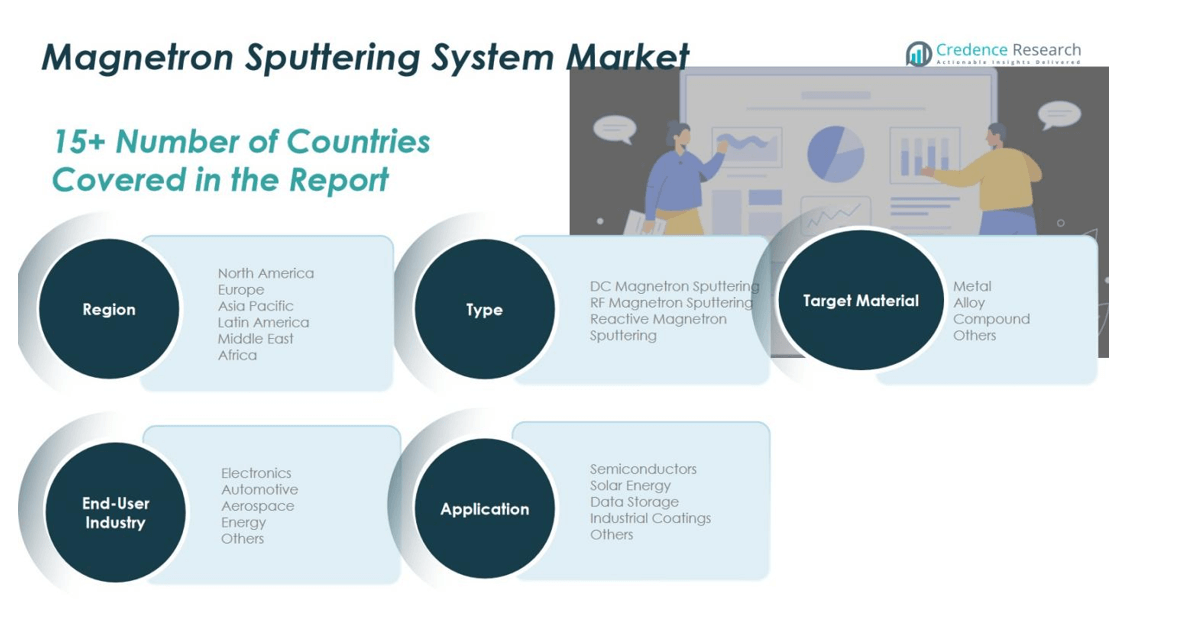
Magnetron Sputtering System Market By Type (DC Magnetron Sputtering, RF Magnetron Sputtering, Reactive Magnetron Sputtering); By Application (Semiconductors, Solar Energy, Data Storage, Industrial Coatings, Others); By Target Material (Metal, Alloy, Compound, Others); By End-User Industry (Electronics, Automotive, Aerospace, Energy, Others) – Growth, Share, Opportunities & Competitive Analysis, 2024 – 2032

Report ID: 8096 | Report Format : Excel, PDF

Market Overview

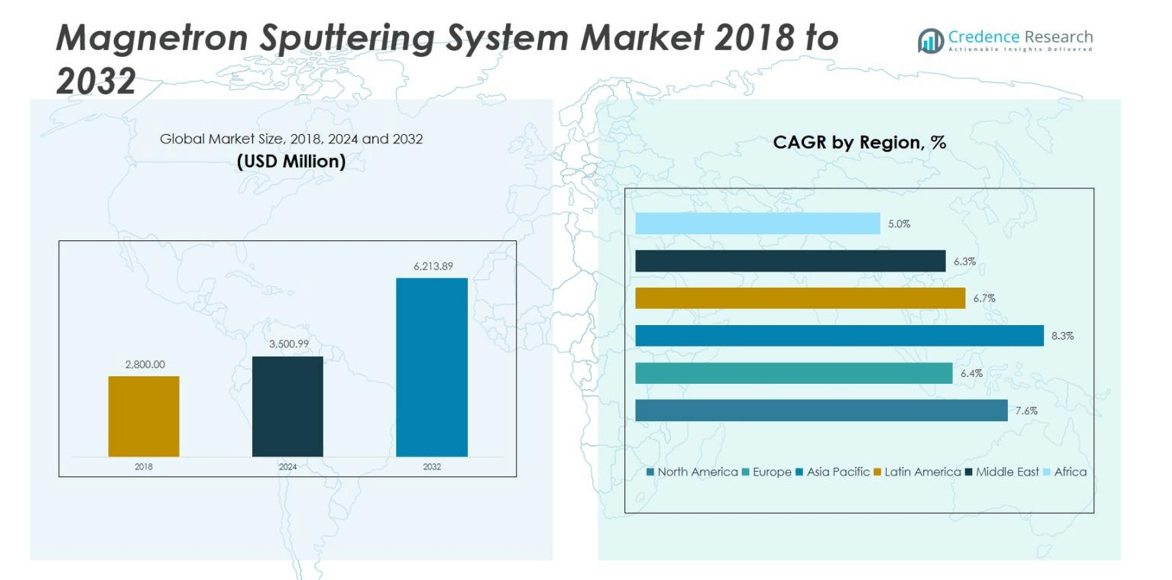
The Global Magnetron Sputtering System Market size was valued at USD 2,800.0 million in 2018, reaching USD 3,500.99 million in 2024, and is anticipated to attain USD 6,213.89 million by 2032, expanding at a CAGR of 7.54% during the forecast period.

REPORT ATTRIBUTE DETAILS
Historical Period 2020-2023
Base Year 2024
Forecast Period 2025-2032
Magnetron Sputtering System Market Size 2024 USD 3,500.99 million
Magnetron Sputtering System Market, CAGR 7.54%
Magnetron Sputtering System Market Size 2032  USD 6,213.89 million


The Magnetron Sputtering System Market is led by prominent players such as Kurt J. Lesker Company, ULVAC Inc., Veeco Instruments Inc., Singulus Technologies AG, Bühler AG, Denton Vacuum LLC, and Oxford Instruments plc. These companies dominate through strong product portfolios, technological innovation, and global distribution networks. They focus on precision coating solutions for semiconductors, solar cells, and industrial applications. Asia Pacific leads the global market with a commanding 46.5% share in 2024, driven by rapid industrialization, semiconductor fabrication, and renewable energy expansion. North America follows with 22.4%, supported by advanced R&D infrastructure and growing demand for thin-film technologies in electronics and aerospace manufacturing.

Magnetron Sputtering System Market size

Market Insights

  • The Global Magnetron Sputtering System Market was valued at USD 3,500.99 million in 2024 and is projected to reach USD 6,213.89 million by 2032, growing at a CAGR of 7.54%.
  • Rising demand for thin-film coatings in semiconductors, solar energy, and electronic devices drives strong market growth across industrial sectors.
  • The market trend is shifting toward automation, AI-based process control, and advanced compound target materials for higher coating precision and energy efficiency.
  • Competition remains moderate, with key players such as ULVAC Inc., Veeco Instruments Inc., and Kurt J. Lesker Company focusing on R&D, partnerships, and expansion in high-demand regions.
  • Asia Pacific leads the market with a 5% share, followed by North America (22.4%) and Europe (17.4%), while the DC Magnetron Sputtering segment dominates by type with about 40% share, driven by its efficiency in high-volume production.

Access crucial information at unmatched prices!

Request your sample report today & start making informed decisions powered by Credence Research Inc.!

Download Sample

Market Segmentation Analysis:

By Type

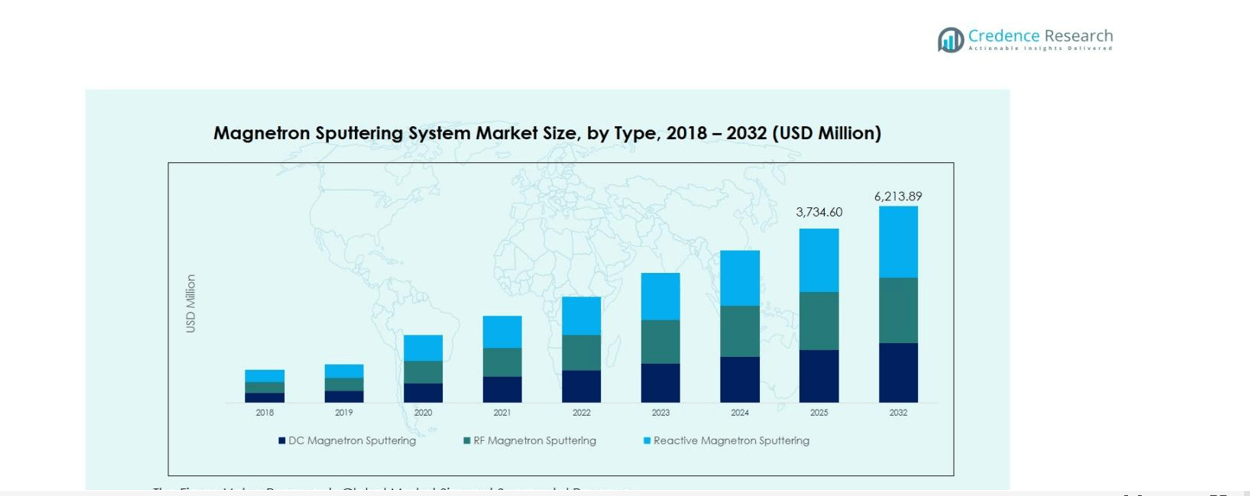
The DC Magnetron Sputtering segment dominates the market with around 40% share, driven by its efficiency and cost-effectiveness in depositing conductive materials. It remains the preferred option for mass production of thin films in electronics and industrial coatings. RF Magnetron Sputtering holds roughly 30% share, gaining traction due to its versatility in handling non-conductive and dielectric materials for advanced semiconductor and optical applications. Reactive Magnetron Sputtering, accounting for about 30%, is rising rapidly for its ability to produce complex compound films such as oxides and nitrides used in solar cells and sensors.

  • For instance, Denton Vacuum offers advanced DC sputtering systems that enable precise deposition of metal films for industrial electronics.

By Application

The Semiconductors segment leads with approximately 45% share, supported by strong demand for precise and uniform thin-film deposition in chip fabrication and display panels. Solar Energy applications represent around 20% share, fueled by increased thin-film photovoltaic manufacturing using transparent conductive coatings. Data Storage contributes about 15%, driven by the need for magnetic films in hard drives and next-generation memory. Industrial Coatings hold nearly 12% share, emphasizing wear-resistant and decorative coatings for automotive and manufacturing sectors, while Other applications account for 8%, including optics and specialty films.

  • For instance, BASF SE offers innovative coatings for automotive OEMs and industrial applications, improving durability, chemical resistance, and aesthetic appeal for vehicles and machinery.

By Target Material

The Metal segment holds the dominant 50% market share, attributed to the extensive use of metallic targets such as aluminum, copper, and titanium in electronics and energy applications. Alloy targets, covering about 25%, are valued for providing enhanced mechanical and thermal properties across aerospace and automotive industries. The Compound segment, with nearly 20% share, benefits from growing use of oxide and nitride materials in solar and semiconductor coatings. Other target materials, accounting for 5%, include high-entropy alloys and specialized ceramics for niche applications like optical and smart coatings.

Key Growth Drivers

Rising Demand from Semiconductor and Electronics Manufacturing

The growing use of thin-film technologies in semiconductor production drives the magnetron sputtering system market. These systems enable precise deposition of conductive and dielectric layers essential for microchips, sensors, and displays. Increasing demand for smaller, high-performance electronic components has pushed manufacturers to adopt advanced sputtering technologies for better control and uniformity. Expanding fabrication facilities in Asia-Pacific, particularly in China, South Korea, and Taiwan, further amplify the need for efficient sputtering solutions to meet the semiconductor industry’s evolving production requirements.

  • For instance, Samsung in South Korea is investing heavily in advanced sputtering for its upcoming 3nm chip fabs in the Gyeonggi Province mega cluster, aiming to enhance layer precision in chip manufacturing.

Expanding Applications in Solar and Energy Storage Technologies

Magnetron sputtering systems are gaining traction in renewable energy sectors, especially in thin-film solar cell and battery electrode manufacturing. The technology allows uniform coating of transparent conductive oxides and protective films, improving device efficiency and durability. Growing investments in solar power infrastructure and clean energy policies across Europe, the U.S., and Asia-Pacific have boosted adoption. Manufacturers are leveraging sputtering to enhance photovoltaic cell performance and support sustainable production practices, making this a critical growth area within the overall market landscape.

  • For instance, AGC Plasma Technology Solutions has developed large-area magnetron sputtering equipment capable of coating substrates as large as 3.2 meters by 6 meters, significantly enhancing energy efficiency and durability in architectural glass, which is crucial for solar energy installations.

Advancements in Material Science and Coating Techniques

Continuous innovation in target materials and deposition methods strengthens the market outlook. The introduction of new metal, alloy, and compound targets enables the creation of customized coatings with superior adhesion, hardness, and optical properties. These improvements have expanded magnetron sputtering’s role beyond electronics into aerospace, optics, and automotive applications. The shift toward high-precision coatings for wear resistance and energy efficiency has encouraged R&D investment, promoting long-term growth and technological competitiveness across global manufacturing sectors.

Magnetron Sputtering System Market share

Key Trends & Opportunities

Integration of Automation and AI in Deposition Processes

Automation and artificial intelligence are transforming magnetron sputtering systems by enhancing process control, uniformity, and efficiency. AI-driven analytics optimize film thickness and target utilization, reducing operational costs and waste. Manufacturers are integrating predictive maintenance and automated calibration to improve throughput in large-scale production environments. This digital transformation not only boosts productivity but also positions sputtering systems as essential tools for smart manufacturing, aligning with Industry 4.0 trends across the semiconductor and materials industries.

  •  For instance, LG Display Company uses VSim software to simulate magnetron sputtering erosion patterns, enabling them to optimize target design and improve process predictability in their production line.

Emerging Demand for Nanocoatings and Flexible Electronics

The rise of flexible displays, wearable sensors, and nanostructured materials creates new opportunities for magnetron sputtering systems. These applications require ultra-thin, defect-free coatings achievable through advanced sputtering techniques. Growing adoption of flexible substrates in consumer electronics and medical devices fuels demand for adaptable coating equipment. As nanotechnology evolves, magnetron sputtering is positioned to support next-generation material innovation, driving revenue streams for manufacturers catering to emerging high-value markets.

  •  For instance, flexible In2O3 thin films used in flexible electronics have been fabricated successfully through magnetron sputtering, demonstrating high electrical performance and mechanical flexibility.

Key Challenges

High Equipment and Maintenance Costs

The high initial cost of magnetron sputtering systems limits their adoption, particularly among small and medium manufacturers. These systems require substantial investment in vacuum infrastructure, precision controls, and maintenance operations. Frequent component replacements, such as targets and power supplies, add to operating expenses. This cost barrier slows penetration in developing markets despite increasing technological demand. Vendors are focusing on modular and energy-efficient system designs to reduce lifecycle costs and improve accessibility.

Technical Complexity and Process Optimization Issues

Maintaining consistency in film thickness, uniformity, and target utilization presents ongoing challenges. Variations in plasma behavior, substrate materials, and reactive gas composition complicate process optimization. These factors demand skilled technicians and precise control systems to achieve desired coating outcomes. Industries with strict performance requirements, such as aerospace and microelectronics, often face extended calibration cycles and downtime. Addressing these technical hurdles through automation and advanced monitoring tools remains essential for sustaining growth and operational efficiency.

Regional Analysis

North America

North America accounted for a 22.4% market share in 2024, with the market rising from USD 639.8 million in 2018 to USD 784.55 million in 2024, projected to reach USD 1,389.44 million by 2032, growing at a CAGR of 7.6%. Growth is driven by strong demand from semiconductor and electronics manufacturing, particularly in the U.S. The region’s emphasis on R&D in thin-film technology, along with investments in renewable energy coatings, supports steady expansion. The presence of major equipment manufacturers and technological innovation also enhances market penetration.

Europe

Europe holds a 17.4% share of the global market, expanding from USD 515.2 million in 2018 to USD 608.38 million in 2024, and is forecast to reach USD 992.69 million by 2032, growing at a CAGR of 6.4%. The region benefits from robust industrial manufacturing and strong adoption in automotive and aerospace coatings. European firms increasingly adopt magnetron sputtering systems to enhance energy efficiency and product durability. Germany, France, and the U.K. lead regional demand, supported by research initiatives focused on advanced materials and green manufacturing processes.

Asia Pacific

Asia Pacific dominates the global market with a 46.5% share in 2024, making it the largest regional segment. The market expanded from USD 1,271.2 million in 2018 to USD 1,627.42 million in 2024 and is expected to reach USD 3,052.89 million by 2032, growing at the highest CAGR of 8.3%. Rapid industrialization, semiconductor fabrication growth, and the booming solar energy sector drive this dominance. China, Japan, South Korea, and India are major contributors, with extensive investments in display panels, consumer electronics, and renewable technologies.

Latin America

Latin America represents a 7.2% share of the market, rising from USD 203.0 million in 2018 to USD 251.69 million in 2024, and is projected to reach USD 418.63 million by 2032 at a CAGR of 6.7%. The region’s growth is supported by increasing demand for advanced coating systems in industrial, automotive, and energy applications. Brazil leads the market with expanding electronics and manufacturing sectors. Investments in renewable energy projects and modernization of production facilities continue to drive steady adoption across the region.

Middle East

The Middle East contributes about 5.3% share to the global market, growing from USD 114.8 million in 2018 to USD 135.12 million in 2024, and reaching USD 218.14 million by 2032, registering a CAGR of 6.3%. The regional growth is fueled by diversification in energy and industrial manufacturing sectors. Countries like the UAE and Saudi Arabia are increasingly adopting sputtering systems for solar and semiconductor applications. Rising technological partnerships and infrastructure investments in smart manufacturing are enhancing the region’s overall adoption rate.

Africa

Africa accounts for a 3.6% market share, with the market increasing from USD 56.0 million in 2018 to USD 93.84 million in 2024, and projected to reach USD 142.11 million by 2032, growing at a CAGR of 5.0%. Growth is moderate but steady, driven by emerging electronics assembly and renewable energy industries, particularly in South Africa and Egypt. Limited industrial infrastructure and high equipment costs remain challenges, but government initiatives promoting local manufacturing and technology adoption are gradually improving market accessibility and investment potential.

Magnetron Sputtering System Market segmentation

Market Segmentations:

By Type

  • DC Magnetron Sputtering
  • RF Magnetron Sputtering
  • Reactive Magnetron Sputtering

By Application

  • Semiconductors
  • Solar Energy
  • Data Storage
  • Industrial Coatings
  • Others

By Target Material

  • Metal
  • Alloy
  • Compound
  • Others

By End-User Industry

  • Electronics
  • Automotive
  • Aerospace
  • Energy
  • Others

By Region

  • North America
    • U.S.
    • Canada
    • Mexico
  • Europe
    • Germany
    • France
    • U.K.
    • Italy
    • Spain
    • Rest of Europe
  • Asia Pacific
    • China
    • Japan
    • India
    • South Korea
    • South-east Asia
    • Rest of Asia Pacific
  • Latin America
    • Brazil
    • Argentina
    • Rest of Latin America
  • Middle East & Africa
    • GCC Countries
    • South Africa
    • Rest of the Middle East and Africa

Competitive Landscape

The competitive landscape of the Magnetron Sputtering System Market features major players such as Kurt J. Lesker Company, ULVAC Inc., Veeco Instruments Inc., Singulus Technologies AG, Denton Vacuum LLC, Bühler AG, Oxford Instruments plc, Angstrom Engineering Inc., and PVD Products Inc. These companies compete on technological innovation, product performance, and global reach. The market is moderately consolidated, with leading firms focusing on expanding product portfolios and enhancing automation, precision control, and energy efficiency. Strategic collaborations with semiconductor and solar manufacturers are common, enabling tailored system integration for specific applications. Continuous R&D investments aim to improve deposition uniformity, scalability, and cost efficiency. Emerging companies are entering niche areas such as nanocoating and flexible electronics sputtering, intensifying competition. Regional expansion across Asia-Pacific and Europe further shapes the landscape, while partnerships and acquisitions remain key strategies for strengthening distribution networks and advancing next-generation sputtering technologies.

Shape Your Report to Specific Countries or Regions & Enjoy 30% Off!

Key Player Analysis

  • Kurt J. Lesker Company
  • AJA International, Inc.
  • Angstrom Engineering Inc.
  • ULVAC, Inc.
  • Plasma Process Group
  • PVD Products, Inc.
  • Singulus Technologies AG
  • Veeco Instruments Inc.
  • Bühler AG
  • Oxford Instruments plc
  • Semicore Equipment, Inc.
  • Denton Vacuum LLC
  • Von Ardenne GmbH
  • Kenosistec Srl
  • Scientific Vacuum Systems Ltd.
  • Moorfield Nanotechnology Limited
  • Shincron Co., Ltd.

Recent Developments

  • In April 12 2024, Singulus Technologies AG introduced its new GENERIS PVD inline magnetron sputtering system, designed for coating bipolar plates used in fuel cells and electrolyzers, marking a significant innovation in vacuum coating technology.
  • On July 6 2022, Denton Vacuum LLC announced a new order for its Versa magnetron sputtering cluster system from a leading Asian sensor manufacturer, highlighting increased demand for advanced thin-film deposition solutions in high-precision applications.
  • On 12 April 2024, Singulus Technologies AG launched an advanced PVD sputtering system for coating bipolar plates used in fuel cells and electrolyzers.
  • On March 26, 2024, Lam Research Corporation announced a breakthrough pulsed laser deposition (PLD) technique using its new Pulsus™ system, optimized for MEMS and 5G components, enhancing film performance (specifically, enabling higher scandium content in AlScN films) in RF filters and microphones

Report Coverage

The research report offers an in-depth analysis based on Type, Application, Target Material, End-User Industry and Region. It details leading market players, providing an overview of their business, product offerings, investments, revenue streams, and key applications. Additionally, the report includes insights into the competitive environment, SWOT analysis, current market trends, as well as the primary drivers and constraints. Furthermore, it discusses various factors that have driven market expansion in recent years. The report also explores market dynamics, regulatory scenarios, and technological advancements that are shaping the industry. It assesses the impact of external factors and global economic changes on market growth. Lastly, it provides strategic recommendations for new entrants and established companies to navigate the complexities of the market.

Future Outlook

  1. The market will continue expanding due to strong demand from semiconductor and electronics manufacturing.
  2. Asia-Pacific will remain the fastest-growing region driven by industrialization and renewable energy projects.
  3. Increased adoption of magnetron sputtering in solar cell production will enhance its long-term growth potential.
  4. Advancements in automation and AI integration will improve system efficiency and process accuracy.
  5. Development of new target materials will enable broader applications in coatings and nanotechnology.
  6. Growing investments in R&D will strengthen the technological competitiveness of key manufacturers.
  7. The shift toward miniaturized and high-performance devices will boost demand for precise thin-film deposition.
  8. Expansion in electric vehicle and battery manufacturing will create new opportunities for sputtering systems.
  9. Strategic collaborations and mergers will accelerate innovation and global market presence.
  10. Sustainability initiatives and energy-efficient coating technologies will shape future system designs and investments.

CHAPTER NO. 1 :   GENESIS OF THE MARKET       

1.1 Market Prelude – Introduction & Scope

1.2 The Big Picture – Objectives & Vision

1.3 Strategic Edge – Unique Value Proposition

1.4 Stakeholder Compass – Key Beneficiaries      

CHAPTER NO. 2 :   EXECUTIVE LENS 

2.1 Pulse of the Industry – Market Snapshot   

2.2 Growth Arc – Revenue Projections (USD Million)      

2.3. Premium Insights – Based on Primary Interviews     

CHAPTER NO. 3 :   MAGNETRON SPUTTERING SYSTEM MARKET FORCES & INDUSTRY PULSE

3.1 Foundations of Change – Market Overview
3.2 Catalysts of Expansion – Key Market Drivers
3.2.1 Momentum Boosters – Growth Triggers
3.2.2 Innovation Fuel – Disruptive Technologies
3.3 Headwinds & Crosswinds – Market Restraints
3.3.1 Regulatory Tides – Compliance Challenges
3.3.2 Economic Frictions – Inflationary Pressures
3.4 Untapped Horizons – Growth Potential & Opportunities
3.5 Strategic Navigation – Industry Frameworks
3.5.1 Market Equilibrium – Porter’s Five Forces
3.5.2 Ecosystem Dynamics – Value Chain Analysis
3.5.3 Macro Forces – PESTEL Breakdown

3.6 Price Trend Analysis

    3.6.1 Regional Price Trend
3.6.2 Price Trend by product

CHAPTER NO. 4 :   KEY INVESTMENT EPICENTER           

4.1 Regional Goldmines – High-Growth Geographies

4.2 Product Frontiers – Lucrative Product Categories

4.3 Application Sweet Spots – Emerging Demand Segments          

CHAPTER NO. 5: REVENUE TRAJECTORY & WEALTH MAPPING

5.1 Momentum Metrics – Forecast & Growth Curves

5.2 Regional Revenue Footprint – Market Share Insights

5.3 Segmental Wealth Flow – Type & Application Revenue

CHAPTER NO. 6 :   TRADE & COMMERCE ANALYSIS      

6.1.      Import Analysis by Region   

6.1.1.   Global Magnetron Sputtering System Market Import Revenue By Region

6.2.      Export Analysis by Region   

6.2.1.   Global Magnetron Sputtering System Market Export Revenue By Region

CHAPTER NO. 7 :   COMPETITION ANALYSIS         

7.1.      Company Market Share Analysis      

7.1.1.   Global Magnetron Sputtering System Market: Company Market Share

7.2.      Global Magnetron Sputtering System Market Company Revenue Market Share

7.3.      Strategic Developments        

7.3.1.   Acquisitions & Mergers        

7.3.2.   New Product Launch

7.3.3.   Regional Expansion

7.4.      Competitive Dashboard

7.5.    Company Assessment Metrics, 2024

CHAPTER NO. 8 :   MAGNETRON SPUTTERING SYSTEM MARKET – BY TYPE SEGMENT ANALYSIS

8.1.      Magnetron Sputtering System Market Overview by Type Segment

8.1.1.   Magnetron Sputtering System Market Revenue Share By Type

8.2.      DC Magnetron Sputtering

8.3.      RF Magnetron Sputtering

8.4.      Reactive Magnetron Sputtering

CHAPTER NO. 9 :   MAGNETRON SPUTTERING SYSTEM MARKET – BY APPLICATION SEGMENT ANALYSIS 

9.1.      Magnetron Sputtering System Market Overview by Application Segment 

9.1.1.   Magnetron Sputtering System Market Revenue Share By Application

9.2.      Semiconductors

9.3.      Solar Energy

9.4.      Data Storage

9.5.      Industrial Coatings

9.6.      Others

CHAPTER NO. 10 : MAGNETRON SPUTTERING SYSTEM MARKET – BY TARGET MATERIAL SEGMENT ANALYSIS 

10.1.    Magnetron Sputtering System Market Overview by Target Material Segment           

10.1.1. Magnetron Sputtering System Market Revenue Share By Target Material

10.2.    Metal

10.3.    Alloy

10.4.    Compound

10.5.    Others

CHAPTER NO. 11 : MAGNETRON SPUTTERING SYSTEM MARKET – BY END-USER INDUSTRY SEGMENT ANALYSIS           

11.1.    Magnetron Sputtering System Market Overview by End-User Industry Segment         

11.1.1. Magnetron Sputtering System Market Revenue Share By End-User Industry

11.2.    Electronics

11.3.    Automotive

11.4.    Aerospace

11.5.    Energy

11.6.    Others

CHAPTER NO. 12 : MAGNETRON SPUTTERING SYSTEM MARKET – REGIONAL ANALYSIS

12.1.    Magnetron Sputtering System Market Overview by Region Segment         

12.1.1. Global Magnetron Sputtering System Market Revenue Share By Region

12.1.2. Regions          

12.1.3. Global Magnetron Sputtering System Market Revenue By Region

12.1.4. Type   

12.1.5. Global Magnetron Sputtering System Market Revenue By Type     

12.1.6. Application    

12.1.7. Global Magnetron Sputtering System Market Revenue By Application

12.1.8. Target Material          

12.1.9. Global Magnetron Sputtering System Market Revenue By Target Material

12.1.10.           End-User Industry     

12.1.11.           Global Magnetron Sputtering System Market Revenue By End-User Industry

CHAPTER NO. 13 : NORTH AMERICA MAGNETRON SPUTTERING SYSTEM MARKET – COUNTRY ANALYSIS   

13.1.    North America Magnetron Sputtering System Market Overview by Country Segment         

13.1.1. North America Magnetron Sputtering System Market Revenue Share By Region

13.2.    North America           

13.2.1. North America Magnetron Sputtering System Market Revenue By Country            

13.2.2. Type   

13.2.3. North America Magnetron Sputtering System Market Revenue By Type   

13.2.4. Application    

13.2.5. North America Magnetron Sputtering System Market Revenue By Application            

13.2.6. Target Material          

13.2.7. North America Magnetron Sputtering System Market Revenue By Target Material         

13.2.8. End-User Industry     

13.2.9. North America Magnetron Sputtering System Market Revenue By End-User Industry          

13.3.    U.S.    

13.4.    Canada           

13.5.    Mexico           

CHAPTER NO. 14 : EUROPE MAGNETRON SPUTTERING SYSTEM MARKET – COUNTRY ANALYSIS

14.1.    Europe Magnetron Sputtering System Market Overview by Country Segment

14.1.1. Europe Magnetron Sputtering System Market Revenue Share By Region

14.2.    Europe

14.2.1. Europe Magnetron Sputtering System Market Revenue By Country           

14.2.2. Type   

14.2.3. Europe Magnetron Sputtering System Market Revenue By Type    

14.2.4. Application    

14.2.5. Europe Magnetron Sputtering System Market Revenue By Application

14.2.6. Target Material          

14.2.7. Europe Magnetron Sputtering System Market Revenue By Target Material

14.2.8. End-User Industry     

14.2.9. Europe Magnetron Sputtering System Market Revenue By End-User Industry

14.3.    UK     

14.4.    France

14.5.    Germany        

14.6.    Italy    

14.7.    Spain  

14.8.    Russia

14.9.   Rest of Europe

CHAPTER NO. 15 : ASIA PACIFIC MAGNETRON SPUTTERING SYSTEM MARKET – COUNTRY ANALYSIS        

15.1.    Asia Pacific Magnetron Sputtering System Market Overview by Country Segment         

15.1.1. Asia Pacific Magnetron Sputtering System Market Revenue Share By Region            

15.2.    Asia Pacific   

15.2.1. Asia Pacific Magnetron Sputtering System Market Revenue By Country

15.2.2. Type   

15.2.3. Asia Pacific Magnetron Sputtering System Market Revenue By Type        

15.2.4. Application    

15.2.5. Asia Pacific Magnetron Sputtering System Market Revenue By Application            

15.2.6. Target Material          

15.2.7. Asia Pacific Magnetron Sputtering System Market Revenue By Target Material         

15.2.8. End-User Industry     

15.2.9. Asia Pacific Magnetron Sputtering System Market Revenue By End-User Industry          

15.3.    China 

15.4.    Japan  

15.5.    South Korea   

15.6.    India   

15.7.    Australia        

15.8.    Southeast Asia

15.9.    Rest of Asia Pacific

CHAPTER NO. 16 : LATIN AMERICA MAGNETRON SPUTTERING SYSTEM MARKET – COUNTRY ANALYSIS

16.1.    Latin America Magnetron Sputtering System Market Overview by Country Segment

16.1.1. Latin America Magnetron Sputtering System Market Revenue Share By Region           

16.2.    Latin America

16.2.1. Latin America Magnetron Sputtering System Market Revenue By Country

16.2.2. Type   

16.2.3. Latin America Magnetron Sputtering System Market Revenue By Type

16.2.4. Application    

16.2.5. Latin America Magnetron Sputtering System Market Revenue By Application            

16.2.6. Target Material          

16.2.7. Latin America Magnetron Sputtering System Market Revenue By Target Material         

16.2.8. End-User Industry     

16.2.9. Latin America Magnetron Sputtering System Market Revenue By End-User Industry

16.3.    Brazil 

16.4.    Argentina       

16.5.    Rest of Latin America

CHAPTER NO. 17 : MIDDLE EAST MAGNETRON SPUTTERING SYSTEM MARKET – COUNTRY ANALYSIS

17.1.    Middle East Magnetron Sputtering System Market Overview by Country Segment         

17.1.1. Middle East Magnetron Sputtering System Market Revenue Share By Region            

17.2.    Middle East   

17.2.1. Middle East Magnetron Sputtering System Market Revenue By Country

17.2.2. Type   

17.2.3. Middle East Magnetron Sputtering System Market Revenue By Type        

17.2.4. Application    

17.2.5. Middle East Magnetron Sputtering System Market Revenue By Application            

17.2.6. Target Material

17.2.7. Middle East Magnetron Sputtering System Market Revenue By Target Material         

17.2.8. End-User Industry

17.2.9. Middle East Magnetron Sputtering System Market Revenue By End-User Industry          

17.3.    GCC Countries          

17.4.    Israel

17.5.    Turkey

17.6.    Rest of Middle East   

CHAPTER NO. 18 : AFRICA MAGNETRON SPUTTERING SYSTEM MARKET – COUNTRY ANALYSIS

18.1.    Africa Magnetron Sputtering System Market Overview by Country Segment

18.1.1. Africa Magnetron Sputtering System Market Revenue Share By Region    

18.2.    Africa

18.2.1. Africa Magnetron Sputtering System Market Revenue By Country

18.2.2. Type   

18.2.3. Africa Magnetron Sputtering System Market Revenue By Type     

18.2.4. Application    

18.2.5. Africa Magnetron Sputtering System Market Revenue By Application

18.2.6. Target Material          

18.2.7. Africa Magnetron Sputtering System Market Revenue By Target Material

18.2.8. End-User Industry     

18.2.9. Africa Magnetron Sputtering System Market Revenue By End-User Industry

18.3.    South Africa

18.4.    Egypt 

18.5.    Rest of Africa

CHAPTER NO. 19 : COMPANY PROFILES     

19.1.    Kurt J. Lesker Company

19.1.1. Company Overview   

19.1.2. Product Portfolio       

19.1.3. Financial Overview   

19.1.4. Recent Developments

19.1.5. Growth Strategy        

19.1.6. SWOT Analysis        

19.2.    AJA International, Inc.

19.3.    Angstrom Engineering Inc.

19.4.    ULVAC, Inc.

19.5.    Plasma Process Group

19.6     PVD Products, Inc.

19.7.    Singulus Technologies AG

19.8.    Veeco Instruments Inc.

19.9.    Buhler AG

19.10.  Oxford Instruments plc

19.11.  Semicore Equipment, Inc.

19.12.  Denton Vacuum LLC

19.13.  Von Ardenne GmbH

19.14.  Kenosistec Srl

19.15.  Scientific Vacuum Systems Ltd.

19.16.  Moorfield Nanotechnology Limited

19.17.  Shincron Co., Ltd.

Request Free Sample

We prioritize the confidentiality and security of your data. Our promise: your information remains private.

Ready to Transform Data into Decisions?

Request Your Sample Report and Start Your Journey of Informed Choices


Providing the strategic compass for industry titans.

cr-clients-logos

Frequently Asked Questions

What is the current market size for Magnetron Sputtering System Market, and what is its projected size in 2032?

The Magnetron Sputtering System Market is valued at USD 3,500.99 million in 2024 and is projected to reach USD 6,213.89 million by 2032.

At what Compound Annual Growth Rate is the Magnetron Sputtering System Market projected to grow between 2025 and 2032?

The Magnetron Sputtering System Market is expected to expand at a CAGR of 7.54% during the forecast period.

Which Magnetron Sputtering System Market segment held the largest share in 2024?

The DC Magnetron Sputtering segment held the largest share in 2024, accounting for 40% of the market.

What are the primary factors fueling the growth of the Magnetron Sputtering System Market?

The Magnetron Sputtering System Market growth is fueled by rising semiconductor production, solar energy applications, and advancements in coating technologies.

Who are the leading companies in the Magnetron Sputtering System Market?

Key players include Kurt J. Lesker Company, ULVAC Inc., Veeco Instruments Inc., Singulus Technologies AG, and Oxford Instruments plc.

Who are the major players in this market?

Buhler AG, Denton Vacuum,Torr International Inc.,Moorfield Nanotechnology Limited, Angstrom Engineering Inc., ULVAC Inc., PRIVACY SP. Z O.O., PVD Products Inc., AJA INTERNATIONAL, Inc. are some of the major players in the global market.

About Author

Sushant Phapale

Sushant Phapale

ICT & Automation Expert

Sushant is an expert in ICT, automation, and electronics with a passion for innovation and market trends.

View Profile

Related Reports

Piezoelectric Polymers Market

Piezoelectric Polymers Market size was valued USD 20557.6 million in 2024 and is anticipated to reach USD 34304.88 million by 2032, at a CAGR of 6.61% during the forecast period.

Power Control Commercial Surge Protection Devices Market

Power Control Commercial Surge Protection Devices Market size was valued at USD 168,584.06 Million in 2024 and is anticipated to reach USD 256,768.30 Million by 2032, at a CAGR of 5.4% during the forecast period.

Electrochromic Smart Glass Systems Market

The electrochromic smart glass systems market was valued at USD 1.25 billion in 2024 and is projected to reach USD 1.78 billion by 2032, registering a compound annual growth rate (CAGR) of 4.5% over the forecast period.

Power Device Analyzer Market

Power Device Analyzer Market size was valued at USD 520.53 Million in 2024 and is anticipated to reach USD 744.22 Million by 2032, at a CAGR of 4.57% during the forecast period.

Power Discrete and Modules Market

Power Discrete and Modules Market size was valued at USD 29,827.76 million in 2024 and is anticipated to reach USD 47,183.3 million by 2032, at a CAGR of 5.9% during the forecast period.

Power Distribution Circuit Breaker Market

Power Distribution Circuit Breaker Market size was valued at USD 19,586.92 million in 2024 and is anticipated to reach USD 40,483.6 million by 2032, at a CAGR of 9.5% during the forecast period.

Dual Voltage Comparator market

The dual voltage comparator market was valued at USD 1.2 billion in 2024 and is projected to reach USD 2.36 billion by 2032, expanding at a CAGR of 8.9% over the forecast period.

Handheld Massagers Market

The Handheld Massagers Market size was valued at USD 8.31 billion in 2024 and is anticipated to reach USD 12.9 billion by 2032, at a CAGR of 5.65% during the forecast period.

Hydrogen/BEV/HEV Powertrain Market

The Hydrogen/BEV/HEV Powertrain Market size was valued at USD 262.3 Million in 2024 and is anticipated to reach USD 764.13 Million by 2032, at a CAGR of 14.3% during the forecast period.

Fibreglass Electrical Enclosure Market

The Fibreglass Electrical Enclosure Market size was valued at USD 328.14 million in 2024 and is anticipated to reach USD 492.24 million by 2032, at a CAGR of 5.2% during the forecast period (2024-2032).

NTC Thermistors Market

NTC Thermistors market was valued at USD 789.53 million in 2024 and is anticipated to reach USD 1184.38 million by 2032, growing at a CAGR of 5.2 % during the forecast period.

Multilayer Transparent Conductors Market

Multilayer Transparent Conductors Market size was valued at USD 14.82 Billion in 2024 and is anticipated to reach USD 42.41 Billion by 2032, at a CAGR of 14.05% during the forecast period.

Licence Option

The report comes as a view-only PDF document, optimized for individual clients. This version is recommended for personal digital use and does not allow printing. Use restricted to one purchaser only.
$4999

To meet the needs of modern corporate teams, our report comes in two formats: a printable PDF and a data-rich Excel sheet. This package is optimized for internal analysis. Unlimited users allowed within one corporate location (e.g., regional office).
$6999

The report will be delivered in printable PDF format along with the report’s data Excel sheet. This license offers 100 Free Analyst hours where the client can utilize Credence Research Inc. research team. Permitted for unlimited global use by all users within the purchasing corporation, such as all employees of a single company.
$12999

Report delivery within 24 to 48 hours

Credence Staff 3

WILLIAM, North America

Support Staff at Credence Research

KEITH PHILLIPS, Europe

Lee - CR Sales Staff

LEE VALLANCE, Asia Pacific

Kieran Jameson

KIERAN JAMESON, Australia

Smallform of Sample request
User Review

Thank you for the data! The numbers are exactly what we asked for and what we need to build our business case.

Materials Scientist
(privacy requested)

User Review

The report was an excellent overview of the Industrial Burners market. This report does a great job of breaking everything down into manageable chunks.

Imre Hof
Management Assistant, Bekaert

cr-clients-logos

Request Sample