| REPORT ATTRIBUTE | DETAILS |
|---|---|
| Historical Period | 2020-2023 |
| Base Year | 2024 |
| Forecast Period | 2025-2032 |
| 2 Seal Pouches Market Size 2024 | USD 17,780.66 million |
| 2 Seal Pouches Market, CAGR | 5.85% |
| 2 Seal Pouches Market Size 2032 | USD 28,952.86 million |
Market Overview:
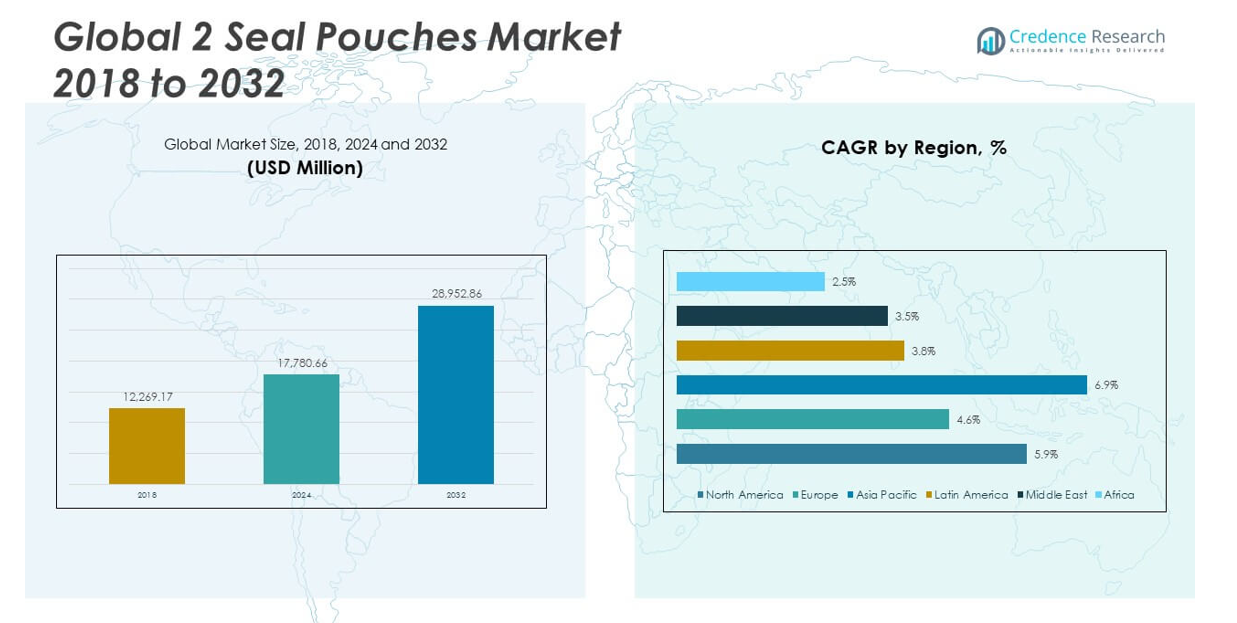
The Global 2 Seal Pouches Market size was valued at USD 12,269.17 million in 2018 to USD 17,780.66 million in 2024 and is anticipated to reach USD 28,952.86 million by 2032, at a CAGR of 5.85% during the forecast period.
The global 2-seal pouches market is witnessing significant growth driven by a combination of convenience, cost-efficiency, and evolving consumer preferences. These pouches offer lightweight, portable, and easy-to-store packaging solutions that are increasingly favored for ready-to-eat meals, dry snacks, and single-serve beverages. Their multi-layer barrier structure enhances shelf life, product protection, and sustainability, making them attractive to manufacturers across various industries. The food and beverage sector remains a primary end user due to the rising demand for on-the-go packaging and flexible portion sizes. Moreover, pharmaceutical and personal care industries are adopting 2-seal pouches for packaging small-format products like tablets, ointments, cosmetic samples, and diagnostic kits. The trend toward environmentally responsible packaging has also accelerated the adoption of recyclable and mono-material films, as companies seek to comply with global sustainability mandates. Leading packaging firms are heavily investing in research and development to create advanced pouches that offer high barrier properties, resealability, and digital printing compatibility.
Asia Pacific dominates the global 2-seal pouches market, accounting for the highest share due to its robust manufacturing base, expanding middle-class population, and growing consumption of packaged foods and personal care products. Countries such as China, India, and Indonesia are experiencing a surge in demand for flexible packaging as urbanization and disposable incomes rise. The region’s growth is also supported by rapid industrialization and increasing adoption of modern retail formats. North America follows closely, driven by strong demand for sustainable packaging and convenience-based food options in the United States and Canada. Technological advancements and high levels of automation in the packaging sector contribute to the region’s steady market performance. In Europe, the market is fueled by strict environmental regulations, which encourage the use of recyclable and eco-friendly packaging materials. The presence of major players like Amcor and Mondi further supports innovation and growth in this region. Latin America and the Middle East & Africa are emerging markets, gradually increasing their adoption of 2-seal pouches, particularly in food, beverage, and healthcare applications.
Market Insights:
- The Global 2 Seal Pouches Market was valued at USD 17,780.66 million in 2024 and is projected to reach USD 28,952.86 million by 2032, growing at a CAGR of 5.85%.
- Food and beverage companies are driving high demand for 2-seal pouches due to their portability, lightweight design, and suitability for ready-to-eat meals and snacks.
- Pharmaceutical and personal care industries are rapidly adopting these pouches to improve safety, hygiene, and product shelf life in small-format packaging.
- Sustainability initiatives are reshaping the market as brands shift toward recyclable, compostable, and mono-material films to meet regulatory and consumer expectations.
- Automation in pouch-filling machinery and demand for high-speed, customizable packaging solutions are accelerating operational efficiency and product turnaround times.
- Raw material price fluctuations and global supply chain disruptions continue to challenge profitability and production stability for manufacturers.
- Asia Pacific holds the highest market share, supported by rapid urbanization, retail modernization, and growing demand for packaged consumer goods, followed by North America and Europe.
Market Drivers:
Growing Consumer Demand for Convenient and Portable Packaging Solutions Across Food and Beverage Applications
The increasing preference for convenient, lightweight, and easy-to-carry packaging formats continues to fuel the demand for 2 seal pouches. These pouches are ideal for single-serve snacks, ready-to-eat meals, and portion-controlled food items. Their compact size and resealability appeal to consumers seeking practical solutions for on-the-go lifestyles. The Global 2 Seal Pouches Market benefits from this trend as food manufacturers adopt flexible packaging to meet evolving consumption patterns. It supports efficient shelf display and storage, making it attractive to both retailers and end users. With growing urbanization and busy schedules, consumers increasingly favor packaging that combines convenience with product protection.
Rising Adoption of Flexible Packaging Across Pharmaceuticals and Personal Care Segments
Pharmaceutical and personal care industries are rapidly incorporating 2 seal pouches into their packaging lines to improve product safety and user experience. The ability of these pouches to provide moisture and oxygen barriers, tamper-evident sealing, and compact storage makes them suitable for medical products, tablets, lotions, and cosmetics. The Global 2 Seal Pouches Market experiences rising traction from these sectors due to the format’s adaptability and compliance with regulatory standards. It enables small-dose packaging and sample distribution, which enhances product accessibility and marketing reach. As healthcare and wellness products continue to diversify, packaging formats that ensure hygiene and integrity are gaining prominence.
- For example, Amcor’s Dual Chamber Pouch, used by Boston Scientific, employs a multi-layer structure with a 70-gauge foil and nylon barrier, providing high abrasion and puncture resistance, and is suitable for both Ethylene oxide (EtO) and radiation sterilization.
Increased Emphasis on Sustainable Packaging Solutions and Material Innovation
Sustainability concerns and regulatory mandates are driving demand for recyclable, compostable, and mono-material pouch formats. Packaging companies are investing in advanced materials that reduce plastic usage while maintaining strength and barrier performance. The Global 2 Seal Pouches Market benefits from innovations in bio-based films, solvent-free lamination, and digital printing, all of which support sustainable branding. It enables brands to align with consumer expectations for eco-conscious packaging without compromising on quality. Demand for reduced carbon footprints and lower packaging waste continues to reshape product design and material sourcing strategies. This shift is fostering long-term investment in greener packaging alternatives.
- For example, Accredo Packaging’s recent innovation uses Braskem’s “I’m Green” sugarcane-derived polyethylene, delivering a negative carbon footprint of 2,150 kg CO₂ sequestered per ton of resin, or approximately 43 grams per pouch.
Advancements in Packaging Machinery and Supply Chain Automation for High-Speed Production
Technological advancements in pre-made pouch fill-and-seal machinery have improved operational efficiency and production scalability. Manufacturers now leverage high-speed packaging lines that accommodate various pouch sizes and formats with minimal downtime. The Global 2 Seal Pouches Market is expanding its industrial footprint due to automation solutions that streamline packaging operations and reduce labor dependency. It allows companies to handle growing volumes across e-commerce and retail channels while maintaining consistency. Rapid packaging setup, combined with flexible print-on-demand features, enables faster product launches and customization. These capabilities are critical for brands aiming to reduce time-to-market and improve supply chain agility.
Market Trends:
Integration of Smart Packaging Technologies to Enhance Consumer Engagement and Product Traceability
Smart packaging features such as QR codes, NFC tags, and temperature indicators are gaining traction in the flexible packaging sector. Brands use these technologies to offer interactive experiences, provide real-time product information, and enable supply chain transparency. The Global 2 Seal Pouches Market is witnessing a growing shift toward digitally-enabled packaging formats that support product authentication and consumer engagement. It enables manufacturers to track product movement and improve inventory control across distribution channels. Smart pouches also assist in combating counterfeiting, especially in high-value products such as supplements and specialty foods. This trend aligns with the broader movement toward digital transformation in packaging.
- For example, companies such as Timestrip have introduced neo time and temperature indicatorsfeaturing individual QR codes, enabling precise product traceability and automated quality control throughout temperature-sensitive supply chains.
Rise in Customization and Short-Run Production Driven by Niche Branding Strategies
Brands are increasingly investing in customized pouch formats tailored to specific marketing campaigns, seasonal promotions, or limited-edition products. Digital printing and flexible manufacturing processes allow for small-batch runs without high setup costs. The Global 2 Seal Pouches Market benefits from this trend as companies use it to enhance shelf presence and customer recall. It supports fast turnaround times and facilitates frequent design updates, which are critical in competitive retail environments. Niche brands and startups leverage customizable pouches to create a distinct visual identity. This trend reflects the growing importance of packaging as a storytelling and branding tool.
Expansion of Functional Add-Ons in Pouch Design to Improve User Experience
Manufacturers are incorporating functional elements such as easy-tear notches, resealable zippers, spouts, and hang holes to elevate packaging usability. These enhancements contribute to better product handling, improved storage, and reduced waste. The Global 2 Seal Pouches Market is evolving to accommodate multifunctional designs that cater to various consumer expectations. It allows brands to differentiate through utility rather than just aesthetics. Functional packaging features also reduce the need for secondary containers, aligning with cost efficiency goals. This shift supports the development of pouches that blend practicality with visual appeal.
Adoption of Transparent and Windowed Packaging to Build Trust and Showcase Product Quality
Transparency in packaging is becoming a key strategy for brands seeking to build consumer trust and highlight product authenticity. Clear windows on pouches enable buyers to inspect the product before purchase, which enhances confidence and purchasing intent. The Global 2 Seal Pouches Market is responding to this trend by offering formats that combine visibility with barrier protection. It supports premium positioning for products such as gourmet snacks, dried fruits, and artisan goods. This approach reflects the consumer desire for openness in product sourcing and manufacturing. Brands adopting this style often report improved customer satisfaction and repeat purchases.
- For example, ClearBagsmanufactures stand-up pouches with clear oval or vertical windows, constructed with 4.8 mil laminated materials for high barrier protection and equipped with strong resealable zippers for convenience. These pouches are FDA-approved for food safety and are available in a variety of shapes and sizes to fit different product and branding needs.
Market Challenges Analysis:
Volatility in Raw Material Prices and Supply Chain Disruptions Impacting Manufacturing Costs
The flexible packaging industry remains highly sensitive to fluctuations in raw material prices, particularly polymers like polyethylene, polypropylene, and polyethylene terephthalate (PET). Changes in crude oil prices, trade restrictions, and geopolitical instability often affect the cost and availability of these materials. The Global 2 Seal Pouches Market faces pressure from rising input costs, which directly impact pricing strategies and profitability margins for manufacturers. It must also manage uncertainties in supply chains, including shipping delays and inconsistent lead times, which challenge production planning. Smaller manufacturers often struggle to absorb sudden cost increases or secure long-term contracts for stable supply. These issues create barriers to scalability and long-term cost optimization.
Recycling Limitations and Regulatory Compliance Hindering Sustainability Goals
While demand for sustainable packaging solutions is growing, the recyclability of multi-layer pouches remains a significant challenge. Many 2 seal pouches are composed of mixed-material laminates that provide excellent barrier protection but are difficult to recycle using conventional methods. The Global 2 Seal Pouches Market must address tightening regulations on single-use plastics and extended producer responsibility (EPR) laws, particularly in North America and Europe. It requires investment in material innovation and new recycling infrastructure to meet compliance and reduce environmental impact. Brands may face reputational risks if packaging fails to meet sustainability expectations or labeling transparency. Overcoming this challenge requires collaboration across the packaging value chain, from material suppliers to waste management firms.
Market Opportunities:
Expanding Applications Across Emerging Sectors and Non-Traditional End-Use Industries
The increasing adaptability of 2 seal pouches is unlocking growth potential across unconventional sectors such as automotive lubricants, agrochemicals, pet care, and industrial goods. These industries seek compact, durable, and leak-resistant packaging for both solid and liquid products. The Global 2 Seal Pouches Market can leverage this shift by developing specialized barrier properties and dispensing mechanisms suited for chemical and high-viscosity contents. It offers an efficient packaging alternative that reduces bulk and enhances logistics in niche sectors. As non-food industries move away from rigid packaging formats, demand for customized pouch solutions is expected to rise. This transition provides opportunities for manufacturers to broaden their customer base and enter new verticals.
Rising Demand in Developing Economies Through Retail Modernization and Urban Lifestyle Shifts
Urbanization, rising incomes, and changing consumption habits across developing countries are boosting demand for flexible packaging. Supermarkets, convenience stores, and online grocery platforms are expanding rapidly, increasing the visibility and accessibility of pouch-based products. The Global 2 Seal Pouches Market is well positioned to capitalize on this trend by offering affordable, attractive, and easy-to-use packaging solutions for mass-market consumers. It enables efficient branding and inventory management for retailers operating in space-constrained environments. With more local brands seeking competitive packaging, the market has room to scale through regional partnerships and low-cost production models. This growth opportunity is particularly strong in Asia-Pacific, Latin America, and parts of Africa.
Market Segmentation Analysis:
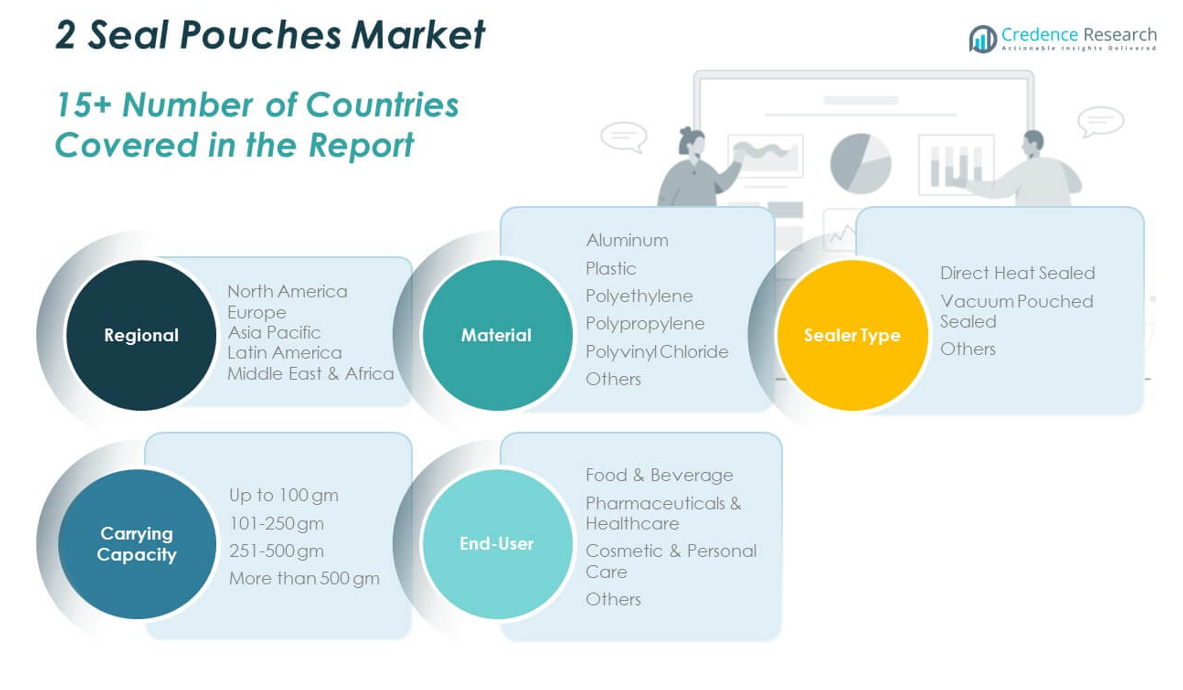
The Global 2 Seal Pouches Market is segmented based on material, sealer type, carrying capacity, and end-user industries.
By material, plastic dominates due to its flexibility, lightweight, and cost-effectiveness. Polyethylene and polypropylene are widely used for their durability and barrier properties, while aluminum is preferred for products requiring high protection. Polyvinyl chloride and other specialty materials serve niche applications where chemical resistance is essential.
- For instance, Berry Global Groupmanufactures its Entour™ series of polyethylene (PE) and polypropylene (PP) films, which are used in over 3 billion flexible pouches annually. These films are engineered for high durability and offer oxygen transmission rates as low as 0.2 cc/m²/day, ensuring product freshness.
By sealer type, direct heat sealed pouches hold the largest share owing to their simplicity and compatibility with high-speed packaging lines. Vacuum pouched sealed variants are gaining attention in food and healthcare sectors for their preservation benefits. Other sealer types cater to custom and specialty uses.
By carrying capacity, the 101–250 gm and 251–500 gm segments are widely used for snacks, pharmaceuticals, and personal care products. Up to 100 gm pouches are popular for sample packaging, while more than 500 gm formats are applied in bulk and industrial uses.
- For instance, Glenroy, Inc.produces 2-seal pouches in the 101–250 gm and 251–500 gm ranges for national snack brands, with each pouch tested to withstand a drop impact of up to 1.2 meters without seal failure.
By end-user, the food and beverage segment leads the Global 2 Seal Pouches Market due to high consumption of packaged foods. Pharmaceuticals and healthcare follow closely, leveraging the format for hygiene and dosage control. Cosmetic and personal care industries use these pouches for convenience and branding. Other sectors adopt the format for items like chemicals, pet food, and homecare products.
Segmentation:
By Material
- Aluminum
- Plastic
- Polyethylene
- Polypropylene
- Polyvinyl Chloride
- Others
By Sealer Type
- Direct Heat Sealed
- Vacuum Pouched Sealed
- Others
By Carrying Capacity
- Up to 100 gm
- 101–250 gm
- 251–500 gm
- More than 500 gm
By End-User
- Food & Beverage
- Pharmaceuticals & Healthcare
- Cosmetic & Personal Care
- Others
By Region
- North America
- U.S.
- Canada
- Mexico
- Europe
- Germany
- France
- U.K.
- Italy
- Spain
- Rest of Europe
- Asia Pacific
- China
- Japan
- India
- South Korea
- South-east Asia
- Rest of Asia Pacific
- Latin America
- Brazil
- Argentina
- Rest of Latin America
- Middle East & Africa
- GCC Countries
- South Africa
- Rest of the Middle East and Africa
Regional Analysis:
North America
The North America 2 Seal Pouches Market size was valued at USD 5,121.76 million in 2018 to USD 7,341.90 million in 2024 and is anticipated to reach USD 11,989.81 million by 2032, at a CAGR of 5.9% during the forecast period. North America holds nearly 31% of the global market share, driven by strong demand for convenience packaging across food, beverages, and pharmaceuticals. The United States leads the region with a mature flexible packaging industry, widespread adoption of automation, and a well-established retail infrastructure. The Global 2 Seal Pouches Market in this region benefits from consumer preferences for resealable and sustainable formats. It also capitalizes on e-commerce growth, where lightweight, durable packaging is essential. Manufacturers in the region continue to invest in recyclable materials and smart packaging technology to stay ahead in a competitive market.
Europe
The Europe 2 Seal Pouches Market size was valued at USD 2,273.97 million in 2018 to USD 3,113.62 million in 2024 and is anticipated to reach USD 4,606.77 million by 2032, at a CAGR of 4.6% during the forecast period. Europe contributes around 13% of the global market share, with Germany, France, and the UK leading adoption. The region’s market growth is supported by strict sustainability regulations and consumer demand for eco-friendly packaging solutions. The Global 2 Seal Pouches Market here benefits from high adoption in premium food, organic products, and pharmaceutical packaging. It sees steady innovation from key players focused on recyclable, compostable, and mono-material pouches. Brand owners in Europe also favor functional features like resealable zippers and transparent windows to enhance product appeal.
Asia Pacific
The Asia Pacific 2 Seal Pouches Market size was valued at USD 3,894.85 million in 2018 to USD 5,931.36 million in 2024 and is anticipated to reach USD 10,458.50 million by 2032, at a CAGR of 6.9% during the forecast period. Asia Pacific accounts for 38% of the global share, making it the largest and fastest-growing region. The Global 2 Seal Pouches Market is expanding rapidly in this region due to rising disposable incomes, urbanization, and the shift toward modern retail channels. China and India dominate demand, driven by their massive consumer bases and expanding food processing and pharmaceutical sectors. It also benefits from regional manufacturing advantages and government support for sustainable packaging initiatives. Growth is further supported by the penetration of digital printing and localized branding strategies.
Latin America
The Latin America 2 Seal Pouches Market size was valued at USD 471.82 million in 2018 to USD 673.33 million in 2024 and is anticipated to reach USD 941.22 million by 2032, at a CAGR of 3.8% during the forecast period. Latin America represents nearly 3% of the global market share, with Brazil and Mexico being the leading contributors. The Global 2 Seal Pouches Market in this region is driven by rising consumer awareness, economic expansion, and growing demand for packaged food and personal care products. It benefits from improving retail infrastructure and increasing adoption of flexible packaging in small and medium enterprises. Manufacturers are gradually shifting from rigid to pouch-based formats to optimize logistics and reduce costs. Though growth is moderate, the market holds long-term potential with localized innovations.
Middle East
The Middle East 2 Seal Pouches Market size was valued at USD 336.79 million in 2018 to USD 445.29 million in 2024 and is anticipated to reach USD 609.27 million by 2032, at a CAGR of 3.5% during the forecast period. The region contributes around 2% of the global market share and shows growing interest in flexible packaging for packaged food, healthcare, and household products. The Global 2 Seal Pouches Market in the Middle East is expanding slowly due to low packaging diversity and limited recycling infrastructure. However, it gains traction in the Gulf Cooperation Council (GCC) countries where premium food brands and pharmaceuticals demand better shelf-life solutions. It also benefits from rising health awareness and interest in product freshness. Strategic partnerships and localized production are expected to accelerate regional adoption.
Africa
The Africa 2 Seal Pouches Market size was valued at USD 169.98 million in 2018 to USD 275.16 million in 2024 and is anticipated to reach USD 347.29 million by 2032, at a CAGR of 2.5% during the forecast period. Africa holds the smallest share of the global market, contributing just over 1%. The Global 2 Seal Pouches Market in this region remains underdeveloped due to limited manufacturing capacity, low awareness, and high dependence on imports. It sees some growth in urban areas where packaged food and personal care products are gaining traction. South Africa and Nigeria lead regional demand, supported by growing retail chains and middle-class consumption. Future growth depends on infrastructure development, cost-effective solutions, and regional investments in packaging technology.
Key Player Analysis:
- Amcor Ltd.
- Sysco Industries Ltd.
- Sixto Packaging
- Pacific Bag Inc.
- Shako Flexipack Pvt. Ltd.
- Bemis Co. Inc.
- Graham Packaging Co.
- Glenroy Inc.
- Sonoco Products Company
- DS Smith PLC
Competitive Analysis:
The Global 2 Seal Pouches Market features a competitive landscape marked by innovation, product differentiation, and strategic expansion. Key players such as Amcor plc, Sealed Air Corporation, Mondi Group, Huhtamaki Oyj, and Constantia Flexibles dominate the market with advanced manufacturing capabilities and broad product portfolios. It fosters competition through investments in sustainable materials, recyclable pouch designs, and high-barrier film technologies. Companies focus on regional expansion, partnerships with FMCG brands, and customization to meet evolving consumer needs. Mid-sized players and regional manufacturers compete on pricing, agility, and niche product offerings. The market rewards those who align closely with regulatory standards, environmental goals, and fast-changing retail demands. Growth opportunities exist for firms that deliver flexible, lightweight, and visually appealing pouches while optimizing production efficiency and supply chain responsiveness. The competitive intensity continues to rise, driven by advancements in packaging automation and rising consumer demand for differentiated, eco-conscious solutions.
Recent Developments:
- In January 2025, Amcor reached a major milestone toward completing its all-stock transaction with Berry Global, filing a definitive joint proxy statement with the U.S. Securities and Exchange Commission. Shareholder meetings for both companies are scheduled for February 25, 2025.
- In April 2025, Sysco launched several new products under its Cutting Edge Solutions (CES) line, designed to help foodservice operations stay innovative and efficient. The CES initiative offers four new product launches annually, supporting menu enhancement and operational streamlining.
- In March 2024, Mondi Groupentered into a strategic partnership with a leading European food manufacturer to supply custom-printed two-seal pouches. This collaboration aims to deliver high-barrier, recyclable pouches that meet the growing demand for sustainable packaging in the food industry.
Market Concentration & Characteristics:
The Global 2 Seal Pouches Market exhibits moderate market concentration, with a mix of global packaging giants and regional manufacturers competing across various end-use sectors. It is characterized by a high degree of product customization, driven by diverse application needs in food, personal care, pharmaceuticals, and industrial products. The market shows strong responsiveness to trends in sustainability, digital printing, and functional design enhancements. It favors companies with integrated manufacturing, strong distribution networks, and innovation capabilities in materials and sealing technologies. Entry barriers remain moderate due to the need for capital investment in machinery and compliance with food safety and environmental regulations. Competitive dynamics are shaped by the ability to offer lightweight, visually appealing, and cost-effective packaging solutions. The market continues to evolve with a focus on recyclable structures and value-added features that meet shifting consumer expectations and regulatory demands.
Report Coverage:
The research report offers an in-depth analysis based on material, sealer type, carrying capacity, and end-user industries. It details leading market players, providing an overview of their business, product offerings, investments, revenue streams, and key applications. Additionally, the report includes insights into the competitive environment, SWOT analysis, current market trends, as well as the primary drivers and constraints. Furthermore, it discusses various factors that have driven market expansion in recent years. The report also explores market dynamics, regulatory scenarios, and technological advancements that are shaping the industry. It assesses the impact of external factors and global economic changes on market growth. Lastly, it provides strategic recommendations for new entrants and established companies to navigate the complexities of the market.
Future Outlook:
- Rising demand for convenient, single-use packaging formats will continue to drive adoption across food and beverage sectors.
- Increased investment in recyclable and mono-material films will shape product development strategies.
- Growth in e-commerce will fuel the need for durable, lightweight, and protective pouch packaging.
- Technological advances in digital printing and automation will enhance customization and production efficiency.
- Expansion into non-food sectors like automotive fluids and agrochemicals will diversify application areas.
- Emerging markets in Asia Pacific, Latin America, and Africa will present new revenue opportunities.
- Sustainability regulations will accelerate the shift toward eco-friendly materials and minimalistic designs.
- Functional features such as resealable closures and transparent windows will gain prominence in consumer packaging.
- Strategic partnerships and M&A activities will help key players strengthen regional presence and capabilities.
- Integration of smart packaging technologies will support product traceability and enhance brand engagement.

Request a Free Sample
Fill in your details and we'll send you a free sample report.
- Sample data tables & charts
- Research methodology
Market Dynamics
Consumer Demand for Convenient and Portable Packaging
The shift toward on-the-go lifestyles and the need for lightweight, resealable packaging is driving food, beverage, and personal care brands to adopt 2 seal pouches. Their compactness and ease of use make them ideal for single-serve and portion-controlled products, supporting efficient storage and transportation.
Rising Adoption in Pharmaceuticals and Personal Care
Pharmaceutical and personal care sectors are increasingly using 2 seal pouches for small-format packaging due to their ability to provide moisture and oxygen barriers, tamper-evident sealing, and improved hygiene. This supports regulatory compliance and enhances product safety and shelf life.
Sustainability and Material Innovation
Growing regulatory and consumer pressure for eco-friendly packaging is accelerating the shift toward recyclable, compostable, and mono-material pouch formats. Brands are investing in advanced materials and bio-based films to reduce plastic usage and carbon footprint while maintaining barrier performance.
Advancements in Packaging Machinery and Automation
Technological improvements in pouch-filling and sealing machinery enable high-speed, customizable production, reducing labor costs and increasing operational efficiency. This allows manufacturers to quickly respond to market trends and scale up production for both large and small batch runs.
Expansion into Emerging and Non-Traditional Sectors
The versatility of 2 seal pouches is unlocking new applications in sectors such as automotive, agrochemicals, and pet care, where durable, leak-resistant, and compact packaging is required. This diversification is broadening the market’s customer base and driving additional growth.
Need a Custom Version of This Report?
Tailor the scope, geography, or segments to your exact requirements.
- Custom geography or segment scope
- Direct access to our analyst team
Frequently Asked Questions
What is the current size of the Global 2 Seal Pouches Market?
What are the key segments within the Global 2 Seal Pouches Market market?
What are some challenges faced by the Global 2 Seal Pouches Market market?
Who are the major players in the Global 2 Seal Pouches Market Market?
Table of Content
Chapter 1 Market Segmentation
- 1.1 Segmentation Framework
- 1.1.1 Product and Service Classification
- 1.1.2 Application and End-Use Classification
- 1.1.3 Technology and Solution Classification
- 1.1.4 Customer and Distribution Channel Classification
- 1.1.5 Geographic Segmentation
- 1.1.6 Market Segment Definitions and Boundaries
- 1.2 By End-User
- 1.2.1 Food & Beverage
- 1.2.2 Pharmaceuticals & Healthcare
- 1.2.3 Cosmetic & Personal Care
- 1.2.4 Others
- 1.3 By Material
- 1.3.1 Plastic
- 1.3.2 Polyethylene
- 1.3.3 Polypropylene
- 1.3.4 Aluminum
- 1.3.5 Polyvinyl Chloride
- 1.3.6 Others
- 1.4 By Sealer Type
- 1.4.1 Direct Heat Sealed
- 1.4.2 Vacuum Pouched Sealed
- 1.4.3 Others
- 1.5 By Carrying Capacity
- 1.5.1 Up to 100 gm
- 1.5.2 101–250 gm
- 1.5.3 251–500 gm
- 1.5.4 More than 500 gm
Chapter 2 Introduction
- 2.1 Report Objectives and Scope
- 2.2 Product Definition and Industry Terminology
- 2.3 Market Inclusions and Exclusions
- 2.4 Research Process
- 2.4.1 Primary Research and Expert Interviews
- 2.4.2 Secondary Research and Source Review
- 2.4.3 Top-Down and Bottom-Up Estimation
- 2.4.4 Data Triangulation and Verification
- 2.5 Market Size Measurement Basis
- 2.5.1 2024: USD 17,780.66 million → 2032: USD 28,952.86 million
- 2.6 Historical and Forecast Reference Periods
- 2.6.1 Base Year: 2024
- 2.6.2 Forecast Period: 2024-2032
- 2.7 Research Assumptions and Limitations
Chapter 3 Executive Summary
- 3.1 Market Snapshot and Key Findings
- 3.2 Base-Year Market Size, 2024
- 3.3 Forecast Market Size, 2032
- 3.4 Revenue and Volume Growth Outlook
- 3.5 Key Demand and Supply Indicators
- 3.6 Leading Market Segments
- 3.7 Fastest-Growing Market Opportunities
- 3.8 Regional Performance Highlights
- 3.9 Technology and Industry Transformation
- 3.10 Competitive Landscape Summary
- 3.11 Analyst View and Strategic Implications
Chapter 4 Global 2 Seal Pouches Market Trends and Developments
- 4.1 Historical Industry Development
- 4.2 Recent Market Trends and Developments
- 4.3 Demand and Customer Behavior Trends
- 4.4 Technology and Product Innovation
- 4.5 Artificial Intelligence, Automation and Digitalization
- 4.6 Local Manufacturing and Supply Chain Realignment
- 4.7 Industry Partnerships, Mergers and Acquisitions
- 4.8 Sustainability and Circular Economy Developments
- 4.9 Government and Private Sector Investment Trends
- 4.10 Emerging Business Models and Commercialization
- 4.11 Industry Developments and Announcements
Chapter 5 Global 2 Seal Pouches Market Production, Supply and Demand Analysis
- 5.1 Demand Trend and Consumption Analysis
- 5.2 Demand Forecast, 2024-2032
- 5.3 Production and Output Trend
- 5.4 Production and Output Forecast, 2024-2032
- 5.5 Installed Capacity and Capacity Utilization
- 5.6 Company-Wise Production Plants and Statistics
- 5.6.1 Installed Production Capacity
- 5.6.2 Actual Production
- 5.6.3 Planned Capacity and Expansion Targets
- 5.7 Supply Chain Structure and Procurement Trends
- 5.8 Supply-Demand Gap and Bottlenecks
- 5.9 Import Dependence and Sourcing Structure
- 5.10 Contract Manufacturing and Outsourcing
- 5.11 Regional Supply and Demand Concentration
Chapter 6 Global 2 Seal Pouches Market Pricing Analysis
- 6.1 Pricing Structure and Measurement
- 6.2 Historical Pricing Trends
- 6.3 Pricing Outlook, 2024-2032
- 6.4 Average Selling Price and Unit Economics
- 6.5 Pricing by Product and Market Segment
- 6.6 Geographic Pricing Differences
- 6.7 Key Input, Energy, Labor and Logistics Costs
- 6.8 Contract Pricing and Purchasing Models
- 6.9 Pricing Sensitivity and Competitive Positioning
- 6.10 Price, Margin and Profitability Implications
Chapter 7 Global 2 Seal Pouches Market Dynamics
- 7.1 Market Growth Drivers
- 7.1.1 Demand-Side Drivers
- 7.1.2 Technology and Innovation Drivers
- 7.1.3 Infrastructure and Investment Drivers
- 7.1.4 Regulatory and Policy Drivers
- 7.2 Market Restraints
- 7.2.1 Cost and Affordability Constraints
- 7.2.2 Technology and Adoption Barriers
- 7.2.3 Supply Chain and Operational Constraints
- 7.3 Market Challenges
- 7.3.1 Competitive Pressure and Margin Erosion
- 7.3.2 Skills, Infrastructure and Implementation Gaps
- 7.4 Emerging Market Opportunities
- 7.5 Market Dynamics Impact and Time-Horizon Assessment
Chapter 8 Global 2 Seal Pouches Value Chain Analysis
- 8.1 Industry Value Chain Overview
- 8.2 Upstream Suppliers and Critical Inputs
- 8.3 Technology and Component Providers
- 8.4 Manufacturing or Service Delivery
- 8.5 Distribution, Channel Partners and Integrators
- 8.6 Downstream Applications and End Users
- 8.7 Value Addition and Profit Pools
- 8.8 Vertical Integration and Outsourcing
- 8.9 Supplier Concentration and Risk
- 8.10 Supply Chain Localization and Resilience
Chapter 9 Global 2 Seal Pouches Market Regulations and Policies
- 9.1 Relevant Laws, Standards and Compliance Frameworks
- 9.2 Product, Service, Safety and Quality Requirements
- 9.3 Government Policies, Incentives and Subsidies
- 9.4 Imports, Exports and Trade Barriers
- 9.5 Public Procurement and Local Content Requirements
- 9.6 Environmental and Sustainability Compliance
- 9.7 Upcoming Policy Changes and Market Implications
Chapter 10 Global 2 Seal Pouches Market Hotspots and Opportunities
- 10.1 Market Opportunity Mapping and Growth Hotspots
- 10.2 High-Growth Applications and Customer Groups
- 10.3 Underserved Markets and White-Space Opportunities
- 10.4 Emerging Technology and Product Opportunities
- 10.5 New Capacity and Investment Hotspots
- 10.6 Market Entry and Expansion Opportunities
- 10.7 Distribution and Partnership Opportunities
- 10.8 Near-Term and Long-Term Commercial Potential
- 10.9 Opportunity Attractiveness and Execution Risks
Chapter 11 Global 2 Seal Pouches Market Outlook, 2024-2032
- 11.1 Market Size and Analysis
- 11.1.1 Revenue (Market Measurement: 2024: USD 17,780.66 million → 2032: USD 28,952.86 million)
- 11.1.2 Market Volume and Quantity Sold
- 11.1.3 Historical Market Size
- 11.1.4 Base-Year Market Size, 2024
- 11.2 Market Forecast, 2024-2032
- 11.2.1 Revenue Forecast to 2032
- 11.2.2 Volume Forecast to 2032
- 11.2.3 CAGR and Year-on-Year Growth
- 11.2.4 Incremental Revenue Opportunity
- 11.3 Forecast Assumptions and Scenario Analysis
- 11.3.1 Base-Case Forecast
- 11.3.2 Optimistic and Conservative Scenarios
- 11.3.3 Technology, Pricing and Policy Sensitivities
- 11.4 Market Attractiveness and Growth Outlook
Chapter 12 Global 2 Seal Pouches Market Segmentation and Outlook
- 12.1 Segmentation Summary and Market Shares, 2024
- 12.2 Largest and Fastest-Growing Segments
- 12.3 By End-User - Market Size and Forecast, 2024-2032
- 12.3.1 Segment Definition and Scope
- 12.3.2 Historical Market Size
- 12.3.3 Revenue Forecast, 2024-2032
- 12.3.4 Volume Forecast, 2024-2032
- 12.3.5 Base-Year Market Share, 2024
- 12.3.6 Segment CAGR and Growth Drivers
- 12.3.7 Subsegment Market Size and Forecast
- 12.3.7.1 Food & Beverage
- 12.3.7.2 Pharmaceuticals & Healthcare
- 12.3.7.3 Cosmetic & Personal Care
- 12.3.7.4 Others
- 12.3.8 Subsegment Pricing and Adoption Trends
- 12.3.9 Leading Suppliers and Competition
- 12.3.10 Regional Demand and Opportunities
- 12.4 By Material - Market Size and Forecast, 2024-2032
- 12.4.1 Segment Definition and Scope
- 12.4.2 Historical Market Size
- 12.4.3 Revenue Forecast, 2024-2032
- 12.4.4 Volume Forecast, 2024-2032
- 12.4.5 Base-Year Market Share, 2024
- 12.4.6 Segment CAGR and Growth Drivers
- 12.4.7 Subsegment Market Size and Forecast
- 12.4.7.1 Plastic
- 12.4.7.2 Polyethylene
- 12.4.7.3 Polypropylene
- 12.4.7.4 Aluminum
- 12.4.7.5 Polyvinyl Chloride
- 12.4.7.6 Others
- 12.4.8 Subsegment Pricing and Adoption Trends
- 12.4.9 Leading Suppliers and Competition
- 12.4.10 Regional Demand and Opportunities
- 12.5 By Sealer Type - Market Size and Forecast, 2024-2032
- 12.5.1 Segment Definition and Scope
- 12.5.2 Historical Market Size
- 12.5.3 Revenue Forecast, 2024-2032
- 12.5.4 Volume Forecast, 2024-2032
- 12.5.5 Base-Year Market Share, 2024
- 12.5.6 Segment CAGR and Growth Drivers
- 12.5.7 Subsegment Market Size and Forecast
- 12.5.7.1 Direct Heat Sealed
- 12.5.7.2 Vacuum Pouched Sealed
- 12.5.7.3 Others
- 12.5.8 Subsegment Pricing and Adoption Trends
- 12.5.9 Leading Suppliers and Competition
- 12.5.10 Regional Demand and Opportunities
- 12.6 By Carrying Capacity - Market Size and Forecast, 2024-2032
- 12.6.1 Segment Definition and Scope
- 12.6.2 Historical Market Size
- 12.6.3 Revenue Forecast, 2024-2032
- 12.6.4 Volume Forecast, 2024-2032
- 12.6.5 Base-Year Market Share, 2024
- 12.6.6 Segment CAGR and Growth Drivers
- 12.6.7 Subsegment Market Size and Forecast
- 12.6.7.1 Up to 100 gm
- 12.6.7.2 101–250 gm
- 12.6.7.3 251–500 gm
- 12.6.7.4 More than 500 gm
- 12.6.8 Subsegment Pricing and Adoption Trends
- 12.6.9 Leading Suppliers and Competition
- 12.6.10 Regional Demand and Opportunities
- 12.7 Segment Growth Comparison
- 12.8 Segment Attractiveness and Priority Matrix
Chapter 13 Global 2 Seal Pouches End-Use and Application Market Outlook
- 13.1 End-Use Industry and Customer Demand Structure
- 13.2 Leading Applications and Customer Groups
- 13.3 End-Use Market Size, Share and Forecast
- 13.4 Major End-Use Industry Deep Dives
- 13.4.1 Customer Requirements and Use Cases
- 13.4.2 Demand and Replacement Cycles
- 13.4.3 Technical and Regulatory Considerations
- 13.4.4 Purchasing and Procurement Models
- 13.4.5 Leading Vendors and Distribution Channels
- 13.4.6 Forecast and Commercial Opportunities
- 13.5 Emerging Applications and Cross-Segment Demand
- 13.6 End-Use Industry Investment Priorities
Chapter 14 Global 2 Seal Pouches Geographic Market Outlook, 2024-2032
- 14.1 Regional Market Size and Share, 2024
- 14.2 Regional Market Forecast, 2024-2032
- 14.3 Regional Pricing, Production and Demand Differences
- 14.4 North America
- 14.4.1 United States
- 14.4.2 Canada
- 14.4.3 Mexico
- 14.5 Europe
- 14.5.1 Germany
- 14.5.2 France
- 14.5.3 Italy
- 14.5.4 United Kingdom
- 14.5.5 Spain
- 14.5.6 Poland
- 14.5.7 Russia
- 14.5.8 Netherlands
- 14.5.9 Belgium
- 14.5.10 Sweden
- 14.5.11 Denmark
- 14.5.12 Norway
- 14.5.13 Rest of Europe
- 14.6 Asia Pacific
- 14.6.1 China
- 14.6.2 India
- 14.6.3 Japan
- 14.6.4 South Korea
- 14.6.5 Thailand
- 14.6.6 Indonesia
- 14.6.7 Vietnam
- 14.6.8 Malaysia
- 14.6.9 Australia
- 14.6.10 Rest of Asia Pacific
- 14.7 Latin America
- 14.7.1 Brazil
- 14.7.2 Argentina
- 14.7.3 Colombia
- 14.7.4 Chile
- 14.7.5 Rest of Latin America
- 14.8 Middle East
- 14.8.1 Saudi Arabia
- 14.8.2 United Arab Emirates
- 14.8.3 Turkey
- 14.8.4 Israel
- 14.8.5 Iran
- 14.8.6 Rest of the Middle East
- 14.9 Africa
- 14.9.1 South Africa
- 14.9.2 Egypt
- 14.9.3 Nigeria
- 14.9.4 Morocco
- 14.9.5 Rest of Africa
- 14.10 Regional Investment, Policy and Supply Chain Differences
- 14.11 Regional Competitive Landscape
- 14.12 Geographic Growth Hotspots
Chapter 15 Global 2 Seal Pouches Technology, Innovation and Sustainability Outlook
- 15.1 Technology Landscape and Maturity
- 15.2 Product, Process and Service Innovation
- 15.3 AI, Automation and Digital Tools in the Industry
- 15.4 Technology Adoption and Performance Benchmarking
- 15.5 Innovation Pipeline and R&D Investment
- 15.6 Patent and Intellectual Property Trends
- 15.7 Energy Efficiency and Resource Management
- 15.8 Sustainability, Recycling and Circularity
- 15.9 Technology Roadmap, 2024-2032
- 15.10 Risks of Obsolescence and Technology Substitution
Chapter 16 Global 2 Seal Pouches Market Key Strategic Imperatives
- 16.1 Growth and Market Entry Priorities
- 16.2 High-Return Products and Segments
- 16.3 Pricing, Profitability and Cost Optimization
- 16.4 Technology Investment and Product Differentiation
- 16.5 Supply Chain Localization and Resilience
- 16.6 Distribution and Customer Acquisition
- 16.7 Partnership, Acquisition and Capacity Strategy
- 16.8 Regional Expansion Priorities
- 16.9 Short-, Medium- and Long-Term Actions
Chapter 17 Competition Outlook
- 17.1 Industry Competition Characteristics
- 17.2 Market Structure and Concentration
- 17.3 Market Share and Competitive Positioning, 2024
- 17.4 Company-Wise Revenue and Product Benchmarking
- 17.5 Production and Service Capacity Benchmarking
- 17.6 Technology, Pricing and Differentiation
- 17.7 Regional Footprint and Distribution Strength
- 17.8 Mergers, Acquisitions and Strategic Alliances
- 17.9 New Entrants and Competitive Threats
- 17.10 Porter's Five Forces and Industry Attractiveness
- 17.11 Competitive Outlook, 2024-2032
Chapter 18 Company Profiles
- 18.1 Company Coverage and Selection Criteria
- 18.2 Amcor Ltd.
- 18.2.1 Business Description
- 18.2.2 Company Ownership and Geographic Presence
- 18.2.3 Product and Service Portfolio
- 18.2.4 Manufacturing and Operating Footprint
- 18.2.5 Production Capacity and Expansion Plans
- 18.2.6 Financial Performance and Investment
- 18.2.7 Market Share and Competitive Position
- 18.2.8 Technology and Innovation Capabilities
- 18.2.9 Strategic Alliances or Partnerships
- 18.2.10 Recent Developments
- 18.2.11 Growth Strategy and Outlook
- 18.3 Sysco Industries Ltd.
- 18.4 Sixto Packaging
- 18.5 Pacific Bag Inc.
- 18.6 Shako Flexipack Pvt. Ltd.
- 18.7 Bemis Co. Inc.
- 18.8 Graham Packaging Co.
- 18.9 Glenroy Inc.
- 18.10 Sonoco Products Company
- 18.11 DS Smith PLC
- 18.12 Other Relevant Market Participants
Note: Every listed company is profiled on the structure shown under the first company. The company list is preliminary and may change based on research findings, market developments, data availability and client requirements.
Chapter 19 Disclaimer
- 19.1 Research and Forecast Disclaimer
- 19.2 Data Source and Estimation Limitations
Note: The depth of individual sections depends on data availability for this market. Volume, capacity, trade and other unit-based metrics are included where applicable.