
Market Overview:
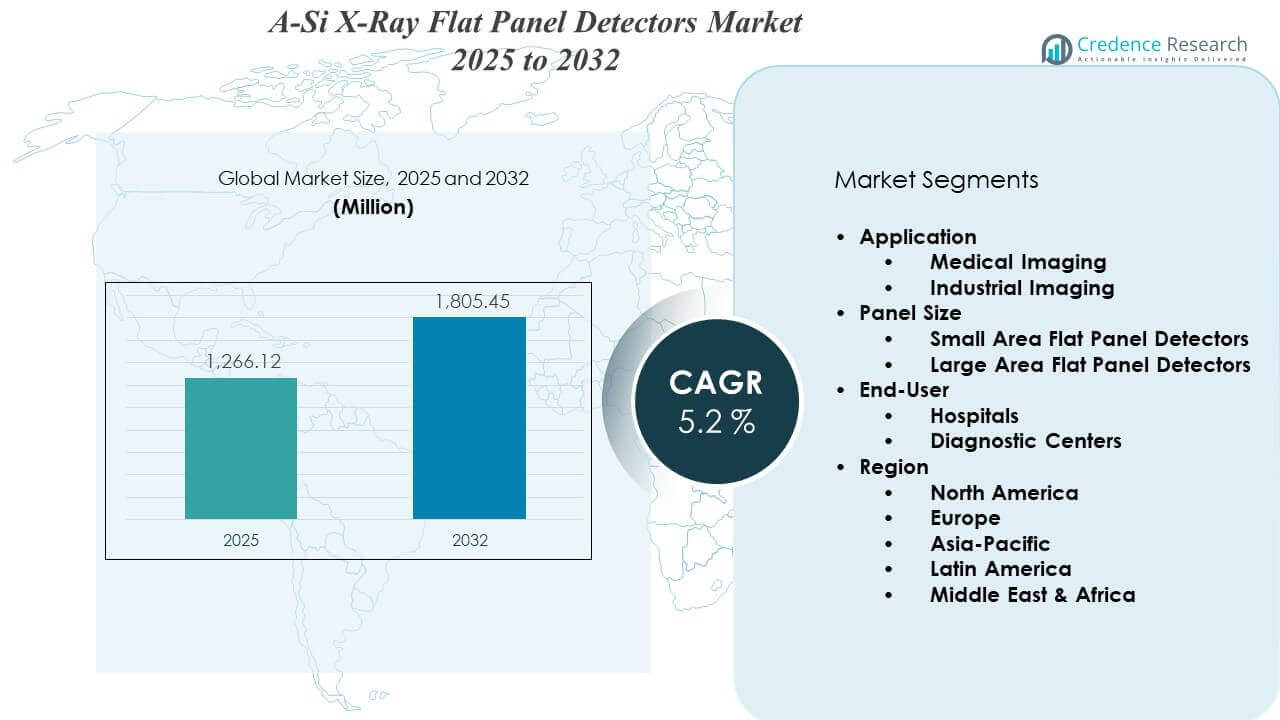
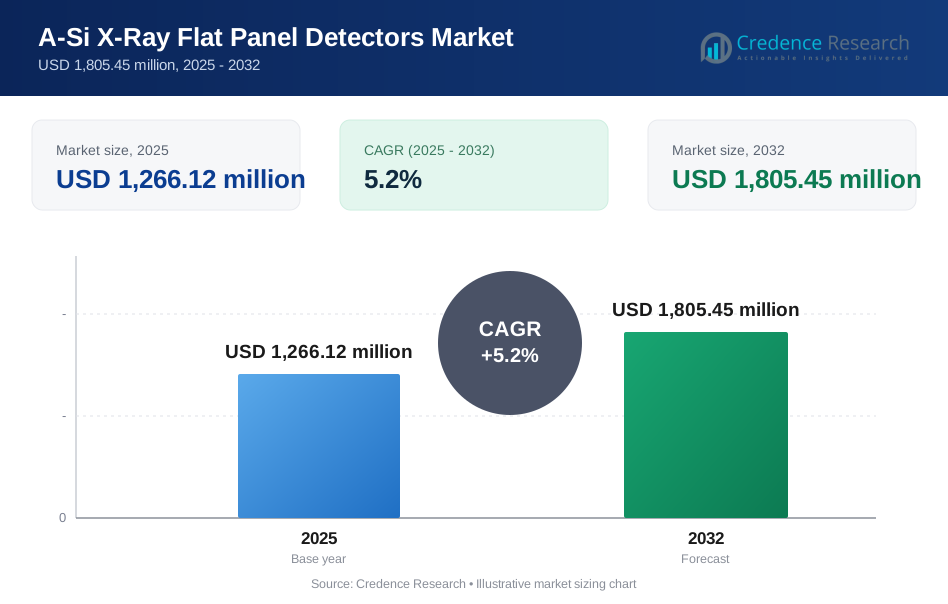
The A-Si X-Ray Flat Panel Detectors Market is projected to grow from USD 1,266.12 million in 2025 to an estimated USD 1,805.45 million by 2032, with a compound annual growth rate (CAGR) of 5.2% from 2025 to 2032.
| REPORT ATTRIBUTE | DETAILS |
|---|---|
| Historical Period | 2020-2023 |
| Base Year | 2024 |
| Forecast Period | 2025-2032 |
| A-Si X-Ray Flat Panel Detectors Market Size 2025 | USD 1,266.12 million |
| A-Si X-Ray Flat Panel Detectors Market, CAGR | 5.2% |
| A-Si X-Ray Flat Panel Detectors Market Size 2032 | USD 1,805.45 million |
Market growth is fueled by rising demand for advanced medical imaging and digital radiography. Hospitals and diagnostic centers are shifting from traditional film-based systems to flat panel detectors due to their higher image quality, lower radiation exposure, and faster imaging time. Manufacturers are investing in portable, low-power detectors to support emergency and mobile healthcare services. Industrial use in security screening and non-destructive testing is also increasing, especially in sectors like aerospace and automotive where precise imaging is critical. The growing burden of chronic diseases and aging populations is driving consistent investments in imaging infrastructure.
North America holds a leading position due to strong healthcare infrastructure and early adoption of digital imaging technologies. Europe follows with widespread implementation in national health systems. Asia-Pacific is emerging rapidly, driven by healthcare digitization in China and India. Investments in diagnostic infrastructure, growing patient populations, and local manufacturing initiatives contribute to regional expansion. Meanwhile, Latin America and the Middle East & Africa are gradually adopting flat panel technologies, supported by medical tourism, international aid, and public health reforms.
Market Insights:
- The A-Si X-Ray Flat Panel Detectors Market is projected to grow from USD 1,266.12 million in 2025 to USD 1,805.45 million by 2032, registering a CAGR of 5.2%.
- North America leads with 35% share due to advanced healthcare infrastructure; Asia-Pacific follows with 30% driven by digitization; Europe holds 22% due to strong equipment replacement cycles.
- Asia-Pacific is the fastest-growing region, supported by rising healthcare investments, local manufacturing, and adoption in both medical and industrial imaging.
- Medical imaging accounts for the dominant application share at over 60%, fueled by hospital demand for accurate diagnostics and workflow efficiency.
- Large area detectors hold around 65% share, favored for full-body scans and high-throughput environments in hospitals and advanced diagnostic centers.
Market Drivers:
Increasing Preference for Digital Radiography in Diagnostic Imaging
Hospitals and diagnostic labs are transitioning from analog systems to digital platforms. Flat panel detectors improve workflow efficiency, reduce radiation exposure, and deliver high-quality imaging. Healthcare providers seek solutions that reduce scanning time and enhance diagnostic accuracy. The A-Si X-Ray Flat Panel Detectors Market benefits from widespread digital upgrades in clinical radiology. It supports streamlined imaging, especially in high-volume centers. Emergency departments adopt these detectors for rapid evaluations. The reduced need for film handling lowers operational costs. The growing burden of chronic illness continues to fuel demand for faster, clearer diagnostic imaging.
- For instance, the Canon CXDI-810C Wireless detector delivers a compact 11" x 14" (27.4 x 35.0 cm) imaging area with approximately 6.1 million pixels (2,800 x 2,192 image matrix). It utilizes a Cesium Iodide (CsI) scintillator with a 125-micron pixel pitch to produce clear bone and soft tissue detail with low noise.
Growing Demand for Portable and Mobile X-Ray Systems in Critical Care
The demand for mobile imaging units is increasing in ICUs, ambulances, and military healthcare. Portable flat panel detectors allow real-time, on-site assessments. The A-Si X-Ray Flat Panel Detectors Market grows through integration in compact mobile solutions. It delivers high sensitivity and flexible deployment across emergency care and field hospitals. Aging populations and limited access to advanced centers push adoption of mobile X-ray devices. Rapid diagnosis capabilities improve outcomes in trauma and critical care. Many vendors develop lightweight, battery-powered detector models. These solutions support faster triage and broader care access.
- For instance Canon’s CXDI‑720C wireless detector weighs just 2.5 kg for a 35×43 cm field and includes built‑in automatic exposure detection to enhance bedside workflow. It delivers high sensitivity and flexible deployment across emergency care and field hospitals.
Wider Use of X-Ray Detectors in Veterinary and Industrial Applications
Beyond healthcare, other industries adopt flat panel detectors for safety and quality control. Veterinary clinics require high-resolution imaging for animals of all sizes. The A-Si X-Ray Flat Panel Detectors Market sees adoption in animal diagnostics and treatment. It also penetrates sectors like aerospace, automotive, and manufacturing. Non-destructive testing uses detectors to inspect welds, castings, and electronics. Compact size and clear imaging support remote inspections. Increased safety regulations drive deployment in industrial quality assurance. The flexibility of these systems expands cross-industry application scope.
Government Investments and Regulatory Push Toward Radiation Safety
Regulatory agencies set stricter norms for radiation protection in imaging. Governments fund projects promoting digital upgrades in public hospitals. The A-Si X-Ray Flat Panel Detectors Market aligns with safety-focused procurement. It helps providers meet exposure limits without compromising diagnostic quality. Policies in developed and emerging economies encourage technology modernization. Equipment tenders increasingly specify flat panel technology standards. Radiation safety rules push out older systems from clinical settings. These efforts create steady public sector demand across markets.
Market Trends:
Growing Adoption of Artificial Intelligence for Image Enhancement and Interpretation
Vendors integrate AI-based tools to support diagnostic workflows. Algorithms enhance image clarity and detect anomalies with high consistency. Radiologists use AI to reduce fatigue and increase reporting speed. The A-Si X-Ray Flat Panel Detectors Market adopts smart platforms for faster interpretation. It allows automatic anomaly flagging and triage assistance in high-volume setups. Software enhancements improve edge detection and noise suppression. AI solutions support early identification of disease patterns. These technologies improve clinical decision-making and imaging efficiency.
- For instance Konica Minolta’s AeroDR XE Series pairs with AI‑assisted software to deliver automated noise reduction and boundary enhancement, improving radiologist interpretation accuracy.
Rising Focus on Product Miniaturization and Panel Flexibility for Niche Use Cases
Manufacturers design thinner and lighter detectors for ease of use. Flexible designs support imaging in constrained or irregular spaces. The A-Si X-Ray Flat Panel Detectors Market moves toward ergonomic and modular formats. Veterinary and pediatric settings demand smaller, maneuverable units. Dental imaging benefits from compact detectors with high resolution. Designers aim for lower weight without compromising output quality. Flat and curved detectors support complex anatomical capture. These trends reshape detector form factors across user segments.
- For instance, Fujifilm launched the FDR D-EVO III which utilizes a glass-free flexible film substrate, reducing the detector weight to just 1.8 kg and achieving a high-resolution pixel pitch of 100 µm, making it significantly easier to maneuver in pediatric and trauma environments compared to traditional glass-based models.
Strategic Collaborations Between OEMs and Healthcare Providers for Tailored Imaging Solutions
Partnerships allow equipment customization for specific clinical needs. OEMs co-develop systems with hospitals to align with workflow and budget goals. The A-Si X-Ray Flat Panel Detectors Market sees more value-based solution delivery models. It enables better integration with hospital IT and PACS infrastructure. Custom solutions increase acceptance in rural or resource-constrained facilities. These collaborations drive long-term adoption and brand loyalty. Providers benefit from training, support, and lifecycle service plans. This trend builds ecosystem-based growth in the detector segment.
Increased Preference for Wireless and Battery-Operated Panels in Modern Imaging Setups
Wireless detectors remove cable clutter and improve system mobility. Battery-operated formats allow longer uptime and fewer workflow disruptions. The A-Si X-Ray Flat Panel Detectors Market responds with high-capacity wireless models. It ensures seamless data transfer and remote control through mobile apps. Clinicians gain freedom to adjust positioning during procedures. Infection control improves due to reduced contact with fixed hardware. These innovations enhance safety and speed in point-of-care imaging. Wireless upgrades continue to replace legacy wired systems.
Market Challenges Analysis:
High Initial Equipment Costs and Budget Constraints in Small and Mid-Sized Healthcare Facilities
Flat panel detectors require significant upfront investment. Many small clinics and rural hospitals struggle with capital limitations. The A-Si X-Ray Flat Panel Detectors Market faces resistance in cost-sensitive regions. It competes with low-cost analog systems still active in developing markets. Budget approvals for digital upgrades often delay purchasing decisions. Public hospitals rely on tenders that favor lower-cost solutions. This restricts growth in facilities with older infrastructure. Price-sensitive buyers demand long warranties, training, and financing assistance.
Limited Reimbursement Policies and Operational Barriers in Underdeveloped Healthcare Systems
Reimbursement delays impact digital X-ray service returns in emerging regions. Health insurance schemes often lack dedicated provisions for digital imaging upgrades. The A-Si X-Ray Flat Panel Detectors Market slows where payer models don’t cover capital investments. Operational barriers like lack of trained staff and digital storage systems restrict adoption. Hospitals may own modern detectors but underutilize features due to limited IT capacity. Poor connectivity and maintenance gaps reduce system uptime. These issues limit full realization of imaging benefits.
Market Opportunities:
Rising Penetration in Home Healthcare, Ambulatory Imaging, and Remote Diagnostic Programs
Shifting care models support imaging outside hospital walls. Home healthcare, mobile diagnostics, and outpatient clinics create new use cases. The A-Si X-Ray Flat Panel Detectors Market gains traction in low-footprint deployments. It supports on-site chest imaging, orthopedics, and injury screening. Lightweight, wireless detectors meet portable service demands. This trend opens access for underserved areas and aging populations. Providers deploy systems on vans or carts for community diagnostics.
Expansion Across Emerging Markets Through Localized Manufacturing and Government Support
Asia-Pacific, Latin America, and Africa offer growth potential due to healthcare infrastructure development. The A-Si X-Ray Flat Panel Detectors Market sees rising imports and local assembly in these regions. Government-backed digital health missions and foreign investments promote adoption. Vendors benefit by forming regional alliances and distribution networks. Local presence reduces cost and enhances compliance with national standards. These steps position manufacturers closer to volume buyers in growing markets.
Market Segmentation Analysis:
By Application: Medical Imaging and Industrial Imaging
Medical imaging dominates the A-Si X-Ray Flat Panel Detectors Market due to increasing diagnostic demand in hospitals and clinics. These detectors offer high-resolution images with faster processing and lower radiation. They support applications such as chest X-rays, orthopedic assessments, and trauma care. It enables efficient workflows and better patient outcomes, especially in high-volume settings. Industrial imaging is also gaining relevance across sectors like aerospace, automotive, and electronics. These detectors help inspect structural integrity, welding quality, and material defects. Portability and precision make them valuable for non-destructive testing. The dual-application scope broadens the market's commercial appeal.
- For instance, FUJIFILM’s FDR ES panel delivers a 17″×17″ active area with a 150 µm pixel pitch, utilizing Irradiated Side Sampling (ISS) technology to enhance image sharpness and dose efficiency. It enables efficient workflows with image previews in as little as 2 seconds and a cycle time of less than 13 seconds, supporting better patient outcomes in high-volume settings.
By Panel Size: Small Area vs Large Area Flat Panel Detectors
Large area detectors hold strong demand in general radiography, fluoroscopy, and full-body scans. Their wide coverage improves efficiency in multi-view imaging. It supports seamless integration in stationary and high-throughput systems. Small area detectors find relevance in dentistry, orthopedics, and veterinary care. Compact panels are ideal for site-specific examinations with space constraints. They also serve mobile and bedside imaging needs. The A-Si X-Ray Flat Panel Detectors Market caters to varied clinical and industrial requirements by offering panel sizes that match usage environments. Manufacturers invest in lightweight designs for both categories.
- For instance, Varex Imaging developed the PaxScan 4343CB, a large-area a-Si detector featuring a 43 cm x 43 cm active area and a 139 µm pixel pitch, which supports high-resolution fluoroscopy at frame rates up to 30 fps, whereas their smaller 2530DX model provides a compact 25 cm x 30 cm footprint specifically optimized for neonatal and orthopedic imaging.
By End-User: Hospitals and Diagnostic Centers
Hospitals remain the largest end-user segment due to high imaging volumes and infrastructure readiness. These facilities continuously upgrade to digital systems to reduce scan times and improve patient care. It provides the reliability and performance hospitals require for 24/7 operations. Diagnostic centers adopt flat panel detectors for fast turnaround and precision. These centers operate independently or as part of large chains, offering scalable imaging services. The market benefits from the growing number of such facilities in urban and semi-urban areas. Strategic procurement and modular systems make adoption more feasible for smaller setups.
Segmentation:
By Application
- Medical Imaging
- Industrial Imaging
By Panel Size
- Small Area Flat Panel Detectors
- Large Area Flat Panel Detectors
By End-User
- Hospitals
- Diagnostic Centers
By Region
- North America
- U.S.
- Canada
- Mexico
- Europe
- Germany
- France
- U.K.
- Italy
- Spain
- Rest of Europe
- Asia Pacific
- China
- Japan
- India
- South Korea
- South-east Asia
- Rest of Asia Pacific
- Latin America
- Brazil
- Argentina
- Rest of Latin America
- Middle East & Africa
- GCC Countries
- South Africa
- Rest of the Middle East and Africa
Regional Analysis:
North America Leads with Strong Infrastructure and High Imaging Volumes
North America holds the largest share in the A-Si X-Ray Flat Panel Detectors Market, accounting for approximately 35% of global revenue. The region benefits from advanced healthcare systems, higher adoption of digital radiography, and established reimbursement frameworks. Hospitals and diagnostic centers continuously upgrade imaging systems, driving demand for efficient flat panel detectors. The U.S. leads in both medical and industrial applications, supported by strong vendor presence and high diagnostic imaging volumes. It remains a key innovation hub with early integration of AI and wireless detector technologies. Canada supports market expansion through public health investment and rural healthcare programs. These factors ensure steady growth across the region.
Asia-Pacific Emerges as a High-Growth Region Driven by Healthcare Modernization
Asia-Pacific represents around 30% of the market and stands as the fastest-growing region. China, Japan, India, and South Korea contribute to rising demand due to expanding healthcare infrastructure and government-backed digital health initiatives. The A-Si X-Ray Flat Panel Detectors Market benefits from increasing awareness of radiation safety and preference for portable imaging systems. Local manufacturing and affordable pricing by regional players support widespread adoption. Hospitals and diagnostic labs in tier 2 and tier 3 cities shift toward digital upgrades. It also finds traction in industrial testing applications in automotive and electronics sectors. Continued investment in healthcare access boosts long-term demand.
Europe and Rest of the World Maintain Steady Adoption with Regional Variations
Europe holds a 22% share, driven by high equipment replacement rates and strong regulatory compliance. Countries like Germany, France, and the UK adopt A-Si detectors in public and private healthcare setups. Digitalization of radiology departments and focus on patient safety continue to shape procurement decisions. Latin America and the Middle East & Africa collectively contribute about 13% market share. Brazil, Mexico, UAE, and South Africa see increasing demand due to urban hospital upgrades and mobile imaging growth. It supports outreach initiatives and non-destructive testing in remote areas. Vendors target these regions with scalable, cost-effective solutions to drive future expansion.
Key Player Analysis:
- Varex Imaging Corporation
- Canon Inc.
- FUJIFILM Holdings Corporation
- Konica Minolta, Inc.
- Thales Group
- Rayence Co., Ltd.
- Carestream Health
Competitive Analysis:
The A-Si X-Ray Flat Panel Detectors Market remains competitive with a strong presence of global and regional players. Key companies focus on product innovation, detector performance, and strategic partnerships to maintain market share. It attracts investment from established imaging brands and emerging manufacturers aiming to diversify their portfolios. Canon Inc., FUJIFILM Holdings, Varex Imaging, and Thales Group lead through extensive product ranges and strong global distribution networks. Rayence and Konica Minolta invest in R&D to enhance panel sensitivity and reduce noise. Companies also prioritize wireless technology and compact designs to meet demand across medical and industrial sectors. Strategic pricing and after-sales support play key roles in emerging regions. New entrants face high technical barriers and compliance requirements.
Recent Developments:
- In November 2025, Varex Imaging Corporation announced the commencement of commercial production of X-ray Flat Panel Detectors at its Visakhapatnam, India site, marking a key expansion in global manufacturing capabilities.
- In December 2024, Varex Imaging Corporation launched the LUMEN HD and LUMEN HD Pro digital radiography detectors, engineered for enhanced performance in healthcare imaging with improved speed and reliability.
Report Coverage:
The research report offers an in-depth analysis based on Application, Panel Size, End-User, and Region. It details leading market players, providing an overview of their business, product offerings, investments, revenue streams, and key applications. Additionally, the report includes insights into the competitive environment, SWOT analysis, current market trends, as well as the primary drivers and constraints. Furthermore, it discusses various factors that have driven market expansion in recent years. The report also explores market dynamics, regulatory scenarios, and technological advancements that are shaping the industry. It assesses the impact of external factors and global economic changes on market growth. Lastly, it provides strategic recommendations for new entrants and established companies to navigate the complexities of the market.
Future Outlook:
- Demand for wireless and battery-powered detectors will grow, driven by the need for flexible and clutter-free imaging in critical care and emergency settings.
- Artificial intelligence will become a key differentiator, supporting automated image optimization and faster clinical decisions across diagnostic environments.
- Portable flat panel systems will expand access to digital radiography in rural healthcare, mobile units, and temporary diagnostic camps.
- Industrial imaging use will rise, especially in aerospace, electronics, and automotive sectors requiring precise, non-invasive inspection tools.
- Compact detector panels will see increased adoption in dental, orthopedic, and veterinary practices due to space constraints and niche use cases.
- Hospitals will continue to dominate end-user adoption, integrating detectors with hospital PACS, EMR systems, and diagnostic workflows.
- Diagnostic centers and imaging chains will demand scalable systems that support high patient volumes with lower operating costs.
- Local manufacturing initiatives and regional assembly units will reduce import dependency and improve market competitiveness in Asia-Pacific.
- Regulatory support for digital imaging standards and radiation safety compliance will drive technology upgrades across public health systems.
- Strategic partnerships between OEMs and care providers will encourage co-development of customized, value-based detector solutions for targeted clinical applications.
Request a Free Sample
Fill in your details and we'll send you a free sample report.
- Sample data tables & charts
- Research methodology
Need a Custom Version of This Report?
Tailor the scope, geography, or segments to your exact requirements.
- Custom geography or segment scope
- Direct access to our analyst team
Frequently Asked Questions
What is the current market size for A-Si X-Ray Flat Panel Detectors Market, and what is its projected size in 2032?
At what Compound Annual Growth Rate is the A-Si X-Ray Flat Panel Detectors Market projected to grow between 2025 and 2032?
Which A-Si X-Ray Flat Panel Detectors Market segment held the largest share in 2025?
What are the primary factors fueling the growth of the A-Si X-Ray Flat Panel Detectors Market?
Who are the leading companies in the A-Si X-Ray Flat Panel Detectors Market?
Which region commanded the largest share of the A-Si X-Ray Flat Panel Detectors Market in 2025?
Table of Content
Chapter 1. Report Introduction
- 1.1 Report Description & Purpose
- 1.1.1 Report Title & Market Definition
- 1.1.2 Unique Selling Propositions (USP) & Key Differentiators
- 1.1.3 Value Proposition for Stakeholders
- 1.2 Research Objectives
- 1.2.1 Market Sizing Objectives (Volume & Revenue)
- 1.2.2 Segmentation Objectives
- 1.2.3 Competitive Intelligence Objectives
- 1.2.4 Forecast & Scenario Objectives
- 1.3 Report Scope
- 1.3.1 A-Si X-Ray Flat Panel Detectors Scope – Types & Subtypes Covered
- 1.3.2 Geographic Scope – Regions & Countries Covered
- 1.3.3 Historical Period, Base Year & Forecast Period (2025; forecast to 2032)
- 1.3.4 Inclusions & Exclusions
- 1.4 HS Code & Classification Framework
- 1.5 Currency, Units & Pricing Basis
- 1.6 Target Stakeholders
- 1.7 Limitations & Assumptions
Chapter 2. Executive Summary
- 2.1 Global A-Si X-Ray Flat Panel Detectors Market Snapshot
- 2.1.1 Market Size – Historical (2025) & Forecast (2025-2032) (2025: USD 1,266.12 million → 2032: USD 1,805.45 million)
- 2.1.2 Volume & Revenue – Global Totals
- 2.1.3 Key Market Highlights – Top Five Facts
- 2.2 A-Si X-Ray Flat Panel Detectors Market Segmentation Snapshot
- 2.2.1 Market Split by Region – 2025 vs. 2032
- 2.3 Competitive Snapshot
- 2.3.1 Top 10 Players by Revenue Share – 2025
- 2.3.2 Top 10 Players by Volume Share – 2025
- 2.3.3 Recent Strategic Developments (18-Month Summary)
- 2.4 Key Investment Highlights & Strategic Conclusions
Chapter 3. A-Si X-Ray Flat Panel Detectors Market Dynamics & Industry Analysis
- 3.1 Market Overview & Context
- 3.1.1 A-Si X-Ray Flat Panel Detectors Market Position in the Broader Automotive Value Chain
- 3.1.2 OEM vs. Replacement Market Dynamics
- 3.1.3 Market Maturity & Development Stage by Region
- 3.2 A-Si X-Ray Flat Panel Detectors Market Drivers
- 3.3 A-Si X-Ray Flat Panel Detectors Market Restraints & Challenges
- 3.4 A-Si X-Ray Flat Panel Detectors Market Opportunities
- 3.5 Porter's Five Forces Analysis
- 3.5.1 Threat of New Entrants
- 3.5.2 Bargaining Power of Suppliers
- 3.5.3 Bargaining Power of Buyers
- 3.5.4 Threat of Substitutes
- 3.5.5 Competitive Rivalry – Intensity Assessment
- 3.6 A-Si X-Ray Flat Panel Detectors Value Chain Analysis
- 3.6.1 Upstream – Raw Material/Input Suppliers
- 3.6.1.1 Raw Material/Input 1
- 3.6.1.2 Raw Material/Input 2
- 3.6.1.3 Raw Material/Input 3
- 3.6.2 Midstream – Production/Manufacturing/Service Delivery
- 3.6.2.1 Production/Process Overview
- 3.6.2.2 Key Facility Locations & Capacity by Manufacturer
- 3.6.3 Downstream – Distribution & End Consumer
- 3.6.3.1 Primary Channel – B2B/OEM
- 3.6.3.2 Secondary Channels – Dealer, Retail, Online, Direct
- 3.6.4 Value Chain Profitability Analysis
- 3.6.1 Upstream – Raw Material/Input Suppliers
- 3.7 PESTEL Analysis
- 3.7.1 Political Factors
- 3.7.2 Economic Factors
- 3.7.3 Social Factors
- 3.7.4 Technological Factors
- 3.7.5 Environmental Factors
- 3.7.6 Legal Factors
- 3.8 A-Si X-Ray Flat Panel Detectors Supply Chain Analysis
- 3.8.1 Raw Material/Input Supply Risk Assessment
- 3.8.2 Manufacturing Concentration Risk (Geographic Exposure)
- 3.8.3 Trade Disruption Impact Analysis
- 3.9 Regulatory & Policy Landscape
Note: The regulatory and policy landscape section covers regulations based on their applicability to the market, A-Si X-Ray Flat Panel Detectors category, geography, and scope of the study. Only regulatory frameworks with a material impact on operations, compliance, trade, sustainability, or market access are analyzed in detail.
Chapter 4. Key Investment Pockets & Opportunity Analysis
- 4.1 A-Si X-Ray Flat Panel Detectors Market Attractiveness Analysis
- 4.1.1 By Region – Investment Attractiveness Matrix (Volume × CAGR)
- 4.2 Absolute Revenue Growth Opportunity
- 4.2.1 By Region – Absolute USD Growth Through 2032
- 4.3 Incremental Volume Opportunity
- 4.3.1 By Region – Incremental Volume Through 2032
- 4.3.2 Segment – Incremental Volume
- 4.4 Emerging Submarket Opportunity Deep Dive (Subject to Applicability)
- 4.5 Emerging Market Opportunity Scorecards
- 4.5.1 United States
- 4.5.2 Europe
- 4.5.3 Asia
- 4.5.4 Middle East & Africa
Note: Emerging Market Opportunity Scorecards will be included based on relevance and strategic importance. Regions listed are indicative and may vary depending on data availability and market dynamics.
Chapter 5. A-Si X-Ray Flat Panel Detectors Import-Export Analysis & Trade Flows
- 5.1 Global Trade Overview
- 5.1.1 Global Export Value by Country (2025)
- 5.1.2 Global Export Volume by Country (2025)
- 5.1.3 Global Import Value by Country (2025)
- 5.1.4 Global Import Volume by Country (2025)
- 5.1.5 Net Trade Balance by Country (2025)
- 5.2 Export Analysis – Segment
- 5.2.1 Type 1 (HS Code)
- 5.2.2 Type 2 (HS Code)
- 5.2.3 Type 3 (HS Code)
- 5.2.4 Type 4 (HS Code)
- 5.2.5 Type 5 (HS Code)
- 5.3 Import Analysis – Segment
- 5.3.1 Type 1 (HS Code)
- 5.3.2 Type 2 (HS Code)
- 5.3.3 Type 3 (HS Code)
- 5.3.4 Type 4 (HS Code)
- 5.3.5 Type 5 (HS Code)
- 5.4 Average Unit Trade Prices
- 5.4.1 Average Export Price – Segment & Country
- 5.4.2 Average Import Price – Segment & Source Country
- 5.4.3 Price Trends (2025)
- 5.5 Key Trade Route Analysis
- 5.5.1 Trade Route 1
- 5.5.2 Trade Route 2
- 5.5.3 Trade Route 3
- 5.5.4 Trade Route 4
- 5.5.5 Trade Route 5
- 5.6 Trade Policy Impact Assessment
- 5.6.1 US Anti-Dumping & Section 301 Tariffs
- 5.6.2 EU Customs Union Impact
- 5.6.3 Major Free Trade Agreements
- 5.6.4 USMCA Rules of Origin
Note: Trade policy analysis will be included only where relevant to the A-Si X-Ray Flat Panel Detectors market.
Chapter 6. Competitive Landscape & Company Benchmarking
- 6.1 A-Si X-Ray Flat Panel Detectors Market Concentration & Structure
- 6.1.1 Herfindahl-Hirschman Index (HHI) – vs. 2025
- 6.1.2 Tier 1, Tier 2 & Tier 3 Market Structure
- 6.1.3 Global, Regional & Local Player Dynamics
- 6.2 A-Si X-Ray Flat Panel Detectors Market Share Analysis – 2025
- 6.2.1 Global Revenue Share by Company
- 6.2.2 Global Volume Share by Company
- 6.2.3 Regional Revenue Share
- 6.2.4 Market Share Evolution ( vs. 2025)
- 6.2.5 OEM Segment Share by Company
- 6.2.6 Replacement Segment Share by Company
- 6.3 Production/Delivery Capacity & Facility Analysis
- 6.3.1 Global Installed Capacity
- 6.3.2 Capacity Utilization Rates
- 6.3.3 Production/Output Volume
- 6.3.4 Facility Locations & Capacity Map
- 6.3.5 Planned Capacity Additions
- 6.4 A-Si X-Ray Flat Panel Detectors Competitive Benchmarking Matrix
- 6.4.1 Revenue, Volume, CAGR & Profitability Comparison
- 6.4.2 Channel Revenue Mix
- 6.4.3 Geographic Revenue Exposure
- 6.4.4 R&D Intensity
- 6.4.5 Sustainability Maturity
- 6.5 Strategic Developments in A-Si X-Ray Flat Panel Detectors (Last 24 Months)
- 6.5.1 Mergers, Acquisitions & Divestments
- 6.5.2 New A-Si X-Ray Flat Panel Detectors Launches
- 6.5.3 Facility Expansions
- 6.5.4 Strategic Alliances, Joint Ventures & Partnerships
- 6.5.5 Distribution Expansion & Market Entry
- 6.5.6 Sustainability & ESG Initiatives
- 6.6 Competitive Strategy Mapping
- 6.6.1 Leader, Challenger, Follower & Niche Classification
- 6.6.2 Pricing Strategy Comparison
- 6.6.3 Channel Strategy Matrix
Note: Strategic developments are included based on their materiality and the availability of reliable information.
Chapter 7. Global A-Si X-Ray Flat Panel Detectors Market – By Distribution Channel
- 7.1 Segment Overview
- 7.1.1 Volume & Revenue Split by Channel (2025 & 2032)
- 7.1.2 Channel Mix Evolution (2025-2032)
Chapter 8. Regional Market Analysis – Global Overview
- 8.1 Global Regional Overview
- 8.1.1 Regional Volume Share
- 8.1.2 Regional Revenue Share
- 8.1.3 Regional Volume by Region
- 8.1.4 Regional Revenue by Region
- 8.1.5 Regional Forecast Through 2032
- 8.2 Cross-Regional Segment Analysis
- 8.2.1 By Distribution Channel
- 8.2.2 By Brand/Price Tier
Chapter 9. North America A-Si X-Ray Flat Panel Detectors Market
- 9.1 United States
- 9.2 Canada
- 9.3 Mexico
Chapter 10. Europe A-Si X-Ray Flat Panel Detectors Market
- 10.1 Germany
- 10.2 France
- 10.3 Italy
- 10.4 United Kingdom
- 10.5 Spain
- 10.6 Poland
- 10.7 Russia
- 10.8 Netherlands
- 10.9 Belgium
- 10.10 Sweden
- 10.11 Denmark
- 10.12 Norway
- 10.13 Rest of Europe
Chapter 11. Asia Pacific A-Si X-Ray Flat Panel Detectors Market
- 11.1 China
- 11.2 India
- 11.3 Japan
- 11.4 South Korea
- 11.5 Thailand
- 11.6 Indonesia
- 11.7 Vietnam
- 11.8 Malaysia
- 11.9 Australia
- 11.10 Rest of Asia Pacific
Chapter 12. Latin America A-Si X-Ray Flat Panel Detectors Market
- 12.1 Brazil
- 12.2 Argentina
- 12.3 Colombia
- 12.4 Chile
- 12.5 Rest of Latin America
Chapter 13. Middle East A-Si X-Ray Flat Panel Detectors Market
- 13.1 Saudi Arabia
- 13.2 United Arab Emirates
- 13.3 Turkey
- 13.4 Israel
- 13.5 Iran
- 13.6 Rest of the Middle East
Chapter 14. Africa A-Si X-Ray Flat Panel Detectors Market
- 14.1 South Africa
- 14.2 Egypt
- 14.3 Nigeria
- 14.4 Morocco
- 14.5 Rest of Africa
Chapter 15. A-Si X-Ray Flat Panel Detectors Company Profiles
- 15.1 [Company 01]
- 15.1.1 Company Overview
- 15.1.2 Key Management Personnel
- 15.1.3 Products & Services Portfolio
- 15.1.4 Financial Performance
- 15.1.5 Key Market Focus & Geographic Presence
- 15.1.6 Recent Developments & Strategic Initiatives
Note: The company profile list is preliminary and may change based on research findings, market developments, data availability, and client requirements.
Chapter 16. Appendices
- Appendix A – List of Abbreviations & Acronyms
- Appendix B – Industry Classification Code Reference – Full Series
- Appendix C – Production & Capacity Data Tables
- Appendix D – End-Use & Demand Base Tables
- Appendix E – Consumption & Replacement Rate Assumptions
- Appendix F – ASP Reference Tables
- Appendix G – Manufacturing & Facility Database
- Appendix H – Import-Export Data Tables
- Appendix I – Regulatory Summary Tables
- Appendix J – Primary Research Participant List (Anonymized)
- Appendix K – Primary Research Questionnaire Framework
- Appendix L – Data Sources & Bibliography
- Appendix M – Market Size Divergence & Source Comparison
Chapter 17. Research Methodology
- 17.1 Research Framework & Philosophy
- 17.2 Secondary Research – Sources, Hierarchy & Data Extraction
- 17.3 Data Modeling – Bottom-Up & Top-Down Market Sizing
- 17.4 Primary Research – Stakeholder Framework, LOI & Sample Sizes
- 17.5 Forecast Methodology – Regression, Scenario & Sensitivity Analysis
- 17.6 Quality Control – Four-Layer Validation Framework
- 17.7 Limitations & Standard Assumptions
- 17.8 Disclaimer
