
Market Overview:
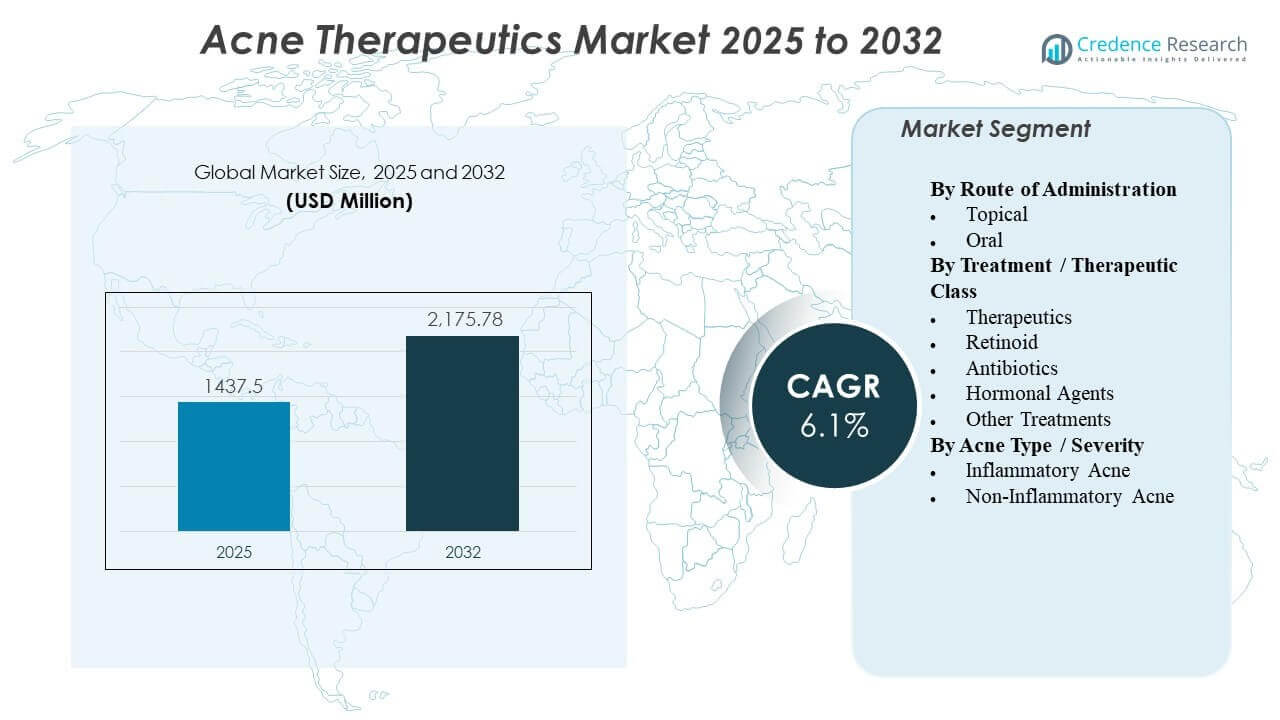
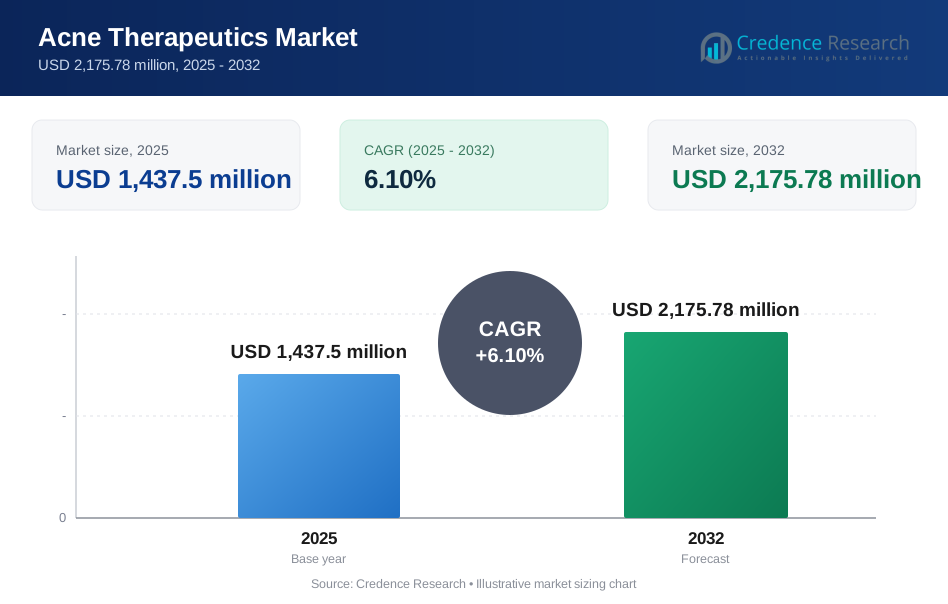
The Acne Therapeutics Market is projected to grow from USD 1,437.5 million in 2025 to an estimated USD 2,175.78 million by 2032, with a compound annual growth rate (CAGR) of 6.1% from 2025 to 2032.
| REPORT ATTRIBUTE | DETAILS |
|---|---|
| Historical Period | 2020-2023 |
| Base Year | 2024 |
| Forecast Period | 2025-2032 |
| Acne Therapeutics Market Size 2025 | USD 1,437.5 million |
| Acne Therapeutics Market, CAGR | 6.1% |
| Acne Therapeutics Market Size 2032 | USD 2,175.78 million |
Growth in the market is driven by rising demand for topical and oral therapies that offer measurable improvement in both inflammatory and non-inflammatory acne. Dermatologists promote structured treatment cycles supported by retinoids, antibiotics, and hormonal agents, which improve adherence and clinical outcomes. Patients seek targeted care earlier due to stronger awareness of skin health, while digital consultation platforms expand access to specialist advice. These factors strengthen the adoption of regulated therapeutic options and encourage innovation across product categories.
Regional growth patterns show strong leadership from North America due to its advanced dermatology infrastructure, higher treatment uptake, and sustained innovation activity. Europe maintains solid momentum supported by standardized care pathways and high consumer preference for evidence-backed solutions. Asia Pacific emerges as the fastest-growing region, driven by a younger population, rapid urbanization, and expanding access to dermatology services. Latin America and the Middle East & Africa continue to develop as awareness increases and more affordable treatment options enter local markets.
Market Insights:
- The Acne Therapeutics Market is set to rise from USD 1,437.5 million in 2025 to USD 2,175.78 million by 2032, growing at a 6.1% CAGR.
- Strong demand for topical and oral therapies drives adoption, supported by early diagnosis, digital consultations, and wider access to dermatologists.
- Market growth faces restraints linked to varied treatment responses, user sensitivity, and concerns over side effects that reduce long-term adherence.
- North America leads due to advanced dermatology care and strong product availability, while Europe shows steady uptake backed by standardized clinical pathways.
- Asia Pacific emerges as the fastest-growing region, driven by a young demographic, rising awareness, and rapid expansion of dermatology services.
Market Drivers
Growing Dermatology Consultations and Rising Demand for Advanced Prescription Therapies
Dermatology visits continue to rise due to higher awareness of skin health and wider access to specialist care. Patients seek faster relief, stronger control of flare-ups, and long-term management plans. Clinics report increasing preference for combination therapies that offer better outcomes. The Acne Therapeutics Market benefits from structured treatment pathways supported by clinical evidence. Prescription volumes rise due to broadened eligibility for topical retinoids and systemic options. It supports stronger adherence through simplified dosing formats. New guidelines promote early intervention to reduce scarring risk. Urban clinics report higher follow-up rates driven by improved counseling models.
Shift Toward Early Diagnosis and Expanding Adoption of Clinically Validated Topical Agents
Parents and young adults pursue early evaluation to avoid long-term marks and discomfort. Stronger screening efforts in schools and primary care improve early case detection. Clinically validated topicals gain traction due to safer profiles and wider tolerability. The Acne Therapeutics Market benefits from expanded training programs for frontline physicians. It encourages higher prescription confidence and faster therapy initiation. Retail pharmacies observe rising demand for dermatology-recommended formulations. Improved packaging designs help maintain compliance. Digital symptom trackers guide users toward timely follow-ups.
- For instance, Galderma received FDA approval for AKLIEF (trifarotene) Cream, the first retinoid to selectively target the retinoic acid receptor (RAR) gamma; in Phase 3 trials, it demonstrated a significant reduction in inflammatory lesions as early as week 2 for the face and week 4 for the chest, shoulders, and back.
Growing Acceptance of Oral Treatments Driven by Reliable Clinical Outcomes and Physician Preference
Clinicians prescribe systemic therapies for moderate and severe cases with higher consistency. Patients trust oral options that demonstrate proven reductions in inflammation. Better monitoring tools reduce concerns over side effects. The Acne Therapeutics Market gains support from routine lab screening protocols that improve safety confidence. It reinforces physician preference for structured dose cycles. Adolescents show strong response rates due to controlled treatment windows. Awareness campaigns help parents understand benefit–risk profiles. Pharmacies observe increased refill frequency linked to improved counseling.
Expansion of Skincare Awareness Programs and Higher Influence of Social Health Education Platforms
Social platforms highlight the importance of evidence-based skincare and proper treatment guidance. Public figures promote accurate information on symptom control and prevention. Schools and workplaces conduct wellness programs that cover skin health. The Acne Therapeutics Market benefits from broad public exposure to medically backed routines. It leads consumers toward regulated formulations rather than random self-treatment. Dermatologists participate in online Q&A sessions that reduce misinformation. Community events support safe product selection. Clinics report rising appointment bookings linked to awareness content.
- For instance, CeraVe (a L’Oréal brand) executed a global "Cleanse Like a Derm" campaign that utilized more than 40 certified dermatologists to reach over 100 million unique viewers, resulting in a documented 27% increase in consumer adherence to three-step dermatologist-recommended acne regimens.
Market Trends
Growing Interest in Microbiome-Focused Formulations and Science-Led Topical Innovations
Researchers explore microbiome balance to support healthy skin environments. New formulations aim to stabilize microbial diversity while reducing irritation. Brands invest in targeted solutions that avoid harsh ingredients. The Acne Therapeutics Market benefits from clinical studies that validate microbiome-supportive products. It strengthens trust in science-led skincare. Startups promote gentle regimens that appeal to sensitive-skin users. Ingredient transparency increases consumer confidence. Regulatory bodies encourage clear labeling standards.
- For instance, Galderma’s Cetaphil brand launched a microbiome-friendly range following a study where 71% of participants showed a measurable increase in skin barrier function and a 42% reduction in redness after 28 days of use.
Rise of Digital Dermatology Platforms and Remote Treatment Optimization
Teledermatology adoption accelerates due to flexible scheduling and remote assessment tools. Patients upload photos for rapid evaluations. Dermatologists issue digital prescriptions with structured follow-up reminders. The Acne Therapeutics Market benefits from streamlined access to specialist care. It reduces delays between consultation and treatment. Remote monitoring tools improve tracking of symptom progress. Younger users prefer chat-based consultations. Coverage expansion supports broader patient engagement.
- For instance, the digital health platform Hims & Hers reported that its automated triage system reduced the average time to physician review to under 24 hours, facilitating over 1 million medical consultations with a patient-reported satisfaction score of 4.7 out of 5.
Growing Popularity of Combination Therapy Protocols Supported by Evidence-Driven Outcomes
Clinicians adopt layered treatment plans to manage diverse acne presentations. Protocols pair retinoids with antimicrobials or adjunctive soothing agents. Trials show better control of inflammation and hyperpigmentation. The Acne Therapeutics Market benefits from updated clinical guidelines that support structured sequencing. It improves patient outcomes through tailored regimens. Providers report lower dropout rates due to enhanced tolerability. Pharmacies stock more multi-step kits. Users report higher satisfaction with guided routines.
Increasing Demand for Clean Beauty Products with Dermatologist Validation
Consumers prefer formulations free from harsh chemicals. Brands highlight minimalistic ingredient lists supported by dermatologist testing. Clean labels influence purchase decisions in both retail and online channels. The Acne Therapeutics Market benefits from rising attention toward gentle and non-comedogenic products. It attracts users seeking controlled routines without heavy medication. Retailers expand shelf space for medically reviewed clean products. Transparency strengthens brand loyalty. Young adults drive faster adoption.
Market Challenges Analysis
Clinical Variability in Treatment Response and High Concerns Over Side Effects Across User Groups
Patients experience different response levels due to genetic factors, skin sensitivity, and severity. Physicians adjust regimens frequently to achieve stable outcomes. Concerns over dryness, redness, and systemic reactions slow adoption for some groups. The Acne Therapeutics Market faces patient hesitation linked to long treatment windows. It drives the need for clearer counseling and realistic expectation setting. Many users discontinue therapy due to slow visible improvement. Pharmacies manage frequent queries about safety. Clinicians must invest more time in dose management.
Rising Self-Medication Practices and Widespread Use of Unregulated Products Across Digital Platforms
Unverified products circulate across online marketplaces with minimal oversight. Users attempt self-treatment without proper evaluation. Poor-quality products create higher risk of irritation and scarring. The Acne Therapeutics Market must address misinformation that spreads through social content. It requires stronger guidance from dermatologists across digital channels. Clinics see an increase in cases worsened by incorrect product use. Regulators evaluate labeling gaps. Retailers strengthen screening of listed brands.
Market Opportunities
Growing Interest in Personalized Dermatology and Data-Driven Treatment Mapping
AI tools support precise evaluation of acne severity through image-based scoring. Personalized routines improve tolerability for diverse skin types. Clinics integrate digital tools to track improvements and adjust dosing. The Acne Therapeutics Market gains momentum through targeted product development. It encourages brands to invest in adaptive formulations. Users prefer solutions that reflect individual skin needs. Pharmacies benefit from tailored product bundles. Dermatology platforms support dynamic treatment mapping.
Expanding Adoption of Minimally Invasive Procedures and Adjunctive Energy-Based Solutions
Energy-based methods such as light therapy attract users seeking non-drug options. Clinics promote short sessions with controlled downtime. Patients respond well to procedures that reduce inflammation and scarring risk. The Acne Therapeutics Market gains traction from rising interest in clinic-based alternatives. It supports providers that combine topicals with advanced devices. Consumer spending rises on result-driven sessions. Platforms highlight evidence supporting procedure safety. Strong demand encourages investment in new devices.
Market Segmentation Analysis:
By Route of Administration
Topical therapies dominate first-line care due to broad suitability, gentle profiles, and direct action on affected areas. Dermatologists prescribe gels, creams, and lotions for early symptoms, and patients follow structured routines that support adherence. Many users prefer topicals because they reduce systemic risk and provide steady improvement with guided use. Clinics promote combination topicals to improve texture and reduce clogged pores. Oral therapies remain essential for moderate and severe cases where inflammation spreads deeper. Physicians monitor dosage to improve safety and maintain control of persistent breakouts. The Acne Therapeutics Market benefits from aligned treatment choices across both routes. It also gains support from pharmacies reporting strong refill consistency during long-term plans.
- For instance, Bausch Health’s ARAZLO (tazarotene) Lotion 0.045% utilizes a proprietary polymeric emulsion technology that allows for a 12% higher skin hydration level compared to traditional tazarotene formulations, enabling 90% of patients to remain compliant throughout a 12-week treatment cycle.
By Treatment / Therapeutic Class
Therapeutic agents anchor clinical practice by addressing core triggers such as excess oil, bacteria, and blockage. Retinoids maintain strong relevance due to their role in promoting skin renewal and supporting smoother texture. Dermatologists start with mild strengths to reduce irritation while maintaining visible results. Antibiotics continue to support flare management under strict duration control to limit resistance. Hormonal agents help manage recurring breakouts linked to hormonal shifts, especially among adult female users. Other treatments, including chemical peels, light therapy, and laser procedures, offer additional correction for stubborn marks. The Acne Therapeutics Market evolves through demand for integrated plans that combine medication with device-based solutions. It reinforces clinical confidence with evidence that supports multi-step protocols.
By Acne Type / Severity
Inflammatory acne requires structured care due to redness, swelling, and deeper lesions. Dermatologists rely on systemic and topical combinations to stabilize flare cycles and prevent scarring. Many patients seek early consultation because discomfort affects daily routines. Clinics review treatment response at regular intervals to maintain progress. Non-inflammatory acne responds well to topical retinoids and gentle exfoliants that clear clogged pores and improve texture. Users value simple routines that prevent progression into more severe forms. The Acne Therapeutics Market supports high demand for mild, daily-use products that maintain long-term clarity. It strengthens adoption through growing awareness of early intervention benefits.
- For instance, Cassiopea’s WINLEVI (clascoterone) cream 1% is the first topical androgen receptor inhibitor approved for both inflammatory and non-inflammatory acne, which demonstrated a 40% reduction in total lesion count in Phase 3 trials involving over 1,400 patients aged 12 and older.
Segmentation:
By Route of Administration
- Topical
- Oral
By Treatment / Therapeutic Class
- Therapeutics
- Retinoid
- Antibiotics
- Hormonal Agents
- Other Treatments
By Acne Type / Severity
- Inflammatory Acne
- Non-Inflammatory Acne
By Region
- North America
- U.S.
- Canada
- Mexico
- Europe
- Germany
- France
- U.K.
- Italy
- Spain
- Rest of Europe
- Asia Pacific
- China
- Japan
- India
- South Korea
- South-east Asia
- Rest of Asia Pacific
- Latin America
- Brazil
- Argentina
- Rest of Latin America
- Middle East & Africa
- GCC Countries
- South Africa
- Rest of the Middle East and Africa
Regional Analysis:
North America holds the largest share of the global landscape with nearly 38%, supported by strong dermatology networks and high treatment adoption. Patients pursue early diagnosis due to broad awareness of skin health and direct access to specialist care. Insurers support many treatment options, which improves uptake across age groups. Digital dermatology platforms also play a major role in routine monitoring and prescription renewal. The Acne Therapeutics Market benefits from strong physician engagement and consistent patient follow-up rates. It gains further momentum from advanced research programs that guide product development. Retail pharmacies see sustained demand for both prescription and over-the-counter solutions.
Europe secures around 30% share due to structured clinical guidelines and strong preference for evidence-backed therapies. Dermatologists follow standardized care pathways that improve treatment consistency across member countries. Users demonstrate high interest in topical and combination plans supported by regulated product standards. Clinics rely on long-term management protocols to reduce scarring risk. The Acne Therapeutics Market gains steady traction through expansion of teleconsultation services. It benefits from widespread consumer focus on medically validated skincare. Regional brands strengthen competitiveness through clean formulations and dermatologist-led testing.
Asia Pacific accounts for nearly 26% share and reflects the fastest expansion in global demand. Rising urbanization increases exposure to stress factors that influence acne prevalence. Young populations seek accessible treatments that deliver reliable control of recurring breakouts. Growing dermatology capacity in China, India, South Korea, and Japan supports higher diagnosis rates. The Acne Therapeutics Market gains momentum from rapid growth in retail channels and e-pharmacy platforms. It attracts users seeking affordable options with strong clinical backing. Clinics report rising interest in combination routines built around both topical and device-based methods.
Key Player Analysis:
- Galderma S.A.
- Johnson & Johnson Services, Inc.
- Bayer Aktiengesellschaft
- L’Oréal S.A.
- AbbVie Inc.
- Teva Pharmaceutical Industries Limited
- Bausch Health Companies Inc.
Competitive Analysis:
Competitive activity remains strong due to continuous product innovation and rising demand across key patient groups. Leading companies invest in improved topical agents, advanced retinoid derivatives, and safer systemic alternatives. The Acne Therapeutics Market supports wide competition by enabling clear differentiation across therapeutic classes. It encourages firms to expand clinical trials to validate tolerability and long-term outcomes. Many brands strengthen market presence through dermatologist partnerships and online education programs. Mid-sized players focus on clean formulations and microbiome-friendly products to capture younger users. Device manufacturers also gain traction by promoting light-based and laser solutions that complement drug therapies.
Recent Developments:
- In December 2025, L’Oréal announced the acquisition of an additional 10% stake in Galderma Group AG from a consortium led by EQT, bringing its total investment to a stronger position in the dermatology leader. This move reinforces their strategic scientific partnership, leveraging complementary expertise in skin biology and dermatological solutions to advance innovations potentially applicable to acne therapeutics.
- In November 2024, Sanofi partnered with A*STAR and the National Skin Centre Singapore via a Memorandum of Understanding to advance acne treatment research. The collaboration includes a phase 1 clinical study starting in Q2 2025 and translational studies on biological markers for acne severity.
- In February 2024, Nutrafol launched Nutrafol Skin, a daily supplement targeting mild-to-moderate acne in women 18 and older using a proprietary Synergen Skin Complex. The vegan formula aims to reduce breakouts, improve post-acne dark spots, balance oil, and enhance hydration within 4-12 weeks
Report Coverage:
The research report offers an in-depth analysis based on Route of Administration, Treatment / Therapeutic Class, and Acne Type / Severity. It details leading market players, providing an overview of their business, product offerings, investments, revenue streams, and key applications. Additionally, the report includes insights into the competitive environment, SWOT analysis, current market trends, as well as the primary drivers and constraints. Furthermore, it discusses various factors that have driven market expansion in recent years. The report also explores market dynamics, regulatory scenarios, and technological advancements that are shaping the industry. It assesses the impact of external factors and global economic changes on market growth. Lastly, it provides strategic recommendations for new entrants and established companies to navigate the complexities of the market.
Future Outlook:
- The Acne Therapeutics Market will see rising demand for advanced topical formulations that support better skin tolerance and smoother outcomes.
- Growth will accelerate through wider access to dermatology consultations delivered through remote platforms.
- Next-generation retinoids will gain attention for their stronger renewal effects and reduced irritation.
- Oral treatments will remain vital for severe cases where rapid control of deep lesions is needed.
- Light-based and laser procedures will expand across clinics due to interest in fast improvement with minimal downtime.
- Clean and microbiome-focused products will gain traction among consumers seeking gentle routines.
- Hormonal therapy usage will continue rising within adult female populations dealing with recurring breakouts.
- Combination protocols will strengthen adoption, supported by updated clinical guidance and structured follow-up.
- Asia Pacific growth will accelerate due to a younger demographic and expanding dermatology capacity.
- Digital tools will improve adherence by guiding dose timing, symptom tracking, and counseling support.
Request a Free Sample
Fill in your details and we'll send you a free sample report.
- Sample data tables & charts
- Research methodology
Need a Custom Version of This Report?
Tailor the scope, geography, or segments to your exact requirements.
- Custom geography or segment scope
- Direct access to our analyst team
Frequently Asked Questions
What is the current market size for the Acne Therapeutics Market, and what is its projected size in 2032?
At what Compound Annual Growth Rate is the Acne Therapeutics Market projected to grow between 2025 and 2032?
Which Acne Therapeutics Market segment held the largest share in 2025?
What are the primary factors fueling the growth of the Acne Therapeutics Market?
Who are the leading companies in the Acne Therapeutics Market?
Which region commanded the largest share of the Acne Therapeutics Market in 2025?
Table of Content
Chapter 1. Report Introduction
- 1.1 Report Description & Purpose
- 1.1.1 Report Title & Market Definition
- 1.1.2 Unique Selling Propositions (USP) & Key Differentiators
- 1.1.3 Value Proposition for Stakeholders
- 1.2 Research Objectives
- 1.2.1 Market Sizing Objectives (Volume & Revenue)
- 1.2.2 Segmentation Objectives
- 1.2.3 Competitive Intelligence Objectives
- 1.2.4 Forecast & Scenario Objectives
- 1.3 Report Scope
- 1.3.1 Acne Therapeutics Scope – Types & Subtypes Covered
- 1.3.2 Geographic Scope – Regions & Countries Covered
- 1.3.3 Historical Period, Base Year & Forecast Period (2025; forecast to 2032)
- 1.3.4 Inclusions & Exclusions
- 1.4 HS Code & Classification Framework
- 1.5 Currency, Units & Pricing Basis
- 1.6 Target Stakeholders
- 1.7 Limitations & Assumptions
Chapter 2. Executive Summary
- 2.1 Global Acne Therapeutics Market Snapshot
- 2.1.1 Market Size – Historical (2025) & Forecast (2025-2032) (2025: USD 1,437.5 million → 2032: USD 2,175.78 million)
- 2.1.2 Volume & Revenue – Global Totals
- 2.1.3 Key Market Highlights – Top Five Facts
- 2.2 Acne Therapeutics Market Segmentation Snapshot
- 2.2.1 Market Split by Region – 2025 vs. 2032
- 2.3 Competitive Snapshot
- 2.3.1 Top 10 Players by Revenue Share – 2025
- 2.3.2 Top 10 Players by Volume Share – 2025
- 2.3.3 Recent Strategic Developments (18-Month Summary)
- 2.4 Key Investment Highlights & Strategic Conclusions
Chapter 3. Acne Therapeutics Market Dynamics & Industry Analysis
- 3.1 Market Overview & Context
- 3.1.1 Acne Therapeutics Market Position in the Broader Automotive Value Chain
- 3.1.2 OEM vs. Replacement Market Dynamics
- 3.1.3 Market Maturity & Development Stage by Region
- 3.2 Acne Therapeutics Market Drivers
- 3.3 Acne Therapeutics Market Restraints & Challenges
- 3.4 Acne Therapeutics Market Opportunities
- 3.5 Porter's Five Forces Analysis
- 3.5.1 Threat of New Entrants
- 3.5.2 Bargaining Power of Suppliers
- 3.5.3 Bargaining Power of Buyers
- 3.5.4 Threat of Substitutes
- 3.5.5 Competitive Rivalry – Intensity Assessment
- 3.6 Acne Therapeutics Value Chain Analysis
- 3.6.1 Upstream – Raw Material/Input Suppliers
- 3.6.1.1 Raw Material/Input 1
- 3.6.1.2 Raw Material/Input 2
- 3.6.1.3 Raw Material/Input 3
- 3.6.2 Midstream – Production/Manufacturing/Service Delivery
- 3.6.2.1 Production/Process Overview
- 3.6.2.2 Key Facility Locations & Capacity by Manufacturer
- 3.6.3 Downstream – Distribution & End Consumer
- 3.6.3.1 Primary Channel – B2B/OEM
- 3.6.3.2 Secondary Channels – Dealer, Retail, Online, Direct
- 3.6.4 Value Chain Profitability Analysis
- 3.6.1 Upstream – Raw Material/Input Suppliers
- 3.7 PESTEL Analysis
- 3.7.1 Political Factors
- 3.7.2 Economic Factors
- 3.7.3 Social Factors
- 3.7.4 Technological Factors
- 3.7.5 Environmental Factors
- 3.7.6 Legal Factors
- 3.8 Acne Therapeutics Supply Chain Analysis
- 3.8.1 Raw Material/Input Supply Risk Assessment
- 3.8.2 Manufacturing Concentration Risk (Geographic Exposure)
- 3.8.3 Trade Disruption Impact Analysis
- 3.9 Regulatory & Policy Landscape
Note: The regulatory and policy landscape section covers regulations based on their applicability to the market, Acne Therapeutics category, geography, and scope of the study. Only regulatory frameworks with a material impact on operations, compliance, trade, sustainability, or market access are analyzed in detail.
Chapter 4. Key Investment Pockets & Opportunity Analysis
- 4.1 Acne Therapeutics Market Attractiveness Analysis
- 4.1.1 By Region – Investment Attractiveness Matrix (Volume × CAGR)
- 4.2 Absolute Revenue Growth Opportunity
- 4.2.1 By Region – Absolute USD Growth Through 2032
- 4.3 Incremental Volume Opportunity
- 4.3.1 By Region – Incremental Volume Through 2032
- 4.3.2 Segment – Incremental Volume
- 4.4 Emerging Submarket Opportunity Deep Dive (Subject to Applicability)
- 4.5 Emerging Market Opportunity Scorecards
- 4.5.1 United States
- 4.5.2 Europe
- 4.5.3 Asia
- 4.5.4 Middle East & Africa
Note: Emerging Market Opportunity Scorecards will be included based on relevance and strategic importance. Regions listed are indicative and may vary depending on data availability and market dynamics.
Chapter 5. Acne Therapeutics Import-Export Analysis & Trade Flows
- 5.1 Global Trade Overview
- 5.1.1 Global Export Value by Country (2025)
- 5.1.2 Global Export Volume by Country (2025)
- 5.1.3 Global Import Value by Country (2025)
- 5.1.4 Global Import Volume by Country (2025)
- 5.1.5 Net Trade Balance by Country (2025)
- 5.2 Export Analysis – Segment
- 5.2.1 Type 1 (HS Code)
- 5.2.2 Type 2 (HS Code)
- 5.2.3 Type 3 (HS Code)
- 5.2.4 Type 4 (HS Code)
- 5.2.5 Type 5 (HS Code)
- 5.3 Import Analysis – Segment
- 5.3.1 Type 1 (HS Code)
- 5.3.2 Type 2 (HS Code)
- 5.3.3 Type 3 (HS Code)
- 5.3.4 Type 4 (HS Code)
- 5.3.5 Type 5 (HS Code)
- 5.4 Average Unit Trade Prices
- 5.4.1 Average Export Price – Segment & Country
- 5.4.2 Average Import Price – Segment & Source Country
- 5.4.3 Price Trends (2025)
- 5.5 Key Trade Route Analysis
- 5.5.1 Trade Route 1
- 5.5.2 Trade Route 2
- 5.5.3 Trade Route 3
- 5.5.4 Trade Route 4
- 5.5.5 Trade Route 5
- 5.6 Trade Policy Impact Assessment
- 5.6.1 US Anti-Dumping & Section 301 Tariffs
- 5.6.2 EU Customs Union Impact
- 5.6.3 Major Free Trade Agreements
- 5.6.4 USMCA Rules of Origin
Note: Trade policy analysis will be included only where relevant to the Acne Therapeutics market.
Chapter 6. Competitive Landscape & Company Benchmarking
- 6.1 Acne Therapeutics Market Concentration & Structure
- 6.1.1 Herfindahl-Hirschman Index (HHI) – vs. 2025
- 6.1.2 Tier 1, Tier 2 & Tier 3 Market Structure
- 6.1.3 Global, Regional & Local Player Dynamics
- 6.2 Acne Therapeutics Market Share Analysis – 2025
- 6.2.1 Global Revenue Share by Company
- 6.2.2 Global Volume Share by Company
- 6.2.3 Regional Revenue Share
- 6.2.4 Market Share Evolution ( vs. 2025)
- 6.2.5 OEM Segment Share by Company
- 6.2.6 Replacement Segment Share by Company
- 6.3 Production/Delivery Capacity & Facility Analysis
- 6.3.1 Global Installed Capacity
- 6.3.2 Capacity Utilization Rates
- 6.3.3 Production/Output Volume
- 6.3.4 Facility Locations & Capacity Map
- 6.3.5 Planned Capacity Additions
- 6.4 Acne Therapeutics Competitive Benchmarking Matrix
- 6.4.1 Revenue, Volume, CAGR & Profitability Comparison
- 6.4.2 Channel Revenue Mix
- 6.4.3 Geographic Revenue Exposure
- 6.4.4 R&D Intensity
- 6.4.5 Sustainability Maturity
- 6.5 Strategic Developments in Acne Therapeutics (Last 24 Months)
- 6.5.1 Mergers, Acquisitions & Divestments
- 6.5.2 New Acne Therapeutics Launches
- 6.5.3 Facility Expansions
- 6.5.4 Strategic Alliances, Joint Ventures & Partnerships
- 6.5.5 Distribution Expansion & Market Entry
- 6.5.6 Sustainability & ESG Initiatives
- 6.6 Competitive Strategy Mapping
- 6.6.1 Leader, Challenger, Follower & Niche Classification
- 6.6.2 Pricing Strategy Comparison
- 6.6.3 Channel Strategy Matrix
Note: Strategic developments are included based on their materiality and the availability of reliable information.
Chapter 7. Global Acne Therapeutics Market – By Distribution Channel
- 7.1 Segment Overview
- 7.1.1 Volume & Revenue Split by Channel (2025 & 2032)
- 7.1.2 Channel Mix Evolution (2025-2032)
Chapter 8. Regional Market Analysis – Global Overview
- 8.1 Global Regional Overview
- 8.1.1 Regional Volume Share
- 8.1.2 Regional Revenue Share
- 8.1.3 Regional Volume by Region
- 8.1.4 Regional Revenue by Region
- 8.1.5 Regional Forecast Through 2032
- 8.2 Cross-Regional Segment Analysis
- 8.2.1 By Distribution Channel
- 8.2.2 By Brand/Price Tier
Chapter 9. North America Acne Therapeutics Market
- 9.1 United States
- 9.2 Canada
- 9.3 Mexico
Chapter 10. Europe Acne Therapeutics Market
- 10.1 Germany
- 10.2 France
- 10.3 Italy
- 10.4 United Kingdom
- 10.5 Spain
- 10.6 Poland
- 10.7 Russia
- 10.8 Netherlands
- 10.9 Belgium
- 10.10 Sweden
- 10.11 Denmark
- 10.12 Norway
- 10.13 Rest of Europe
Chapter 11. Asia Pacific Acne Therapeutics Market
- 11.1 China
- 11.2 India
- 11.3 Japan
- 11.4 South Korea
- 11.5 Thailand
- 11.6 Indonesia
- 11.7 Vietnam
- 11.8 Malaysia
- 11.9 Australia
- 11.10 Rest of Asia Pacific
Chapter 12. Latin America Acne Therapeutics Market
- 12.1 Brazil
- 12.2 Argentina
- 12.3 Colombia
- 12.4 Chile
- 12.5 Rest of Latin America
Chapter 13. Middle East Acne Therapeutics Market
- 13.1 Saudi Arabia
- 13.2 United Arab Emirates
- 13.3 Turkey
- 13.4 Israel
- 13.5 Iran
- 13.6 Rest of the Middle East
Chapter 14. Africa Acne Therapeutics Market
- 14.1 South Africa
- 14.2 Egypt
- 14.3 Nigeria
- 14.4 Morocco
- 14.5 Rest of Africa
Chapter 15. Acne Therapeutics Company Profiles
- 15.1 [Company 01]
- 15.1.1 Company Overview
- 15.1.2 Key Management Personnel
- 15.1.3 Products & Services Portfolio
- 15.1.4 Financial Performance
- 15.1.5 Key Market Focus & Geographic Presence
- 15.1.6 Recent Developments & Strategic Initiatives
Note: The company profile list is preliminary and may change based on research findings, market developments, data availability, and client requirements.
Chapter 16. Appendices
- Appendix A – List of Abbreviations & Acronyms
- Appendix B – Industry Classification Code Reference – Full Series
- Appendix C – Production & Capacity Data Tables
- Appendix D – End-Use & Demand Base Tables
- Appendix E – Consumption & Replacement Rate Assumptions
- Appendix F – ASP Reference Tables
- Appendix G – Manufacturing & Facility Database
- Appendix H – Import-Export Data Tables
- Appendix I – Regulatory Summary Tables
- Appendix J – Primary Research Participant List (Anonymized)
- Appendix K – Primary Research Questionnaire Framework
- Appendix L – Data Sources & Bibliography
- Appendix M – Market Size Divergence & Source Comparison
Chapter 17. Research Methodology
- 17.1 Research Framework & Philosophy
- 17.2 Secondary Research – Sources, Hierarchy & Data Extraction
- 17.3 Data Modeling – Bottom-Up & Top-Down Market Sizing
- 17.4 Primary Research – Stakeholder Framework, LOI & Sample Sizes
- 17.5 Forecast Methodology – Regression, Scenario & Sensitivity Analysis
- 17.6 Quality Control – Four-Layer Validation Framework
- 17.7 Limitations & Standard Assumptions
- 17.8 Disclaimer
