
Market Overview:
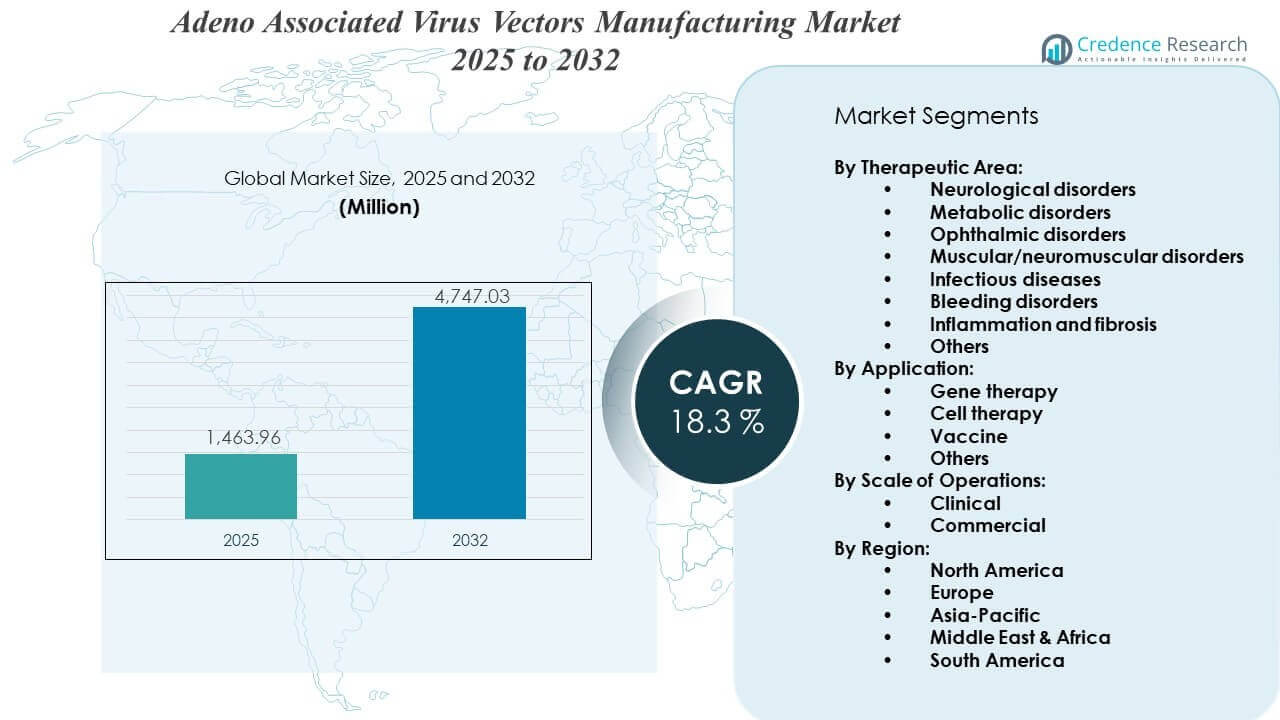
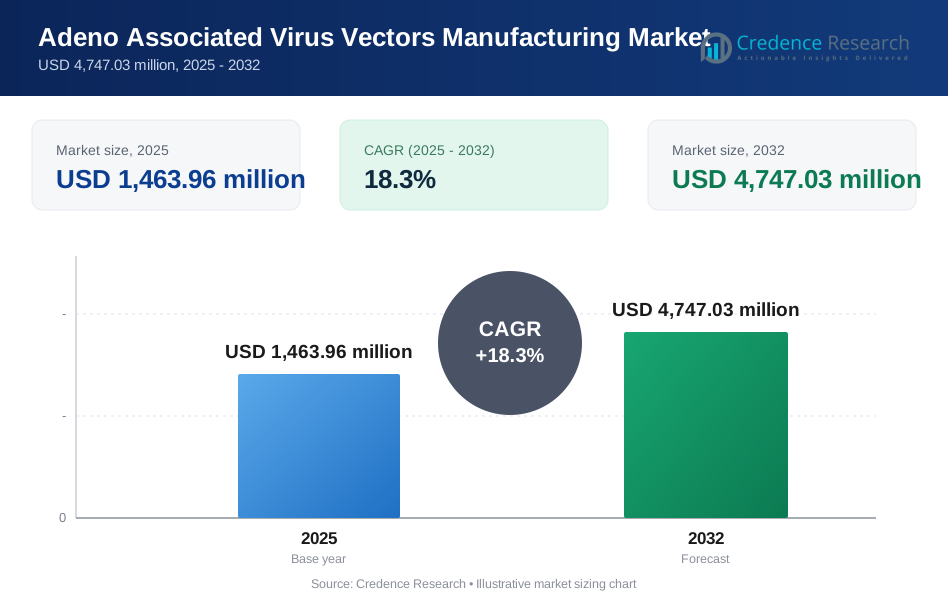
The Adeno Associated Virus (AAV) Vectors Manufacturing Market is projected to grow from USD 1,463.96 million in 2025 to an estimated USD 4,747.03 million by 2032, with a compound annual growth rate (CAGR) of 18.3% from 2025 to 2032.
| REPORT ATTRIBUTE | DETAILS |
|---|---|
| Historical Period | 2020-2023 |
| Base Year | 2024 |
| Forecast Period | 2025-2032 |
| Adeno Associated Virus (AAV) Vectors Manufacturing Market Size 2025 | USD 1,463.96 million |
| Adeno Associated Virus (AAV) Vectors Manufacturing Market CAGR | 18.3% |
| Adeno Associated Virus (AAV) Vectors Manufacturing Market Size 2032 | USD 4,747.03 million |
The market is driven by the expanding pipeline of gene therapies and increased regulatory approvals. As pharmaceutical companies invest in scalable and GMP-compliant production platforms, AAV vectors are becoming the preferred delivery system for targeted gene therapy. Manufacturing technologies have advanced toward higher-yield cell lines and more efficient purification methods. Partnerships between biotech firms and contract development and manufacturing organizations (CDMOs) further support capacity expansion. The rising incidence of genetic disorders and rare diseases adds urgency for scalable vector solutions across preclinical to commercial stages.
North America leads the market, driven by strong biotech funding, regulatory support, and established players in the U.S. Europe follows due to government incentives and clinical research activity. Meanwhile, the Asia-Pacific region is emerging rapidly, especially in China and Japan, owing to increased local biotech ventures and infrastructure investments in biomanufacturing. These dynamics reflect a global push toward accessible and effective gene therapies powered by AAV vector platforms.
Market Insights:
- The Adeno Associated Virus Vectors Manufacturing Market was valued at USD 1,463.96 million in 2025 and is projected to reach USD 4,747.03 million by 2032, growing at a CAGR of 18.3% from 2025 to 2032.
- North America led the market with a 44% share in 2025, driven by strong clinical pipelines, early product approvals, and robust biomanufacturing infrastructure. Europe followed with a 30% share due to centralized healthcare programs and leading CDMOs, while Asia-Pacific held 18% supported by regional investments and rising clinical activity.
- Asia-Pacific is the fastest-growing region with 18% share, fueled by expanding biomanufacturing hubs in China, Japan, and South Korea, along with supportive government policies and local biotech scaling.
- By application, gene therapy dominated the market in 2025 with over 60% share, supported by increasing adoption in monogenic and rare disease treatment.
- In terms of scale, clinical operations accounted for more than 65% of market share in 2025, reflecting the concentration of AAV usage in trial-stage programs.
Market Drivers:
Rising Gene Therapy Pipelines Across Rare and Chronic Disease Areas
The global focus on gene therapy is expanding rapidly across multiple therapeutic segments, including rare genetic disorders, oncology, and neurodegenerative diseases. Biopharmaceutical companies are prioritizing Adeno Associated Virus Vectors Manufacturing Market to support clinical trials and new product approvals. Governments and regulatory bodies are fast-tracking approvals, enabling faster translation from labs to clinics. This demand fuels the need for scalable, high-yield AAV vector production technologies. The surge in personalized medicine is also prompting investment in tailored viral vectors. Research institutions and startups contribute to this growth through preclinical innovations. Venture capital is actively flowing into companies with AAV vector development capabilities. The Adeno Associated Virus Vectors Manufacturing Market benefits directly from this ecosystem of clinical innovation and regulatory support.
- For instance, Sarepta Therapeutics reported that Elevidys has been administered to over 1,100 patients globally across clinical and real-world settings as of late 2025. This scale supports a pipeline of over 40 programs, though the company underwent a strategic restructuring in mid-2025 to prioritize high-impact assets following safety-related clinical holds and manufacturing quality write-offs.
Expanding Partnerships with CDMOs for Scalable Manufacturing Support
Contract development and manufacturing organizations (CDMOs) play a critical role in expanding vector production capabilities. Companies lacking in-house GMP manufacturing rely on external partnerships to meet project timelines. This model supports both early-stage firms and large pharmaceutical companies. CDMOs are investing in advanced bioreactors and purification platforms to handle diverse AAV serotypes. These facilities often operate under regulatory-compliant frameworks that accelerate market readiness. Their flexible capacity models also suit fluctuating project volumes. It helps reduce the upfront infrastructure burden on therapy developers. The Adeno Associated Virus Vectors Manufacturing Market gains efficiency and speed through these outsourced collaborations.
Technological Advancements in Upstream and Downstream AAV Processing
Continuous improvements in upstream cell culture systems and downstream purification techniques are critical growth drivers. High-density cell lines and scalable suspension cultures now enable better productivity. Chromatography advancements reduce vector loss while ensuring purity. Companies are focusing on modular production lines that can be rapidly adapted to different serotypes. These developments lower cost per dose and enhance quality consistency. Automated systems also minimize human error and improve batch traceability. It supports regulatory compliance and facilitates global distribution. The Adeno Associated Virus Vectors Manufacturing Market grows stronger with each new wave of process optimization.
- For instance, Oxford Biomedica has reported achieving multi‑fold improvements in AAV vector yield through optimized producer cell lines and proprietary downstream purification processes deployed at its Oxbox GMP manufacturing facilities.
Growing Focus on Pediatric and Rare Disease Applications Worldwide
Pediatric patients often benefit significantly from gene therapy using AAV vectors due to early disease onset. Rare disease communities are highly engaged and push for fast-track treatments. Regulators are offering incentives, such as orphan drug status and priority review vouchers. These programs motivate developers to increase investments in AAV vector manufacturing. It promotes the growth of tailored, smaller-batch production platforms. National health agencies are funding pilot programs and cross-border initiatives. These efforts build momentum for both public and private manufacturers. The Adeno Associated Virus Vectors Manufacturing Market aligns with this rising global focus on therapeutic equity and rare disease access.
Market Trends:
Shifting Toward Next-Generation Serotypes and Capsid Engineering
Researchers are developing new AAV serotypes that improve targeting precision and reduce immune responses. These serotypes allow for more effective delivery across tissues such as the liver, CNS, and muscles. Capsid engineering helps evade pre-existing immunity in patients, improving therapeutic outcomes. Companies are investing in platform technologies to develop proprietary capsid libraries. It allows more flexibility for customizing gene therapies for specific populations. The Adeno Associated Virus Vectors Manufacturing Market is adjusting to accommodate these complex, next-generation vectors. Innovation in capsid design also supports expanded use in oncology and cardiovascular therapy. These advancements bring both opportunities and complexity to the market.
- For instance, Dyno Therapeutics published peer‑reviewed data demonstrating engineered AAV capsids achieving more than tenfold improvement in CNS transduction compared with conventional AAV9 in preclinical models.
Integration of AI and Automation in Vector Manufacturing Workflows
AI tools now support various stages of AAV vector production, from process design to quality control. Predictive analytics help monitor cell growth and optimize batch yield. Automation systems reduce manual errors and streamline GMP documentation. Smart bioreactors adjust parameters in real-time, ensuring consistent vector expression. Companies are using digital twins to simulate production cycles before scaling. It increases manufacturing predictability and reduces wastage. The Adeno Associated Virus Vectors Manufacturing Market is moving toward a digitally integrated environment. These upgrades improve regulatory compliance and shorten time-to-market.
- For instance, Charles River Laboratories has disclosed the use of automated analytics and digital process monitoring across hundreds of viral vector development and GMP manufacturing batches annually within its cell and gene therapy services.
Emergence of Decentralized Manufacturing Models and Modular Facilities
Biotech firms are exploring decentralized production models to reduce logistical risk and improve supply chain control. Modular facilities allow rapid setup of GMP-compliant units near key clinical or commercial hubs. It supports faster delivery timelines and adapts to regional regulatory needs. Companies can scale locally without relying on centralized global facilities. These trends are vital for meeting urgent demand in cell and gene therapy programs. The Adeno Associated Virus Vectors Manufacturing Market is responding with flexible infrastructure solutions. Governments are also supporting local biomanufacturing through policy and funding initiatives. Modular architecture is expected to become standard in future expansions.
Rise in Dual-Use Platforms for AAV Manufacturing and Non-Viral Modalities
Companies are designing manufacturing platforms that support both AAV vectors and emerging non-viral systems. These dual-use lines reduce CAPEX and improve ROI. Shared infrastructure helps organizations pivot between technologies based on therapy needs. CDMOs are adopting hybrid production models to attract a broader client base. The Adeno Associated Virus Vectors Manufacturing Market benefits from this versatility in service offerings. It also supports faster technology transitions and risk mitigation. Firms are developing standardized cleanroom formats that fit different vector modalities. This trend increases operational agility in a dynamic therapeutic landscape.
Market Challenges Analysis:
High Cost and Technical Complexity Associated with Large-Scale Vector Production
Scaling up AAV vector manufacturing involves significant technical hurdles and cost burdens. The process requires stringent quality control, customized equipment, and skilled personnel. Bioreactor contamination and batch inconsistency remain major risks during scale-up. Purification processes demand high efficiency while preserving vector integrity. Companies often struggle to balance scalability with compliance and profitability. These challenges are especially acute for small firms with limited funding. It affects production timelines and increases per-unit therapy cost. The Adeno Associated Virus Vectors Manufacturing Market must navigate these technical bottlenecks to achieve broader commercialization.
Limited Availability of Raw Materials and Manufacturing Expertise Globally
Critical raw materials such as plasmids, reagents, and cell lines are subject to supply chain disruptions. Regional shortages can delay batch production or increase material costs. Skilled technicians and engineers with AAV-specific experience remain in short supply. This limits how quickly companies can expand or optimize manufacturing sites. New entrants face long onboarding periods for workforce and vendor setup. It impacts global consistency in product quality and delivery timelines. The Adeno Associated Virus Vectors Manufacturing Market continues to face structural constraints that slow down manufacturing growth.
Market Opportunities:
Expansion in Emerging Markets to Build Localized Biomanufacturing Ecosystems
Biotech investment is rising in Asia-Pacific, Latin America, and the Middle East. These regions offer strong demand from underserved patient populations. Governments are funding biotech zones and easing approval frameworks. Firms entering these areas can benefit from cost-effective operations and regulatory incentives. It helps diversify supply chains and bring therapies closer to target populations. The Adeno Associated Virus Vectors Manufacturing Market can unlock value by tapping regional strengths.
Adoption of Platform Manufacturing Technologies for Multi-Therapy Pipelines
Platform manufacturing technologies enable faster switching between therapies while using the same infrastructure. These systems support economies of scale and reduce batch failures. Companies can adapt quickly to pipeline changes or market shifts. It boosts flexibility and long-term operational efficiency. The Adeno Associated Virus Vectors Manufacturing Market is well-positioned to grow through such adaptable models.
Market Segmentation Analysis:
Therapeutic Area Segmentation Highlights Diverse Clinical Applications
The Adeno Associated Virus Vectors Manufacturing Market spans a broad spectrum of therapeutic areas. Neurological disorders remain a major segment due to increasing gene therapy approvals targeting spinal muscular atrophy and Parkinson’s. Metabolic and muscular/neuromuscular disorders are growing focus areas as genetic delivery systems gain traction in treating enzyme deficiencies and muscle degeneration. Ophthalmic disorders benefit from localized vector delivery and high clinical success rates. Infectious diseases, bleeding disorders, inflammation, and fibrosis also present demand for scalable AAV platforms. Manufacturers tailor vector designs to match disease-specific tropism. This diversification stabilizes long-term demand. It supports varied R&D pipelines globally.
- For instance, Spark Therapeutics reported sustained multi‑year retinal gene expression following single‑dose AAV administration in clinical studies for inherited retinal dystrophy cited in FDA approval documents.
Application-Wise Adoption Signals Strength in Gene and Cell Therapy Development
Gene therapy dominates the application segment due to the established use of AAV vectors in monogenic disease treatment. Cell therapy follows closely, particularly in ex vivo gene editing applications. Vaccine development using AAV vectors remains limited but strategic for certain infectious targets. The growing acceptance of AAV in regulatory pathways has boosted its clinical value. Researchers are also exploring AAV vectors for immune modulation. It positions the Adeno Associated Virus Vectors Manufacturing Market as a crucial enabler for next-generation treatments. Flexibility across therapeutic formats supports widespread market adoption.
- For instance, Pfizer disclosed clinical data showing sustained clotting factor expression beyond three years in hemophilia patients treated with its AAV‑based gene therapy candidates.
Scale of Operations Reflects Maturity of Clinical and Commercial Pipelines
The clinical-scale segment remains the largest due to the high number of early- and mid-stage trials. Manufacturers are optimizing batch sizes and quality systems tailored to small patient populations. Commercial-scale operations are expanding, driven by recent gene therapy product launches. Transitioning from clinical to commercial production requires investment in process validation and regulatory alignment. Companies build dedicated lines for late-stage programs. It encourages faster scale-up after approval. The Adeno Associated Virus Vectors Manufacturing Market supports both phases with increasing infrastructure and technology readiness.
Segmentation:
By Therapeutic Area:
- Neurological disorders
- Metabolic disorders
- Ophthalmic disorders
- Muscular/neuromuscular disorders
- Infectious diseases
- Bleeding disorders
- Inflammation and fibrosis
- Others
By Application:
- Gene therapy
- Cell therapy
- Vaccine
- Others
By Scale of Operations:
- Clinical
- Commercial
By Region:
- North America
- U.S.
- Canada
- Mexico
- Europe
- Germany
- France
- U.K.
- Italy
- Spain
- Rest of Europe
- Asia Pacific
- China
- Japan
- India
- South Korea
- South-east Asia
- Rest of Asia Pacific
- Latin America
- Brazil
- Argentina
- Rest of Latin America
- Middle East & Africa
- GCC Countries
- South Africa
- Rest of the Middle East and Africa
Regional Analysis:
North America Leads with Strong R&D Base and Commercial Activity
North America holds the largest share of the Adeno Associated Virus Vectors Manufacturing Market, accounting for over 44% of global revenue. The United States drives this dominance through its advanced biopharmaceutical sector, strong regulatory infrastructure, and early adoption of gene therapies. Major players such as Pfizer, Sarepta Therapeutics, and Charles River operate large-scale AAV vector facilities across the region. The market benefits from consistent clinical trial funding, government grants, and public-private partnerships supporting rare disease research. It remains the preferred launchpad for first-to-market gene therapies due to favorable approval pathways and reimbursement models. The region continues to attract global CDMO investments, strengthening its leadership position.
Europe Shows Steady Growth Backed by Regulatory and Academic Support
Europe contributes around 30% of the global Adeno Associated Virus Vectors Manufacturing Market share. The region supports AAV development through robust academic networks and centralized healthcare systems that encourage early access programs. Countries like Germany, the UK, and France lead manufacturing capacity with support from organizations like EMA and Horizon Europe funding. Oxford Biomedica and GenScript (ProBio) play a significant role in regional production. Regulatory harmonization across member states improves cross-border clinical collaboration. It supports the rise of specialized facilities focused on neurological and ophthalmic indications. Despite cost pressures, Europe maintains a stable pipeline of AAV-based therapies.
Asia-Pacific Emerges as a Key Growth Engine with Infrastructure Expansion
Asia-Pacific holds nearly 18% share of the Adeno Associated Virus Vectors Manufacturing Market and is the fastest-growing region. China, Japan, and South Korea drive this growth through aggressive biomanufacturing expansion and policy-driven biotech support. Governments are investing in innovation parks and domestic CDMO capabilities to reduce dependency on Western suppliers. Local players partner with global firms to build capacity and access advanced vector technologies. It supports cost-effective production and accelerates entry into clinical stages. The region is attracting attention from international pharmaceutical companies looking to diversify supply chains and expand patient access in high-population countries.
Key Player Analysis:
- Hoffmann-La Roche Ltd
- Charles River Laboratories
- Oxford Biomedica PLC
- WuXi AppTec
- Pfizer Inc.
- Sarepta Therapeutics, Inc.
- Yposkesi, Inc.
- Genezen
- Creative Biogene
- GenScript (ProBio)
Competitive Analysis:
The Adeno Associated Virus Vectors Manufacturing Market is highly competitive, with leading pharmaceutical and biotech companies investing in process scalability, technology platforms, and regional expansion. Firms like Pfizer, Oxford Biomedica, WuXi AppTec, and Charles River maintain a strong foothold through vertically integrated production models and strategic CDMO offerings. New entrants are focusing on capsid engineering and hybrid vector platforms to differentiate. Established players are expanding GMP facilities to support both clinical and commercial demand. It rewards innovation, compliance strength, and speed-to-market capabilities. Intellectual property, automation, and regulatory alignment remain key competitive advantages. Market share is shifting toward players with end-to-end service capabilities.
Recent Developments:
- In October 2025, Oxford Biomedica PLC acquired a commercial‑scale viral vector manufacturing facility in North Carolina, U.S., strengthening its production footprint in the largest global market. This acquisition adds a GMP‑certified site capable of supporting both clinical and commercial AAV vector production, enabling the company to better serve contract clients and accelerate throughput for diverse viral platforms.
- In January 2025, Roche exercised an option with Dyno Therapeutics to license a novel AAV capsid for a neurological gene therapy program, originally from a 2020 collaboration. This builds on their October 2024 agreement for CNS treatments.
Report Coverage:
The research report offers an in-depth analysis based on Therapeutic Area, Application, Scale of Operations, and Region. It details leading market players, providing an overview of their business, product offerings, investments, revenue streams, and key applications. Additionally, the report includes insights into the competitive environment, SWOT analysis, current market trends, as well as the primary drivers and constraints. Furthermore, it discusses various factors that have driven market expansion in recent years. The report also explores market dynamics, regulatory scenarios, and technological advancements that are shaping the industry. It assesses the impact of external factors and global economic changes on market growth. Lastly, it provides strategic recommendations for new entrants and established companies to navigate the complexities of the market.
Future Outlook:
- The market will experience increased adoption of platform manufacturing systems that support multiple serotypes and therapy types across a single scalable infrastructure.
- More pharmaceutical companies will invest in in-house AAV production capabilities to reduce dependence on third-party CDMOs and improve IP security and process control.
- Clinical pipelines will expand for CNS, ophthalmic, and metabolic disorders, driving customization in vector design and capsid engineering.
- North America and Europe will continue leading approvals, while Asia-Pacific will emerge with fast-track capacity and regulatory frameworks that attract global partnerships.
- Regulatory authorities will refine guidelines specific to AAV vector characterization, potency assays, and long-term safety tracking, driving compliance-based innovation.
- Technological breakthroughs in AI-driven capsid optimization and vector deimmunization will unlock new therapeutic targets and improve patient response rates.
- Market players will adopt closed and automated systems to minimize contamination risks and reduce operational variability, especially in high-throughput GMP settings.
- Governments and private investors will fund local biomanufacturing hubs in emerging regions to improve access, reduce logistics costs, and strengthen pandemic preparedness.
- CDMOs offering hybrid service models—including vector engineering, analytics, and regulatory consulting—will gain significant market traction across early-stage clients.
- Sustainability will gain strategic importance, with companies investing in energy-efficient bioreactors, water recovery systems, and waste-reducing purification technologies.
Request a Free Sample
Fill in your details and we'll send you a free sample report.
- Sample data tables & charts
- Research methodology
Need a Custom Version of This Report?
Tailor the scope, geography, or segments to your exact requirements.
- Custom geography or segment scope
- Direct access to our analyst team
Frequently Asked Questions
What is the current market size for Adeno Associated Virus Vectors Manufacturing Market, and what is its projected size in 2032?
At what Compound Annual Growth Rate is the Adeno Associated Virus Vectors Manufacturing Market projected to grow between 2025 and 2032?
Which Adeno Associated Virus Vectors Manufacturing Market segment held the largest share in 2025?
What are the primary factors fueling the growth of the Adeno Associated Virus Vectors Manufacturing Market?
Who are the leading companies in the Adeno Associated Virus Vectors Manufacturing Market?
Which region commanded the largest share of the Adeno Associated Virus Vectors Manufacturing Market in 2025?
Table of Content
Chapter 1. Report Introduction
- 1.1 Report Description & Purpose
- 1.1.1 Report Title & Market Definition
- 1.1.2 Unique Selling Propositions (USP) & Key Differentiators
- 1.1.3 Value Proposition for Stakeholders
- 1.2 Research Objectives
- 1.2.1 Market Sizing Objectives (Volume & Revenue)
- 1.2.2 Segmentation Objectives
- 1.2.3 Competitive Intelligence Objectives
- 1.2.4 Forecast & Scenario Objectives
- 1.3 Report Scope
- 1.3.1 Adeno Associated Virus Vectors Manufacturing Scope – Types & Subtypes Covered
- 1.3.2 Geographic Scope – Regions & Countries Covered
- 1.3.3 Historical Period, Base Year & Forecast Period (2025; forecast to 2032)
- 1.3.4 Inclusions & Exclusions
- 1.4 HS Code & Classification Framework
- 1.5 Currency, Units & Pricing Basis
- 1.6 Target Stakeholders
- 1.7 Limitations & Assumptions
Chapter 2. Executive Summary
- 2.1 Global Adeno Associated Virus Vectors Manufacturing Market Snapshot
- 2.1.1 Market Size – Historical (2025) & Forecast (2025-2032) (2025: USD 1,463.96 million → 2032: USD 4,747.03 million)
- 2.1.2 Volume & Revenue – Global Totals
- 2.1.3 Key Market Highlights – Top Five Facts
- 2.2 Adeno Associated Virus Vectors Manufacturing Market Segmentation Snapshot
- 2.2.1 Market Split by Region – 2025 vs. 2032
- 2.3 Competitive Snapshot
- 2.3.1 Top 10 Players by Revenue Share – 2025
- 2.3.2 Top 10 Players by Volume Share – 2025
- 2.3.3 Recent Strategic Developments (18-Month Summary)
- 2.4 Key Investment Highlights & Strategic Conclusions
Chapter 3. Adeno Associated Virus Vectors Manufacturing Market Dynamics & Industry Analysis
- 3.1 Market Overview & Context
- 3.1.1 Adeno Associated Virus Vectors Manufacturing Market Position in the Broader Automotive Value Chain
- 3.1.2 OEM vs. Replacement Market Dynamics
- 3.1.3 Market Maturity & Development Stage by Region
- 3.2 Adeno Associated Virus Vectors Manufacturing Market Drivers
- 3.3 Adeno Associated Virus Vectors Manufacturing Market Restraints & Challenges
- 3.4 Adeno Associated Virus Vectors Manufacturing Market Opportunities
- 3.5 Porter's Five Forces Analysis
- 3.5.1 Threat of New Entrants
- 3.5.2 Bargaining Power of Suppliers
- 3.5.3 Bargaining Power of Buyers
- 3.5.4 Threat of Substitutes
- 3.5.5 Competitive Rivalry – Intensity Assessment
- 3.6 Adeno Associated Virus Vectors Manufacturing Value Chain Analysis
- 3.6.1 Upstream – Raw Material/Input Suppliers
- 3.6.1.1 Raw Material/Input 1
- 3.6.1.2 Raw Material/Input 2
- 3.6.1.3 Raw Material/Input 3
- 3.6.2 Midstream – Production/Manufacturing/Service Delivery
- 3.6.2.1 Production/Process Overview
- 3.6.2.2 Key Facility Locations & Capacity by Manufacturer
- 3.6.3 Downstream – Distribution & End Consumer
- 3.6.3.1 Primary Channel – B2B/OEM
- 3.6.3.2 Secondary Channels – Dealer, Retail, Online, Direct
- 3.6.4 Value Chain Profitability Analysis
- 3.6.1 Upstream – Raw Material/Input Suppliers
- 3.7 PESTEL Analysis
- 3.7.1 Political Factors
- 3.7.2 Economic Factors
- 3.7.3 Social Factors
- 3.7.4 Technological Factors
- 3.7.5 Environmental Factors
- 3.7.6 Legal Factors
- 3.8 Adeno Associated Virus Vectors Manufacturing Supply Chain Analysis
- 3.8.1 Raw Material/Input Supply Risk Assessment
- 3.8.2 Manufacturing Concentration Risk (Geographic Exposure)
- 3.8.3 Trade Disruption Impact Analysis
- 3.9 Regulatory & Policy Landscape
Note: The regulatory and policy landscape section covers regulations based on their applicability to the market, Adeno Associated Virus Vectors Manufacturing category, geography, and scope of the study. Only regulatory frameworks with a material impact on operations, compliance, trade, sustainability, or market access are analyzed in detail.
Chapter 4. Key Investment Pockets & Opportunity Analysis
- 4.1 Adeno Associated Virus Vectors Manufacturing Market Attractiveness Analysis
- 4.1.1 By Region – Investment Attractiveness Matrix (Volume × CAGR)
- 4.2 Absolute Revenue Growth Opportunity
- 4.2.1 By Region – Absolute USD Growth Through 2032
- 4.3 Incremental Volume Opportunity
- 4.3.1 By Region – Incremental Volume Through 2032
- 4.3.2 Segment – Incremental Volume
- 4.4 Emerging Submarket Opportunity Deep Dive (Subject to Applicability)
- 4.5 Emerging Market Opportunity Scorecards
- 4.5.1 United States
- 4.5.2 Europe
- 4.5.3 Asia
- 4.5.4 Middle East & Africa
Note: Emerging Market Opportunity Scorecards will be included based on relevance and strategic importance. Regions listed are indicative and may vary depending on data availability and market dynamics.
Chapter 5. Adeno Associated Virus Vectors Manufacturing Import-Export Analysis & Trade Flows
- 5.1 Global Trade Overview
- 5.1.1 Global Export Value by Country (2025)
- 5.1.2 Global Export Volume by Country (2025)
- 5.1.3 Global Import Value by Country (2025)
- 5.1.4 Global Import Volume by Country (2025)
- 5.1.5 Net Trade Balance by Country (2025)
- 5.2 Export Analysis – Segment
- 5.2.1 Type 1 (HS Code)
- 5.2.2 Type 2 (HS Code)
- 5.2.3 Type 3 (HS Code)
- 5.2.4 Type 4 (HS Code)
- 5.2.5 Type 5 (HS Code)
- 5.3 Import Analysis – Segment
- 5.3.1 Type 1 (HS Code)
- 5.3.2 Type 2 (HS Code)
- 5.3.3 Type 3 (HS Code)
- 5.3.4 Type 4 (HS Code)
- 5.3.5 Type 5 (HS Code)
- 5.4 Average Unit Trade Prices
- 5.4.1 Average Export Price – Segment & Country
- 5.4.2 Average Import Price – Segment & Source Country
- 5.4.3 Price Trends (2025)
- 5.5 Key Trade Route Analysis
- 5.5.1 Trade Route 1
- 5.5.2 Trade Route 2
- 5.5.3 Trade Route 3
- 5.5.4 Trade Route 4
- 5.5.5 Trade Route 5
- 5.6 Trade Policy Impact Assessment
- 5.6.1 US Anti-Dumping & Section 301 Tariffs
- 5.6.2 EU Customs Union Impact
- 5.6.3 Major Free Trade Agreements
- 5.6.4 USMCA Rules of Origin
Note: Trade policy analysis will be included only where relevant to the Adeno Associated Virus Vectors Manufacturing market.
Chapter 6. Competitive Landscape & Company Benchmarking
- 6.1 Adeno Associated Virus Vectors Manufacturing Market Concentration & Structure
- 6.1.1 Herfindahl-Hirschman Index (HHI) – vs. 2025
- 6.1.2 Tier 1, Tier 2 & Tier 3 Market Structure
- 6.1.3 Global, Regional & Local Player Dynamics
- 6.2 Adeno Associated Virus Vectors Manufacturing Market Share Analysis – 2025
- 6.2.1 Global Revenue Share by Company
- 6.2.2 Global Volume Share by Company
- 6.2.3 Regional Revenue Share
- 6.2.4 Market Share Evolution ( vs. 2025)
- 6.2.5 OEM Segment Share by Company
- 6.2.6 Replacement Segment Share by Company
- 6.3 Production/Delivery Capacity & Facility Analysis
- 6.3.1 Global Installed Capacity
- 6.3.2 Capacity Utilization Rates
- 6.3.3 Production/Output Volume
- 6.3.4 Facility Locations & Capacity Map
- 6.3.5 Planned Capacity Additions
- 6.4 Adeno Associated Virus Vectors Manufacturing Competitive Benchmarking Matrix
- 6.4.1 Revenue, Volume, CAGR & Profitability Comparison
- 6.4.2 Channel Revenue Mix
- 6.4.3 Geographic Revenue Exposure
- 6.4.4 R&D Intensity
- 6.4.5 Sustainability Maturity
- 6.5 Strategic Developments in Adeno Associated Virus Vectors Manufacturing (Last 24 Months)
- 6.5.1 Mergers, Acquisitions & Divestments
- 6.5.2 New Adeno Associated Virus Vectors Manufacturing Launches
- 6.5.3 Facility Expansions
- 6.5.4 Strategic Alliances, Joint Ventures & Partnerships
- 6.5.5 Distribution Expansion & Market Entry
- 6.5.6 Sustainability & ESG Initiatives
- 6.6 Competitive Strategy Mapping
- 6.6.1 Leader, Challenger, Follower & Niche Classification
- 6.6.2 Pricing Strategy Comparison
- 6.6.3 Channel Strategy Matrix
Note: Strategic developments are included based on their materiality and the availability of reliable information.
Chapter 7. Global Adeno Associated Virus Vectors Manufacturing Market – By Distribution Channel
- 7.1 Segment Overview
- 7.1.1 Volume & Revenue Split by Channel (2025 & 2032)
- 7.1.2 Channel Mix Evolution (2025-2032)
Chapter 8. Regional Market Analysis – Global Overview
- 8.1 Global Regional Overview
- 8.1.1 Regional Volume Share
- 8.1.2 Regional Revenue Share
- 8.1.3 Regional Volume by Region
- 8.1.4 Regional Revenue by Region
- 8.1.5 Regional Forecast Through 2032
- 8.2 Cross-Regional Segment Analysis
- 8.2.1 By Distribution Channel
- 8.2.2 By Brand/Price Tier
Chapter 9. North America Adeno Associated Virus Vectors Manufacturing Market
- 9.1 United States
- 9.2 Canada
- 9.3 Mexico
Chapter 10. Europe Adeno Associated Virus Vectors Manufacturing Market
- 10.1 Germany
- 10.2 France
- 10.3 Italy
- 10.4 United Kingdom
- 10.5 Spain
- 10.6 Poland
- 10.7 Russia
- 10.8 Netherlands
- 10.9 Belgium
- 10.10 Sweden
- 10.11 Denmark
- 10.12 Norway
- 10.13 Rest of Europe
Chapter 11. Asia Pacific Adeno Associated Virus Vectors Manufacturing Market
- 11.1 China
- 11.2 India
- 11.3 Japan
- 11.4 South Korea
- 11.5 Thailand
- 11.6 Indonesia
- 11.7 Vietnam
- 11.8 Malaysia
- 11.9 Australia
- 11.10 Rest of Asia Pacific
Chapter 12. Latin America Adeno Associated Virus Vectors Manufacturing Market
- 12.1 Brazil
- 12.2 Argentina
- 12.3 Colombia
- 12.4 Chile
- 12.5 Rest of Latin America
Chapter 13. Middle East Adeno Associated Virus Vectors Manufacturing Market
- 13.1 Saudi Arabia
- 13.2 United Arab Emirates
- 13.3 Turkey
- 13.4 Israel
- 13.5 Iran
- 13.6 Rest of the Middle East
Chapter 14. Africa Adeno Associated Virus Vectors Manufacturing Market
- 14.1 South Africa
- 14.2 Egypt
- 14.3 Nigeria
- 14.4 Morocco
- 14.5 Rest of Africa
Chapter 15. Adeno Associated Virus Vectors Manufacturing Company Profiles
- 15.1 [Company 01]
- 15.1.1 Company Overview
- 15.1.2 Key Management Personnel
- 15.1.3 Products & Services Portfolio
- 15.1.4 Financial Performance
- 15.1.5 Key Market Focus & Geographic Presence
- 15.1.6 Recent Developments & Strategic Initiatives
Note: The company profile list is preliminary and may change based on research findings, market developments, data availability, and client requirements.
Chapter 16. Appendices
- Appendix A – List of Abbreviations & Acronyms
- Appendix B – Industry Classification Code Reference – Full Series
- Appendix C – Production & Capacity Data Tables
- Appendix D – End-Use & Demand Base Tables
- Appendix E – Consumption & Replacement Rate Assumptions
- Appendix F – ASP Reference Tables
- Appendix G – Manufacturing & Facility Database
- Appendix H – Import-Export Data Tables
- Appendix I – Regulatory Summary Tables
- Appendix J – Primary Research Participant List (Anonymized)
- Appendix K – Primary Research Questionnaire Framework
- Appendix L – Data Sources & Bibliography
- Appendix M – Market Size Divergence & Source Comparison
Chapter 17. Research Methodology
- 17.1 Research Framework & Philosophy
- 17.2 Secondary Research – Sources, Hierarchy & Data Extraction
- 17.3 Data Modeling – Bottom-Up & Top-Down Market Sizing
- 17.4 Primary Research – Stakeholder Framework, LOI & Sample Sizes
- 17.5 Forecast Methodology – Regression, Scenario & Sensitivity Analysis
- 17.6 Quality Control – Four-Layer Validation Framework
- 17.7 Limitations & Standard Assumptions
- 17.8 Disclaimer
