
Market Overview:
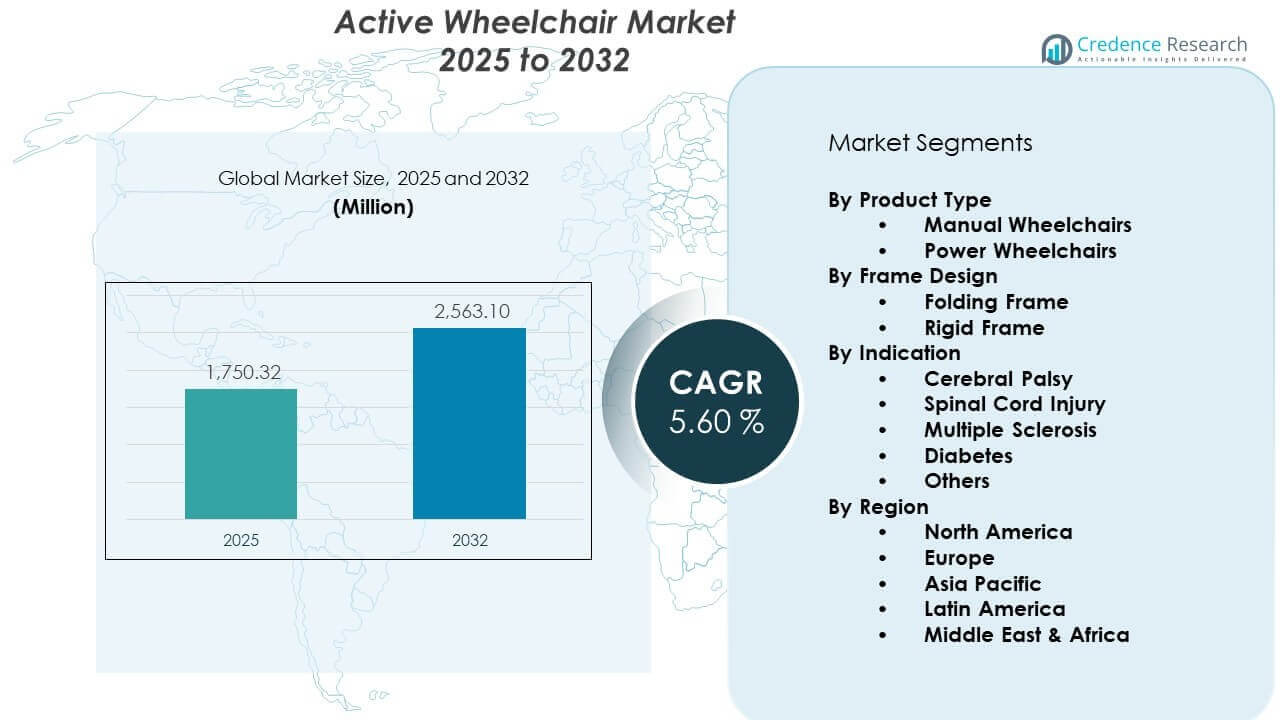
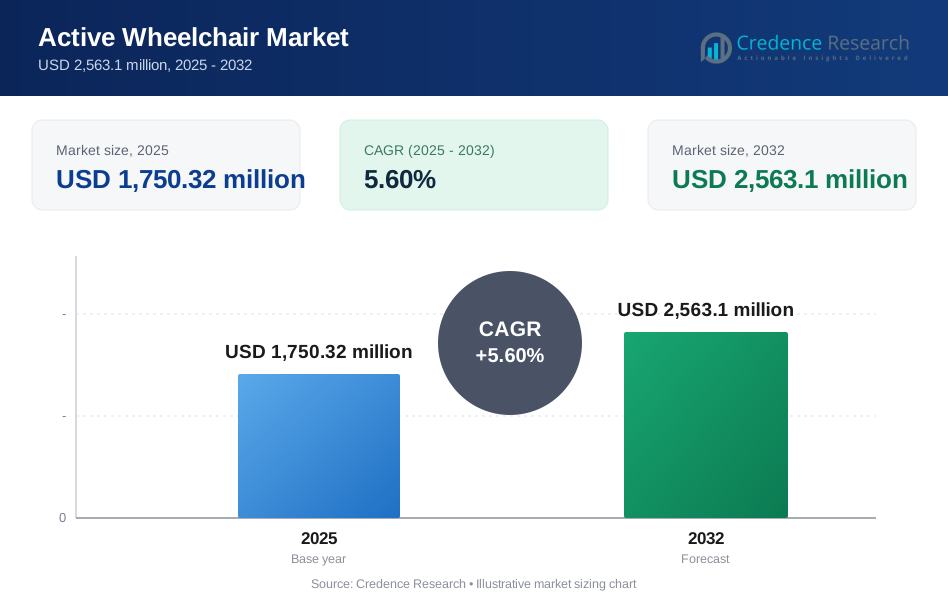
The Active Wheelchair Market is projected to grow from USD 1,750.32 million in 2025 to an estimated USD 2,563.1 million by 2032, with a compound annual growth rate (CAGR) of 5.60% from 2025 to 2032.
| REPORT ATTRIBUTE | DETAILS |
|---|---|
| Historical Period | 2020-2023 |
| Base Year | 2024 |
| Forecast Period | 2025-2032 |
| Active Wheelchair Market Size 2025 | USD 1,750.32 million |
| Active Wheelchair Market, CAGR | 5.60% |
| Active Wheelchair Market Size 2032 | USD 2,563.1 million |
A growing aging population, rising rates of mobility-related disabilities, and increasing demand for independent movement are driving the active wheelchair market. Technological advances in lightweight materials and ergonomic design are improving comfort, durability, and control. Users increasingly seek active wheelchairs for sports, recreation, and day-to-day use, especially those with spinal injuries or muscular disorders. Healthcare reimbursement support and expanded access through hospitals, rehabilitation centers, and e-commerce platforms are also fueling demand. Innovation in custom-fit solutions and smart add-ons is further enhancing product appeal. As patients look for solutions that boost both mobility and independence, the market is seeing steady uptake across both developed and developing healthcare systems.
North America leads the market due to strong healthcare infrastructure, higher awareness, and presence of key manufacturers. Europe follows with growing focus on rehabilitation and disability inclusion. In the Asia Pacific region, emerging economies like India and China are expanding access to assistive technologies, driven by government programs and rising disability rates. Latin America and the Middle East & Africa show improving adoption trends as healthcare access widens. The market reflects a global push toward personalized, user-driven mobility solutions.
Market Insights:
- The Active Wheelchair Market is projected to grow from USD 1,750.32 million in 2025 to USD 2,563.1 million by 2032, at a CAGR of 5.60% from 2025 to 2032.
- North America (37%), Europe (28%), and Asia Pacific (22%) lead the market due to strong healthcare systems, early adoption, and growing disability inclusion efforts.
- Asia Pacific is the fastest-growing region, driven by rising chronic conditions, expanding rehabilitation access, and government support across India, China, and Southeast Asia.
- Manual wheelchairs hold the largest product type share at 60–65%, favored for affordability, mobility, and day-to-day use across age groups.
- Folding frame designs dominate with over 55% share, preferred for portability, ease of transport, and compatibility with caregiver support systems.
Market Drivers:
Rising Global Demand for Personalized Mobility Devices to Support Independent Living
The increasing global population of individuals with mobility impairments is creating higher demand for functional and independent transport solutions. Active wheelchairs are becoming essential tools for users who seek agility and comfort without depending on assistance. The product category now includes lightweight frames, energy-efficient wheels, and customizable seating for daily movement. The [Active Wheelchair Market] benefits from a shift toward personal empowerment and lifestyle mobility. Patients recovering from injuries or with chronic disorders increasingly choose active models over traditional ones. They prioritize usability in outdoor and indoor settings, which fuels innovation in all product types. Healthcare practitioners recommend these models to improve physical and emotional well-being. Insurers in developed nations also promote such devices, which accelerates usage and market penetration.
- For instance, the RGK Veypr Sub4 by Sunrise Medical features a frame constructed from four layers of carbon fiber and is built using over 30 individual measurements to ensure a precise fit for the user.
Technological Innovations Supporting Ergonomic Designs and Lightweight Materials
Manufacturers are integrating aerospace-grade materials, compact wheel technologies, and shock-absorbing suspensions into modern wheelchairs. These innovations reduce fatigue for users and improve handling across varied terrains. The [Active Wheelchair Market] is advancing through improvements in weight-to-strength ratios and adjustable design features. Several models now support high-mobility sports, encouraging physical activity among users. New propulsion systems and responsive braking give users greater control without compromising stability. Smart features like activity tracking and position memory also influence buying behavior. The demand for ultra-light carbon fiber frames continues to grow, especially among younger users. These developments are helping manufacturers meet rising performance expectations.
- For instance, Sunrise Medical’s QUICKIE QS5 X features a FreeFold mechanism requiring over 40 % less force to fold relative to traditional folding models, improving convenience and portability.
Favorable Government Policies and Rehabilitation Infrastructure Expansion
Many countries are improving disability welfare programs, which expands access to mobility aids. Procurement policies, tax subsidies, and reimbursements are making active wheelchairs affordable to larger populations. The [Active Wheelchair Market] benefits from initiatives that integrate rehabilitation into public health systems. New clinics and therapy centers invest in high-performance mobility products to meet patient recovery targets. Emerging markets are also including mobility equipment in insurance schemes. Partnerships between government bodies and NGOs promote distribution in underserved areas. Import duty relaxations and grants on assistive devices further support growth in mid- and low-income nations. These supportive frameworks help normalize assistive mobility in everyday life.
Rising Sports Participation and Lifestyle Mobility Preferences Among Younger Users
Young adults with physical disabilities are turning to active wheelchairs for competitive sports, outdoor recreation, and lifestyle independence. This group demands dynamic and durable equipment suited for quick movement. The [Active Wheelchair Market] has expanded its offerings to include models with enhanced maneuverability and speed. Global events like the Paralympics spotlight performance chairs and increase market visibility. Customization in seat dimensions, caster wheels, and frame angles enhances comfort during long usage hours. Youth-focused designs are influencing broader consumer appeal. Social media visibility also helps spread awareness and product interest. This cultural shift supports active living through advanced wheelchair design.
Market Trends:
Growing Integration of Smart Assistive Technologies in High-End Models
Technology developers are embedding sensors and software into active wheelchairs to track usage patterns, monitor health, and optimize performance. These tools enhance user independence and improve safety during travel. The [Active Wheelchair Market] is shifting toward models that offer features like tilt monitoring, GPS navigation, and caregiver connectivity. Smartphone apps allow users to adjust chair settings and review their movement history. Some products now offer AI-based controls for easier terrain adaptation. Remote troubleshooting and diagnostics reduce maintenance concerns. Battery monitoring and push-assist systems also improve user experience. These advancements create new value in both home and clinical applications.
- For instance, Permobil’s SmartDrive with PushTracker E3 utilizes Bluetooth technology to reduce manual pushing by up to 80%, allowing users to travel up to 19.3 km on a single charge while monitoring over 10 different performance metrics via the Apple Watch integration.
Expansion of Direct-to-Consumer Sales Channels with E-Commerce Growth
Consumers are increasingly purchasing active wheelchairs online, bypassing traditional hospital supply chains. Digital platforms provide detailed product specifications, reviews, and customization options. The [Active Wheelchair Market] is witnessing a shift in distribution, with manufacturers improving virtual consultation and delivery systems. Startups and niche brands benefit from lower entry barriers online. E-commerce enables quicker access to upgrades and replacement parts. Marketing campaigns on social platforms raise awareness across younger demographics. Retailers now offer try-at-home options and flexible return policies. This trend supports broader product visibility and boosts user engagement.
Increased Focus on Aesthetics, Design Personalization, and Color Variants
Consumers are treating mobility devices as lifestyle products, not just medical tools. There is growing demand for visually appealing and personalized wheelchair designs. The [Active Wheelchair Market] is adapting by offering a wider range of color finishes, frame shapes, and seat materials. Custom branding and design elements are especially popular among sports users. Users can now select accessories like wheel covers, handles, and storage in themed styles. Style-conscious buyers expect sleek builds and minimalistic looks without sacrificing durability. Visual identity plays a key role in long-term product satisfaction. Manufacturers are investing in design teams to improve aesthetics alongside performance.
- For instance, Sunrise Medical’s Quickie brand offers the Nitrum series with over 32 distinct frame colors and 5 different accent colors, utilizing an "Open Frame" design that weighs as little as 7.5 kg, allowing for more than 1,000 possible aesthetic combinations to meet specific user lifestyle preferences.
Focus on Pediatric Active Wheelchairs and Early Mobility Support Solutions
Demand for pediatric active wheelchairs is rising due to better diagnosis of mobility challenges at early ages. These chairs feature adjustable frames, safety systems, and colorful designs that cater to children’s needs. The [Active Wheelchair Market] is addressing this segment with innovations in growth-accommodating products. Schools and pediatric clinics seek lightweight and foldable models for daily use. Rehabilitation centers prefer active solutions that promote child movement and self-confidence. Parents value features like easy portability and simple folding mechanisms. Brands are targeting younger age groups with educational campaigns and demo programs. This segment holds strong long-term value through early brand loyalty.
Market Challenges Analysis:
High Product Cost and Limited Access to Financing in Developing Economies
Despite rising demand, active wheelchairs remain unaffordable for many potential users. Advanced models with smart features or sports performance components command premium pricing. In low- and middle-income regions, few financing options exist to make these products accessible. The [Active Wheelchair Market] faces adoption barriers where insurance systems are weak or non-existent. Government subsidies are inconsistent across geographies, affecting import and distribution volume. NGOs fill some gaps, but availability often remains limited to urban areas. Healthcare institutions in rural zones lack the budget or infrastructure to offer diverse mobility options. This challenge limits growth and slows inclusion progress.
Lack of Trained Support Staff and Inadequate After-Sales Service Infrastructure
The use of active wheelchairs often requires professional guidance in configuration, fitting, and maintenance. In many regions, there is a shortage of trained therapists and technicians to assist users. The [Active Wheelchair Market] suffers when after-sales service fails to meet expectations. Delays in repair or lack of spare parts can discourage long-term use. Poor product knowledge among retailers leads to misinformed purchases. Some users may abandon devices that are not fitted properly or are difficult to maintain. This erodes trust in the product category and hinders user satisfaction. Reliable support systems are essential for sustainable market growth.
Market Opportunities:
Growing Demand for Customized and Modular Wheelchair Configurations Globally
Manufacturers can tap into the unmet need for chairs that adapt to different body types and lifestyles. Consumers seek products tailored to height, weight, activity level, and terrain use. The [Active Wheelchair Market] can expand by offering modular parts, interchangeable components, and design flexibility. Clinics and therapists also prefer adaptable products that support varying rehabilitation needs.
Rising Healthcare Investments and Disability Inclusion Programs in Emerging Markets
Countries in Asia Pacific, Latin America, and parts of Africa are investing in rehabilitation and elderly care. These programs create new funding channels and improve access to assistive technologies. The [Active Wheelchair Market] can grow by building local partnerships and training programs that ensure proper deployment and long-term usage.
Market Segmentation Analysis:
By Product Type
Manual wheelchairs dominate demand due to lightweight design, ease of use, and lower maintenance needs. Users prefer manual models for daily mobility, sports, and active lifestyles. Power wheelchairs address needs where upper body strength is limited or fatigue is common. These models support extended use and controlled movement across varied surfaces. The Active Wheelchair Market benefits from clear product differentiation that supports both independence-focused and assistance-focused users.
- For instance, Ottobock’s Zenit range includes ultra‑light manual wheelchairs with folding and rigid frame options engineered for direct energy transfer and efficient propulsion.
By Frame Design
Folding frame wheelchairs offer portability and storage convenience, which suits travel and home use. Caregivers and users value quick handling and transport flexibility. Rigid frame wheelchairs focus on performance, stability, and energy transfer. Athletes and highly active users prefer rigid designs for speed and control. This segment reflects growing demand for purpose-built mobility solutions.
- For instance, the Ottobock Avantgarde folding models offer a compact folded dimension of about 27 cm, enabling easier transport and storage without sacrificing load capacity.
By Indication Spinal cord injury represents a major application due to long-term mobility dependence and need for active movement. Cerebral palsy drives demand for customized and supportive seating systems. Multiple sclerosis users rely on adaptive designs that manage fatigue and balance issues. Diabetes-related mobility challenges increase demand among aging populations. Other indications include trauma recovery and degenerative conditions, which expand clinical and home use across diverse patient groups.
Segmentation:
By Product Type
- Manual Wheelchairs
- Power Wheelchairs
By Frame Design
- Folding Frame
- Rigid Frame
By Indication
- Cerebral Palsy
- Spinal Cord Injury
- Multiple Sclerosis
- Diabetes
- Others
By Region
- North America
- U.S.
- Canada
- Mexico
- Europe
- Germany
- France
- U.K.
- Italy
- Spain
- Rest of Europe
- Asia Pacific
- China
- Japan
- India
- South Korea
- South-east Asia
- Rest of Asia Pacific
- Latin America
- Brazil
- Argentina
- Rest of Latin America
- Middle East & Africa
- GCC Countries
- South Africa
- Rest of the Middle East and Africa
Regional Analysis:
North America Dominates Due to Early Adoption and Strong Insurance Ecosystem
North America holds the largest market share, accounting for approximately 37% of the global [Active Wheelchair Market]. The region leads in terms of product innovation, reimbursement coverage, and accessibility standards. Strong demand stems from a large elderly population and high awareness of mobility solutions. Companies based in the U.S. invest heavily in smart assistive technologies and ergonomic designs. Access to insurance support makes high-end products more affordable across various income groups. The presence of major manufacturers like Invacare and Pride Mobility also strengthens the regional supply chain.
Europe Shows Steady Growth with Strong Healthcare Integration
Europe contributes around 28% of the global market, backed by well-established healthcare systems and rehabilitation centers. Countries such as Germany, the UK, and France support wide adoption through social insurance schemes and disability inclusion programs. The market benefits from high product standards and emphasis on user comfort. It also shows growing interest in sports wheelchairs and pediatric mobility aids. Companies like Ottobock and MEYRA GmbH actively innovate for various patient needs. It continues to grow through government grants and public-private partnerships that improve access to assistive technologies.
Asia Pacific Emerges as a High-Growth Region with Expanding Access
Asia Pacific holds about 22% of the total market share and is growing rapidly due to large populations and increased healthcare spending. Countries like Japan and Australia offer advanced mobility care, while India and China focus on expanding basic access. The [Active Wheelchair Market] in this region is driven by increasing cases of spinal cord injury and diabetes-related disabilities. Local production and low-cost imports improve availability in mid-tier cities. Governments are introducing assistive device subsidies to bridge accessibility gaps. With urbanization and rising awareness, the region presents strong potential for long-term growth.
Key Player Analysis:
- Sunrise Medical
- Permobil
- Invacare Corporation
- Numotion
- MEYRA GmbH
- Ottobock
- Pride Mobility
- Mountain Trike
- Ki Mobility
- Drive Medical
Competitive Analysis:
The [Active Wheelchair Market] features a competitive mix of global manufacturers and regional specialists that focus on performance, customization, and clinical reliability. Leading players invest in lightweight materials, ergonomic frames, and user-focused design to strengthen brand loyalty. Competition centers on product range depth, customization capability, and rehabilitation partnerships. Companies also compete through dealer networks and direct-to-user service models. Innovation cycles remain frequent, with strong emphasis on sports, pediatric, and lifestyle mobility products. Strategic focus on after-sales support and clinician engagement helps differentiate offerings. Market leaders maintain scale advantages, while niche brands attract users with specialized performance solutions.
Recent Developments:
- In July 2025, Sunrise Medical expanded its neurorehabilitation portfolio through the acquisition of Made for Movement (MfM), specialists in devices for complex mobility needs that support active user lifestyles.
- In May 2025, Sunrise Medical also launched a new color palette for its QUICKIE adult manual, ZIPPIE pediatric, and JAY back products enhancing personalization options relevant to active wheelchair users across North America, EU, and APAC markets.
Report Coverage:
The research report offers an in-depth analysis based on product type, frame design, indication, and regional segmentation. It details leading market players, providing an overview of their business, product offerings, investments, revenue streams, and key applications. Additionally, the report includes insights into the competitive environment, SWOT analysis, current market trends, as well as the primary drivers and constraints. Furthermore, it discusses various factors that have driven market expansion in recent years. The report also explores market dynamics, regulatory scenarios, and technological advancements that are shaping the industry. It assesses the impact of external factors and global economic changes on market growth. Lastly, it provides strategic recommendations for new entrants and established companies to navigate the complexities of the market.
Future Outlook:
- Product innovation will increasingly focus on carbon fiber and aerospace-grade materials, reducing chair weight while enhancing durability and energy efficiency for long-term users.
- Smart wheelchair technologies will become standard in premium models, featuring real-time motion tracking, remote diagnostics, and AI-based terrain adaptability.
- The pediatric active wheelchair segment will grow steadily, driven by early diagnosis, rising awareness, and demand for adjustable, child-friendly models in both education and home care settings.
- Customization demand will expand across all user segments, with manufacturers offering modular components, body-specific fitting, and performance-enhancing upgrades.
- E-commerce and direct-to-consumer channels will account for a larger share of sales, driven by demand for convenience, online configurators, and flexible delivery options.
- Governments and NGOs in emerging markets will roll out new funding schemes and subsidy programs, improving access to high-quality mobility solutions in underserved regions.
- Rehabilitation and sports centers will influence procurement, prioritizing high-mobility and low-maintenance models tailored for therapy and competition environments.
- Sustainability concerns will encourage the use of recyclable materials and environmentally conscious production processes in mobility device manufacturing.
- Companies will invest more in telehealth integration, enabling clinicians to remotely assess user performance and recommend adjustments through digital platforms.
- Cross-sector partnerships between technology firms and wheelchair manufacturers will increase, bringing advanced features like machine learning, GPS navigation, and smart sensors to mainstream models.
Request a Free Sample
Fill in your details and we'll send you a free sample report.
- Sample data tables & charts
- Research methodology
Need a Custom Version of This Report?
Tailor the scope, geography, or segments to your exact requirements.
- Custom geography or segment scope
- Direct access to our analyst team
Frequently Asked Questions
What is the current market size for Active Wheelchair Market, and what is its projected size in 2032?
At what Compound Annual Growth Rate is the Active Wheelchair Market projected to grow between 2025 and 2032?
Which Active Wheelchair Market segment held the largest share in 2025?
What are the primary factors fueling the growth of the Active Wheelchair Market?
Who are the leading companies in the Active Wheelchair Market?
Which region commanded the largest share of the Active Wheelchair Market in 2025?
Table of Content
Chapter 1. Report Introduction
- 1.1 Report Description & Purpose
- 1.1.1 Report Title & Market Definition
- 1.1.2 Unique Selling Propositions (USP) & Key Differentiators
- 1.1.3 Value Proposition for Stakeholders
- 1.2 Research Objectives
- 1.2.1 Market Sizing Objectives (Volume & Revenue)
- 1.2.2 Segmentation Objectives
- 1.2.3 Competitive Intelligence Objectives
- 1.2.4 Forecast & Scenario Objectives
- 1.3 Report Scope
- 1.3.1 Active Wheelchair Scope – Types & Subtypes Covered
- 1.3.2 Geographic Scope – Regions & Countries Covered
- 1.3.3 Historical Period, Base Year & Forecast Period (2025; forecast to 2032)
- 1.3.4 Inclusions & Exclusions
- 1.4 HS Code & Classification Framework
- 1.5 Currency, Units & Pricing Basis
- 1.6 Target Stakeholders
- 1.7 Limitations & Assumptions
Chapter 2. Executive Summary
- 2.1 Global Active Wheelchair Market Snapshot
- 2.1.1 Market Size – Historical (2025) & Forecast (2025-2032) (2025: USD 1,750.32 million → 2032: USD 2,563.1 million)
- 2.1.2 Volume & Revenue – Global Totals
- 2.1.3 Key Market Highlights – Top Five Facts
- 2.2 Active Wheelchair Market Segmentation Snapshot
- 2.2.1 Market Split by Region – 2025 vs. 2032
- 2.3 Competitive Snapshot
- 2.3.1 Top 10 Players by Revenue Share – 2025
- 2.3.2 Top 10 Players by Volume Share – 2025
- 2.3.3 Recent Strategic Developments (18-Month Summary)
- 2.4 Key Investment Highlights & Strategic Conclusions
Chapter 3. Active Wheelchair Market Dynamics & Industry Analysis
- 3.1 Market Overview & Context
- 3.1.1 Active Wheelchair Market Position in the Broader Automotive Value Chain
- 3.1.2 OEM vs. Replacement Market Dynamics
- 3.1.3 Market Maturity & Development Stage by Region
- 3.2 Active Wheelchair Market Drivers
- 3.3 Active Wheelchair Market Restraints & Challenges
- 3.4 Active Wheelchair Market Opportunities
- 3.5 Porter's Five Forces Analysis
- 3.5.1 Threat of New Entrants
- 3.5.2 Bargaining Power of Suppliers
- 3.5.3 Bargaining Power of Buyers
- 3.5.4 Threat of Substitutes
- 3.5.5 Competitive Rivalry – Intensity Assessment
- 3.6 Active Wheelchair Value Chain Analysis
- 3.6.1 Upstream – Raw Material/Input Suppliers
- 3.6.1.1 Raw Material/Input 1
- 3.6.1.2 Raw Material/Input 2
- 3.6.1.3 Raw Material/Input 3
- 3.6.2 Midstream – Production/Manufacturing/Service Delivery
- 3.6.2.1 Production/Process Overview
- 3.6.2.2 Key Facility Locations & Capacity by Manufacturer
- 3.6.3 Downstream – Distribution & End Consumer
- 3.6.3.1 Primary Channel – B2B/OEM
- 3.6.3.2 Secondary Channels – Dealer, Retail, Online, Direct
- 3.6.4 Value Chain Profitability Analysis
- 3.6.1 Upstream – Raw Material/Input Suppliers
- 3.7 PESTEL Analysis
- 3.7.1 Political Factors
- 3.7.2 Economic Factors
- 3.7.3 Social Factors
- 3.7.4 Technological Factors
- 3.7.5 Environmental Factors
- 3.7.6 Legal Factors
- 3.8 Active Wheelchair Supply Chain Analysis
- 3.8.1 Raw Material/Input Supply Risk Assessment
- 3.8.2 Manufacturing Concentration Risk (Geographic Exposure)
- 3.8.3 Trade Disruption Impact Analysis
- 3.9 Regulatory & Policy Landscape
Note: The regulatory and policy landscape section covers regulations based on their applicability to the market, Active Wheelchair category, geography, and scope of the study. Only regulatory frameworks with a material impact on operations, compliance, trade, sustainability, or market access are analyzed in detail.
Chapter 4. Key Investment Pockets & Opportunity Analysis
- 4.1 Active Wheelchair Market Attractiveness Analysis
- 4.1.1 By Region – Investment Attractiveness Matrix (Volume × CAGR)
- 4.2 Absolute Revenue Growth Opportunity
- 4.2.1 By Region – Absolute USD Growth Through 2032
- 4.3 Incremental Volume Opportunity
- 4.3.1 By Region – Incremental Volume Through 2032
- 4.3.2 Segment – Incremental Volume
- 4.4 Emerging Submarket Opportunity Deep Dive (Subject to Applicability)
- 4.5 Emerging Market Opportunity Scorecards
- 4.5.1 United States
- 4.5.2 Europe
- 4.5.3 Asia
- 4.5.4 Middle East & Africa
Note: Emerging Market Opportunity Scorecards will be included based on relevance and strategic importance. Regions listed are indicative and may vary depending on data availability and market dynamics.
Chapter 5. Active Wheelchair Import-Export Analysis & Trade Flows
- 5.1 Global Trade Overview
- 5.1.1 Global Export Value by Country (2025)
- 5.1.2 Global Export Volume by Country (2025)
- 5.1.3 Global Import Value by Country (2025)
- 5.1.4 Global Import Volume by Country (2025)
- 5.1.5 Net Trade Balance by Country (2025)
- 5.2 Export Analysis – Segment
- 5.2.1 Type 1 (HS Code)
- 5.2.2 Type 2 (HS Code)
- 5.2.3 Type 3 (HS Code)
- 5.2.4 Type 4 (HS Code)
- 5.2.5 Type 5 (HS Code)
- 5.3 Import Analysis – Segment
- 5.3.1 Type 1 (HS Code)
- 5.3.2 Type 2 (HS Code)
- 5.3.3 Type 3 (HS Code)
- 5.3.4 Type 4 (HS Code)
- 5.3.5 Type 5 (HS Code)
- 5.4 Average Unit Trade Prices
- 5.4.1 Average Export Price – Segment & Country
- 5.4.2 Average Import Price – Segment & Source Country
- 5.4.3 Price Trends (2025)
- 5.5 Key Trade Route Analysis
- 5.5.1 Trade Route 1
- 5.5.2 Trade Route 2
- 5.5.3 Trade Route 3
- 5.5.4 Trade Route 4
- 5.5.5 Trade Route 5
- 5.6 Trade Policy Impact Assessment
- 5.6.1 US Anti-Dumping & Section 301 Tariffs
- 5.6.2 EU Customs Union Impact
- 5.6.3 Major Free Trade Agreements
- 5.6.4 USMCA Rules of Origin
Note: Trade policy analysis will be included only where relevant to the Active Wheelchair market.
Chapter 6. Competitive Landscape & Company Benchmarking
- 6.1 Active Wheelchair Market Concentration & Structure
- 6.1.1 Herfindahl-Hirschman Index (HHI) – vs. 2025
- 6.1.2 Tier 1, Tier 2 & Tier 3 Market Structure
- 6.1.3 Global, Regional & Local Player Dynamics
- 6.2 Active Wheelchair Market Share Analysis – 2025
- 6.2.1 Global Revenue Share by Company
- 6.2.2 Global Volume Share by Company
- 6.2.3 Regional Revenue Share
- 6.2.4 Market Share Evolution ( vs. 2025)
- 6.2.5 OEM Segment Share by Company
- 6.2.6 Replacement Segment Share by Company
- 6.3 Production/Delivery Capacity & Facility Analysis
- 6.3.1 Global Installed Capacity
- 6.3.2 Capacity Utilization Rates
- 6.3.3 Production/Output Volume
- 6.3.4 Facility Locations & Capacity Map
- 6.3.5 Planned Capacity Additions
- 6.4 Active Wheelchair Competitive Benchmarking Matrix
- 6.4.1 Revenue, Volume, CAGR & Profitability Comparison
- 6.4.2 Channel Revenue Mix
- 6.4.3 Geographic Revenue Exposure
- 6.4.4 R&D Intensity
- 6.4.5 Sustainability Maturity
- 6.5 Strategic Developments in Active Wheelchair (Last 24 Months)
- 6.5.1 Mergers, Acquisitions & Divestments
- 6.5.2 New Active Wheelchair Launches
- 6.5.3 Facility Expansions
- 6.5.4 Strategic Alliances, Joint Ventures & Partnerships
- 6.5.5 Distribution Expansion & Market Entry
- 6.5.6 Sustainability & ESG Initiatives
- 6.6 Competitive Strategy Mapping
- 6.6.1 Leader, Challenger, Follower & Niche Classification
- 6.6.2 Pricing Strategy Comparison
- 6.6.3 Channel Strategy Matrix
Note: Strategic developments are included based on their materiality and the availability of reliable information.
Chapter 7. Global Active Wheelchair Market – By Distribution Channel
- 7.1 Segment Overview
- 7.1.1 Volume & Revenue Split by Channel (2025 & 2032)
- 7.1.2 Channel Mix Evolution (2025-2032)
Chapter 8. Regional Market Analysis – Global Overview
- 8.1 Global Regional Overview
- 8.1.1 Regional Volume Share
- 8.1.2 Regional Revenue Share
- 8.1.3 Regional Volume by Region
- 8.1.4 Regional Revenue by Region
- 8.1.5 Regional Forecast Through 2032
- 8.2 Cross-Regional Segment Analysis
- 8.2.1 By Distribution Channel
- 8.2.2 By Brand/Price Tier
Chapter 9. North America Active Wheelchair Market
- 9.1 United States
- 9.2 Canada
- 9.3 Mexico
Chapter 10. Europe Active Wheelchair Market
- 10.1 Germany
- 10.2 France
- 10.3 Italy
- 10.4 United Kingdom
- 10.5 Spain
- 10.6 Poland
- 10.7 Russia
- 10.8 Netherlands
- 10.9 Belgium
- 10.10 Sweden
- 10.11 Denmark
- 10.12 Norway
- 10.13 Rest of Europe
Chapter 11. Asia Pacific Active Wheelchair Market
- 11.1 China
- 11.2 India
- 11.3 Japan
- 11.4 South Korea
- 11.5 Thailand
- 11.6 Indonesia
- 11.7 Vietnam
- 11.8 Malaysia
- 11.9 Australia
- 11.10 Rest of Asia Pacific
Chapter 12. Latin America Active Wheelchair Market
- 12.1 Brazil
- 12.2 Argentina
- 12.3 Colombia
- 12.4 Chile
- 12.5 Rest of Latin America
Chapter 13. Middle East Active Wheelchair Market
- 13.1 Saudi Arabia
- 13.2 United Arab Emirates
- 13.3 Turkey
- 13.4 Israel
- 13.5 Iran
- 13.6 Rest of the Middle East
Chapter 14. Africa Active Wheelchair Market
- 14.1 South Africa
- 14.2 Egypt
- 14.3 Nigeria
- 14.4 Morocco
- 14.5 Rest of Africa
Chapter 15. Active Wheelchair Company Profiles
- 15.1 [Company 01]
- 15.1.1 Company Overview
- 15.1.2 Key Management Personnel
- 15.1.3 Products & Services Portfolio
- 15.1.4 Financial Performance
- 15.1.5 Key Market Focus & Geographic Presence
- 15.1.6 Recent Developments & Strategic Initiatives
Note: The company profile list is preliminary and may change based on research findings, market developments, data availability, and client requirements.
Chapter 16. Appendices
- Appendix A – List of Abbreviations & Acronyms
- Appendix B – Industry Classification Code Reference – Full Series
- Appendix C – Production & Capacity Data Tables
- Appendix D – End-Use & Demand Base Tables
- Appendix E – Consumption & Replacement Rate Assumptions
- Appendix F – ASP Reference Tables
- Appendix G – Manufacturing & Facility Database
- Appendix H – Import-Export Data Tables
- Appendix I – Regulatory Summary Tables
- Appendix J – Primary Research Participant List (Anonymized)
- Appendix K – Primary Research Questionnaire Framework
- Appendix L – Data Sources & Bibliography
- Appendix M – Market Size Divergence & Source Comparison
Chapter 17. Research Methodology
- 17.1 Research Framework & Philosophy
- 17.2 Secondary Research – Sources, Hierarchy & Data Extraction
- 17.3 Data Modeling – Bottom-Up & Top-Down Market Sizing
- 17.4 Primary Research – Stakeholder Framework, LOI & Sample Sizes
- 17.5 Forecast Methodology – Regression, Scenario & Sensitivity Analysis
- 17.6 Quality Control – Four-Layer Validation Framework
- 17.7 Limitations & Standard Assumptions
- 17.8 Disclaimer
