
Market Overview:
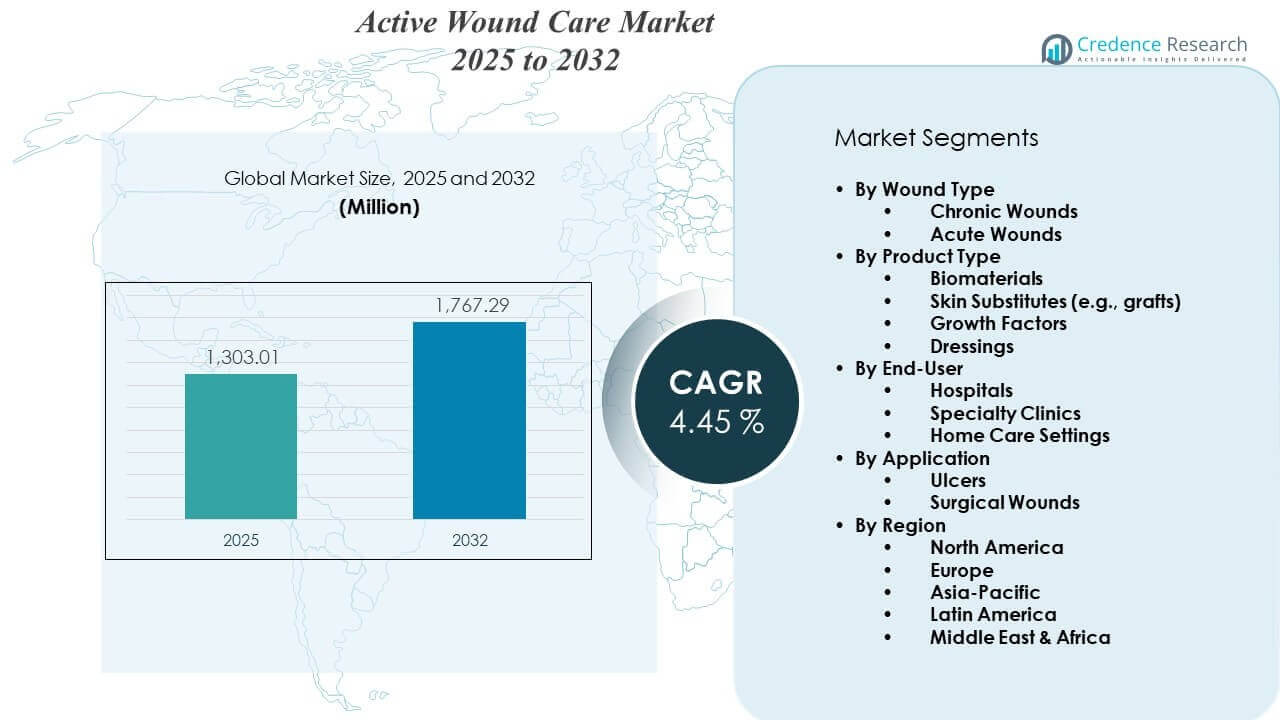
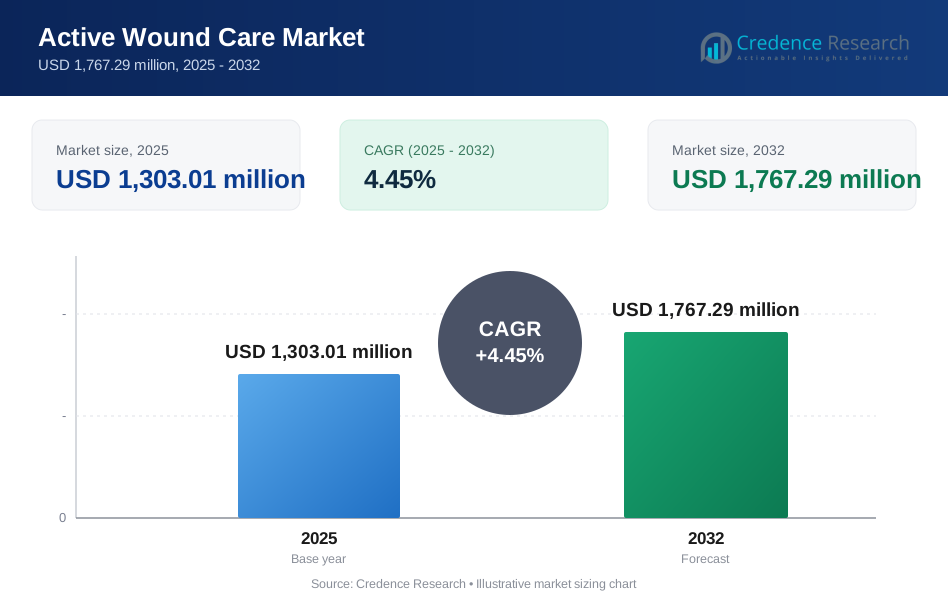
The Active Wound Care Market is projected to grow from USD 1,303.01 million in 2025 to an estimated USD 1,767.29 million by 2032, with a compound annual growth rate (CAGR) of 4.45% from 2025 to 2032.
| REPORT ATTRIBUTE | DETAILS |
|---|---|
| Historical Period | 2020-2023 |
| Base Year | 2024 |
| Forecast Period | 2025-2032 |
| Active Wound Care Market Size 2025 | USD 1,303.01 million |
| Active Wound Care Market, CAGR | 4.45% |
| Active Wound Care Market Size 2032 | USD 1,767.29 million |
The market is expanding due to the increasing prevalence of chronic wounds, such as diabetic foot ulcers, pressure ulcers, and venous leg ulcers. Rising elderly populations with reduced healing capacities and the surge in surgical procedures are driving demand for advanced healing products. Healthcare providers now prefer bioactive therapies and tissue-engineered products that promote faster recovery and reduce infection risks. Continuous innovation in wound dressings, including hydrogel, collagen, and alginate-based materials, further supports market growth. Governments and private insurers are also increasing reimbursement support for effective treatments.
North America leads the global Active Wound Care Market due to a high incidence of chronic wounds, strong healthcare infrastructure, and greater patient awareness. Europe follows closely, supported by favorable reimbursement policies and aging populations. Asia-Pacific is emerging as a fast-growing region, driven by rising diabetes cases, increasing healthcare investments, and improving access to advanced wound care in countries like China, India, and South Korea. Latin America and the Middle East & Africa are witnessing steady growth, albeit from a smaller base, as awareness and healthcare access improve.
Market Insights:
- The Active Wound Care Market was valued at USD 1,303.01 million in 2024 and is projected to reach USD 1,767.29 million by 2032, expanding at a CAGR of 4.45%, driven by chronic wound prevalence and advanced therapies.
- North America (~45%), Europe (~25%), and Asia-Pacific (~20%) represent the top regional shares due to strong healthcare systems, high chronic disease burden, and structured wound care protocols.
- Asia-Pacific (~20%) is the fastest-growing region, supported by rising diabetes incidence, aging populations, expanding hospital infrastructure, and improving access to advanced wound care.
- Chronic wounds account for ~59% of segment share, led by diabetic foot ulcers and pressure ulcers that require prolonged and specialized treatment.
- Hospitals hold ~52% of end-user share due to high patient inflow, advanced wound care units, and greater adoption of bioactive dressings and skin substitutes.
Market Drivers:
Increasing Prevalence of Chronic Wounds and Diabetic Ulcers in Aging Populations
Chronic wounds such as pressure ulcers, venous leg ulcers, and diabetic foot ulcers are rising across developed and developing nations. The aging population is more prone to such wounds due to slower tissue regeneration and reduced immunity. The growing burden of diabetes and obesity further increases the risk of hard-to-heal ulcers. Healthcare providers are prioritizing wound management as untreated ulcers often lead to severe complications. The Active Wound Care Market benefits from this surge in chronic wound cases that demand continuous and advanced care. The need for specialized wound healing products has increased across hospitals and home settings. Patients now seek quicker recovery and reduced hospital stays. This creates sustained demand for bioengineered dressings and cell-based therapies.
- For instance, diabetic foot ulcers affect 18.6 million people worldwide each year, with about 1.6 million cases in the United States, often leading to hospital admission or amputation.
Technological Advancement in Bioactive Products and Tissue Regeneration Therapies
Advanced wound care solutions now focus on promoting cellular activity and tissue regeneration. Key developments include amniotic membranes, stem cell-based products, and synthetic grafts that improve healing rates. These innovations outperform traditional dressings and meet the clinical needs of complex wounds. Manufacturers are investing in R&D to launch next-generation collagen-based and matrix-based products. The Active Wound Care Market evolves with these innovations and delivers better patient outcomes. Hospitals are shifting from passive protection to active healing strategies. Surgeons and wound care specialists increasingly adopt these products in post-operative and trauma care. Continuous improvement in material science supports these advancements.
- For instance, Smith+Nephew’s new ALLEVYN COMPLETE CARE 5‑Layer Foam Dressing demonstrates up to 93% absorption and shear dissipation compared to prior foams, improving pressure injury prevention.
Growing Preference for Outpatient and Home-Based Wound Treatment Modalities
Healthcare systems now emphasize reducing inpatient burden through outpatient care and home-based recovery. Portable and easy-to-apply wound care products suit these new care models. Home care services for wound management continue to expand, especially in developed markets. Insurance providers also support outpatient care, encouraging faster discharge and lower treatment costs. The Active Wound Care Market grows with this shift toward convenience and efficiency. Patients prefer treatments that reduce hospital visits and promote autonomy. Healthcare professionals recommend advanced dressings with self-application support. These trends accelerate product penetration in homecare environments.
Government and Institutional Support for Chronic Wound Management Programs
Public health systems now recognize chronic wounds as a key healthcare concern. Several governments implement national programs for pressure ulcer and diabetic ulcer prevention. Reimbursement frameworks increasingly include advanced wound care products in their coverage. Research institutions receive funding to study wound healing mechanisms and product effectiveness. The Active Wound Care Market gains traction from such structured support and awareness campaigns. Hospitals benefit from funding initiatives aimed at improving wound care units. Clinical training programs enhance professionals' skills in advanced wound therapies. Policy-level backing improves adoption and drives innovation in treatment offerings.
Market Trends:
Adoption of Smart Wound Technologies with Sensors and Real-Time Monitoring
Smart wound dressings are entering clinical practice with embedded sensors that track healing. These technologies monitor temperature, pH levels, and moisture to optimize care decisions. Researchers are integrating wireless communication modules for real-time data sharing. Care teams gain visibility into healing progress without removing dressings. The Active Wound Care Market aligns with this trend by enabling personalized, responsive wound care. Remote monitoring is useful for rural areas and post-surgical cases. It improves wound surveillance while lowering infection risk. Innovation in flexible electronics and biocompatible sensors supports this development.
- For instance, Research into IoMT systems shows automated wound classification achieving 99.9% accuracy across more than 5,000 wound images, enabling real‑time severity tracking and clinical alerts.
Increased Use of Synthetic Biologics and Scaffolds for Wound Matrix Construction
Manufacturers now develop synthetic biologics that mimic human extracellular matrices. These bioengineered scaffolds stimulate cellular migration and vascularization at the wound site. It improves outcomes in complex wounds that require regeneration. Companies focus on tunable mechanical properties and sustained-release formulations. The Active Wound Care Market gains strength from synthetic substitutes that offer consistency and scalability. Clinicians prefer standardized biologics for chronic and post-operative care. Customizable scaffolds enable tailored treatment protocols. The use of synthetic components also reduces risks associated with donor tissues.
- For instance, advanced scaffold designs incorporate tailored mechanical properties and sustained‑release bioactive components that support regeneration of complex chronic wounds.
Growing Integration of Artificial Intelligence for Wound Assessment and Treatment Planning
Artificial intelligence tools are now used to automate wound assessment using image-based algorithms. Machine learning models help classify wounds, estimate depth, and suggest treatment stages. Clinicians use AI dashboards to monitor healing trends over time. The Active Wound Care Market adapts to digital workflows that enhance diagnostic speed and accuracy. AI-based apps support triage decisions in emergency and outpatient settings. Hospitals benefit from reduced burden on specialists. Software integration with electronic health records improves continuity in care. Image annotation tools also support clinical training.
Rise of Customized and Patient-Specific Wound Care Solutions through 3D Printing
3D printing enables creation of wound care products tailored to wound shape, size, and patient biology. Bioinks and printable scaffolds enhance precision in wound coverage. It supports tissue regeneration by mimicking cellular structures. Hospitals increasingly adopt this for burn victims and complex surgical wounds. The Active Wound Care Market gains traction with customizable solutions that reduce treatment time. On-demand fabrication supports emergency and remote deployments. Researchers explore 3D-printed hydrogel blends for chronic wound sites. Personalized care protocols improve patient outcomes.
Market Challenges Analysis:
High Cost of Advanced Therapies and Limited Reimbursement in Emerging Markets
Advanced wound care solutions often carry high manufacturing and distribution costs. These include engineered skin substitutes, stem cell-based matrices, and specialized biofilms. Healthcare providers in cost-sensitive markets hesitate to adopt such solutions. Insurance coverage remains limited or absent for premium products in emerging economies. The Active Wound Care Market faces pricing pressures that hinder wide-scale access in low-income regions. Public hospitals often lack the budget for bulk procurement. Price sensitivity affects patient adoption outside urban centers. Manufacturers struggle to balance affordability and innovation.
Clinical Complexity, Long Healing Timelines, and Limited Standardization Across Care Settings
Chronic wounds are complex and influenced by multiple patient factors such as age, comorbidities, and infection. Healing often spans several weeks or months, requiring consistent care and monitoring. Lack of standard protocols across institutions results in fragmented treatment approaches. The Active Wound Care Market must address variability in clinician training and product use. Inconsistent documentation and poor tracking affect outcome measurement. Multidisciplinary coordination is often lacking, delaying optimal intervention. Care teams face challenges in adopting new tools without clear guidelines. Patient non-compliance further complicates recovery.
Market Opportunities:
Rising Demand in Emerging Economies Due to Urbanization and Improved Healthcare Access
Urbanization increases access to advanced healthcare facilities in developing nations. More patients now seek professional care for wounds previously managed at home. The Active Wound Care Market sees untapped potential in expanding healthcare networks. Private sector investment boosts hospital infrastructure in urban clusters. Domestic manufacturing creates cost-effective options for local markets. Public awareness programs support early wound intervention. Multinational companies form local partnerships to strengthen distribution. These factors open new revenue streams for vendors.
Focus on Regenerative Medicine and Cell-Based Innovations for Complex Wound Healing
R&D in regenerative medicine presents strong growth prospects for wound treatment. Stem cell-based formulations and growth factor therapies gain traction in clinical trials. The Active Wound Care Market benefits from products that promote angiogenesis and tissue remodeling. Innovation supports long-term healing of deep and non-healing wounds. Hospital networks show growing interest in trials for bioengineered skin. Academic institutions partner with biotech firms to fast-track research. Regulatory bodies show openness to novel therapies in unmet clinical needs.
Market Segmentation Analysis:
By Wound Type
Chronic wounds dominate the Active Wound Care Market, accounting for nearly 59% of total share. Diabetic foot ulcers, pressure ulcers, and lower limb ulcers are rising due to aging populations and growing diabetes prevalence. Chronic wounds require prolonged care, making them a strong revenue generator. Acute wounds, including surgical incisions and burns, also contribute significantly, especially in emergency and trauma care. Treatment protocols differ by wound type, driving demand for tailored products.
By Product Type
Dressings hold a major share among product types due to wide applicability in both acute and chronic wound cases. Biomaterials and skin substitutes are gaining momentum, especially for hard-to-heal wounds. Grafts and tissue-engineered products offer faster recovery and improved outcomes. Growth factors represent a high-value niche, primarily used in specialized cases under medical supervision. The Active Wound Care Market benefits from continuous innovation across all product categories.
- For instance, Organogenesis’s Apligraf was the first bioengineered skin substitute to achieve a 56% complete wound closure rate in clinical trials for venous leg ulcers compared to just 38% with compression therapy alone.
By End-User
Hospitals lead end-user segmentation with over 50% share, driven by high patient inflow and advanced wound care units. Specialty clinics are expanding due to their focus on outpatient services and chronic wound management. Home care settings gain traction as aging populations and post-operative patients seek in-home healing solutions. Product design now caters to both clinical and personal care needs.
By Application
Ulcers form the largest application area, with diabetic and venous ulcers leading demand. Surgical wounds remain a critical focus, especially for post-operative care and infection prevention. It addresses diverse healing challenges across both segments through advanced therapies and efficient delivery formats.
- For instance, MiMedx Group’s EpiFix, a dehydrated human amnion/chorion membrane allograft, achieved a 77% healing rate within 4 weeks for diabetic foot ulcers in a landmark randomized controlled trial.
Segmentation:
By Wound Type
- Chronic Wounds
- Acute Wounds
By Product Type
- Biomaterials
- Skin Substitutes (e.g., grafts)
- Growth Factors
- Dressings
By End-User
- Hospitals
- Specialty Clinics
- Home Care Settings
By Application
- Ulcers
- Surgical Wounds
By Region
- North America
- U.S.
- Canada
- Mexico
- Europe
- Germany
- France
- U.K.
- Italy
- Spain
- Rest of Europe
- Asia Pacific
- China
- Japan
- India
- South Korea
- South-east Asia
- Rest of Asia Pacific
- Latin America
- Brazil
- Argentina
- Rest of Latin America
- Middle East & Africa
- GCC Countries
- South Africa
- Rest of the Middle East and Africa
Regional Analysis:
North America Leads with Robust Infrastructure and Reimbursement Systems
North America holds the largest share in the Active Wound Care Market, contributing nearly 45% of global revenue. The U.S. remains the dominant country, accounting for close to 39% alone. High incidence of chronic wounds, diabetes, and obesity supports recurring demand for advanced wound therapies. Strong insurance reimbursement policies and presence of leading manufacturers help sustain product penetration across hospitals and specialty clinics. Healthcare providers adopt bioactive dressings, skin grafts, and cell-based therapies as part of routine care. It benefits from research-driven innovation and early adoption of smart wound care technologies.
Europe Maintains Steady Demand Through Public Health Systems
Europe contributes approximately 25% to the Active Wound Care Market, led by countries like Germany, the UK, and France. National health services in these countries provide structured chronic wound management and preventive care. Hospitals and outpatient centers incorporate advanced wound dressings and growth factors into standard protocols. Training programs for wound care specialists support consistent product usage across care levels. Regulatory clarity and reimbursement access enable moderate but stable market expansion. It continues to grow through established distribution and clinical adoption frameworks.
Asia-Pacific Emerges as the Fastest Growing Region
Asia-Pacific holds around 20% share in the Active Wound Care Market and records the fastest growth among all regions. Countries like China and India drive this growth with expanding healthcare infrastructure and growing diabetic populations. Government initiatives and private investments improve access to wound care in urban hospitals. Local manufacturing capabilities enhance affordability and distribution across developing areas. Increasing awareness of wound complications encourages earlier intervention and greater product usage. It shows strong potential as providers modernize treatment protocols and adopt newer wound care formats.
Key Player Analysis:
- Smith & Nephew
- Integra LifeSciences
- Organogenesis Inc.
- Mölnlycke Health Care
- MiMedx
- Convatec
- 3M / Solventum
- Tissue Regenix
Competitive Analysis:
The Active Wound Care Market features strong competition among global and regional players focused on biologics, skin substitutes, and advanced dressings. Companies such as Smith & Nephew, 3M, Organogenesis, and Integra LifeSciences lead through broad product portfolios and innovation pipelines. These players invest in clinical trials, acquisitions, and product development to expand their wound care offerings. It benefits from continuous technological advancements in tissue-engineered products and bioactive matrices. Emerging firms are entering with niche solutions for chronic wound management and personalized care. Pricing competition and regulatory compliance remain key focus areas. Strategic partnerships with hospitals and research institutes strengthen product visibility and adoption.
Recent Developments:
- In December 2025, MiMedx Group, Inc. entered an exclusive U.S. distribution agreement with Regen Lab USA LLC to offer RegenKit® Wound Gel, an autologous wound gel product for chronic wound treatment, enhancing its wound care offerings and expanding market reach in the United States.
- In October 2025, MiMedx Group, Inc. launched EPIXPRESS®, a new placental allograft designed to support clinicians in treating chronic and hard‑to‑heal wounds, including diabetic foot ulcers and venous leg ulcers by improving fluid movement through tissue and broadening its advanced wound care product portfolio.
- In September 2025, Smith+Nephew launched the CENTRIO Platelet-Rich-Plasma (PRP) System in the US, a biodynamic hematogel derived from a patient's own platelets and plasma to aid healing of chronic exuding wounds like diabetic foot ulcers and venous leg ulcers; this was enabled by an exclusive private label distribution agreement with Nuo Therapeutics Inc.
- In April 2025, Convatec Group PLC launched ConvaNiox™, a nitric oxide‑based antimicrobial and antibiofilm wound care technology targeting difficult‑to‑heal wounds such as diabetic foot ulcers, with initial regional rollout planned before broader deployment.
Report Coverage:
The research report offers an in-depth analysis based on Wound Type, Product Type, End-User, Application, and Region. It details leading market players, providing an overview of their business, product offerings, investments, revenue streams, and key applications. Additionally, the report includes insights into the competitive environment, SWOT analysis, current market trends, as well as the primary drivers and constraints. Furthermore, it discusses various factors that have driven market expansion in recent years. The report also explores market dynamics, regulatory scenarios, and technological advancements that are shaping the industry. It assesses the impact of external factors and global economic changes on market growth. Lastly, it provides strategic recommendations for new entrants and established companies to navigate the complexities of the market.
Future Outlook:
- The market will experience sustained growth driven by rising chronic wound cases, particularly diabetic foot ulcers and pressure ulcers.
- Technological advances in tissue regeneration, such as stem cell therapies and bioengineered skin, will transform complex wound management.
- Smart wound care devices with embedded sensors and real-time monitoring will become mainstream in hospital and homecare settings.
- Expansion of healthcare infrastructure across Asia-Pacific and Latin America will open new revenue streams for global and regional players.
- Manufacturers will focus on personalized wound care products enabled by 3D printing and AI-assisted diagnostic platforms.
- Growing adoption of outpatient and home-based wound care will create demand for portable, easy-to-apply, and self-activating dressings.
- Public and private insurers will expand reimbursement support for advanced wound care products, strengthening access across income groups.
- Strategic collaborations between hospitals, biotech firms, and medtech companies will accelerate R&D and clinical validation cycles.
- Regulatory frameworks will evolve to fast-track approvals for innovative wound healing biologics and smart devices.
- Leading companies will pursue mergers and acquisitions to consolidate their product portfolios and extend geographic presence in emerging markets.
Request a Free Sample
Fill in your details and we'll send you a free sample report.
- Sample data tables & charts
- Research methodology
Need a Custom Version of This Report?
Tailor the scope, geography, or segments to your exact requirements.
- Custom geography or segment scope
- Direct access to our analyst team
Frequently Asked Questions
What is the current market size for Active Wound Care Market, and what is its projected size in 2032?
At what Compound Annual Growth Rate is the Active Wound Care Market projected to grow between 2025 and 2032?
Which Active Wound Care Market segment held the largest share in 2025?
What are the primary factors fueling the growth of the Active Wound Care Market?
Who are the leading companies in the Active Wound Care Market?
Which region commanded the largest share of the Active Wound Care Market in 2025?
Table of Content
Chapter 1. Report Introduction
- 1.1 Report Description & Purpose
- 1.1.1 Report Title & Market Definition
- 1.1.2 Unique Selling Propositions (USP) & Key Differentiators
- 1.1.3 Value Proposition for Stakeholders
- 1.2 Research Objectives
- 1.2.1 Market Sizing Objectives (Volume & Revenue)
- 1.2.2 Segmentation Objectives
- 1.2.3 Competitive Intelligence Objectives
- 1.2.4 Forecast & Scenario Objectives
- 1.3 Report Scope
- 1.3.1 Active Wound Care Scope – Types & Subtypes Covered
- 1.3.2 Geographic Scope – Regions & Countries Covered
- 1.3.3 Historical Period, Base Year & Forecast Period (2025; forecast to 2032)
- 1.3.4 Inclusions & Exclusions
- 1.4 HS Code & Classification Framework
- 1.5 Currency, Units & Pricing Basis
- 1.6 Target Stakeholders
- 1.7 Limitations & Assumptions
Chapter 2. Executive Summary
- 2.1 Global Active Wound Care Market Snapshot
- 2.1.1 Market Size – Historical (2025) & Forecast (2025-2032) (2025: USD 1,303.01 million → 2032: USD 1,767.29 million)
- 2.1.2 Volume & Revenue – Global Totals
- 2.1.3 Key Market Highlights – Top Five Facts
- 2.2 Active Wound Care Market Segmentation Snapshot
- 2.2.1 Market Split by Region – 2025 vs. 2032
- 2.3 Competitive Snapshot
- 2.3.1 Top 10 Players by Revenue Share – 2025
- 2.3.2 Top 10 Players by Volume Share – 2025
- 2.3.3 Recent Strategic Developments (18-Month Summary)
- 2.4 Key Investment Highlights & Strategic Conclusions
Chapter 3. Active Wound Care Market Dynamics & Industry Analysis
- 3.1 Market Overview & Context
- 3.1.1 Active Wound Care Market Position in the Broader Automotive Value Chain
- 3.1.2 OEM vs. Replacement Market Dynamics
- 3.1.3 Market Maturity & Development Stage by Region
- 3.2 Active Wound Care Market Drivers
- 3.3 Active Wound Care Market Restraints & Challenges
- 3.4 Active Wound Care Market Opportunities
- 3.5 Porter's Five Forces Analysis
- 3.5.1 Threat of New Entrants
- 3.5.2 Bargaining Power of Suppliers
- 3.5.3 Bargaining Power of Buyers
- 3.5.4 Threat of Substitutes
- 3.5.5 Competitive Rivalry – Intensity Assessment
- 3.6 Active Wound Care Value Chain Analysis
- 3.6.1 Upstream – Raw Material/Input Suppliers
- 3.6.1.1 Raw Material/Input 1
- 3.6.1.2 Raw Material/Input 2
- 3.6.1.3 Raw Material/Input 3
- 3.6.2 Midstream – Production/Manufacturing/Service Delivery
- 3.6.2.1 Production/Process Overview
- 3.6.2.2 Key Facility Locations & Capacity by Manufacturer
- 3.6.3 Downstream – Distribution & End Consumer
- 3.6.3.1 Primary Channel – B2B/OEM
- 3.6.3.2 Secondary Channels – Dealer, Retail, Online, Direct
- 3.6.4 Value Chain Profitability Analysis
- 3.6.1 Upstream – Raw Material/Input Suppliers
- 3.7 PESTEL Analysis
- 3.7.1 Political Factors
- 3.7.2 Economic Factors
- 3.7.3 Social Factors
- 3.7.4 Technological Factors
- 3.7.5 Environmental Factors
- 3.7.6 Legal Factors
- 3.8 Active Wound Care Supply Chain Analysis
- 3.8.1 Raw Material/Input Supply Risk Assessment
- 3.8.2 Manufacturing Concentration Risk (Geographic Exposure)
- 3.8.3 Trade Disruption Impact Analysis
- 3.9 Regulatory & Policy Landscape
Note: The regulatory and policy landscape section covers regulations based on their applicability to the market, Active Wound Care category, geography, and scope of the study. Only regulatory frameworks with a material impact on operations, compliance, trade, sustainability, or market access are analyzed in detail.
Chapter 4. Key Investment Pockets & Opportunity Analysis
- 4.1 Active Wound Care Market Attractiveness Analysis
- 4.1.1 By Region – Investment Attractiveness Matrix (Volume × CAGR)
- 4.2 Absolute Revenue Growth Opportunity
- 4.2.1 By Region – Absolute USD Growth Through 2032
- 4.3 Incremental Volume Opportunity
- 4.3.1 By Region – Incremental Volume Through 2032
- 4.3.2 Segment – Incremental Volume
- 4.4 Emerging Submarket Opportunity Deep Dive (Subject to Applicability)
- 4.5 Emerging Market Opportunity Scorecards
- 4.5.1 United States
- 4.5.2 Europe
- 4.5.3 Asia
- 4.5.4 Middle East & Africa
Note: Emerging Market Opportunity Scorecards will be included based on relevance and strategic importance. Regions listed are indicative and may vary depending on data availability and market dynamics.
Chapter 5. Active Wound Care Import-Export Analysis & Trade Flows
- 5.1 Global Trade Overview
- 5.1.1 Global Export Value by Country (2025)
- 5.1.2 Global Export Volume by Country (2025)
- 5.1.3 Global Import Value by Country (2025)
- 5.1.4 Global Import Volume by Country (2025)
- 5.1.5 Net Trade Balance by Country (2025)
- 5.2 Export Analysis – Segment
- 5.2.1 Type 1 (HS Code)
- 5.2.2 Type 2 (HS Code)
- 5.2.3 Type 3 (HS Code)
- 5.2.4 Type 4 (HS Code)
- 5.2.5 Type 5 (HS Code)
- 5.3 Import Analysis – Segment
- 5.3.1 Type 1 (HS Code)
- 5.3.2 Type 2 (HS Code)
- 5.3.3 Type 3 (HS Code)
- 5.3.4 Type 4 (HS Code)
- 5.3.5 Type 5 (HS Code)
- 5.4 Average Unit Trade Prices
- 5.4.1 Average Export Price – Segment & Country
- 5.4.2 Average Import Price – Segment & Source Country
- 5.4.3 Price Trends (2025)
- 5.5 Key Trade Route Analysis
- 5.5.1 Trade Route 1
- 5.5.2 Trade Route 2
- 5.5.3 Trade Route 3
- 5.5.4 Trade Route 4
- 5.5.5 Trade Route 5
- 5.6 Trade Policy Impact Assessment
- 5.6.1 US Anti-Dumping & Section 301 Tariffs
- 5.6.2 EU Customs Union Impact
- 5.6.3 Major Free Trade Agreements
- 5.6.4 USMCA Rules of Origin
Note: Trade policy analysis will be included only where relevant to the Active Wound Care market.
Chapter 6. Competitive Landscape & Company Benchmarking
- 6.1 Active Wound Care Market Concentration & Structure
- 6.1.1 Herfindahl-Hirschman Index (HHI) – vs. 2025
- 6.1.2 Tier 1, Tier 2 & Tier 3 Market Structure
- 6.1.3 Global, Regional & Local Player Dynamics
- 6.2 Active Wound Care Market Share Analysis – 2025
- 6.2.1 Global Revenue Share by Company
- 6.2.2 Global Volume Share by Company
- 6.2.3 Regional Revenue Share
- 6.2.4 Market Share Evolution ( vs. 2025)
- 6.2.5 OEM Segment Share by Company
- 6.2.6 Replacement Segment Share by Company
- 6.3 Production/Delivery Capacity & Facility Analysis
- 6.3.1 Global Installed Capacity
- 6.3.2 Capacity Utilization Rates
- 6.3.3 Production/Output Volume
- 6.3.4 Facility Locations & Capacity Map
- 6.3.5 Planned Capacity Additions
- 6.4 Active Wound Care Competitive Benchmarking Matrix
- 6.4.1 Revenue, Volume, CAGR & Profitability Comparison
- 6.4.2 Channel Revenue Mix
- 6.4.3 Geographic Revenue Exposure
- 6.4.4 R&D Intensity
- 6.4.5 Sustainability Maturity
- 6.5 Strategic Developments in Active Wound Care (Last 24 Months)
- 6.5.1 Mergers, Acquisitions & Divestments
- 6.5.2 New Active Wound Care Launches
- 6.5.3 Facility Expansions
- 6.5.4 Strategic Alliances, Joint Ventures & Partnerships
- 6.5.5 Distribution Expansion & Market Entry
- 6.5.6 Sustainability & ESG Initiatives
- 6.6 Competitive Strategy Mapping
- 6.6.1 Leader, Challenger, Follower & Niche Classification
- 6.6.2 Pricing Strategy Comparison
- 6.6.3 Channel Strategy Matrix
Note: Strategic developments are included based on their materiality and the availability of reliable information.
Chapter 7. Global Active Wound Care Market – By Distribution Channel
- 7.1 Segment Overview
- 7.1.1 Volume & Revenue Split by Channel (2025 & 2032)
- 7.1.2 Channel Mix Evolution (2025-2032)
Chapter 8. Regional Market Analysis – Global Overview
- 8.1 Global Regional Overview
- 8.1.1 Regional Volume Share
- 8.1.2 Regional Revenue Share
- 8.1.3 Regional Volume by Region
- 8.1.4 Regional Revenue by Region
- 8.1.5 Regional Forecast Through 2032
- 8.2 Cross-Regional Segment Analysis
- 8.2.1 By Distribution Channel
- 8.2.2 By Brand/Price Tier
Chapter 9. North America Active Wound Care Market
- 9.1 United States
- 9.2 Canada
- 9.3 Mexico
Chapter 10. Europe Active Wound Care Market
- 10.1 Germany
- 10.2 France
- 10.3 Italy
- 10.4 United Kingdom
- 10.5 Spain
- 10.6 Poland
- 10.7 Russia
- 10.8 Netherlands
- 10.9 Belgium
- 10.10 Sweden
- 10.11 Denmark
- 10.12 Norway
- 10.13 Rest of Europe
Chapter 11. Asia Pacific Active Wound Care Market
- 11.1 China
- 11.2 India
- 11.3 Japan
- 11.4 South Korea
- 11.5 Thailand
- 11.6 Indonesia
- 11.7 Vietnam
- 11.8 Malaysia
- 11.9 Australia
- 11.10 Rest of Asia Pacific
Chapter 12. Latin America Active Wound Care Market
- 12.1 Brazil
- 12.2 Argentina
- 12.3 Colombia
- 12.4 Chile
- 12.5 Rest of Latin America
Chapter 13. Middle East Active Wound Care Market
- 13.1 Saudi Arabia
- 13.2 United Arab Emirates
- 13.3 Turkey
- 13.4 Israel
- 13.5 Iran
- 13.6 Rest of the Middle East
Chapter 14. Africa Active Wound Care Market
- 14.1 South Africa
- 14.2 Egypt
- 14.3 Nigeria
- 14.4 Morocco
- 14.5 Rest of Africa
Chapter 15. Active Wound Care Company Profiles
- 15.1 [Company 01]
- 15.1.1 Company Overview
- 15.1.2 Key Management Personnel
- 15.1.3 Products & Services Portfolio
- 15.1.4 Financial Performance
- 15.1.5 Key Market Focus & Geographic Presence
- 15.1.6 Recent Developments & Strategic Initiatives
Note: The company profile list is preliminary and may change based on research findings, market developments, data availability, and client requirements.
Chapter 16. Appendices
- Appendix A – List of Abbreviations & Acronyms
- Appendix B – Industry Classification Code Reference – Full Series
- Appendix C – Production & Capacity Data Tables
- Appendix D – End-Use & Demand Base Tables
- Appendix E – Consumption & Replacement Rate Assumptions
- Appendix F – ASP Reference Tables
- Appendix G – Manufacturing & Facility Database
- Appendix H – Import-Export Data Tables
- Appendix I – Regulatory Summary Tables
- Appendix J – Primary Research Participant List (Anonymized)
- Appendix K – Primary Research Questionnaire Framework
- Appendix L – Data Sources & Bibliography
- Appendix M – Market Size Divergence & Source Comparison
Chapter 17. Research Methodology
- 17.1 Research Framework & Philosophy
- 17.2 Secondary Research – Sources, Hierarchy & Data Extraction
- 17.3 Data Modeling – Bottom-Up & Top-Down Market Sizing
- 17.4 Primary Research – Stakeholder Framework, LOI & Sample Sizes
- 17.5 Forecast Methodology – Regression, Scenario & Sensitivity Analysis
- 17.6 Quality Control – Four-Layer Validation Framework
- 17.7 Limitations & Standard Assumptions
- 17.8 Disclaimer
