
Acaricides Market Overview:
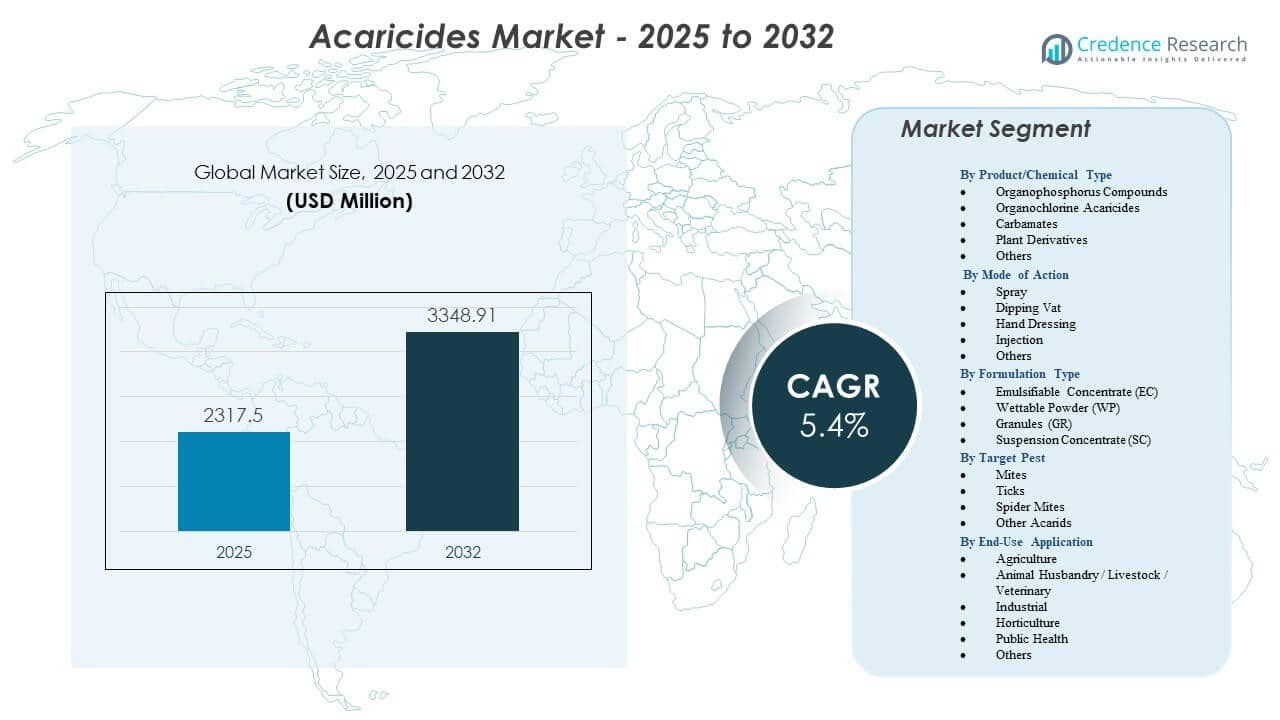
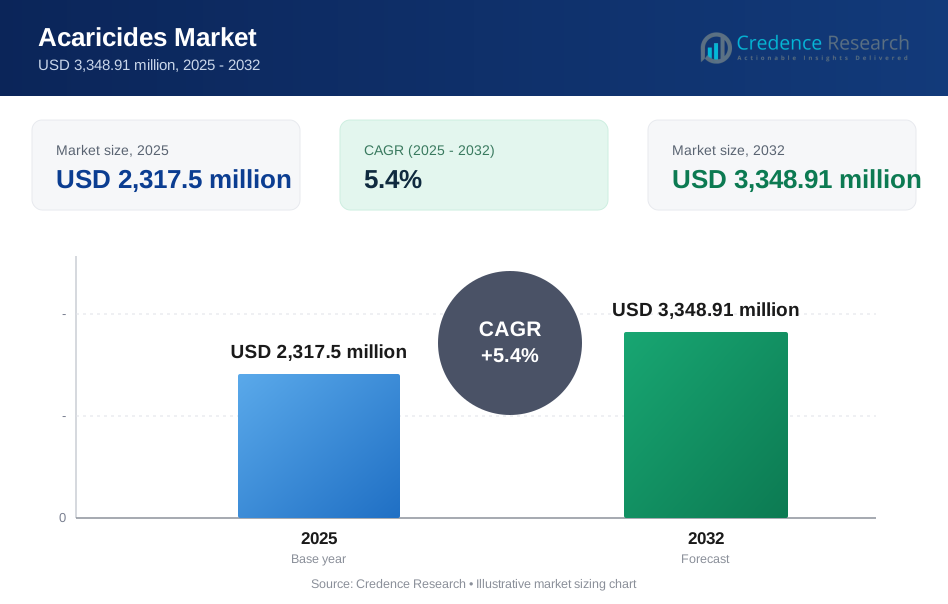
The Acaricides Market is projected to grow from USD 2,317.5 million in 2025 to an estimated USD 3,348.91 million by 2032, with a compound annual growth rate (CAGR) of 5.4% from 2025 to 2032.
| REPORT ATTRIBUTE | DETAILS |
|---|---|
| Historical Period | 2020-2023 |
| Base Year | 2024 |
| Forecast Period | 2025-2032 |
| Acaricides Market Size 2025 | USD 2,317.5 million |
| Acaricides Market, CAGR | 5.4% |
| Acaricides Market Size 2032 | USD 3,348.91million |
Market growth is driven by increasing mite infestations in high-value crops and expanding livestock populations that require reliable parasite control. Users adopt selective and low-toxicity chemistries that improve safety profiles while maintaining strong field efficacy. Biological acaricides gain traction as growers aim to meet residue limits in export supply chains. Strong innovation pipelines from global manufacturers introduce new modes of action designed to manage resistance more effectively. Digital monitoring tools help farmers optimize timing and improve treatment success across varying climatic conditions.
Regionally, North America leads due to advanced agricultural systems and higher adoption of regulated acaricides in crop and livestock management. Europe follows with strict compliance norms that encourage selective and low-residue solutions. Asia-Pacific emerges as the fastest-growing region driven by expanding commercial farming, high pest pressure, and greater awareness of crop protection practices. Latin America grows steadily with rising horticulture and fruit exports, while the Middle East & Africa progress through broader adoption in livestock and public health programs.
Acaricides Market Insights:
- The Acaricides Market is projected to grow from USD 2,317.5 million in 2025 to USD 3,348.91 million by 2032, supported by a 5.4% CAGR during the forecast period.
- Rising mite pressure in crops and livestock strengthens demand for selective chemistries and biological solutions that enhance control while meeting safety standards.
- Regulatory constraints and resistance development in certain mite species create challenges that push manufacturers toward innovation and stricter formulation compliance.
- North America maintains leadership due to mature farming systems and strong veterinary usage, while Europe emphasizes low-residue and eco-safe products driven by strict regulations.
- Asia-Pacific shows rapid expansion as commercial farming scales up and growers adopt better pest-management practices across diverse climates and crop types.
Acaricides Market Drivers
Rising Pest Pressure Across Crop Production and Livestock Health
Growing infestation levels in major crops raise demand for effective control tools that protect yield and quality. Farmers adopt modern formulations that target resistant mite species with stronger precision. Livestock producers expand treatment protocols to maintain herd health and reduce productivity loss. The Acaricides Market gains support from ongoing pressure to manage rising vector populations. Government programs promote regulated chemicals that fit into integrated pest management. Product innovation helps users handle complex pest cycles in varied climates. Leading companies focus on fast-acting solutions that boost field efficiency. Adoption strengthens across diverse farming zones.
- For instance, Zoetis demonstrated that its CYDECTIN injectable provided up to 28 days of persistent protection against Psoroptes ovis, supporting stronger control in high-infestation regions. Adoption strengthens across diverse farming zones.
Increasing Preference For Selective And Low-Toxicity Acaricides
Users shift toward products that reduce residue levels while maintaining strong performance. Newer chemistries offer safer handling and lower risk to beneficial insects. It drives widespread acceptance in regions that enforce strict environmental rules. Many growers choose selective modes of action that support resistance control. Veterinary users rely on improved formulations that protect animals without heavy stress. Regulatory approvals encourage stable product launches across high-demand segments. Companies invest in research to create targeted options that work efficiently at low doses. Global demand rises with stronger focus on safety and sustainable usage.
- For instance, Bioceres Crop Solutions reported that its biological acaricide GRANDEVO achieved 75–85% suppression of mite populations while maintaining a 0-day PHI and 4-hour REI, meeting strict residue and safety expectations. Global demand rises with stronger focus on safety and sustainable usage.
Rapid Expansion Of Commercial Farming And Protected Cultivation Systems
Commercial farms increase acreage under high-value crops where mites cause severe losses. Protected cultivation systems expand in vegetables, fruits, and ornamentals, which heightens the need for reliable control. The Acaricides Market benefits from growers who adopt routine treatment cycles to secure output. Large farms rely on advanced monitoring tools that help trigger timely interventions. Modern irrigation improves conditions for pests, which pushes demand for effective control agents. Contract farming encourages uniform pest control programs across large networks. Strong investment in greenhouse farming increases product penetration. Higher yield expectations push growers toward strict pest management.
Growing Regulatory Support For Standardized Pest Control Frameworks
Many countries enforce strong compliance norms that guide chemical usage and improve product quality. Certifications encourage adoption of approved acaricides with defined safety benchmarks. It supports manufacturers that focus on quality-driven formulations. Research institutions promote science-backed practices that strengthen adoption across farms. Global trade rules require clean produce, which raises demand for regulated solutions. Governments invest in extension programs that educate growers on best control practices. Industry players align their portfolios to meet evolving regulations. Strong oversight helps create predictable market conditions.
Acaricides Market Trends
Shift Toward Bio-Based And Botanical Formulations In Miticide Categories
Producers introduce bio-based products to meet sustainability goals and reduce chemical load. Many growers adopt biological acaricides that support residue-free cultivation. The Acaricides Market observes rising interest in plant-derived compounds used in integrated programs. It helps users manage sensitive crops without high toxicity concerns. Improved extraction methods support consistent performance across seasons. Markets with strict residue limits encourage rapid uptake. Companies invest in scalable production technologies for bio-based solutions. Regulatory pathways for biological products continue to expand globally.
- For instance, Marrone Bio Innovations(now Bioceres Crop Solutions) developed GRANDEVO, a bio-insecticide/acaricide derived from Chromobacterium subtsugae. In field trials, this formulation achieved a 75% to 85% reduction in mite populations while maintaining a 0-day Pre-Harvest Interval (PHI) and a 4-hour Re-entry Interval (REI).
Advancement Of Smart Monitoring Tools And Precision Application Methods
Digital monitoring tools help detect mite activity early and improve decision-making in farms. Predictive models guide treatment planning with higher accuracy. Growers adopt precision sprayers that reduce waste and improve coverage. The Acaricides Market sees increasing integration of automation into pest control routines. It helps reduce labor needs while maintaining strong field performance. Drone-based application gains interest in large farms. Digital dashboards support rapid assessment of treatment outcomes. Adoption rises in regions with high investment in farm technology.
Expansion Of Combination Products And Multi-Mode Action Formulations Manufacturers design combination products that manage resistant mite populations more effectively. Multi-mode action formulas deliver wider coverage across varied species. It supports long-term field outcomes by lowering dependence on single modes of action. Growers value products that deliver predictable results under tough pest pressure. The Acaricides Market experiences rising development of synergistic chemistries. New research identifies combinations that maintain performance at lower doses. Companies release specialized blends for protected cultivation. Market acceptance improves with rising concern about resistance buildup.
Growing Adoption Of Residue-Management Practices In Export-Focused Farming
Export farmers adopt stricter residue protocols that shape buying patterns for acaricides. Many producers prefer short pre-harvest intervals to meet international trade rules. It encourages faster-acting formulations with defined dissipation profiles. The Acaricides Market aligns with global residue standards that influence product design. Certification programs motivate growers to choose compliant solutions. Trading partners enforce strict checks that raise awareness. Companies promote products with clear residue reduction timelines. Demand grows for solutions that support clean-label farming.
- For instance, ADAMA Agricultural Solutions expanded the use of its BANZAI® acaricide, designed for cocoa and export-oriented crops, which is registered for effective control of Distantiella theobroma while meeting the stringent residue requirements set by the European Union. Field evaluations have shown strong suppression of mirid populations, supporting growers who must comply with low-residue export standards.
Acaricides Market Challenges Analysis
Rising Resistance Development Among Key Mite Species And Limited New Chemistry Introduction
Resistance buildup reduces effectiveness of widely used active ingredients and pressures growers to change strategies. Many regions report faster adaptation of mite species, which strains existing control programs. It forces users to rotate chemistries, often with limited choices. The Acaricides Market faces a slow rate of new molecule introduction due to long regulatory timelines. Research costs rise while approvals become stricter. Product withdrawals reduce available tools for growers. Some crops face heavy losses where control options remain narrow. Regions with poor monitoring face greater difficulty managing resistant strains.
Stringent Regulatory Constraints And High Compliance Costs For Manufacturers
Tight chemical regulations demand recurring safety data and frequent updates. It raises operational costs for producers that support large portfolios. The Acaricides Market experiences delays in approvals that slow product launches. Compliance rules vary across regions, which increases complexity. Some active ingredients face phased restrictions that shrink market availability. Users in low-income regions struggle with higher prices linked to compliance costs. Limited awareness of proper usage increases misuse risk. Manufacturers must balance innovation with regulatory expectations.
Acaricides Market Opportunities
Expansion Of Biological Acaricides And Eco-Safe Formulation Technologies
Demand grows for biological options that support residue-free farming and safer handling. Newer microbial and botanical solutions offer strong action against mites in sensitive crops. It encourages investment in scalable fermentation and extraction processes. The Acaricides Market benefits from rising organic farming and greenhouse adoption. Regions with strict chemical norms shift quickly toward eco-safe solutions. Research centers explore synergistic blends that enhance biological performance. Improved storage stability increases usability across climates. Companies gain long-term growth prospects through sustainable portfolios.
Rising Adoption Of Precision Agriculture And Digital Pest Management Systems
Precision tools create strong opportunities for targeted acaricide use across large farms. Smart sensors and modeling platforms help detect outbreaks earlier. It improves treatment timing and reduces overall chemical load. The Acaricides Market gains traction where farmers adopt drones, automated sprayers, and remote monitoring. Digital platforms help track pest cycles for better planning. Large export farms invest in technology that supports clean produce. Providers develop integrated solutions that combine monitoring with application tools. Growth accelerates in regions with active digital farming programs.
Acaricides Market Segmentation Analysis:
By Product/Chemical Type
The Acaricides Market shows steady uptake across organophosphorus compounds, organochlorine acaricides, carbamates, plant derivatives, and other chemistries. Organophosphorus products maintain strong demand due to broad activity against resistant species. Organochlorine acaricides hold limited use in regulated regions but remain present in markets with fewer restrictions. Carbamates provide reliable action in integrated programs. Plant derivatives attract users who seek safer options with residue control. It supports diverse needs across farming, veterinary care, and horticulture. Users choose specific chemistries based on crop type, pest severity, and compliance rules.
By Mode of Action / Application Method
The Acaricides Market adopts multiple application methods that align with varied field or animal management needs. Spray methods lead due to widespread compatibility with crops and equipment. Dipping vats support livestock operations that require full-body treatment. Hand dressing finds use in small herds or targeted zones. Injection methods offer precise control in veterinary care where systemic action is needed. Other application modes fill niche requirements across industrial and public health environments. It ensures flexible choices for different pest loads and operational setups.
- For instance, Zoetisutilizes advanced injection technology with its "CYDECTIN" (Moxidectin) injectable solution, which provides up to 28 days of persistent protection against Psoroptes ovis (sheep scab mites) with a single 0 mL per 50 kg body weight dosage.
By Formulation Type
Formulation choice in the Acaricides Market shapes user adoption and performance reliability. Emulsifiable concentrates remain common due to easy mixing and strong field penetration. Wettable powders offer stability and cost advantages in large-scale programs. Granules support controlled release needs in specific crops and soil conditions. Suspension concentrates deliver uniform coverage and reduced handling risk. It allows users to match formulation with environmental conditions, application tools, and target pest behavior.
- For instance, Syngenta’s Agri-Mek SC formulation delivers improved coverage and lower volatility compared to older emulsifiable concentrate versions, as confirmed in multiple extension trial summaries that highlight more uniform deposition on leaf surfaces for enhanced mite control.
By Target Pest
Target pest segmentation in the Acaricides Market centers on mites, ticks, spider mites, and other acarids. Mites dominate demand in crop sectors where infestations reduce quality and yield. Ticks remain a priority in livestock and veterinary care due to disease transmission concerns. Spider mites affect greenhouses and high-value crops, driving need for fast action. Other acarids create sporadic but relevant pressure in regional markets. It drives tailored solutions that match species behavior and resistance patterns.
By End-Use Application
End-use applications in the Acaricides Market span agriculture, animal husbandry, industrial uses, horticulture, public health, and other specialized sectors. Agriculture leads due to extensive crop cultivation and rising pest intensity. Livestock operations rely on solutions that protect animal health and prevent disease spread. Industrial users apply products for wood preservation where mite control is essential. Horticulture and greenhouse operations demand selective options that protect sensitive plants. Public health programs target pest vectors in residential and community spaces. It supports broad adoption across structured and emerging markets.
Acaricides Market Segmentation:
By Product/Chemical Type
- Organophosphorus Compounds
- Organochlorine Acaricides
- Carbamates
- Plant Derivatives
- Others
By Mode of Action / Application Method
- Spray
- Dipping Vat
- Hand Dressing
- Injection
- Others
By Formulation Type
- Emulsifiable Concentrate (EC)
- Wettable Powder (WP)
- Granules (GR)
- Suspension Concentrate (SC)
By Target Pest
- Mites
- Ticks
- Spider Mites
- Other Acarids
By End-Use Application
- Agriculture
- Animal Husbandry / Livestock / Veterinary
- Industrial
- Horticulture
- Public Health
- Others
By Region
- North America
- U.S.
- Canada
- Mexico
- Europe
- Germany
- France
- U.K.
- Italy
- Spain
- Rest of Europe
- Asia Pacific
- China
- Japan
- India
- South Korea
- South-east Asia
- Rest of Asia Pacific
- Latin America
- Brazil
- Argentina
- Rest of Latin America
- Middle East & Africa
- GCC Countries
- South Africa
- Rest of the Middle East and Africa
Regional Analysis:
North America holds a leading share of the Acaricides Market, accounting for nearly 32% of global demand. Strong commercial farming practices and advanced veterinary care drive steady use across the United States and Canada. High awareness of integrated pest management supports adoption of regulated chemical and biological solutions. It benefits from strict quality standards that encourage investment in innovative formulations. Greenhouse expansions in select states strengthen demand for targeted mite control. Regional distributors maintain wide portfolios that support varied crop and livestock environments.
Europe follows with about 27% share, supported by strict environmental norms and strong emphasis on residue compliance. Growers prefer selective chemistries that meet regulatory expectations and protect beneficial insects. Veterinary applications maintain stable demand across high-density livestock regions. The Acaricides Market gains support from greenhouse clusters in Spain, Italy, and the Netherlands. It sees rising adoption of bio-based solutions due to strong policy incentives. Public health programs add controlled demand in areas with vector risks.
Asia-Pacific accounts for nearly 29% share and remains the fastest-growing region due to rapid agriculture expansion and higher pest pressure. Large farming communities rely on accessible formulations that fit varied climatic zones. Livestock sectors in China, India, and Southeast Asia create extensive need for tick control. The Acaricides Market benefits from rising awareness of crop loss prevention. It gains momentum through greenhouse growth in China and South Korea. Latin America and the Middle East & Africa together hold about 12%, supported by horticulture expansion, fruit exports, and livestock intensification.
Key Player Analysis:
- Corteva Agriscience
- Bayer AG / Bayer CropScience
- BASF SE
- FMC Corporation
- Nissan Chemical Corporation
- UPL Limited
- Syngenta AG
- DuPont
- Nufarm Limited
- Sumitomo Chemical Co., Ltd.
- PI Industries Ltd.
- Nippon Soda Co., Ltd.
- Star Bio Science
- Arysta LifeScience Corporation
- Indofil Industries Limited
Competitive Analysis:
The competitive landscape of the Acaricides Market features a mix of global agrochemical companies and regional manufacturers that target diverse crop and livestock segments. Leading players strengthen portfolios through new formulations, improved modes of action, and wider residue-management capabilities. It reflects active investment in biological acaricides driven by regulatory shifts and user preference for low-toxicity options. Companies such as Bayer, BASF, Corteva, Syngenta, FMC, and UPL maintain strong distribution networks that support large farming regions. Regional firms focus on cost-effective solutions that meet local compliance rules. Partnerships with distributors, expansion into greenhouse markets, and targeted product launches help players compete in high-growth countries. Research pipelines prioritize resistance-management strategies that secure long-term adoption.
Recent Developments:
- In March 2024, BASF SE announced the launch of a new mite-control formulation designed to support resistance management programs in high-value crops. The update expanded its biological and low-toxicity portfolio aimed at greenhouse and fruit growers seeking safer and more targeted options.
Report Coverage:
The research report offers an in-depth analysis based on Product/Chemical Type, Mode of Action, Formulation Type, Target Pest, End-Use Application and Region. It details leading market players, providing an overview of their business, product offerings, investments, revenue streams, and key applications. Additionally, the report includes insights into the competitive environment, SWOT analysis, current market trends, as well as the primary drivers and constraints. Furthermore, it discusses various factors that have driven market expansion in recent years. The report also explores market dynamics, regulatory scenarios, and technological advancements that are shaping the industry. It assesses the impact of external factors and global economic changes on market growth. Lastly, it provides strategic recommendations for new entrants and established companies to navigate the complexities of the market.
Future Outlook:
- Demand for targeted mite and tick control will rise as growers adopt stricter residue-management practices across key farming regions in the Acaricides Market.
- Biological and botanical acaricides will gain traction due to stronger focus on eco-safe solutions and support for integrated pest programs.
- Formulation innovation will expand, with companies prioritizing stable, low-toxicity products that improve field performance and user safety.
- Digital monitoring tools will influence treatment decisions by guiding precise application timing in commercial farms.
- Greenhouse and protected cultivation will drive new adoption patterns where sensitive crops require selective and rapid-acting solutions.
- Veterinary applications will expand with broader treatment protocols for livestock exposed to rising tick pressure.
- Regulatory alignment across major markets will encourage investment in compliant formulations with defined safety profiles.
- Resistance-management strategies will shape product development cycles and redefine long-term portfolio planning.
- Premium solutions will gain popularity in regions with intensive export farming driven by quality assurance requirements.
- Expansion across emerging economies will strengthen market penetration as awareness of pest control technologies improves.
Request a Free Sample
Fill in your details and we'll send you a free sample report.
- Sample data tables & charts
- Research methodology
Need a Custom Version of This Report?
Tailor the scope, geography, or segments to your exact requirements.
- Custom geography or segment scope
- Direct access to our analyst team
Frequently Asked Questions
What is the current market size for the Acaricides Market, and what is its projected size in 2032?
At what Compound Annual Growth Rate is the Acaricides Market projected to grow between 2025 and 2032?
Which Acaricides Market segment held the largest share in 2025?
What are the primary factors fueling the growth of the Acaricides Market?
Who are the leading companies in the Acaricides Market?
Which region commanded the largest share of the Acaricides Market in 2025?
Table of Content
Chapter 1. Report Introduction
- 1.1 Report Description & Purpose
- 1.1.1 Report Title & Market Definition
- 1.1.2 Unique Selling Propositions (USP) & Key Differentiators
- 1.1.3 Value Proposition for Stakeholders
- 1.2 Research Objectives
- 1.2.1 Market Sizing Objectives (Volume & Revenue)
- 1.2.2 Segmentation Objectives
- 1.2.3 Competitive Intelligence Objectives
- 1.2.4 Forecast & Scenario Objectives
- 1.3 Report Scope
- 1.3.1 Acaricides Scope – Types & Subtypes Covered
- 1.3.2 Geographic Scope – Regions & Countries Covered
- 1.3.3 Historical Period, Base Year & Forecast Period (2025; forecast to 2032)
- 1.3.4 Inclusions & Exclusions
- 1.4 HS Code & Classification Framework
- 1.5 Currency, Units & Pricing Basis
- 1.6 Target Stakeholders
- 1.7 Limitations & Assumptions
Chapter 2. Executive Summary
- 2.1 Global Acaricides Market Snapshot
- 2.1.1 Market Size – Historical (2025) & Forecast (2025-2032) (2025: USD 2,317.5 million → 2032: USD 3,348.91 million)
- 2.1.2 Volume & Revenue – Global Totals
- 2.1.3 Key Market Highlights – Top Five Facts
- 2.2 Acaricides Market Segmentation Snapshot
- 2.2.1 Market Split by Region – 2025 vs. 2032
- 2.3 Competitive Snapshot
- 2.3.1 Top 10 Players by Revenue Share – 2025
- 2.3.2 Top 10 Players by Volume Share – 2025
- 2.3.3 Recent Strategic Developments (18-Month Summary)
- 2.4 Key Investment Highlights & Strategic Conclusions
Chapter 3. Acaricides Market Dynamics & Industry Analysis
- 3.1 Market Overview & Context
- 3.1.1 Acaricides Market Position in the Broader Automotive Value Chain
- 3.1.2 OEM vs. Replacement Market Dynamics
- 3.1.3 Market Maturity & Development Stage by Region
- 3.2 Acaricides Market Drivers
- 3.3 Acaricides Market Restraints & Challenges
- 3.4 Acaricides Market Opportunities
- 3.5 Porter's Five Forces Analysis
- 3.5.1 Threat of New Entrants
- 3.5.2 Bargaining Power of Suppliers
- 3.5.3 Bargaining Power of Buyers
- 3.5.4 Threat of Substitutes
- 3.5.5 Competitive Rivalry – Intensity Assessment
- 3.6 Acaricides Value Chain Analysis
- 3.6.1 Upstream – Raw Material/Input Suppliers
- 3.6.1.1 Raw Material/Input 1
- 3.6.1.2 Raw Material/Input 2
- 3.6.1.3 Raw Material/Input 3
- 3.6.2 Midstream – Production/Manufacturing/Service Delivery
- 3.6.2.1 Production/Process Overview
- 3.6.2.2 Key Facility Locations & Capacity by Manufacturer
- 3.6.3 Downstream – Distribution & End Consumer
- 3.6.3.1 Primary Channel – B2B/OEM
- 3.6.3.2 Secondary Channels – Dealer, Retail, Online, Direct
- 3.6.4 Value Chain Profitability Analysis
- 3.6.1 Upstream – Raw Material/Input Suppliers
- 3.7 PESTEL Analysis
- 3.7.1 Political Factors
- 3.7.2 Economic Factors
- 3.7.3 Social Factors
- 3.7.4 Technological Factors
- 3.7.5 Environmental Factors
- 3.7.6 Legal Factors
- 3.8 Acaricides Supply Chain Analysis
- 3.8.1 Raw Material/Input Supply Risk Assessment
- 3.8.2 Manufacturing Concentration Risk (Geographic Exposure)
- 3.8.3 Trade Disruption Impact Analysis
- 3.9 Regulatory & Policy Landscape
Note: The regulatory and policy landscape section covers regulations based on their applicability to the market, Acaricides category, geography, and scope of the study. Only regulatory frameworks with a material impact on operations, compliance, trade, sustainability, or market access are analyzed in detail.
Chapter 4. Key Investment Pockets & Opportunity Analysis
- 4.1 Acaricides Market Attractiveness Analysis
- 4.1.1 By Region – Investment Attractiveness Matrix (Volume × CAGR)
- 4.2 Absolute Revenue Growth Opportunity
- 4.2.1 By Region – Absolute USD Growth Through 2032
- 4.3 Incremental Volume Opportunity
- 4.3.1 By Region – Incremental Volume Through 2032
- 4.3.2 Segment – Incremental Volume
- 4.4 Emerging Submarket Opportunity Deep Dive (Subject to Applicability)
- 4.5 Emerging Market Opportunity Scorecards
- 4.5.1 United States
- 4.5.2 Europe
- 4.5.3 Asia
- 4.5.4 Middle East & Africa
Note: Emerging Market Opportunity Scorecards will be included based on relevance and strategic importance. Regions listed are indicative and may vary depending on data availability and market dynamics.
Chapter 5. Acaricides Import-Export Analysis & Trade Flows
- 5.1 Global Trade Overview
- 5.1.1 Global Export Value by Country (2025)
- 5.1.2 Global Export Volume by Country (2025)
- 5.1.3 Global Import Value by Country (2025)
- 5.1.4 Global Import Volume by Country (2025)
- 5.1.5 Net Trade Balance by Country (2025)
- 5.2 Export Analysis – Segment
- 5.2.1 Type 1 (HS Code)
- 5.2.2 Type 2 (HS Code)
- 5.2.3 Type 3 (HS Code)
- 5.2.4 Type 4 (HS Code)
- 5.2.5 Type 5 (HS Code)
- 5.3 Import Analysis – Segment
- 5.3.1 Type 1 (HS Code)
- 5.3.2 Type 2 (HS Code)
- 5.3.3 Type 3 (HS Code)
- 5.3.4 Type 4 (HS Code)
- 5.3.5 Type 5 (HS Code)
- 5.4 Average Unit Trade Prices
- 5.4.1 Average Export Price – Segment & Country
- 5.4.2 Average Import Price – Segment & Source Country
- 5.4.3 Price Trends (2025)
- 5.5 Key Trade Route Analysis
- 5.5.1 Trade Route 1
- 5.5.2 Trade Route 2
- 5.5.3 Trade Route 3
- 5.5.4 Trade Route 4
- 5.5.5 Trade Route 5
- 5.6 Trade Policy Impact Assessment
- 5.6.1 US Anti-Dumping & Section 301 Tariffs
- 5.6.2 EU Customs Union Impact
- 5.6.3 Major Free Trade Agreements
- 5.6.4 USMCA Rules of Origin
Note: Trade policy analysis will be included only where relevant to the Acaricides market.
Chapter 6. Competitive Landscape & Company Benchmarking
- 6.1 Acaricides Market Concentration & Structure
- 6.1.1 Herfindahl-Hirschman Index (HHI) – vs. 2025
- 6.1.2 Tier 1, Tier 2 & Tier 3 Market Structure
- 6.1.3 Global, Regional & Local Player Dynamics
- 6.2 Acaricides Market Share Analysis – 2025
- 6.2.1 Global Revenue Share by Company
- 6.2.2 Global Volume Share by Company
- 6.2.3 Regional Revenue Share
- 6.2.4 Market Share Evolution ( vs. 2025)
- 6.2.5 OEM Segment Share by Company
- 6.2.6 Replacement Segment Share by Company
- 6.3 Production/Delivery Capacity & Facility Analysis
- 6.3.1 Global Installed Capacity
- 6.3.2 Capacity Utilization Rates
- 6.3.3 Production/Output Volume
- 6.3.4 Facility Locations & Capacity Map
- 6.3.5 Planned Capacity Additions
- 6.4 Acaricides Competitive Benchmarking Matrix
- 6.4.1 Revenue, Volume, CAGR & Profitability Comparison
- 6.4.2 Channel Revenue Mix
- 6.4.3 Geographic Revenue Exposure
- 6.4.4 R&D Intensity
- 6.4.5 Sustainability Maturity
- 6.5 Strategic Developments in Acaricides (Last 24 Months)
- 6.5.1 Mergers, Acquisitions & Divestments
- 6.5.2 New Acaricides Launches
- 6.5.3 Facility Expansions
- 6.5.4 Strategic Alliances, Joint Ventures & Partnerships
- 6.5.5 Distribution Expansion & Market Entry
- 6.5.6 Sustainability & ESG Initiatives
- 6.6 Competitive Strategy Mapping
- 6.6.1 Leader, Challenger, Follower & Niche Classification
- 6.6.2 Pricing Strategy Comparison
- 6.6.3 Channel Strategy Matrix
Note: Strategic developments are included based on their materiality and the availability of reliable information.
Chapter 7. Global Acaricides Market – By Distribution Channel
- 7.1 Segment Overview
- 7.1.1 Volume & Revenue Split by Channel (2025 & 2032)
- 7.1.2 Channel Mix Evolution (2025-2032)
Chapter 8. Regional Market Analysis – Global Overview
- 8.1 Global Regional Overview
- 8.1.1 Regional Volume Share
- 8.1.2 Regional Revenue Share
- 8.1.3 Regional Volume by Region
- 8.1.4 Regional Revenue by Region
- 8.1.5 Regional Forecast Through 2032
- 8.2 Cross-Regional Segment Analysis
- 8.2.1 By Distribution Channel
- 8.2.2 By Brand/Price Tier
Chapter 9. North America Acaricides Market
- 9.1 United States
- 9.2 Canada
- 9.3 Mexico
Chapter 10. Europe Acaricides Market
- 10.1 Germany
- 10.2 France
- 10.3 Italy
- 10.4 United Kingdom
- 10.5 Spain
- 10.6 Poland
- 10.7 Russia
- 10.8 Netherlands
- 10.9 Belgium
- 10.10 Sweden
- 10.11 Denmark
- 10.12 Norway
- 10.13 Rest of Europe
Chapter 11. Asia Pacific Acaricides Market
- 11.1 China
- 11.2 India
- 11.3 Japan
- 11.4 South Korea
- 11.5 Thailand
- 11.6 Indonesia
- 11.7 Vietnam
- 11.8 Malaysia
- 11.9 Australia
- 11.10 Rest of Asia Pacific
Chapter 12. Latin America Acaricides Market
- 12.1 Brazil
- 12.2 Argentina
- 12.3 Colombia
- 12.4 Chile
- 12.5 Rest of Latin America
Chapter 13. Middle East Acaricides Market
- 13.1 Saudi Arabia
- 13.2 United Arab Emirates
- 13.3 Turkey
- 13.4 Israel
- 13.5 Iran
- 13.6 Rest of the Middle East
Chapter 14. Africa Acaricides Market
- 14.1 South Africa
- 14.2 Egypt
- 14.3 Nigeria
- 14.4 Morocco
- 14.5 Rest of Africa
Chapter 15. Acaricides Company Profiles
- 15.1 [Company 01]
- 15.1.1 Company Overview
- 15.1.2 Key Management Personnel
- 15.1.3 Products & Services Portfolio
- 15.1.4 Financial Performance
- 15.1.5 Key Market Focus & Geographic Presence
- 15.1.6 Recent Developments & Strategic Initiatives
Note: The company profile list is preliminary and may change based on research findings, market developments, data availability, and client requirements.
Chapter 16. Appendices
- Appendix A – List of Abbreviations & Acronyms
- Appendix B – Industry Classification Code Reference – Full Series
- Appendix C – Production & Capacity Data Tables
- Appendix D – End-Use & Demand Base Tables
- Appendix E – Consumption & Replacement Rate Assumptions
- Appendix F – ASP Reference Tables
- Appendix G – Manufacturing & Facility Database
- Appendix H – Import-Export Data Tables
- Appendix I – Regulatory Summary Tables
- Appendix J – Primary Research Participant List (Anonymized)
- Appendix K – Primary Research Questionnaire Framework
- Appendix L – Data Sources & Bibliography
- Appendix M – Market Size Divergence & Source Comparison
Chapter 17. Research Methodology
- 17.1 Research Framework & Philosophy
- 17.2 Secondary Research – Sources, Hierarchy & Data Extraction
- 17.3 Data Modeling – Bottom-Up & Top-Down Market Sizing
- 17.4 Primary Research – Stakeholder Framework, LOI & Sample Sizes
- 17.5 Forecast Methodology – Regression, Scenario & Sensitivity Analysis
- 17.6 Quality Control – Four-Layer Validation Framework
- 17.7 Limitations & Standard Assumptions
- 17.8 Disclaimer
