
Cucumber And Gherkins Market Overview:
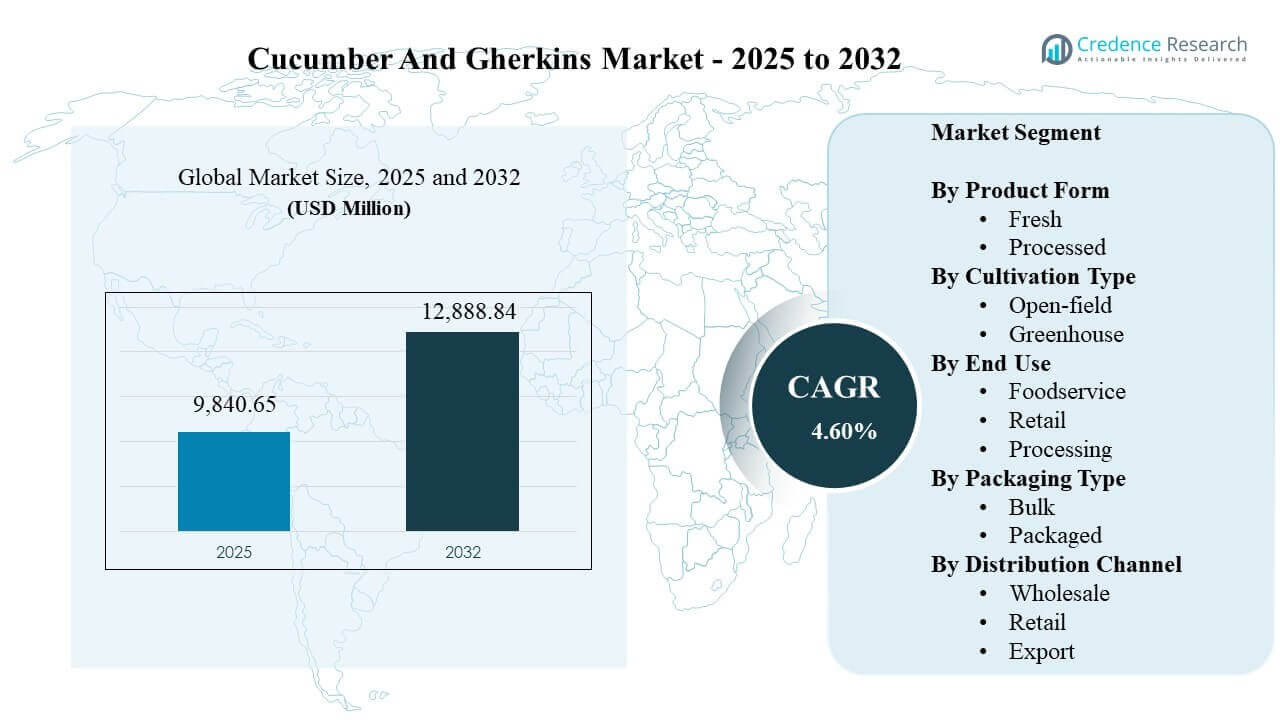
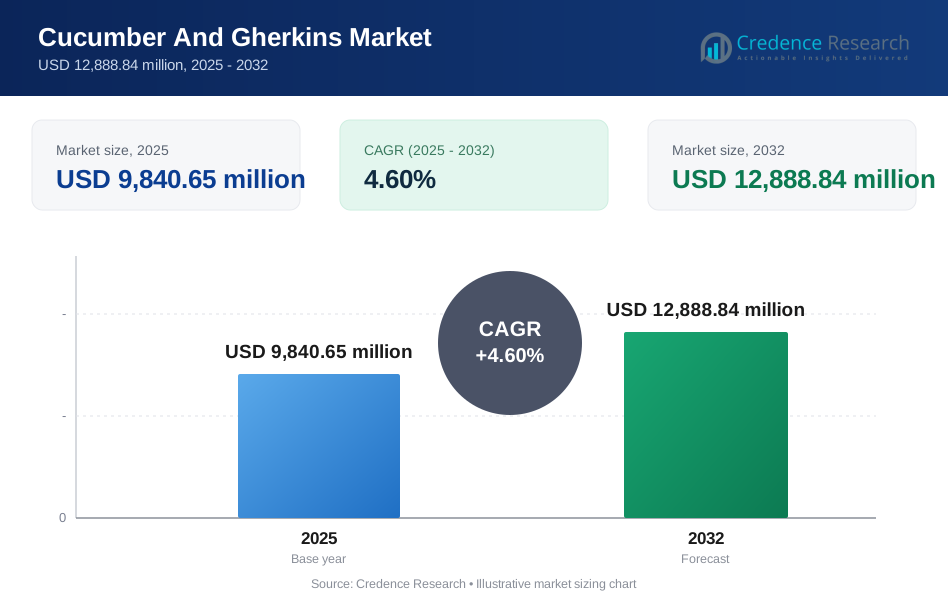
The global Cucumber And Gherkins Market size was estimated at USD 9,840.65 million in 2025 and is expected to reach USD 12,888.84 million by 2032, growing at a CAGR of 4.60% from 2025 to 2032. Demand growth is primarily supported by rising year-round consumption across retail and foodservice, supported by expanded protected cultivation and more consistent cold-chain distribution that reduces seasonal availability gaps. Processing demand for preserved formats also supports baseline offtake by stabilizing procurement and creating multi-channel demand for standardized grades.
| REPORT ATTRIBUTE | DETAILS |
|---|---|
| Historical Period | 2020-2024 |
| Base Year | 2025 |
| Forecast Period | 2026-2032 |
| Cucumber And Gherkins Market Size 2025 | USD 9,840.65 million |
| Cucumber And Gherkins Market, CAGR | 4.60% |
| Cucumber And Gherkins Market Size 2032 | USD 12,888.84 million |
Key Market Trends & Insights
- The market is projected to expand from USD 9,840.65 million in 2025 to USD 12,888.84 million by 2032, indicating steady volume-led growth across fresh and processed supply chains.
- Fresh accounted for the largest share of 66.40% in 2025, supported by high household penetration and strong demand for salad, snacking, and meal-prep use cases.
- Retail held 54.10% share in 2025, reflecting the scale of household consumption and the growing role of organized retail and packaged fresh produce programs.
- Asia Pacific represented 79.96% of revenue in 2025, anchored by concentrated production ecosystems, large domestic consumption bases, and export-linked processing capacity.
- North America held 7.85% share in 2025, supported by year-round sourcing and rising greenhouse-linked supply consistency that reduces seasonality risk.
Segment Analysis
Product form dynamics in the Cucumber And Gherkins Market reflect the balance between immediate consumption preferences and the stabilizing influence of processing. Fresh volume benefits from convenience-led household use, broader availability across retail formats, and greater consistency in quality due to improvements in protected cultivation and handling. Processed formats support demand smoothing by absorbing graded volumes and creating stable procurement programs for suppliers, particularly in export-aligned value chains.
End-use patterns show retail as the key demand anchor because cucumbers are a frequent-purchase fresh item with broad menu versatility. Foodservice demand remains important through salads, sandwiches, and quick-service applications that favor consistent size and texture specifications. Processing demand complements both channels by supporting utilization of standardized varieties and by creating predictable offtake tied to preservation and packaged formats.
Channel and packaging decisions are increasingly shaped by quality assurance, traceability expectations, and the need to reduce shrink. Bulk movement remains central for aggregation and downstream sorting, while packaged formats expand in organized retail where branding, labeling compliance, and portioning align with shopper convenience.
By Product Form Insights
Fresh accounted for the largest share of 66.40% in 2025. Fresh leadership is supported by high consumption frequency and broad culinary use across salads, snacks, and meal preparation. Retailers prioritize consistent supply and appearance grades, which favors suppliers with strong post-harvest handling and controlled-environment sourcing programs. Fresh trade is also reinforced by year-round procurement models that reduce seasonal demand swings and support stable pricing windows.
By Cultivation Type Insights
Open-field production remains the volume backbone in many growing regions due to scale and lower unit costs, supporting wholesale and processing flows. Greenhouse output expands where buyers require tighter quality specifications, consistent sizing, and reliable supply during off-season periods. Protected cultivation also supports better yield stability and improved resilience to weather variability, which helps suppliers meet contract commitments. Growth in controlled environments is further supported by modern irrigation practices and integrated pest management requirements in higher-spec markets.
By End Use Insights
Retail accounted for the largest share of 54.10% in 2025. Retail demand leads because household usage spans everyday meals, hydration-oriented diets, and convenience-led fresh snacking. Organized retail programs increasingly emphasize consistent quality, shelf-life performance, and traceability, which supports suppliers that can deliver standardized grades. Retail demand also benefits from broader availability of packaged fresh formats, which encourages higher basket penetration and repeat purchases.
By Packaging Type Insights
Bulk packaging remains critical for efficient aggregation, grading, and distribution to processors and foodservice operators. Packaged formats continue to expand in organized retail where portioning, labeling, and presentation influence purchase decisions and reduce handling at store level. Packaging choices are also shaped by efforts to reduce shrink through better moisture control and protection during transit. Sustainability expectations and recycling compliance increasingly influence material selection and secondary packaging design in major markets.
By Distribution Channel Insights
Wholesale channels continue to anchor the market by consolidating farm output, managing quality sorting, and supplying both retail and foodservice efficiently. Retail distribution gains importance where organized chains expand fresh produce programs and prioritize supplier compliance and service levels. Export flows are shaped by quality standards, residue compliance, and the ability to deliver consistent grades and preservation specifications for gherkins in particular. Channel performance is closely tied to cold-chain availability and route-to-market efficiency.
Market Drivers
Expansion of protected cultivation and year-round availability
Greenhouse and controlled-environment production improves supply consistency and reduces seasonal gaps, which supports stable retail programs and foodservice contracts. Better yield predictability strengthens growers’ ability to commit to volumes and quality specifications across longer time windows. Controlled environments also help manage pest and disease pressure and support tighter sizing and cosmetic standards. These factors reduce procurement risk for buyers and encourage wider distribution across organized channels.
Rising retail penetration and packaged fresh produce programs
Retail-driven demand grows as organized chains widen fresh produce assortments and prioritize reliable supplier partnerships. Packaged formats support convenience, reduce in-store handling, and improve shelf presentation, which can lift purchase frequency. Retail standards for traceability and quality control also incentivize investments in sorting, grading, and cold-chain handling. As household consumption remains steady, retail programs serve as a dependable demand base for fresh cucumbers.
Processing demand supporting stable offtake for graded volumes
Processing creates predictable demand for cucumbers and gherkins by converting supply into preserved and value-added formats. This channel supports utilization of standardized varieties and creates a buffer for volumes that do not meet premium fresh appearance requirements. Processing-linked demand also encourages contract farming structures that align variety selection, agronomy practices, and harvesting schedules. These arrangements improve supply planning and strengthen supplier-buyer relationships.
- For instance, Bonduelle highlighted a strategic North American base with 15,000 tons of capacity, illustrating how industrial-scale facilities help absorb and standardize vegetable flows for downstream channels.
Growth in foodservice usage and menu versatility
Foodservice demand benefits from cucumbers’ versatility in salads, sandwiches, bowls, and side dishes, supporting consistent procurement across formats. Large operators typically require consistent size and texture specifications, which favors suppliers with strong quality management. Foodservice demand can also support bulk distribution efficiency and predictable weekly ordering cycles. As dining formats diversify, cucumbers remain a low-preparation ingredient that fits multiple cuisines and menu concepts.
- For instance, Fresh Del Monte reports operating approximately 11,000 refrigerated containers and owning or leasing about 355 trucks and refrigerated trailers in the U.S., reinforcing how temperature-controlled logistics supports frequent replenishment for foodservice and other high-velocity channels.
Market Challenges
Weather volatility and disease pressure remain persistent challenges for open-field production, affecting yields, sizing consistency, and supply timing. These factors can amplify price fluctuations and complicate contract fulfillment, especially when cold-chain capacity is limited. Variability in water availability and input costs also affects grower economics, which can reduce planting stability across seasons.
- For instance, NatureSweet reports its greenhouse production uses 58% less water than open-field farms, reflecting how controlled-environment and drip-based systems can reduce weather exposure and stabilize output quality under water-stress conditions.
Quality compliance and food safety expectations create additional operating complexity across the supply chain. Buyers increasingly require traceability, residue compliance, and standardized grading, which raises costs for smaller growers and aggregators. Handling-related losses during transport and distribution can also pressure margins, particularly in long-haul shipments without robust cold-chain infrastructure. Market participants must continuously invest in post-harvest practices to reduce shrink and maintain appearance quality.
Market Trends and Opportunities
Higher adoption of controlled-environment systems creates opportunities for suppliers to deliver premium grades during off-season periods and build long-term retail partnerships. Investments in greenhouse expansion, modern irrigation, and precision agronomy can improve yield stability and reduce procurement uncertainty for buyers. These shifts support stronger supplier differentiation based on service levels and consistent specifications rather than price alone.
- For instance, Bayer CropScience’s ‘Climate FieldView’ digital farming platform has been deployed across more than 220 million acres globally, allowing greenhouse operators to monitor microclimate and soil parameters in real time. Similarly, Fruition Sciences partnered with Treasury Wine Estates to use optical sensors and sap-flow monitoring systems, cutting irrigation water usage by 25% while sustaining grape yield stability across seasons.
Value-added processing and product innovation offer growth pathways beyond fresh commodity trade. Preserved formats, branded packs, and convenience-led offerings can improve pricing power and reduce exposure to short-term fresh price volatility. Export-oriented processing ecosystems also create opportunities for contract farming models that improve predictability for both growers and processors. Over time, tighter integration across production, processing, and distribution can improve resilience and supply planning.
Regional Insights
North America
North America represented 7.85% share in 2025, supported by strong retail penetration and year-round sourcing models that reduce seasonal availability risk. Demand is reinforced by household consumption and steady foodservice usage across salads and sandwich-oriented menus. Growth prospects improve as greenhouse output expands and cold-chain distribution strengthens, supporting consistent quality and fewer handling losses. Supplier differentiation increasingly centers on compliance, service levels, and predictable volumes.
Europe
Europe held 5.72% share in 2025, shaped by structured procurement programs and steady demand for both fresh cucumbers and preserved formats. Retail standards emphasize traceability and consistent grading, which favors suppliers that can deliver standardized specifications. Imports and cross-border flows play a key role in maintaining year-round availability, especially during seasonal production gaps. Processing-linked demand supports baseline volumes and stable offtake for standardized varieties.
Asia Pacific
Asia Pacific accounted for 79.96% share in 2025, anchored by large-scale production ecosystems and strong domestic consumption. The region’s scale supports efficient supply chains across wholesale, retail, and processing channels, enabling continuous market throughput. Export-linked processing capacity for gherkins strengthens demand stability and supports contract farming structures. Productivity improvements and supply-chain modernization continue to shape competitiveness across key producing areas.
Latin America
Latin America represented 3.04% share in 2025, supported by localized fresh consumption and selective participation in export-oriented supply chains. Production economics are influenced by climate variability and infrastructure differences across growing regions. Investments in post-harvest handling and cold-chain access can improve competitiveness and reduce shrink. Opportunities are strongest where suppliers can meet higher-grade specifications and align with organized retail and processing demand.
Middle East & Africa
Middle East & Africa held 3.43% share in 2025, driven by growing urban demand and a rising role for protected cultivation in water-constrained environments. Local production expansion supports import substitution in some markets and improves year-round availability. Supply chains remain sensitive to logistics costs and cold-chain development, which affect quality preservation in distribution. Market growth is supported by investments in modern irrigation, greenhouse systems, and standardized procurement.
Competitive Landscape
Competition in the Cucumber And Gherkins Market centers on supply consistency, quality compliance, and the ability to serve multiple channels with predictable specifications. Suppliers and brand owners differentiate through sourcing networks, controlled-environment capacity, post-harvest handling, and contract farming structures that improve traceability. Processing-oriented participants strengthen positioning through preservation capabilities, export compliance, and relationships with private-label and foodservice buyers. Channel reach and cold-chain execution remain important factors influencing scale advantages.
Greenyard’s positioning benefits from integrated fresh produce capabilities and established relationships with large retail customers, supporting structured sourcing and service-level execution. The company’s scale advantages can support stable procurement programs, coordinated logistics, and consistent quality management across high-frequency categories. Emphasis on supply-chain efficiency and compliance readiness supports competitiveness in organized retail environments. Continued focus on assortment breadth and reliable delivery performance strengthens buyer confidence in long-term partnerships.
The industry research and growth report includes detailed analyses of the competitive landscape of the market and information about key companies, including:
- Greenyard
- Del Monte Foods
- Bonduelle
- Conagra Brands
- Dole
- Fresh Del Monte
- SunOpta
- Agrokor
- Princes Group
- NatureSweet
Qualitative and quantitative analysis of companies has been conducted to help clients understand the wider business environment as well as the strengths and weaknesses of key industry players. Data is qualitatively analyzed to categorize companies as pure play, category-focused, industry-focused, and diversified; it is quantitatively analyzed to categorize companies as dominant, leading, strong, tentative, and weak.
Recent Developments
- In December 2025, BASF SE announced the acquisition of Noble Seeds India, a supplier of cucumber and other vegetable hybrids to growers in India and South Asia, with the transaction designed to strengthen BASF’s cucumber portfolio, deepen its distribution reach in key Indian states, and bolster technical support for contract farming programs serving the country’s export-oriented gherkin sector.
Report Scope
| Report Attribute | Details |
| Market size value in 2025 | USD 9,840.65 million |
| Revenue forecast in 2032 | USD 12,888.84 million |
| Growth rate (CAGR) | 4.60% (2025–2032) |
| Base year | 2025 |
| Forecast period | 2026-2032 |
| Quantitative units | USD million |
| Segments covered | By Product Form (Fresh, Processed); By Cultivation Type (Open-field, Greenhouse); By End Use (Foodservice, Retail, Processing); By Packaging Type (Bulk, Packaged); By Distribution Channel (Wholesale, Retail, Export) |
| Regional scope | North America, Europe, Asia Pacific, Latin America, Middle East & Africa |
| Key companies profiled | Greenyard; Del Monte Foods; Bonduelle; Conagra Brands; Dole; Fresh Del Monte; SunOpta; Agrokor; Princes Group; NatureSweet |
| No. of Pages | 327 |
Segmentation
By Product Form
- Fresh
- Processed
By Cultivation Type
- Open-field
- Greenhouse
By End Use
- Foodservice
- Retail
- Processing
By Packaging Type
- Bulk
- Packaged
By Distribution Channel
- Wholesale
- Retail
- Export
By Region
- North America
- U.S.
- Canada
- Mexico
- Europe
- Germany
- France
- U.K.
- Italy
- Spain
- Rest of Europe
- Asia Pacific
- China
- Japan
- India
- South Korea
- South-east Asia
- Rest of Asia Pacific
- Latin America
- Brazil
- Argentina
- Rest of Latin America
- Middle East & Africa
- GCC Countries
- South Africa
- Rest of the Middle East and Africa
Request a Free Sample
Fill in your details and we'll send you a free sample report.
- Sample data tables & charts
- Research methodology
Need a Custom Version of This Report?
Tailor the scope, geography, or segments to your exact requirements.
- Custom geography or segment scope
- Direct access to our analyst team
Frequently Asked Questions
What is the market size and forecast for the Cucumber And Gherkins Market?
What is the CAGR for the Cucumber And Gherkins Market?
What is the largest segment in the Cucumber And Gherkins Market?
What factors are driving growth in the Cucumber And Gherkins Market?
Which companies are leading in the Cucumber And Gherkins Market?
Which region leads the Cucumber And Gherkins Market?
Table of Content
Chapter 1. Report Introduction
- 1.1 Report Description & Purpose
- 1.1.1 Report Title & Market Definition
- 1.1.2 Unique Selling Propositions (USP) & Key Differentiators
- 1.1.3 Value Proposition for Stakeholders
- 1.2 Research Objectives
- 1.2.1 Market Sizing Objectives (Volume & Revenue)
- 1.2.2 Segmentation Objectives
- 1.2.3 Competitive Intelligence Objectives
- 1.2.4 Forecast & Scenario Objectives
- 1.3 Report Scope
- 1.3.1 Cucumber And Gherkins Scope – Types & Subtypes Covered
- 1.3.2 Geographic Scope – Regions & Countries Covered
- 1.3.3 Historical Period, Base Year & Forecast Period (2025; forecast to 2032)
- 1.3.4 Inclusions & Exclusions
- 1.4 HS Code & Classification Framework
- 1.5 Currency, Units & Pricing Basis
- 1.6 Target Stakeholders
- 1.7 Limitations & Assumptions
Chapter 2. Executive Summary
- 2.1 Global Cucumber And Gherkins Market Snapshot
- 2.1.1 Market Size – Historical (2025) & Forecast (2025-2032) (2025: USD 9,840.65 million → 2032: USD 12,888.84 million)
- 2.1.2 Volume & Revenue – Global Totals
- 2.1.3 Key Market Highlights – Top Five Facts
- 2.2 Cucumber And Gherkins Market Segmentation Snapshot
- 2.2.1 Market Split by Region – 2025 vs. 2032
- 2.3 Competitive Snapshot
- 2.3.1 Top 10 Players by Revenue Share – 2025
- 2.3.2 Top 10 Players by Volume Share – 2025
- 2.3.3 Recent Strategic Developments (18-Month Summary)
- 2.4 Key Investment Highlights & Strategic Conclusions
Chapter 3. Cucumber And Gherkins Market Dynamics & Industry Analysis
- 3.1 Market Overview & Context
- 3.1.1 Cucumber And Gherkins Market Position in the Broader Automotive Value Chain
- 3.1.2 OEM vs. Replacement Market Dynamics
- 3.1.3 Market Maturity & Development Stage by Region
- 3.2 Cucumber And Gherkins Market Drivers
- 3.3 Cucumber And Gherkins Market Restraints & Challenges
- 3.4 Cucumber And Gherkins Market Opportunities
- 3.5 Porter's Five Forces Analysis
- 3.5.1 Threat of New Entrants
- 3.5.2 Bargaining Power of Suppliers
- 3.5.3 Bargaining Power of Buyers
- 3.5.4 Threat of Substitutes
- 3.5.5 Competitive Rivalry – Intensity Assessment
- 3.6 Cucumber And Gherkins Value Chain Analysis
- 3.6.1 Upstream – Raw Material/Input Suppliers
- 3.6.1.1 Raw Material/Input 1
- 3.6.1.2 Raw Material/Input 2
- 3.6.1.3 Raw Material/Input 3
- 3.6.2 Midstream – Production/Manufacturing/Service Delivery
- 3.6.2.1 Production/Process Overview
- 3.6.2.2 Key Facility Locations & Capacity by Manufacturer
- 3.6.3 Downstream – Distribution & End Consumer
- 3.6.3.1 Primary Channel – B2B/OEM
- 3.6.3.2 Secondary Channels – Dealer, Retail, Online, Direct
- 3.6.4 Value Chain Profitability Analysis
- 3.6.1 Upstream – Raw Material/Input Suppliers
- 3.7 PESTEL Analysis
- 3.7.1 Political Factors
- 3.7.2 Economic Factors
- 3.7.3 Social Factors
- 3.7.4 Technological Factors
- 3.7.5 Environmental Factors
- 3.7.6 Legal Factors
- 3.8 Cucumber And Gherkins Supply Chain Analysis
- 3.8.1 Raw Material/Input Supply Risk Assessment
- 3.8.2 Manufacturing Concentration Risk (Geographic Exposure)
- 3.8.3 Trade Disruption Impact Analysis
- 3.9 Regulatory & Policy Landscape
Note: The regulatory and policy landscape section covers regulations based on their applicability to the market, Cucumber And Gherkins category, geography, and scope of the study. Only regulatory frameworks with a material impact on operations, compliance, trade, sustainability, or market access are analyzed in detail.
Chapter 4. Key Investment Pockets & Opportunity Analysis
- 4.1 Cucumber And Gherkins Market Attractiveness Analysis
- 4.1.1 By Region – Investment Attractiveness Matrix (Volume × CAGR)
- 4.2 Absolute Revenue Growth Opportunity
- 4.2.1 By Region – Absolute USD Growth Through 2032
- 4.3 Incremental Volume Opportunity
- 4.3.1 By Region – Incremental Volume Through 2032
- 4.3.2 Segment – Incremental Volume
- 4.4 Emerging Submarket Opportunity Deep Dive (Subject to Applicability)
- 4.5 Emerging Market Opportunity Scorecards
- 4.5.1 United States
- 4.5.2 Europe
- 4.5.3 Asia
- 4.5.4 Middle East & Africa
Note: Emerging Market Opportunity Scorecards will be included based on relevance and strategic importance. Regions listed are indicative and may vary depending on data availability and market dynamics.
Chapter 5. Cucumber And Gherkins Import-Export Analysis & Trade Flows
- 5.1 Global Trade Overview
- 5.1.1 Global Export Value by Country (2025)
- 5.1.2 Global Export Volume by Country (2025)
- 5.1.3 Global Import Value by Country (2025)
- 5.1.4 Global Import Volume by Country (2025)
- 5.1.5 Net Trade Balance by Country (2025)
- 5.2 Export Analysis – Segment
- 5.2.1 Type 1 (HS Code)
- 5.2.2 Type 2 (HS Code)
- 5.2.3 Type 3 (HS Code)
- 5.2.4 Type 4 (HS Code)
- 5.2.5 Type 5 (HS Code)
- 5.3 Import Analysis – Segment
- 5.3.1 Type 1 (HS Code)
- 5.3.2 Type 2 (HS Code)
- 5.3.3 Type 3 (HS Code)
- 5.3.4 Type 4 (HS Code)
- 5.3.5 Type 5 (HS Code)
- 5.4 Average Unit Trade Prices
- 5.4.1 Average Export Price – Segment & Country
- 5.4.2 Average Import Price – Segment & Source Country
- 5.4.3 Price Trends (2025)
- 5.5 Key Trade Route Analysis
- 5.5.1 Trade Route 1
- 5.5.2 Trade Route 2
- 5.5.3 Trade Route 3
- 5.5.4 Trade Route 4
- 5.5.5 Trade Route 5
- 5.6 Trade Policy Impact Assessment
- 5.6.1 US Anti-Dumping & Section 301 Tariffs
- 5.6.2 EU Customs Union Impact
- 5.6.3 Major Free Trade Agreements
- 5.6.4 USMCA Rules of Origin
Note: Trade policy analysis will be included only where relevant to the Cucumber And Gherkins market.
Chapter 6. Competitive Landscape & Company Benchmarking
- 6.1 Cucumber And Gherkins Market Concentration & Structure
- 6.1.1 Herfindahl-Hirschman Index (HHI) – vs. 2025
- 6.1.2 Tier 1, Tier 2 & Tier 3 Market Structure
- 6.1.3 Global, Regional & Local Player Dynamics
- 6.2 Cucumber And Gherkins Market Share Analysis – 2025
- 6.2.1 Global Revenue Share by Company
- 6.2.2 Global Volume Share by Company
- 6.2.3 Regional Revenue Share
- 6.2.4 Market Share Evolution ( vs. 2025)
- 6.2.5 OEM Segment Share by Company
- 6.2.6 Replacement Segment Share by Company
- 6.3 Production/Delivery Capacity & Facility Analysis
- 6.3.1 Global Installed Capacity
- 6.3.2 Capacity Utilization Rates
- 6.3.3 Production/Output Volume
- 6.3.4 Facility Locations & Capacity Map
- 6.3.5 Planned Capacity Additions
- 6.4 Cucumber And Gherkins Competitive Benchmarking Matrix
- 6.4.1 Revenue, Volume, CAGR & Profitability Comparison
- 6.4.2 Channel Revenue Mix
- 6.4.3 Geographic Revenue Exposure
- 6.4.4 R&D Intensity
- 6.4.5 Sustainability Maturity
- 6.5 Strategic Developments in Cucumber And Gherkins (Last 24 Months)
- 6.5.1 Mergers, Acquisitions & Divestments
- 6.5.2 New Cucumber And Gherkins Launches
- 6.5.3 Facility Expansions
- 6.5.4 Strategic Alliances, Joint Ventures & Partnerships
- 6.5.5 Distribution Expansion & Market Entry
- 6.5.6 Sustainability & ESG Initiatives
- 6.6 Competitive Strategy Mapping
- 6.6.1 Leader, Challenger, Follower & Niche Classification
- 6.6.2 Pricing Strategy Comparison
- 6.6.3 Channel Strategy Matrix
Note: Strategic developments are included based on their materiality and the availability of reliable information.
Chapter 7. Global Cucumber And Gherkins Market – By Distribution Channel
- 7.1 Segment Overview
- 7.1.1 Volume & Revenue Split by Channel (2025 & 2032)
- 7.1.2 Channel Mix Evolution (2025-2032)
Chapter 8. Regional Market Analysis – Global Overview
- 8.1 Global Regional Overview
- 8.1.1 Regional Volume Share
- 8.1.2 Regional Revenue Share
- 8.1.3 Regional Volume by Region
- 8.1.4 Regional Revenue by Region
- 8.1.5 Regional Forecast Through 2032
- 8.2 Cross-Regional Segment Analysis
- 8.2.1 By Distribution Channel
- 8.2.2 By Brand/Price Tier
Chapter 9. North America Cucumber And Gherkins Market
- 9.1 United States
- 9.2 Canada
- 9.3 Mexico
Chapter 10. Europe Cucumber And Gherkins Market
- 10.1 Germany
- 10.2 France
- 10.3 Italy
- 10.4 United Kingdom
- 10.5 Spain
- 10.6 Poland
- 10.7 Russia
- 10.8 Netherlands
- 10.9 Belgium
- 10.10 Sweden
- 10.11 Denmark
- 10.12 Norway
- 10.13 Rest of Europe
Chapter 11. Asia Pacific Cucumber And Gherkins Market
- 11.1 China
- 11.2 India
- 11.3 Japan
- 11.4 South Korea
- 11.5 Thailand
- 11.6 Indonesia
- 11.7 Vietnam
- 11.8 Malaysia
- 11.9 Australia
- 11.10 Rest of Asia Pacific
Chapter 12. Latin America Cucumber And Gherkins Market
- 12.1 Brazil
- 12.2 Argentina
- 12.3 Colombia
- 12.4 Chile
- 12.5 Rest of Latin America
Chapter 13. Middle East Cucumber And Gherkins Market
- 13.1 Saudi Arabia
- 13.2 United Arab Emirates
- 13.3 Turkey
- 13.4 Israel
- 13.5 Iran
- 13.6 Rest of the Middle East
Chapter 14. Africa Cucumber And Gherkins Market
- 14.1 South Africa
- 14.2 Egypt
- 14.3 Nigeria
- 14.4 Morocco
- 14.5 Rest of Africa
Chapter 15. Cucumber And Gherkins Company Profiles
- 15.1 [Company 01]
- 15.1.1 Company Overview
- 15.1.2 Key Management Personnel
- 15.1.3 Products & Services Portfolio
- 15.1.4 Financial Performance
- 15.1.5 Key Market Focus & Geographic Presence
- 15.1.6 Recent Developments & Strategic Initiatives
Note: The company profile list is preliminary and may change based on research findings, market developments, data availability, and client requirements.
Chapter 16. Appendices
- Appendix A – List of Abbreviations & Acronyms
- Appendix B – Industry Classification Code Reference – Full Series
- Appendix C – Production & Capacity Data Tables
- Appendix D – End-Use & Demand Base Tables
- Appendix E – Consumption & Replacement Rate Assumptions
- Appendix F – ASP Reference Tables
- Appendix G – Manufacturing & Facility Database
- Appendix H – Import-Export Data Tables
- Appendix I – Regulatory Summary Tables
- Appendix J – Primary Research Participant List (Anonymized)
- Appendix K – Primary Research Questionnaire Framework
- Appendix L – Data Sources & Bibliography
- Appendix M – Market Size Divergence & Source Comparison
Chapter 17. Research Methodology
- 17.1 Research Framework & Philosophy
- 17.2 Secondary Research – Sources, Hierarchy & Data Extraction
- 17.3 Data Modeling – Bottom-Up & Top-Down Market Sizing
- 17.4 Primary Research – Stakeholder Framework, LOI & Sample Sizes
- 17.5 Forecast Methodology – Regression, Scenario & Sensitivity Analysis
- 17.6 Quality Control – Four-Layer Validation Framework
- 17.7 Limitations & Standard Assumptions
- 17.8 Disclaimer
