
Cinnamon Market Overview:
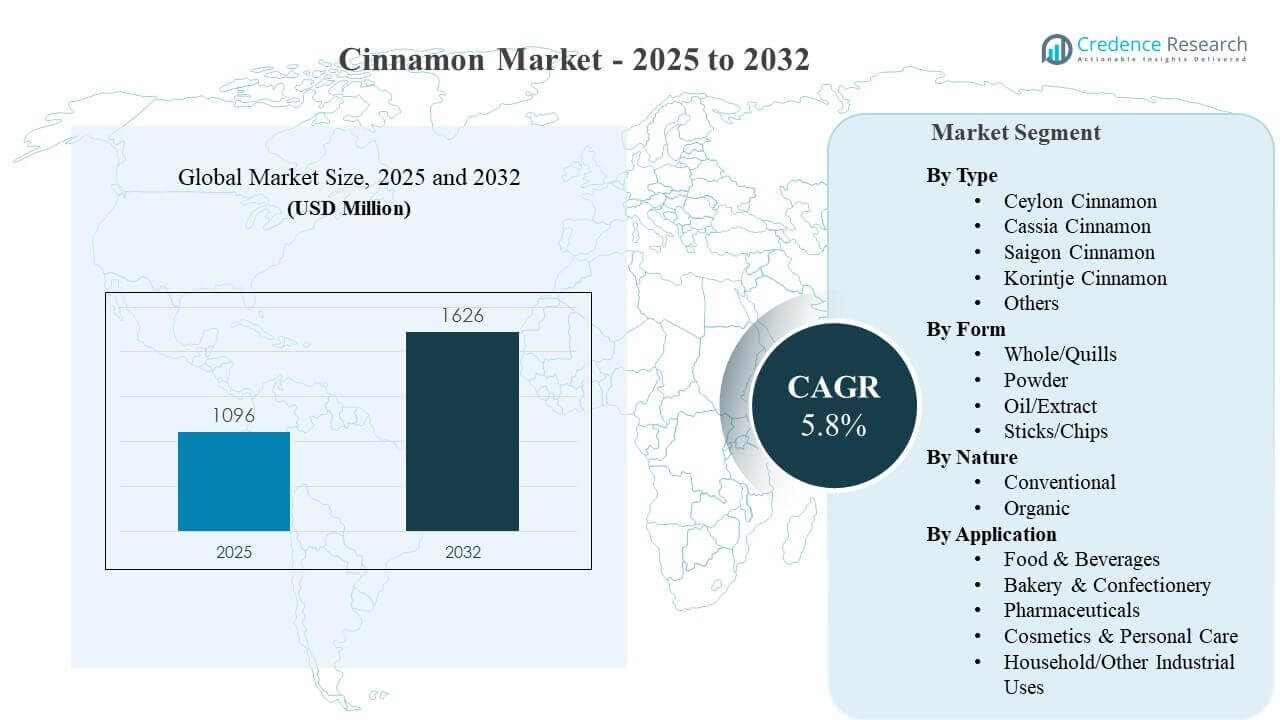
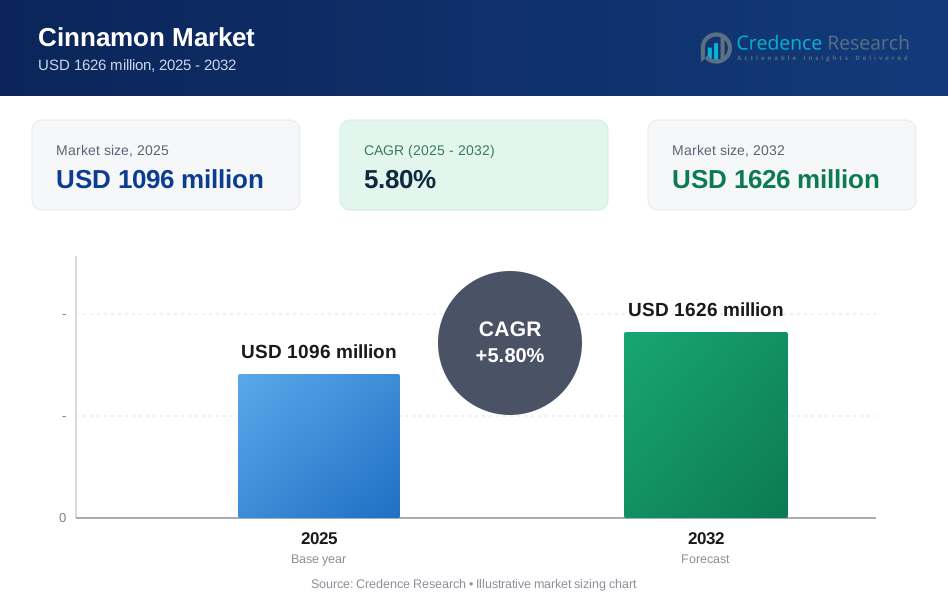
The global Cinnamon Market size was estimated at USD 1096 million in 2025 and is expected to reach USD 1626 million by 2032, growing at a CAGR of 5.8% from 2025 to 2032. Demand is being propelled by the expanding use of cinnamon as a natural flavor and functional ingredient across packaged foods, beverages, and wellness-led formulations. Supply-chain professionalization—especially around origin traceability and quality testing—continues to influence buyer preferences and sourcing choices across industrial and retail channels.
| REPORT ATTRIBUTE | DETAILS |
|---|---|
| Historical Period | 2020-2024 |
| Base Year | 2025 |
| Forecast Period | 2026-2032 |
| Cinnamon Market Size 2025 | USD 1096 million |
| Cinnamon Market, CAGR | 5.8% |
| Cinnamon Market Size 2032 | USD 1626 million |
Key Market Trends & Insights
- The Cinnamon Market is projected to expand from USD 1096 million (2025) to USD 1626 million (2032) at a 5.8% CAGR (2025–2032).
- Asia Pacific accounted for 65.9% of global revenue in 2025, reflecting concentration of supply origins and strong regional consumption intensity.
- In 2025, North America represented 15.6% of revenue, supported by packaged-food scale and high import dependence for spices and seasonings.
- Whole/Quills held 28.6% share in 2025, sustained by premium culinary usage and perceived authenticity versus ground formats.
- Pharmaceuticals/Nutraceuticals contributed 18.7% of revenue in 2025, driven by extract-led applications and wellness positioning.
Segment Analysis
Cinnamon demand is increasingly shaped by a dual-track market: high-volume culinary consumption and higher-margin value-added formats such as standardized powders, extracts, and oils. Buyers prioritize sensory consistency, contaminant risk controls, and reliable origin documentation, particularly for industrial applications where batch-to-batch uniformity directly affects finished product quality. Premiumization also remains visible in branded retail, where consumers associate whole/quill formats with freshness and authenticity and use them for infusion, brewing, and artisanal cooking.
Growth is further supported by cross-category adoption beyond traditional cooking. Wellness-oriented positioning expands usage in supplements and functional foods, while personal care brands adopt botanical ingredients for fragrance and perceived natural benefits. At the same time, procurement teams increasingly emphasize specification tightening, supplier audits, and testing disclosures, which raises the importance of compliant sourcing and traceable supply chains for both conventional and organic streams.
By Type Insights
Ceylon Cinnamon remains the most commercially attractive type for premium positioning because buyers associate it with authenticity, cleaner sensory profile, and stronger origin branding. Importers and branded packers typically value consistent cut, color, and aroma attributes that support repeatable product performance. Supplier selection is increasingly influenced by documentation quality, traceability depth, and the ability to meet evolving compliance expectations. Type differentiation also impacts pricing power, with premium grades often used for higher-trust retail and value-added formulations.
By Form Insights
Whole/Quills accounted for the largest share of 28.6% in 2025. Whole formats preserve aroma integrity and enable premium presentation for culinary infusion, beverage steeping, and gourmet use cases. Buyers also perceive whole cinnamon as less prone to quality dilution than ground products, supporting preference in higher-trust channels. Foodservice and specialty retail continue to support demand for whole forms, while manufacturers use them for controlled grinding and fresh aroma release.
By Nature Insights
Organic cinnamon demand benefits from clean-label preference and brand commitments to responsible sourcing, particularly in premium retail and wellness categories. However, certification complexity, supply constraints, and price volatility can limit broad-based penetration across mass-market applications. Conventional cinnamon remains essential for large-scale food processing due to availability, consistent supply continuity, and cost competitiveness. Across both nature types, buyers increasingly expect traceability documentation and validated specifications that reduce reputational risk.
By Application Insights
Food & Beverages remains the backbone of cinnamon demand due to broad inclusion across cooking, beverages, seasoning blends, and ready-to-eat formulations. Bakery & Confectionery sustains steady volumes through seasonal and indulgence-led products where warm spice notes are core. Pharmaceuticals/Nutraceuticals represented 18.7% share in 2025, reflecting growing extract usage aligned to wellness positioning and standardized dosing formats. Cosmetics & Personal Care and household/industrial uses are expanding steadily as formulators adopt botanical ingredients and natural fragrance components.
Cinnamon Market Drivers
Expansion of packaged food and beverage flavor systems
Packaged food producers continue to increase spice usage to differentiate taste profiles in snacks, bakery mixes, cereals, and beverages. Cinnamon benefits from broad cultural familiarity and high versatility across sweet and savory products, making it a common formulation anchor. Product developers also value cinnamon for aroma intensity, allowing lower inclusion rates than some botanicals. Growth is further supported by premium seasoning blends and ready-to-use flavor systems that incorporate cinnamon across retail and foodservice.
- For instance, AVT McCormick states that it supplies more than 20 spices in formats including whole, ground, crushed, cracked, and tea cuts, and that these are processed through USFDA microbiology-reduction-protocol-validated steam sterilizers before being offered as bottle-ready spices and blends.
Rising demand for natural and “better-for-you” ingredients
Consumers increasingly prefer recognizable ingredients and natural flavoring solutions, which supports cinnamon adoption across clean-label product lines. Cinnamon also benefits from strong association with wellness narratives, enabling its positioning in functional foods and nutraceutical formats. Brands use cinnamon to complement sugar-reduction strategies by delivering perceived sweetness and warmth without raising sugar content. This driver is particularly relevant for beverage mixes, breakfast products, and supplement-linked food applications.
- For instance, Kerry says its Tastesense Sweet platform delivers clean-label sugar reduction of up to 30% without compromising taste, while Tastesense Advanced is positioned for up to 100% sugar reduction with a cleaner taste profile.
Increasing use of extracts and oils in value-added applications
Industrial buyers are expanding use of cinnamon oil and standardized extracts to achieve consistent flavor performance, solubility, and dosing control. Extract formats reduce variability from agricultural factors and enable easier integration into liquids, personal care products, and certain pharmaceutical preparations. The shift toward formulated ingredients also increases the role of supplier capability in standardization, documentation, and application support. This transition supports higher average selling prices in selected application clusters.
Strengthening procurement focus on traceability and compliance
Quality assurance and procurement teams are tightening supplier qualification and specification requirements across spices. Cinnamon, like other ground spices, faces heightened scrutiny around contaminants and authenticity, which increases demand for validated testing and origin transparency. Buyers prefer suppliers capable of consistent documentation, batch controls, and reliable audit readiness. As a result, compliant sourcing becomes a competitive advantage, particularly for branded retail, large processors, and private-label supply chains.
Cinnamon Market Challenges
Cinnamon markets face persistent supply-side variability driven by weather, yield fluctuations, and origin-level operational constraints, which can create pricing volatility and inconsistent availability for industrial buyers. Quality inconsistency across grades and origins can also lead to sensory variability that complicates formulation consistency for large manufacturers. In addition, fragmented supply chains raise the risk of adulteration perceptions, documentation gaps, and uneven compliance performance. These factors increase the cost of supplier qualification and can elongate procurement cycles.
Regulatory and customer-driven scrutiny around contaminants and labeling expectations creates additional operational burden for cinnamon suppliers and packers. Testing frequency, specification tightening, and documentation requirements increase overhead costs, especially for smaller exporters and processors. Retailers and branded buyers may respond to category-wide concerns by switching suppliers, changing sourcing origins, or revising product specifications. Such changes can disrupt long-standing trading relationships and intensify competitive pressure on quality systems and traceability capabilities.
- For example, UK Food Standards Agency survey for which Eurofins Laboratory (Wolverhampton) conducted coumarin analysis recorded coumarin levels in ground cinnamon as high as 1,657 mg/kg far exceeding permissible limits in multiple food applications under EU flavoring regulations illustrating the testing burden that such contamination findings place on the broader supply network.
Cinnamon Market Trends and Opportunities
A key trend is premiumization through origin storytelling, verified grade claims, and differentiated product formats such as quills, specialty cuts, and standardized extracts. Brands and ingredient suppliers that can demonstrate consistent sensory profiles and credible sourcing practices are better positioned to win higher-value contracts. This trend is also extending into spice blends and functional seasoning systems, where cinnamon is used to support warmth, sweetness perception, and aroma complexity. Premium retail demand further supports innovation in packaging and freshness preservation.
- For instance, Cylonies defines Alba-grade Ceylon cinnamon at 6–7 mm in quill diameter with a minimum of 45 whole 42-inch quills per kilogram, while McCormick’s 2025 Gourmet redesign extended across 72 flavors, including 54 certified organic varieties such as Saigon Cinnamon Sticks, and its broader bottle upgrade added freshness-sealing closures, 50% post-consumer recycled plastic, and an air-reduction filling process to better preserve flavor over time.
Another opportunity lies in expanding cinnamon’s role in nutraceuticals, functional foods, and personal care formulations through standardized extract systems. Ingredient suppliers are investing in application support to help manufacturers optimize dosing, solubility, and stability in finished products. Organic and sustainability-led programs also create routes to differentiation, particularly with buyers seeking traceable, audited supply chains. Over time, suppliers that combine compliance strength with scalable sourcing networks are likely to capture incremental share.
Regional Insights
North America
North America accounted for 15.6% share in 2025, supported by large packaged-food production, high retail spice penetration, and demand for cinnamon-containing blends and baking applications. Import dependence keeps procurement focused on supplier reliability and documentation quality. The region also shows strong demand for value-added formats, including ground cinnamon with tighter specifications and standardized extracts used in functional foods. Private-label activity intensifies supplier competition on quality assurance and pricing consistency.
Europe
Europe held 11.5% share in 2025, anchored by robust bakery and confectionery consumption where cinnamon is a core warm-spice input. Buyers emphasize compliance, quality consistency, and specification adherence, which favors suppliers with strong traceability practices. The region also supports steady uptake in beverages and seasonal product launches across major retail markets. Demand is expected to remain stable with incremental value growth driven by premium formats and verified sourcing.
Asia Pacific
Asia Pacific led the market with 65.9% share in 2025, reflecting high regional consumption alongside concentration of major supply and processing ecosystems. Culinary usage is deeply embedded across multiple cuisines, supporting large baseline volumes. The region also benefits from expanding food processing capacity and greater penetration of packaged foods in urbanizing markets. Supplier competitiveness is shaped by origin access, processing scale, and ability to meet export-grade documentation and testing requirements.
Latin America
Latin America represented 3.1% share in 2025, with demand concentrated in food processing, beverages, and household culinary usage. The market is influenced by import pricing, distributor reach, and the pace of packaged-food expansion. While volumes remain smaller than in major regions, opportunities exist in blends, bakery applications, and value-added retail formats. Supplier selection typically balances price competitiveness with consistency and availability.
Middle East & Africa
Middle East & Africa accounted for 3.9% share in 2025, supported by strong spice usage in traditional cuisines and steady demand for tea and infusion applications. Import channels and distributor networks play a central role in shaping availability and pricing. In some markets, demand favors whole and cut formats used in cooking and beverages, while urban retail expansion supports packaged spice growth. Quality expectations vary by channel, creating space for both value and premium suppliers.
Competitive Landscape
Competition in the Cinnamon Market is shaped by sourcing reach, supplier qualification depth, and the ability to deliver consistent quality across grades and formats. Larger ingredient players emphasize traceable supply chains, documented quality systems, and scale-based continuity, while specialized exporters compete through origin expertise and product-grade differentiation. Product format breadth ranging from quills and cuts to powders and extracts also influences positioning, especially for industrial buyers seeking standardization. Brand trust, certification credibility, and reliability in meeting specifications remain critical differentiators across channels.
McCormick & Company, Inc. typically competes through strong retail distribution, brand equity, and product portfolio breadth across spices and seasoning blends. The company’s scale supports consistent packaging, quality assurance workflows, and broad channel coverage. Brand-led merchandising and seasonal innovation can drive shelf visibility and category velocity, which can influence cinnamon demand indirectly through blends and adjacent products. In mature markets, such capabilities strengthen share retention and support premium pricing in select formats.
The industry research and growth report includes detailed analyses of the competitive landscape of the market and information about key companies, including:
- McCormick & Company, Inc.
- Olam Food Ingredients
- Frontier Co-op
- C.F. Sauer Company
- DS Group
- Biofoods Pvt. Ltd.
- Eko-Land Pvt. Ltd.
- KC Golden Spices Pvt. Ltd.
- Samagi Spice Exports Pvt. Ltd.
- New Lanka Cinnamon Pvt. Ltd.
- Ruhunu Spice Exports Pvt. Ltd.
- PT Haldin Pacific Semesta
Qualitative and quantitative analysis of companies has been conducted to help clients understand the wider business environment as well as the strengths and weaknesses of key industry players. Data is qualitatively analyzed to categorize companies as pure play, category-focused, industry-focused, and diversified; it is quantitatively analyzed to categorize companies as dominant, leading, strong, tentative, and weak.
Recent Developments
- In January 2024, the International Finance Corporation (IFC), together with Sri Lanka’s Ministry of Plantation Industries and the Sri Lanka Export Development Board, advanced a partnership effort to strengthen high-value Ceylon cinnamon exports by recognizing the country’s first batch of GI-certified Ceylon Cinnamon growers.
- In May 2024, Sweetmore Bakeries announced the acquisition of Sweet Eddie’s Inc., a wholesale manufacturer of cinnamon rolls and other baked goods, as part of its strategy to expand into the cinnamon roll category. The company said the deal would broaden its premium bakery portfolio across retail and foodservice channels while adding complementary cinnamon roll and yeast-raised products.
- In August 2025, Givaudan partnered with Verger Naturals to launch a one-year initiative aimed at improving conditions in Sri Lanka’s cinnamon supply chain. The update highlights a supply-chain-focused collaboration tied directly to cinnamon sourcing and sustainability, making it a notable recent partnership in the cinnamon market
Report Scope
| Report Attribute | Details |
| Market size value in 2025 | USD 1096 million |
| Revenue forecast in 2032 | USD 1626 million |
| Growth rate (CAGR) | 5.8% (2025–2032) |
| Base year | 2025 |
| Forecast period | 2026–2032 |
| Quantitative units | USD million |
| Segments covered | By Type Outlook: Ceylon Cinnamon, Cassia Cinnamon, Saigon Cinnamon, Korintje Cinnamon, Others; By Form Outlook: Whole/Quills, Powder, Oil/Extract, Sticks/Chips; By Nature Outlook: Conventional, Organic; By Application Outlook: Food & Beverages, Bakery & Confectionery, Pharmaceuticals/Nutraceuticals, Cosmetics & Personal Care, Household/Other Industrial Uses |
| Regional scope | North America, Europe, Asia Pacific, Latin America, Middle East & Africa |
| Key companies profiled | McCormick & Company, Inc.; Olam Food Ingredients; Frontier Co-op; C.F. Sauer Company; DS Group; Biofoods Pvt. Ltd.; Eko-Land Pvt. Ltd.; KC Golden Spices Pvt. Ltd.; Samagi Spice Exports Pvt. Ltd.; New Lanka Cinnamon Pvt. Ltd.; Ruhunu Spice Exports Pvt. Ltd.; PT Haldin Pacific Semesta |
| No. of Pages | 334 |
By Segmentation
By Type
- Ceylon Cinnamon
- Cassia Cinnamon
- Saigon Cinnamon
- Korintje Cinnamon
- Others
By Form
- Whole/Quills
- Powder
- Oil/Extract
- Sticks/Chips
By Nature
- Conventional
- Organic
By Application
- Food & Beverages
- Bakery & Confectionery
- Pharmaceuticals/Nutraceuticals
- Cosmetics & Personal Care
- Household/Other Industrial Uses
By Region
- North America
- U.S.
- Canada
- Mexico
- Europe
- Germany
- France
- U.K.
- Italy
- Spain
- Rest of Europe
- Asia Pacific
- China
- Japan
- India
- South Korea
- South-east Asia
- Rest of Asia Pacific
- Latin America
- Brazil
- Argentina
- Rest of Latin America
- Middle East & Africa
- GCC Countries
- South Africa
- Rest of the Middle East and Africa
Request a Free Sample
Fill in your details and we'll send you a free sample report.
- Sample data tables & charts
- Research methodology
Need a Custom Version of This Report?
Tailor the scope, geography, or segments to your exact requirements.
- Custom geography or segment scope
- Direct access to our analyst team
Frequently Asked Questions
What is the Cinnamon Market size in 2025 and forecast by 2032?
What is the CAGR for the Cinnamon Market during 2025–2032?
Which segment is the largest by form in 2025?
What are the major factors driving growth in the Cinnamon Market?
Who are the leading companies in the Cinnamon Market?
Which region leads the Cinnamon Market in 2025?
Table of Content
Chapter 1. Report Introduction
- 1.1 Report Description & Purpose
- 1.1.1 Report Title & Market Definition
- 1.1.2 Unique Selling Propositions (USP) & Key Differentiators
- 1.1.3 Value Proposition for Stakeholders
- 1.2 Research Objectives
- 1.2.1 Market Sizing Objectives (Volume & Revenue)
- 1.2.2 Segmentation Objectives
- 1.2.3 Competitive Intelligence Objectives
- 1.2.4 Forecast & Scenario Objectives
- 1.3 Report Scope
- 1.3.1 Cinnamon Scope – Types & Subtypes Covered
- 1.3.2 Geographic Scope – Regions & Countries Covered
- 1.3.3 Historical Period, Base Year & Forecast Period (2025; forecast to 2032)
- 1.3.4 Inclusions & Exclusions
- 1.4 HS Code & Classification Framework
- 1.5 Currency, Units & Pricing Basis
- 1.6 Target Stakeholders
- 1.7 Limitations & Assumptions
Chapter 2. Executive Summary
- 2.1 Global Cinnamon Market Snapshot
- 2.1.1 Market Size – Historical (2025) & Forecast (2025-2032) (2025: USD 1096 million → 2032: USD 1626 million)
- 2.1.2 Volume & Revenue – Global Totals
- 2.1.3 Key Market Highlights – Top Five Facts
- 2.2 Cinnamon Market Segmentation Snapshot
- 2.2.1 Market Split by Region – 2025 vs. 2032
- 2.3 Competitive Snapshot
- 2.3.1 Top 10 Players by Revenue Share – 2025
- 2.3.2 Top 10 Players by Volume Share – 2025
- 2.3.3 Recent Strategic Developments (18-Month Summary)
- 2.4 Key Investment Highlights & Strategic Conclusions
Chapter 3. Cinnamon Market Dynamics & Industry Analysis
- 3.1 Market Overview & Context
- 3.1.1 Cinnamon Market Position in the Broader Automotive Value Chain
- 3.1.2 OEM vs. Replacement Market Dynamics
- 3.1.3 Market Maturity & Development Stage by Region
- 3.2 Cinnamon Market Drivers
- 3.3 Cinnamon Market Restraints & Challenges
- 3.4 Cinnamon Market Opportunities
- 3.5 Porter's Five Forces Analysis
- 3.5.1 Threat of New Entrants
- 3.5.2 Bargaining Power of Suppliers
- 3.5.3 Bargaining Power of Buyers
- 3.5.4 Threat of Substitutes
- 3.5.5 Competitive Rivalry – Intensity Assessment
- 3.6 Cinnamon Value Chain Analysis
- 3.6.1 Upstream – Raw Material/Input Suppliers
- 3.6.1.1 Raw Material/Input 1
- 3.6.1.2 Raw Material/Input 2
- 3.6.1.3 Raw Material/Input 3
- 3.6.2 Midstream – Production/Manufacturing/Service Delivery
- 3.6.2.1 Production/Process Overview
- 3.6.2.2 Key Facility Locations & Capacity by Manufacturer
- 3.6.3 Downstream – Distribution & End Consumer
- 3.6.3.1 Primary Channel – B2B/OEM
- 3.6.3.2 Secondary Channels – Dealer, Retail, Online, Direct
- 3.6.4 Value Chain Profitability Analysis
- 3.6.1 Upstream – Raw Material/Input Suppliers
- 3.7 PESTEL Analysis
- 3.7.1 Political Factors
- 3.7.2 Economic Factors
- 3.7.3 Social Factors
- 3.7.4 Technological Factors
- 3.7.5 Environmental Factors
- 3.7.6 Legal Factors
- 3.8 Cinnamon Supply Chain Analysis
- 3.8.1 Raw Material/Input Supply Risk Assessment
- 3.8.2 Manufacturing Concentration Risk (Geographic Exposure)
- 3.8.3 Trade Disruption Impact Analysis
- 3.9 Regulatory & Policy Landscape
Note: The regulatory and policy landscape section covers regulations based on their applicability to the market, Cinnamon category, geography, and scope of the study. Only regulatory frameworks with a material impact on operations, compliance, trade, sustainability, or market access are analyzed in detail.
Chapter 4. Key Investment Pockets & Opportunity Analysis
- 4.1 Cinnamon Market Attractiveness Analysis
- 4.1.1 By Region – Investment Attractiveness Matrix (Volume × CAGR)
- 4.2 Absolute Revenue Growth Opportunity
- 4.2.1 By Region – Absolute USD Growth Through 2032
- 4.3 Incremental Volume Opportunity
- 4.3.1 By Region – Incremental Volume Through 2032
- 4.3.2 Segment – Incremental Volume
- 4.4 Emerging Submarket Opportunity Deep Dive (Subject to Applicability)
- 4.5 Emerging Market Opportunity Scorecards
- 4.5.1 United States
- 4.5.2 Europe
- 4.5.3 Asia
- 4.5.4 Middle East & Africa
Note: Emerging Market Opportunity Scorecards will be included based on relevance and strategic importance. Regions listed are indicative and may vary depending on data availability and market dynamics.
Chapter 5. Cinnamon Import-Export Analysis & Trade Flows
- 5.1 Global Trade Overview
- 5.1.1 Global Export Value by Country (2025)
- 5.1.2 Global Export Volume by Country (2025)
- 5.1.3 Global Import Value by Country (2025)
- 5.1.4 Global Import Volume by Country (2025)
- 5.1.5 Net Trade Balance by Country (2025)
- 5.2 Export Analysis – Segment
- 5.2.1 Type 1 (HS Code)
- 5.2.2 Type 2 (HS Code)
- 5.2.3 Type 3 (HS Code)
- 5.2.4 Type 4 (HS Code)
- 5.2.5 Type 5 (HS Code)
- 5.3 Import Analysis – Segment
- 5.3.1 Type 1 (HS Code)
- 5.3.2 Type 2 (HS Code)
- 5.3.3 Type 3 (HS Code)
- 5.3.4 Type 4 (HS Code)
- 5.3.5 Type 5 (HS Code)
- 5.4 Average Unit Trade Prices
- 5.4.1 Average Export Price – Segment & Country
- 5.4.2 Average Import Price – Segment & Source Country
- 5.4.3 Price Trends (2025)
- 5.5 Key Trade Route Analysis
- 5.5.1 Trade Route 1
- 5.5.2 Trade Route 2
- 5.5.3 Trade Route 3
- 5.5.4 Trade Route 4
- 5.5.5 Trade Route 5
- 5.6 Trade Policy Impact Assessment
- 5.6.1 US Anti-Dumping & Section 301 Tariffs
- 5.6.2 EU Customs Union Impact
- 5.6.3 Major Free Trade Agreements
- 5.6.4 USMCA Rules of Origin
Note: Trade policy analysis will be included only where relevant to the Cinnamon market.
Chapter 6. Competitive Landscape & Company Benchmarking
- 6.1 Cinnamon Market Concentration & Structure
- 6.1.1 Herfindahl-Hirschman Index (HHI) – vs. 2025
- 6.1.2 Tier 1, Tier 2 & Tier 3 Market Structure
- 6.1.3 Global, Regional & Local Player Dynamics
- 6.2 Cinnamon Market Share Analysis – 2025
- 6.2.1 Global Revenue Share by Company
- 6.2.2 Global Volume Share by Company
- 6.2.3 Regional Revenue Share
- 6.2.4 Market Share Evolution ( vs. 2025)
- 6.2.5 OEM Segment Share by Company
- 6.2.6 Replacement Segment Share by Company
- 6.3 Production/Delivery Capacity & Facility Analysis
- 6.3.1 Global Installed Capacity
- 6.3.2 Capacity Utilization Rates
- 6.3.3 Production/Output Volume
- 6.3.4 Facility Locations & Capacity Map
- 6.3.5 Planned Capacity Additions
- 6.4 Cinnamon Competitive Benchmarking Matrix
- 6.4.1 Revenue, Volume, CAGR & Profitability Comparison
- 6.4.2 Channel Revenue Mix
- 6.4.3 Geographic Revenue Exposure
- 6.4.4 R&D Intensity
- 6.4.5 Sustainability Maturity
- 6.5 Strategic Developments in Cinnamon (Last 24 Months)
- 6.5.1 Mergers, Acquisitions & Divestments
- 6.5.2 New Cinnamon Launches
- 6.5.3 Facility Expansions
- 6.5.4 Strategic Alliances, Joint Ventures & Partnerships
- 6.5.5 Distribution Expansion & Market Entry
- 6.5.6 Sustainability & ESG Initiatives
- 6.6 Competitive Strategy Mapping
- 6.6.1 Leader, Challenger, Follower & Niche Classification
- 6.6.2 Pricing Strategy Comparison
- 6.6.3 Channel Strategy Matrix
Note: Strategic developments are included based on their materiality and the availability of reliable information.
Chapter 7. Global Cinnamon Market – By Distribution Channel
- 7.1 Segment Overview
- 7.1.1 Volume & Revenue Split by Channel (2025 & 2032)
- 7.1.2 Channel Mix Evolution (2025-2032)
Chapter 8. Regional Market Analysis – Global Overview
- 8.1 Global Regional Overview
- 8.1.1 Regional Volume Share
- 8.1.2 Regional Revenue Share
- 8.1.3 Regional Volume by Region
- 8.1.4 Regional Revenue by Region
- 8.1.5 Regional Forecast Through 2032
- 8.2 Cross-Regional Segment Analysis
- 8.2.1 By Distribution Channel
- 8.2.2 By Brand/Price Tier
Chapter 9. North America Cinnamon Market
- 9.1 United States
- 9.2 Canada
- 9.3 Mexico
Chapter 10. Europe Cinnamon Market
- 10.1 Germany
- 10.2 France
- 10.3 Italy
- 10.4 United Kingdom
- 10.5 Spain
- 10.6 Poland
- 10.7 Russia
- 10.8 Netherlands
- 10.9 Belgium
- 10.10 Sweden
- 10.11 Denmark
- 10.12 Norway
- 10.13 Rest of Europe
Chapter 11. Asia Pacific Cinnamon Market
- 11.1 China
- 11.2 India
- 11.3 Japan
- 11.4 South Korea
- 11.5 Thailand
- 11.6 Indonesia
- 11.7 Vietnam
- 11.8 Malaysia
- 11.9 Australia
- 11.10 Rest of Asia Pacific
Chapter 12. Latin America Cinnamon Market
- 12.1 Brazil
- 12.2 Argentina
- 12.3 Colombia
- 12.4 Chile
- 12.5 Rest of Latin America
Chapter 13. Middle East Cinnamon Market
- 13.1 Saudi Arabia
- 13.2 United Arab Emirates
- 13.3 Turkey
- 13.4 Israel
- 13.5 Iran
- 13.6 Rest of the Middle East
Chapter 14. Africa Cinnamon Market
- 14.1 South Africa
- 14.2 Egypt
- 14.3 Nigeria
- 14.4 Morocco
- 14.5 Rest of Africa
Chapter 15. Cinnamon Company Profiles
- 15.1 [Company 01]
- 15.1.1 Company Overview
- 15.1.2 Key Management Personnel
- 15.1.3 Products & Services Portfolio
- 15.1.4 Financial Performance
- 15.1.5 Key Market Focus & Geographic Presence
- 15.1.6 Recent Developments & Strategic Initiatives
Note: The company profile list is preliminary and may change based on research findings, market developments, data availability, and client requirements.
Chapter 16. Appendices
- Appendix A – List of Abbreviations & Acronyms
- Appendix B – Industry Classification Code Reference – Full Series
- Appendix C – Production & Capacity Data Tables
- Appendix D – End-Use & Demand Base Tables
- Appendix E – Consumption & Replacement Rate Assumptions
- Appendix F – ASP Reference Tables
- Appendix G – Manufacturing & Facility Database
- Appendix H – Import-Export Data Tables
- Appendix I – Regulatory Summary Tables
- Appendix J – Primary Research Participant List (Anonymized)
- Appendix K – Primary Research Questionnaire Framework
- Appendix L – Data Sources & Bibliography
- Appendix M – Market Size Divergence & Source Comparison
Chapter 17. Research Methodology
- 17.1 Research Framework & Philosophy
- 17.2 Secondary Research – Sources, Hierarchy & Data Extraction
- 17.3 Data Modeling – Bottom-Up & Top-Down Market Sizing
- 17.4 Primary Research – Stakeholder Framework, LOI & Sample Sizes
- 17.5 Forecast Methodology – Regression, Scenario & Sensitivity Analysis
- 17.6 Quality Control – Four-Layer Validation Framework
- 17.7 Limitations & Standard Assumptions
- 17.8 Disclaimer
