
Cowpeas Market Overview:
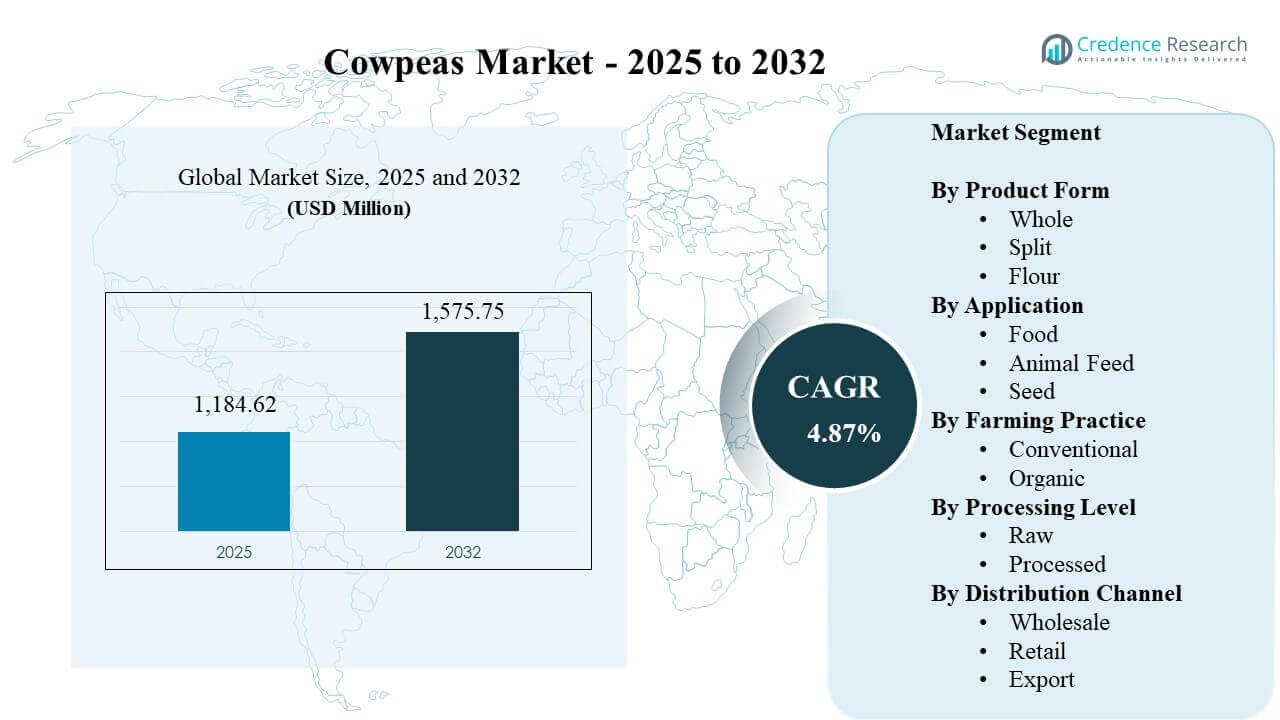
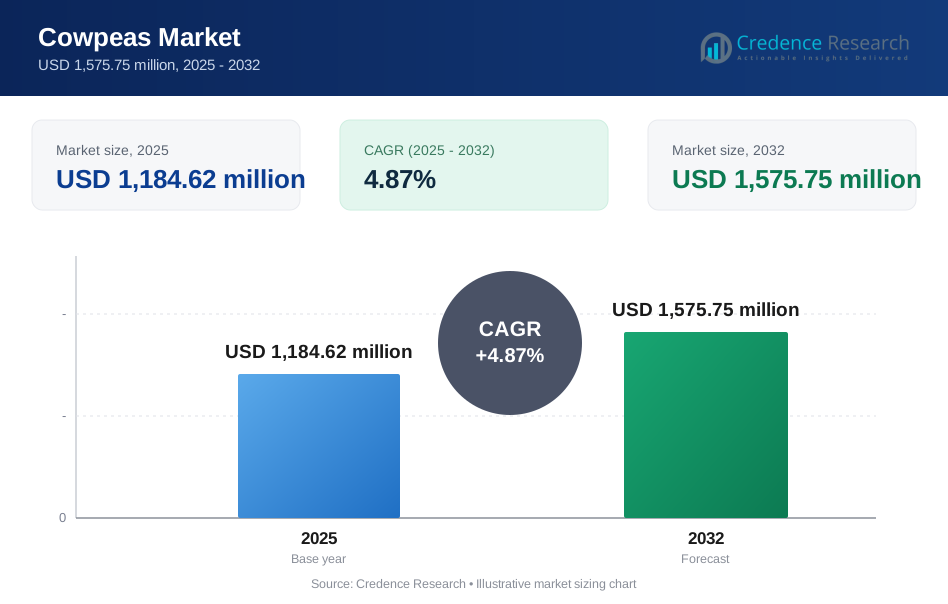
The global Cowpeas Market size was estimated at USD 1,184.62 million in 2025 and is expected to reach USD 1,575.75 million by 2032, growing at a CAGR of 4.87% from 2025 to 2032. Growth is supported by expanding demand for affordable plant-based protein across staple diets and processed food formulations, particularly in price-sensitive markets where pulses remain a core nutrition source. Cowpeas Market momentum also benefits from improving cross-border trade availability and wider use of pulse flours in packaged foods.
| REPORT ATTRIBUTE | DETAILS |
|---|---|
| Historical Period | 2020-2024 |
| Base Year | 2025 |
| Forecast Period | 2026-2032 |
| Cowpeas Market Size 2025 | USD 1,184.62 million |
| Cowpeas Market, CAGR | 4.87% |
| Cowpeas Market Size 2032 | USD 1,575.75million |
Key Market Trends & Insights
- Cowpeas Market is projected to expand from USD 1,184.62 million (2025) to USD 1,575.75 million (2032), reflecting a 4.87% CAGR (2025–2032).
- Whole accounted for the largest share of 52.6% in 2025 within By Product Form, supported by high household preference and bulk trade suitability.
- Middle East & Africa represented 38.0% of Cowpeas Market revenue in 2025, reflecting concentration of production and staple consumption.
- Asia Pacific captured 25.1% of Cowpeas Market revenue in 2025, supported by broad pulse consumption and demand for protein diversification.
- Europe held 15.4% of Cowpeas Market revenue in 2025, driven by import-led supply and growth in packaged pulse offerings.
Segment Analysis
Cowpeas Market demand is anchored in food consumption, where cowpeas serve as a staple pulse in multiple cuisines and increasingly support protein fortification strategies in processed foods. Buyers typically prioritize consistent grain size, moisture control, and low defect rates, which keeps quality sorting and handling central to supplier differentiation. Cowpeas Market also benefits from the functional versatility of cowpeas in soups, stews, snacks, and flour-based applications, supporting wider utilization beyond traditional whole-grain cooking.
Supply-side dynamics remain closely tied to farming conditions, yield stability, and post-harvest infrastructure. Cowpeas Market participants focus on strengthening aggregation networks, storage practices, and trade logistics to reduce losses and improve consistency across seasons. Processing investment and private-label growth in retail channels further support downstream adoption, especially where consumers seek convenient, shelf-stable pulse options.
By Product Form Insights
Whole accounted for the largest share of 52.6% in 2025. Whole cowpeas lead because the format aligns with traditional household cooking patterns and offers flexibility for both direct consumption and downstream processing. Whole cowpeas also move efficiently through wholesale channels due to bulk handling and standardized grading. Whole cowpeas provide better perceived value for consumers who prefer visual inspection of quality before purchase.
By Application Insights
Cowpeas Market application mix is led by food usage, supported by staple consumption patterns and the growing role of pulses in balanced diets. Animal feed demand is supported where cowpeas and residues are utilized as protein supplementation, particularly in mixed farming systems. Seed use remains important in production hubs as growers adopt improved varieties and climate-resilient practices. Cowpeas Market growth in this dimension is influenced by affordability, storage stability, and local availability.
By Farming Practice Insights
Conventional farming remains the dominant production base due to yield priorities, input accessibility, and established cultivation practices in major producing regions. Organic cowpeas growth is supported by clean-label positioning and demand from specialty retailers, though supply is constrained by certification costs and segregation requirements. Cowpeas Market suppliers increasingly emphasize traceability, residue management, and consistent grading to meet evolving buyer requirements. Farming practice selection also impacts export readiness through compliance and documentation.
By Processing Level Insights
Raw cowpeas remain central to Cowpeas Market trade because whole grains are widely distributed as staples and are compatible with wholesale aggregation. Processed offerings are expanding as food manufacturers integrate cowpea flour and value-added pulse ingredients into packaged products. Processing also improves convenience and helps stabilize quality for retail formats. Cowpeas Market participants that invest in sorting, milling, and packaging can improve margins and reduce reliance on commodity pricing.
By Distribution Channel Insights
Wholesale channels remain structurally important because they enable bulk aggregation, storage, and regional redistribution at scale. Retail channels benefit from growth in packaged pulses and improved shelf presentation, especially in urban markets and import-reliant regions. Export demand is shaped by corridor efficiency, documentation, and consistent quality specifications. Cowpeas Market channel performance often depends on reliable supply availability across seasons and competitive landed costs.
Cowpeas Market Drivers
Rising demand for affordable plant-based protein
Cowpeas Market expansion is supported by increasing demand for affordable protein sources in diets where consumers balance nutrition and cost. Cowpeas provide a versatile pulse option that fits traditional meals and modern recipe formats. Food manufacturers also use cowpeas to strengthen protein positioning in packaged foods and pulse-based blends. Cowpeas Market growth improves as retailers widen shelf space for pulses and improve availability across modern trade formats.
- For instance, commercially sold black-eyed peas from JP Global Exports are specified at 7.73 g of protein and 6.5 g of dietary fiber per 100 g, reinforcing how cowpea-based products are positioned as affordable, nutrient-dense protein options in packaged trade.
Growth in value-added pulse ingredients and food formulations
Cowpeas Market demand is strengthened by increasing adoption of pulse flours and functional ingredients across bakery, snacks, and protein-forward products. Cowpea flour supports product differentiation through protein enrichment and compatibility with blended formulations. Processing growth also improves shelf stability and standardizes quality for commercial buyers. Cowpeas Market participants that build sorting, milling, and packaging capability are better positioned to capture value-added demand.
- For instance, Bühler’s SORTEX H SpectraVision for grains and pulses delivers a 50% yield increase, up to 50% higher reject concentrations, and captures more than 500 data points per second, giving processors measurable gains in flour-line consistency and raw-material recovery.
Supply chain and aggregation improvements in producing regions
Cowpeas Market supply improves as aggregators and traders strengthen procurement networks, storage practices, and post-harvest handling. Better aggregation reduces quality variability and supports larger, more consistent export volumes. Improvements in grading and cleaning also help meet buyer specifications across retail and industrial channels. Cowpeas Market efficiency gains are reinforced when logistics corridors and documentation practices become more standardized.
Expanding retail penetration and packaged pulse adoption
Cowpeas Market growth is supported by rising penetration of packaged pulses across supermarkets, convenience formats, and e-commerce channels. Packaged formats emphasize cleanliness, consistency, and labeling, which can increase consumer trust and repeat purchase. Retail-led growth also supports diversified product formats, including split and flour. Cowpeas Market benefits as private-label pulse offerings scale and price competition improves access.
Cowpeas Market Challenges
Cowpeas Market faces challenges linked to yield variability, weather sensitivity, and inconsistent post-harvest handling in key producing areas. Quality issues such as moisture, defects, and pest damage can increase sorting losses and raise landed costs for buyers. Supply volatility also increases procurement risk for retailers and processors that require consistent specifications. Cowpeas Market participants often need stronger storage and aggregation practices to reduce seasonal swings.
Cowpeas Market pricing is also influenced by competing pulse crops, currency movements, and trade policy friction. Export-oriented flows can be disrupted by documentation complexity, port congestion, and inconsistent grading standards. Smaller producers may struggle to meet traceability and compliance expectations demanded by premium buyers. Cowpeas Market competitiveness improves when standardization and buyer-supplier alignment reduce transaction friction.
- For instance, Walmart reported that its traceability program developed with IBM reduced the time needed to trace sliced mangoes from about six days to 2.2 seconds, and Walmart said suppliers would use the IBM Food Trust network with GS1-standard data capture to support faster end-to-end traceability.
Market Trends and Opportunities
Cowpeas Market opportunity is expanding through product innovation in pulse-based foods, including blended flours, protein mixes, and ready-to-cook formats. Ingredient-led adoption supports higher-value demand beyond staple whole-grain consumption. Retailers also increasingly focus on cleaner labels and better-for-you positioning, supporting stronger shelf presence for pulses. Cowpeas Market suppliers that provide consistent quality and packaging differentiation can strengthen brand and private-label partnerships.
- For instance, Devigere Biosolutions markets a black-eyed pea concentrate that it describes as 100% chemical-free and water-soluble, with applications across bakery, confectionery, dietary supplements, snacks, sports nutrition, and vegetarian or vegan products.
Cowpeas Market is also positioned to benefit from stronger trade connectivity and digital procurement across wholesale networks. Improved quality assurance, grading, and traceability can unlock access to premium retail channels and institutional buyers. Processing investments create opportunities for regional value addition and improved margins. Cowpeas Market participants that diversify sourcing and strengthen supplier development can reduce risk and improve supply continuity.
Regional Insights
North America
Cowpeas Market in North America accounted for 11.3% of revenue in 2025. Demand is supported by ethnic cuisine consumption, foodservice usage, and growing interest in pulse-based nutrition. Retail availability improves as packaged pulses expand across modern grocery and specialty channels. Buyers emphasize consistent grading, cleanliness, and labeling, supporting opportunities for value-added packaging and supply reliability.
Europe
Cowpeas Market in Europe captured 15.4% of revenue in 2025. Import-led sourcing and growth in packaged pulses support steady demand across retail and ingredient channels. Product consistency, documentation, and standardized quality specifications influence supplier competitiveness. Food manufacturers also support demand through pulse flour blends and protein-forward formulations across multiple categories.
Asia Pacific
Cowpeas Market in Asia Pacific represented 25.1% of revenue in 2025. Large consumer bases and high pulse consumption support strong demand, while urban retail expansion increases packaged pulse penetration. Buyers value price competitiveness and stable supply, supporting growth in wholesale aggregation and regional redistribution. Processing growth creates additional opportunity for flour and blended formulations in packaged foods.
Latin America
Cowpeas Market in Latin America held 10.2% of revenue in 2025. Regional production and trade flows support consumption across select markets, while retail modernization supports packaged offerings. Growth is influenced by relative competitiveness versus other pulses and local dietary patterns. Suppliers that improve quality sorting and provide consistent packaging can expand reach in modern trade.
Middle East & Africa
Cowpeas Market in Middle East & Africa led globally with a 38.0% revenue share in 2025. Strong staple consumption and production concentration support scale across domestic markets and cross-border trade. Supply-chain improvements in storage, aggregation, and grading can reduce losses and improve price stability. Processing growth also supports expanding use of split and flour formats in urban retail and institutional demand.
Competitive Landscape
Cowpeas Market competition is shaped by origination strength, aggregation reach, quality control, and the ability to supply consistent volumes across seasons. Large agricultural merchants compete through procurement networks, storage access, risk management, and logistics capabilities that stabilize supply to food, feed, and ingredient customers. Value-added activities such as cleaning, sorting, milling, and packaging increasingly differentiate suppliers serving modern retail and industrial buyers. Commercial advantage also depends on meeting documentation, traceability, and specification requirements demanded by import-oriented markets.
Olam Group participation in Cowpeas Market is supported by global origination capabilities, structured sourcing relationships, and logistics networks that enable consistent supply into diverse customer segments. Olam Group’s capability to manage quality specifications and provide downstream services such as cleaning and packaging supports competitiveness in retail-facing and ingredient-facing channels. Supply continuity and compliance readiness strengthen positioning where buyers prioritize standardized grading and documentation. Strategic focus on efficiency and portfolio optimization can further support competitive intensity across agricultural commodity categories.
The industry research and growth report includes detailed analyses of the competitive landscape of the market and information about key companies, including:
- Olam Group
- ADM
- Cargill
- Wilmar
- ETG Group
- Louis Dreyfus
- Bunge
- AGT Food
- SunOpta
- GrainCorp
Qualitative and quantitative analysis of companies has been conducted to help clients understand the wider business environment as well as the strengths and weaknesses of key industry players. Data is qualitatively analyzed to categorize companies as pure play, category-focused, industry-focused, and diversified; it is quantitatively analyzed to categorize companies as dominant, leading, strong, tentative, and weak.
Recent Developments
- In January 2026, ADM announced an investment to expand and upgrade a U.S. facility to strengthen capabilities supporting food and beverage reformulation demand and ingredient innovation.
- In March 2026, Cargill showcased scalable food solutions and formulation-focused innovations for manufacturers, reflecting continued emphasis on ingredient-led growth in major food markets.
Report Scope
| Report Attribute | Details |
| Market size value in 2025 | USD 1,184.62 million |
| Revenue forecast in 2032 | USD 1,575.75 million |
| Growth rate (CAGR) | 4.87% (2025–2032) |
| Base year | 2025 |
| Forecast period | 2026–2032 |
| Quantitative units | USD million |
| Segments covered | By Product Form; By Application; By Farming Practice; By Processing Level; By Distribution Channel |
| Regional scope | North America, Europe, Asia Pacific, Latin America, Middle East & Africa |
| Key companies profiled | Olam Group; ADM; Cargill; Wilmar; ETG Group; Louis Dreyfus; Bunge; AGT Food; SunOpta; GrainCorp |
| No. of Pages | 336 |
Segmentation
By Product Form
- Whole
- Split
- Flour
By Application
- Food
- Animal Feed
- Seed
By Farming Practice
- Conventional
- Organic
By Processing Level
- Raw
- Processed
By Distribution Channel
- Wholesale
- Retail
- Export
By Region
- North America
- U.S.
- Canada
- Mexico
- Europe
- Germany
- France
- U.K.
- Italy
- Spain
- Rest of Europe
- Asia Pacific
- China
- Japan
- India
- South Korea
- South-east Asia
- Rest of Asia Pacific
- Latin America
- Brazil
- Argentina
- Rest of Latin America
- Middle East & Africa
- GCC Countries
- South Africa
- Rest of the Middle East and Africa
Request a Free Sample
Fill in your details and we'll send you a free sample report.
- Sample data tables & charts
- Research methodology
Need a Custom Version of This Report?
Tailor the scope, geography, or segments to your exact requirements.
- Custom geography or segment scope
- Direct access to our analyst team
Frequently Asked Questions
What is the Cowpeas Market size and forecast?
What is the Cowpeas Market CAGR?
What is the largest segment in Cowpeas Market?
What factors are driving Cowpeas Market growth?
Who are the key players in Cowpeas Market?
Which region leads the Cowpeas Market?
Table of Content
Chapter 1. Report Introduction
- 1.1 Report Description & Purpose
- 1.1.1 Report Title & Market Definition
- 1.1.2 Unique Selling Propositions (USP) & Key Differentiators
- 1.1.3 Value Proposition for Stakeholders
- 1.2 Research Objectives
- 1.2.1 Market Sizing Objectives (Volume & Revenue)
- 1.2.2 Segmentation Objectives
- 1.2.3 Competitive Intelligence Objectives
- 1.2.4 Forecast & Scenario Objectives
- 1.3 Report Scope
- 1.3.1 Cowpeas Scope – Types & Subtypes Covered
- 1.3.2 Geographic Scope – Regions & Countries Covered
- 1.3.3 Historical Period, Base Year & Forecast Period (2025; forecast to 2032)
- 1.3.4 Inclusions & Exclusions
- 1.4 HS Code & Classification Framework
- 1.5 Currency, Units & Pricing Basis
- 1.6 Target Stakeholders
- 1.7 Limitations & Assumptions
Chapter 2. Executive Summary
- 2.1 Global Cowpeas Market Snapshot
- 2.1.1 Market Size – Historical (2025) & Forecast (2025-2032) (2025: USD 1,184.62 million → 2032: USD 1,575.75 million)
- 2.1.2 Volume & Revenue – Global Totals
- 2.1.3 Key Market Highlights – Top Five Facts
- 2.2 Cowpeas Market Segmentation Snapshot
- 2.2.1 Market Split by Region – 2025 vs. 2032
- 2.3 Competitive Snapshot
- 2.3.1 Top 10 Players by Revenue Share – 2025
- 2.3.2 Top 10 Players by Volume Share – 2025
- 2.3.3 Recent Strategic Developments (18-Month Summary)
- 2.4 Key Investment Highlights & Strategic Conclusions
Chapter 3. Cowpeas Market Dynamics & Industry Analysis
- 3.1 Market Overview & Context
- 3.1.1 Cowpeas Market Position in the Broader Automotive Value Chain
- 3.1.2 OEM vs. Replacement Market Dynamics
- 3.1.3 Market Maturity & Development Stage by Region
- 3.2 Cowpeas Market Drivers
- 3.3 Cowpeas Market Restraints & Challenges
- 3.4 Cowpeas Market Opportunities
- 3.5 Porter's Five Forces Analysis
- 3.5.1 Threat of New Entrants
- 3.5.2 Bargaining Power of Suppliers
- 3.5.3 Bargaining Power of Buyers
- 3.5.4 Threat of Substitutes
- 3.5.5 Competitive Rivalry – Intensity Assessment
- 3.6 Cowpeas Value Chain Analysis
- 3.6.1 Upstream – Raw Material/Input Suppliers
- 3.6.1.1 Raw Material/Input 1
- 3.6.1.2 Raw Material/Input 2
- 3.6.1.3 Raw Material/Input 3
- 3.6.2 Midstream – Production/Manufacturing/Service Delivery
- 3.6.2.1 Production/Process Overview
- 3.6.2.2 Key Facility Locations & Capacity by Manufacturer
- 3.6.3 Downstream – Distribution & End Consumer
- 3.6.3.1 Primary Channel – B2B/OEM
- 3.6.3.2 Secondary Channels – Dealer, Retail, Online, Direct
- 3.6.4 Value Chain Profitability Analysis
- 3.6.1 Upstream – Raw Material/Input Suppliers
- 3.7 PESTEL Analysis
- 3.7.1 Political Factors
- 3.7.2 Economic Factors
- 3.7.3 Social Factors
- 3.7.4 Technological Factors
- 3.7.5 Environmental Factors
- 3.7.6 Legal Factors
- 3.8 Cowpeas Supply Chain Analysis
- 3.8.1 Raw Material/Input Supply Risk Assessment
- 3.8.2 Manufacturing Concentration Risk (Geographic Exposure)
- 3.8.3 Trade Disruption Impact Analysis
- 3.9 Regulatory & Policy Landscape
Note: The regulatory and policy landscape section covers regulations based on their applicability to the market, Cowpeas category, geography, and scope of the study. Only regulatory frameworks with a material impact on operations, compliance, trade, sustainability, or market access are analyzed in detail.
Chapter 4. Key Investment Pockets & Opportunity Analysis
- 4.1 Cowpeas Market Attractiveness Analysis
- 4.1.1 By Region – Investment Attractiveness Matrix (Volume × CAGR)
- 4.2 Absolute Revenue Growth Opportunity
- 4.2.1 By Region – Absolute USD Growth Through 2032
- 4.3 Incremental Volume Opportunity
- 4.3.1 By Region – Incremental Volume Through 2032
- 4.3.2 Segment – Incremental Volume
- 4.4 Emerging Submarket Opportunity Deep Dive (Subject to Applicability)
- 4.5 Emerging Market Opportunity Scorecards
- 4.5.1 United States
- 4.5.2 Europe
- 4.5.3 Asia
- 4.5.4 Middle East & Africa
Note: Emerging Market Opportunity Scorecards will be included based on relevance and strategic importance. Regions listed are indicative and may vary depending on data availability and market dynamics.
Chapter 5. Cowpeas Import-Export Analysis & Trade Flows
- 5.1 Global Trade Overview
- 5.1.1 Global Export Value by Country (2025)
- 5.1.2 Global Export Volume by Country (2025)
- 5.1.3 Global Import Value by Country (2025)
- 5.1.4 Global Import Volume by Country (2025)
- 5.1.5 Net Trade Balance by Country (2025)
- 5.2 Export Analysis – Segment
- 5.2.1 Type 1 (HS Code)
- 5.2.2 Type 2 (HS Code)
- 5.2.3 Type 3 (HS Code)
- 5.2.4 Type 4 (HS Code)
- 5.2.5 Type 5 (HS Code)
- 5.3 Import Analysis – Segment
- 5.3.1 Type 1 (HS Code)
- 5.3.2 Type 2 (HS Code)
- 5.3.3 Type 3 (HS Code)
- 5.3.4 Type 4 (HS Code)
- 5.3.5 Type 5 (HS Code)
- 5.4 Average Unit Trade Prices
- 5.4.1 Average Export Price – Segment & Country
- 5.4.2 Average Import Price – Segment & Source Country
- 5.4.3 Price Trends (2025)
- 5.5 Key Trade Route Analysis
- 5.5.1 Trade Route 1
- 5.5.2 Trade Route 2
- 5.5.3 Trade Route 3
- 5.5.4 Trade Route 4
- 5.5.5 Trade Route 5
- 5.6 Trade Policy Impact Assessment
- 5.6.1 US Anti-Dumping & Section 301 Tariffs
- 5.6.2 EU Customs Union Impact
- 5.6.3 Major Free Trade Agreements
- 5.6.4 USMCA Rules of Origin
Note: Trade policy analysis will be included only where relevant to the Cowpeas market.
Chapter 6. Competitive Landscape & Company Benchmarking
- 6.1 Cowpeas Market Concentration & Structure
- 6.1.1 Herfindahl-Hirschman Index (HHI) – vs. 2025
- 6.1.2 Tier 1, Tier 2 & Tier 3 Market Structure
- 6.1.3 Global, Regional & Local Player Dynamics
- 6.2 Cowpeas Market Share Analysis – 2025
- 6.2.1 Global Revenue Share by Company
- 6.2.2 Global Volume Share by Company
- 6.2.3 Regional Revenue Share
- 6.2.4 Market Share Evolution ( vs. 2025)
- 6.2.5 OEM Segment Share by Company
- 6.2.6 Replacement Segment Share by Company
- 6.3 Production/Delivery Capacity & Facility Analysis
- 6.3.1 Global Installed Capacity
- 6.3.2 Capacity Utilization Rates
- 6.3.3 Production/Output Volume
- 6.3.4 Facility Locations & Capacity Map
- 6.3.5 Planned Capacity Additions
- 6.4 Cowpeas Competitive Benchmarking Matrix
- 6.4.1 Revenue, Volume, CAGR & Profitability Comparison
- 6.4.2 Channel Revenue Mix
- 6.4.3 Geographic Revenue Exposure
- 6.4.4 R&D Intensity
- 6.4.5 Sustainability Maturity
- 6.5 Strategic Developments in Cowpeas (Last 24 Months)
- 6.5.1 Mergers, Acquisitions & Divestments
- 6.5.2 New Cowpeas Launches
- 6.5.3 Facility Expansions
- 6.5.4 Strategic Alliances, Joint Ventures & Partnerships
- 6.5.5 Distribution Expansion & Market Entry
- 6.5.6 Sustainability & ESG Initiatives
- 6.6 Competitive Strategy Mapping
- 6.6.1 Leader, Challenger, Follower & Niche Classification
- 6.6.2 Pricing Strategy Comparison
- 6.6.3 Channel Strategy Matrix
Note: Strategic developments are included based on their materiality and the availability of reliable information.
Chapter 7. Global Cowpeas Market – By Distribution Channel
- 7.1 Segment Overview
- 7.1.1 Volume & Revenue Split by Channel (2025 & 2032)
- 7.1.2 Channel Mix Evolution (2025-2032)
Chapter 8. Regional Market Analysis – Global Overview
- 8.1 Global Regional Overview
- 8.1.1 Regional Volume Share
- 8.1.2 Regional Revenue Share
- 8.1.3 Regional Volume by Region
- 8.1.4 Regional Revenue by Region
- 8.1.5 Regional Forecast Through 2032
- 8.2 Cross-Regional Segment Analysis
- 8.2.1 By Distribution Channel
- 8.2.2 By Brand/Price Tier
Chapter 9. North America Cowpeas Market
- 9.1 United States
- 9.2 Canada
- 9.3 Mexico
Chapter 10. Europe Cowpeas Market
- 10.1 Germany
- 10.2 France
- 10.3 Italy
- 10.4 United Kingdom
- 10.5 Spain
- 10.6 Poland
- 10.7 Russia
- 10.8 Netherlands
- 10.9 Belgium
- 10.10 Sweden
- 10.11 Denmark
- 10.12 Norway
- 10.13 Rest of Europe
Chapter 11. Asia Pacific Cowpeas Market
- 11.1 China
- 11.2 India
- 11.3 Japan
- 11.4 South Korea
- 11.5 Thailand
- 11.6 Indonesia
- 11.7 Vietnam
- 11.8 Malaysia
- 11.9 Australia
- 11.10 Rest of Asia Pacific
Chapter 12. Latin America Cowpeas Market
- 12.1 Brazil
- 12.2 Argentina
- 12.3 Colombia
- 12.4 Chile
- 12.5 Rest of Latin America
Chapter 13. Middle East Cowpeas Market
- 13.1 Saudi Arabia
- 13.2 United Arab Emirates
- 13.3 Turkey
- 13.4 Israel
- 13.5 Iran
- 13.6 Rest of the Middle East
Chapter 14. Africa Cowpeas Market
- 14.1 South Africa
- 14.2 Egypt
- 14.3 Nigeria
- 14.4 Morocco
- 14.5 Rest of Africa
Chapter 15. Cowpeas Company Profiles
- 15.1 [Company 01]
- 15.1.1 Company Overview
- 15.1.2 Key Management Personnel
- 15.1.3 Products & Services Portfolio
- 15.1.4 Financial Performance
- 15.1.5 Key Market Focus & Geographic Presence
- 15.1.6 Recent Developments & Strategic Initiatives
Note: The company profile list is preliminary and may change based on research findings, market developments, data availability, and client requirements.
Chapter 16. Appendices
- Appendix A – List of Abbreviations & Acronyms
- Appendix B – Industry Classification Code Reference – Full Series
- Appendix C – Production & Capacity Data Tables
- Appendix D – End-Use & Demand Base Tables
- Appendix E – Consumption & Replacement Rate Assumptions
- Appendix F – ASP Reference Tables
- Appendix G – Manufacturing & Facility Database
- Appendix H – Import-Export Data Tables
- Appendix I – Regulatory Summary Tables
- Appendix J – Primary Research Participant List (Anonymized)
- Appendix K – Primary Research Questionnaire Framework
- Appendix L – Data Sources & Bibliography
- Appendix M – Market Size Divergence & Source Comparison
Chapter 17. Research Methodology
- 17.1 Research Framework & Philosophy
- 17.2 Secondary Research – Sources, Hierarchy & Data Extraction
- 17.3 Data Modeling – Bottom-Up & Top-Down Market Sizing
- 17.4 Primary Research – Stakeholder Framework, LOI & Sample Sizes
- 17.5 Forecast Methodology – Regression, Scenario & Sensitivity Analysis
- 17.6 Quality Control – Four-Layer Validation Framework
- 17.7 Limitations & Standard Assumptions
- 17.8 Disclaimer
