| REPORT ATTRIBUTE | DETAILS |
|---|---|
| Historical Period | 2020-2023 |
| Base Year | 2024 |
| Forecast Period | 2025-2032 |
| Europe Retail Pharmacy Market Size 2025 | USD 316.70 billion |
| Europe Retail Pharmacy Market, CAGR | 3.19% |
| Europe Retail Pharmacy Market Size 2032 | USD 396.17 billion |
Market Overview
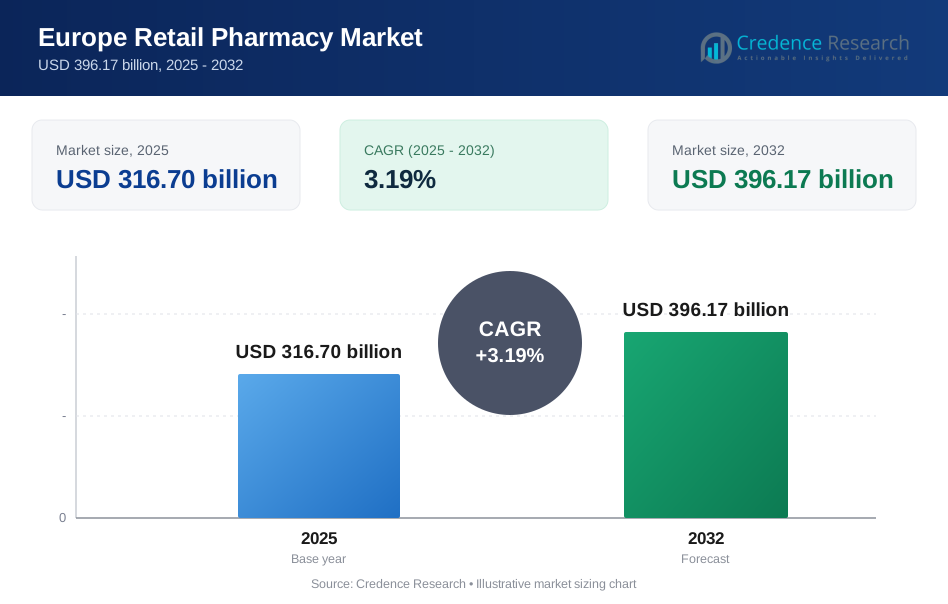
The Europe Retail Pharmacy Market was valued at USD 227.68 billion in 2018 and reached USD 316.70 billion in 2025, reflecting steady expansion supported by rising prescription volumes, wider access to over-the-counter medicines and stronger demand for pharmacy-led healthcare services. The market is projected to reach USD 396.17 billion by 2032, growing at a CAGR of 3.19% from 2025 to 2032.
Growth is driven by aging demographics, increasing chronic disease prevalence, digital pharmacy adoption and expanding consumer reliance on retail pharmacies for preventive care, wellness products and medication management. Europe’s mature healthcare infrastructure, strong reimbursement systems and evolving pharmacy service models continue to support stable revenue growth, while competition among pharmacy chains, independent pharmacies and online platforms shapes pricing, service quality and customer retention across the region.
Market Insights
- The Global Retail Pharmacy Market is expected to grow from USD 14,45,920.00 million in 2024 to USD 19,65,958.05 million by 2032, at a CAGR of 3.92% from 2025 to 2032.
- The Europe Retail Pharmacy Market reached USD 316.70 billion in 2025 and is projected to reach USD 396.17 billion by 2032, growing at a CAGR of 3.19% from 2025 to 2032.
- Prescription drugs remain the core revenue contributor, supported by chronic disease treatment demand, aging demographics, reimbursed medicine access and recurring prescription refill volumes.
- Chain pharmacies lead by pharmacy type due to procurement scale, broader product portfolios, private-label expansion, standardized store formats and stronger digital integration.
- Brick and mortar retail remains the dominant sales channel, driven by in-person pharmacist consultation, immediate medicine access and the trusted role of community pharmacies.
- E-pharmacy, hybrid pharmacy models and digital prescription systems are reshaping competition as operators improve convenience, refill management, home delivery and customer retention.
Report Scope
This report segments the Europe Retail Pharmacy Market as follows:

Market Drivers
Rapid expansion of e-pharmacy and digital prescription ecosystems
The Europe Retail Pharmacy Market benefits from the rapid expansion of e-pharmacy platforms, digital prescription systems and omnichannel pharmacy models. Consumers increasingly prefer online ordering, home delivery and app-based prescription refills, which improve access and convenience across urban and rural areas. Digital prescription infrastructure also helps pharmacies reduce dispensing errors, manage inventory more efficiently and strengthen patient adherence programs. This shift supports higher transaction volumes, improves customer retention and allows pharmacy operators to expand beyond traditional store-based sales. It also creates long-term value for businesses by integrating prescription management, telehealth referrals and personalized wellness services into pharmacy retail operations.
Expansion of private-label and value-based pharmacy offerings
The Europe Retail Pharmacy Market continues to gain from the expansion of private-label products and value-based pharmacy offerings. Pharmacy chains increasingly promote affordable wellness, personal care, nutrition and over-the-counter products under their own brands to improve margins and strengthen customer loyalty. Consumers across Europe remain price-conscious, which supports demand for cost-effective alternatives to branded medicines and health products. Private-label portfolios also help retailers differentiate their product mix, reduce dependence on third-party brands and capture stronger profitability across high-frequency categories. This trend supports competitive positioning, especially among large pharmacy chains that use scale, procurement strength and targeted merchandising to expand value-based offerings.
Growing role of pharmacies as primary health care access points
The Europe Retail Pharmacy Market is supported by the growing role of pharmacies as accessible primary health care points. Retail pharmacies increasingly provide vaccination support, medication counseling, chronic disease management, health screening and preventive care services. This role is important in Europe because health systems face pressure from aging populations, physician shortages and rising demand for convenient care. Pharmacies help reduce the burden on clinics and hospitals by offering routine services closer to patients. This shift strengthens the strategic value of retail pharmacies, improves customer engagement and positions pharmacy operators as key partners in community-based health care delivery.
Market Trends
Expansion of digital health and omnichannel pharmacy models The Europe Retail Pharmacy Market is seeing strong adoption of digital health tools, e-prescriptions and omnichannel pharmacy platforms. Retail pharmacy operators are combining physical stores, mobile apps, online ordering, home delivery and refill management to improve patient convenience and service continuity. This trend supports stronger customer retention because patients can manage prescriptions, wellness products and pharmacist consultations across multiple channels. It also helps pharmacies improve inventory planning, reduce waiting times and expand access in underserved areas. Digital integration is becoming a key competitive factor as consumers expect faster, more flexible and more personalized pharmacy services. Rising adoption of private-label and value-based products The Europe Retail Pharmacy Market is shifting toward private-label and value-based health products as consumers seek affordable options across over-the-counter medicines, personal care, nutrition and wellness categories. Pharmacy chains use private-label portfolios to improve margins, build customer loyalty and differentiate their stores from supermarkets and online retailers. This trend also supports stronger control over pricing, packaging and product positioning. Value-based offerings remain important in Europe’s cost-conscious health care environment, where consumers compare product quality, affordability and convenience before purchase. Large pharmacy networks are likely to expand these portfolios to strengthen profitability and capture repeat purchases. Growing role of pharmacies as frontline health care hubs The Europe Retail Pharmacy Market is evolving as pharmacies expand beyond dispensing medicines into frontline health care services. Pharmacies increasingly support vaccination programs, medication reviews, minor ailment advice, chronic disease monitoring and preventive health screening. This trend reflects the need for accessible care points as European health systems manage aging populations, higher chronic disease burdens and pressure on primary care providers. Pharmacies benefit from frequent patient interaction and trusted local presence, which allows them to support early intervention and adherence. This service-led model strengthens the role of retail pharmacies in community health care and creates new revenue opportunities beyond traditional product sales.Market Challenges
Stringent regulatory frameworks and ownership restrictions The Europe Retail Pharmacy Market faces challenges from strict regulatory frameworks that shape pharmacy ownership, licensing, dispensing practices and professional service standards. Several European countries maintain ownership rules that limit chain expansion or require pharmacist-led control of retail pharmacy operations. These rules protect patient safety and professional independence, but they can restrict consolidation, investment flexibility and rapid market entry. Compliance requirements also raise administrative costs for operators that manage multiple stores across different national markets. This regulatory complexity makes expansion slower and requires pharmacy businesses to adapt operating models to each country’s legal and health care system requirements. Margin pressure from pricing controls and rising operating costs The Europe Retail Pharmacy Market remains under pressure from medicine pricing controls, reimbursement limits and rising operating costs. Governments and payers continue to manage health care spending through regulated medicine prices, generic substitution policies and reimbursement controls. These measures support affordability for patients, but they reduce profit flexibility for pharmacies, especially in prescription drug categories. Labor costs, rent, energy expenses and digital infrastructure investments further pressure operating margins. Retail pharmacy operators must improve procurement efficiency, expand higher-margin wellness categories and strengthen private-label offerings to protect profitability in a cost-sensitive market. Fragmented online pharmacy regulations and cross-border limitations The Europe Retail Pharmacy Market faces barriers from fragmented online pharmacy rules and cross-border restrictions across European countries. While digital pharmacy adoption continues to grow, regulations on prescription fulfillment, remote verification, delivery, data privacy and advertising differ widely by market. These differences make it difficult for operators to scale e-pharmacy platforms across multiple countries with one standard model. Cross-border limitations also restrict access to wider customer bases and reduce the efficiency benefits of centralized digital operations. This fragmented environment slows omnichannel expansion and requires careful compliance planning for pharmacies that target regional digital growth.Market Opportunities
Growth of E-commerce and Digital Health Solutions
The increasing demand for e-commerce and digital health solutions presents a significant opportunity for the Europe Retail Pharmacy Market. As consumer preferences shift towards online shopping for convenience, pharmacies have the chance to expand their digital presence. E-pharmacies, offering home delivery of medications, over-the-counter products, and personalized health services, are gaining traction among tech-savvy consumers. By adopting e-commerce platforms and integrating digital tools like telemedicine consultations, virtual health assessments, and mobile health apps, retail pharmacies can attract a broader customer base. This trend is particularly beneficial in reaching rural or underserved areas where access to physical pharmacies may be limited.
Moreover, the integration of artificial intelligence (AI) and machine learning into pharmacy operations offers opportunities to enhance the customer experience, such as through personalized recommendations, real-time inventory management, and automated prescriptions. The growing trend of digital health is further supported by the EU’s digital health initiatives, which encourage innovation in healthcare delivery. Retail pharmacies that embrace these digital advancements can not only cater to changing consumer preferences but also streamline operations, reduce overhead costs, and improve customer satisfaction.
Expansion into Preventive Healthcare and Wellness Products
The rising consumer interest in preventive healthcare and wellness products offers a prime opportunity for retail pharmacies in Europe. As consumers become more health-conscious and proactive about maintaining their well-being, pharmacies have the chance to diversify their product offerings beyond traditional pharmaceuticals. By expanding into the wellness segment, including vitamins, supplements, fitness aids, and organic health products, pharmacies can tap into a growing market.
Additionally, pharmacies can offer personalized wellness services, such as dietary consultations, weight management programs, and stress relief therapies, further positioning themselves as holistic health hubs. This trend aligns with the broader shift toward self-care and preventive healthcare, with consumers increasingly seeking products and services that promote long-term health and disease prevention. Retail pharmacies that capitalize on this trend can drive revenue growth while strengthening their role in overall health management, thereby enhancing customer loyalty and capturing a broader market segment.
Market Segmentation Analysis
By Product Prescription drugs dominated the Europe Retail Pharmacy Market in 2025 with an estimated 67% share, supported by strong prescription volumes across chronic disease therapies, reimbursed medicines and long-term treatment categories. The segment benefits from Europe’s aging population, high medicine adherence needs and pharmacy-centered dispensing systems across major countries. Retail pharmacies remain key access points for regulated medicines, while electronic prescriptions and refill programs support repeat purchases. OTC products continue to grow, but prescription drugs remain the core revenue base. By Pharmacy type Chain pharmacies led the Europe Retail Pharmacy Market in 2025 with an estimated 42% share, driven by scale advantages, strong procurement networks, wider product availability and standardized service models. Their leadership reflects rising consolidation in several European markets and stronger investment in loyalty programs, private-label products and omnichannel platforms. Chain operators also benefit from higher brand visibility and better capacity to manage regulated pricing pressure. Independent pharmacies remain important locally, but chain pharmacies hold stronger commercial reach and operating efficiency. By Sales channel Brick and mortar retail dominated the Europe Retail Pharmacy Market in 2025 with an estimated 71% share, supported by consumer preference for immediate medicine access, pharmacist consultation and in-person prescription fulfillment. Physical pharmacies remain central to community health care because they provide trusted advice, urgent OTC access and regulated dispensing services. The channel also benefits from proximity-based demand in urban and rural areas. Hybrid and pure online models are expanding, but physical stores remain the primary transaction point across Europe. By Customer type Individual consumers dominated the Europe Retail Pharmacy Market in 2025 with an estimated 84% share, supported by daily demand for prescription medicines, OTC products, personal care items and wellness products. The segment benefits from aging demographics, rising self-care behavior and higher use of retail pharmacies for medication management and preventive health support. Individual purchasing remains frequent and broad-based across pharmacy categories. Institutional buyers contribute steady demand from clinics, hospitals and care homes, but consumer-led retail spending remains the market’s main revenue driver.
Segments
By Product- Prescription Drugs
- OTC Products
- Chain Pharmacies
- Independent Pharmacies
- Hospital-Attached Retail Pharmacies
- Online / E-Pharmacies
- Others
- Brick & Mortar Retail
- Hybrid (Physical + Digital)
- Pure Online
- Individual Consumers
- Institutional Buyers (Clinics, Hospitals, Care homes))
Based on Region
- Western Europe
- Southern Europe
- Eastern Europe
- Northern Europe
- Central Europe
Regional Analysis
Western Europe
Western Europe holds the largest share of the Europe Retail Pharmacy Market, accounting for approximately XX% of the total market share. Key countries such as Germany, France, the UK, and the Netherlands dominate this region. These countries benefit from well-established healthcare systems, high healthcare spending, and a large consumer base with a high demand for both prescription and over-the-counter (OTC) drugs. The adoption of digital health technologies, such as e-pharmacies and online consultation services, has further accelerated market growth in this region. The growing elderly population in countries like Germany and France, combined with high rates of chronic diseases, contributes to a robust demand for pharmaceutical products and services. Western Europe also leads in regulatory advancements and healthcare innovations, making it a key region for both pharmaceutical companies and retail pharmacies.
Southern Europe
Southern Europe represents approximately XX% of the Europe Retail Pharmacy Market. Countries such as Italy, Spain, and Greece are the primary contributors to this region’s market share. The market is growing steadily due to a rising middle class, increasing health awareness, and the growing adoption of pharmacy-based health services. However, Southern European countries face challenges such as economic instability, which can affect consumer spending on non-essential medications and services. Despite this, retail pharmacies are capitalizing on the demand for preventive healthcare products, over-the-counter drugs, and personalized health services. The trend toward digital health solutions is also gaining momentum in this region, contributing to market growth.
Key players
- Walgreens Boots Alliance
- PHOENIX Group
- Dirk Rossmann GmbH
- DocMorris AG
- AS Watson Group
- Dr. Max Group
- Day Lewis Pharmacy
- Apotea AB
- Redcare Pharmacy
- Euro-Pharmas
- Others

Competitive Analysis
The Europe Retail Pharmacy Market is competitive, with large pharmacy chains, regional operators, online pharmacy platforms and independent pharmacies competing across country-specific regulatory environments. Leading players such as Walgreens Boots Alliance, Phoenix Group, Dirk Rossmann GmbH, DocMorris AG, AS Watson, Dr. Max Group, Day Lewis Pharmacy, Apotea AB, Redcare Pharmacy and Euro-pharmas focus on store network expansion, digital pharmacy platforms, private-label products, prescription fulfillment and value-added health care services.
Competition is shaped by pricing controls, ownership restrictions, reimbursement policies and the growing shift toward omnichannel pharmacy models. Independent pharmacies continue to hold a strong position, while larger groups use procurement scale, logistics capabilities and technology integration to improve efficiency and customer retention. The market is gradually moving toward consolidation, but national regulations and strong community pharmacy networks keep the competitive landscape fragmented across Europe.
Recent Developments
- In 2026, Boots launches PrescriptionsPlus to simplify managing NHS repeat prescriptions.
- In January 31, 2024, Boots launched the NHS Pharmacy First service across its stores in England, marking a significant expansion in the role of community pharmacists.
- In Mar 2025, HCSC announced it completed the acquisition of The Cigna Group’s Medicare businesses and CareAllies, reiterating that Cigna would continue to provide pharmacy benefit services for an agreed period post-closing.
- In March 6, 2025, Walgreens Boots Alliance (WBA) entered into a definitive agreement to be acquired by the private equity firm Sycamore Partners in a transaction valued at up to $23.7 billion.
- In October 15, 2025, CVS Pharmacy announced it had completed the acquisition of select assets from Rite Aid and Bartell Drugs as part of Rite Aid's bankruptcy process.
- As of March 31, 2024, Apollo Pharmacy operated 6,030 stores across approximately 1,200 cities and towns in 22 states and 5 union territories. The company continues to expand its digital healthcare platform, offering services like online medicine delivery and virtual doctor consultations.
- In October 2024, Caring Pharmacy Retail Management Sdn Bhd, a 75%-owned unit of 7-Eleven Malaysia Holdings Bhd, announced acquisitions of equity interest and business assets in several pharmaceutical outlets for a combined cash consideration of RM48.86 million.
- In June 2024, the Australian Competition and Consumer Commission (ACCC) expressed concerns that the proposed acquisition of Chemist Warehouse by Sigma Healthcare could substantially lessen competition in pharmacy retailing, potentially leading to higher prices and reduced service quality.
- In January 2025, Watsons Philippines ended 2024 with 1,166 stores, expanding its community pharmacy format. The company opened more than 50 stores outside of Metro Manila.
Market Concentration and Characteristics
The Europe Retail Pharmacy Market shows moderate market concentration, with a mix of large pharmacy groups, regional chains, online pharmacy platforms and independent community pharmacies competing across highly regulated national markets. Leading companies such as Walgreens Boots Alliance, Phoenix Group, Dirk Rossmann GmbH, DocMorris AG, AS Watson and Dr. Max Group hold strong positions through store networks, digital platforms, procurement scale and private-label portfolios. However, independent pharmacies remain highly influential, accounting for about 62.48% of the market in 2025, which shows that the market is still fragmented despite consolidation among large operators. Market characteristics include strong dependence on prescription drug demand, rising adoption of e-pharmacy, expansion of omnichannel services, growing pharmacy-led health care services and strict country-level regulations that shape ownership, pricing and operating models. The market is also characterized by stable demand, regulated margins and increasing competition between brick-and-mortar, hybrid and pure online pharmacy formats.
Report Coverage
The research report offers an in-depth analysis based on Product, Pharmacy Type, Sales Channel, Customer Type and Region. It details leading market players, providing an overview of their business, product offerings, investments, revenue streams, and key applications. Additionally, the report includes insights into the competitive environment, SWOT analysis, current market trends, as well as the primary drivers and constraints. Furthermore, it discusses various factors that have driven market expansion in recent years. The report also explores market dynamics, regulatory scenarios, and technological advancements that are shaping the industry. It assesses the impact of external factors and global economic changes on market growth. Lastly, it provides strategic recommendations for new entrants and established companies to navigate the complexities of the market.
Future Outlook
- The integration of e-pharmacy platforms and digital health services will continue to grow, offering greater accessibility for consumers. Online pharmacies will play an increasingly critical role in shaping the market, driven by the demand for convenience and remote healthcare services.
- Preventive healthcare products and services will experience significant growth as consumers focus more on health management. Pharmacies will expand their wellness offerings, such as dietary supplements, health screenings, and personalized health consultations.
- The aging population in Europe will continue to drive the demand for chronic disease management and age-related medications. Retail pharmacies will need to adapt their services to meet the healthcare needs of the elderly, offering specialized products and care.
- As chronic conditions such as diabetes, cardiovascular diseases, and respiratory issues rise, pharmacies will increasingly offer chronic disease management services. This will include medication management, health monitoring, and personalized consultations for better disease control.
- The rise of telehealth and remote consultations will influence pharmacy services, allowing consumers to access healthcare advice and prescriptions digitally. Pharmacies will integrate these services to enhance customer convenience and improve healthcare access.
- As the market evolves, stricter regulations regarding the sale of pharmaceuticals, e-commerce practices, and data protection will be implemented. Retail pharmacies will need to navigate these regulations to ensure compliance and minimize operational disruptions.
- Retail pharmacies will diversify their product offerings to include more health and wellness products, from supplements to home healthcare devices. This diversification will help pharmacies tap into the growing self-care market and broaden their revenue streams.
- Strategic partnerships, mergers, and acquisitions will increase as players seek to expand market share and enhance service offerings. Large pharmacy chains will collaborate with technology firms and healthcare providers to offer integrated health solutions.
- Sustainability efforts will become increasingly important, with pharmacies focusing on reducing waste, using eco-friendly packaging, and promoting environmentally friendly products. Consumer demand for sustainable practices will drive pharmacies to implement greener solutions.
- As e-pharmacies gain traction, traditional brick-and-mortar pharmacies will face intensified competition. To stay competitive, physical pharmacies will invest in digital capabilities, offering integrated services that combine both in-store and online experiences for consumers.
Request a Free Sample
Fill in your details and we'll send you a free sample report.
- Sample data tables & charts
- Research methodology
Market Dynamics
Expansion of E-Pharmacy and Digital Prescription Ecosystems
The rapid adoption of e-pharmacy platforms and digital prescription systems is making pharmacy services more accessible and convenient, especially in urban and rural areas. This digital shift enables pharmacies to streamline operations, reduce dispensing errors, and improve patient adherence, driving higher transaction volumes and customer retention.
Aging Population and Chronic Disease Prevalence
Europe’s aging demographics and the increasing prevalence of chronic diseases are fueling demand for prescription medications and pharmacy-led healthcare services. Retail pharmacies are key access points for ongoing medication management, chronic disease monitoring, and preventive care, supporting steady market growth.
Expansion of Private-Label and Value-Based Offerings
Pharmacy chains are increasingly promoting private-label wellness, personal care, and OTC products to improve margins and customer loyalty. The demand for affordable alternatives to branded medicines supports the growth of value-based offerings, helping pharmacies differentiate and capture higher profitability.
Pharmacies as Primary Healthcare Access Points
Retail pharmacies are expanding their roles to include vaccination support, medication counseling, health screenings, and chronic disease management. This shift alleviates pressure on traditional healthcare providers and positions pharmacies as essential community health hubs, increasing their strategic value and revenue streams.
Omnichannel and Digital Health Integration
The integration of physical stores with online platforms, mobile apps, and home delivery services is enhancing patient convenience and service continuity. Omnichannel models allow pharmacies to reach broader customer segments, improve inventory management, and adapt to evolving consumer expectations for personalized and flexible healthcare services.
Need a Custom Version of This Report?
Tailor the scope, geography, or segments to your exact requirements.
- Custom geography or segment scope
- Direct access to our analyst team
Frequently Asked Questions
What is the market size of the Europe Retail Pharmacy Market in 2025 and 2032?
What are the key drivers of the Europe Retail Pharmacy Market's growth?
How has e-commerce influenced the Europe Retail Pharmacy Market?
Which regions contribute most to the Europe Retail Pharmacy Market?
Who are the key players in the Europe Retail Pharmacy Market?
Table of Content
Chapter 1 Market Segmentation
- 1.1 Segmentation Framework
- 1.1.1 Product and Service Classification
- 1.1.2 Application and End-Use Classification
- 1.1.3 Technology and Solution Classification
- 1.1.4 Customer and Distribution Channel Classification
- 1.1.5 Geographic Segmentation
- 1.1.6 Market Segment Definitions and Boundaries
- 1.2 By Product
- 1.2.1 Prescription Drugs
- 1.2.2 OTC Products
- 1.3 By Customer Type
- 1.3.1 Individual Consumers
- 1.3.2 Institutional Buyers (Clinics, Hospitals, Care homes)
- 1.4 By Pharmacy Type
- 1.4.1 Chain Pharmacies
- 1.4.2 Independent Pharmacies
- 1.4.3 Hospital-Attached Retail Pharmacies
- 1.4.4 Online / E-Pharmacies
- 1.4.5 Others
- 1.5 By Sales Channel
- 1.5.1 Brick & Mortar Retail
- 1.5.2 Hybrid (Physical + Digital)
- 1.5.3 Pure Online
Chapter 2 Introduction
- 2.1 Report Objectives and Scope
- 2.2 Product Definition and Industry Terminology
- 2.3 Market Inclusions and Exclusions
- 2.4 Research Process
- 2.4.1 Primary Research and Expert Interviews
- 2.4.2 Secondary Research and Source Review
- 2.4.3 Top-Down and Bottom-Up Estimation
- 2.4.4 Data Triangulation and Verification
- 2.5 Market Size Measurement Basis
- 2.5.1 2025: USD 316.70 billion → 2032: USD 396.17 billion
- 2.6 Historical and Forecast Reference Periods
- 2.6.1 Base Year: 2025
- 2.6.2 Forecast Period: 2025-2032
- 2.7 Research Assumptions and Limitations
Chapter 3 Executive Summary
- 3.1 Market Snapshot and Key Findings
- 3.2 Base-Year Market Size, 2025
- 3.3 Forecast Market Size, 2032
- 3.4 Revenue and Volume Growth Outlook
- 3.5 Key Demand and Supply Indicators
- 3.6 Leading Market Segments
- 3.7 Fastest-Growing Market Opportunities
- 3.8 Regional Performance Highlights
- 3.9 Technology and Industry Transformation
- 3.10 Competitive Landscape Summary
- 3.11 Analyst View and Strategic Implications
Chapter 4 Europe Retail Pharmacy Market Trends and Developments
- 4.1 Historical Industry Development
- 4.2 Recent Market Trends and Developments
- 4.3 Demand and Customer Behavior Trends
- 4.4 Technology and Product Innovation
- 4.5 Artificial Intelligence, Automation and Digitalization
- 4.6 Local Manufacturing and Supply Chain Realignment
- 4.7 Industry Partnerships, Mergers and Acquisitions
- 4.8 Sustainability and Circular Economy Developments
- 4.9 Government and Private Sector Investment Trends
- 4.10 Emerging Business Models and Commercialization
- 4.11 Industry Developments and Announcements
Chapter 5 Europe Retail Pharmacy Market Production, Supply and Demand Analysis
- 5.1 Demand Trend and Consumption Analysis
- 5.2 Demand Forecast, 2025-2032
- 5.3 Production and Output Trend
- 5.4 Production and Output Forecast, 2025-2032
- 5.5 Installed Capacity and Capacity Utilization
- 5.6 Company-Wise Production Plants and Statistics
- 5.6.1 Installed Production Capacity
- 5.6.2 Actual Production
- 5.6.3 Planned Capacity and Expansion Targets
- 5.7 Supply Chain Structure and Procurement Trends
- 5.8 Supply-Demand Gap and Bottlenecks
- 5.9 Import Dependence and Sourcing Structure
- 5.10 Contract Manufacturing and Outsourcing
- 5.11 Regional Supply and Demand Concentration
Chapter 6 Europe Retail Pharmacy Market Pricing Analysis
- 6.1 Pricing Structure and Measurement
- 6.2 Historical Pricing Trends
- 6.3 Pricing Outlook, 2025-2032
- 6.4 Average Selling Price and Unit Economics
- 6.5 Pricing by Product and Market Segment
- 6.6 Geographic Pricing Differences
- 6.7 Key Input, Energy, Labor and Logistics Costs
- 6.8 Contract Pricing and Purchasing Models
- 6.9 Pricing Sensitivity and Competitive Positioning
- 6.10 Price, Margin and Profitability Implications
Chapter 7 Europe Retail Pharmacy Market Dynamics
- 7.1 Market Growth Drivers
- 7.1.1 Demand-Side Drivers
- 7.1.2 Technology and Innovation Drivers
- 7.1.3 Infrastructure and Investment Drivers
- 7.1.4 Regulatory and Policy Drivers
- 7.2 Market Restraints
- 7.2.1 Cost and Affordability Constraints
- 7.2.2 Technology and Adoption Barriers
- 7.2.3 Supply Chain and Operational Constraints
- 7.3 Market Challenges
- 7.3.1 Competitive Pressure and Margin Erosion
- 7.3.2 Skills, Infrastructure and Implementation Gaps
- 7.4 Emerging Market Opportunities
- 7.5 Market Dynamics Impact and Time-Horizon Assessment
Chapter 8 Europe Retail Pharmacy Value Chain Analysis
- 8.1 Industry Value Chain Overview
- 8.2 Upstream Suppliers and Critical Inputs
- 8.3 Technology and Component Providers
- 8.4 Manufacturing or Service Delivery
- 8.5 Distribution, Channel Partners and Integrators
- 8.6 Downstream Applications and End Users
- 8.7 Value Addition and Profit Pools
- 8.8 Vertical Integration and Outsourcing
- 8.9 Supplier Concentration and Risk
- 8.10 Supply Chain Localization and Resilience
Chapter 9 Europe Retail Pharmacy Market Regulations and Policies
- 9.1 Relevant Laws, Standards and Compliance Frameworks
- 9.2 Product, Service, Safety and Quality Requirements
- 9.3 Government Policies, Incentives and Subsidies
- 9.4 Imports, Exports and Trade Barriers
- 9.5 Public Procurement and Local Content Requirements
- 9.6 Environmental and Sustainability Compliance
- 9.7 Upcoming Policy Changes and Market Implications
Chapter 10 Europe Retail Pharmacy Market Hotspots and Opportunities
- 10.1 Market Opportunity Mapping and Growth Hotspots
- 10.2 High-Growth Applications and Customer Groups
- 10.3 Underserved Markets and White-Space Opportunities
- 10.4 Emerging Technology and Product Opportunities
- 10.5 New Capacity and Investment Hotspots
- 10.6 Market Entry and Expansion Opportunities
- 10.7 Distribution and Partnership Opportunities
- 10.8 Near-Term and Long-Term Commercial Potential
- 10.9 Opportunity Attractiveness and Execution Risks
Chapter 11 Europe Retail Pharmacy Market Outlook, 2025-2032
- 11.1 Market Size and Analysis
- 11.1.1 Revenue (Market Measurement: 2025: USD 316.70 billion → 2032: USD 396.17 billion)
- 11.1.2 Market Volume and Quantity Sold
- 11.1.3 Historical Market Size
- 11.1.4 Base-Year Market Size, 2025
- 11.2 Market Forecast, 2025-2032
- 11.2.1 Revenue Forecast to 2032
- 11.2.2 Volume Forecast to 2032
- 11.2.3 CAGR and Year-on-Year Growth
- 11.2.4 Incremental Revenue Opportunity
- 11.3 Forecast Assumptions and Scenario Analysis
- 11.3.1 Base-Case Forecast
- 11.3.2 Optimistic and Conservative Scenarios
- 11.3.3 Technology, Pricing and Policy Sensitivities
- 11.4 Market Attractiveness and Growth Outlook
Chapter 12 Europe Retail Pharmacy Market Segmentation and Outlook
- 12.1 Segmentation Summary and Market Shares, 2025
- 12.2 Largest and Fastest-Growing Segments
- 12.3 By Product - Market Size and Forecast, 2025-2032
- 12.3.1 Segment Definition and Scope
- 12.3.2 Historical Market Size
- 12.3.3 Revenue Forecast, 2025-2032
- 12.3.4 Volume Forecast, 2025-2032
- 12.3.5 Base-Year Market Share, 2025
- 12.3.6 Segment CAGR and Growth Drivers
- 12.3.7 Subsegment Market Size and Forecast
- 12.3.7.1 Prescription Drugs
- 12.3.7.2 OTC Products
- 12.3.8 Subsegment Pricing and Adoption Trends
- 12.3.9 Leading Suppliers and Competition
- 12.3.10 Regional Demand and Opportunities
- 12.4 By Customer Type - Market Size and Forecast, 2025-2032
- 12.4.1 Segment Definition and Scope
- 12.4.2 Historical Market Size
- 12.4.3 Revenue Forecast, 2025-2032
- 12.4.4 Volume Forecast, 2025-2032
- 12.4.5 Base-Year Market Share, 2025
- 12.4.6 Segment CAGR and Growth Drivers
- 12.4.7 Subsegment Market Size and Forecast
- 12.4.7.1 Individual Consumers
- 12.4.7.2 Institutional Buyers (Clinics, Hospitals, Care homes)
- 12.4.8 Subsegment Pricing and Adoption Trends
- 12.4.9 Leading Suppliers and Competition
- 12.4.10 Regional Demand and Opportunities
- 12.5 By Pharmacy Type - Market Size and Forecast, 2025-2032
- 12.5.1 Segment Definition and Scope
- 12.5.2 Historical Market Size
- 12.5.3 Revenue Forecast, 2025-2032
- 12.5.4 Volume Forecast, 2025-2032
- 12.5.5 Base-Year Market Share, 2025
- 12.5.6 Segment CAGR and Growth Drivers
- 12.5.7 Subsegment Market Size and Forecast
- 12.5.7.1 Chain Pharmacies
- 12.5.7.2 Independent Pharmacies
- 12.5.7.3 Hospital-Attached Retail Pharmacies
- 12.5.7.4 Online / E-Pharmacies
- 12.5.7.5 Others
- 12.5.8 Subsegment Pricing and Adoption Trends
- 12.5.9 Leading Suppliers and Competition
- 12.5.10 Regional Demand and Opportunities
- 12.6 By Sales Channel - Market Size and Forecast, 2025-2032
- 12.6.1 Segment Definition and Scope
- 12.6.2 Historical Market Size
- 12.6.3 Revenue Forecast, 2025-2032
- 12.6.4 Volume Forecast, 2025-2032
- 12.6.5 Base-Year Market Share, 2025
- 12.6.6 Segment CAGR and Growth Drivers
- 12.6.7 Subsegment Market Size and Forecast
- 12.6.7.1 Brick & Mortar Retail
- 12.6.7.2 Hybrid (Physical + Digital)
- 12.6.7.3 Pure Online
- 12.6.8 Subsegment Pricing and Adoption Trends
- 12.6.9 Leading Suppliers and Competition
- 12.6.10 Regional Demand and Opportunities
- 12.7 Segment Growth Comparison
- 12.8 Segment Attractiveness and Priority Matrix
Chapter 13 Europe Retail Pharmacy End-Use and Application Market Outlook
- 13.1 End-Use Industry and Customer Demand Structure
- 13.2 Leading Applications and Customer Groups
- 13.3 End-Use Market Size, Share and Forecast
- 13.4 Major End-Use Industry Deep Dives
- 13.4.1 Customer Requirements and Use Cases
- 13.4.2 Demand and Replacement Cycles
- 13.4.3 Technical and Regulatory Considerations
- 13.4.4 Purchasing and Procurement Models
- 13.4.5 Leading Vendors and Distribution Channels
- 13.4.6 Forecast and Commercial Opportunities
- 13.5 Emerging Applications and Cross-Segment Demand
- 13.6 End-Use Industry Investment Priorities
Chapter 14 Europe Retail Pharmacy Geographic Market Outlook, 2025-2032
- 14.1 Regional Market Size and Country-Level Shares, 2025
- 14.2 Country Market Size Comparison, 2025
- 14.3 Country Market Forecasts, 2025-2032
- 14.4 Subregional Industrial and Demand Clusters
- 14.5 Intra-Regional Pricing and Cost Differences
- 14.6 Cross-Border Trade and Supply Networks
- 14.7 Regional Supply and Demand Balances
- 14.8 Country Opportunity Comparison and Prioritization
Note: Every listed country is covered on the structure shown under the first country.
Chapter 15 Europe Retail Pharmacy Technology, Innovation and Sustainability Outlook
- 15.1 Technology Landscape and Maturity
- 15.2 Product, Process and Service Innovation
- 15.3 AI, Automation and Digital Tools in the Industry
- 15.4 Technology Adoption and Performance Benchmarking
- 15.5 Innovation Pipeline and R&D Investment
- 15.6 Patent and Intellectual Property Trends
- 15.7 Energy Efficiency and Resource Management
- 15.8 Sustainability, Recycling and Circularity
- 15.9 Technology Roadmap, 2025-2032
- 15.10 Risks of Obsolescence and Technology Substitution
Chapter 16 Europe Retail Pharmacy Market Key Strategic Imperatives
- 16.1 Growth and Market Entry Priorities
- 16.2 High-Return Products and Segments
- 16.3 Pricing, Profitability and Cost Optimization
- 16.4 Technology Investment and Product Differentiation
- 16.5 Supply Chain Localization and Resilience
- 16.6 Distribution and Customer Acquisition
- 16.7 Partnership, Acquisition and Capacity Strategy
- 16.8 Regional Expansion Priorities
- 16.9 Short-, Medium- and Long-Term Actions
Chapter 17 Competition Outlook
- 17.1 Industry Competition Characteristics
- 17.2 Market Structure and Concentration
- 17.3 Market Share and Competitive Positioning, 2025
- 17.4 Company-Wise Revenue and Product Benchmarking
- 17.5 Production and Service Capacity Benchmarking
- 17.6 Technology, Pricing and Differentiation
- 17.7 Regional Footprint and Distribution Strength
- 17.8 Mergers, Acquisitions and Strategic Alliances
- 17.9 New Entrants and Competitive Threats
- 17.10 Porter's Five Forces and Industry Attractiveness
- 17.11 Competitive Outlook, 2025-2032
Chapter 18 Company Profiles
- 18.1 Company Coverage and Selection Criteria
- 18.2 Walgreens Boots Alliance
- 18.2.1 Business Description
- 18.2.2 Company Ownership and Geographic Presence
- 18.2.3 Product and Service Portfolio
- 18.2.4 Manufacturing and Operating Footprint
- 18.2.5 Production Capacity and Expansion Plans
- 18.2.6 Financial Performance and Investment
- 18.2.7 Market Share and Competitive Position
- 18.2.8 Technology and Innovation Capabilities
- 18.2.9 Strategic Alliances or Partnerships
- 18.2.10 Recent Developments
- 18.2.11 Growth Strategy and Outlook
- 18.3 PHOENIX Group
- 18.4 Dirk Rossmann GmbH
- 18.5 DocMorris AG
- 18.6 AS Watson Group
- 18.7 Dr. Max Group
- 18.8 Day Lewis Pharmacy
- 18.9 Apotea AB
- 18.10 Redcare Pharmacy
- 18.11 Euro-Pharmas
- 18.12 Other Relevant Market Participants
Note: Every listed company is profiled on the structure shown under the first company. The company list is preliminary and may change based on research findings, market developments, data availability and client requirements.
Chapter 19 Disclaimer
- 19.1 Research and Forecast Disclaimer
- 19.2 Data Source and Estimation Limitations
Note: The depth of individual sections depends on data availability for this market. Volume, capacity, trade and other unit-based metrics are included where applicable.