
| REPORT ATTRIBUTE | DETAILS |
|---|---|
| Historical Period | 2020-2023 |
| Base Year | 2024 |
| Forecast Period | 2025-2032 |
| Africa Feminine Hygiene Products Market Size 2023 | USD 428.69 Million |
| Africa Feminine Hygiene Products Market, CAGR | 3.44% |
| Africa Feminine Hygiene Products Market Size 2032 | USD 584.10 Million |
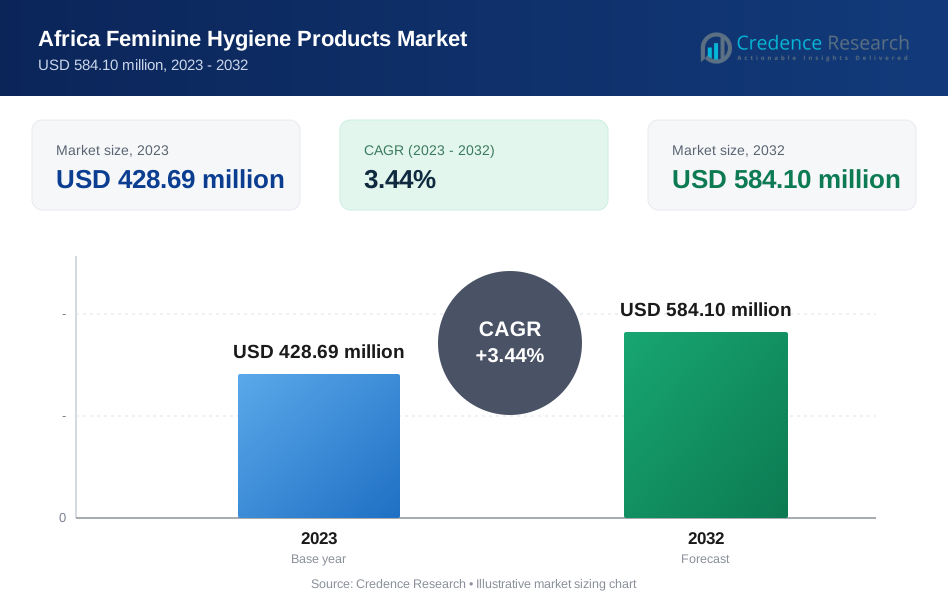
Africa Feminine Hygiene Products Market size was valued at USD 428.69 million in 2023 and is anticipated to reach USD 584.10 million by 2032, at a CAGR of 3.44% during the forecast period (2023-2032).
Several factors are propelling the expansion of the feminine hygiene market in Africa. Urbanization is a key driver, as more women in urban areas gain access to retail outlets and information, leading to higher demand for hygiene products. Additionally, rising disposable incomes enable consumers to opt for higher-quality and sustainable products. Government initiatives and non-governmental organization efforts to combat period poverty are also instrumental in improving product accessibility and education, thereby fostering market growth. Increasing focus on menstrual health awareness, particularly through community programs, has helped break taboos around menstruation, driving acceptance of hygiene products. Furthermore, the growing preference for eco-friendly alternatives, such as reusable menstrual cups and biodegradable pads, reflects a shift toward more sustainable practices across the continent.
South Africa stands out as a significant contributor to the African feminine hygiene market, driven by increasing disposable income, changing lifestyles, and a growing awareness of menstrual health. The country’s market is expected to experience a robust growth trajectory in the coming years, with urban centers leading the way in demand for hygiene products. In East Africa, countries like Ethiopia, Kenya, and Uganda are witnessing a rise in demand for eco-friendly and sustainable menstrual products, reflecting a shift towards environmentally conscious consumer choices. However, challenges such as stigma, limited access to sanitation facilities, and affordability continue to hinder widespread adoption in rural areas, despite efforts to improve access to menstrual hygiene products. In West Africa, the market is gaining momentum, particularly in countries like Nigeria and Ghana, where educational campaigns and improving retail infrastructure are enhancing product availability.
Market Insights:
- The African feminine hygiene products market was valued at USD 428.69 million in 2023 and is expected to reach USD 584.10 million by 2032, growing at a CAGR of 3.44% during the forecast period (2023-2032).
- The global feminine hygiene products market, valued at USD 23,490.00 million in 2023, is projected to reach USD 43,917.35 million by 2032, growing at a CAGR of 7.2% from 2023 to 2032.
- Urbanization plays a key role in the market's growth, as increased access to retail outlets and information in urban areas drives demand for feminine hygiene products.
- Rising disposable incomes in urban centers are encouraging consumers to purchase higher-quality, eco-friendly, and sustainable menstrual products like organic cotton pads and menstrual cups.
- Government and NGO-led initiatives to combat period poverty and improve menstrual hygiene education are playing a vital role in increasing product accessibility and breaking cultural taboos surrounding menstruation.
- The market is seeing a growing shift toward sustainable and eco-friendly alternatives, including reusable menstrual cups and biodegradable pads, as environmental awareness among consumers increases.
- Despite the growing demand, cultural taboos and stigmas surrounding menstruation continue to hinder the widespread adoption of hygiene products, particularly in rural areas.
- Affordability remains a significant barrier, as many women, especially in low-income regions, still struggle to access sanitary products, often resorting to unsafe alternatives.
Market Drivers:
Increasing Awareness of Menstrual Health
One of the primary drivers of growth in the African feminine hygiene products market is the increasing awareness of menstrual health. Over the past decade, governments, NGOs, and advocacy groups have launched numerous campaigns to educate women and girls about the importance of menstrual hygiene management (MHM). For example, in Ghana, the construction of sanitation facilities at more than 260 schools in the Greater Accra Metropolitan Area each with separate toilets, changing rooms, and hygienic disposal spaces has directly supported adolescent girls’ educational engagement and menstrual health. These initiatives focus on breaking the cultural taboos surrounding menstruation and encouraging open dialogue. The rise in awareness has not only increased the acceptance of feminine hygiene products but also improved the understanding of proper menstrual care, driving demand for sanitary products. Educational efforts in schools and communities across Africa have helped to normalize menstruation, making feminine hygiene products more accessible and appealing.
Growing Disposable Incomes
The steady rise in disposable incomes across the African continent is another significant factor contributing to the growth of the feminine hygiene products market. As countries such as South Africa, Nigeria, Kenya, and Ghana experience economic development, a larger segment of the population is able to afford quality hygiene products. This shift towards higher purchasing power enables more women to choose premium sanitary products, such as organic cotton pads, tampons, and menstrual cups, over traditional alternatives. For instance, companies like ZanaAfrica in Kenya have designed affordable, high-quality pads, and their Nia HealthLink chatbot provides real-time reproductive health support, further supporting women’s ability to manage menstruation with dignity and confidence. The growing middle class in urban areas is also driving the demand for modern, convenient, and eco-friendly menstrual products that cater to the evolving lifestyle of women across the continent.
Government and NGO Initiatives
Government policies and the efforts of NGOs in Africa have significantly impacted the growth of the feminine hygiene market. Many governments have initiated programs aimed at improving menstrual hygiene access, especially in underserved areas. These programs often involve the distribution of free or subsidized products, particularly in schools, to ensure that young girls do not miss out on education due to menstrual health issues. Additionally, several NGOs are actively addressing period poverty by providing free menstrual products to low-income women and girls, further driving demand for affordable and accessible feminine hygiene products. These programs are not only helping to bridge the affordability gap but are also playing a crucial role in changing societal attitudes toward menstruation.
Shift Toward Sustainable and Eco-Friendly Products
The shift towards sustainability and eco-friendly products is another key driver in the African feminine hygiene market. As environmental concerns rise globally, African consumers are becoming increasingly aware of the negative impact of single-use plastic and non-biodegradable products. In response, many women are now opting for more sustainable alternatives, such as menstrual cups, cloth pads, and biodegradable sanitary pads. This trend is particularly evident in urban areas, where consumers have better access to such products. The growing demand for eco-friendly products is also being fueled by the rising popularity of organic and natural product lines, which cater to women’s increasing desire for health-conscious and environmentally responsible choices. Consequently, manufacturers are increasingly focusing on developing sustainable, reusable, and eco-friendly hygiene products to meet the demand of environmentally conscious consumers.
Market Trends:
Expansion of E-Commerce Channels
The growth of e-commerce in Africa is a key trend shaping the feminine hygiene products market. As internet penetration increases across the continent, more consumers are turning to online platforms for purchasing personal care products, including feminine hygiene items. E-commerce provides women in both urban and rural areas with easier access to a broader range of products, from international brands to local alternatives, which they may not find in traditional retail stores. The rise of mobile money services and digital payment platforms further facilitates online transactions, making it more convenient for consumers to purchase these products. For instance, platforms like Jumia have played a pivotal role in this shift, offering women in both urban and rural areas the ability to purchase a wide range of feminine hygiene products online, including tampons, sanitary pads, and menstrual cups. The convenience of home delivery and the privacy that online shopping offers have further accelerated this trend, especially among younger, tech-savvy consumers.
Introduction of Innovative Products
Innovation in product development is another significant trend in the African feminine hygiene market. Manufacturers are increasingly focused on creating products that cater to the specific needs of African consumers, such as pads and tampons designed to handle the hot and humid climate typical in many parts of the continent. Additionally, the introduction of more specialized products, including organic cotton pads, hypoallergenic products, and menstrual cups, is gaining popularity. This trend reflects a growing consumer preference for natural, chemical-free options that align with health and sustainability concerns. For example, Daye, a UK-based company, develops biodegradable and pain-relieving pads and tampons, while local brands like Ubuntu Blooms in South Africa produce eco-friendly sanitary pads from dried water hyacinth, providing both a sustainable product and employment opportunities for local women. Furthermore, there is a marked increase in product diversity, with manufacturers offering a range of sizes, absorbencies, and packaging to suit varying customer preferences.
Emphasis on Health and Wellness
The growing focus on health and wellness is a significant trend driving the African feminine hygiene market. As women become more health-conscious, they are increasingly looking for products that not only ensure comfort and convenience but also promote better overall well-being. This shift is evident in the rising demand for organic, toxin-free, and eco-friendly menstrual products. The increasing awareness of the risks associated with traditional products that contain chemicals or synthetic materials is pushing women to seek safer, healthier alternatives. The wellness trend extends beyond the use of hygiene products to encompass broader issues of menstrual health, with more women prioritizing proper hygiene and preventive healthcare.
Focus on Local Manufacturing and Sourcing
Another important trend in the African feminine hygiene products market is the increasing focus on local manufacturing and sourcing. As demand for feminine hygiene products continues to grow, there is a push for local production to reduce import dependency and improve product availability. Local manufacturers are increasingly entering the market, offering products tailored to regional preferences and at competitive price points. This trend is also supported by governments’ efforts to boost local industries and reduce reliance on imports. By establishing production facilities within the continent, manufacturers can better address supply chain challenges, reduce costs, and create jobs, thus fostering economic growth while meeting the needs of African consumers more effectively.
Market Challenges Analysis:
Cultural Taboos and Stigma
Cultural taboos surrounding menstruation remain one of the significant challenges in the African feminine hygiene products market. In many communities, menstruation is still considered a private or shameful topic, leading to reluctance in discussing menstrual health openly. For instance, in East Africa, menstruation is considered taboo even among women, leading to communication barriers and hindering menstrual hygiene education. This stigma affects women's willingness to purchase or even access sanitary products. In rural areas, where traditional beliefs are often more ingrained, these taboos are even more prominent, limiting the adoption of modern hygiene products. The ongoing societal discomfort surrounding menstruation prevents many women from seeking the products they need, thus restraining market growth.
Affordability and Access
Affordability remains a major barrier in the widespread adoption of feminine hygiene products in Africa. Despite the growing middle class in urban areas, many women, particularly in low-income and rural regions, still struggle to afford sanitary products. Period poverty, where women are unable to purchase menstrual hygiene items, affects millions across the continent. In such cases, women may resort to unsafe alternatives such as rags or leaves, which can lead to health complications. While efforts from governments and NGOs aim to provide low-cost or free products, affordability remains a critical issue for a large segment of the population.
Limited Distribution Channels
Limited distribution networks also present a challenge to the growth of the African feminine hygiene products market. In many rural areas, access to modern retail outlets and pharmacies is still limited. Women in these regions often face challenges in sourcing sanitary products, which can lead to periods of scarcity or reliance on informal markets. While e-commerce has grown rapidly, it is still not a viable option for many women in remote areas due to factors such as low internet penetration, lack of digital payment options, and inadequate delivery infrastructure. This hampers the market's ability to reach a wider audience, particularly in less developed regions.
Lack of Education and Awareness
Despite growing efforts to improve menstrual health education, a lack of awareness persists in many parts of Africa. Many women and girls are still unaware of the importance of menstrual hygiene management, proper product usage, and the risks associated with poor menstrual health. This knowledge gap further limits the uptake of hygiene products, as misconceptions and misinformation about menstruation continue to hinder progress. Without adequate education and awareness, many women are not empowered to make informed choices regarding their menstrual health, thereby restraining market growth.
Market Opportunities:
One of the most significant market opportunities in Africa's feminine hygiene products sector is the increasing demand for sustainable and eco-friendly alternatives. As environmental concerns continue to rise globally, African consumers are becoming more conscious of the ecological impact of traditional feminine hygiene products, such as non-biodegradable sanitary pads. This shift toward sustainability presents a unique opportunity for manufacturers to introduce and expand their portfolios of eco-friendly products, such as reusable menstrual cups, cloth pads, and biodegradable sanitary pads. With the growing middle class and increased awareness of environmental issues, there is strong potential for these products to gain traction in both urban and rural markets, particularly among environmentally conscious consumers. Manufacturers who can tap into this demand for green products will not only appeal to a growing customer base but also contribute to the broader sustainability movement in Africa.
Another significant opportunity lies in expanding access to feminine hygiene products in underserved rural areas. While urban centers are witnessing increased demand due to better access to retail outlets and online shopping, many rural regions remain underserved. There is a significant opportunity for businesses to expand distribution networks and improve the availability of feminine hygiene products in these areas. Local manufacturing initiatives, along with partnerships with NGOs and governments, can help lower product costs and increase availability. By addressing period poverty and ensuring that women in remote areas have access to affordable hygiene products, companies can capture a large untapped market segment, driving both social impact and business growth.
Market Segmentation Analysis:
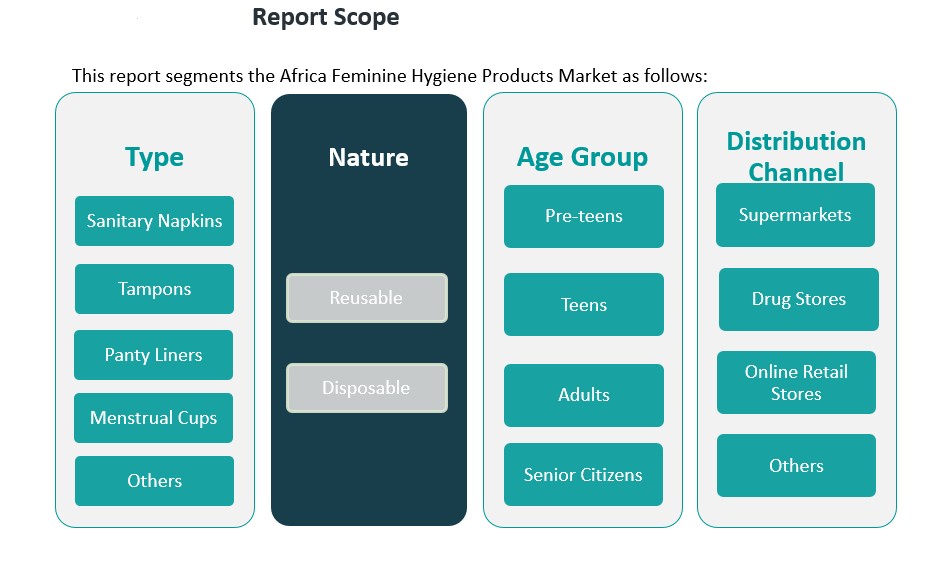
The African feminine hygiene products market is diverse, with several key segments driving growth.
By type, segment is led by sanitary napkins, which hold the largest market share due to their widespread use and affordability. Tampons and panty liners are also popular, particularly among women in urban areas, while menstrual cups are gaining traction due to the growing demand for eco-friendly alternatives. The others category includes products like menstrual discs and organic cotton pads, catering to specific consumer preferences.
By nature, segment, disposable products dominate the market, particularly sanitary napkins and tampons, due to their convenience and accessibility. However, the demand for reusable products, such as menstrual cups and cloth pads, is rising as more consumers opt for sustainable and eco-friendly solutions, especially in urban centers where environmental awareness is higher.
By age-group segment reveals diverse consumer needs. Pre-teens and teens primarily use pads and panty liners, with a focus on comfort and convenience. Adults are the largest demographic, using a mix of sanitary napkins, tampons, and menstrual cups, with a growing preference for health-conscious and eco-friendly options. Senior citizens require products with higher absorbency and comfort, often preferring pads designed for incontinence.
By distribution channels, supermarkets and drug stores are the primary outlets for feminine hygiene products, especially in urban areas. The rise of online retail stores has increased accessibility, offering a wider variety of products and the convenience of home delivery, which is becoming popular among younger, tech-savvy consumers.
Segmentation:
By Type
- Sanitary Napkins
- Tampons
- Panty Liners
- Menstrual Cups
- Others
By Nature
- Reusable
- Disposable
By Age-Group
- Pre-teens
- Teens
- Adults
- Senior Citizens
By Distribution Channel
- Supermarkets
- Drug Stores
- Online Retail Stores
- Others
Regional Analysis:
The African feminine hygiene products market is experiencing growth across various regions, each contributing to the overall market dynamics in unique ways. Regional differences in consumer behavior, economic development, and access to hygiene products are influencing the adoption of feminine hygiene products across the continent.
Southern Africa holds a significant share of the market, particularly led by South Africa, which dominates the region. South Africa accounts for approximately 30% of the overall African feminine hygiene products market. The growth in this region is driven by higher disposable incomes, increasing urbanization, and the growing awareness of menstrual health. South Africa’s urban centers, such as Johannesburg and Cape Town, are key markets due to the prevalence of modern retail outlets, increased e-commerce penetration, and a higher demand for premium products. Other countries in Southern Africa, such as Namibia and Botswana, are also seeing steady growth, though at a slower pace compared to South Africa.
East Africa is another rapidly growing market, with countries like Kenya, Uganda, and Tanzania leading the way. This region is expected to see a market share growth of around 20% by 2029. Key drivers in East Africa include improving education on menstrual hygiene, increasing government and NGO-led initiatives, and rising disposable incomes in urban areas. Kenya, for instance, is seeing an uptick in demand for eco-friendly products such as menstrual cups and reusable pads, as environmental awareness grows. However, challenges remain in rural areas, where access to hygiene products is still limited.
West Africa, particularly Nigeria, Ghana, and Ivory Coast, also presents a growing market opportunity. Nigeria holds a substantial market share in the region, with the country’s urban areas such as Lagos and Abuja leading the way in demand for feminine hygiene products. The West African market is expected to account for around 25% of the total African market by 2029. Market growth in this region is driven by increasing disposable incomes, rising awareness of menstrual hygiene, and improvements in distribution networks. However, challenges such as period poverty and cultural taboos still hinder widespread adoption in rural areas.
North Africa, including Egypt, Morocco, and Algeria, has a relatively smaller share compared to other regions, but it is still a significant player in the African market. This region accounts for approximately 15% of the total market share. In North Africa, the market is driven by a mix of urbanization, government health initiatives, and increasing awareness of women's health issues. Urban consumers are more likely to adopt premium hygiene products, while rural areas face similar challenges related to affordability and access.
Key Player Analysis:
- Johnson & Johnson
- Procter & Gamble
- Kimberly-Clark
- Essity Aktiebolag
- Kao Corporation
- Daio Paper Corporation
- Unicharm Corporation
- Premier FMCG
- Ontex
- Hengan International Group Company Ltd
- Drylock Technologies
- Natracare LLC
- First Quality Enterprises, Inc
- Bingbing Paper Co., Ltd
Competitive Analysis:
The competitive landscape of the Africa feminine hygiene products market is characterized by a mix of global and local players striving to meet the diverse needs of consumers. Major international brands such as Procter & Gamble, Kimberly-Clark, and Johnson & Johnson dominate the market, leveraging their established brand presence, extensive distribution networks, and ability to offer a wide range of products. These companies have a strong foothold in Southern and Western Africa, where urbanization and rising incomes drive demand for premium hygiene products. Local players, such as African Cotton Industries and Mama’s Choice, are increasingly gaining market share by offering affordable, regionally tailored products. These brands are particularly popular in East and West Africa, where cost-effective options are essential due to the price sensitivity of consumers. Additionally, the rise of eco-friendly product demand has encouraged both global and local brands to innovate with sustainable, reusable products like menstrual cups and cloth pads, catering to an environmentally conscious demographic.
Recent Developments:
- In January 2025, Unicharm Corporation, in partnership with Toyota Tsusho Corporation and its group company CFAO Kenya Limited, began local production and sales of sanitary napkins in Kenya. This initiative marks Unicharm's first local manufacturing operation for feminine hygiene products on the African continent. By leveraging Toyota Tsusho’s extensive regional network and Unicharm’s technological expertise, the companies aim to provide high-quality, affordable sanitary products tailored to local needs.
Market Concentration & Characteristics:
The African feminine hygiene products market is moderately concentrated, with a few major global brands holding significant market share, particularly in urban areas. Multinational companies such as Procter & Gamble, Kimberly-Clark, and Johnson & Johnson dominate the market, benefiting from established distribution networks, brand recognition, and economies of scale. These companies typically offer a wide range of products, including sanitary napkins, tampons, and panty liners, catering to various consumer preferences and income levels. However, local manufacturers are also gaining traction, especially in cost-sensitive markets. These companies often focus on affordability and cater to regional preferences, offering products tailored to local needs. The rise in demand for eco-friendly options has led to a shift toward innovation, with both global and local players introducing sustainable products such as menstrual cups and reusable pads. This trend reflects the growing consumer awareness around environmental issues, making the market increasingly dynamic and competitive.
Report Coverage:
The research report offers an in-depth analysis based on Type, Nature, Age-Group and Distribution Channel. It details leading market players, providing an overview of their business, product offerings, investments, revenue streams, and key applications. Additionally, the report includes insights into the competitive environment, SWOT analysis, current market trends, as well as the primary drivers and constraints. Furthermore, it discusses various factors that have driven market expansion in recent years. The report also explores market dynamics, regulatory scenarios, and technological advancements that are shaping the industry. It assesses the impact of external factors and global economic changes on market growth. Lastly, it provides strategic recommendations for new entrants and established companies to navigate the complexities of the market.
Future Outlook:
- The African feminine hygiene products market is expected to grow at a steady pace, driven by increased awareness of menstrual health and hygiene.
- Rising disposable incomes, particularly in urban areas, will lead to higher demand for premium and eco-friendly products.
- E-commerce platforms will continue to expand access to a wider range of hygiene products, improving consumer convenience and product variety.
- The demand for sustainable and reusable products, such as menstrual cups and cloth pads, will increase as environmental awareness grows.
- Government and NGO-led initiatives to address period poverty will contribute to market expansion, especially in rural areas.
- Innovations in product design, such as better absorption and comfort, will cater to a broader consumer base.
- Local manufacturers are expected to gain market share by offering affordable, region-specific products.
- Regional distribution networks will improve, enhancing product availability in underserved areas.
- Increased focus on health and wellness will drive consumers to seek safer, chemical-free hygiene options.
- The expansion of retail channels, including supermarkets and pharmacies, will support the market's growth in both urban and rural settings.
Request a Free Sample
Fill in your details and we'll send you a free sample report.
- Sample data tables & charts
- Research methodology
Need a Custom Version of This Report?
Tailor the scope, geography, or segments to your exact requirements.
- Custom geography or segment scope
- Direct access to our analyst team
Frequently Asked Questions
What is the current size of the Africa Feminine Hygiene Products Market?
What factors are driving the growth of the Africa Feminine Hygiene Products market?
What are the key segments within the Africa Feminine Hygiene Products market?
What are some challenges faced by the Africa Feminine Hygiene Products market?
Who are the major players in the Africa Feminine Hygiene Products Market?
Table of Content
Chapter 1. Report Introduction
- 1.1 Report Description & Purpose
- 1.1.1 Report Title & Market Definition
- 1.1.2 Unique Selling Propositions (USP) & Key Differentiators
- 1.1.3 Value Proposition for Stakeholders
- 1.2 Research Objectives
- 1.2.1 Market Sizing Objectives (Volume & Revenue) (Volume Where Applicable)
- 1.2.2 Segmentation Objectives
- 1.2.3 Competitive Intelligence Objectives
- 1.2.4 Forecast & Scenario Objectives
- 1.3 Report Scope
- 1.3.1 Africa Feminine Hygiene Products Scope – Segments & Subsegments Covered
- 1.3.2 Geographic Scope – Selected Region & Countries Covered
- 1.3.3 Historical Period, Base Year & Forecast Period (2023; forecast to 2032)
- 1.3.4 Inclusions & Exclusions
- 1.4 Industry Classification & Applicable Codes
- 1.5 Currency, Measurement Units & Valuation Basis
- 1.6 Target Stakeholders
- 1.7 Limitations & Assumptions
Chapter 2. Executive Summary
- 2.1 Africa Feminine Hygiene Products Snapshot
- 2.1.1 Market Size – Historical (2023) & Forecast (2023-2032) (2023: USD 428.69 million → 2032: USD 584.10 million)
- 2.1.2 Volume & Revenue – Regional Totals (Volume Where Applicable)
- 2.1.3 Key Market Highlights – Top Five Facts
- 2.2 Africa Feminine Hygiene Products Segmentation Snapshot
- 2.2.1 Market Split by Country – 2023 vs. 2032
- 2.3 Competitive Snapshot
- 2.3.1 Top 10 Players by Revenue Share – 2023
- 2.3.2 Top 10 Players by Volume Share – 2023 (Volume Where Applicable)
- 2.3.3 Recent Strategic Developments (18-Month Summary)
- 2.4 Key Investment Highlights & Strategic Conclusions
Chapter 3. Africa Feminine Hygiene Products Dynamics & Industry Analysis
- 3.1 Market Overview & Context
- 3.1.1 Africa Feminine Hygiene Products Position in the Broader Industry Value Chain
- 3.1.2 Demand Structure & Purchasing Dynamics
- 3.1.3 Market Maturity & Development Stage by Country
- 3.2 Africa Feminine Hygiene Products Drivers
- 3.3 Africa Feminine Hygiene Products Restraints & Challenges
- 3.4 Africa Feminine Hygiene Products Opportunities
- 3.5 Porter's Five Forces Analysis
- 3.5.1 Threat of New Entrants
- 3.5.2 Bargaining Power of Suppliers
- 3.5.3 Bargaining Power of Buyers
- 3.5.4 Threat of Substitutes
- 3.5.5 Competitive Rivalry – Intensity Assessment
- 3.6 Africa Feminine Hygiene Products Value Chain Analysis
- 3.6.1 Upstream – Key Inputs, Resources & Suppliers
- 3.6.1.1 Key Input/Resource 1
- 3.6.1.2 Key Input/Resource 2
- 3.6.1.3 Key Input/Resource 3
- 3.6.2 Midstream – Core Operations & Value Creation
- 3.6.2.1 Operating Model & Process Overview
- 3.6.2.2 Key Operating Locations & Capabilities by Company
- 3.6.3 Downstream – Market Channels & End Users
- 3.6.3.1 Direct Sales & Customer Engagement Channels
- 3.6.3.2 Indirect Sales, Intermediaries & Partner Channels
- 3.6.4 Value Chain Profitability Analysis
- 3.6.1 Upstream – Key Inputs, Resources & Suppliers
- 3.7 PESTEL Analysis
- 3.7.1 Political Factors
- 3.7.2 Economic Factors
- 3.7.3 Social Factors
- 3.7.4 Technological Factors
- 3.7.5 Environmental Factors
- 3.7.6 Legal Factors
- 3.8 Africa Feminine Hygiene Products Supply Chain Analysis
- 3.8.1 Critical Input & Resource Availability Risk Assessment
- 3.8.2 Supplier & Operational Concentration Risk (Geographic Exposure)
- 3.8.3 Supply & Service Disruption Impact Analysis
- 3.9 Regional & Country Regulatory Landscape
Note: The regulatory and policy landscape section covers regulations based on their applicability to the market, Africa Feminine Hygiene Products category, geography, and scope of the study. Only regulatory frameworks with a material impact on operations, compliance, trade, sustainability, or market access are analyzed in detail.
Chapter 4. Key Investment Pockets & Opportunity Analysis
- 4.1 Africa Feminine Hygiene Products Attractiveness Analysis
- 4.1.1 By Country – Investment Attractiveness Matrix (Market Size × CAGR)
- 4.2 Absolute Revenue Growth Opportunity
- 4.2.1 By Country – Absolute Revenue Growth Through 2032
- 4.3 Incremental Demand Opportunity
- 4.3.1 By Country – Incremental Demand Through 2032
- 4.3.2 Segment – Incremental Demand
- 4.4 Emerging Submarket Opportunity Deep Dive (Subject to Applicability)
- 4.5 Priority Country Opportunity Scorecards
- 4.5.1 Priority Country 1
- 4.5.2 Priority Country 2
- 4.5.3 Priority Country 3
- 4.5.4 Priority Country 4
Note: Priority countries are selected from within the region covered by the study. Numbered entries are indicative and are populated with relevant country names based on market size, growth potential, and strategic relevance.
Chapter 5. Africa Feminine Hygiene Products Cross-Border Trade & Market Access Analysis
- 5.1 Intra-Regional & Extra-Regional Trade Overview
- 5.1.1 Regional Export Value by Country (2023)
- 5.1.2 Regional Export Volume by Country (2023) (Volume Where Applicable)
- 5.1.3 Regional Import Value by Country (2023)
- 5.1.4 Regional Import Volume by Country (2023) (Volume Where Applicable)
- 5.1.5 Net Trade Balance by Country (2023)
- 5.2 Export Analysis – Segment
- 5.2.1 Category 1 (Applicable Classification Code)
- 5.2.2 Category 2 (Applicable Classification Code)
- 5.2.3 Category 3 (Applicable Classification Code)
- 5.2.4 Category 4 (Applicable Classification Code)
- 5.2.5 Category 5 (Applicable Classification Code)
- 5.3 Import Analysis – Segment
- 5.3.1 Category 1 (Applicable Classification Code)
- 5.3.2 Category 2 (Applicable Classification Code)
- 5.3.3 Category 3 (Applicable Classification Code)
- 5.3.4 Category 4 (Applicable Classification Code)
- 5.3.5 Category 5 (Applicable Classification Code)
- 5.4 Cross-Border Pricing & Transaction Benchmarks
- 5.4.1 Export Pricing – Segment & Country
- 5.4.2 Import Pricing – Segment & Source Country
- 5.4.3 Price Trends (2023)
- 5.5 Key Cross-Border Trade & Delivery Routes
- 5.5.1 Cross-Border Trade/Delivery Route 1
- 5.5.2 Cross-Border Trade/Delivery Route 2
- 5.5.3 Cross-Border Trade/Delivery Route 3
- 5.5.4 Cross-Border Trade/Delivery Route 4
- 5.5.5 Cross-Border Trade/Delivery Route 5
- 5.6 Trade Policy & Market Access Impact Assessment
- 5.6.1 Tariff & Non-Tariff Barriers
- 5.6.2 Regional Trade & Economic Integration Frameworks
- 5.6.3 Bilateral & Multilateral Trade Agreements
- 5.6.4 Cross-Border Operating, Licensing & Localization Requirements
Note: Cross-border analysis applies where relevant to Africa Feminine Hygiene Products. Country trade flows distinguish intra-regional activity from trade with markets outside the region. Regional external trade totals exclude intra-regional flows to avoid double counting. Classifications and transaction measures follow the market scope; volume and route analyses apply only where meaningful.
Chapter 6. Competitive Landscape & Company Benchmarking
- 6.1 Africa Feminine Hygiene Products Concentration & Structure
- 6.1.1 Herfindahl-Hirschman Index (HHI) – the historical period vs. 2023
- 6.1.2 Leading, Mid-Sized & Emerging Player Structure
- 6.1.3 Global, Regional & Local Player Dynamics
- 6.2 Africa Feminine Hygiene Products Share Analysis – 2023
- 6.2.1 Regional Revenue Share by Company
- 6.2.2 Regional Volume Share by Company (Volume Where Applicable)
- 6.2.3 Company Revenue Share by Country
- 6.2.4 Market Share Evolution (the historical period vs. 2023)
- 6.2.5 Company Market Share by Key Segment
- 6.2.6 Company Market Share by Customer Group
- 6.3 Operating Scale, Capacity & Infrastructure Analysis
- 6.3.1 Regional Operating Scale & Supply Capacity
- 6.3.2 Resource Utilization & Operating Efficiency
- 6.3.3 Output, Service Delivery & Activity Metrics
- 6.3.4 Operating Footprint & Infrastructure Map
- 6.3.5 Planned Operational & Capacity Expansion
- 6.4 Africa Feminine Hygiene Products Competitive Benchmarking Matrix
- 6.4.1 Revenue, Growth, Profitability & Operating Metric Comparison
- 6.4.2 Channel Revenue Mix
- 6.4.3 Revenue Exposure by Country Within the Region
- 6.4.4 R&D Intensity
- 6.4.5 Sustainability Maturity
- 6.5 Strategic Developments in Africa Feminine Hygiene Products (Last 24 Months)
- 6.5.1 Mergers, Acquisitions & Divestments
- 6.5.2 New Products, Services & Solutions in Africa Feminine Hygiene Products
- 6.5.3 Operational & Infrastructure Expansions
- 6.5.4 Strategic Alliances, Joint Ventures & Partnerships
- 6.5.5 Distribution Expansion & Market Entry
- 6.5.6 Sustainability & ESG Initiatives
- 6.6 Competitive Strategy Mapping
- 6.6.1 Leader, Challenger, Follower & Niche Classification
- 6.6.2 Pricing Strategy Comparison
- 6.6.3 Channel Strategy Matrix
Note: Strategic developments are included based on their materiality and the availability of reliable information.
Chapter 7. Africa Feminine Hygiene Products – By Sales & Delivery Channel
- 7.1 Segment Overview
- 7.1.1 Volume & Revenue Split by Channel (2023 & 2032) (Volume Where Applicable)
- 7.1.2 Channel Mix Evolution (2023-2032)
Chapter 8. Country Market Analysis – Regional Overview
- 8.1 Country Market Overview Within the Region
- 8.1.1 Country Volume Share Within the Region (Where Applicable)
- 8.1.2 Country Revenue Share Within the Region
- 8.1.3 Market Volume by Country (Where Applicable)
- 8.1.4 Market Revenue by Country
- 8.1.5 Country Forecasts Through 2032
- 8.2 Cross-Country Segment Analysis
- 8.2.1 By Sales & Delivery Channel
- 8.2.2 By Competitive Positioning & Price Tier
Chapter 9. Africa Feminine Hygiene Products – Priority Country 1
Chapter 10. Africa Feminine Hygiene Products – Priority Country 2
Chapter 11. Africa Feminine Hygiene Products – Priority Country 3
Chapter 12. Africa Feminine Hygiene Products – Priority Country 4
Chapter 13. Africa Feminine Hygiene Products Company Profiles
- 13.1 [Company 01]
- 13.1.1 Company Overview
- 13.1.2 Key Management Personnel
- 13.1.3 Products & Services Portfolio
- 13.1.4 Financial Performance
- 13.1.5 Regional Market Focus & Country Presence
- 13.1.6 Recent Developments & Strategic Initiatives
Note: The company profile list is preliminary and may change based on research findings, market developments, data availability, and client requirements.
Chapter 14. Appendices
- Appendix A – List of Abbreviations & Acronyms
- Appendix B – Industry Classification Code Reference – Full Series
- Appendix C – Supply, Output & Operating Capacity Data Tables
- Appendix D – End-Use & Demand Base Tables
- Appendix E – Demand, Adoption & Usage Assumptions
- Appendix F – Pricing & Revenue Metric Reference Tables
- Appendix G – Company Operations & Infrastructure Database
- Appendix H – Cross-Border Trade & Activity Data Tables (Where Applicable)
- Appendix I – Regulatory Summary Tables
- Appendix J – Primary Research Participant List (Anonymized)
- Appendix K – Primary Research Questionnaire Framework
- Appendix L – Data Sources & Bibliography
- Appendix M – Market Size Divergence & Source Comparison
Chapter 15. Research Methodology
- 15.1 Research Framework & Philosophy
- 15.2 Secondary Research – Sources, Hierarchy & Data Extraction
- 15.3 Data Modeling – Country-Level Estimates & Regional Aggregation
- 15.4 Primary Research – Stakeholder Framework, LOI & Sample Sizes
- 15.5 Forecast Methodology – Regression, Scenario & Sensitivity Analysis
- 15.6 Quality Control – Four-Layer Validation Framework
- 15.7 Limitations & Standard Assumptions
- 15.8 Disclaimer
