
Agricultural Irrigation Machinery Market Overview:
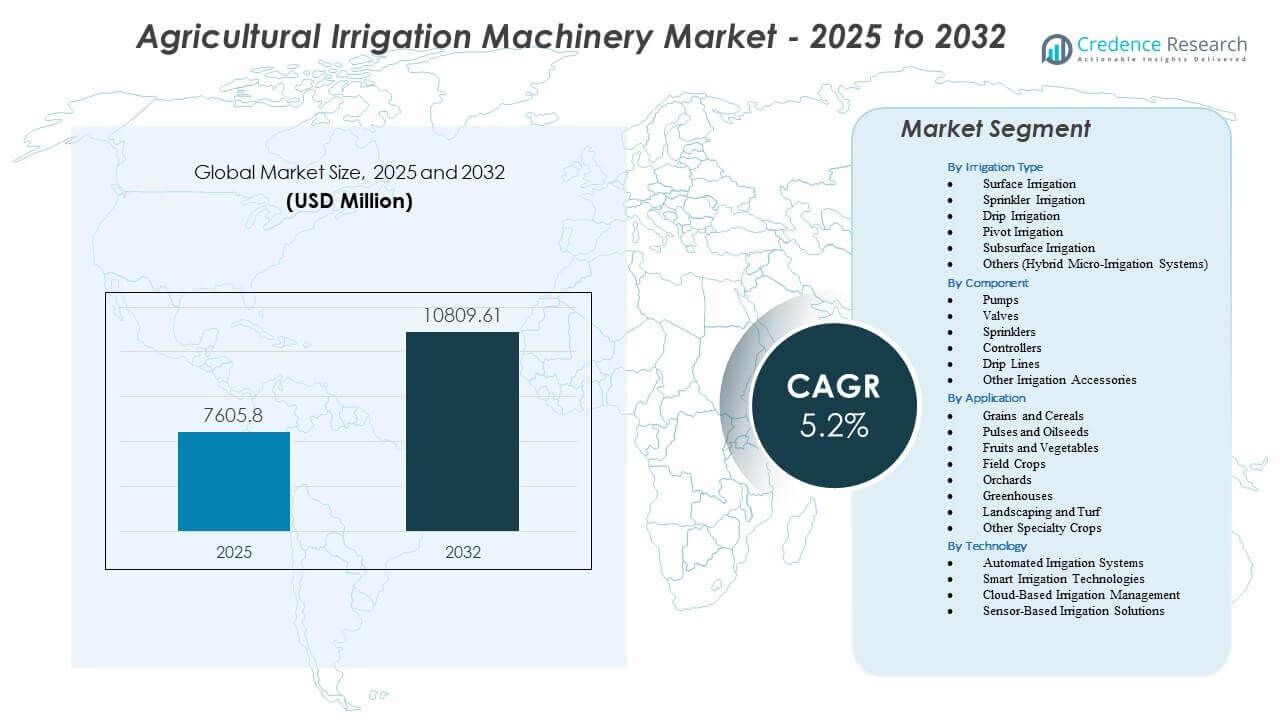
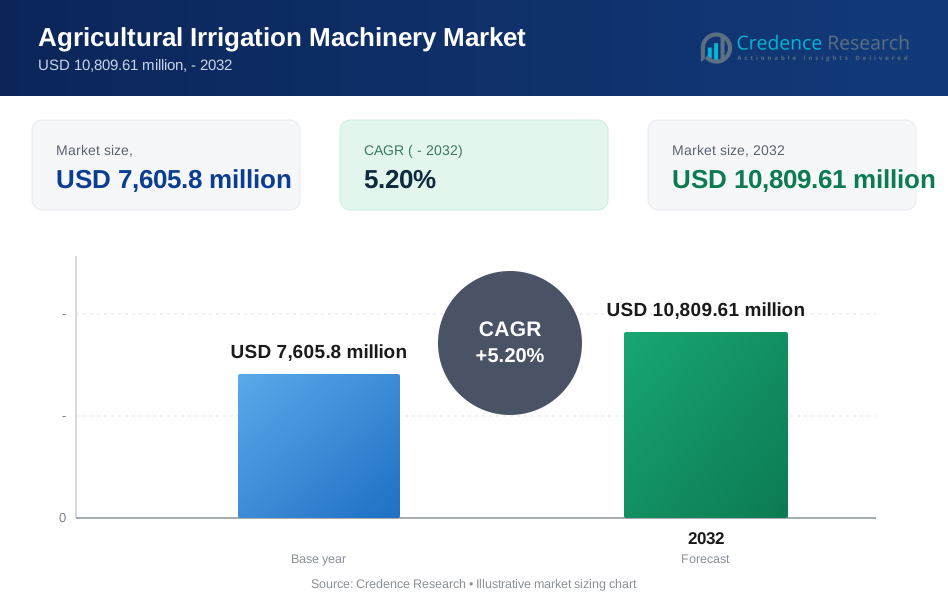
The Agricultural Irrigation Machinery Market is projected to grow from USD 7,605.8 million in 2025 to an estimated USD 10,809.61 million by 2032, with a compound annual growth rate (CAGR) of 5.2% from 2025 to 2032.
Growth is supported by rising adoption of precision irrigation, increasing pressure on water resources, and stronger government initiatives promoting efficient irrigation systems.
| REPORT ATTRIBUTE | DETAILS |
|---|---|
| Historical Period | 2020-2024 |
| Base Year | 2025 |
| Forecast Period | 2026-2032 |
| Agricultural Irrigation Machinery Market Size 2025 | USD 7,605.8 million |
| Agricultural Irrigation Machinery Market, CAGR | 5.2% |
| Agricultural Irrigation Machinery Market Size 2032 | USD 10,809.61 million |
Agricultural Irrigation Machinery Market Insights:
- Strong demand for precision irrigation drives market growth as farmers adopt drip, sprinkler, and automated systems to improve water efficiency and enhance crop performance.
- High upfront cost and limited financing access in rural regions restrain adoption, particularly among small and marginal farmers facing budget constraints.
- North America leads the market due to advanced mechanization, while Europe maintains steady growth supported by strict water management policies and greenhouse expansion.
- Asia-Pacific emerges as the fastest‐growing region because governments promote micro-irrigation, large crop zones require efficient systems, and technology adoption increases across developing economies.
Agricultural Irrigation Machinery Market Drivers
Rising Demand for Efficient Water Use Due to Scarcity Across Major Farming Regions
Growing pressure on freshwater resources pushes farmers to adopt systems that reduce waste and support stable crop cycles. Rising climatic stress forces growers to protect yields with better control of water flow. Smart units help farmers shift from manual irrigation to precise delivery. Wider acceptance of automation supports faster field decisions and reduces manual labor. Government bodies promote water-smart practices through subsidy programs. Farmers in dry belts prefer systems that help maintain soil moisture balance. Accurate water distribution improves crop health during peak stress. The Agricultural Irrigation Machinery Market gains steady momentum due to the focus on long-term water security.
Expansion of Commercial Farming and Mechanized Cultivation Across Developing Economies
Large farms increase demand for high-capacity irrigation units that support multi-crop operations. Growing exports drive producers to maintain uniform crop quality through reliable watering cycles. Mechanized irrigation helps farmers meet strict supply deadlines in horticulture and plantation crops. New farm investments across emerging economies improve adoption of center pivot and drip lines. Growing infrastructure spending supports the setup of new irrigation networks across rural zones. Rising labor shortages increase interest in automated spray systems. Smart controls help large growers shorten field cycles. The Agricultural Irrigation Machinery Market responds strongly to rising commercial farm consolidation.
- For instance, Valmont Industries reports that its Valley® center pivots operate across more than 30 million acres worldwide, enabling large-scale farms to automate irrigation and maintain high output consistency.
Government Incentives and Policy Push for Water-Efficient Agricultural Technologies
Many countries offer tax benefits and grants to support micro-irrigation uptake. Public agencies run awareness programs that highlight the benefits of controlled water flow. Adoption of high-efficiency systems increases when subsidy coverage reduces upfront cost. Strong policy push helps marginal farmers shift from flood irrigation to drip setups. State programs aim to cut water loss in dry regions. Government tender projects promote local manufacturing of irrigation units. Policy support helps raise adoption rates in water-stressed belts. The Agricultural Irrigation Machinery Market expands with continuous policy engagement.
- For instance, India's PMKSY micro-irrigation scheme supported over 14 million hectares with efficient irrigation technologies, enabling thousands of farmers to adopt drip systems supplied by companies such as Jain Irrigation and Netafim India.
Shift Toward High-Value Crops That Require Precise and Controlled Water Application
Growers increase acreage under fruits, vegetables, and greenhouse crops that need accurate moisture control. Precision irrigation supports quality gains across sensitive crops. Smart sensors help maintain stable root-zone moisture. Drip and micro-spray units reduce wastage during peak demand cycles. Larger focus on export-oriented crops improves reliance on controlled systems. Yield stability rises when farmers manage uniform water distribution. Controlled irrigation reduces crop stress in extreme heat periods. The Agricultural Irrigation Machinery Market benefits from the shift toward premium agriculture.
Agricultural Irrigation Machinery Market Trends
Rapid Integration of IoT-Enabled Controls and Real-Time Monitoring in Irrigation Systems
IoT tools help growers manage pumps, valves, and flow lines with remote dashboards. Sensor networks track soil moisture at short intervals. Data-guided insights help farmers adjust water levels in real time. Connectivity improves decision accuracy across large farms. Predictive alerts help prevent over-watering and under-watering. Digital consoles bring more control to seasonal crops. Smart updates improve planning cycles and reduce manual checks. The Agricultural Irrigation Machinery Market moves toward tech-enabled field automation.
Growing Preference for Solar-Powered Irrigation Solutions Across Off-Grid Farming Zones
Solar pump systems cut energy cost for small and medium farms. Reliable off-grid power supports uninterrupted irrigation in remote zones. Falling panel prices increase adoption across developing markets. Solar-driven units help stabilize farm output during long dry seasons. Standalone systems reduce dependence on diesel pumps. Hybrid solutions give flexibility during variable sunlight conditions. Renewable systems help meet sustainability goals set by national bodies. The Agricultural Irrigation Machinery Market shifts toward cleaner power sources.
- For instance, Jain Irrigation has deployed more than 100,000 solar pumping systems across rural India, supporting irrigation in regions with limited grid access through solar-powered water delivery.
Rising Popularity of Modular and Customizable Irrigation Units Supporting Diverse Farm Sizes
Farmers seek units that fit varied land layouts and crop structures. Modular kits offer easy expansion during seasonal changes. Lightweight systems improve setup speed. Portable drip lines support quick movement across small plots. Custom layouts help orchards manage tree-level watering with consistency. Flexible designs reduce long-term replacement cost. Farmers prefer systems that scale with changing land patterns. The Agricultural Irrigation Machinery Market adopts modular engineering at a fast pace.
- For instance, Rivulis’ modular drip systems are installed across 70+ countries, offering growers field-specific kits that support rapid customization for orchards, vineyards, and row crops.
Adoption of Data-Driven Irrigation Planning Through AI-Based Farm Advisory Platforms
AI tools guide farmers to plan water cycles using weather, crop stage, and soil data. Decision engines help growers reduce wastage during critical crop phases. Advisory platforms give recommendations on pump timing. Data mapping helps manage precise irrigation windows. AI models improve field uniformity across sensitive crops. Digital advice reduces dependence on manual judgement. Large growers use AI dashboards to plan whole-farm water schedules. The Agricultural Irrigation Machinery Market aligns closely with digital advisory ecosystems.
Agricultural Irrigation Machinery Market Challenges Analysis
High Capital Requirement and Limited Access to Affordable Financing for Small Growers
Advanced units require high upfront investment, which limits small farm adoption. Many growers lack access to credit lines that support equipment purchase. Financial gaps slow adoption in rural belts. Complex loan processes reduce farmer interest in long-term upgrades. Subsidy delays weaken market momentum in low-income regions. Maintenance cost concerns reduce interest in automated systems. Limited awareness of financing schemes holds back adoption. The Agricultural Irrigation Machinery Market faces strong cost-related barriers in many developing areas.
Technical Skill Gaps and Limited After-Sales Support Across Rural Farming Communities
Farmers in remote zones face difficulty operating automated systems. Limited technical training restricts full use of installed equipment. Poor service networks delay repairs and reduce system uptime. Lack of spare parts increases downtime during peak crop cycles. Inconsistent quality among local suppliers leads to trust issues. Farmers hesitate to adopt new systems without strong support backing. Knowledge gaps reduce the impact of digital tools. The Agricultural Irrigation Machinery Market must address these gaps to improve long-term sustainability.
Agricultural Irrigation Machinery Market Opportunities
Rising Government Focus on Micro-Irrigation Coverage Expansion Across Developing Economies
Public programs aim to scale micro-irrigation coverage to millions of hectares. New schemes provide direct incentives to reduce purchase cost. Awareness drives educate farmers about long-term water savings. Expanding subsidy coverage invites stronger private investments. Large irrigation modernization projects create space for new suppliers. Rural development plans support drip installation across dry belts. Higher adoption rates improve demand for service networks. The Agricultural Irrigation Machinery Market can capture strong growth from these policy shifts.
Growing Adoption of Smart Farming Platforms and Remote Operation Tools in Commercial Farms
Large farms move toward fully digital irrigation cycles. Remote dashboards help operators manage large acreage with fewer workers. Data-rich insights improve control of water flow. Integration with weather models supports better planning. Smart units give growers flexibility during variable climate conditions. Automation reduces reliance on manual skills. Strong interest from agritech firms boosts innovation pipelines. The Agricultural Irrigation Machinery Market benefits from the expanding digital farm ecosystem.
Agricultural Irrigation Machinery Market Segmentation Analysis:
By Irrigation Type
Surface, sprinkler, drip, pivot, subsurface, and hybrid micro-irrigation systems shape demand patterns in the Agricultural Irrigation Machinery Market. Surface irrigation holds strong use across large farms where cost control guides decisions. Sprinkler systems support flexible coverage across varied soil types. Drip setups improve water efficiency across high-value crops. Pivot units help large growers manage uniform watering over wide areas. Subsurface units support deeper moisture control in dry belts. Hybrid micro-irrigation widens adoption among small farms. The market grows steadily with rising interest in efficient water use.
- For instance, Valley Irrigation reports that its center pivots operate on more than 25 million acres globally, supporting uniform water delivery across large-scale agricultural zones.
By Component
Pumps, valves, sprinklers, controllers, drip lines, and accessories form the core machinery landscape within the Agricultural Irrigation Machinery Market. Pumps enable stable water movement across different terrains. Valves improve precision in flow control. Sprinklers support broad coverage for field crops. Controllers help farmers automate delivery cycles. Drip lines guide exact moisture placement at plant level. Accessories fill operational gaps for diverse farm needs. The segment advances with higher preference for reliable and long-life components.
- For instance, Nelson Irrigation’s R3000 Rotator® sprinklers are deployed across millions of acres and are documented to achieve up to 25% better application uniformity compared to older impact sprinkler designs.
By Application
Grains, cereals, pulses, oilseeds, fruits, vegetables, field crops, orchards, greenhouses, landscaping, and specialty crops represent broad use cases in the Agricultural Irrigation Machinery Market. Grains and cereals adopt systems that improve field uniformity. Pulses and oilseeds depend on controlled watering during critical stages. Fruits and vegetables require precise moisture for yield stability. Field crops benefit from mechanized coverage. Orchards use micro-irrigation for root-zone control. Greenhouses rely on automated units. Landscaping and specialty crops adopt flexible and low-wastage systems.
By Technology
Automated systems, smart solutions, cloud-based tools, and sensor-guided platforms define the technology shift in the Agricultural Irrigation Machinery Market. Automated machinery supports low-labor operations. Smart tools improve timing and dosage accuracy. Cloud platforms help farmers monitor multiple zones. Sensor-guided units enhance decision quality. Each technology improves consistency in water placement. Adoption rises with the need for real-time insights. The segment strengthens with broader digital integration across farms.
Segmentation:
By Irrigation Type
- Surface Irrigation
- Sprinkler Irrigation
- Drip Irrigation
- Pivot Irrigation
- Subsurface Irrigation
- Others (Hybrid Micro-Irrigation Systems)
By Component
- Pumps
- Valves
- Sprinklers
- Controllers
- Drip Lines
- Other Irrigation Accessories
By Application
- Grains and Cereals
- Pulses and Oilseeds
- Fruits and Vegetables
- Field Crops
- Orchards
- Greenhouses
- Landscaping and Turf
- Other Specialty Crops
By Technology
- Automated Irrigation Systems
- Smart Irrigation Technologies
- Cloud-Based Irrigation Management
- Sensor-Based Irrigation Solutions
By Region
- North America
- U.S.
- Canada
- Mexico
- Europe
- Germany
- France
- U.K.
- Italy
- Spain
- Rest of Europe
- Asia Pacific
- China
- Japan
- India
- South Korea
- South-east Asia
- Rest of Asia Pacific
- Latin America
- Brazil
- Argentina
- Rest of Latin America
- Middle East & Africa
- GCC Countries
- South Africa
- Rest of the Middle East and Africa
Regional Analysis:
North America holds a significant share of the Agricultural Irrigation Machinery Market, supported by strong mechanization rates and high adoption of precision irrigation. The region accounts for an estimated 32–34% share due to large commercial farms and investment in automated systems. Farmers in the U.S. prefer advanced sprinkler, pivot, and sensor-driven setups. Demand grows steadily as drought-prone states increase reliance on efficient water technologies. Canada shows rising adoption in greenhouse and specialty crop segments. The Agricultural Irrigation Machinery Market benefits from strong infrastructure and steady farm modernization across the region.
Europe maintains an estimated 25–27% share driven by strict water management policies and the expansion of high-value crop production. Countries like Spain, Italy, and France invest in drip and micro-irrigation to manage water scarcity. Greenhouse clusters across the Netherlands and Central Europe increase machine demand. Farmers prioritize systems that reduce water waste and support climate adaptation goals. Incentive programs strengthen uptake of automated and cloud-based tools. The Agricultural Irrigation Machinery Market gains from regional sustainability targets that encourage technology upgrades.
Asia-Pacific holds the largest share at 36–38%, driven by extensive agricultural land and rising micro-irrigation penetration in India, China, and Southeast Asia. Strong government subsidy programs accelerate adoption among small and medium farms. High-value crops in China and fruit belts in India expand demand for drip and sprinkler systems. Growth accelerates with rising dependence on controlled irrigation during variable monsoon cycles. The region shows strong momentum in solar-powered and sensor-based systems. The Agricultural Irrigation Machinery Market benefits from the shift toward water-efficient irrigation across diverse crop zones.
Key Player Analysis:
- Valmont Industries, Inc.
- Lindsay Corporation
- The Toro Company
- Nelson Irrigation
- Netafim Ltd. (Orbia / Netafim USA)
- Rain Bird Corporation
- Deere & Company
- Jain Irrigation Systems Ltd.
- Rivulis Irrigation Ltd.
- Reinke Manufacturing Co., Inc.
- Mahindra EPC Irrigation Limited
- Hunter Industries Inc.
- Kothari Agritech Private Limited
Competitive Analysis:
Key players drive innovation in the Agricultural Irrigation Machinery Market through automation, digital integration, and expanded product portfolios. Leading companies focus on efficient pump systems, precision sprinklers, and advanced drip technologies. Strong research pipelines support the development of smart controllers and cloud-linked monitoring tools. Global brands strengthen distribution networks to reach small and medium farms. Many companies invest in solar-compatible systems to meet demand across off-grid regions. Competition intensifies as firms target greenhouse and orchard-based applications with customized solutions. The Agricultural Irrigation Machinery Market reflects active competition shaped by technology upgrades, regional partnerships, and product reliability.
Recent Developments:
- In January 2026, Valley Irrigation, a Valmont Industries company, announced winners of its $100,000 grant program supporting agricultural innovation. This initiative highlights Valmont's ongoing commitment to advancing irrigation technologies amid precision farming trends.
- In November 2025. Komet Irrigationlaunched the Komet Precision Wave (KPW) pivot sprinkler. This innovation enhances water distribution uniformity and irrigation efficiency by minimizing runoff and evaporation losses.
- In August 2024, Rain Bird Corporation acquired Adritec Group International’s assets in Jordan and Mexico to strengthen its agricultural irrigation presence in the Middle East, Africa, and Latin America. This move leverages Adritec's drip irrigation expertise to expand Rain Bird's product offerings.
- In April 2024, Mahindra Irrigation (under Mahindra EPC Irrigation Limited) secured contracts worth USD 1.59 million to supply micro-irrigation systems for 2,700 hectares, with completion targeted within one year. The deal underscores Mahindra's focus on sustainable irrigation solutions in India.
Report Coverage:
The research report offers an in-depth analysis based on Irrigation Type, Component, Application, and Technology. It details leading market players, providing an overview of their business, product offerings, investments, revenue streams, and key applications. Additionally, the report includes insights into the competitive environment, SWOT analysis, current market trends, as well as the primary drivers and constraints. Furthermore, it discusses various factors that have driven market expansion in recent years. The report also explores market dynamics, regulatory scenarios, and technological advancements that are shaping the industry. It assesses the impact of external factors and global economic changes on market growth. Lastly, it provides strategic recommendations for new entrants and established companies to navigate the complexities of the market.
Future Outlook:
- Demand for advanced irrigation systems will rise as growers shift toward high-value crops that require precise moisture management.
- Automation adoption will expand as farms reduce labor dependence and strengthen real-time control of water delivery cycles.
- Drip and subsurface systems will gain wider acceptance in dry regions where water efficiency guides long-term planning.
- Digital platforms will support broader use of cloud dashboards and analytics tools for multi-zone farm monitoring.
- Solar-powered and hybrid pumping units will see stronger demand across off-grid agricultural belts.
- Smart controllers and sensor-driven solutions will integrate deeper with existing irrigation networks.
- Pivot irrigation growth will continue across large commercial farms seeking uniform field coverage.
- Government subsidy programs will accelerate micro-irrigation penetration among small and medium growers.
- Greenhouse expansion across Asia and Europe will raise demand for compact automated irrigation tools.
- The Agricultural Irrigation Machinery Market will move toward connected, sustainable, and low-wastage technologies that support stable crop cycles.
Request a Free Sample
Fill in your details and we'll send you a free sample report.
- Sample data tables & charts
- Research methodology
Need a Custom Version of This Report?
Tailor the scope, geography, or segments to your exact requirements.
- Custom geography or segment scope
- Direct access to our analyst team
Frequently Asked Questions
What is the current market size for the Agricultural Irrigation Machinery Market, and what is its projected size in 2032?
At what Compound Annual Growth Rate is the Agricultural Irrigation Machinery Market projected to grow between 2025 and 2032?
Which Agricultural Irrigation Machinery Market segment held the largest share in 2025?
What are the primary factors fueling the growth of the Agricultural Irrigation Machinery Market?
Who are the leading companies in the Agricultural Irrigation Machinery Market?
Which region commanded the largest share of the Agricultural Irrigation Machinery Market in 2025?
Table of Content
Chapter 1. Report Introduction
- 1.1 Report Description & Purpose
- 1.1.1 Report Title & Market Definition
- 1.1.2 Unique Selling Propositions (USP) & Key Differentiators
- 1.1.3 Value Proposition for Stakeholders
- 1.2 Research Objectives
- 1.2.1 Market Sizing Objectives (Volume & Revenue)
- 1.2.2 Segmentation Objectives
- 1.2.3 Competitive Intelligence Objectives
- 1.2.4 Forecast & Scenario Objectives
- 1.3 Report Scope
- 1.3.1 Agricultural Irrigation Machinery Scope – Types & Subtypes Covered
- 1.3.2 Geographic Scope – Regions & Countries Covered
- 1.3.3 Historical Period, Base Year & Forecast Period (the historical period; forecast to 2032)
- 1.3.4 Inclusions & Exclusions
- 1.4 HS Code & Classification Framework
- 1.5 Currency, Units & Pricing Basis
- 1.6 Target Stakeholders
- 1.7 Limitations & Assumptions
Chapter 2. Executive Summary
- 2.1 Global Agricultural Irrigation Machinery Market Snapshot
- 2.1.1 Market Size – Historical (the historical period) & Forecast (2032) (base year: USD 7,605.8 million → 2032: USD 10,809.61 million)
- 2.1.2 Volume & Revenue – Global Totals
- 2.1.3 Key Market Highlights – Top Five Facts
- 2.2 Agricultural Irrigation Machinery Market Segmentation Snapshot
- 2.2.1 Market Split by Region – vs. 2032
- 2.3 Competitive Snapshot
- 2.3.1 Top 10 Players by Revenue Share –
- 2.3.2 Top 10 Players by Volume Share –
- 2.3.3 Recent Strategic Developments (18-Month Summary)
- 2.4 Key Investment Highlights & Strategic Conclusions
Chapter 3. Agricultural Irrigation Machinery Market Dynamics & Industry Analysis
- 3.1 Market Overview & Context
- 3.1.1 Agricultural Irrigation Machinery Market Position in the Broader Automotive Value Chain
- 3.1.2 OEM vs. Replacement Market Dynamics
- 3.1.3 Market Maturity & Development Stage by Region
- 3.2 Agricultural Irrigation Machinery Market Drivers
- 3.3 Agricultural Irrigation Machinery Market Restraints & Challenges
- 3.4 Agricultural Irrigation Machinery Market Opportunities
- 3.5 Porter's Five Forces Analysis
- 3.5.1 Threat of New Entrants
- 3.5.2 Bargaining Power of Suppliers
- 3.5.3 Bargaining Power of Buyers
- 3.5.4 Threat of Substitutes
- 3.5.5 Competitive Rivalry – Intensity Assessment
- 3.6 Agricultural Irrigation Machinery Value Chain Analysis
- 3.6.1 Upstream – Raw Material/Input Suppliers
- 3.6.1.1 Raw Material/Input 1
- 3.6.1.2 Raw Material/Input 2
- 3.6.1.3 Raw Material/Input 3
- 3.6.2 Midstream – Production/Manufacturing/Service Delivery
- 3.6.2.1 Production/Process Overview
- 3.6.2.2 Key Facility Locations & Capacity by Manufacturer
- 3.6.3 Downstream – Distribution & End Consumer
- 3.6.3.1 Primary Channel – B2B/OEM
- 3.6.3.2 Secondary Channels – Dealer, Retail, Online, Direct
- 3.6.4 Value Chain Profitability Analysis
- 3.6.1 Upstream – Raw Material/Input Suppliers
- 3.7 PESTEL Analysis
- 3.7.1 Political Factors
- 3.7.2 Economic Factors
- 3.7.3 Social Factors
- 3.7.4 Technological Factors
- 3.7.5 Environmental Factors
- 3.7.6 Legal Factors
- 3.8 Agricultural Irrigation Machinery Supply Chain Analysis
- 3.8.1 Raw Material/Input Supply Risk Assessment
- 3.8.2 Manufacturing Concentration Risk (Geographic Exposure)
- 3.8.3 Trade Disruption Impact Analysis
- 3.9 Regulatory & Policy Landscape
Note: The regulatory and policy landscape section covers regulations based on their applicability to the market, Agricultural Irrigation Machinery category, geography, and scope of the study. Only regulatory frameworks with a material impact on operations, compliance, trade, sustainability, or market access are analyzed in detail.
Chapter 4. Key Investment Pockets & Opportunity Analysis
- 4.1 Agricultural Irrigation Machinery Market Attractiveness Analysis
- 4.1.1 By Region – Investment Attractiveness Matrix (Volume × CAGR)
- 4.2 Absolute Revenue Growth Opportunity
- 4.2.1 By Region – Absolute USD Growth Through 2032
- 4.3 Incremental Volume Opportunity
- 4.3.1 By Region – Incremental Volume Through 2032
- 4.3.2 Segment – Incremental Volume
- 4.4 Emerging Submarket Opportunity Deep Dive (Subject to Applicability)
- 4.5 Emerging Market Opportunity Scorecards
- 4.5.1 United States
- 4.5.2 Europe
- 4.5.3 Asia
- 4.5.4 Middle East & Africa
Note: Emerging Market Opportunity Scorecards will be included based on relevance and strategic importance. Regions listed are indicative and may vary depending on data availability and market dynamics.
Chapter 5. Agricultural Irrigation Machinery Import-Export Analysis & Trade Flows
- 5.1 Global Trade Overview
- 5.1.1 Global Export Value by Country (the historical period)
- 5.1.2 Global Export Volume by Country (the historical period)
- 5.1.3 Global Import Value by Country (the historical period)
- 5.1.4 Global Import Volume by Country (the historical period)
- 5.1.5 Net Trade Balance by Country (the historical period)
- 5.2 Export Analysis – Segment
- 5.2.1 Type 1 (HS Code)
- 5.2.2 Type 2 (HS Code)
- 5.2.3 Type 3 (HS Code)
- 5.2.4 Type 4 (HS Code)
- 5.2.5 Type 5 (HS Code)
- 5.3 Import Analysis – Segment
- 5.3.1 Type 1 (HS Code)
- 5.3.2 Type 2 (HS Code)
- 5.3.3 Type 3 (HS Code)
- 5.3.4 Type 4 (HS Code)
- 5.3.5 Type 5 (HS Code)
- 5.4 Average Unit Trade Prices
- 5.4.1 Average Export Price – Segment & Country
- 5.4.2 Average Import Price – Segment & Source Country
- 5.4.3 Price Trends (the historical period)
- 5.5 Key Trade Route Analysis
- 5.5.1 Trade Route 1
- 5.5.2 Trade Route 2
- 5.5.3 Trade Route 3
- 5.5.4 Trade Route 4
- 5.5.5 Trade Route 5
- 5.6 Trade Policy Impact Assessment
- 5.6.1 US Anti-Dumping & Section 301 Tariffs
- 5.6.2 EU Customs Union Impact
- 5.6.3 Major Free Trade Agreements
- 5.6.4 USMCA Rules of Origin
Note: Trade policy analysis will be included only where relevant to the Agricultural Irrigation Machinery market.
Chapter 6. Competitive Landscape & Company Benchmarking
- 6.1 Agricultural Irrigation Machinery Market Concentration & Structure
- 6.1.1 Herfindahl-Hirschman Index (HHI) – vs.
- 6.1.2 Tier 1, Tier 2 & Tier 3 Market Structure
- 6.1.3 Global, Regional & Local Player Dynamics
- 6.2 Agricultural Irrigation Machinery Market Share Analysis –
- 6.2.1 Global Revenue Share by Company
- 6.2.2 Global Volume Share by Company
- 6.2.3 Regional Revenue Share
- 6.2.4 Market Share Evolution ( vs. )
- 6.2.5 OEM Segment Share by Company
- 6.2.6 Replacement Segment Share by Company
- 6.3 Production/Delivery Capacity & Facility Analysis
- 6.3.1 Global Installed Capacity
- 6.3.2 Capacity Utilization Rates
- 6.3.3 Production/Output Volume
- 6.3.4 Facility Locations & Capacity Map
- 6.3.5 Planned Capacity Additions
- 6.4 Agricultural Irrigation Machinery Competitive Benchmarking Matrix
- 6.4.1 Revenue, Volume, CAGR & Profitability Comparison
- 6.4.2 Channel Revenue Mix
- 6.4.3 Geographic Revenue Exposure
- 6.4.4 R&D Intensity
- 6.4.5 Sustainability Maturity
- 6.5 Strategic Developments in Agricultural Irrigation Machinery (Last 24 Months)
- 6.5.1 Mergers, Acquisitions & Divestments
- 6.5.2 New Agricultural Irrigation Machinery Launches
- 6.5.3 Facility Expansions
- 6.5.4 Strategic Alliances, Joint Ventures & Partnerships
- 6.5.5 Distribution Expansion & Market Entry
- 6.5.6 Sustainability & ESG Initiatives
- 6.6 Competitive Strategy Mapping
- 6.6.1 Leader, Challenger, Follower & Niche Classification
- 6.6.2 Pricing Strategy Comparison
- 6.6.3 Channel Strategy Matrix
Note: Strategic developments are included based on their materiality and the availability of reliable information.
Chapter 7. Global Agricultural Irrigation Machinery Market – By Distribution Channel
- 7.1 Segment Overview
- 7.1.1 Volume & Revenue Split by Channel ( & 2032)
- 7.1.2 Channel Mix Evolution (2032)
Chapter 8. Regional Market Analysis – Global Overview
- 8.1 Global Regional Overview
- 8.1.1 Regional Volume Share
- 8.1.2 Regional Revenue Share
- 8.1.3 Regional Volume by Region
- 8.1.4 Regional Revenue by Region
- 8.1.5 Regional Forecast Through 2032
- 8.2 Cross-Regional Segment Analysis
- 8.2.1 By Distribution Channel
- 8.2.2 By Brand/Price Tier
Chapter 9. North America Agricultural Irrigation Machinery Market
- 9.1 United States
- 9.2 Canada
- 9.3 Mexico
Chapter 10. Europe Agricultural Irrigation Machinery Market
- 10.1 Germany
- 10.2 France
- 10.3 Italy
- 10.4 United Kingdom
- 10.5 Spain
- 10.6 Poland
- 10.7 Russia
- 10.8 Netherlands
- 10.9 Belgium
- 10.10 Sweden
- 10.11 Denmark
- 10.12 Norway
- 10.13 Rest of Europe
Chapter 11. Asia Pacific Agricultural Irrigation Machinery Market
- 11.1 China
- 11.2 India
- 11.3 Japan
- 11.4 South Korea
- 11.5 Thailand
- 11.6 Indonesia
- 11.7 Vietnam
- 11.8 Malaysia
- 11.9 Australia
- 11.10 Rest of Asia Pacific
Chapter 12. Latin America Agricultural Irrigation Machinery Market
- 12.1 Brazil
- 12.2 Argentina
- 12.3 Colombia
- 12.4 Chile
- 12.5 Rest of Latin America
Chapter 13. Middle East Agricultural Irrigation Machinery Market
- 13.1 Saudi Arabia
- 13.2 United Arab Emirates
- 13.3 Turkey
- 13.4 Israel
- 13.5 Iran
- 13.6 Rest of the Middle East
Chapter 14. Africa Agricultural Irrigation Machinery Market
- 14.1 South Africa
- 14.2 Egypt
- 14.3 Nigeria
- 14.4 Morocco
- 14.5 Rest of Africa
Chapter 15. Agricultural Irrigation Machinery Company Profiles
- 15.1 [Company 01]
- 15.1.1 Company Overview
- 15.1.2 Key Management Personnel
- 15.1.3 Products & Services Portfolio
- 15.1.4 Financial Performance
- 15.1.5 Key Market Focus & Geographic Presence
- 15.1.6 Recent Developments & Strategic Initiatives
Note: The company profile list is preliminary and may change based on research findings, market developments, data availability, and client requirements.
Chapter 16. Appendices
- Appendix A – List of Abbreviations & Acronyms
- Appendix B – Industry Classification Code Reference – Full Series
- Appendix C – Production & Capacity Data Tables
- Appendix D – End-Use & Demand Base Tables
- Appendix E – Consumption & Replacement Rate Assumptions
- Appendix F – ASP Reference Tables
- Appendix G – Manufacturing & Facility Database
- Appendix H – Import-Export Data Tables
- Appendix I – Regulatory Summary Tables
- Appendix J – Primary Research Participant List (Anonymized)
- Appendix K – Primary Research Questionnaire Framework
- Appendix L – Data Sources & Bibliography
- Appendix M – Market Size Divergence & Source Comparison
Chapter 17. Research Methodology
- 17.1 Research Framework & Philosophy
- 17.2 Secondary Research – Sources, Hierarchy & Data Extraction
- 17.3 Data Modeling – Bottom-Up & Top-Down Market Sizing
- 17.4 Primary Research – Stakeholder Framework, LOI & Sample Sizes
- 17.5 Forecast Methodology – Regression, Scenario & Sensitivity Analysis
- 17.6 Quality Control – Four-Layer Validation Framework
- 17.7 Limitations & Standard Assumptions
- 17.8 Disclaimer
