
Agricultural Microbials Market Overview:
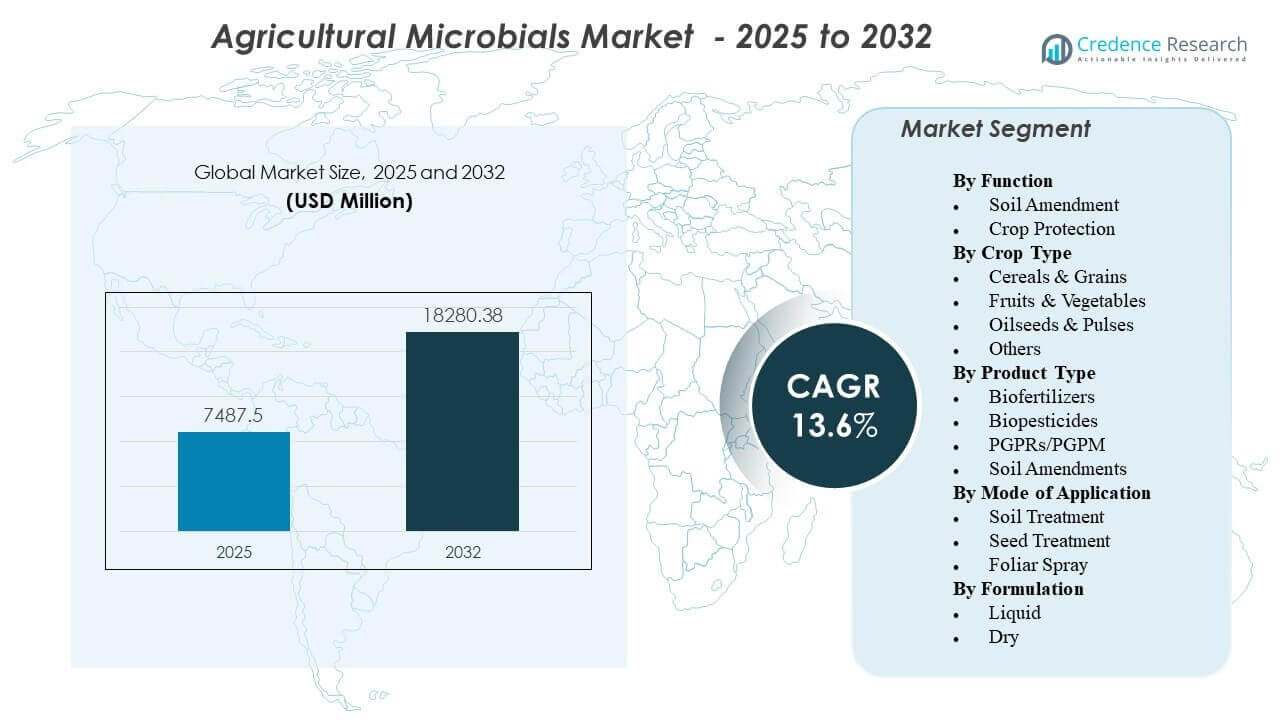
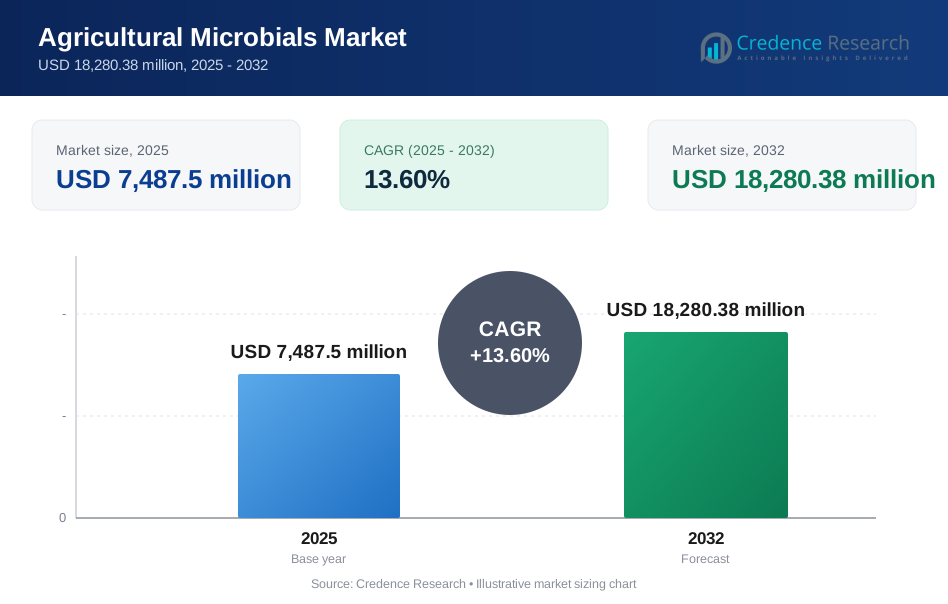
The Agricultural Microbials Market is projected to grow from USD 7,487.5 million in 2025 to USD 18,280.38 million by 2032. This reflects a compound annual growth rate (CAGR) of 13.60% from 2025 to 2032.
| REPORT ATTRIBUTE | DETAILS |
|---|---|
| Historical Period | 2020-2024 |
| Base Year | 2025 |
| Forecast Period | 2026-2032 |
| Agricultural Microbials Market Size 2025 | USD 7,487.5 million |
| Agricultural Microbials Market, CAGR | 13.60% |
| Agricultural Microbials Market Size 2032 | USD 18,280.38 million |
Growth in the Agricultural Microbials Market stems from rising demand for sustainable crop protection and nutrient management.
Agricultural Microbials Market Insights:
- North America holds about 32% of the market, Europe around 28%, and Asia-Pacific roughly 25%, supported by strict pesticide regulations, strong distribution networks, and advanced advisory and R&D ecosystems.
- Asia-Pacific, with an estimated 25% share, is the fastest-growing region, driven by expanding horticulture, supportive government programs for bioinputs, and rising focus on soil health and residue-compliant production.
- By product type, biopesticides account for around 40% of the market, followed by biofertilizers at approximately 30%, with PGPRs/PGPM and soil amendments together representing about 30% on the strength of soil health and stress-tolerance needs.
- By function, crop protection microbials represent roughly 60% of demand, while soil amendment solutions account for about 40%, reflecting a balanced focus on pest and disease control alongside long-term soil productivity.
Agricultural Microbials Market Drivers:
Rising Demand For Sustainable And Eco-Friendly Crop Protection Inputs
The Agricultural Microbials Market gains momentum as growers seek safer inputs that reduce chemical residues on food and in soil. Farmers respond to retailer and exporter pressure for residue compliance by shifting toward microbial biofertilizers and biopesticides. They want solutions that protect yields while keeping maximum residue limits comfortably below regulatory thresholds. Governments support this shift through policies that favor biological registration, shorten approval timelines, and restrict high-risk synthetic molecules. Certification bodies for organic and integrated production standards endorse microbial products, which encourages wider adoption across fruits, vegetables, and field crops. Input suppliers position microbial portfolios as key tools for climate-smart agriculture that maintains yield under stress. This narrative aligns stakeholder interests from regulators to food brands around biological alternatives. It strengthens long-term demand for new microbial strains that deliver consistent performance under farm conditions.
- For instance, Bayer AG has utilized its biological fungicide Serenade® to help growers meet strict European export standards, as the product is exempt from Maximum Residue Limit (MRL) requirements and has demonstrated the ability to maintain zero-day pre-harvest intervals while controlling diseases like Botrytis.
Supportive Regulatory Frameworks And Environmental Policies Across Key Agricultural Economies
The Agricultural Microbials Market benefits from regulatory reforms that limit the use of certain synthetic pesticides and encourage safer biological alternatives. Authorities in major farming regions roll out action plans for soil health, biodiversity protection, and groundwater quality, which favor microbials. These frameworks include stricter re-registration reviews for conventional chemistry and streamlined evaluation routes for biological products. Governments promote integrated pest management, where microbial solutions play a central role alongside cultural and mechanical practices. Subsidy schemes and public extension programs sometimes include biofertilizers and biostimulants in recommended input packages. Policy makers highlight microbials in national targets for emission reduction and sustainable intensification. This support improves investor confidence in biological platforms and encourages long-term capacity expansion. It gives manufacturers clearer visibility on compliance requirements and speeds up product portfolios tailored to local regulations.
- For instance, Corteva Agriscience accelerated the launch of its biological portfolio in the EU following the "Farm to Fork" strategy, which aims for a 50% reduction in the use of chemical pesticides by 2030, facilitating the rapid registration of its BlueN™ nitrogen-fixation nutrient manager.
Advances In Strain Discovery Formulation Technology And Delivery Systems
The Agricultural Microbials Market advances through rapid innovation in strain discovery, formulation science, and application technology. Research teams use genomics and high-throughput screening to identify microbial candidates with improved efficacy under stress conditions. Formulators design encapsulation systems and carriers that protect sensitive organisms from ultraviolet exposure and desiccation. These innovations extend product shelf life, improve storage stability, and make logistics easier for distributors. Application technology supports precise delivery through seed treatments, fertigation, and foliar sprays that fit existing farm equipment. Compatibility with common tank-mix partners improves adoption because growers can integrate microbials into current spray schedules. Companies validate performance through multi-location field trials that reflect variable soil types and climates. It helps build agronomist confidence and supports the positioning of microbials as reliable tools rather than experimental inputs.
Rising Focus On Yield Stability Profitability And Resistance Management For Farmers
The Agricultural Microbials Market expands as farmers look for tools that stabilize yields and protect farm profitability under volatile conditions. Biological products help manage resistance pressure that builds up against repeatedly used synthetic modes of action. Growers combine microbials with reduced chemical doses to maintain control levels while protecting beneficial organisms. This approach supports long-term field productivity and delays resistance development in insect, disease, and weed populations. Microbial biofertilizers and biostimulants improve nutrient use efficiency, which reduces input costs for fertilizers. Stronger root systems and improved stress tolerance help crops withstand drought, salinity, and temperature extremes. Retailers and food companies reward suppliers that demonstrate sustainable practices backed by traceable input records. It creates a commercial incentive for farmers to integrate microbials into standard agronomy programs across diverse cropping systems.
Agricultural Microbials Market Trends:
Expansion Of Integrated Biological Platforms And Hybrid Input Portfolios By Major Suppliers
The Agricultural Microbials Market shows a clear trend toward integrated biological platforms offered by multinational crop input companies. Large suppliers combine microbials with seed traits, conventional crop protection, and digital advisory tools in bundled solutions. These platforms allow farmers to access biological seed treatments, in-furrow inoculants, and foliar biofungicides through a single channel. Companies use cross-selling strategies where existing chemical portfolios help introduce microbial lines into established customer bases. Product teams design program-based recommendations where each crop stage links to specific microbial interventions. Distributors promote season-long packages that include biologicals for planting, vegetative growth, and harvest quality. This integration supports higher adoption because growers see microbials within a complete agronomic program, not as stand-alone products. It drives recurring demand and encourages continuous upgrade cycles as new strains reach the market.
- For instance, Syngenta’s VAYANTIS® fungicide seed treatment, based on the active ingredient picarbutrazox, is designed to protect corn and soybean seedlings against key Pythium species and support stronger early-season stand establishment under high disease pressure. It delivers improved and more consistent protection compared with older oomycete seed treatment chemistries, helping growers secure uniform emergence in challenging soil and weather conditions.
Shifting Focus Toward Specialty Crops High-Value Horticulture And Protected Cultivation Systems
The Agricultural Microbials Market increasingly targets high-value horticultural crops and protected cultivation systems such as greenhouses and net houses. Growers in these segments face strict residue limits and premium quality standards that push demand for biological tools. Microbials support fruit firmness, color development, and shelf life, which matter for export markets and retail branding. Protected cultivation provides controlled environments where microbial products often deliver more consistent results. Suppliers design crop-specific programs for berries, grapes, greenhouse vegetables, and ornamentals with tailored microbial consortia. These programs help producers meet buyer protocols that emphasize reduced synthetic inputs and sustainability certifications. Adoption in such high-margin crops demonstrates the value of microbials and builds strong reference cases. It encourages gradual expansion into broad-acre crops where growers expect proof of return on investment before large-scale adoption.
- For instance, BASF SE has deployed its Velifer® biological insecticide in greenhouse operations, where it achieves up to 90% suppression of thrips and whiteflies, allowing growers to reduce chemical interventions during the sensitive flowering stage.
Growing Use Of Digital Platforms Data Analytics And Prescription-Based Biological Applications
The Agricultural Microbials Market aligns with the wider digitalization of agriculture through data-driven prescription tools. Precision agriculture platforms integrate soil data, weather information, and crop health maps to identify zones that benefit most from microbial use. Variable-rate application maps enable targeted placement of biofertilizers and biopesticides on specific field areas. Digital scouting and remote sensing help detect early disease pressure where microbial solutions can act preventively. Some suppliers link microbial programs with farm management software that records application history and performance outcomes. These records support traceability demands from buyers and help fine-tune product recommendations each season. Decision-support tools simplify complex choices around timing, dosage, and compatibility with other inputs. It enhances user confidence and increases the probability that microbial interventions deliver measurable agronomic and economic gains.
Rising Industry Consolidation Partnerships And Licensing Deals In The Biologicals Space
The Agricultural Microbials Market experiences strong consolidation and collaboration activity among established agrochemical firms and specialized biological companies. Major players acquire niche microbial developers to secure access to proprietary strains and formulation know-how. Licensing deals allow regional firms to commercialize global microbial technologies under local brands. Strategic alliances between input manufacturers and biotech start-ups shorten the pathway from laboratory discovery to field-scale launch. Venture capital flows into microbial platforms that show scalable manufacturing and regulatory readiness. Co-development agreements between seed companies and biological firms create combined seed-microbial solutions. Distributors and cooperatives also enter partnership models to secure differentiated biological portfolios for their networks. It accelerates innovation diffusion and creates a more structured competitive landscape where validated technologies reach farmers faster.
Agricultural Microbials Market Challenges Analysis:
Variability In Field Performance Regulatory Complexity And Shelf-Life Constraints For Microbial Products
The Agricultural Microbials Market faces significant challenges linked to variable field performance and complex regulatory pathways. Microbial efficacy often depends on soil type, climate, crop variety, and farm practices, which leads to inconsistent results across regions. Growers may lose confidence when trial plots do not match promotional expectations. Regulatory frameworks for biologicals remain fragmented across countries, with differing data requirements and evaluation criteria. Registration timelines can still be long for multi-strain products or novel modes of action. Shelf-life limitations and sensitivity to storage conditions pose further obstacles for distributors and retailers. Cold-chain needs or strict handling guidelines increase logistics costs in remote rural markets. It forces manufacturers to invest heavily in advocacy, education, and technical support to sustain adoption momentum.
Low Awareness Limited Technical Know-How And Fragmented Distribution In Emerging Farming Regions
The Agricultural Microbials Market also struggles with low awareness and limited technical expertise in many emerging agricultural regions. Smallholder farmers may not fully understand how microbials differ from conventional chemicals in mode of action and application timing. Misuse, poor storage, or incorrect mixing practices reduce product performance and reinforce skepticism. Extension services and dealer networks sometimes lack clear training on biologicals, so advice in the field may be inconsistent. Fragmented distribution channels make it difficult for companies to maintain quality control from factory to farm. Counterfeit or substandard products can enter informal markets and damage category reputation. Price sensitivity among growers slows adoption when microbials appear more expensive per unit than generic chemicals. It creates a need for targeted demonstration plots, farmer education campaigns, and robust stewardship programs.
Agricultural Microbials Market Opportunities:
Rising Potential In Emerging Economies High-Value Export Chains And Regenerative Farming Models
The Agricultural Microbials Market holds strong opportunity in emerging economies where governments promote sustainable intensification and export growth. Growers of fruits, vegetables, coffee, cocoa, and spices face strict buyer protocols that favor biological input use. Microbials can help these producers meet residue standards while preserving quality attributes valued in premium markets. Regenerative farming and carbon-focused projects also create space for microbial solutions that support soil health restoration. Financial institutions and food brands explore incentive schemes linked to sustainable practices that include biological adoption. Local manufacturing and contract fermentation facilities lower costs and improve supply reliability in high-potential regions. It enables regional champions to scale microbial portfolios tailored to local crops and agro-climatic conditions.
Innovation In Stress-Tolerant Strains Tailored Consortia And Complementary Digital Advisory Services
The Agricultural Microbials Market gains further opportunity from innovation in stress-tolerant strains and tailored microbial consortia. Research teams focus on solutions that enhance crop resilience to drought, salinity, and temperature extremes. Customized consortia for specific crops and soil types can address multiple constraints at once. Integration with digital advisory tools and decision-support platforms improves timing and placement of applications. Partnerships with seed companies, irrigation providers, and equipment manufacturers create bundled solutions. These integrated offers make adoption easier for farmers and strengthen loyalty to specific brands. It positions microbials as essential components of next-generation, data-driven, and climate-smart agronomy systems.
Agricultural Microbials Market Segmentation Analysis:
By Function
The Agricultural Microbials Market structures its core offerings around soil amendment and crop protection functions. Soil amendment solutions enhance soil structure, nutrient cycling, and microbial balance to support long-term fertility. Crop protection microbials target diseases, insects, and nematodes while helping reduce reliance on synthetic chemistry. Farmers use soil amendments to build resilient root zones and maintain productivity under climate stress. Crop protection products fit naturally into integrated pest management strategies. Together, these functions form complementary pillars within sustainable agronomy programs. For instance, UPL Ltd.’s Zeba, a corn-starch-based soil amendment, can absorb over 400 times its weight in water and helps improve soil moisture retention and microbiome health in drought-prone fields.
- For instance, UPL Ltd., through its Natural Plant Protection (NPP) business, offers Zeba®, a biodegradable starch-based soil amendment capable of absorbing up to 400 times its weight in water, helping improve soil moisture retention in drought-prone fields.
By Crop Type
The Agricultural Microbials Market serves cereals and grains, fruits and vegetables, oilseeds and pulses, and other specialty crops. Cereals and grains contribute major volume because of large planted areas and growing focus on soil health. Fruits and vegetables drive higher value per hectare, where strict residue standards push rapid microbial adoption. Oilseeds and pulses rely on microbials to support nitrogen fixation and manage soil-borne diseases. Specialty crops such as coffee, cocoa, spices, and ornamentals use microbials to secure quality traits and shelf life. Different crop systems require tailored microbial programs aligned with local agronomy practices. It encourages suppliers to design crop-specific packages supported by field data.
- For instance, Novozymes (part of Novonesis) developed the Optimize® technology for soybean crops, a dual-action seed treatment that combines LCO (Lipo-chitooligosaccharide) technology with Bradyrhizobium to increase nodulation by up to 20% compared to standard inoculants.
By Product Type
Within product type, the Agricultural Microbials Market groups offerings into biofertilizers, biopesticides, PGPRs/PGPM, and soil amendments. Biofertilizers improve nutrient use efficiency and support nitrogen, phosphorus, and micronutrient availability. Biopesticides provide biological alternatives for insect, disease, and nematode control within integrated pest management. PGPRs and PGPM promote root growth, nutrient uptake, and stress tolerance through rhizosphere interactions. Soil amendments improve water retention, structure, and microbial habitat. Companies frequently combine these product types into consortia that address multiple constraints in one application. It strengthens the perceived value of microbial programs and supports repeat usage across seasons.
By Mode Of Application
The Agricultural Microbials Market relies on soil treatment, seed treatment, and foliar spray as key application modes. Soil treatments rebuild degraded soils, enhance root-zone biology, and support long-season effects. Seed treatments place microbes directly on the seed, ensuring early colonization and targeted delivery at germination. Foliar sprays provide flexible in-season tools for disease suppression and stress mitigation. Growers often integrate multiple modes within a crop program to cover different growth stages and risks. Mode selection reflects crop type, equipment availability, and labor constraints at farm level. It supports highly customized programs that match local production realities. For instance, Novozymes’ Optimize XC soybean inoculant combines Bradyrhizobium japonicum with LCO technology and has been shown to deliver up to twice the rate of early nodulation compared with rhizobia alone, strengthening seed-applied microbial performance.
By Formulation
Formulation segmentation in the Agricultural Microbials Market centers on liquid and dry formats that meet different operational needs. Liquid formulations integrate easily into fertigation and foliar spray systems, providing uniform coverage and straightforward handling. These formats suit high-value horticulture and protected cultivation where applicators already use liquid inputs. Dry formulations, including powders and granules, offer longer shelf life and greater tolerance to temperature fluctuations. They work well for seed treatment and in-furrow applications at planting. Distributors favor dry products where cold-chain infrastructure is limited or costly. Farmers evaluate formulation choice against equipment compatibility, storage conditions, and application frequency. It drives continuous innovation in carriers and stabilizers to protect microbial viability while simplifying on-farm use.
Segmentation:
By Function
- Soil Amendment
- Crop Protection
By Crop Type
- Cereals & Grains
- Fruits & Vegetables
- Oilseeds & Pulses
- Others
By Product Type
- Biofertilizers
- Biopesticides
- PGPRs/PGPM
- Soil Amendments
By Mode of Application
- Soil Treatment
- Seed Treatment
- Foliar Spray
By Formulation
- Liquid
- Dry
By Region
- North America
- U.S.
- Canada
- Mexico
- Europe
- Germany
- France
- U.K.
- Italy
- Spain
- Rest of Europe
- Asia Pacific
- China
- Japan
- India
- South Korea
- South-east Asia
- Rest of Asia Pacific
- Latin America
- Brazil
- Argentina
- Rest of Latin America
- Middle East & Africa
- GCC Countries
- South Africa
- Rest of the Middle East and Africa
Regional Analysis:
North America And Europe Establish Early Leadership Through Regulation And Technology Adoption
North America holds the largest share of the [ Agricultural Microbials Market ], at around NA%, supported by strong awareness of biological inputs and advanced distribution networks. Farmers adopt microbials quickly to comply with residue rules from retailers and processors. Large growers integrate biofertilizers and biopesticides into precision agriculture systems and digital farm platforms. Presence of leading multinationals and active start-ups sustains product innovation pipelines. Europe accounts for about EU% of the global market, driven by strict pesticide regulations and Green Deal sustainability targets. Widespread organic farming and integrated pest management frameworks favor biological solutions across key crops. It benefits from strong policy support, mature advisory networks, and coordinated industry initiatives.
Asia-Pacific Emerges As Fastest-Growing Region With Intensifying Horticulture And Policy Support
Asia-Pacific represents roughly APAC% of the [ Agricultural Microbials Market ] and stands out as the fastest-growing region. High adoption in fruits, vegetables, and plantation crops underpins this share. Governments in India, China, and Southeast Asian countries promote biofertilizers and biopesticides through subsidies and extension programs. Farmers seek to improve soil health and reduce dependence on imported synthetic inputs. Expanding protected cultivation and drip irrigation systems support more precise microbial use. Local manufacturers scale fermentation capacity and improve distribution into semi-urban and rural belts. It gains momentum as export-focused growers align with international residue and sustainability requirements.
Latin America And Middle East Africa Offer Strong Upside Through Export Crops And Soil Health Programs
Latin America captures around LATAM% share of the [ Agricultural Microbials Market ], anchored by Brazil, Argentina, and Mexico. Producers of soybeans, sugarcane, coffee, and fruits use microbials to support nitrogen fixation, disease control, and soil resilience. Strong export orientation encourages compliance with global sustainability and residue standards. Middle East and Africa together hold nearly MEA% share, with growth driven by soil restoration and water efficiency goals. Governments and development agencies promote biological inputs in cereals, pulses, and horticulture under climate stress. Distribution gaps and lower awareness still limit penetration in some smallholder segments. It nevertheless shows rising demand where large farms and export clusters invest in regenerative and climate-smart practices.
Key Player Analysis:
- BASF SE
- Bayer AG / CropScience
- Corteva Agriscience
- Syngenta Group
- UPL Ltd.
Competitive Analysis:
The [ Agricultural Microbials Market ] features intense competition among global agrochemical majors and specialized biologicals companies that scale dedicated microbial portfolios. Leading players such as BASF, Bayer, Corteva, Syngenta, and UPL expand biofertilizer, biopesticide, and biostimulant lines through internal R&D and targeted acquisitions. Many competitors integrate microbials into broader crop solutions that combine seeds, traits, chemicals, and digital tools. This approach strengthens farmer loyalty and raises switching costs. Regional companies and start-ups compete through localized strains, lower price points, and strong agronomist networks. Intellectual property around strains, formulations, and consortia design remains a key differentiator. It pushes firms to invest heavily in field trials, registration dossiers, and technical support services. Distributors and cooperatives increasingly favor suppliers with proven performance data and consistent supply reliability.
Recent Developments:
- In January 2026, UPL Ltd. received approval for new agrochemical and biological registrations following the 468th RC meeting, reinforcing its position in the Indian agri-input market. The company continues to see rising adoption of its seed treatment and biological solutions among Indian farmers as an alternative to traditional chemical methods. Earlier, in August 2025, UPL launched the new herbicide 'Brucia' for maize, integrating it into its broader sustainable agriculture technology portfolio that emphasizes precision nutrient and microbial application.
- In October 2025, Corteva Agriscience announced a major strategic shift to separate its business into two independent public companies by the second half of 2026. One entity, named "New Corteva," will focus exclusively on crop protection with a primary emphasis on biologicals, which remains one of the company's fastest-growing segments. This move follows a strong performance in the first half of 2025, where Corteva reported an 8% increase in volume driven specifically by high demand for new biological and fungicide products.
- In February 2025, Syngenta Group significantly strengthened its global leadership in the biologicals sector by acquiring natural products and genetic strain assets from Novartis. This acquisition was paired with the inauguration of a new production facility in South Carolina, USA, designed to accelerate the transition to sustainable farming practices. In November 2025, Syngenta partnered with Amoeba SA to commercialize a breakthrough bio-fungicide for the UK and EU, utilizing single-celled microorganisms to protect cereal crops from fungal diseases.
Report Coverage:
The research report offers an in-depth analysis based on Function, Crop Type, Product Type, Mode of Application, Formulation, and Region. It details leading market players, providing an overview of their business, product offerings, investments, revenue streams, and key applications. Additionally, the report includes insights into the competitive environment, SWOT analysis, current market trends, as well as the primary drivers and constraints. Furthermore, it discusses various factors that have driven market expansion in recent years. The report also explores market dynamics, regulatory scenarios, and technological advancements that are shaping the industry. It assesses the impact of external factors and global economic changes on market growth. Lastly, it provides strategic recommendations for new entrants and established companies to navigate the complexities of the market.
Future Outlook:
- Demand for microbials will rise with stricter residue norms and retailer requirements for safer crop inputs.
- Biological portfolios will integrate more tightly with seeds, traits, and digital decision-support tools.
- Innovation will focus on stress-tolerant strains and microbial consortia for challenging agro-climates.
- Seed treatment and in-furrow microbial applications will gain share over stand-alone foliar products.
- Local manufacturing and regional fermentation hubs will expand in high-growth emerging markets.
- Regulatory frameworks for biologicals will become more harmonized, shortening approval cycles in key regions.
- Demonstration farms and outcome-based advisory models will strengthen farmer confidence in microbials.
- Partnerships between multinationals and local specialists will accelerate tailored product development.
- Carbon and soil health programs will position microbials as core tools in regenerative agriculture projects.
- Consolidation will continue, with acquisitions focused on proprietary strains, formulation technologies, and data platforms.
Request a Free Sample
Fill in your details and we'll send you a free sample report.
- Sample data tables & charts
- Research methodology
Need a Custom Version of This Report?
Tailor the scope, geography, or segments to your exact requirements.
- Custom geography or segment scope
- Direct access to our analyst team
Frequently Asked Questions
What is the current market size for Agricultural Microbials Market, and what is its projected size in 2032?
At what Compound Annual Growth Rate is the Agricultural Microbials Market projected to grow between 2025 and 2032?
Which Agricultural Microbials Market segment held the largest share in 2025?
What are the primary factors fueling the growth of the Agricultural Microbials Market?
Who are the leading companies in the Agricultural Microbials Market?
Which region commanded the largest share of the Agricultural Microbials Market in 2025?
Table of Content
Chapter 1. Report Introduction
- 1.1 Report Description & Purpose
- 1.1.1 Report Title & Market Definition
- 1.1.2 Unique Selling Propositions (USP) & Key Differentiators
- 1.1.3 Value Proposition for Stakeholders
- 1.2 Research Objectives
- 1.2.1 Market Sizing Objectives (Volume & Revenue)
- 1.2.2 Segmentation Objectives
- 1.2.3 Competitive Intelligence Objectives
- 1.2.4 Forecast & Scenario Objectives
- 1.3 Report Scope
- 1.3.1 Agricultural Microbials Scope – Types & Subtypes Covered
- 1.3.2 Geographic Scope – Regions & Countries Covered
- 1.3.3 Historical Period, Base Year & Forecast Period (2025; forecast to 2032)
- 1.3.4 Inclusions & Exclusions
- 1.4 HS Code & Classification Framework
- 1.5 Currency, Units & Pricing Basis
- 1.6 Target Stakeholders
- 1.7 Limitations & Assumptions
Chapter 2. Executive Summary
- 2.1 Global Agricultural Microbials Market Snapshot
- 2.1.1 Market Size – Historical (2025) & Forecast (2025-2032) (2025: USD 7,487.5 million → 2032: USD 18,280.38 million)
- 2.1.2 Volume & Revenue – Global Totals
- 2.1.3 Key Market Highlights – Top Five Facts
- 2.2 Agricultural Microbials Market Segmentation Snapshot
- 2.2.1 Market Split by Region – 2025 vs. 2032
- 2.3 Competitive Snapshot
- 2.3.1 Top 10 Players by Revenue Share – 2025
- 2.3.2 Top 10 Players by Volume Share – 2025
- 2.3.3 Recent Strategic Developments (18-Month Summary)
- 2.4 Key Investment Highlights & Strategic Conclusions
Chapter 3. Agricultural Microbials Market Dynamics & Industry Analysis
- 3.1 Market Overview & Context
- 3.1.1 Agricultural Microbials Market Position in the Broader Automotive Value Chain
- 3.1.2 OEM vs. Replacement Market Dynamics
- 3.1.3 Market Maturity & Development Stage by Region
- 3.2 Agricultural Microbials Market Drivers
- 3.3 Agricultural Microbials Market Restraints & Challenges
- 3.4 Agricultural Microbials Market Opportunities
- 3.5 Porter's Five Forces Analysis
- 3.5.1 Threat of New Entrants
- 3.5.2 Bargaining Power of Suppliers
- 3.5.3 Bargaining Power of Buyers
- 3.5.4 Threat of Substitutes
- 3.5.5 Competitive Rivalry – Intensity Assessment
- 3.6 Agricultural Microbials Value Chain Analysis
- 3.6.1 Upstream – Raw Material/Input Suppliers
- 3.6.1.1 Raw Material/Input 1
- 3.6.1.2 Raw Material/Input 2
- 3.6.1.3 Raw Material/Input 3
- 3.6.2 Midstream – Production/Manufacturing/Service Delivery
- 3.6.2.1 Production/Process Overview
- 3.6.2.2 Key Facility Locations & Capacity by Manufacturer
- 3.6.3 Downstream – Distribution & End Consumer
- 3.6.3.1 Primary Channel – B2B/OEM
- 3.6.3.2 Secondary Channels – Dealer, Retail, Online, Direct
- 3.6.4 Value Chain Profitability Analysis
- 3.6.1 Upstream – Raw Material/Input Suppliers
- 3.7 PESTEL Analysis
- 3.7.1 Political Factors
- 3.7.2 Economic Factors
- 3.7.3 Social Factors
- 3.7.4 Technological Factors
- 3.7.5 Environmental Factors
- 3.7.6 Legal Factors
- 3.8 Agricultural Microbials Supply Chain Analysis
- 3.8.1 Raw Material/Input Supply Risk Assessment
- 3.8.2 Manufacturing Concentration Risk (Geographic Exposure)
- 3.8.3 Trade Disruption Impact Analysis
- 3.9 Regulatory & Policy Landscape
Note: The regulatory and policy landscape section covers regulations based on their applicability to the market, Agricultural Microbials category, geography, and scope of the study. Only regulatory frameworks with a material impact on operations, compliance, trade, sustainability, or market access are analyzed in detail.
Chapter 4. Key Investment Pockets & Opportunity Analysis
- 4.1 Agricultural Microbials Market Attractiveness Analysis
- 4.1.1 By Region – Investment Attractiveness Matrix (Volume × CAGR)
- 4.2 Absolute Revenue Growth Opportunity
- 4.2.1 By Region – Absolute USD Growth Through 2032
- 4.3 Incremental Volume Opportunity
- 4.3.1 By Region – Incremental Volume Through 2032
- 4.3.2 Segment – Incremental Volume
- 4.4 Emerging Submarket Opportunity Deep Dive (Subject to Applicability)
- 4.5 Emerging Market Opportunity Scorecards
- 4.5.1 United States
- 4.5.2 Europe
- 4.5.3 Asia
- 4.5.4 Middle East & Africa
Note: Emerging Market Opportunity Scorecards will be included based on relevance and strategic importance. Regions listed are indicative and may vary depending on data availability and market dynamics.
Chapter 5. Agricultural Microbials Import-Export Analysis & Trade Flows
- 5.1 Global Trade Overview
- 5.1.1 Global Export Value by Country (2025)
- 5.1.2 Global Export Volume by Country (2025)
- 5.1.3 Global Import Value by Country (2025)
- 5.1.4 Global Import Volume by Country (2025)
- 5.1.5 Net Trade Balance by Country (2025)
- 5.2 Export Analysis – Segment
- 5.2.1 Type 1 (HS Code)
- 5.2.2 Type 2 (HS Code)
- 5.2.3 Type 3 (HS Code)
- 5.2.4 Type 4 (HS Code)
- 5.2.5 Type 5 (HS Code)
- 5.3 Import Analysis – Segment
- 5.3.1 Type 1 (HS Code)
- 5.3.2 Type 2 (HS Code)
- 5.3.3 Type 3 (HS Code)
- 5.3.4 Type 4 (HS Code)
- 5.3.5 Type 5 (HS Code)
- 5.4 Average Unit Trade Prices
- 5.4.1 Average Export Price – Segment & Country
- 5.4.2 Average Import Price – Segment & Source Country
- 5.4.3 Price Trends (2025)
- 5.5 Key Trade Route Analysis
- 5.5.1 Trade Route 1
- 5.5.2 Trade Route 2
- 5.5.3 Trade Route 3
- 5.5.4 Trade Route 4
- 5.5.5 Trade Route 5
- 5.6 Trade Policy Impact Assessment
- 5.6.1 US Anti-Dumping & Section 301 Tariffs
- 5.6.2 EU Customs Union Impact
- 5.6.3 Major Free Trade Agreements
- 5.6.4 USMCA Rules of Origin
Note: Trade policy analysis will be included only where relevant to the Agricultural Microbials market.
Chapter 6. Competitive Landscape & Company Benchmarking
- 6.1 Agricultural Microbials Market Concentration & Structure
- 6.1.1 Herfindahl-Hirschman Index (HHI) – vs. 2025
- 6.1.2 Tier 1, Tier 2 & Tier 3 Market Structure
- 6.1.3 Global, Regional & Local Player Dynamics
- 6.2 Agricultural Microbials Market Share Analysis – 2025
- 6.2.1 Global Revenue Share by Company
- 6.2.2 Global Volume Share by Company
- 6.2.3 Regional Revenue Share
- 6.2.4 Market Share Evolution ( vs. 2025)
- 6.2.5 OEM Segment Share by Company
- 6.2.6 Replacement Segment Share by Company
- 6.3 Production/Delivery Capacity & Facility Analysis
- 6.3.1 Global Installed Capacity
- 6.3.2 Capacity Utilization Rates
- 6.3.3 Production/Output Volume
- 6.3.4 Facility Locations & Capacity Map
- 6.3.5 Planned Capacity Additions
- 6.4 Agricultural Microbials Competitive Benchmarking Matrix
- 6.4.1 Revenue, Volume, CAGR & Profitability Comparison
- 6.4.2 Channel Revenue Mix
- 6.4.3 Geographic Revenue Exposure
- 6.4.4 R&D Intensity
- 6.4.5 Sustainability Maturity
- 6.5 Strategic Developments in Agricultural Microbials (Last 24 Months)
- 6.5.1 Mergers, Acquisitions & Divestments
- 6.5.2 New Agricultural Microbials Launches
- 6.5.3 Facility Expansions
- 6.5.4 Strategic Alliances, Joint Ventures & Partnerships
- 6.5.5 Distribution Expansion & Market Entry
- 6.5.6 Sustainability & ESG Initiatives
- 6.6 Competitive Strategy Mapping
- 6.6.1 Leader, Challenger, Follower & Niche Classification
- 6.6.2 Pricing Strategy Comparison
- 6.6.3 Channel Strategy Matrix
Note: Strategic developments are included based on their materiality and the availability of reliable information.
Chapter 7. Global Agricultural Microbials Market – By Distribution Channel
- 7.1 Segment Overview
- 7.1.1 Volume & Revenue Split by Channel (2025 & 2032)
- 7.1.2 Channel Mix Evolution (2025-2032)
Chapter 8. Regional Market Analysis – Global Overview
- 8.1 Global Regional Overview
- 8.1.1 Regional Volume Share
- 8.1.2 Regional Revenue Share
- 8.1.3 Regional Volume by Region
- 8.1.4 Regional Revenue by Region
- 8.1.5 Regional Forecast Through 2032
- 8.2 Cross-Regional Segment Analysis
- 8.2.1 By Distribution Channel
- 8.2.2 By Brand/Price Tier
Chapter 9. North America Agricultural Microbials Market
- 9.1 United States
- 9.2 Canada
- 9.3 Mexico
Chapter 10. Europe Agricultural Microbials Market
- 10.1 Germany
- 10.2 France
- 10.3 Italy
- 10.4 United Kingdom
- 10.5 Spain
- 10.6 Poland
- 10.7 Russia
- 10.8 Netherlands
- 10.9 Belgium
- 10.10 Sweden
- 10.11 Denmark
- 10.12 Norway
- 10.13 Rest of Europe
Chapter 11. Asia Pacific Agricultural Microbials Market
- 11.1 China
- 11.2 India
- 11.3 Japan
- 11.4 South Korea
- 11.5 Thailand
- 11.6 Indonesia
- 11.7 Vietnam
- 11.8 Malaysia
- 11.9 Australia
- 11.10 Rest of Asia Pacific
Chapter 12. Latin America Agricultural Microbials Market
- 12.1 Brazil
- 12.2 Argentina
- 12.3 Colombia
- 12.4 Chile
- 12.5 Rest of Latin America
Chapter 13. Middle East Agricultural Microbials Market
- 13.1 Saudi Arabia
- 13.2 United Arab Emirates
- 13.3 Turkey
- 13.4 Israel
- 13.5 Iran
- 13.6 Rest of the Middle East
Chapter 14. Africa Agricultural Microbials Market
- 14.1 South Africa
- 14.2 Egypt
- 14.3 Nigeria
- 14.4 Morocco
- 14.5 Rest of Africa
Chapter 15. Agricultural Microbials Company Profiles
- 15.1 [Company 01]
- 15.1.1 Company Overview
- 15.1.2 Key Management Personnel
- 15.1.3 Products & Services Portfolio
- 15.1.4 Financial Performance
- 15.1.5 Key Market Focus & Geographic Presence
- 15.1.6 Recent Developments & Strategic Initiatives
Note: The company profile list is preliminary and may change based on research findings, market developments, data availability, and client requirements.
Chapter 16. Appendices
- Appendix A – List of Abbreviations & Acronyms
- Appendix B – Industry Classification Code Reference – Full Series
- Appendix C – Production & Capacity Data Tables
- Appendix D – End-Use & Demand Base Tables
- Appendix E – Consumption & Replacement Rate Assumptions
- Appendix F – ASP Reference Tables
- Appendix G – Manufacturing & Facility Database
- Appendix H – Import-Export Data Tables
- Appendix I – Regulatory Summary Tables
- Appendix J – Primary Research Participant List (Anonymized)
- Appendix K – Primary Research Questionnaire Framework
- Appendix L – Data Sources & Bibliography
- Appendix M – Market Size Divergence & Source Comparison
Chapter 17. Research Methodology
- 17.1 Research Framework & Philosophy
- 17.2 Secondary Research – Sources, Hierarchy & Data Extraction
- 17.3 Data Modeling – Bottom-Up & Top-Down Market Sizing
- 17.4 Primary Research – Stakeholder Framework, LOI & Sample Sizes
- 17.5 Forecast Methodology – Regression, Scenario & Sensitivity Analysis
- 17.6 Quality Control – Four-Layer Validation Framework
- 17.7 Limitations & Standard Assumptions
- 17.8 Disclaimer
