
Agricultural Pyrethroids Market Overview:
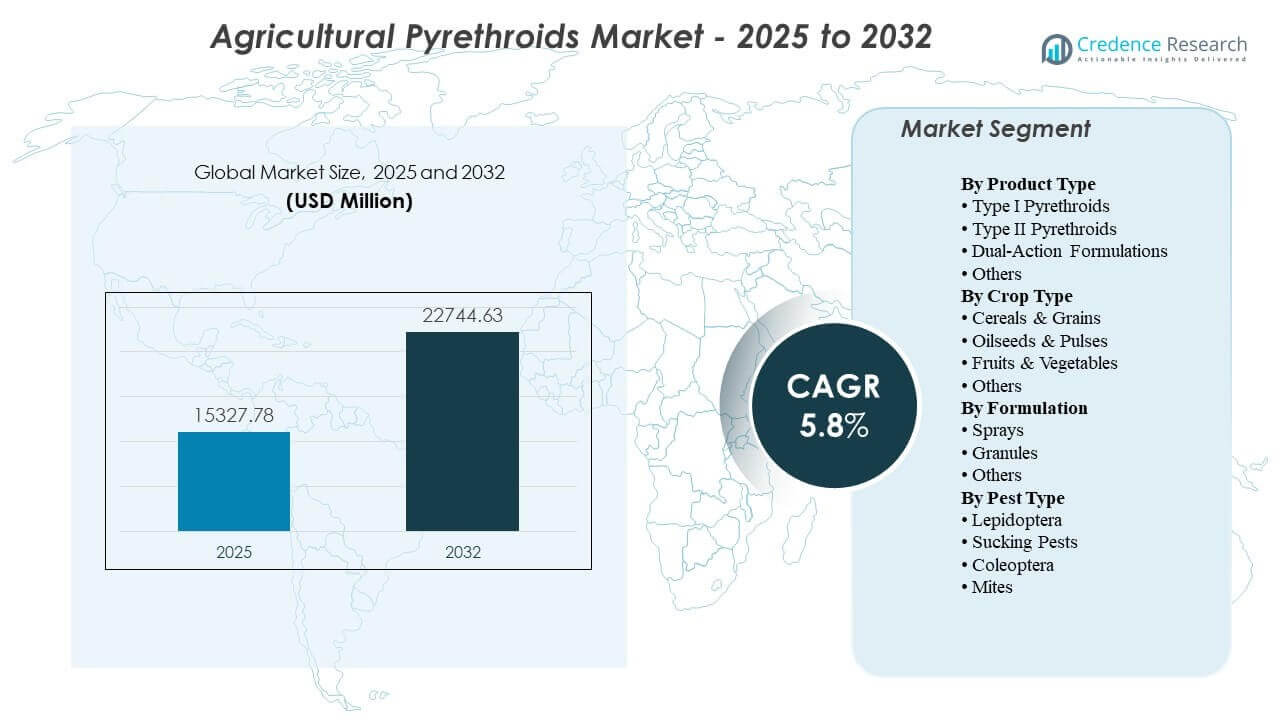
The Agricultural Pyrethroids Market is projected to grow from USD 15,327.78 million in 2025 to an estimated USD 22,744.63 million by 2032, with a compound annual growth rate (CAGR) of 5.8% from 2025 to 2032.
| REPORT ATTRIBUTE | DETAILS |
|---|---|
| Historical Period | 2020-2024 |
| Base Year | 2025 |
| Forecast Period | 2026-2032 |
| Agricultural Pyrethroids Market Size 2025 | USD 15,327.78 million |
| Agricultural Pyrethroids Market, CAGR | 5.8% |
| Agricultural Pyrethroids Market Size 2032 | USD 22,744.63 million |
Agricultural Pyrethroids Market Insights:
- Strong demand arises from fast-action pest control needs, expanding pest pressure, and the preference for broad-spectrum solutions across cereals, oilseeds, and high-value horticulture.
- Market restraints emerge from rising regulatory scrutiny, environmental concerns, and increasing insect resistance, which push manufacturers toward improved formulations and stewardship programs.
- Asia Pacific leads market expansion due to large agricultural acreage and high pest intensity, while North America and Europe maintain stable adoption within structured pest management systems.
- Growth potential strengthens in emerging regions where smallholder farmers adopt pyrethroids to protect yield stability under unpredictable pest outbreaks.
Agricultural Pyrethroids Market Drivers
Rising Crop Losses Due to Expanding Pest Pressure and Climate Variability
Farmers face higher pest pressure due to warmer temperatures that support longer breeding cycles. The shift in weather patterns helps invasive species enter new regions. Growers increase pyrethroid adoption to protect crops that show higher vulnerability under volatile conditions. The Agricultural Pyrethroids Market benefits from this demand shift because pyrethroids deliver strong knockdown effects. It supports farmers who require fast action during peak infestation periods. Many growers choose these solutions when other chemical groups fail due to resistance issues. Strong field performance keeps pyrethroids important for large-scale cultivation. Governments highlight yield protection goals that reinforce their use.
Increasing Demand for High-Yield Production Systems Across Diverse Crop Categories
Countries with rising food demand promote intensive farming that needs reliable pest control inputs. It helps growers maintain harvest stability across grains, fruits, and vegetables. Many high-yield crops face rapid pest multiplication that drives reliance on fast-acting insecticides. The Agricultural Pyrethroids Market gains attention because pyrethroids support heavy field loads without complex application cycles. Farmers use them to secure production in regions that lack wide alternative options. Many producers invest in timely interventions to avoid financial loss from untreated outbreaks. Strong user familiarity improves responsible application in commercial farms. Expanding acreage in emerging economies pushes steady product flow.
Growing Preference for Broad-Spectrum Insect Control to Reduce Multi-Product Dependency
Farmers attempt to cut the number of pesticides used per season to reduce input complexity. Pyrethroids meet this need because they target a wide range of destructive insects. The Agricultural Pyrethroids Market supports growers who need flexible solutions for mixed farming zones. It helps streamline pest control plans that often include multiple crops grown together. Broad-spectrum impact lowers labor requirements linked to repeated product switches. Farmers trust these solutions due to stable field data and regulatory clarity. Wide adoption supports uniform crop protection standards in developing regions. Improving stewardship training pushes safer and more efficient product use.
- For instance, UPL Limitedstreamlined pest management for Indian cotton farmers by deploying Cypermethrin blends that effectively control over 30 different species of sucking and chewing pests with a single application, reducing field entry frequency by 20%.
Strengthening Adoption in Integrated Pest Management Due to Faster Action Requirements
Integrated pest programs now include more rapid-response tools to handle sudden pest outbreaks. Pyrethroids offer quick effects that support these programs during peak infestations. The Agricultural Pyrethroids Market aligns with field strategies that combine monitoring, thresholds, and timely sprays. It helps growers react before pest levels reach economic injury points. Faster suppression helps limit secondary crop infections triggered by insect feeding. Many extension agencies recommend rotational use to reduce resistance buildup. Adoption grows in outdoor farming that faces unpredictable pest surges. Strong compatibility with existing equipment improves field-level convenience.
- For instance, Bayer CropScienceintegrated Decis (Deltamethrin) into IPM protocols for European cereals, where its rapid action successfully reduced the transmission of Barley Yellow Dwarf Virus (BYDV) by neutralizing aphid vectors in under 5 minutes post-contact.
Agricultural Pyrethroids Market Trends
Expansion of Formulation Advancements to Improve Stability, Coverage, and User Safety
Manufacturers focus on new formulations that enhance leaf coverage and reduce drift. Improved emulsifiable and microencapsulated forms deliver stronger field consistency. The Agricultural Pyrethroids Market sees greater interest in products that improve adhesion under variable climates. It supports farmers who seek stable performance during rain or strong sunlight. New delivery systems help reduce user exposure during handling steps. Many companies invest in advanced surfactants that extend residual control. Wide testing programs validate these benefits across diverse crop types. Innovation supports compliance with updated safety requirements in major markets.
- For instance, Syngenta developed Zeon Technology for its lambda-cyhalothrin products, utilizing quick-release microcapsules that are 2.5 micrometres in diameter, which significantly improves UV stability and provides rainfastness within 60 minutes of application.
Rising Use of Digital Tools and Precision Platforms to Optimize Application Efficiency
Many growers use remote sensing and AI-driven scouting to improve insect detection. These tools help identify infestation zones that require focused treatment. The Agricultural Pyrethroids Market integrates with platforms that support precise spray volumes. It assists growers who plan targeted interventions rather than uniform coverage. Decision tools help reduce overuse that increases resistance pressure. Digital mapping platforms guide farmers toward optimized nozzle settings. Precision systems gain wide acceptance in commercial farms with complex field layouts. Adoption grows in regions that support digital farming incentives.
Increasing Shift Toward Resistance Management Strategies Within Commercial Farming Systems
Growers adopt structured rotation plans to protect long-term product effectiveness. These plans include switching across chemical classes to delay resistance. The Agricultural Pyrethroids Market plays a role in rotation cycles due to rapid knockdown actions. It offers farmers an important tool when pressure peaks during key crop stages. Many training programs teach growers how to combine cultural practices with timed sprays. Resistance monitoring networks share data that guide treatment windows. Farmers adjust schedules based on emerging field patterns. Responsible use frameworks support long-term sustainability across regions.
- For instance, BASF SE incorporates alpha-cypermethrin into its "Fastac" rotation protocols, which are engineered to manage the Diamondback moth; field trials in these structured programs have demonstrated a 30% reduction in the development of metabolic resistance compared to continuous, non-rotated pyrethroid use.
Wider Penetration in Smallholder Farming Segments Through Low-Cost and Accessible Products
Small farms in developing regions favor products that offer strong control at accessible price points. Many smallholders choose pyrethroids because they need fast solutions with familiar application methods. The Agricultural Pyrethroids Market expands in these areas due to growing awareness programs. It helps users improve crop security with minimal technical complexity. Low-dose options meet safety expectations in sensitive rural communities. Retail networks support wide distribution in remote districts. User training groups guide farmers on correct mixing and spray intervals. Strong adoption helps strengthen food supply chains in rural zones.
Agricultural Pyrethroids Market Challenges Analysis
Escalating Regulatory Pressure and Environmental Concerns Across Major Agricultural Regions
Regulators tighten rules that govern toxicity, residue limits, and water contamination risks. Many countries reassess older active ingredients due to ecosystem impact concerns. The Agricultural Pyrethroids Market faces scrutiny because runoff can affect aquatic species. It requires manufacturers to redesign formulations that reduce drift and improve containment. Farmers worry about potential bans that limit available tools for high-pressure seasons. Compliance costs rise due to expanded testing and reporting needs. Advocacy groups push for stricter oversight backed by environmental data. Market players adjust strategies to meet evolving global requirements.
Rapid Growth of Insecticide Resistance in Key Crop Pests Across Commercial Farming Zones
Resistance spreads faster in regions that depend on repeated pyrethroid use. It reduces the strength of solutions that once delivered strong control. The Agricultural Pyrethroids Market responds with stewardship programs that guide rotation and timing. It helps delay resistance buildup through structured field practices. Farmers struggle when resistant pests damage crops despite timely sprays. Research groups invest in monitoring networks to track resistance shifts. Many growers require better advisory systems to manage outbreaks. Market participants emphasize integrated tools to support long-term control.
Agricultural Pyrethroids Market Opportunities
Rising Global Push for Sustainable Farming Inputs That Balance Yield Protection and Safety Standards
Many countries promote solutions that improve farm productivity while meeting strict residue norms. New-generation pyrethroid formulations support these goals with improved precision and lower drift. The Agricultural Pyrethroids Market benefits from demand for safer profiles in large food-exporting regions. It enables growers to meet premium-market requirements without complex application changes. Interest grows in products that work well with biologicals in integrated programs. Manufacturers explore eco-friendlier additives that improve environmental behavior. Retailers promote stewardship guidelines that boost trust among growers. Growth potential strengthens where sustainability rules tighten.
Growing Demand for Reliable Pest Control in Expanding Horticulture and High-Value Crop Segments
Fruit and vegetable farms require strong protection due to higher sensitivity to pest damage. These crops face rapid spoilage when infestations rise during peak growth stages. The Agricultural Pyrethroids Market targets this segment due to the need for quick suppression. It helps growers maintain produce quality for export and domestic retail chains. Many horticulture regions rely on pyrethroids because they deliver predictable results under tight harvest cycles. Rising greenhouse farming creates new demand for controlled-use products. Companies explore solutions tailored to pest profiles in protected cultivation. The segment offers strong growth due to rising premium food demand.
Agricultural Pyrethroids Market Segmentation Analysis:
By Product Type
The product type structure in the Agricultural Pyrethroids Market reflects varied performance needs across crop protection programs. Type I options support quick knockdown where rapid suppression is important for early-stage infestations. Type II products offer longer residual action that helps growers maintain extended coverage in high-pressure zones. Dual-action formulations gain traction because they support broader pest control in mixed cropping systems. Other product categories remain useful in regions that depend on legacy chemistry to manage diverse field conditions. Farmers choose each type based on crop cycles, climate patterns, and pest severity. Many producers integrate multiple product classes across the season. The segment remains balanced due to continuous field demand.
- For instance, BASF SE’s Alpha-Cypermethrin (a Type II pyrethroid) is engineered to provide high lipophilicity, which allows the compound to bind to the insect cuticle and maintain 90% efficacy for up to 14 days after application, significantly outlasting standard Type I alternatives.
By Crop Type
Crop type segmentation highlights broad adoption across cereals, oilseeds, and high-value fruits and vegetables in the Agricultural Pyrethroids Market. Cereals and grains depend on pyrethroids to protect yield stability during peak pest periods. Oilseeds and pulses require strong protection due to fast pest reproduction during early growth. Fruits and vegetables need fast-acting solutions that maintain quality standards for retail and export markets. Other crop groups use these products to support routine field protection under shifting pest cycles. Farmers align product choice with crop sensitivity and harvest timelines. It supports flexible application strategies across diverse agricultural zones. The segment maintains steady expansion in high-intensity farming regions.
- For instance, FMC Corporation’s Talstar (Bifenthrin) has been documented in cotton cultivation to protect against yield loss by controlling over 75 different pest species, resulting in a recorded retention of 200–300 lbs of additional lint per acre compared to untreated control plots.
By Formulation
Formulation preferences in the Agricultural Pyrethroids Market center on ease of use and field performance. Sprays dominate due to wide compatibility with standard farm equipment and uniform coverage across large fields. Granules support targeted soil-level pest control where crop roots face higher exposure. Other formats serve specialty needs in localized pest management. Farmers select formulations based on crop structure, infestation stage, and labor availability. Many producers rely on sprays for speed during urgent field conditions. It helps maintain consistent application across varying acreage sizes. The segment stays flexible to meet changing field requirements.
By Pest Type
Pest type segmentation in the Agricultural Pyrethroids Market covers strong control needs for Lepidoptera, sucking pests, coleoptera, and mites. Lepidoptera outbreaks drive high usage due to heavy feeding damage during early growth. Sucking pests require quick intervention to prevent virus transmission in sensitive crops. Coleoptera management depends on fast suppression to reduce yield loss in staple crops. Mite issues rise under warm climates where rapid population growth affects crop vigor. Farmers choose targeted solutions based on pest biology and field patterns. It helps optimize application timing and frequency. The segment remains important for growers facing diverse pest pressures.
Segmentation:
By Product Type
- Type I Pyrethroids
- Type II Pyrethroids
- Dual-Action Formulations
- Others
By Crop Type
- Cereals & Grains
- Oilseeds & Pulses
- Fruits & Vegetables
- Others
By Formulation
- Sprays
- Granules
- Others
By Pest Type
- Lepidoptera
- Sucking Pests
- Coleoptera
- Mites
By Region
- North America
- U.S.
- Canada
- Mexico
- Europe
- Germany
- France
- U.K.
- Italy
- Spain
- Rest of Europe
- Asia Pacific
- China
- Japan
- India
- South Korea
- South-east Asia
- Rest of Asia Pacific
- Latin America
- Brazil
- Argentina
- Rest of Latin America
- Middle East & Africa
- GCC Countries
- South Africa
- Rest of the Middle East and Africa
Regional Analysis:
North America holds a strong share in the Agricultural Pyrethroids Market due to large-scale farming, structured pest management programs, and steady adoption across cereals and specialty crops. The region benefits from strict stewardship guidelines that support responsible product use. Farmers depend on pyrethroids during peak pest cycles when rapid action is required. Broad acreage in the United States leads demand growth, while Canada maintains a stable contribution. Regulatory frameworks guide product rotation to protect long-term field performance. It supports high adoption in integrated pest management programs. The region continues to secure a leading position due to strong commercial farming strength.
Europe maintains a significant share driven by advanced agricultural practices, high-value crop cultivation, and the need for fast-action insect control. Growers favor pyrethroids where alternative biological options deliver limited control under high pest pressure. The Agricultural Pyrethroids Market in Europe benefits from structured field monitoring systems that support timely treatments. Southern countries record higher seasonal consumption due to warmer climates that support rapid pest growth. Northern regions apply these products more selectively within regulated chemical-use frameworks. It remains a controlled yet relevant market due to balanced adoption across diverse crops. Market share remains stable despite rising regulatory scrutiny.
Asia Pacific holds the largest share due to extensive agricultural land, high pest intensity, and strong reliance on chemical pest control in emerging economies. Farmers in India and China use pyrethroids widely to protect cereals, vegetables, and oilseeds under heavy infestation cycles. The Agricultural Pyrethroids Market benefits from rapid expansion in horticulture and smallholder farming. Southeast Asian growers depend on these solutions to handle unpredictable pest movements linked to climate shifts. Local manufacturing supports competitive pricing and wide availability. It strengthens regional dominance through deep rural penetration. The region continues to expand faster than other global markets.
Key Player Analysis:
- BASF SE
- Bayer AG
- Syngenta AG
- FMC Corporation
- UPL Limited
- Nufarm Limited
- Corteva Agriscience
- Sumitomo Chemical
- DuPont
- SinoHarvest Corporation
- Arysta LifeScience
- Cheminova
- Monsanto
- Adama Agricultural Solutions
- AMVAC Chemical Corporation
Competitive Analysis:
The Agricultural Pyrethroids Market includes global chemical producers and regional manufacturers that compete on formulation quality, active ingredient range, and distribution reach. Leading companies invest in new-generation formulations that improve stability, reduce drift, and support compliance with evolving safety standards. Competitors strengthen portfolios with Type I and Type II pyrethroids to meet diverse crop and pest requirements. Strong R&D pipelines focus on resistance management to help growers sustain long-term field performance. It drives adoption of integrated solutions that align with modern farming practices. Regional players compete through price efficiency and tailored products for local pest patterns. Global firms maintain advantage through established regulatory approvals and large-scale supply capabilities.
Recent Developments:
- In January 2026, BASF Agricultural Solutions agreed to acquire AgBiTech, a biological insect control company specializing in nucleopolyhedrovirus technology for crops like corn and soybeans, from Paine Schwartz Partners. The deal, announced on January 13, aims to strengthen BASF's biologicals portfolio in Brazil, with closure expected in the first half of 2026 pending regulatory approval.
Report Coverage:
The research report offers an in-depth analysis based on Product Type, Crop Type, Formulation, Pest Type, and Region. It details leading market players, providing an overview of their business, product offerings, investments, revenue streams, and key applications. Additionally, the report includes insights into the competitive environment, SWOT analysis, current market trends, as well as the primary drivers and constraints. Furthermore, it discusses various factors that have driven market expansion in recent years. The report also explores market dynamics, regulatory scenarios, and technological advancements that are shaping the industry. It assesses the impact of external factors and global economic changes on market growth. Lastly, it provides strategic recommendations for new entrants and established companies to navigate the complexities of the market.
Future Outlook:
- The Agricultural Pyrethroids Market is expected to grow steadily as farmers use fast-acting solutions for reliable pest control across different climates.
- Demand will increase in intensive farming regions where repeated pest attacks require simple and dependable chemical treatments.
- Product development will focus on improved formulations that deliver better leaf coverage and reduce spray drift in changing field conditions.
- Integration with digital and precision farming tools will support accurate application and help reduce resistance risks in multi-crop systems.
- Adoption in high-value fruits and vegetables will expand because growers need quick insect control within short harvest periods.
- Resistance management programs will influence product rotation and support long-term field effectiveness.
- Emerging economies will drive higher demand as smallholder farmers increase usage to protect crops during sudden pest outbreaks.
- Regulatory changes will encourage cleaner product profiles and improved environmental performance.
- Market consolidation will increase as leading companies invest in advanced chemistry and stronger distribution networks.
- The market will remain relevant despite growth in biological alternatives, due to consistent performance during peak pest pressure.
Request a Free Sample
Fill in your details and we'll send you a free sample report.
- Sample data tables & charts
- Research methodology
Need a Custom Version of This Report?
Tailor the scope, geography, or segments to your exact requirements.
- Custom geography or segment scope
- Direct access to our analyst team
Frequently Asked Questions
What is the current market size for Agricultural Colorants Market, and what is its projected size in 2032?
At what Compound Annual Growth Rate is the Agricultural Colorants Market projected to grow between 2025 and 2032?
Which Agricultural Colorants Market segment held the largest share in 2025?
What are the primary factors fueling the growth of the Agricultural Colorants Market?
Who are the leading companies in the Agricultural Colorants Market?
Which region commanded the largest share of the Agricultural Colorants Market in 2025?
Table of Content
Chapter 1. Report Introduction
- 1.1 Report Description & Purpose
- 1.1.1 Report Title & Market Definition
- 1.1.2 Unique Selling Propositions (USP) & Key Differentiators
- 1.1.3 Value Proposition for Stakeholders
- 1.2 Research Objectives
- 1.2.1 Market Sizing Objectives (Volume & Revenue)
- 1.2.2 Segmentation Objectives
- 1.2.3 Competitive Intelligence Objectives
- 1.2.4 Forecast & Scenario Objectives
- 1.3 Report Scope
- 1.3.1 Agricultural Pyrethroids Scope – Types & Subtypes Covered
- 1.3.2 Geographic Scope – Regions & Countries Covered
- 1.3.3 Historical Period, Base Year & Forecast Period (2025; forecast to 2032)
- 1.3.4 Inclusions & Exclusions
- 1.4 HS Code & Classification Framework
- 1.5 Currency, Units & Pricing Basis
- 1.6 Target Stakeholders
- 1.7 Limitations & Assumptions
Chapter 2. Executive Summary
- 2.1 Global Agricultural Pyrethroids Market Snapshot
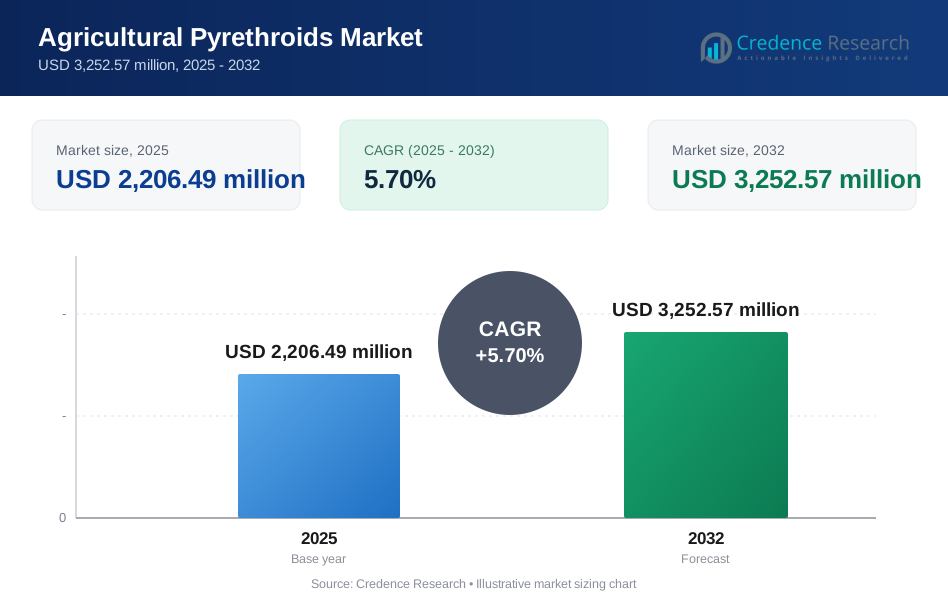
- 2.1.1 Market Size – Historical (2025) & Forecast (2025-2032) (2025: USD 2,206.49 million → 2032: USD 3,252.57 million)
- 2.1.2 Volume & Revenue – Global Totals
- 2.1.3 Key Market Highlights – Top Five Facts
- 2.2 Agricultural Pyrethroids Market Segmentation Snapshot
- 2.2.1 Market Split by Region – 2025 vs. 2032
- 2.3 Competitive Snapshot
- 2.3.1 Top 10 Players by Revenue Share – 2025
- 2.3.2 Top 10 Players by Volume Share – 2025
- 2.3.3 Recent Strategic Developments (18-Month Summary)
- 2.4 Key Investment Highlights & Strategic Conclusions
Chapter 3. Agricultural Pyrethroids Market Dynamics & Industry Analysis
- 3.1 Market Overview & Context
- 3.1.1 Agricultural Pyrethroids Market Position in the Broader Automotive Value Chain
- 3.1.2 OEM vs. Replacement Market Dynamics
- 3.1.3 Market Maturity & Development Stage by Region
- 3.2 Agricultural Pyrethroids Market Drivers
- 3.3 Agricultural Pyrethroids Market Restraints & Challenges
- 3.4 Agricultural Pyrethroids Market Opportunities
- 3.5 Porter's Five Forces Analysis
- 3.5.1 Threat of New Entrants
- 3.5.2 Bargaining Power of Suppliers
- 3.5.3 Bargaining Power of Buyers
- 3.5.4 Threat of Substitutes
- 3.5.5 Competitive Rivalry – Intensity Assessment
- 3.6 Agricultural Pyrethroids Value Chain Analysis
- 3.6.1 Upstream – Raw Material/Input Suppliers
- 3.6.1.1 Raw Material/Input 1
- 3.6.1.2 Raw Material/Input 2
- 3.6.1.3 Raw Material/Input 3
- 3.6.2 Midstream – Production/Manufacturing/Service Delivery
- 3.6.2.1 Production/Process Overview
- 3.6.2.2 Key Facility Locations & Capacity by Manufacturer
- 3.6.3 Downstream – Distribution & End Consumer
- 3.6.3.1 Primary Channel – B2B/OEM
- 3.6.3.2 Secondary Channels – Dealer, Retail, Online, Direct
- 3.6.4 Value Chain Profitability Analysis
- 3.6.1 Upstream – Raw Material/Input Suppliers
- 3.7 PESTEL Analysis
- 3.7.1 Political Factors
- 3.7.2 Economic Factors
- 3.7.3 Social Factors
- 3.7.4 Technological Factors
- 3.7.5 Environmental Factors
- 3.7.6 Legal Factors
- 3.8 Agricultural Pyrethroids Supply Chain Analysis
- 3.8.1 Raw Material/Input Supply Risk Assessment
- 3.8.2 Manufacturing Concentration Risk (Geographic Exposure)
- 3.8.3 Trade Disruption Impact Analysis
- 3.9 Regulatory & Policy Landscape
Note: The regulatory and policy landscape section covers regulations based on their applicability to the market, Agricultural Pyrethroids category, geography, and scope of the study. Only regulatory frameworks with a material impact on operations, compliance, trade, sustainability, or market access are analyzed in detail.
Chapter 4. Key Investment Pockets & Opportunity Analysis
- 4.1 Agricultural Pyrethroids Market Attractiveness Analysis
- 4.1.1 By Region – Investment Attractiveness Matrix (Volume × CAGR)
- 4.2 Absolute Revenue Growth Opportunity
- 4.2.1 By Region – Absolute USD Growth Through 2032
- 4.3 Incremental Volume Opportunity
- 4.3.1 By Region – Incremental Volume Through 2032
- 4.3.2 Segment – Incremental Volume
- 4.4 Emerging Submarket Opportunity Deep Dive (Subject to Applicability)
- 4.5 Emerging Market Opportunity Scorecards
- 4.5.1 United States
- 4.5.2 Europe
- 4.5.3 Asia
- 4.5.4 Middle East & Africa
Note: Emerging Market Opportunity Scorecards will be included based on relevance and strategic importance. Regions listed are indicative and may vary depending on data availability and market dynamics.
Chapter 5. Agricultural Pyrethroids Import-Export Analysis & Trade Flows
- 5.1 Global Trade Overview
- 5.1.1 Global Export Value by Country (2025)
- 5.1.2 Global Export Volume by Country (2025)
- 5.1.3 Global Import Value by Country (2025)
- 5.1.4 Global Import Volume by Country (2025)
- 5.1.5 Net Trade Balance by Country (2025)
- 5.2 Export Analysis – Segment
- 5.2.1 Type 1 (HS Code)
- 5.2.2 Type 2 (HS Code)
- 5.2.3 Type 3 (HS Code)
- 5.2.4 Type 4 (HS Code)
- 5.2.5 Type 5 (HS Code)
- 5.3 Import Analysis – Segment
- 5.3.1 Type 1 (HS Code)
- 5.3.2 Type 2 (HS Code)
- 5.3.3 Type 3 (HS Code)
- 5.3.4 Type 4 (HS Code)
- 5.3.5 Type 5 (HS Code)
- 5.4 Average Unit Trade Prices
- 5.4.1 Average Export Price – Segment & Country
- 5.4.2 Average Import Price – Segment & Source Country
- 5.4.3 Price Trends (2025)
- 5.5 Key Trade Route Analysis
- 5.5.1 Trade Route 1
- 5.5.2 Trade Route 2
- 5.5.3 Trade Route 3
- 5.5.4 Trade Route 4
- 5.5.5 Trade Route 5
- 5.6 Trade Policy Impact Assessment
- 5.6.1 US Anti-Dumping & Section 301 Tariffs
- 5.6.2 EU Customs Union Impact
- 5.6.3 Major Free Trade Agreements
- 5.6.4 USMCA Rules of Origin
Note: Trade policy analysis will be included only where relevant to the Agricultural Pyrethroids market.
Chapter 6. Competitive Landscape & Company Benchmarking
- 6.1 Agricultural Pyrethroids Market Concentration & Structure
- 6.1.1 Herfindahl-Hirschman Index (HHI) – vs. 2025
- 6.1.2 Tier 1, Tier 2 & Tier 3 Market Structure
- 6.1.3 Global, Regional & Local Player Dynamics
- 6.2 Agricultural Pyrethroids Market Share Analysis – 2025
- 6.2.1 Global Revenue Share by Company
- 6.2.2 Global Volume Share by Company
- 6.2.3 Regional Revenue Share
- 6.2.4 Market Share Evolution ( vs. 2025)
- 6.2.5 OEM Segment Share by Company
- 6.2.6 Replacement Segment Share by Company
- 6.3 Production/Delivery Capacity & Facility Analysis
- 6.3.1 Global Installed Capacity
- 6.3.2 Capacity Utilization Rates
- 6.3.3 Production/Output Volume
- 6.3.4 Facility Locations & Capacity Map
- 6.3.5 Planned Capacity Additions
- 6.4 Agricultural Pyrethroids Competitive Benchmarking Matrix
- 6.4.1 Revenue, Volume, CAGR & Profitability Comparison
- 6.4.2 Channel Revenue Mix
- 6.4.3 Geographic Revenue Exposure
- 6.4.4 R&D Intensity
- 6.4.5 Sustainability Maturity
- 6.5 Strategic Developments in Agricultural Pyrethroids (Last 24 Months)
- 6.5.1 Mergers, Acquisitions & Divestments
- 6.5.2 New Agricultural Pyrethroids Launches
- 6.5.3 Facility Expansions
- 6.5.4 Strategic Alliances, Joint Ventures & Partnerships
- 6.5.5 Distribution Expansion & Market Entry
- 6.5.6 Sustainability & ESG Initiatives
- 6.6 Competitive Strategy Mapping
- 6.6.1 Leader, Challenger, Follower & Niche Classification
- 6.6.2 Pricing Strategy Comparison
- 6.6.3 Channel Strategy Matrix
Note: Strategic developments are included based on their materiality and the availability of reliable information.
Chapter 7. Global Agricultural Pyrethroids Market – By Distribution Channel
- 7.1 Segment Overview
- 7.1.1 Volume & Revenue Split by Channel (2025 & 2032)
- 7.1.2 Channel Mix Evolution (2025-2032)
Chapter 8. Regional Market Analysis – Global Overview
- 8.1 Global Regional Overview
- 8.1.1 Regional Volume Share
- 8.1.2 Regional Revenue Share
- 8.1.3 Regional Volume by Region
- 8.1.4 Regional Revenue by Region
- 8.1.5 Regional Forecast Through 2032
- 8.2 Cross-Regional Segment Analysis
- 8.2.1 By Distribution Channel
- 8.2.2 By Brand/Price Tier
Chapter 9. North America Agricultural Pyrethroids Market
- 9.1 United States
- 9.2 Canada
- 9.3 Mexico
Chapter 10. Europe Agricultural Pyrethroids Market
- 10.1 Germany
- 10.2 France
- 10.3 Italy
- 10.4 United Kingdom
- 10.5 Spain
- 10.6 Poland
- 10.7 Russia
- 10.8 Netherlands
- 10.9 Belgium
- 10.10 Sweden
- 10.11 Denmark
- 10.12 Norway
- 10.13 Rest of Europe
Chapter 11. Asia Pacific Agricultural Pyrethroids Market
- 11.1 China
- 11.2 India
- 11.3 Japan
- 11.4 South Korea
- 11.5 Thailand
- 11.6 Indonesia
- 11.7 Vietnam
- 11.8 Malaysia
- 11.9 Australia
- 11.10 Rest of Asia Pacific
Chapter 12. Latin America Agricultural Pyrethroids Market
- 12.1 Brazil
- 12.2 Argentina
- 12.3 Colombia
- 12.4 Chile
- 12.5 Rest of Latin America
Chapter 13. Middle East Agricultural Pyrethroids Market
- 13.1 Saudi Arabia
- 13.2 United Arab Emirates
- 13.3 Turkey
- 13.4 Israel
- 13.5 Iran
- 13.6 Rest of the Middle East
Chapter 14. Africa Agricultural Pyrethroids Market
- 14.1 South Africa
- 14.2 Egypt
- 14.3 Nigeria
- 14.4 Morocco
- 14.5 Rest of Africa
Chapter 15. Agricultural Pyrethroids Company Profiles
- 15.1 [Company 01]
- 15.1.1 Company Overview
- 15.1.2 Key Management Personnel
- 15.1.3 Products & Services Portfolio
- 15.1.4 Financial Performance
- 15.1.5 Key Market Focus & Geographic Presence
- 15.1.6 Recent Developments & Strategic Initiatives
Note: The company profile list is preliminary and may change based on research findings, market developments, data availability, and client requirements.
Chapter 16. Appendices
- Appendix A – List of Abbreviations & Acronyms
- Appendix B – Industry Classification Code Reference – Full Series
- Appendix C – Production & Capacity Data Tables
- Appendix D – End-Use & Demand Base Tables
- Appendix E – Consumption & Replacement Rate Assumptions
- Appendix F – ASP Reference Tables
- Appendix G – Manufacturing & Facility Database
- Appendix H – Import-Export Data Tables
- Appendix I – Regulatory Summary Tables
- Appendix J – Primary Research Participant List (Anonymized)
- Appendix K – Primary Research Questionnaire Framework
- Appendix L – Data Sources & Bibliography
- Appendix M – Market Size Divergence & Source Comparison
Chapter 17. Research Methodology
- 17.1 Research Framework & Philosophy
- 17.2 Secondary Research – Sources, Hierarchy & Data Extraction
- 17.3 Data Modeling – Bottom-Up & Top-Down Market Sizing
- 17.4 Primary Research – Stakeholder Framework, LOI & Sample Sizes
- 17.5 Forecast Methodology – Regression, Scenario & Sensitivity Analysis
- 17.6 Quality Control – Four-Layer Validation Framework
- 17.7 Limitations & Standard Assumptions
- 17.8 Disclaimer
