
Market Overview
The Agricultural Sensors Market is projected to grow from USD 4,150.45 Million in 2025 to an estimated USD 8,575.27 Million by 2032, with a CAGR of 12.86% from 2024 to 2032. Market growth is driven by rising adoption of precision farming tools that help growers improve input efficiency, field visibility and yield outcomes. North America leads global demand because large commercial farms, advanced farm machinery fleets and strong digital agriculture adoption support faster sensor deployment.| REPORT ATTRIBUTE | DETAILS |
|---|---|
| Historical Period: | 2020-2023 |
| Base Year | 2024 |
| Forecast Period | 2025-2032 |
| Agricultural Sensors Market Market Size 2024 | USD 4,150.45 Million |
| Agricultural Sensors Market CAGR | 12.86% |
| Agricultural Sensors Market Market Size 2032 | USD 8,575.27 Million |
Market Insights
- North America accounted for 34.8% of global revenue in 2024, supported by strong precision agriculture adoption across large-scale row crop farming.
- Soil sensors led type segmentation with an estimated 31.4% share because growers rely on root-zone data to manage irrigation, fertilization and soil health.
- Moisture sensors remained leading sensor function with 29.8% share, while precision farming led applications with 42.6% because data-led input optimization stays central to farm decisions.
- Large farms held 47.3% of end-user demand as higher capital budgets and faster return-on-investment cycles support broader deployment of connected sensing systems.
- Deere & Company, Trimble Inc., Bosch, AGCO Corporation and CropX remain prominent market participants, while multi-parameter sensing integrated with analytics platforms defines current market direction.
Market Segmentation Analysis
By Type (Soil Sensors, Climate Sensors, Water Sensors, Livestock Sensors, Others) Soil sensors held the largest percentage share of 31.4% in 2024, reflecting their central role in measuring moisture, salinity, temperature and nutrient conditions at field level. Demand remains strongest in row crops, orchards and high-value horticulture where growers need continuous root-zone visibility to improve irrigation timing, reduce fertilizer loss and support variable-rate farming programs. By Sensor Function (Moisture, Temperature, Humidity, Nutrient, pH, Optical) Moisture sensors accounted for the largest percentage share of 29.8% in 2024 because water management remains the most immediate and measurable use case for agricultural sensing. Their dominance is supported by increasing water stress, expansion of smart irrigation programs and broad compatibility with farm management platforms that translate soil moisture readings into actionable irrigation schedules. By Application (Precision Farming, Smart Irrigation, Livestock Monitoring, Greenhouse Monitoring) Precision farming led applications with a 42.6% share in 2024 as producers increasingly use sensor-driven field intelligence to guide planting, nutrient placement, crop scouting and yield optimization. Adoption is especially strong where farms combine sensors with GPS-enabled equipment, farm software and analytics tools to improve operational efficiency and input productivity across large acreages. By End-user (Large Farms, SMB Farms, Agribusiness Enterprises) Large farms captured the highest share at 47.3% in 2024 because they have stronger investment capacity, clearer labor-saving needs and greater ability to integrate sensors into mechanized production systems. These operations also benefit from scale economics, making payback periods more attractive for connected sensing networks used in irrigation, climate monitoring and field automation.Key Growth Drivers
Rising precision agriculture adoption accelerates sensor deployment Agricultural sensors are becoming foundational tools in precision farming because they convert field variability into measurable operating decisions. Growers use soil, climate and optical sensors to monitor crop conditions in real time, improve seeding accuracy and match fertilizer and water use to actual field needs. This shift is especially visible in large commercial farms where yield improvement and input control directly affect margins. Sensor adoption also rises as equipment manufacturers and software providers make field data easier to interpret through dashboards, alerts and prescription tools. Publicly available company data shows that John Deere’s Operations Center connects more than 455 million acres worldwide, illustrating how digital agronomy ecosystems are expanding and creating stronger pull-through demand for field-based sensing hardware. As more farms standardize data-led workflows, sensors move from optional monitoring devices to core operational infrastructure. Water efficiency needs strengthen demand for moisture and irrigation sensing Water scarcity, higher pumping costs and tighter water-use governance are pushing farmers toward sensor-based irrigation decisions. Moisture sensors, water flow monitoring tools and localized climate sensors help growers irrigate more precisely, reduce runoff and avoid crop stress caused by under- or over-watering. Demand is strongest in water-constrained regions and in specialty crops where irrigation timing strongly influences quality and yield. Smart irrigation systems also appeal to farms facing labor shortages because they reduce manual field checks and support automated control logic. Global agricultural water use remains a major structural driver, with international estimates showing that agriculture accounts for about 70% of freshwater withdrawals. That scale keeps pressure on growers, irrigation managers and agribusiness operators to invest in sensing tools that improve water productivity and strengthen compliance with increasingly disciplined water management practices. Need to improve farm profitability supports broader multi-parameter monitoring Farm operators are under pressure from volatile input prices, uncertain weather and tighter profitability targets, which increases demand for technologies that reduce decision risk. Agricultural sensors support this need by giving continuous insight into soil health, microclimate conditions, crop stress and livestock environments. Better monitoring helps farmers detect problems earlier, apply inputs more selectively and protect yield potential without relying only on manual scouting. Agribusiness enterprises also adopt sensing systems to standardize field performance across distributed operations and supplier networks. As sensor prices gradually ease and battery life, wireless range and software usability improve, return on investment becomes more compelling for farms that want dependable, repeatable productivity gains across seasons.Key Trends & Opportunities
Multi-parameter sensing integrates with farm analytics platforms Current market development increasingly favors connected sensing systems that combine moisture, temperature, humidity, nutrient and optical readings within single farm dashboards. Buyers now prefer platforms that move beyond raw data collection and instead provide alerts, irrigation recommendations and agronomic interpretations that fit daily farm workflows. This trend supports vendors that can link sensors with telematics, weather intelligence and mobile applications. Interoperability has become a critical purchasing criterion because farms rarely want standalone devices that create separate data silos. Publicly available U.S. irrigation survey data showed about 55.8 million acres of irrigated land, reinforcing how large irrigated crop footprints create sustained demand for integrated sensing and decision support rather than isolated measurement tools. Low-power wireless and rugged designs widen field use cases Vendors are improving sensor durability, battery life and communications performance to suit open-field farming, orchards, remote grazing areas and protected cultivation. Low-power wide-area networks, cellular modules and edge-enabled devices allow farms to deploy sensors across larger footprints with fewer maintenance visits. Buyers also increasingly favor modular systems that can scale from one field block to an enterprise-wide network. Greenhouse operators and livestock producers are adopting compact sensors that track temperature, humidity and environmental stability with minimal installation complexity. This trend strengthens demand for robust products that operate reliably under dust, moisture, heat variation and seasonal workload pressures. SMB farm penetration remains underdeveloped Small and mid-sized farms represent a significant growth opportunity because many still rely on manual monitoring or basic weather information rather than continuous field sensing. Vendors that simplify setup, offer subscription-based pricing and package analytics in clear agronomic language can unlock broader adoption in this customer group. Lower-cost sensor bundles tied to irrigation control, crop advisory services or local dealer support can make the value proposition more accessible. Markets with fragmented farm structures, rising labor costs and growing horticulture production are especially attractive for solutions that require limited technical expertise and deliver visible savings within a single season. Emerging markets can drive next wave of demand Asia Pacific, Latin America and parts of Middle East & Africa present strong headroom for growth as commercial agriculture modernizes and water management becomes more urgent. Adoption opportunities are particularly compelling in high-value export crops, greenhouse cultivation, sugarcane, cotton and large irrigated estates where sensor-led monitoring improves consistency and resource efficiency. Partnerships with irrigation suppliers, equipment dealers, telecom operators and agronomy service firms can accelerate market entry in these regions. Vendors that localize recommendations by crop type, climate pattern and language will be better positioned to convert interest into recurring deployment across diverse agricultural systems.Key Challenges
High upfront cost and unclear payback for smaller growers Agricultural sensors often require spending on devices, gateways, connectivity, software subscriptions and support services, which can slow purchasing decisions among cost-sensitive farms. Smaller operators may understand agronomic value yet still delay adoption because savings are not always immediate or easy to quantify across one crop cycle. Sales conversion becomes harder when suppliers cannot translate data outputs into direct operating gains such as reduced water use, fewer field visits or more stable yields. Connectivity gaps and data complexity limit full-scale utilization Many farms operate in areas with inconsistent cellular coverage, limited broadband access or challenging field conditions that interrupt reliable data transfer. Even when hardware performs well, growers may struggle to integrate sensor outputs with machinery platforms, irrigation controls and farm management software. Data overload also remains a practical barrier, especially where farm teams lack time or technical skills to convert multiple readings into timely field actions. These issues can reduce long-term engagement and raise customer support requirements.Regional Analysis
North America Agricultural Sensors Market Market Trends
In 2024, North America accounted for 34.8% of the global Agricultural Sensors Market. Regional demand is led by the United States and Canada, where large commercial farms adopt precision agriculture tools at scale and prioritize measurable returns from water, nutrient and labor optimization. Soil moisture, climate and optical sensors see strong use in corn, soybean, wheat, cotton and specialty crop operations. Dealer-led machinery ecosystems and digital agronomy platforms make integration easier for growers that already use connected equipment. Demand also benefits from stronger willingness to invest in subscription software, data services and automated irrigation workflows. Competition remains intense as established equipment brands, sensor specialists and software providers all target enterprise-scale farm accounts.Asia Pacific Agricultural Sensors Market Market Trends
In 2024, Asia Pacific accounted for 24.6% of the global Agricultural Sensors Market. The region combines high-volume agricultural activity with rising pressure on water efficiency, crop productivity and protected cultivation, which supports demand for moisture, humidity and greenhouse monitoring systems. Adoption patterns vary widely, with advanced use cases in Australia, Japan and parts of China, while emerging deployment grows through pilot projects, agri-tech partnerships and government-backed farm modernization efforts elsewhere. Greenhouse vegetables, orchards, rice cultivation and irrigation-intensive farming create diverse application demand. Price sensitivity remains higher than in North America and Europe, so vendors compete through modular offerings, localized service and lower-cost connectivity options. Regional growth potential remains strong because large farming populations still have limited sensor penetration.Europe Agricultural Sensors Market Market Trends
In 2024, Europe accounted for 27.1% of the global Agricultural Sensors Market. Demand is supported by strong regulatory emphasis on sustainable input use, traceability and climate-smart farming, which encourages adoption of soil, nutrient and environmental monitoring tools. Growers across Western Europe increasingly use sensors to reduce fertilizer runoff, improve irrigation scheduling and manage high-value crops in controlled environments. Greenhouse monitoring is particularly relevant in markets with advanced horticulture production, while livestock sensing sees steady uptake in dairy and animal health applications. Distribution often flows through agri-tech integrators, irrigation specialists and farm equipment partners rather than direct device-only sales. Competitive intensity is moderate to high because buyers expect interoperability, durable performance and compliance with broader digital farm management systems.Latin America Agricultural Sensors Market Market Trends
In 2024, Latin America accounted for 7.2% of the global Agricultural Sensors Market. Regional demand is concentrated in export-oriented agriculture, especially large-scale soybean, sugarcane, coffee, fruit and irrigated crop production where sensing can improve input efficiency and field consistency. Brazil and Mexico are key markets because commercial agribusiness operators are more willing to deploy field monitoring technologies across larger land areas. Water management and climate variability are major purchase drivers, supporting use of soil moisture, weather and irrigation-linked sensors. Adoption still faces constraints from uneven rural connectivity, import dependence for some technologies and sensitivity to seasonal farm income. Even so, agribusiness modernization and growing use of data-led farm management continue to expand the addressable market.Middle East & Africa Agricultural Sensors Market Market Trends
In 2024, Middle East & Africa accounted for 6.3% of the global Agricultural Sensors Market. Demand is shaped by water scarcity, controlled-environment agriculture and the need to manage crops efficiently under harsh climatic conditions. Moisture, climate and greenhouse sensors are especially relevant in Gulf markets, while parts of Africa show growing interest in affordable monitoring tools for irrigation planning and crop risk management. Deployment often depends on project-based procurement, commercial farming clusters and partnerships with irrigation system suppliers or development-led agriculture programs. Price, maintenance capability and after-sales support remain critical purchase factors because field conditions can be demanding and technical service coverage is uneven. Growth prospects are strongest where governments and commercial operators prioritize food security, protected farming and water productivity.Market Segmentations
- By Type
- Soil Sensors
- Climate Sensors
- Water Sensors
- Livestock Sensors
- Others
- By Sensor Function
- Moisture
- Temperature
- Humidity
- Nutrient
- pH
- Optical
- By Application
- Precision Farming
- Smart Irrigation
- Livestock Monitoring
- Greenhouse Monitoring
- By End-user
- Large Farms
- SMB Farms
- Agribusiness Enterprises
- By Geography
- North America
- Europe
- Asia Pacific
- Latin America
- Middle East & Africa
Competitive Landscape
The Agricultural Sensors Market features a mix of global farm equipment companies, industrial sensor suppliers and specialized agri-tech firms competing on device accuracy, platform integration and agronomic usability. Innovation focuses on multi-parameter sensing, low-power connectivity, rugged field performance and analytics that convert raw data into irrigation, nutrient and crop management actions. Product strategies increasingly center on bundled solutions that combine sensors with software, telematics and advisory tools rather than stand-alone hardware. Distribution relies on equipment dealers, irrigation partners, agri-input networks and direct enterprise sales, while partnerships with software providers and farm management platforms help expand reach and retention. Competitive intensity continues to rise as established brands leverage scale, installed farm relationships and service infrastructure, while smaller specialists differentiate through niche crop expertise, faster product iteration and flexible deployment models. Market success depends on interoperability, pricing discipline, support capability and clear proof of farm-level return on investment.Key Player Analysis
- Deere & Company
- Trimble Inc.
- Bosch
- AGCO Corporation
- Topcon Positioning Systems
- CropX
- Sensoterra
- Libelium
- Arable Labs
- Davis Instruments
- Pessl Instruments
- Teralytic
Recent Developments
In January 2025, Deere & Company expanded sensor-linked agronomic workflows within its digital farming ecosystem to improve field data integration across planting, spraying and irrigation decisions. In June 2025, CropX broadened partnerships with irrigation and farm management technology providers to strengthen closed-loop soil sensing and decision support capabilities for growers. In February 2026, Bosch advanced compact environmental sensing modules for agricultural monitoring applications, supporting lower-power deployment in greenhouse and open-field use cases.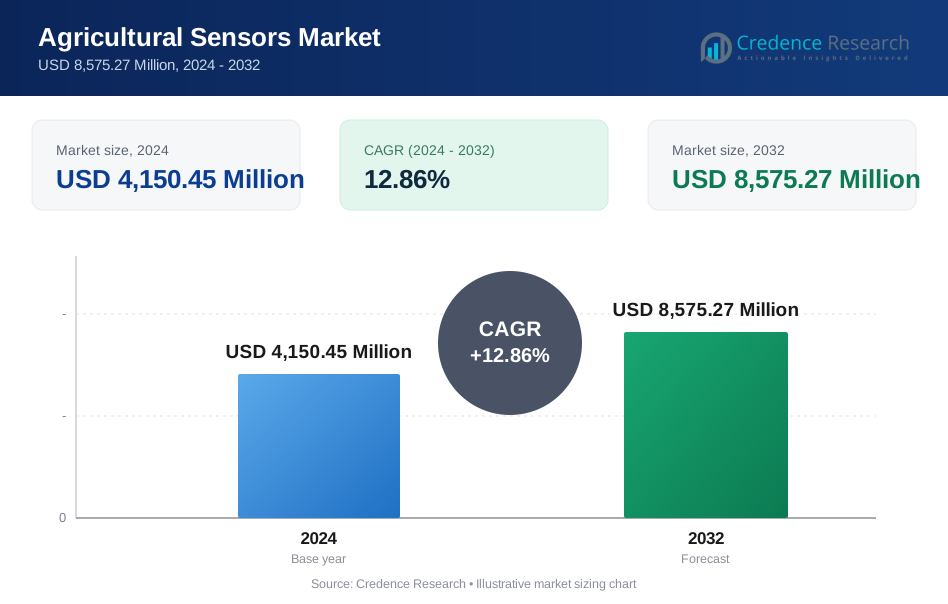
Request a Free Sample
Fill in your details and we'll send you a free sample report.
- Sample data tables & charts
- Research methodology
Need a Custom Version of This Report?
Tailor the scope, geography, or segments to your exact requirements.
- Custom geography or segment scope
- Direct access to our analyst team
Frequently Asked Questions
What is the size of the Agricultural Sensors Market?
What are the main growth drivers in the Agricultural Sensors Market?
What trends are shaping the Agricultural Sensors Market?
Which segments lead the Agricultural Sensors Market?
Who are the top players in the Agricultural Sensors Market?
Table of Content
Chapter 1. Report Introduction
- 1.1 Report Description & Purpose
- 1.1.1 Report Title & Market Definition
- 1.1.2 Unique Selling Propositions (USP) & Key Differentiators
- 1.1.3 Value Proposition for Stakeholders
- 1.2 Research Objectives
- 1.2.1 Market Sizing Objectives (Volume & Revenue)
- 1.2.2 Segmentation Objectives
- 1.2.3 Competitive Intelligence Objectives
- 1.2.4 Forecast & Scenario Objectives
- 1.3 Report Scope
- 1.3.1 Agricultural Sensors Scope – Types & Subtypes Covered
- 1.3.2 Geographic Scope – Regions & Countries Covered
- 1.3.3 Historical Period, Base Year & Forecast Period (2024; forecast to 2032)
- 1.3.4 Inclusions & Exclusions
- 1.4 HS Code & Classification Framework
- 1.5 Currency, Units & Pricing Basis
- 1.6 Target Stakeholders
- 1.7 Limitations & Assumptions
Chapter 2. Executive Summary
- 2.1 Global Agricultural Sensors Market Snapshot
- 2.1.1 Market Size – Historical (2024) & Forecast (2024-2032) (2024: USD 4,150.45 Million → 2032: USD 8,575.27 Million)
- 2.1.2 Volume & Revenue – Global Totals
- 2.1.3 Key Market Highlights – Top Five Facts
- 2.2 Agricultural Sensors Market Segmentation Snapshot
- 2.2.1 Market Split by Region – 2024 vs. 2032
- 2.3 Competitive Snapshot
- 2.3.1 Top 10 Players by Revenue Share – 2024
- 2.3.2 Top 10 Players by Volume Share – 2024
- 2.3.3 Recent Strategic Developments (18-Month Summary)
- 2.4 Key Investment Highlights & Strategic Conclusions
Chapter 3. Agricultural Sensors Market Dynamics & Industry Analysis
- 3.1 Market Overview & Context
- 3.1.1 Agricultural Sensors Market Position in the Broader Automotive Value Chain
- 3.1.2 OEM vs. Replacement Market Dynamics
- 3.1.3 Market Maturity & Development Stage by Region
- 3.2 Agricultural Sensors Market Drivers
- 3.3 Agricultural Sensors Market Restraints & Challenges
- 3.4 Agricultural Sensors Market Opportunities
- 3.5 Porter's Five Forces Analysis
- 3.5.1 Threat of New Entrants
- 3.5.2 Bargaining Power of Suppliers
- 3.5.3 Bargaining Power of Buyers
- 3.5.4 Threat of Substitutes
- 3.5.5 Competitive Rivalry – Intensity Assessment
- 3.6 Agricultural Sensors Value Chain Analysis
- 3.6.1 Upstream – Raw Material/Input Suppliers
- 3.6.1.1 Raw Material/Input 1
- 3.6.1.2 Raw Material/Input 2
- 3.6.1.3 Raw Material/Input 3
- 3.6.2 Midstream – Production/Manufacturing/Service Delivery
- 3.6.2.1 Production/Process Overview
- 3.6.2.2 Key Facility Locations & Capacity by Manufacturer
- 3.6.3 Downstream – Distribution & End Consumer
- 3.6.3.1 Primary Channel – B2B/OEM
- 3.6.3.2 Secondary Channels – Dealer, Retail, Online, Direct
- 3.6.4 Value Chain Profitability Analysis
- 3.6.1 Upstream – Raw Material/Input Suppliers
- 3.7 PESTEL Analysis
- 3.7.1 Political Factors
- 3.7.2 Economic Factors
- 3.7.3 Social Factors
- 3.7.4 Technological Factors
- 3.7.5 Environmental Factors
- 3.7.6 Legal Factors
- 3.8 Agricultural Sensors Supply Chain Analysis
- 3.8.1 Raw Material/Input Supply Risk Assessment
- 3.8.2 Manufacturing Concentration Risk (Geographic Exposure)
- 3.8.3 Trade Disruption Impact Analysis
- 3.9 Regulatory & Policy Landscape
Note: The regulatory and policy landscape section covers regulations based on their applicability to the market, Agricultural Sensors category, geography, and scope of the study. Only regulatory frameworks with a material impact on operations, compliance, trade, sustainability, or market access are analyzed in detail.
Chapter 4. Key Investment Pockets & Opportunity Analysis
- 4.1 Agricultural Sensors Market Attractiveness Analysis
- 4.1.1 By Region – Investment Attractiveness Matrix (Volume × CAGR)
- 4.2 Absolute Revenue Growth Opportunity
- 4.2.1 By Region – Absolute USD Growth Through 2032
- 4.3 Incremental Volume Opportunity
- 4.3.1 By Region – Incremental Volume Through 2032
- 4.3.2 Segment – Incremental Volume
- 4.4 Emerging Submarket Opportunity Deep Dive (Subject to Applicability)
- 4.5 Emerging Market Opportunity Scorecards
- 4.5.1 United States
- 4.5.2 Europe
- 4.5.3 Asia
- 4.5.4 Middle East & Africa
Note: Emerging Market Opportunity Scorecards will be included based on relevance and strategic importance. Regions listed are indicative and may vary depending on data availability and market dynamics.
Chapter 5. Agricultural Sensors Import-Export Analysis & Trade Flows
- 5.1 Global Trade Overview
- 5.1.1 Global Export Value by Country (2024)
- 5.1.2 Global Export Volume by Country (2024)
- 5.1.3 Global Import Value by Country (2024)
- 5.1.4 Global Import Volume by Country (2024)
- 5.1.5 Net Trade Balance by Country (2024)
- 5.2 Export Analysis – Segment
- 5.2.1 Type 1 (HS Code)
- 5.2.2 Type 2 (HS Code)
- 5.2.3 Type 3 (HS Code)
- 5.2.4 Type 4 (HS Code)
- 5.2.5 Type 5 (HS Code)
- 5.3 Import Analysis – Segment
- 5.3.1 Type 1 (HS Code)
- 5.3.2 Type 2 (HS Code)
- 5.3.3 Type 3 (HS Code)
- 5.3.4 Type 4 (HS Code)
- 5.3.5 Type 5 (HS Code)
- 5.4 Average Unit Trade Prices
- 5.4.1 Average Export Price – Segment & Country
- 5.4.2 Average Import Price – Segment & Source Country
- 5.4.3 Price Trends (2024)
- 5.5 Key Trade Route Analysis
- 5.5.1 Trade Route 1
- 5.5.2 Trade Route 2
- 5.5.3 Trade Route 3
- 5.5.4 Trade Route 4
- 5.5.5 Trade Route 5
- 5.6 Trade Policy Impact Assessment
- 5.6.1 US Anti-Dumping & Section 301 Tariffs
- 5.6.2 EU Customs Union Impact
- 5.6.3 Major Free Trade Agreements
- 5.6.4 USMCA Rules of Origin
Note: Trade policy analysis will be included only where relevant to the Agricultural Sensors market.
Chapter 6. Competitive Landscape & Company Benchmarking
- 6.1 Agricultural Sensors Market Concentration & Structure
- 6.1.1 Herfindahl-Hirschman Index (HHI) – vs. 2024
- 6.1.2 Tier 1, Tier 2 & Tier 3 Market Structure
- 6.1.3 Global, Regional & Local Player Dynamics
- 6.2 Agricultural Sensors Market Share Analysis – 2024
- 6.2.1 Global Revenue Share by Company
- 6.2.2 Global Volume Share by Company
- 6.2.3 Regional Revenue Share
- 6.2.4 Market Share Evolution ( vs. 2024)
- 6.2.5 OEM Segment Share by Company
- 6.2.6 Replacement Segment Share by Company
- 6.3 Production/Delivery Capacity & Facility Analysis
- 6.3.1 Global Installed Capacity
- 6.3.2 Capacity Utilization Rates
- 6.3.3 Production/Output Volume
- 6.3.4 Facility Locations & Capacity Map
- 6.3.5 Planned Capacity Additions
- 6.4 Agricultural Sensors Competitive Benchmarking Matrix
- 6.4.1 Revenue, Volume, CAGR & Profitability Comparison
- 6.4.2 Channel Revenue Mix
- 6.4.3 Geographic Revenue Exposure
- 6.4.4 R&D Intensity
- 6.4.5 Sustainability Maturity
- 6.5 Strategic Developments in Agricultural Sensors (Last 24 Months)
- 6.5.1 Mergers, Acquisitions & Divestments
- 6.5.2 New Agricultural Sensors Launches
- 6.5.3 Facility Expansions
- 6.5.4 Strategic Alliances, Joint Ventures & Partnerships
- 6.5.5 Distribution Expansion & Market Entry
- 6.5.6 Sustainability & ESG Initiatives
- 6.6 Competitive Strategy Mapping
- 6.6.1 Leader, Challenger, Follower & Niche Classification
- 6.6.2 Pricing Strategy Comparison
- 6.6.3 Channel Strategy Matrix
Note: Strategic developments are included based on their materiality and the availability of reliable information.
Chapter 7. Global Agricultural Sensors Market – By Distribution Channel
- 7.1 Segment Overview
- 7.1.1 Volume & Revenue Split by Channel (2024 & 2032)
- 7.1.2 Channel Mix Evolution (2024-2032)
Chapter 8. Regional Market Analysis – Global Overview
- 8.1 Global Regional Overview
- 8.1.1 Regional Volume Share
- 8.1.2 Regional Revenue Share
- 8.1.3 Regional Volume by Region
- 8.1.4 Regional Revenue by Region
- 8.1.5 Regional Forecast Through 2032
- 8.2 Cross-Regional Segment Analysis
- 8.2.1 By Distribution Channel
- 8.2.2 By Brand/Price Tier
Chapter 9. North America Agricultural Sensors Market
- 9.1 United States
- 9.2 Canada
- 9.3 Mexico
Chapter 10. Europe Agricultural Sensors Market
- 10.1 Germany
- 10.2 France
- 10.3 Italy
- 10.4 United Kingdom
- 10.5 Spain
- 10.6 Poland
- 10.7 Russia
- 10.8 Netherlands
- 10.9 Belgium
- 10.10 Sweden
- 10.11 Denmark
- 10.12 Norway
- 10.13 Rest of Europe
Chapter 11. Asia Pacific Agricultural Sensors Market
- 11.1 China
- 11.2 India
- 11.3 Japan
- 11.4 South Korea
- 11.5 Thailand
- 11.6 Indonesia
- 11.7 Vietnam
- 11.8 Malaysia
- 11.9 Australia
- 11.10 Rest of Asia Pacific
Chapter 12. Latin America Agricultural Sensors Market
- 12.1 Brazil
- 12.2 Argentina
- 12.3 Colombia
- 12.4 Chile
- 12.5 Rest of Latin America
Chapter 13. Middle East Agricultural Sensors Market
- 13.1 Saudi Arabia
- 13.2 United Arab Emirates
- 13.3 Turkey
- 13.4 Israel
- 13.5 Iran
- 13.6 Rest of the Middle East
Chapter 14. Africa Agricultural Sensors Market
- 14.1 South Africa
- 14.2 Egypt
- 14.3 Nigeria
- 14.4 Morocco
- 14.5 Rest of Africa
Chapter 15. Agricultural Sensors Company Profiles
- 15.1 [Company 01]
- 15.1.1 Company Overview
- 15.1.2 Key Management Personnel
- 15.1.3 Products & Services Portfolio
- 15.1.4 Financial Performance
- 15.1.5 Key Market Focus & Geographic Presence
- 15.1.6 Recent Developments & Strategic Initiatives
Note: The company profile list is preliminary and may change based on research findings, market developments, data availability, and client requirements.
Chapter 16. Appendices
- Appendix A – List of Abbreviations & Acronyms
- Appendix B – Industry Classification Code Reference – Full Series
- Appendix C – Production & Capacity Data Tables
- Appendix D – End-Use & Demand Base Tables
- Appendix E – Consumption & Replacement Rate Assumptions
- Appendix F – ASP Reference Tables
- Appendix G – Manufacturing & Facility Database
- Appendix H – Import-Export Data Tables
- Appendix I – Regulatory Summary Tables
- Appendix J – Primary Research Participant List (Anonymized)
- Appendix K – Primary Research Questionnaire Framework
- Appendix L – Data Sources & Bibliography
- Appendix M – Market Size Divergence & Source Comparison
Chapter 17. Research Methodology
- 17.1 Research Framework & Philosophy
- 17.2 Secondary Research – Sources, Hierarchy & Data Extraction
- 17.3 Data Modeling – Bottom-Up & Top-Down Market Sizing
- 17.4 Primary Research – Stakeholder Framework, LOI & Sample Sizes
- 17.5 Forecast Methodology – Regression, Scenario & Sensitivity Analysis
- 17.6 Quality Control – Four-Layer Validation Framework
- 17.7 Limitations & Standard Assumptions
- 17.8 Disclaimer
