
Cabbages and Other Brassicas Market Overview:
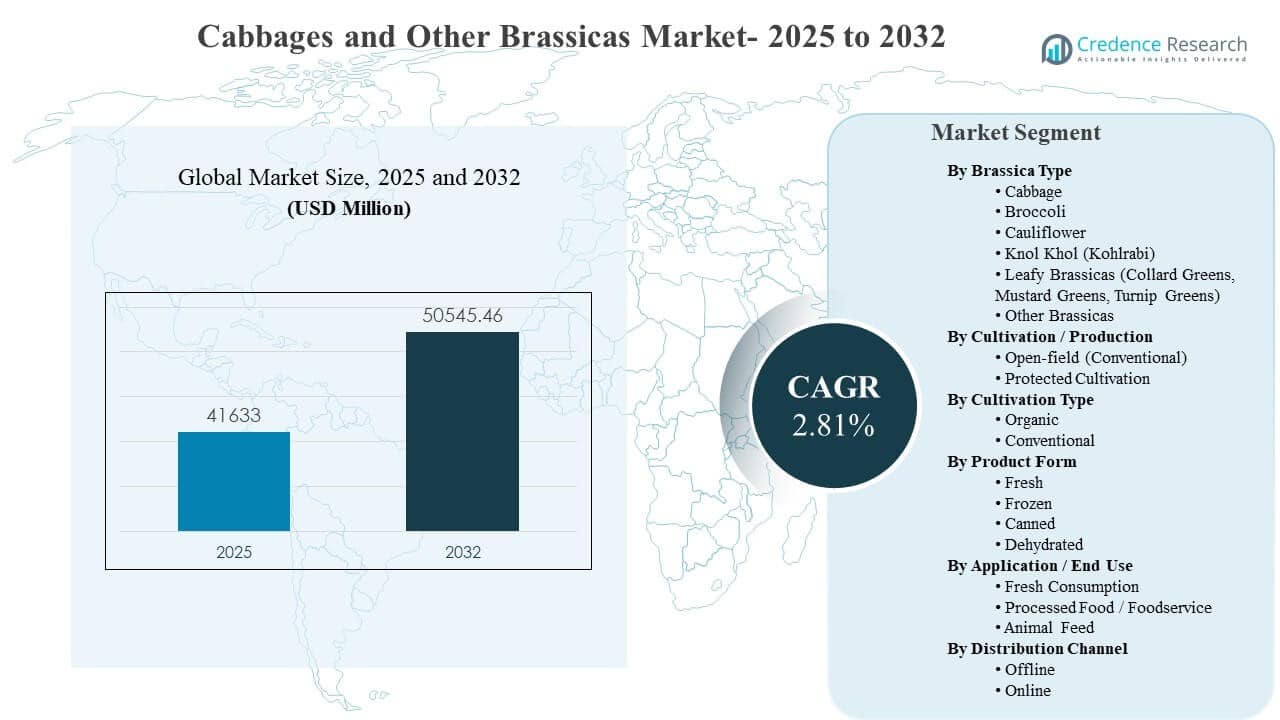
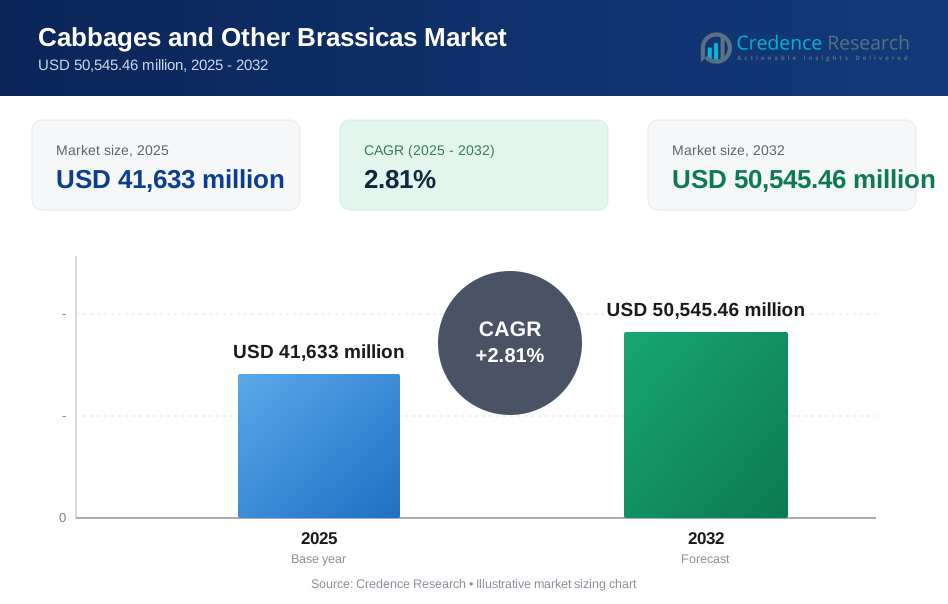
The global Cabbages and Other Brassicas Market size was estimated at USD 41,633 million in 2025 and is expected to reach USD 50,545.46 million by 2032, growing at a CAGR of 2.81% from 2025 to 2032. Growth is primarily driven by steady, everyday consumption across household cooking and foodservice menus, supported by year-round availability from diversified growing regions and improving cold-chain distribution. Expanding demand for convenient, value-added vegetable formats across modern retail further strengthens throughput for brassica crops across fresh and processed supply chains.
| REPORT ATTRIBUTE | DETAILS |
|---|---|
| Historical Period | 2020-2024 |
| Base Year | 2025 |
| Forecast Period | 2026-2032 |
| Cabbages and Other Brassicas Market Size 2025 | USD 41,633 million |
| Cabbages and Other Brassicas Market, CAGR | 2.81% |
| Cabbages and Other Brassicas Market Size 2032 | USD 50,545.46 million |
Key Market Trends & Insights
- The market is projected to expand from USD 41,633 million (2025) to USD 50,545.46 million (2032), registering a 2.81% CAGR during 2025–2032.
- Cabbage accounted for the largest share of 61.6% in 2025, supported by high staple usage across cuisines and strong price accessibility.
- Open-field (conventional) production held 87.6% share in 2025, reflecting scale economics and widespread acreage-based supply.
- Asia Pacific represented 51.9% of 2025 revenue, anchored by large production bases and strong household consumption intensity.
- Protected cultivation is expected to expand steadily during 2026–2032, supported by improved yield stability and increased proximity-to-market supply.
Segment Analysis
Demand across the Cabbages and Other Brassicas Market remains anchored in fresh household consumption, with rising support from packaged and value-added formats used by retailers and foodservice operators. Product mix continues to evolve toward convenience, including chopped blends and ready-to-cook items that improve shelf-life and reduce preparation time. Processing-oriented channels also create pull-through for standardized grades and consistent supply, strengthening coordination between growers, packers, and downstream buyers.
Supply dynamics are shaped by a large open-field base, complemented by expanding protected cultivation in regions facing climate variability and water constraints. As buyers prioritize continuity, appearance, and food safety compliance, suppliers increasingly compete on agronomic consistency, post-harvest handling, and cold-chain reliability. These factors collectively support gradual market expansion even in price-sensitive contexts.
By Brassica Type Insights
Cabbage accounted for the largest share of 61.6% in 2025. Broad household penetration and high culinary versatility sustain cabbage’s volume leadership across fresh and processed consumption. Strong storage performance and supply availability support dependable retail turnover and wholesale trading. Fermented and prepared-food demand also reinforces stable procurement, particularly where cabbage functions as a core ingredient in traditional staples and packaged salads.
By Cultivation / Production Insights
Open-field (Conventional) accounted for the largest share of 87.6% in 2025. Scale-driven economics and established acreage-based production keep open-field supply dominant across major producing regions. Large harvest volumes support mainstream retail and wholesale channels, where pricing and continuity are critical. Protected cultivation expands from a smaller base where buyers prioritize uniform quality, seasonal stability, and tighter control over pest pressure and crop performance.
By Cultivation Type Insights
Organic and conventional cultivation both contribute to overall brassica supply, with purchasing shaped by price sensitivity, certification availability, and retailer assortment strategies. Conventional output remains widely distributed due to established agronomy and cost advantages at scale. Organic demand is supported by clean-label preferences and premium retail positioning in select markets. Supply growth is influenced by transition economics, certification timelines, and the ability to maintain consistent yields and cosmetic quality.
By Product Form Insights
Fresh, frozen, canned, and dehydrated forms address distinct demand pools across household consumption, ingredient usage, and foodservice preparation. Fresh formats remain central to daily cooking and retail produce throughput, especially for cabbage, broccoli, and cauliflower. Frozen and canned offerings support supply stability and labor savings for foodservice and processors where predictable input costs matter. Dehydrated formats typically serve niche ingredient applications, prioritizing shelf stability and logistics efficiency.
By Application / End Use Insights
Fresh consumption through households and retail remains the primary demand base, supported by frequent purchase cycles and broad culinary use. Processed food and foodservice channels strengthen demand for standardized cuts and consistent supply in prepared meals and salad-oriented menus. Animal feed usage remains secondary and is often tied to local economics, by-product availability, and seasonal oversupply conditions. End-use mix depends on distribution infrastructure and the degree of processing capacity within each region.
By Distribution Channel Insights
Offline distribution continues to dominate due to the importance of physical handling, freshness assessment, and high-frequency replenishment across traditional markets and supermarkets. Wholesalers play a critical role in aggregating supply and stabilizing availability for urban retail demand. Online grocery expands as cold-chain fulfillment improves and consumers adopt scheduled deliveries for routine vegetables. Omnichannel retailers increasingly use packaged and value-added formats to improve shelf-life and reduce shrink across both in-store and delivery baskets.
Cabbages and Other Brassicas Market Drivers
Expanding Modern Retail and Cold-Chain Coverage
Modern retail expansion improves the availability of consistent-grade brassicas through standardized procurement, packaging, and quality controls. Cold-chain improvements reduce spoilage and widen the effective supply radius for growers and packers. Better temperature management supports higher throughput for broccoli and leafy brassicas that are more sensitive to post-harvest handling. Retailers also increase promotions and bundled offers that drive repeat purchases across staple vegetables.
- For instance, Sysco partnered with Verdant Technologies to pilot HarvestHold post-harvest technology across its U.S. Broadline distribution sites, recording a 40% improvement in customer experience scores at pilot locations alongside measurable reductions in broccoli spoilage and shrink.
Growing Demand for Convenient, Value-Added Vegetable Formats
Packaged chopped mixes, salad kits, and ready-to-cook formats increase consumption by reducing preparation time and improving usability. Foodservice operators adopt pre-processed brassica inputs to improve labor efficiency and standardize portioning. This shift supports higher demand for consistent sizing and cut specifications, strengthening coordination across the supply chain. Product innovation in seasoning blends and meal kits further increases brassica pull-through within modern retail baskets.
- For instance, Taylor Farms North America's leading producer of ready-to-eat salads and fresh-cut vegetables rolled out fully automated fresh-cut vegetable processing technology at its Yuma production plant in February 2025, replacing 10 conventional dryers with just 3 next-generation carousel dryers that process equivalent lettuce and brassica volumes with significantly lower energy consumption.
Stable Baseline Consumption Across Households and Foodservice
Cabbage, broccoli, and cauliflower maintain stable demand because these vegetables remain integral to everyday diets across multiple cuisines. Strong baseline usage limits volatility and supports predictable seasonal planning for growers and traders. Foodservice menus incorporate brassicas through soups, stir-fries, salads, and prepared meals, sustaining steady off-take. This consumption base supports incremental growth as distribution and packaging options improve.
Production Scaling and Yield Improvements in Key Growing Regions
Improved seed varieties, agronomic practices, and pest management support better yields and more consistent crop quality. Larger producing regions increase planting intensity and strengthen supply continuity across seasons. Protected cultivation also expands in select areas to mitigate weather risks and stabilize output. These changes support reliable availability, which is essential for retail contracts and processed supply programs tied to consistent specifications.
Cabbages and Other Brassicas Market Challenges
Weather variability, pest pressure, and water availability create yield uncertainty across open-field supply, raising procurement risk for buyers requiring consistent volumes. Price sensitivity in staple vegetables can limit value capture, particularly when supply surges pressure farmgate and wholesale pricing. Post-harvest losses remain meaningful where cold-chain infrastructure is uneven, especially for more perishable brassica types. Quality requirements tied to appearance and uniformity can elevate sorting costs and increase shrink rates across distribution.
- For instance, Cropin states that its agri-intelligence platform has computed over 1 billion acres and digitized 7 million farmers, illustrating the scale at which digital farm monitoring is being used to improve visibility across variable field conditions and dispersed supply bases.
Fragmented production structures can reduce standardization and complicate traceability, particularly where smallholders dominate cultivation. Logistics disruptions and rising transport costs can compress margins for packers and distributors in long-haul supply corridors. Food safety expectations are increasing for value-added formats, requiring stronger supplier controls and verification programs. Processing capacity constraints in some regions also limit the ability to absorb seasonal oversupply into frozen, canned, or dehydrated channels.
Cabbages and Other Brassicas Market Trends and Opportunities
Protected cultivation and controlled-environment practices continue to expand in regions facing climate volatility, creating opportunities for stable supply programs and premium quality positioning. Retailers increasingly favor contract-based procurement and standardized specifications, supporting suppliers that can deliver consistent grades and documentation. Growth in pre-cut and packaged formats creates differentiation through freshness management, packaging innovation, and recipe-led merchandising. These trends encourage investments in packing automation and post-harvest handling.
- For instance, 80 Acres Farms opened a 200,000-square-foot indoor farm in Kentucky that can grow up to 40 million servings of produce per year, with the site reported as about three times larger than the company’s previous biggest farm and at least four times as productive, demonstrating how proprietary software, robotics, and environmental controls can strengthen consistent supply execution.
Online grocery and omnichannel retail create incremental demand for packaged brassicas that travel well and maintain quality across delivery windows. Suppliers can capture additional value through branded offerings, traceable sourcing narratives, and tailored SKUs for e-commerce fulfillment. Processors can benefit from expanded utilization of off-grade produce through ingredient applications, improving overall yield economics. Regional trade opportunities also increase as cold-chain reliability improves cross-border movement for high-demand brassica varieties.
Regional Insights
North America
North America represented 17.3% of 2025 revenue, supported by modern retail penetration, strong packaged-produce adoption, and steady demand across household cooking and foodservice. Large buyers favor consistent grades, food safety programs, and reliable year-round supply. Value-added formats such as chopped mixes and meal kits strengthen demand for standardized inputs. Supply networks prioritize cold-chain performance and shrink reduction to protect margins in distribution-heavy channels.
Europe
Europe accounted for 19.7% of 2025 revenue, driven by high vegetable intake, structured retail procurement, and established processing demand across soups, prepared meals, and fresh-cut categories. Buyers emphasize quality consistency, traceability, and compliance with food safety standards. Seasonal production is complemented by imports and storage strategies that stabilize availability. Premiumization opportunities exist in organic and packaged formats where retailer assortment strategies support differentiated offerings.
Asia Pacific
Asia Pacific held 51.9% of 2025 revenue, reflecting large-scale production and strong everyday consumption across major population centers. Household demand remains a dominant driver, with cabbage and other brassicas widely used in traditional cooking. Supply chains span wholesale markets and expanding modern retail, supporting both bulk trade and packaged formats. Growing cold-chain and processing capacity supports incremental demand for higher-value, standardized products across urban markets.
Latin America
Latin America captured 7.8% of 2025 revenue, supported by expanding urban consumption and improving retail infrastructure in key markets. Traditional wholesale channels remain important for volume distribution, with supermarkets increasing influence on quality and packaging requirements. Opportunities are linked to post-harvest upgrades that reduce losses and improve consistency for retailers. Processing demand develops gradually as packaged and convenience-led products gain traction.
Middle East & Africa
Middle East & Africa represented 3.3% of 2025 revenue, with growth supported by retail expansion, selective greenhouse investment, and gradual cold-chain improvements. Supply constraints and logistics challenges can limit the consistent availability of premium brassica formats. Demand is supported by staple usage and expanding foodservice in urban centers. Opportunities exist for import optimization, protected cultivation in water-constrained areas, and improved post-harvest handling to reduce spoilage.
Competitive Landscape
Competition in the Cabbages and Other Brassicas Market is shaped by supply reliability, quality consistency, food safety compliance, and the ability to serve both bulk and value-added channels. Large suppliers differentiate through scale procurement, packing capabilities, and cold-chain performance that reduces shrink for retailers. Value-added product innovation, such as chopped blends and meal-oriented kits, supports higher-margin positioning for suppliers with strong processing and packaging infrastructure. Brand partnerships and retail program execution increasingly influence buyer selection.
Food Company Inc. is positioned to compete through dependable supply execution and alignment with large-buyer requirements around consistent grades, packaging formats, and fulfillment performance. Differentiation depends on the ability to support retail programs with standardized specifications and traceable sourcing. Expanded value-added capabilities strengthen participation in convenience-driven categories such as chopped mixes and prepared produce lines. Operational discipline across packing, logistics, and quality systems remains central to sustaining long-term retail relationships.
The industry research and growth report includes detailed analyses of the competitive landscape of the market and information about key companies, including:
- Food Company Inc.
- Bonduelle Americas Inc.
- Grimmway Enterprises Inc.
- Taylor Fresh Foods Inc.
- Fresh Express Incorporated
- Earthbound Farm LLC
- Vegpro International Inc.
- Green Giant Fresh LLC
- Church Brothers LLC
- Pero Family Farms Food Company LLC
- Pacific Coast Producers
- Lakeside Produce
- Ocean Mist Farms
- AeroFarms
Qualitative and quantitative analysis of companies has been conducted to help clients understand the wider business environment as well as the strengths and weaknesses of key industry players. Data is qualitatively analyzed to categorize companies as pure play, category-focused, industry-focused, and diversified; it is quantitatively analyzed to categorize companies as dominant, leading, strong, tentative, and weak.
Recent Developments
- In a March 2026 acquisition update, Grimmway Produce Group, associated with Grimmway Enterprises Inc., acquired Fresha’s headquarters, nearly 40 acres of land, and a carrot-processing plant in Morris, Minnesota.
- In a November 2025 acquisition, Taylor Fresh Foods Inc. announced that it had acquired Natures Way Foods in the U.K. to expand its fresh prepared foods footprint and support further innovation.
- In a February 2025 product launch, Bonduelle Americas Inc. introduced ready-to-eat Lunch Bowls, expanding its plant-rich convenience portfolio in the U.S.
- In a December 2024 acquisition, Fresh Express Incorporated bought McEntire Produce to expand its foodservice operations across North America.
Report Scope
| Report Attribute | Details |
| Market size value in 2025 | USD 41,633 million |
| Revenue forecast in 2032 | USD 50,545.46 million |
| Growth rate (CAGR) | 2.81% (2025–2032) |
| Base year | 2025 |
| Forecast period | 2026-2032 |
| Quantitative units | USD million |
| Segments covered | By Brassica Type; By Cultivation / Production; By Cultivation Type; By Product Form; By Application / End Use; By Distribution Channel |
| Regional scope | North America, Europe, Asia Pacific, Latin America, Middle East & Africa |
| Key companies profiled | Food Company Inc.; Bonduelle Americas Inc.; Grimmway Enterprises Inc.; Taylor Fresh Foods Inc.; Fresh Express Incorporated; Earthbound Farm LLC; Vegpro International Inc.; Green Giant Fresh LLC; Church Brothers LLC; Pero Family Farms Food Company LLC; Pacific Coast Producers; Lakeside Produce; Ocean Mist Farms; AeroFarms |
| No.of Pages | 336 |
Segmentation
By Brassica Type
- Cabbage
- Broccoli
- Cauliflower
- Knol Khol (Kohlrabi)
- Leafy Brassicas (Collard Greens, Mustard Greens, Turnip Greens)
- Other Brassicas
By Cultivation / Production
- Open-field (Conventional)
- Protected Cultivation (Greenhouse/Polyhouse/Controlled environment)
By Cultivation Type
- Organic
- Conventional
By Product Form
- Fresh
- Frozen
- Canned
- Dehydrated
By Application / End Use
- Fresh Consumption (Household/Retail)
- Processed Food / Foodservice
- Animal Feed
By Distribution Channel
- Offline [Traditional markets, Wholesalers, Supermarkets]
- Online
By Region
- North America
- U.S.
- Canada
- Mexico
- Europe
- Germany
- France
- U.K.
- Italy
- Spain
- Rest of Europe
- Asia Pacific
- China
- Japan
- India
- South Korea
- South-east Asia
- Rest of Asia Pacific
- Latin America
- Brazil
- Argentina
- Rest of Latin America
- Middle East & Africa
- GCC Countries
- South Africa
- Rest of the Middle East and Africa
Request a Free Sample
Fill in your details and we'll send you a free sample report.
- Sample data tables & charts
- Research methodology
Need a Custom Version of This Report?
Tailor the scope, geography, or segments to your exact requirements.
- Custom geography or segment scope
- Direct access to our analyst team
Frequently Asked Questions
What is the current and forecast size of the Cabbages and Other Brassicas Market?
What is the CAGR for the market during the forecast period?
Which segment holds the largest share in 2025?
What factors are driving market growth?
Who are the leading companies in the market?
Which region leads the market in 2025?
Table of Content
Chapter 1. Report Introduction
- 1.1 Report Description & Purpose
- 1.1.1 Report Title & Market Definition
- 1.1.2 Unique Selling Propositions (USP) & Key Differentiators
- 1.1.3 Value Proposition for Stakeholders
- 1.2 Research Objectives
- 1.2.1 Market Sizing Objectives (Volume & Revenue)
- 1.2.2 Segmentation Objectives
- 1.2.3 Competitive Intelligence Objectives
- 1.2.4 Forecast & Scenario Objectives
- 1.3 Report Scope
- 1.3.1 Cabbages and Other Brassicas Scope – Types & Subtypes Covered
- 1.3.2 Geographic Scope – Regions & Countries Covered
- 1.3.3 Historical Period, Base Year & Forecast Period (2025; forecast to 2032)
- 1.3.4 Inclusions & Exclusions
- 1.4 HS Code & Classification Framework
- 1.5 Currency, Units & Pricing Basis
- 1.6 Target Stakeholders
- 1.7 Limitations & Assumptions
Chapter 2. Executive Summary
- 2.1 Global Cabbages and Other Brassicas Market Snapshot
- 2.1.1 Market Size – Historical (2025) & Forecast (2025-2032) (2025: USD 41,633 million → 2032: USD 50,545.46 million)
- 2.1.2 Volume & Revenue – Global Totals
- 2.1.3 Key Market Highlights – Top Five Facts
- 2.2 Cabbages and Other Brassicas Market Segmentation Snapshot
- 2.2.1 Market Split by Region – 2025 vs. 2032
- 2.3 Competitive Snapshot
- 2.3.1 Top 10 Players by Revenue Share – 2025
- 2.3.2 Top 10 Players by Volume Share – 2025
- 2.3.3 Recent Strategic Developments (18-Month Summary)
- 2.4 Key Investment Highlights & Strategic Conclusions
Chapter 3. Cabbages and Other Brassicas Market Dynamics & Industry Analysis
- 3.1 Market Overview & Context
- 3.1.1 Cabbages and Other Brassicas Market Position in the Broader Automotive Value Chain
- 3.1.2 OEM vs. Replacement Market Dynamics
- 3.1.3 Market Maturity & Development Stage by Region
- 3.2 Cabbages and Other Brassicas Market Drivers
- 3.3 Cabbages and Other Brassicas Market Restraints & Challenges
- 3.4 Cabbages and Other Brassicas Market Opportunities
- 3.5 Porter's Five Forces Analysis
- 3.5.1 Threat of New Entrants
- 3.5.2 Bargaining Power of Suppliers
- 3.5.3 Bargaining Power of Buyers
- 3.5.4 Threat of Substitutes
- 3.5.5 Competitive Rivalry – Intensity Assessment
- 3.6 Cabbages and Other Brassicas Value Chain Analysis
- 3.6.1 Upstream – Raw Material/Input Suppliers
- 3.6.1.1 Raw Material/Input 1
- 3.6.1.2 Raw Material/Input 2
- 3.6.1.3 Raw Material/Input 3
- 3.6.2 Midstream – Production/Manufacturing/Service Delivery
- 3.6.2.1 Production/Process Overview
- 3.6.2.2 Key Facility Locations & Capacity by Manufacturer
- 3.6.3 Downstream – Distribution & End Consumer
- 3.6.3.1 Primary Channel – B2B/OEM
- 3.6.3.2 Secondary Channels – Dealer, Retail, Online, Direct
- 3.6.4 Value Chain Profitability Analysis
- 3.6.1 Upstream – Raw Material/Input Suppliers
- 3.7 PESTEL Analysis
- 3.7.1 Political Factors
- 3.7.2 Economic Factors
- 3.7.3 Social Factors
- 3.7.4 Technological Factors
- 3.7.5 Environmental Factors
- 3.7.6 Legal Factors
- 3.8 Cabbages and Other Brassicas Supply Chain Analysis
- 3.8.1 Raw Material/Input Supply Risk Assessment
- 3.8.2 Manufacturing Concentration Risk (Geographic Exposure)
- 3.8.3 Trade Disruption Impact Analysis
- 3.9 Regulatory & Policy Landscape
Note: The regulatory and policy landscape section covers regulations based on their applicability to the market, Cabbages and Other Brassicas category, geography, and scope of the study. Only regulatory frameworks with a material impact on operations, compliance, trade, sustainability, or market access are analyzed in detail.
Chapter 4. Key Investment Pockets & Opportunity Analysis
- 4.1 Cabbages and Other Brassicas Market Attractiveness Analysis
- 4.1.1 By Region – Investment Attractiveness Matrix (Volume × CAGR)
- 4.2 Absolute Revenue Growth Opportunity
- 4.2.1 By Region – Absolute USD Growth Through 2032
- 4.3 Incremental Volume Opportunity
- 4.3.1 By Region – Incremental Volume Through 2032
- 4.3.2 Segment – Incremental Volume
- 4.4 Emerging Submarket Opportunity Deep Dive (Subject to Applicability)
- 4.5 Emerging Market Opportunity Scorecards
- 4.5.1 United States
- 4.5.2 Europe
- 4.5.3 Asia
- 4.5.4 Middle East & Africa
Note: Emerging Market Opportunity Scorecards will be included based on relevance and strategic importance. Regions listed are indicative and may vary depending on data availability and market dynamics.
Chapter 5. Cabbages and Other Brassicas Import-Export Analysis & Trade Flows
- 5.1 Global Trade Overview
- 5.1.1 Global Export Value by Country (2025)
- 5.1.2 Global Export Volume by Country (2025)
- 5.1.3 Global Import Value by Country (2025)
- 5.1.4 Global Import Volume by Country (2025)
- 5.1.5 Net Trade Balance by Country (2025)
- 5.2 Export Analysis – Segment
- 5.2.1 Type 1 (HS Code)
- 5.2.2 Type 2 (HS Code)
- 5.2.3 Type 3 (HS Code)
- 5.2.4 Type 4 (HS Code)
- 5.2.5 Type 5 (HS Code)
- 5.3 Import Analysis – Segment
- 5.3.1 Type 1 (HS Code)
- 5.3.2 Type 2 (HS Code)
- 5.3.3 Type 3 (HS Code)
- 5.3.4 Type 4 (HS Code)
- 5.3.5 Type 5 (HS Code)
- 5.4 Average Unit Trade Prices
- 5.4.1 Average Export Price – Segment & Country
- 5.4.2 Average Import Price – Segment & Source Country
- 5.4.3 Price Trends (2025)
- 5.5 Key Trade Route Analysis
- 5.5.1 Trade Route 1
- 5.5.2 Trade Route 2
- 5.5.3 Trade Route 3
- 5.5.4 Trade Route 4
- 5.5.5 Trade Route 5
- 5.6 Trade Policy Impact Assessment
- 5.6.1 US Anti-Dumping & Section 301 Tariffs
- 5.6.2 EU Customs Union Impact
- 5.6.3 Major Free Trade Agreements
- 5.6.4 USMCA Rules of Origin
Note: Trade policy analysis will be included only where relevant to the Cabbages and Other Brassicas market.
Chapter 6. Competitive Landscape & Company Benchmarking
- 6.1 Cabbages and Other Brassicas Market Concentration & Structure
- 6.1.1 Herfindahl-Hirschman Index (HHI) – vs. 2025
- 6.1.2 Tier 1, Tier 2 & Tier 3 Market Structure
- 6.1.3 Global, Regional & Local Player Dynamics
- 6.2 Cabbages and Other Brassicas Market Share Analysis – 2025
- 6.2.1 Global Revenue Share by Company
- 6.2.2 Global Volume Share by Company
- 6.2.3 Regional Revenue Share
- 6.2.4 Market Share Evolution ( vs. 2025)
- 6.2.5 OEM Segment Share by Company
- 6.2.6 Replacement Segment Share by Company
- 6.3 Production/Delivery Capacity & Facility Analysis
- 6.3.1 Global Installed Capacity
- 6.3.2 Capacity Utilization Rates
- 6.3.3 Production/Output Volume
- 6.3.4 Facility Locations & Capacity Map
- 6.3.5 Planned Capacity Additions
- 6.4 Cabbages and Other Brassicas Competitive Benchmarking Matrix
- 6.4.1 Revenue, Volume, CAGR & Profitability Comparison
- 6.4.2 Channel Revenue Mix
- 6.4.3 Geographic Revenue Exposure
- 6.4.4 R&D Intensity
- 6.4.5 Sustainability Maturity
- 6.5 Strategic Developments in Cabbages and Other Brassicas (Last 24 Months)
- 6.5.1 Mergers, Acquisitions & Divestments
- 6.5.2 New Cabbages and Other Brassicas Launches
- 6.5.3 Facility Expansions
- 6.5.4 Strategic Alliances, Joint Ventures & Partnerships
- 6.5.5 Distribution Expansion & Market Entry
- 6.5.6 Sustainability & ESG Initiatives
- 6.6 Competitive Strategy Mapping
- 6.6.1 Leader, Challenger, Follower & Niche Classification
- 6.6.2 Pricing Strategy Comparison
- 6.6.3 Channel Strategy Matrix
Note: Strategic developments are included based on their materiality and the availability of reliable information.
Chapter 7. Global Cabbages and Other Brassicas Market – By Distribution Channel
- 7.1 Segment Overview
- 7.1.1 Volume & Revenue Split by Channel (2025 & 2032)
- 7.1.2 Channel Mix Evolution (2025-2032)
Chapter 8. Regional Market Analysis – Global Overview
- 8.1 Global Regional Overview
- 8.1.1 Regional Volume Share
- 8.1.2 Regional Revenue Share
- 8.1.3 Regional Volume by Region
- 8.1.4 Regional Revenue by Region
- 8.1.5 Regional Forecast Through 2032
- 8.2 Cross-Regional Segment Analysis
- 8.2.1 By Distribution Channel
- 8.2.2 By Brand/Price Tier
Chapter 9. North America Cabbages and Other Brassicas Market
- 9.1 United States
- 9.2 Canada
- 9.3 Mexico
Chapter 10. Europe Cabbages and Other Brassicas Market
- 10.1 Germany
- 10.2 France
- 10.3 Italy
- 10.4 United Kingdom
- 10.5 Spain
- 10.6 Poland
- 10.7 Russia
- 10.8 Netherlands
- 10.9 Belgium
- 10.10 Sweden
- 10.11 Denmark
- 10.12 Norway
- 10.13 Rest of Europe
Chapter 11. Asia Pacific Cabbages and Other Brassicas Market
- 11.1 China
- 11.2 India
- 11.3 Japan
- 11.4 South Korea
- 11.5 Thailand
- 11.6 Indonesia
- 11.7 Vietnam
- 11.8 Malaysia
- 11.9 Australia
- 11.10 Rest of Asia Pacific
Chapter 12. Latin America Cabbages and Other Brassicas Market
- 12.1 Brazil
- 12.2 Argentina
- 12.3 Colombia
- 12.4 Chile
- 12.5 Rest of Latin America
Chapter 13. Middle East Cabbages and Other Brassicas Market
- 13.1 Saudi Arabia
- 13.2 United Arab Emirates
- 13.3 Turkey
- 13.4 Israel
- 13.5 Iran
- 13.6 Rest of the Middle East
Chapter 14. Africa Cabbages and Other Brassicas Market
- 14.1 South Africa
- 14.2 Egypt
- 14.3 Nigeria
- 14.4 Morocco
- 14.5 Rest of Africa
Chapter 15. Cabbages and Other Brassicas Company Profiles
- 15.1 [Company 01]
- 15.1.1 Company Overview
- 15.1.2 Key Management Personnel
- 15.1.3 Products & Services Portfolio
- 15.1.4 Financial Performance
- 15.1.5 Key Market Focus & Geographic Presence
- 15.1.6 Recent Developments & Strategic Initiatives
Note: The company profile list is preliminary and may change based on research findings, market developments, data availability, and client requirements.
Chapter 16. Appendices
- Appendix A – List of Abbreviations & Acronyms
- Appendix B – Industry Classification Code Reference – Full Series
- Appendix C – Production & Capacity Data Tables
- Appendix D – End-Use & Demand Base Tables
- Appendix E – Consumption & Replacement Rate Assumptions
- Appendix F – ASP Reference Tables
- Appendix G – Manufacturing & Facility Database
- Appendix H – Import-Export Data Tables
- Appendix I – Regulatory Summary Tables
- Appendix J – Primary Research Participant List (Anonymized)
- Appendix K – Primary Research Questionnaire Framework
- Appendix L – Data Sources & Bibliography
- Appendix M – Market Size Divergence & Source Comparison
Chapter 17. Research Methodology
- 17.1 Research Framework & Philosophy
- 17.2 Secondary Research – Sources, Hierarchy & Data Extraction
- 17.3 Data Modeling – Bottom-Up & Top-Down Market Sizing
- 17.4 Primary Research – Stakeholder Framework, LOI & Sample Sizes
- 17.5 Forecast Methodology – Regression, Scenario & Sensitivity Analysis
- 17.6 Quality Control – Four-Layer Validation Framework
- 17.7 Limitations & Standard Assumptions
- 17.8 Disclaimer
