
Cereals And Grains Seed Market Overview:
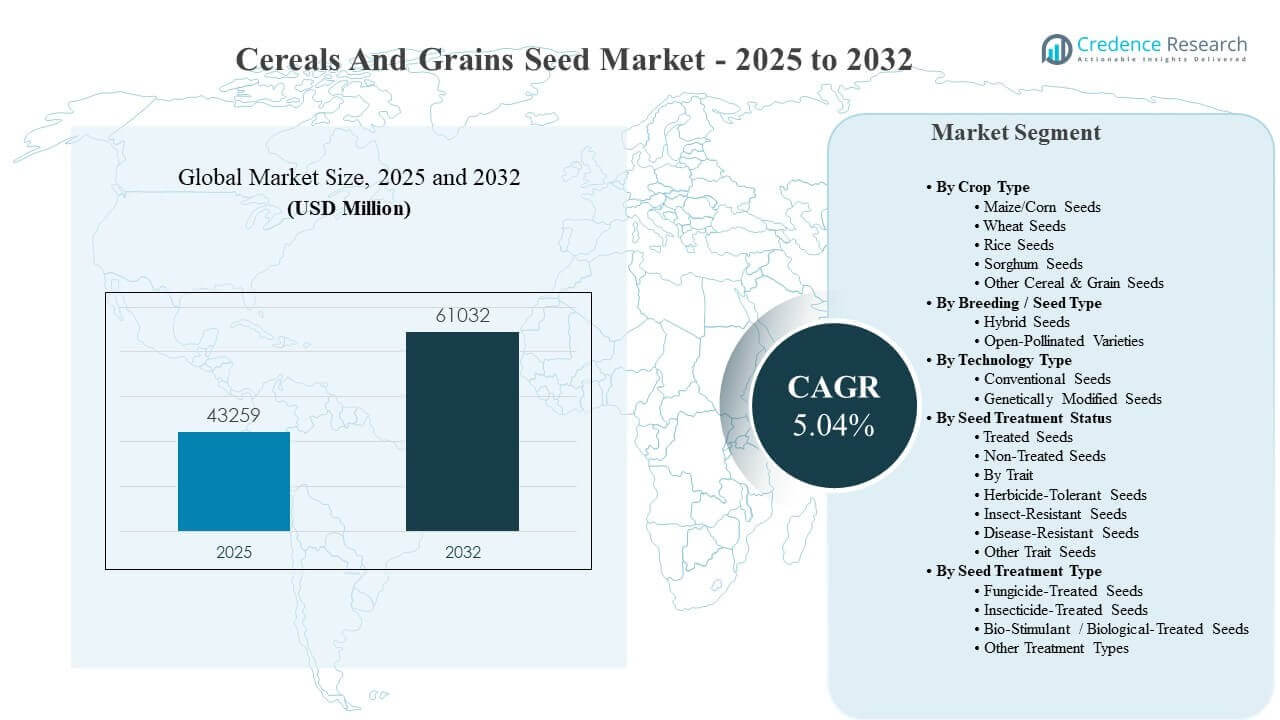
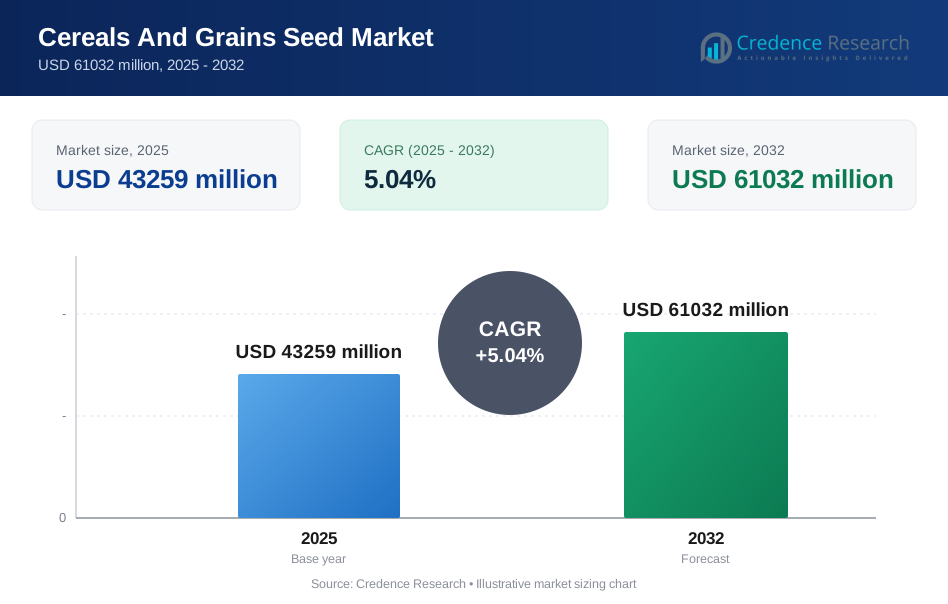
The global Cereals and Grains Seed Market size was estimated at USD 43259 million in 2025 and is expected to reach USD 61032 million by 2032, growing at a CAGR of 5.04% from 2025 to 2032. Growth is primarily driven by rising demand for higher-yielding seed varieties that improve crop performance under weather variability and input-cost pressure, pushing faster replacement cycles in major cereal crops. Expansion in commercial seed distribution, improved seed quality standards, and wider availability of differentiated genetics across key producing countries further support sustained market momentum.
| REPORT ATTRIBUTE | DETAILS |
|---|---|
| Historical Period | 2020-2024 |
| Base Year | 2025 |
| Forecast Period | 2026-2032 |
| Cereals and Grains Seed Market Size 2025 | USD 43259 million |
| Cereals and Grains Seed Market, CAGR | 5.04% |
| Cereals and Grains Seed Market Size 2032 | USD 61032 million |
Key Market Trends & Insights
- The market is projected to reach USD 61032 million by 2032, expanding at 5.04% CAGR (2025–2032).
- Maize/Corn Seeds accounted for the largest share of 56.70% in 2025, supported by strong feed and industrial demand pull.
- Hybrid Seeds held 61.90% share in 2025, reflecting preference for yield stability and uniform agronomic performance.
- North America represented 34.60% of 2025 revenue, supported by highly commercialized farming systems and high seed replacement rates.
- Asia Pacific captured 28.10% of 2025 revenue, underpinned by large cereal acreage and scaling of formal seed channels.
Segment Analysis
The Cereals And Grains Seed Market is shaped by the economic value of improved genetics and the ability of seed suppliers to deliver consistent field performance across variable climates. Hybrid offerings strengthen value capture by improving uniformity and stand establishment, which supports farmer willingness to repurchase seed rather than rely on saved seed. Adoption also benefits from modern seed production and processing practices, where automation in cleaning, sorting, and packaging improves lot consistency and reduces operational waste. In many producing regions, channel formalization and stronger dealer networks are also improving access to certified seed.
Technology and trait decisions are strongly influenced by regulatory acceptance, stewardship requirements, and export-channel sensitivities. Trait commercialization can carry significant compliance and approval burdens across jurisdictions, which can slow rollout and concentrate advanced trait portfolios among suppliers with larger regulatory capacity. In parallel, the market is seeing increased interest in biological and bio-stimulant seed treatments as part of integrated crop establishment strategies, especially where sustainability positioning, soil health narratives, and stress mitigation benefits influence purchase decisions.
Buyer behavior varies by crop economics and risk profile, but a common theme is a growing preference for solutions that reduce yield volatility and improve predictability. Farmers typically prioritize genetics that demonstrate stable performance under heat, drought, and pest pressure, particularly in water-stressed cereal zones. Counterfeit or low-quality seed remains a commercial risk in some emerging regions, reinforcing the importance of authentication, traceability, and trusted retail relationships to protect brand confidence.
By Crop Type Insights
Maize/Corn Seeds accounted for the largest share of 56.70% in 2025. The segment leads because corn seed spending is anchored in large planted areas, high commercialization, and strong demand from feed, starch, and industrial value chains. Seed replacement cycles are more consistent in corn than in several other cereals, supporting repeat purchasing behavior. Suppliers also differentiate corn portfolios through performance positioning, localized agronomy recommendations, and bundling with treatment and advisory services.
By Breeding / Seed Type Insights
Hybrid Seeds accounted for the largest share of 61.90% in 2025. Hybrids lead due to their perceived advantage in yield stability, uniform emergence, and predictable harvest outcomes, which improves return on seed investment. The value proposition strengthens further in environments exposed to climate variability where hybrids can reduce downside risk. Ongoing improvements in breeding speed, analytics-driven selection, and wider availability across crops are also supporting sustained hybrid penetration.
By Technology Type Insights
Technology adoption in cereals and grains seeds remains region- and crop-specific, shaped by regulatory pathways and market-access considerations. Conventional seed improvements continue to matter where GM cultivation is limited or where premium export channels discourage certain traits. Genetically modified options tend to expand more rapidly in markets with established approvals and stewardship frameworks. Seed suppliers increasingly balance these realities by tailoring portfolios by crop and geography, maintaining both conventional and biotech tracks.
By Seed Treatment Status Insights
Seed treatment status is influenced by pest and disease pressure, the value of the underlying seed lot, and local agronomic practice intensity. Treated seed is often preferred for higher-value hybrid lots where preserving emergence and stand establishment protects yield outcomes. Non-treated seed remains relevant in lower-input systems and in regions where treatment economics or regulatory policies limit broad adoption. Channel bundling and retailer recommendations can materially influence treatment uptake.
By Trait Insights
Trait demand is driven by the need to manage weeds, insects, and diseases more effectively while protecting yield stability. Herbicide-tolerant and insect-resistant traits can be particularly attractive where weed resistance or insect pressure is persistent and where management costs are rising. Disease-resistance traits gain importance as weather volatility increases disease prevalence and as growers seek to reduce reliance on in-season interventions. Trait adoption is also shaped by approval timelines, stewardship requirements, and seed affordability.
By Seed Treatment Type Insights
Fungicide-treated and insecticide-treated solutions remain foundational in many cereal systems where early-season establishment risks are material. Biological and bio-stimulant treatments are increasingly evaluated as complements, particularly for stress mitigation, root vigor, and sustainability-aligned positioning. Treatment selection often depends on local disease and insect complexes, planting windows, and soil conditions. Suppliers continue to innovate around formulation compatibility and seed safety to protect germination and storage performance.
Cereals and Grains Seed Market Drivers
Rising demand for yield stability under climate variability
Weather volatility is increasing the value of genetics that protect yield stability across variable growing seasons. Farmers are prioritizing seed performance that reduces downside risk from heat stress, drought exposure, and irregular rainfall patterns. This strengthens demand for advanced hybrids, localized product positioning, and improved breeding pipelines. In turn, suppliers expand multi-environment testing and stress-tolerance selection to maintain performance credibility and farmer repurchase behavior.
- For instance, Bayer states that the Preceon™ Smart Corn System was rolled out in the top corn-producing U.S. states in 2024 and later expanded into Italy and Canada, while the company also describes its short-stature corn platform as being designed to improve tolerance to lodging and greensnap under high winds and challenging weather, illustrating how seed developers are commercializing climate-resilience traits through regionally targeted launches and stress-performance positioning.
Commercialization of cereal value chains and seed replacement expansion
Growth in commercial farming and structured procurement is increasing certified seed usage for major cereals. As farm operations scale and become more input-optimized, predictable stand establishment and uniform crop development become higher priorities. This supports faster replacement cycles, especially in crops where seed quality materially changes yield outcomes. Stronger dealer networks and improved availability also increase adoption in regions transitioning from informal seed systems.
- For instance, Corteva connects its regional seed brands through farmer-dealer networks and retail channels that bundle seed and chemistry solutions, while Bayer reports reaching 53 million smallholder farmers in low- and middle-income countries through products, services, and partnerships, highlighting how distribution scale and access programs support seed replacement and formal market adoption.
Innovation in breeding speed, analytics, and product differentiation
Seed companies are applying advanced analytics, faster breeding cycles, and larger trial networks to improve time-to-market and product performance. Competitive advantage increasingly depends on delivering consistent outcomes in specific agro-climatic zones rather than one-size-fits-all varieties. This drives deeper segmentation of product portfolios and more targeted agronomy support. Over time, these capabilities lift farmer trust and expand premium seed penetration in high-value cereal regions.
Bundling of genetics with treatments and advisory support
Farmers increasingly evaluate seed as part of a broader crop establishment package rather than a standalone input. Bundling genetics with seed treatments, disease protection positioning, and agronomic guidance improves perceived ROI and simplifies decision-making. Retailers and distribution partners often amplify this effect by recommending integrated solutions suited to local risk profiles. This bundling approach can increase repeat purchasing, reduce churn, and strengthen supplier pricing power where outcomes are measurable.
Cereals and Grains Seed Market Challenges
Regulatory divergence remains a major constraint on technology and trait diffusion across cereals and grains. Technology acceptance varies by country and can be influenced by import requirements, stewardship expectations, and public policy, which complicates global portfolio scaling. Approval complexity can lengthen commercialization timelines and raise compliance costs, affecting which traits reach market and when. This creates uneven adoption patterns and can limit the addressable market for certain technology stacks.
- For instance, Bioceres highlighted this issue through its HB4 wheat platform: when Brazil approved commercial cultivation in 2023, it became only the second country to clear HB4 wheat for cultivation after Argentina, even though the trait had already obtained food and feed approvals in the United States, Colombia, New Zealand, Australia, South Africa and Nigeria, plus feed approval in Indonesia.
Channel integrity and seed quality consistency also challenge growth, particularly in regions where counterfeit seed or weak enforcement can erode farmer confidence. Quality issues increase replanting risk and can reduce willingness to pay for premium offerings, compressing value capture. Suppliers must invest in authentication, traceability, and education to protect brand trust. Logistics, storage conditions, and last-mile handling also influence germination outcomes and customer satisfaction.
Cereals and Grains Seed Market Trends and Opportunities
Biological and bio-stimulant seed treatments are becoming more visible as complement technologies to improve crop establishment and stress resilience. As sustainability expectations increase, growers and supply chains are evaluating solutions that can support performance while aligning with reduced chemical load narratives. This supports innovation in biological formulations, compatibility with conventional treatments, and tailored positioning by crop and region. Over time, treatment innovation can become a differentiation lever alongside genetics.
Hybrid wheat and improved sorghum offerings present opportunities to expand hybrid penetration beyond traditional strongholds. Where hybridization has historically been limited by economics or scalability, advances in breeding, seed production systems, and regional targeting can unlock new demand. In stress-prone environments, drought-tolerant cereals can gain importance as water availability tightens. These shifts can expand addressable revenue pools and reshape competitive positioning across key crop categories.
- For instance, Bayer has stated that hybrid wheat can deliver about 10–15% higher yields than varietal wheat, and in a later investor presentation indicated expected gains of 10% to as much as 20%, underscoring why hybrid wheat is being viewed as a meaningful step-change in cereal breeding economics; similarly, KWS reported that its first fully competitive grain sorghum hybrid was approved in early 2025, highlighting how breeding progress is beginning to strengthen the commercial case for sorghum hybrid adoption in drought-prone markets.
Regional Insights
North America
North America held 34.60% share in 2025, supported by highly commercialized cereal production and strong adoption of premium seed solutions. Seed replacement cycles are relatively consistent due to farm scale, mechanization, and outcome-driven input selection. Supplier differentiation often emphasizes locally validated performance, agronomy support, and bundled seed-plus-service positioning. Demand is also reinforced by large feed and industrial end markets that sustain high planting intensity for key cereals.
Europe
Europe represented 22.50% share in 2025, shaped by strong cereal cropping systems and stringent quality expectations across many markets. Innovation frequently emphasizes non-transgenic pathways, improved stress tolerance, and variety performance under region-specific conditions. Formal channels and certification practices support consistent demand for high-quality seed lots. Supplier positioning often focuses on varietal performance data, disease management fit, and compatibility with local agronomy requirements.
Asia Pacific
Asia Pacific captured 28.10% share in 2025, underpinned by large cereal acreage and increasing modernization of seed systems in several countries. Growth is supported by expanding formal distribution, rising awareness of certified seed benefits, and efforts to improve yields in staple crops. Adoption varies widely by crop and market maturity, but hybridization initiatives and quality upgrades are increasing value capture. Seed suppliers that combine local breeding focus with scalable distribution can strengthen share in this region.
Latin America
Latin America accounted for 9.70% share in 2025, supported by pockets of high commercialization and strong performance-led purchasing behavior in major producing zones. Demand is reinforced by professional farming operations and the economics of yield stability in climates exposed to variability. Supplier strategies often emphasize localized product positioning and field performance validation. The region’s share remains lower than North America and Asia Pacific due to crop mix and differing intensity across cereal systems.
Middle East & Africa
Middle East & Africa held 5.10% share in 2025, with demand influenced by climate exposure, food security priorities, and the need for resilient cereal production. Adoption is constrained in some areas by affordability, inconsistent channel quality, and lower seed replacement rates in informal systems. However, stress-tolerant cereals and improved certified seed availability can expand uptake where support programs and distribution improve. Supplier focus on trusted channels and farmer education is important to build long-term demand.
Competitive Landscape
Competition in the Cereals And Grains Seed Market is defined by breeding pipeline strength, localized performance credibility, and the ability to scale seed production and distribution efficiently. Leading players differentiate through hybrid and trait portfolios, multi-location testing networks, and agronomy-led commercialization strategies that link seed choice to expected field outcomes. Portfolio breadth across multiple cereal crops supports cross-selling, while partnerships and licensing can accelerate trait access in select markets. Channel strength and brand trust remain critical, particularly where quality assurance and authentication influence purchasing confidence.
Bayer AG is positioned as a multi-crop seed and crop science participant with focus on differentiated genetics, system-based offerings, and farm-level decision support that strengthens product stickiness. The company’s approach typically emphasizes performance positioning backed by extensive trialing, alongside integrated crop establishment concepts that combine genetics with agronomic recommendations. This strategy can improve switching costs and deepen customer relationships in corn-heavy geographies. Continued investment in pipeline depth and commercialization capability supports competitiveness across major cereal seed categories.
The industry research and growth report includes detailed analyses of the competitive landscape of the market and information about key companies, including:
- Bayer AG
- Corteva Agriscience
- Syngenta Group
- Advanta Seeds (UPL Ltd.)
- KWS SAAT SE & Co. KGaA
- BASF SE
- Limagrain
- Land O’Lakes, Inc.
- DLF
- Takii & Co., Ltd.
- Rallis India Limited
- Barenbrug South Africa
- FMC Corporation
- Allied Seed, LLC
- Mahyco
- Rasi Seeds Pvt. Ltd.
Qualitative and quantitative analysis of companies has been conducted to help clients understand the wider business environment as well as the strengths and weaknesses of key industry players. Data is qualitatively analyzed to categorize companies as pure play, category-focused, industry-focused, and diversified; it is quantitatively analyzed to categorize companies as dominant, leading, strong, tentative, and weak.
Recent Developments
- In February 2026, Bayer CropScience launched newgold®, its first multi-crop seed brand specifically developed for low-carbon intensity crops, designed to help farmers participate directly in the fast-growing biofuels market while enhancing farm profitability opportunities. This launch targets the sustainable aviation fuel and renewable diesel sectors, addressing the challenge of scaling low-carbon fuels without competing with food production.
- In February 2026, Corteva Agriscience and Bayer CropScience reached a comprehensive $610 million licensing agreement that accelerates corn technology licensing to 2027, unlocks cotton licensing, and resolves ongoing litigation between the two companies. This pact clears the licensing path for Corteva's seed business, which has been gaining market share in corn and soybeans.
- In September 2025, Valley Seeds launched two new wheat varieties, Limpopo and Zambezi, in Kwekwe, Zimbabwe, to help reduce the country's wheat import bill for bread production. Early harvests at DCK Farms yielded strong results, averaging 6.5–7 metric tons per hectare, with a focus on both productivity and baking quality.
- In July 2025, BASF SE and the Malaysian Agricultural Research and Development Institute (MARDI) introduced two Clearfield rice varieties, MR-CL3 and MR-CL4, in Malaysia. These varieties provide enhanced weed control capabilities and increased yield potential, contributing to sustainable rice production in the region.
Report Scope
| Report Attribute | Details |
| Market size value in 2025 | USD 43259 million |
| Revenue forecast in 2032 | USD 61032 million |
| Growth rate (CAGR) | 5.04% (2025–2032) |
| Base year | 2025 |
| Forecast period | 2026–2032 |
| Quantitative units | USD million |
| Segments covered | Crop type, breeding/seed type, technology type, seed treatment status, trait, and seed treatment type outlooks as defined in this report |
| Regional scope | North America, Europe, Asia Pacific, Latin America, Middle East & Africa |
| Key companies profiled | Bayer AG; Corteva Agriscience; Syngenta Group; Advanta Seeds (UPL Ltd.); KWS SAAT SE & Co. KGaA; BASF SE; Limagrain; Land O’Lakes, Inc.; DLF; Takii & Co., Ltd.; Rallis India Limited; Barenbrug South Africa; FMC Corporation; Allied Seed, LLC; Mahyco; Rasi Seeds Pvt. Ltd. |
| No. of pages | 338 |
Segmentation
By Crop Type
- Maize/Corn Seeds
- Wheat Seeds
- Rice Seeds
- Sorghum Seeds
- Other Cereal & Grain Seeds
By Breeding / Seed Type
- Hybrid Seeds
- Open-Pollinated Varieties
By Technology Type
- Conventional Seeds
- Genetically Modified Seeds
By Seed Treatment Status
- Treated Seeds
- Non-Treated Seeds
By Trait
- Herbicide-Tolerant Seeds
- Insect-Resistant Seeds
- Disease-Resistant Seeds
- Other Trait Seeds
By Seed Treatment Type
- Fungicide-Treated Seeds
- Insecticide-Treated Seeds
- Bio-Stimulant / Biological-Treated Seeds
- Other Treatment Types
By Region
- North America
- U.S.
- Canada
- Mexico
- Europe
- Germany
- France
- U.K.
- Italy
- Spain
- Rest of Europe
- Asia Pacific
- China
- Japan
- India
- South Korea
- South-east Asia
- Rest of Asia Pacific
- Latin America
- Brazil
- Argentina
- Rest of Latin America
- Middle East & Africa
- GCC Countries
- South Africa
- Rest of the Middle East and Africa
Request a Free Sample
Fill in your details and we'll send you a free sample report.
- Sample data tables & charts
- Research methodology
Need a Custom Version of This Report?
Tailor the scope, geography, or segments to your exact requirements.
- Custom geography or segment scope
- Direct access to our analyst team
Frequently Asked Questions
What is the current and forecast market size for the Cereals And Grains Seed Market?
What is the growth rate of the Cereals And Grains Seed Market?
What is the largest segment in the market?
What factors are driving market growth?
Which companies are leading in this market?
Which region leads the Cereals And Grains Seed Market?
Table of Content
Chapter 1. Report Introduction
- 1.1 Report Description & Purpose
- 1.1.1 Report Title & Market Definition
- 1.1.2 Unique Selling Propositions (USP) & Key Differentiators
- 1.1.3 Value Proposition for Stakeholders
- 1.2 Research Objectives
- 1.2.1 Market Sizing Objectives (Volume & Revenue)
- 1.2.2 Segmentation Objectives
- 1.2.3 Competitive Intelligence Objectives
- 1.2.4 Forecast & Scenario Objectives
- 1.3 Report Scope
- 1.3.1 Cereals And Grains Seed Scope – Types & Subtypes Covered
- 1.3.2 Geographic Scope – Regions & Countries Covered
- 1.3.3 Historical Period, Base Year & Forecast Period (2025; forecast to 2032)
- 1.3.4 Inclusions & Exclusions
- 1.4 HS Code & Classification Framework
- 1.5 Currency, Units & Pricing Basis
- 1.6 Target Stakeholders
- 1.7 Limitations & Assumptions
Chapter 2. Executive Summary
- 2.1 Global Cereals And Grains Seed Market Snapshot
- 2.1.1 Market Size – Historical (2025) & Forecast (2025-2032) (2025: USD 43259 million → 2032: USD 61032 million)
- 2.1.2 Volume & Revenue – Global Totals
- 2.1.3 Key Market Highlights – Top Five Facts
- 2.2 Cereals And Grains Seed Market Segmentation Snapshot
- 2.2.1 Market Split by Region – 2025 vs. 2032
- 2.3 Competitive Snapshot
- 2.3.1 Top 10 Players by Revenue Share – 2025
- 2.3.2 Top 10 Players by Volume Share – 2025
- 2.3.3 Recent Strategic Developments (18-Month Summary)
- 2.4 Key Investment Highlights & Strategic Conclusions
Chapter 3. Cereals And Grains Seed Market Dynamics & Industry Analysis
- 3.1 Market Overview & Context
- 3.1.1 Cereals And Grains Seed Market Position in the Broader Automotive Value Chain
- 3.1.2 OEM vs. Replacement Market Dynamics
- 3.1.3 Market Maturity & Development Stage by Region
- 3.2 Cereals And Grains Seed Market Drivers
- 3.3 Cereals And Grains Seed Market Restraints & Challenges
- 3.4 Cereals And Grains Seed Market Opportunities
- 3.5 Porter's Five Forces Analysis
- 3.5.1 Threat of New Entrants
- 3.5.2 Bargaining Power of Suppliers
- 3.5.3 Bargaining Power of Buyers
- 3.5.4 Threat of Substitutes
- 3.5.5 Competitive Rivalry – Intensity Assessment
- 3.6 Cereals And Grains Seed Value Chain Analysis
- 3.6.1 Upstream – Raw Material/Input Suppliers
- 3.6.1.1 Raw Material/Input 1
- 3.6.1.2 Raw Material/Input 2
- 3.6.1.3 Raw Material/Input 3
- 3.6.2 Midstream – Production/Manufacturing/Service Delivery
- 3.6.2.1 Production/Process Overview
- 3.6.2.2 Key Facility Locations & Capacity by Manufacturer
- 3.6.3 Downstream – Distribution & End Consumer
- 3.6.3.1 Primary Channel – B2B/OEM
- 3.6.3.2 Secondary Channels – Dealer, Retail, Online, Direct
- 3.6.4 Value Chain Profitability Analysis
- 3.6.1 Upstream – Raw Material/Input Suppliers
- 3.7 PESTEL Analysis
- 3.7.1 Political Factors
- 3.7.2 Economic Factors
- 3.7.3 Social Factors
- 3.7.4 Technological Factors
- 3.7.5 Environmental Factors
- 3.7.6 Legal Factors
- 3.8 Cereals And Grains Seed Supply Chain Analysis
- 3.8.1 Raw Material/Input Supply Risk Assessment
- 3.8.2 Manufacturing Concentration Risk (Geographic Exposure)
- 3.8.3 Trade Disruption Impact Analysis
- 3.9 Regulatory & Policy Landscape
Note: The regulatory and policy landscape section covers regulations based on their applicability to the market, Cereals And Grains Seed category, geography, and scope of the study. Only regulatory frameworks with a material impact on operations, compliance, trade, sustainability, or market access are analyzed in detail.
Chapter 4. Key Investment Pockets & Opportunity Analysis
- 4.1 Cereals And Grains Seed Market Attractiveness Analysis
- 4.1.1 By Region – Investment Attractiveness Matrix (Volume × CAGR)
- 4.2 Absolute Revenue Growth Opportunity
- 4.2.1 By Region – Absolute USD Growth Through 2032
- 4.3 Incremental Volume Opportunity
- 4.3.1 By Region – Incremental Volume Through 2032
- 4.3.2 Segment – Incremental Volume
- 4.4 Emerging Submarket Opportunity Deep Dive (Subject to Applicability)
- 4.5 Emerging Market Opportunity Scorecards
- 4.5.1 United States
- 4.5.2 Europe
- 4.5.3 Asia
- 4.5.4 Middle East & Africa
Note: Emerging Market Opportunity Scorecards will be included based on relevance and strategic importance. Regions listed are indicative and may vary depending on data availability and market dynamics.
Chapter 5. Cereals And Grains Seed Import-Export Analysis & Trade Flows
- 5.1 Global Trade Overview
- 5.1.1 Global Export Value by Country (2025)
- 5.1.2 Global Export Volume by Country (2025)
- 5.1.3 Global Import Value by Country (2025)
- 5.1.4 Global Import Volume by Country (2025)
- 5.1.5 Net Trade Balance by Country (2025)
- 5.2 Export Analysis – Segment
- 5.2.1 Type 1 (HS Code)
- 5.2.2 Type 2 (HS Code)
- 5.2.3 Type 3 (HS Code)
- 5.2.4 Type 4 (HS Code)
- 5.2.5 Type 5 (HS Code)
- 5.3 Import Analysis – Segment
- 5.3.1 Type 1 (HS Code)
- 5.3.2 Type 2 (HS Code)
- 5.3.3 Type 3 (HS Code)
- 5.3.4 Type 4 (HS Code)
- 5.3.5 Type 5 (HS Code)
- 5.4 Average Unit Trade Prices
- 5.4.1 Average Export Price – Segment & Country
- 5.4.2 Average Import Price – Segment & Source Country
- 5.4.3 Price Trends (2025)
- 5.5 Key Trade Route Analysis
- 5.5.1 Trade Route 1
- 5.5.2 Trade Route 2
- 5.5.3 Trade Route 3
- 5.5.4 Trade Route 4
- 5.5.5 Trade Route 5
- 5.6 Trade Policy Impact Assessment
- 5.6.1 US Anti-Dumping & Section 301 Tariffs
- 5.6.2 EU Customs Union Impact
- 5.6.3 Major Free Trade Agreements
- 5.6.4 USMCA Rules of Origin
Note: Trade policy analysis will be included only where relevant to the Cereals And Grains Seed market.
Chapter 6. Competitive Landscape & Company Benchmarking
- 6.1 Cereals And Grains Seed Market Concentration & Structure
- 6.1.1 Herfindahl-Hirschman Index (HHI) – vs. 2025
- 6.1.2 Tier 1, Tier 2 & Tier 3 Market Structure
- 6.1.3 Global, Regional & Local Player Dynamics
- 6.2 Cereals And Grains Seed Market Share Analysis – 2025
- 6.2.1 Global Revenue Share by Company
- 6.2.2 Global Volume Share by Company
- 6.2.3 Regional Revenue Share
- 6.2.4 Market Share Evolution ( vs. 2025)
- 6.2.5 OEM Segment Share by Company
- 6.2.6 Replacement Segment Share by Company
- 6.3 Production/Delivery Capacity & Facility Analysis
- 6.3.1 Global Installed Capacity
- 6.3.2 Capacity Utilization Rates
- 6.3.3 Production/Output Volume
- 6.3.4 Facility Locations & Capacity Map
- 6.3.5 Planned Capacity Additions
- 6.4 Cereals And Grains Seed Competitive Benchmarking Matrix
- 6.4.1 Revenue, Volume, CAGR & Profitability Comparison
- 6.4.2 Channel Revenue Mix
- 6.4.3 Geographic Revenue Exposure
- 6.4.4 R&D Intensity
- 6.4.5 Sustainability Maturity
- 6.5 Strategic Developments in Cereals And Grains Seed (Last 24 Months)
- 6.5.1 Mergers, Acquisitions & Divestments
- 6.5.2 New Cereals And Grains Seed Launches
- 6.5.3 Facility Expansions
- 6.5.4 Strategic Alliances, Joint Ventures & Partnerships
- 6.5.5 Distribution Expansion & Market Entry
- 6.5.6 Sustainability & ESG Initiatives
- 6.6 Competitive Strategy Mapping
- 6.6.1 Leader, Challenger, Follower & Niche Classification
- 6.6.2 Pricing Strategy Comparison
- 6.6.3 Channel Strategy Matrix
Note: Strategic developments are included based on their materiality and the availability of reliable information.
Chapter 7. Global Cereals And Grains Seed Market – By Distribution Channel
- 7.1 Segment Overview
- 7.1.1 Volume & Revenue Split by Channel (2025 & 2032)
- 7.1.2 Channel Mix Evolution (2025-2032)
Chapter 8. Regional Market Analysis – Global Overview
- 8.1 Global Regional Overview
- 8.1.1 Regional Volume Share
- 8.1.2 Regional Revenue Share
- 8.1.3 Regional Volume by Region
- 8.1.4 Regional Revenue by Region
- 8.1.5 Regional Forecast Through 2032
- 8.2 Cross-Regional Segment Analysis
- 8.2.1 By Distribution Channel
- 8.2.2 By Brand/Price Tier
Chapter 9. North America Cereals And Grains Seed Market
- 9.1 United States
- 9.2 Canada
- 9.3 Mexico
Chapter 10. Europe Cereals And Grains Seed Market
- 10.1 Germany
- 10.2 France
- 10.3 Italy
- 10.4 United Kingdom
- 10.5 Spain
- 10.6 Poland
- 10.7 Russia
- 10.8 Netherlands
- 10.9 Belgium
- 10.10 Sweden
- 10.11 Denmark
- 10.12 Norway
- 10.13 Rest of Europe
Chapter 11. Asia Pacific Cereals And Grains Seed Market
- 11.1 China
- 11.2 India
- 11.3 Japan
- 11.4 South Korea
- 11.5 Thailand
- 11.6 Indonesia
- 11.7 Vietnam
- 11.8 Malaysia
- 11.9 Australia
- 11.10 Rest of Asia Pacific
Chapter 12. Latin America Cereals And Grains Seed Market
- 12.1 Brazil
- 12.2 Argentina
- 12.3 Colombia
- 12.4 Chile
- 12.5 Rest of Latin America
Chapter 13. Middle East Cereals And Grains Seed Market
- 13.1 Saudi Arabia
- 13.2 United Arab Emirates
- 13.3 Turkey
- 13.4 Israel
- 13.5 Iran
- 13.6 Rest of the Middle East
Chapter 14. Africa Cereals And Grains Seed Market
- 14.1 South Africa
- 14.2 Egypt
- 14.3 Nigeria
- 14.4 Morocco
- 14.5 Rest of Africa
Chapter 15. Cereals And Grains Seed Company Profiles
- 15.1 [Company 01]
- 15.1.1 Company Overview
- 15.1.2 Key Management Personnel
- 15.1.3 Products & Services Portfolio
- 15.1.4 Financial Performance
- 15.1.5 Key Market Focus & Geographic Presence
- 15.1.6 Recent Developments & Strategic Initiatives
Note: The company profile list is preliminary and may change based on research findings, market developments, data availability, and client requirements.
Chapter 16. Appendices
- Appendix A – List of Abbreviations & Acronyms
- Appendix B – Industry Classification Code Reference – Full Series
- Appendix C – Production & Capacity Data Tables
- Appendix D – End-Use & Demand Base Tables
- Appendix E – Consumption & Replacement Rate Assumptions
- Appendix F – ASP Reference Tables
- Appendix G – Manufacturing & Facility Database
- Appendix H – Import-Export Data Tables
- Appendix I – Regulatory Summary Tables
- Appendix J – Primary Research Participant List (Anonymized)
- Appendix K – Primary Research Questionnaire Framework
- Appendix L – Data Sources & Bibliography
- Appendix M – Market Size Divergence & Source Comparison
Chapter 17. Research Methodology
- 17.1 Research Framework & Philosophy
- 17.2 Secondary Research – Sources, Hierarchy & Data Extraction
- 17.3 Data Modeling – Bottom-Up & Top-Down Market Sizing
- 17.4 Primary Research – Stakeholder Framework, LOI & Sample Sizes
- 17.5 Forecast Methodology – Regression, Scenario & Sensitivity Analysis
- 17.6 Quality Control – Four-Layer Validation Framework
- 17.7 Limitations & Standard Assumptions
- 17.8 Disclaimer
