
Market Overview
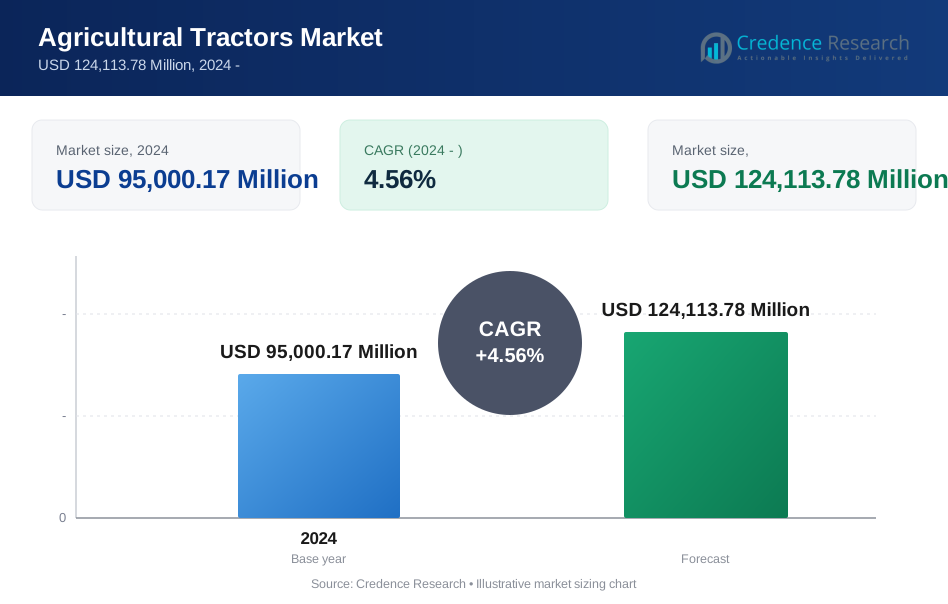
The Agricultural Tractors Market is projected to grow from USD 95,000.17 Million in 2024 to an estimated USD 124,113.78 Million by 2032, with a CAGR of 4.56% from 2024 to 2032. Market expansion is driven by rising farm mechanization, labor shortages in agriculture and wider adoption of precision farming tools. Asia Pacific leads global demand because India and China sustain high unit volumes, broad dealer networks and strong domestic manufacturing capacity.| REPORT ATTRIBUTE | DETAILS |
|---|---|
| Historical Period: | 2020-2023 |
| Base Year | 2024 |
| Forecast Period | 2025-2032 |
| Agricultural Tractors Market Market Size 2024 | USD 95,000.17 Million |
| Agricultural Tractors Market CAGR | 4.56% |
| Agricultural Tractors Market Market Size 2032 | USD 124,113.78 Million |
Market Insights
- Asia Pacific accounted for 47.2% of global revenue in 2024, supported by large farm populations, replacement demand and deep local production in India and China.
- Utility tractors led the type segment with an estimated 32.8% share because they serve mixed farming, haulage and loader work at manageable ownership cost.
- 100 HP tractors held the leading horsepower position with an estimated 54.6% share as buyers favored balanced power, fuel efficiency and implement compatibility.
- John Deere, CNH Industrial, AGCO, Kubota and Mahindra & Mahindra remained the most influential competitors because of broad portfolios, financing reach and strong dealer coverage.
- Current market direction centers on precision agriculture integration, telematics-enabled fleet management and gradual migration toward higher-specification 4WD platforms.
Market Segmentation Analysis
By Type (Utility, Row Crop, Orchard, Compact, Specialty) Utility tractors held the largest share of the type segment in 2024, at an estimated 32.8% of global revenue. Their lead reflects broad use across mixed farming operations, livestock support, light tillage and transport work. Buyers value these machines for versatility, lower acquisition cost than row-crop models and compatibility with loaders, trailers and routine field implements. By HP Range (100 HP) The 100 HP range accounted for the largest portion of market demand in 2024, at an estimated 54.6% share. This power class meets the needs of medium-duty cultivation, spraying, seeding and haulage without pushing fuel and financing costs too high. Farmers increasingly prefer this range because it balances output, maneuverability and implement flexibility across diverse cropping systems. By Drive Type (2WD, 4WD) 2WD tractors dominated the drive type segment in 2024, with an estimated 58.1% revenue share. Their position remains strong in price-sensitive markets where farms operate on relatively flat terrain and prioritize low maintenance costs. Wider affordability, easier servicing and strong availability in lower and mid-horsepower models continue to support demand for 2WD units. By End User (SME Farms, Large Farms, Contractors) SME Farms represented the largest end-user segment in 2024, with an estimated 61.4% share of global demand. This dominance reflects the large number of small and medium farm holdings across Asia Pacific, Latin America and parts of Europe. Purchase decisions in this segment are driven by subsidized financing, multi-purpose usage needs and rising pressure to improve labor productivity.Key Growth Drivers
Rising mechanization across fragmented farm structures Farm mechanization remains the strongest structural driver for tractor demand because growers need to raise output, reduce field-cycle time and manage rising labor scarcity. This trend is especially visible in markets with fragmented landholdings, where farmers are moving from animal traction and manual tools to entry and mid-range tractors. Demand is also expanding where rural wages have risen faster than crop realization, pushing operators to protect margins through mechanized plowing, sowing and transport. India remains a critical indicator of this shift, with annual tractor sales staying above 900,000 units in recent years, which reflects both replacement demand and first-time purchases. As governments and lenders widen access to seasonal credit, trade-in programs and equipment subsidies, more small and medium farms can justify ownership rather than relying only on rental services. Precision agriculture adoption boosts replacement demand Farmers increasingly evaluate tractors as digital work platforms rather than stand-alone mechanical assets. Demand is shifting toward models that support auto-guidance, implement control, telematics, variable-rate application and remote diagnostics. These features help operators cut overlap, improve fuel use and manage machine uptime more effectively during narrow planting and harvesting windows. This change supports replacement demand in mature markets and premiumization in developing markets. Large manufacturers are reinforcing this shift through technology investment, and John Deere continues to spend more than USD 2 billion annually on research and development, strengthening software, automation and connected equipment capabilities. As precision tools become easier to use and dealers bundle them with financing and aftersales support, farmers show greater willingness to upgrade to higher-value tractor platforms. Public support and rural finance expand equipment access Government-backed mechanization programs, subsidized interest rates and rural lending channels continue to support tractor purchases in many agricultural economies. These programs reduce upfront cost pressure and improve affordability for farmers that would otherwise delay replacement cycles. Public support also helps accelerate adoption in regions where tractors serve multiple roles, including field preparation, irrigation support, haulage and basic land development. In many countries, local authorities promote mechanization to strengthen food security, improve planting timeliness and reduce post-harvest inefficiencies. Growth also benefits from the expansion of non-bank finance, captive finance arms and dealer-led installment plans, which improve market access for first-time buyers. Together, policy support and financing availability create a more resilient demand base across both SME farms and commercial operations.Key Trends & Opportunities
Smart tractors gain commercial traction One of the clearest trends in the Agricultural Tractors Market is the move toward connected and increasingly automated machines. Buyers now prioritize integrated GPS guidance, telematics, yield-linked task planning and predictive maintenance tools that reduce downtime during peak field operations. Connectivity also improves fleet visibility for contractors and large farms that manage several operators across dispersed plots. This trend is moving from premium row-crop platforms into utility and specialty categories as component costs decline. Technology investment from major manufacturers continues to reinforce adoption, and John Deere’s annual research and development spend above USD 2 billion shows how strongly global leaders are positioning tractors as software-enabled assets rather than only mechanical equipment. Higher-specification models reshape product mix Another clear trend is the migration toward more capable tractor configurations, especially 4WD drivetrains, better hydraulics and improved operator comfort packages. Farmers are increasingly pairing tractors with heavier implements, front loaders and precision attachments, which raises demand for higher lift capacity and stronger transmission performance. Cab comfort, visibility and ergonomics are also becoming decisive in regions facing labor shortages and rising machine utilization hours. Specialty agriculture is influencing product development as well, with orchard and compact platforms adopting tighter turning radius, lower-profile designs and electronics suited to confined working environments. This shift is lifting average selling prices and widening the gap between entry-level mechanical tractors and premium precision-ready models. Emerging markets create volume opportunity Significant opportunity remains in emerging agricultural economies where mechanization levels still trail global averages. In these markets, tractor ownership can materially improve land preparation speed, transport efficiency and seasonal labor productivity. Demand potential is strongest where governments encourage domestic food production, irrigation expansion and mechanized sowing. Manufacturers can capture this opportunity by localizing production, expanding dealer coverage and offering durable utility tractors with simple maintenance requirements. Products that fit mixed farming systems, low total cost of ownership and flexible financing terms are likely to see the best response. Rental-to-own and community hiring models also create practical entry points for farmers who cannot immediately finance full ownership. Low-emission and alternative-power platforms open new niches Opportunity is also building around low-emission tractors, especially compact and specialty units used in orchards, vineyards, municipalities and enclosed environments. Battery-electric and alternative-fuel platforms remain a small part of the installed base, yet they offer strategic potential where noise reduction, indoor use and local emissions rules matter. This is particularly relevant in developed markets with strict environmental targets and premium horticulture segments. Suppliers that can combine clean-power systems with dependable runtime and competitive service support may secure early mover advantage. Over time, this niche can expand into broader tractor classes as charging access, energy density and total-cost economics improve.Key Challenges
High acquisition cost and volatile input economics Tractor purchases remain highly sensitive to farm income, commodity prices and interest rates. When crop margins weaken, farmers often postpone replacement cycles and extend equipment use beyond ideal service life. This challenge is more acute for small and medium farms, which face tighter credit conditions and less bargaining power with dealers. Rising steel, tire, electronics and logistics costs can also lift machine prices and reduce affordability. Even when demand fundamentals remain healthy, price escalation can shift customers toward used equipment, lower-horsepower models or rental alternatives, which limits premium product penetration. Service gaps and supply chain complexity Aftersales capability remains a critical barrier in many rural markets. Farmers expect reliable parts supply, fast repair turnaround and qualified technicians because breakdowns during planting or harvesting can damage seasonal output. However, service coverage varies widely by geography, especially for advanced tractors that rely on sensors, software and electronic control systems. Supply chain disruption adds further pressure by extending lead times for components and delaying dealer inventory replenishment. Manufacturers must therefore balance technology upgrades with service simplicity, local parts stocking and dealer training to avoid slower adoption in underserved markets.Regional Analysis
North America Agricultural Tractors Market Market Trends North America accounted for 18.7% of global Agricultural Tractors Market revenue in 2024. Demand in this region is shaped by large commercial farms, strong replacement cycles and rapid adoption of high-horsepower and precision-enabled tractor platforms. Buyers place high value on telematics, guidance systems, operator comfort and financing packages tied to seasonal cash flow. Dealer service coverage and parts availability strongly influence brand choice, especially during planting and harvest windows. The market also shows healthy demand for compact tractors used in small farms, acreage management and municipal applications, which broadens volume beyond large row-crop operations. Competitive intensity stays high because premium product positioning, digital services and aftersales responsiveness all affect purchase decisions. Asia Pacific Agricultural Tractors Market Market Trends Asia Pacific accounted for 47.2% of global Agricultural Tractors Market revenue in 2024. The region leads because it combines very high farm populations with large domestic manufacturing bases and wide product availability across price points. India drives substantial unit demand in lower and mid-horsepower categories, while China supports both mechanization upgrades and local equipment production. SME farms dominate purchasing behavior, which keeps demand strong for utility tractors, simple drivetrains and finance-backed ownership models. Dealer proximity, affordable spare parts and durability in mixed farming conditions are more decisive than advanced features in many local markets. At the same time, precision-ready and specialty tractors are gaining traction in commercial farms and high-value horticulture areas. Europe Agricultural Tractors Market Market Trends Europe accounted for 21.4% of global Agricultural Tractors Market revenue in 2024. The region benefits from advanced mechanization, strong replacement demand and steady adoption of premium tractors with precision agriculture capabilities. Farms in Western Europe often prioritize fuel efficiency, emissions compliance, cab comfort and integrated digital control systems when selecting equipment. Specialty tractors for vineyards, orchards and narrow-field applications represent an important product niche, particularly in Southern Europe. Regulatory pressure on emissions and sustainability encourages manufacturers to improve engine efficiency and explore alternative-power concepts in compact segments. Brand competition remains intense, with buyers often favoring suppliers that offer strong dealer support, technology integration and reliable residual values. Latin America Agricultural Tractors Market Market Trends Latin America accounted for 7.1% of global Agricultural Tractors Market revenue in 2024. Regional demand is closely linked to large-scale cultivation of soybeans, corn, sugarcane and other export-oriented crops, which support purchases of durable medium and high-horsepower tractors. Brazil remains the main demand center because its commercial farms require equipment for broad-acre fieldwork and heavy seasonal utilization. Financing availability and crop income expectations materially affect order timing, creating more cyclical purchasing patterns than in some mature markets. 4WD demand is comparatively strong in areas that require traction for large implements and varied soil conditions. Manufacturers compete through local assembly, dealer reach and support packages that reduce downtime in remote agricultural zones. Middle East & Africa Agricultural Tractors Market Market Trends Middle East & Africa accounted for 5.6% of global Agricultural Tractors Market revenue in 2024. Market performance varies widely across countries, with demand strongest in areas investing in food production, irrigation expansion and basic mechanization. Buyers in many markets prioritize rugged utility tractors, simple maintenance and low operating cost because service infrastructure can be limited. Government programs, development financing and fleet purchases by contractors often play an outsized role in market formation. In more mature agricultural pockets, demand is moving toward higher-power and 4WD models suited to larger farms and tougher field conditions. Import dependence remains significant in several countries, making pricing more sensitive to currency movements, freight costs and distributor capability.Market Segmentations
- By Type
- Utility
- Row Crop
- Orchard
- Compact
- Specialty
- By HP Range
- 100 HP
- By Drive Type
- 2WD
- 4WD
- By End User
- SME Farms
- Large Farms
- Contractors
- By Geography
- North America
- U.S.
- Canada
- Mexico
- Europe
- Germany
- France
- UK
- Italy
- Spain
- Rest of Europe
- Asia Pacific
- China
- India
- Japan
- South Korea
- Southeast Asia
- Rest of Asia Pacific
- Latin America
- Brazil
- Argentina
- Rest of Latin America
- Middle East & Africa
- GCC
- South Africa
- Rest of Middle East & Africa
- North America
Competitive Landscape
The Agricultural Tractors Market shows strong competitive intensity, with global leaders and regional manufacturers competing on technology depth, product breadth and channel strength. Major companies focus on innovation in precision guidance, telematics, automation, fuel efficiency and operator comfort to lift machine value and support premium pricing. Product strategy centers on broad portfolios that cover compact, utility, row-crop and specialty tractors, allowing suppliers to address both SME farms and large commercial operations. Distribution remains a decisive competitive lever because buyers depend on dealer proximity, parts access, financing support and fast field service. Partnerships with precision agriculture providers, local distributors and finance institutions help expand reach and improve customer retention. Competitive pressure is highest in Asia Pacific and Europe, where pricing discipline, localized manufacturing and frequent feature upgrades shape purchase decisions. Brand equity remains important, but aftersales execution increasingly determines long-term market share.Key Player Analysis
- John Deere
- CNH Industrial
- AGCO
- Kubota
- Mahindra & Mahindra
- CLAAS
- Yanmar
- Escorts Kubota
- SAME Deutz-Fahr
- JCB
- TAFE
Recent Developments
- In January 2025, John Deere expanded its autonomous machinery roadmap at CES 2025, highlighting next-generation autonomous capabilities for agricultural equipment and reinforcing its push into software-led tractor operations.
- In March 2025, Kubota introduced updated smart farming functionality across selected tractor platforms, adding stronger connectivity, guidance integration and fleet-management features for commercial users.
- In February 2026, AGCO advanced rollout of PTx precision agriculture solutions across Fendt and Massey Ferguson tractor lines, strengthening factory-fit technology options and digital workflow integration.
Request a Free Sample
Fill in your details and we'll send you a free sample report.
- Sample data tables & charts
- Research methodology
Need a Custom Version of This Report?
Tailor the scope, geography, or segments to your exact requirements.
- Custom geography or segment scope
- Direct access to our analyst team
Frequently Asked Questions
What was the size of the Agricultural Tractors Market in 2024?
What is driving growth in the Agricultural Tractors Market?
What key trend is shaping the Agricultural Tractors Market?
Which segment leads the Agricultural Tractors Market by type?
Who are the top players in the Agricultural Tractors Market?
Table of Content
Chapter 1. Report Introduction
- 1.1 Report Description & Purpose
- 1.1.1 Report Title & Market Definition
- 1.1.2 Unique Selling Propositions (USP) & Key Differentiators
- 1.1.3 Value Proposition for Stakeholders
- 1.2 Research Objectives
- 1.2.1 Market Sizing Objectives (Volume & Revenue)
- 1.2.2 Segmentation Objectives
- 1.2.3 Competitive Intelligence Objectives
- 1.2.4 Forecast & Scenario Objectives
- 1.3 Report Scope
- 1.3.1 Agricultural Tractors Scope – Types & Subtypes Covered
- 1.3.2 Geographic Scope – Regions & Countries Covered
- 1.3.3 Historical Period, Base Year & Forecast Period (2024; forecast to the forecast period)
- 1.3.4 Inclusions & Exclusions
- 1.4 HS Code & Classification Framework
- 1.5 Currency, Units & Pricing Basis
- 1.6 Target Stakeholders
- 1.7 Limitations & Assumptions
Chapter 2. Executive Summary
- 2.1 Global Agricultural Tractors Market Snapshot
- 2.1.1 Market Size – Historical (2024) & Forecast (the forecast period) (2024: USD 95,000.17 Million → forecast year: USD 124,113.78 Million)
- 2.1.2 Volume & Revenue – Global Totals
- 2.1.3 Key Market Highlights – Top Five Facts
- 2.2 Agricultural Tractors Market Segmentation Snapshot
- 2.2.1 Market Split by Region – 2024 vs.
- 2.3 Competitive Snapshot
- 2.3.1 Top 10 Players by Revenue Share – 2024
- 2.3.2 Top 10 Players by Volume Share – 2024
- 2.3.3 Recent Strategic Developments (18-Month Summary)
- 2.4 Key Investment Highlights & Strategic Conclusions
Chapter 3. Agricultural Tractors Market Dynamics & Industry Analysis
- 3.1 Market Overview & Context
- 3.1.1 Agricultural Tractors Market Position in the Broader Automotive Value Chain
- 3.1.2 OEM vs. Replacement Market Dynamics
- 3.1.3 Market Maturity & Development Stage by Region
- 3.2 Agricultural Tractors Market Drivers
- 3.3 Agricultural Tractors Market Restraints & Challenges
- 3.4 Agricultural Tractors Market Opportunities
- 3.5 Porter's Five Forces Analysis
- 3.5.1 Threat of New Entrants
- 3.5.2 Bargaining Power of Suppliers
- 3.5.3 Bargaining Power of Buyers
- 3.5.4 Threat of Substitutes
- 3.5.5 Competitive Rivalry – Intensity Assessment
- 3.6 Agricultural Tractors Value Chain Analysis
- 3.6.1 Upstream – Raw Material/Input Suppliers
- 3.6.1.1 Raw Material/Input 1
- 3.6.1.2 Raw Material/Input 2
- 3.6.1.3 Raw Material/Input 3
- 3.6.2 Midstream – Production/Manufacturing/Service Delivery
- 3.6.2.1 Production/Process Overview
- 3.6.2.2 Key Facility Locations & Capacity by Manufacturer
- 3.6.3 Downstream – Distribution & End Consumer
- 3.6.3.1 Primary Channel – B2B/OEM
- 3.6.3.2 Secondary Channels – Dealer, Retail, Online, Direct
- 3.6.4 Value Chain Profitability Analysis
- 3.6.1 Upstream – Raw Material/Input Suppliers
- 3.7 PESTEL Analysis
- 3.7.1 Political Factors
- 3.7.2 Economic Factors
- 3.7.3 Social Factors
- 3.7.4 Technological Factors
- 3.7.5 Environmental Factors
- 3.7.6 Legal Factors
- 3.8 Agricultural Tractors Supply Chain Analysis
- 3.8.1 Raw Material/Input Supply Risk Assessment
- 3.8.2 Manufacturing Concentration Risk (Geographic Exposure)
- 3.8.3 Trade Disruption Impact Analysis
- 3.9 Regulatory & Policy Landscape
Note: The regulatory and policy landscape section covers regulations based on their applicability to the market, Agricultural Tractors category, geography, and scope of the study. Only regulatory frameworks with a material impact on operations, compliance, trade, sustainability, or market access are analyzed in detail.
Chapter 4. Key Investment Pockets & Opportunity Analysis
- 4.1 Agricultural Tractors Market Attractiveness Analysis
- 4.1.1 By Region – Investment Attractiveness Matrix (Volume × CAGR)
- 4.2 Absolute Revenue Growth Opportunity
- 4.2.1 By Region – Absolute USD Growth Through the forecast period
- 4.3 Incremental Volume Opportunity
- 4.3.1 By Region – Incremental Volume Through the forecast period
- 4.3.2 Segment – Incremental Volume
- 4.4 Emerging Submarket Opportunity Deep Dive (Subject to Applicability)
- 4.5 Emerging Market Opportunity Scorecards
- 4.5.1 United States
- 4.5.2 Europe
- 4.5.3 Asia
- 4.5.4 Middle East & Africa
Note: Emerging Market Opportunity Scorecards will be included based on relevance and strategic importance. Regions listed are indicative and may vary depending on data availability and market dynamics.
Chapter 5. Agricultural Tractors Import-Export Analysis & Trade Flows
- 5.1 Global Trade Overview
- 5.1.1 Global Export Value by Country (2024)
- 5.1.2 Global Export Volume by Country (2024)
- 5.1.3 Global Import Value by Country (2024)
- 5.1.4 Global Import Volume by Country (2024)
- 5.1.5 Net Trade Balance by Country (2024)
- 5.2 Export Analysis – Segment
- 5.2.1 Type 1 (HS Code)
- 5.2.2 Type 2 (HS Code)
- 5.2.3 Type 3 (HS Code)
- 5.2.4 Type 4 (HS Code)
- 5.2.5 Type 5 (HS Code)
- 5.3 Import Analysis – Segment
- 5.3.1 Type 1 (HS Code)
- 5.3.2 Type 2 (HS Code)
- 5.3.3 Type 3 (HS Code)
- 5.3.4 Type 4 (HS Code)
- 5.3.5 Type 5 (HS Code)
- 5.4 Average Unit Trade Prices
- 5.4.1 Average Export Price – Segment & Country
- 5.4.2 Average Import Price – Segment & Source Country
- 5.4.3 Price Trends (2024)
- 5.5 Key Trade Route Analysis
- 5.5.1 Trade Route 1
- 5.5.2 Trade Route 2
- 5.5.3 Trade Route 3
- 5.5.4 Trade Route 4
- 5.5.5 Trade Route 5
- 5.6 Trade Policy Impact Assessment
- 5.6.1 US Anti-Dumping & Section 301 Tariffs
- 5.6.2 EU Customs Union Impact
- 5.6.3 Major Free Trade Agreements
- 5.6.4 USMCA Rules of Origin
Note: Trade policy analysis will be included only where relevant to the Agricultural Tractors market.
Chapter 6. Competitive Landscape & Company Benchmarking
- 6.1 Agricultural Tractors Market Concentration & Structure
- 6.1.1 Herfindahl-Hirschman Index (HHI) – vs. 2024
- 6.1.2 Tier 1, Tier 2 & Tier 3 Market Structure
- 6.1.3 Global, Regional & Local Player Dynamics
- 6.2 Agricultural Tractors Market Share Analysis – 2024
- 6.2.1 Global Revenue Share by Company
- 6.2.2 Global Volume Share by Company
- 6.2.3 Regional Revenue Share
- 6.2.4 Market Share Evolution ( vs. 2024)
- 6.2.5 OEM Segment Share by Company
- 6.2.6 Replacement Segment Share by Company
- 6.3 Production/Delivery Capacity & Facility Analysis
- 6.3.1 Global Installed Capacity
- 6.3.2 Capacity Utilization Rates
- 6.3.3 Production/Output Volume
- 6.3.4 Facility Locations & Capacity Map
- 6.3.5 Planned Capacity Additions
- 6.4 Agricultural Tractors Competitive Benchmarking Matrix
- 6.4.1 Revenue, Volume, CAGR & Profitability Comparison
- 6.4.2 Channel Revenue Mix
- 6.4.3 Geographic Revenue Exposure
- 6.4.4 R&D Intensity
- 6.4.5 Sustainability Maturity
- 6.5 Strategic Developments in Agricultural Tractors (Last 24 Months)
- 6.5.1 Mergers, Acquisitions & Divestments
- 6.5.2 New Agricultural Tractors Launches
- 6.5.3 Facility Expansions
- 6.5.4 Strategic Alliances, Joint Ventures & Partnerships
- 6.5.5 Distribution Expansion & Market Entry
- 6.5.6 Sustainability & ESG Initiatives
- 6.6 Competitive Strategy Mapping
- 6.6.1 Leader, Challenger, Follower & Niche Classification
- 6.6.2 Pricing Strategy Comparison
- 6.6.3 Channel Strategy Matrix
Note: Strategic developments are included based on their materiality and the availability of reliable information.
Chapter 7. Global Agricultural Tractors Market – By Distribution Channel
- 7.1 Segment Overview
- 7.1.1 Volume & Revenue Split by Channel (2024 & )
- 7.1.2 Channel Mix Evolution (the forecast period)
Chapter 8. Regional Market Analysis – Global Overview
- 8.1 Global Regional Overview
- 8.1.1 Regional Volume Share
- 8.1.2 Regional Revenue Share
- 8.1.3 Regional Volume by Region
- 8.1.4 Regional Revenue by Region
- 8.1.5 Regional Forecast Through the forecast period
- 8.2 Cross-Regional Segment Analysis
- 8.2.1 By Distribution Channel
- 8.2.2 By Brand/Price Tier
Chapter 9. North America Agricultural Tractors Market
- 9.1 United States
- 9.2 Canada
- 9.3 Mexico
Chapter 10. Europe Agricultural Tractors Market
- 10.1 Germany
- 10.2 France
- 10.3 Italy
- 10.4 United Kingdom
- 10.5 Spain
- 10.6 Poland
- 10.7 Russia
- 10.8 Netherlands
- 10.9 Belgium
- 10.10 Sweden
- 10.11 Denmark
- 10.12 Norway
- 10.13 Rest of Europe
Chapter 11. Asia Pacific Agricultural Tractors Market
- 11.1 China
- 11.2 India
- 11.3 Japan
- 11.4 South Korea
- 11.5 Thailand
- 11.6 Indonesia
- 11.7 Vietnam
- 11.8 Malaysia
- 11.9 Australia
- 11.10 Rest of Asia Pacific
Chapter 12. Latin America Agricultural Tractors Market
- 12.1 Brazil
- 12.2 Argentina
- 12.3 Colombia
- 12.4 Chile
- 12.5 Rest of Latin America
Chapter 13. Middle East Agricultural Tractors Market
- 13.1 Saudi Arabia
- 13.2 United Arab Emirates
- 13.3 Turkey
- 13.4 Israel
- 13.5 Iran
- 13.6 Rest of the Middle East
Chapter 14. Africa Agricultural Tractors Market
- 14.1 South Africa
- 14.2 Egypt
- 14.3 Nigeria
- 14.4 Morocco
- 14.5 Rest of Africa
Chapter 15. Agricultural Tractors Company Profiles
- 15.1 [Company 01]
- 15.1.1 Company Overview
- 15.1.2 Key Management Personnel
- 15.1.3 Products & Services Portfolio
- 15.1.4 Financial Performance
- 15.1.5 Key Market Focus & Geographic Presence
- 15.1.6 Recent Developments & Strategic Initiatives
Note: The company profile list is preliminary and may change based on research findings, market developments, data availability, and client requirements.
Chapter 16. Appendices
- Appendix A – List of Abbreviations & Acronyms
- Appendix B – Industry Classification Code Reference – Full Series
- Appendix C – Production & Capacity Data Tables
- Appendix D – End-Use & Demand Base Tables
- Appendix E – Consumption & Replacement Rate Assumptions
- Appendix F – ASP Reference Tables
- Appendix G – Manufacturing & Facility Database
- Appendix H – Import-Export Data Tables
- Appendix I – Regulatory Summary Tables
- Appendix J – Primary Research Participant List (Anonymized)
- Appendix K – Primary Research Questionnaire Framework
- Appendix L – Data Sources & Bibliography
- Appendix M – Market Size Divergence & Source Comparison
Chapter 17. Research Methodology
- 17.1 Research Framework & Philosophy
- 17.2 Secondary Research – Sources, Hierarchy & Data Extraction
- 17.3 Data Modeling – Bottom-Up & Top-Down Market Sizing
- 17.4 Primary Research – Stakeholder Framework, LOI & Sample Sizes
- 17.5 Forecast Methodology – Regression, Scenario & Sensitivity Analysis
- 17.6 Quality Control – Four-Layer Validation Framework
- 17.7 Limitations & Standard Assumptions
- 17.8 Disclaimer
