
Market Overview
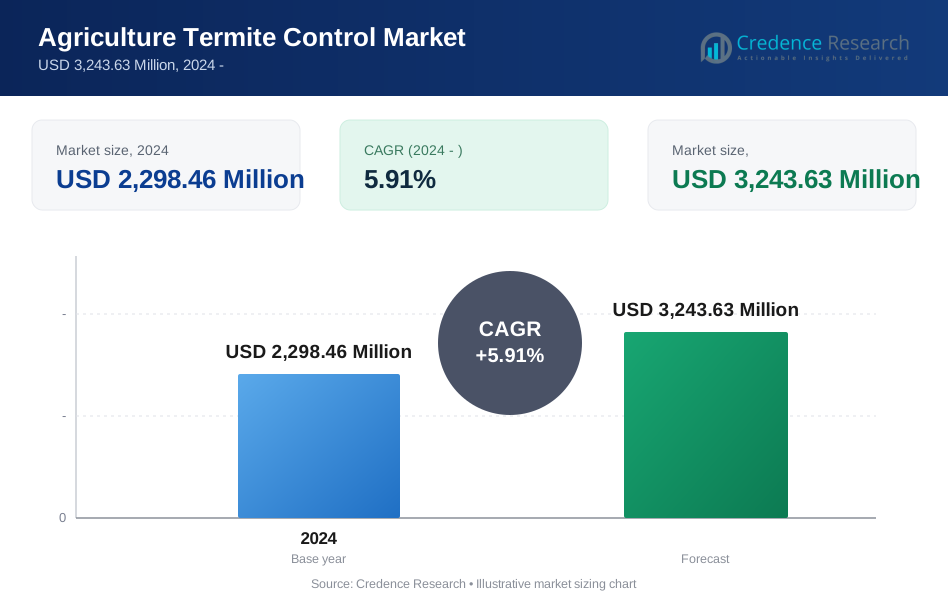
The Agriculture Termite Control Market was valued at USD 2,298.46 Million in 2024 and is projected to reach USD 3,243.63 Million by 2032, expanding at a CAGR of 5.91% from 2024 to 2032. Market growth is driven by rising termite pressure on farm infrastructure, crop storage assets and soil protection systems. Asia Pacific led global demand in 2024 because of extensive agricultural activity, tropical climate exposure and broad use of chemical and bait-based termite management across farms and rural buildings.
| REPORT ATTRIBUTE | DETAILS |
|---|---|
| Historical Period: | 2020-2023 |
| Base Year | 2024 |
| Forecast Period | 2025-2032 |
| Agriculture Termite Control Market Market Size 2024 | USD 2,298.46 Million |
| Agriculture Termite Control Market CAGR | 5.91% |
| Agriculture Termite Control Market Market Size 2032 | USD 3,243.63 Million |
Market Insights
- Asia Pacific held the leading regional position in 2024 with 36.20% of global revenue, supported by high termite prevalence across major agricultural economies.
- Chemical control led by method with an estimated 48.7% share in 2024 because growers continue to prioritize fast knockdown and wide treatment coverage.
- Liquid termiticides remained the top product segment with a 41.3% share as they fit soil barriers, perimeter applications and structural protection programs.
- Subterranean termites dominated pest type demand with a 57.6% share, reflecting their strong presence in soil systems, storage zones and farm structures.
- BASF, Syngenta, Bayer, Corteva and FMC Corporation remained key market participants, while integrated pest management and lower-residue solutions shaped current market direction.
Market Segmentation Analysis
Control Method (Chemical, Baiting, Biological, Integrated Pest Management)
Chemical held the largest share of the Agriculture Termite Control Market at 48.7% in 2024. This dominance reflects its rapid action, proven field performance and ease of deployment across large agricultural sites. Growers and rural property operators continue to prefer chemical solutions for preventive soil barriers, curative structural treatment and broad-area termite suppression where infestation risk can escalate quickly.
By Product Type (Liquid Termiticides, Granules, Bait Stations, Foam Treatments)
Liquid termiticides accounted for the largest product share at 41.3% in 2024. Their leadership comes from strong penetration into soil treatment and structural perimeter applications, where uniform coverage and long residual action remain critical. Agricultural users value liquid formulations because they work well in pre-construction, post-construction and farm infrastructure protection programs with relatively straightforward application protocols.
By Application Area (Soil Treatment, Structural Protection, Crop Storage, Farm Infrastructure)
Soil treatment led the application landscape with a 38.9% share in 2024. This segment benefits from the central role of below-ground termite management in protecting crop roots, foundations and storage-adjacent land. Preventive soil barriers are widely used because subterranean termite colonies often originate below the surface and spread unnoticed before material damage becomes visible.
By Pest Type (Subterranean, Drywood, Dampwood)
Subterranean termites represented the dominant pest type with 57.6% of market revenue in 2024. Their dominance stems from extensive soil-based nesting behavior, high colony size and strong destructive capacity across wooden structures, irrigation supports and underground access points. Demand for control remains elevated because these termites frequently affect farms, warehouses and rural buildings with persistent reinfestation risk.
By End User (Farms, Warehouses, Greenhouses, Rural Buildings)
Farms held the largest end-user share at 44.8% in 2024. Farms drive demand because they combine soil exposure, storage areas, fencing, utility posts and operational buildings that are vulnerable to termite attack. Large farm footprints also increase the need for recurring inspection, preventive treatment and integrated programs that protect both productive land and supporting agricultural infrastructure.
Key Growth Drivers
Protect crop storage and soil assets from rising termite pressure
Termite activity is becoming more costly for agricultural operators because infestations now threaten storage units, packaging areas, wooden supports and soil-adjacent assets across intensive farming systems. This raises demand for liquid termiticides, bait systems and preventive soil treatment that can protect stored produce and reduce structural losses. Pressure is especially high in warm and humid production belts where termites remain active for longer periods of the year and spread rapidly across untreated sites.
A major supporting factor is post-harvest loss reduction. Global food agencies estimate that around 14% of food is lost between harvest and retail, which keeps pest exclusion and storage protection high on investment agendas. As growers try to preserve crop quality, maintain shelf life and avoid contamination, termite control spending becomes part of broader farm risk management and asset protection programs.
Expand investment in farm infrastructure and rural construction
Agricultural modernization is driving construction of warehouses, pack houses, sheds, irrigation housing, fencing systems and processing units that require long-term termite protection. New and upgraded rural buildings increase demand for pre-construction soil barriers, post-construction corrective treatment and recurring inspection contracts. In many markets, larger commercial farms are shifting from reactive treatment to planned protection because damage to support structures can interrupt logistics, storage and field operations.
Publicly available estimates show termites cause more than USD 5 billion in damage each year in the United States alone, underscoring how costly unchecked infestations can become for buildings and wood-based assets. This cost signal supports greater adoption of durable treatment programs in agriculture, where infrastructure utilization rates are high and replacement costs can disrupt operating margins.
Shift toward integrated pest management and stewardship-led programs
Buyers are increasingly selecting termite solutions that balance efficacy, safety, residue control and regulatory compliance. This change is pushing demand toward integrated pest management programs that combine inspection, monitoring, targeted chemical use and site sanitation. Agricultural customers value these programs because they can lower overtreatment risk while still protecting crop storage and farm infrastructure.
Manufacturers and service providers are responding with more selective formulations, application guidance and service-led contracts that improve treatment timing and follow-up. The trend also aligns with rising procurement discipline among commercial farms, cooperatives and warehouse operators, which now assess treatment performance, worker safety and stewardship credentials before purchase. As a result, integrated offerings are expanding the addressable market beyond one-time product sales and into recurring service revenue.
Key Trends & Opportunities
Advance precision monitoring and formulation innovation
Market participants are moving toward more targeted termite management that combines inspection data, bait placement strategy and formulation upgrades. This trend reflects growing demand for better treatment precision around crop storage, greenhouses and rural structures where indiscriminate application is less desirable. Suppliers are improving residual performance, site-specific placement and compatibility with integrated pest management workflows. Innovation capacity remains important in this shift. BASF has publicly indicated annual agricultural research and development investment above EUR 900 million, which supports ongoing formulation improvement, stewardship testing and differentiated delivery systems across pest control categories. In termite control, that innovation mindset supports products that offer better persistence, lower dose intensity and stronger fit with professional service programs.
Expand biological and integrated solutions across agriculture
Buyers increasingly prefer solutions that can fit stricter residue expectations and broader sustainability goals. This is encouraging more use of biological agents, baiting systems and integrated pest management combinations rather than relying only on broad chemical treatment. Demand is strongest in greenhouse operations, premium crop systems and export-linked storage environments where users prioritize documentation, traceability and controlled application. Service providers are also packaging inspection, monitoring and corrective treatment into single contracts, which improves retention and creates more predictable buying cycles. As this model scales, market competition is shifting from stand-alone products toward performance-led solutions that can demonstrate protection value over time.
Capture demand from warehouse modernization and rural asset protection
Significant opportunity exists in warehouse modernization, farm infrastructure upgrades and rural construction expansion across Asia Pacific, Latin America and parts of Africa. As agricultural value chains add new storage, sorting and handling assets, termite control suppliers can sell preventive soil treatment, perimeter protection and recurring monitoring. Warehouses and rural buildings are especially attractive because they often require both initial treatment and follow-up maintenance. Suppliers that offer bundled programs for structural protection, crop storage hygiene and pest monitoring can improve contract value. Opportunity is also rising in secondary cities and district-level agricultural hubs, where organized storage capacity is expanding faster than local pest management capability.
Build service-led channels and strategic partnerships
Another major opportunity lies in expanding distribution through agri-input dealers, rural construction contractors, warehouse service firms and specialized pest management operators. These channels help suppliers reach fragmented farm customers without relying only on direct sales. Partnerships can also support training, application quality and localized recommendations, which are critical in termite control because infestation patterns vary widely by climate and structure type. Companies that combine product supply with advisory support, inspection tools and service agreements can deepen customer relationships and defend pricing. This creates room for recurring revenue models in farms, greenhouses and rural commercial buildings where prevention is usually more cost effective than late-stage remediation.
Key Challenges
Tightening regulation and application restrictions
Regulatory scrutiny remains a major challenge for the Agriculture Termite Control Market because active ingredient reviews, residue concerns and environmental standards can limit product choice and slow approvals. Suppliers must invest in reformulation, label adaptation and stewardship programs to keep products compliant across multiple markets. This raises development cost and can delay commercialization, especially for products sold across both agricultural and structural use settings.
Fragmented demand and high price sensitivity
Market demand remains highly fragmented across farms, warehouses, greenhouses and rural buildings, which complicates sales execution and service delivery. Many customers still buy reactively after visible infestation rather than through planned prevention contracts. Price sensitivity is high in emerging markets, where users may postpone treatment or choose low-cost options with inconsistent performance. This limits premium product penetration and increases competitive pressure on distributors and service providers.
Regional Analysis
North America Agriculture Termite Control Market Market Trends
North America accounted for 27.40% of global Agriculture Termite Control Market revenue in 2024. Demand in the region is supported by high awareness of structural termite risk across farm buildings, grain storage sites and rural commercial properties. Buyers favor liquid termiticides and bait stations because they fit preventive treatment around foundations, utility poles and storage infrastructure. Professional service delivery is well established, which supports recurring inspection contracts and integrated treatment programs rather than one-time product purchases. Distribution remains concentrated through pest management specialists, farm supply channels and commercial building service providers. Competitive intensity is high because users expect documented efficacy, regulatory compliance and reliable follow-up service.
Asia Pacific Agriculture Termite Control Market Market Trends
Asia Pacific accounted for 36.20% of global Agriculture Termite Control Market revenue in 2024. The region leads because large agricultural economies face persistent termite exposure across tropical and subtropical production zones. Farms, greenhouses and rural buildings often require both soil treatment and structural protection, which supports broad use of chemical and bait-based solutions. Demand is also lifted by expanding warehouse capacity, rural infrastructure development and higher investment in crop protection across India, China and Southeast Asia. Distribution is mixed, with multinational crop protection companies, local formulators and pest control operators all active in the market. Pricing remains competitive, but buyers increasingly value durable performance and lower retreatment frequency.
Europe Agriculture Termite Control Market Market Trends
Europe accounted for 17.30% of global Agriculture Termite Control Market revenue in 2024. Regional demand is more selective and compliance driven, with buyers placing greater emphasis on stewardship, documentation and controlled application. Southern Europe contributes a larger share of consumption because warmer climates support termite activity around farms, vineyards, storage assets and rural structures. Integrated pest management has stronger traction here than in many regions, which benefits bait systems, targeted formulations and service-led monitoring. Distribution depends heavily on regulated professional channels and specialized pest management providers rather than broad commodity sales. Market growth remains steady, though product approval timelines and environmental review standards can slow portfolio expansion.
Latin America Agriculture Termite Control Market Market Trends
Latin America accounted for 10.80% of global Agriculture Termite Control Market revenue in 2024. The market benefits from warm climates, extensive agricultural land and continued investment in export-oriented crop storage and farm infrastructure. Large farms and plantation systems support demand for soil barriers, perimeter treatment and protection of wooden and mixed-material structures. Buyers often prioritize cost-effective chemical solutions, though interest in integrated pest management is increasing in commercial operations linked to international quality standards. Distributor networks and agri-retail channels play a central role because many customers operate outside major urban service centers. Market performance also depends on seasonal purchasing cycles and local currency conditions that influence input affordability.
Middle East & Africa Agriculture Termite Control Market Market Trends
Middle East & Africa accounted for 8.30% of global Agriculture Termite Control Market revenue in 2024. Demand is shaped by the need to protect rural buildings, irrigation-linked assets, storage units and farm perimeters in climates where termite pressure can be severe. In several markets, control programs focus on preventive soil treatment and structural protection because replacement of damaged assets is expensive and logistically difficult. Adoption is rising as commercial farming expands and food security projects increase investment in storage and handling infrastructure. However, affordability constraints still influence product choice, which keeps lower-cost chemical options relevant alongside premium service-led offerings. Growth opportunities remain strongest where organized agriculture and professional pest management networks are scaling together.
Market Segmentations
- By Control Method
- Chemical
- Baiting
- Biological
- Integrated Pest Management
- By Product Type
- Liquid Termiticides
- Granules
- Bait Stations
- Foam Treatments
- By Application Area
- Soil Treatment
- Structural Protection
- Crop Storage
- Farm Infrastructure
- By Pest Type
- Subterranean
- Drywood
- Dampwood
- By End User
- Farms
- Warehouses
- Greenhouses
- Rural Buildings
- By Geography
- North America
- U.S.
- Canada
- Mexico
- Europe
- Germany
- UK
- France
- Italy
- Spain
- Rest of Europe
- Asia Pacific
- China
- Japan
- India
- South Korea
- Southeast Asia
- Rest of Asia Pacific
- Latin America
- Brazil
- Argentina
- Rest of Latin America
- Middle East & Africa
- GCC Countries
- South Africa
- Rest of Middle East & Africa
- North America
Competitive Landscape
The Agriculture Termite Control Market shows moderate to high competitive intensity, with global crop protection companies, specialist pest management firms and niche formulators competing on performance, compliance and service reach. Innovation remains a core differentiator as suppliers refine liquid termiticides, bait systems and integrated programs that improve residual control and application precision. Product strategy increasingly centers on lower-residue formulations, stewardship support and compatibility with integrated pest management.
Distribution strength also matters because success depends on access to farms, warehouses, greenhouses and rural buildings through agri-input dealers, contractor networks and professional pest control channels. Partnerships with local distributors and service providers help companies expand in fragmented rural markets and improve post-sale support. Competition is strongest in regions where regulatory standards are tightening and buyers demand documented efficacy, reliable inspection cycles and cost-effective prevention rather than reactive treatment alone.
Key Player Analysis
- BASF
- Syngenta
- Bayer
- Corteva
- FMC Corporation
- Sumitomo Chemical
- UPL
- Rentokil Initial
- Anticimex
- Ensystex
- Bell Labs
Recent Developments
- In February 2025, BASF highlighted continued investment in formulation improvement and stewardship support across professional pest management and agricultural protection channels, strengthening its position in site-specific termite management.
- In August 2025, Rentokil Initial announced further expansion of its service network through local pest control acquisitions, improving coverage for warehouse, rural building and commercial agricultural customers.
- In January 2026, Syngenta expanded commercialization efforts in biological and integrated crop protection solutions across Asia Pacific and Latin America, supporting broader adoption of lower-residue pest management programs relevant to termite control environments.
Request a Free Sample
Fill in your details and we'll send you a free sample report.
- Sample data tables & charts
- Research methodology
Need a Custom Version of This Report?
Tailor the scope, geography, or segments to your exact requirements.
- Custom geography or segment scope
- Direct access to our analyst team
Frequently Asked Questions
What is the current size of the Agriculture Termite Control Market?
What is driving growth in the Agriculture Termite Control Market?
What key trend is shaping the Agriculture Termite Control Market?
Which segment leads the Agriculture Termite Control Market by control method?
Who are the top players in the Agriculture Termite Control Market?
Table of Content
Chapter 1. Report Introduction
- 1.1 Report Description & Purpose
- 1.1.1 Report Title & Market Definition
- 1.1.2 Unique Selling Propositions (USP) & Key Differentiators
- 1.1.3 Value Proposition for Stakeholders
- 1.2 Research Objectives
- 1.2.1 Market Sizing Objectives (Volume & Revenue)
- 1.2.2 Segmentation Objectives
- 1.2.3 Competitive Intelligence Objectives
- 1.2.4 Forecast & Scenario Objectives
- 1.3 Report Scope
- 1.3.1 Agriculture Termite Control Scope – Types & Subtypes Covered
- 1.3.2 Geographic Scope – Regions & Countries Covered
- 1.3.3 Historical Period, Base Year & Forecast Period (2024; forecast to the forecast period)
- 1.3.4 Inclusions & Exclusions
- 1.4 HS Code & Classification Framework
- 1.5 Currency, Units & Pricing Basis
- 1.6 Target Stakeholders
- 1.7 Limitations & Assumptions
Chapter 2. Executive Summary
- 2.1 Global Agriculture Termite Control Market Snapshot
- 2.1.1 Market Size – Historical (2024) & Forecast (the forecast period) (2024: USD 2,298.46 Million → forecast year: USD 3,243.63 Million)
- 2.1.2 Volume & Revenue – Global Totals
- 2.1.3 Key Market Highlights – Top Five Facts
- 2.2 Agriculture Termite Control Market Segmentation Snapshot
- 2.2.1 Market Split by Region – 2024 vs.
- 2.3 Competitive Snapshot
- 2.3.1 Top 10 Players by Revenue Share – 2024
- 2.3.2 Top 10 Players by Volume Share – 2024
- 2.3.3 Recent Strategic Developments (18-Month Summary)
- 2.4 Key Investment Highlights & Strategic Conclusions
Chapter 3. Agriculture Termite Control Market Dynamics & Industry Analysis
- 3.1 Market Overview & Context
- 3.1.1 Agriculture Termite Control Market Position in the Broader Automotive Value Chain
- 3.1.2 OEM vs. Replacement Market Dynamics
- 3.1.3 Market Maturity & Development Stage by Region
- 3.2 Agriculture Termite Control Market Drivers
- 3.3 Agriculture Termite Control Market Restraints & Challenges
- 3.4 Agriculture Termite Control Market Opportunities
- 3.5 Porter's Five Forces Analysis
- 3.5.1 Threat of New Entrants
- 3.5.2 Bargaining Power of Suppliers
- 3.5.3 Bargaining Power of Buyers
- 3.5.4 Threat of Substitutes
- 3.5.5 Competitive Rivalry – Intensity Assessment
- 3.6 Agriculture Termite Control Value Chain Analysis
- 3.6.1 Upstream – Raw Material/Input Suppliers
- 3.6.1.1 Raw Material/Input 1
- 3.6.1.2 Raw Material/Input 2
- 3.6.1.3 Raw Material/Input 3
- 3.6.2 Midstream – Production/Manufacturing/Service Delivery
- 3.6.2.1 Production/Process Overview
- 3.6.2.2 Key Facility Locations & Capacity by Manufacturer
- 3.6.3 Downstream – Distribution & End Consumer
- 3.6.3.1 Primary Channel – B2B/OEM
- 3.6.3.2 Secondary Channels – Dealer, Retail, Online, Direct
- 3.6.4 Value Chain Profitability Analysis
- 3.6.1 Upstream – Raw Material/Input Suppliers
- 3.7 PESTEL Analysis
- 3.7.1 Political Factors
- 3.7.2 Economic Factors
- 3.7.3 Social Factors
- 3.7.4 Technological Factors
- 3.7.5 Environmental Factors
- 3.7.6 Legal Factors
- 3.8 Agriculture Termite Control Supply Chain Analysis
- 3.8.1 Raw Material/Input Supply Risk Assessment
- 3.8.2 Manufacturing Concentration Risk (Geographic Exposure)
- 3.8.3 Trade Disruption Impact Analysis
- 3.9 Regulatory & Policy Landscape
Note: The regulatory and policy landscape section covers regulations based on their applicability to the market, Agriculture Termite Control category, geography, and scope of the study. Only regulatory frameworks with a material impact on operations, compliance, trade, sustainability, or market access are analyzed in detail.
Chapter 4. Key Investment Pockets & Opportunity Analysis
- 4.1 Agriculture Termite Control Market Attractiveness Analysis
- 4.1.1 By Region – Investment Attractiveness Matrix (Volume × CAGR)
- 4.2 Absolute Revenue Growth Opportunity
- 4.2.1 By Region – Absolute USD Growth Through the forecast period
- 4.3 Incremental Volume Opportunity
- 4.3.1 By Region – Incremental Volume Through the forecast period
- 4.3.2 Segment – Incremental Volume
- 4.4 Emerging Submarket Opportunity Deep Dive (Subject to Applicability)
- 4.5 Emerging Market Opportunity Scorecards
- 4.5.1 United States
- 4.5.2 Europe
- 4.5.3 Asia
- 4.5.4 Middle East & Africa
Note: Emerging Market Opportunity Scorecards will be included based on relevance and strategic importance. Regions listed are indicative and may vary depending on data availability and market dynamics.
Chapter 5. Agriculture Termite Control Import-Export Analysis & Trade Flows
- 5.1 Global Trade Overview
- 5.1.1 Global Export Value by Country (2024)
- 5.1.2 Global Export Volume by Country (2024)
- 5.1.3 Global Import Value by Country (2024)
- 5.1.4 Global Import Volume by Country (2024)
- 5.1.5 Net Trade Balance by Country (2024)
- 5.2 Export Analysis – Segment
- 5.2.1 Type 1 (HS Code)
- 5.2.2 Type 2 (HS Code)
- 5.2.3 Type 3 (HS Code)
- 5.2.4 Type 4 (HS Code)
- 5.2.5 Type 5 (HS Code)
- 5.3 Import Analysis – Segment
- 5.3.1 Type 1 (HS Code)
- 5.3.2 Type 2 (HS Code)
- 5.3.3 Type 3 (HS Code)
- 5.3.4 Type 4 (HS Code)
- 5.3.5 Type 5 (HS Code)
- 5.4 Average Unit Trade Prices
- 5.4.1 Average Export Price – Segment & Country
- 5.4.2 Average Import Price – Segment & Source Country
- 5.4.3 Price Trends (2024)
- 5.5 Key Trade Route Analysis
- 5.5.1 Trade Route 1
- 5.5.2 Trade Route 2
- 5.5.3 Trade Route 3
- 5.5.4 Trade Route 4
- 5.5.5 Trade Route 5
- 5.6 Trade Policy Impact Assessment
- 5.6.1 US Anti-Dumping & Section 301 Tariffs
- 5.6.2 EU Customs Union Impact
- 5.6.3 Major Free Trade Agreements
- 5.6.4 USMCA Rules of Origin
Note: Trade policy analysis will be included only where relevant to the Agriculture Termite Control market.
Chapter 6. Competitive Landscape & Company Benchmarking
- 6.1 Agriculture Termite Control Market Concentration & Structure
- 6.1.1 Herfindahl-Hirschman Index (HHI) – vs. 2024
- 6.1.2 Tier 1, Tier 2 & Tier 3 Market Structure
- 6.1.3 Global, Regional & Local Player Dynamics
- 6.2 Agriculture Termite Control Market Share Analysis – 2024
- 6.2.1 Global Revenue Share by Company
- 6.2.2 Global Volume Share by Company
- 6.2.3 Regional Revenue Share
- 6.2.4 Market Share Evolution ( vs. 2024)
- 6.2.5 OEM Segment Share by Company
- 6.2.6 Replacement Segment Share by Company
- 6.3 Production/Delivery Capacity & Facility Analysis
- 6.3.1 Global Installed Capacity
- 6.3.2 Capacity Utilization Rates
- 6.3.3 Production/Output Volume
- 6.3.4 Facility Locations & Capacity Map
- 6.3.5 Planned Capacity Additions
- 6.4 Agriculture Termite Control Competitive Benchmarking Matrix
- 6.4.1 Revenue, Volume, CAGR & Profitability Comparison
- 6.4.2 Channel Revenue Mix
- 6.4.3 Geographic Revenue Exposure
- 6.4.4 R&D Intensity
- 6.4.5 Sustainability Maturity
- 6.5 Strategic Developments in Agriculture Termite Control (Last 24 Months)
- 6.5.1 Mergers, Acquisitions & Divestments
- 6.5.2 New Agriculture Termite Control Launches
- 6.5.3 Facility Expansions
- 6.5.4 Strategic Alliances, Joint Ventures & Partnerships
- 6.5.5 Distribution Expansion & Market Entry
- 6.5.6 Sustainability & ESG Initiatives
- 6.6 Competitive Strategy Mapping
- 6.6.1 Leader, Challenger, Follower & Niche Classification
- 6.6.2 Pricing Strategy Comparison
- 6.6.3 Channel Strategy Matrix
Note: Strategic developments are included based on their materiality and the availability of reliable information.
Chapter 7. Global Agriculture Termite Control Market – By Distribution Channel
- 7.1 Segment Overview
- 7.1.1 Volume & Revenue Split by Channel (2024 & )
- 7.1.2 Channel Mix Evolution (the forecast period)
Chapter 8. Regional Market Analysis – Global Overview
- 8.1 Global Regional Overview
- 8.1.1 Regional Volume Share
- 8.1.2 Regional Revenue Share
- 8.1.3 Regional Volume by Region
- 8.1.4 Regional Revenue by Region
- 8.1.5 Regional Forecast Through the forecast period
- 8.2 Cross-Regional Segment Analysis
- 8.2.1 By Distribution Channel
- 8.2.2 By Brand/Price Tier
Chapter 9. North America Agriculture Termite Control Market
- 9.1 United States
- 9.2 Canada
- 9.3 Mexico
Chapter 10. Europe Agriculture Termite Control Market
- 10.1 Germany
- 10.2 France
- 10.3 Italy
- 10.4 United Kingdom
- 10.5 Spain
- 10.6 Poland
- 10.7 Russia
- 10.8 Netherlands
- 10.9 Belgium
- 10.10 Sweden
- 10.11 Denmark
- 10.12 Norway
- 10.13 Rest of Europe
Chapter 11. Asia Pacific Agriculture Termite Control Market
- 11.1 China
- 11.2 India
- 11.3 Japan
- 11.4 South Korea
- 11.5 Thailand
- 11.6 Indonesia
- 11.7 Vietnam
- 11.8 Malaysia
- 11.9 Australia
- 11.10 Rest of Asia Pacific
Chapter 12. Latin America Agriculture Termite Control Market
- 12.1 Brazil
- 12.2 Argentina
- 12.3 Colombia
- 12.4 Chile
- 12.5 Rest of Latin America
Chapter 13. Middle East Agriculture Termite Control Market
- 13.1 Saudi Arabia
- 13.2 United Arab Emirates
- 13.3 Turkey
- 13.4 Israel
- 13.5 Iran
- 13.6 Rest of the Middle East
Chapter 14. Africa Agriculture Termite Control Market
- 14.1 South Africa
- 14.2 Egypt
- 14.3 Nigeria
- 14.4 Morocco
- 14.5 Rest of Africa
Chapter 15. Agriculture Termite Control Company Profiles
- 15.1 [Company 01]
- 15.1.1 Company Overview
- 15.1.2 Key Management Personnel
- 15.1.3 Products & Services Portfolio
- 15.1.4 Financial Performance
- 15.1.5 Key Market Focus & Geographic Presence
- 15.1.6 Recent Developments & Strategic Initiatives
Note: The company profile list is preliminary and may change based on research findings, market developments, data availability, and client requirements.
Chapter 16. Appendices
- Appendix A – List of Abbreviations & Acronyms
- Appendix B – Industry Classification Code Reference – Full Series
- Appendix C – Production & Capacity Data Tables
- Appendix D – End-Use & Demand Base Tables
- Appendix E – Consumption & Replacement Rate Assumptions
- Appendix F – ASP Reference Tables
- Appendix G – Manufacturing & Facility Database
- Appendix H – Import-Export Data Tables
- Appendix I – Regulatory Summary Tables
- Appendix J – Primary Research Participant List (Anonymized)
- Appendix K – Primary Research Questionnaire Framework
- Appendix L – Data Sources & Bibliography
- Appendix M – Market Size Divergence & Source Comparison
Chapter 17. Research Methodology
- 17.1 Research Framework & Philosophy
- 17.2 Secondary Research – Sources, Hierarchy & Data Extraction
- 17.3 Data Modeling – Bottom-Up & Top-Down Market Sizing
- 17.4 Primary Research – Stakeholder Framework, LOI & Sample Sizes
- 17.5 Forecast Methodology – Regression, Scenario & Sensitivity Analysis
- 17.6 Quality Control – Four-Layer Validation Framework
- 17.7 Limitations & Standard Assumptions
- 17.8 Disclaimer
