
AI in Epidemiology Market Overview:
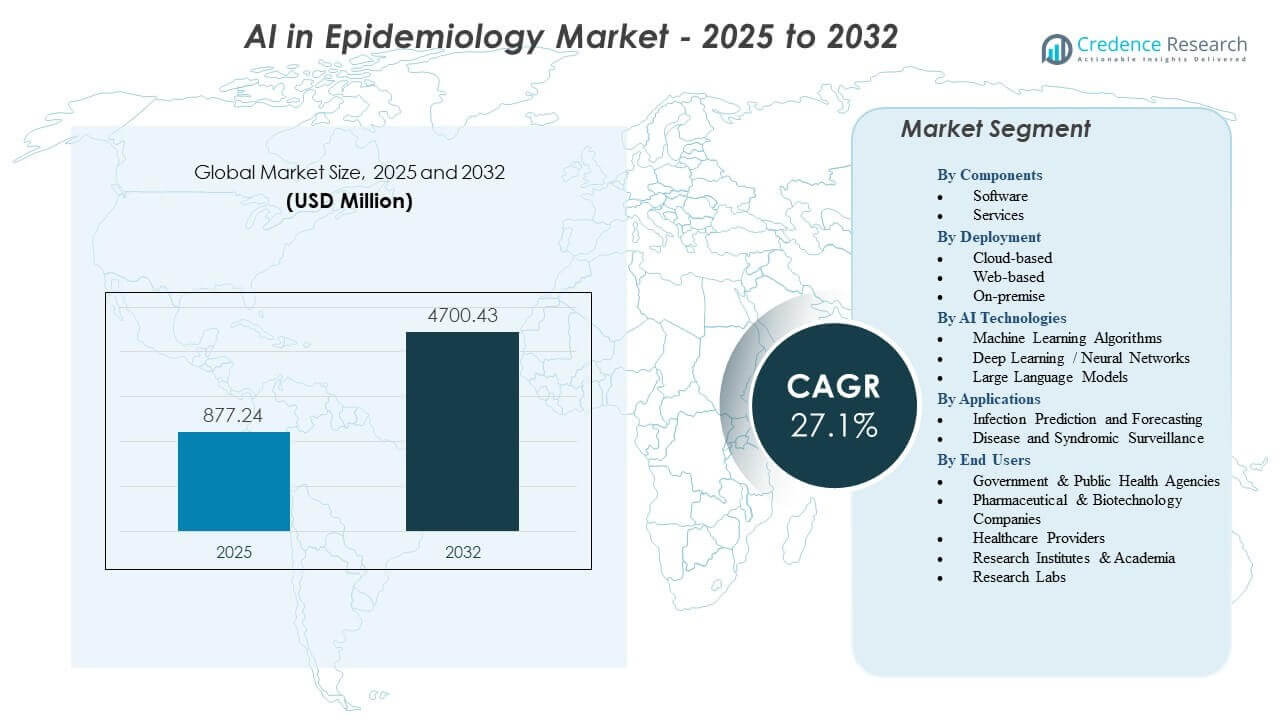
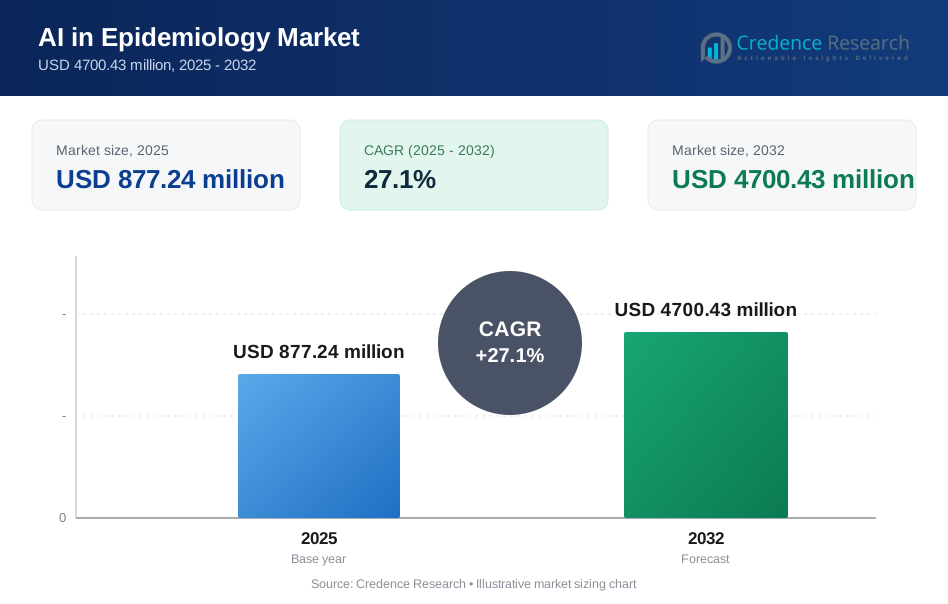
The AI in Epidemiology Market is projected to grow from USD 877.24 million in 2025 to an estimated USD 4700.43 million by 2032, with a compound annual growth rate (CAGR) of 27.1% from 2025 to 2032.
| REPORT ATTRIBUTE | DETAILS |
|---|---|
| Historical Period | 2020-2023 |
| Base Year | 2024 |
| Forecast Period | 2025-2032 |
| AI in Epidemiology Market Size 2025 | USD 877.24 million |
| AI in Epidemiology Market, CAGR | 27.1% |
| AI in Epidemiology Market Size 2032 | USD 4700.43 million |
Rising focus on early disease detection drives strong adoption of AI models across national surveillance programs. Public health institutions seek predictive tools that refine situational awareness, improve response planning, and help identify emerging threats more accurately. Hospitals and healthcare providers use AI-based forecasting to manage surge capacity and reduce operational risk. Governments invest in digital reporting and simulation systems to strengthen preparedness strategies. Research organizations advance algorithm development for population modeling and syndromic analysis, supporting the broader shift toward data-driven epidemiology.
North America leads the AI in Epidemiology Market with strong digital infrastructure, extensive research activity, and early adoption of cloud-based intelligence tools. Europe follows due to coordinated disease surveillance programs and supportive regulatory frameworks that encourage uptake of advanced analytics. Asia Pacific emerges as a high-growth region, driven by rapid digital health expansion in major countries and rising investments in national disease monitoring systems. Latin America and parts of the Middle East show steady progress as governments modernize public health networks. Africa continues expanding adoption gradually through ongoing digital transformation efforts.
AI in Epidemiology Market Insights:
- The AI in Epidemiology Market is projected to grow from USD 877.24 million in 2025 to USD 4700.43 million by 2032, supported by a strong 27.1% CAGR during the forecast period.
- Rising demand for early outbreak detection and predictive modeling accelerates adoption of AI tools across hospitals, government agencies, and research institutions.
- Limited data standardization, privacy concerns, and infrastructure gaps in low-resource regions continue to restrain faster deployment of AI-driven epidemiological systems.
- North America leads due to advanced digital health capabilities, while Europe follows with strong public health coordination and regulatory support.
- Asia Pacific emerges as the fastest-growing region, driven by expanding digital health ecosystems and increasing government investment in national surveillance programs.
AI in Epidemiology Market Drivers
Growing Need For Faster Outbreak Detection Supported By Advanced Predictive Intelligence Frameworks
Public health institutions seek tools that deliver early warnings for infectious threats. Agencies push for real-time analytics that detect hidden transmission patterns. Hospitals rely on AI models that refine surveillance accuracy across large datasets. Governments strengthen digital reporting systems to improve national preparedness. Research teams use simulation models that guide policy decisions with stronger evidence. Technology vendors introduce automated platforms that reduce manual data load. The AI in Epidemiology Market benefits from stronger demand for proactive monitoring. It drives system-wide upgrades across healthcare networks.
Rapid Integration Of Multi-Source Health Data Into Unified Epidemiological Analytics Platforms
Healthcare providers gather clinical, laboratory, mobility, and behavioral data at scale. Unified systems convert these inputs into detailed risk insights. Decision makers depend on structured dashboards that support rapid response strategies. Digital health tools speed up disease tracking across diverse environments. Cloud platforms improve accessibility for remote or resource-limited users. Automation reduces reporting delays that often slow containment actions. The AI in Epidemiology Market expands as data ecosystems mature. It strengthens national disease intelligence programs through unified frameworks.
- For instance, Google processes over 5 billion search queries per day globally, a verifiable figure reported by Google and widely cited in public health studies that use Google Trends data to detect early shifts in disease-related search behavior
Expansion Of AI-Enabled Public Health Infrastructure Backed By Strong Institutional Funding Initiatives
Public bodies create grants that support AI-based surveillance development. Health departments invest in automation that enhances emergency planning. Universities partner with analytics firms to validate emerging models. National task forces adopt digital intelligence tools for resilience planning. Biosecurity programs integrate AI into long-term preparedness goals. Innovation centers encourage research on new pathogen forecasting techniques. The AI in Epidemiology Market grows within this evolving institutional landscape. It gains stability through science-driven modernization efforts.
- For instance, the NIH “All of Us Research Program” has enrolled more than 730,000 participants and gathered over 414,000 electronic health records, providing one of the largest population datasets used in AI research for epidemiological modeling.
Rising Focus On Strengthening Pandemic Preparedness Through Automated Forecasting And Response Models
Global outbreaks highlight gaps in traditional epidemiology workflows. Governments pursue tools that forecast hospital demand and infection peaks. AI systems support contact tracing and situational awareness. Risk dashboards guide containment strategies during critical phases. Cross-border travel increases urgency for real-time surveillance. Public agencies depend on scenario models that inform intervention timing. The AI in Epidemiology Market aligns with updated preparedness frameworks. It supports stronger coordination across health and emergency sectors.
AI in Epidemiology Market Trends
Increasing Use Of Digital Twins And Virtual Population Models To Simulate Disease Progression Scenarios
Digital twin technology enables modeling of population-level outcomes. Epidemiologists use these tools to test intervention strategies. Virtual populations help refine decisions for vaccination and mobility control. Policy teams evaluate different response pathways using simulation runs. Technology firms create platforms that support scenario comparison. These models reduce uncertainty in long-term health planning. The AI in Epidemiology Market reflects broader adoption of digital replica systems. It improves predictive capability for multi-layered threats.
Growing Application Of NLP And Automated Insight Extraction For Unstructured Epidemiological Text Sources
Public health teams analyze reports, field notes, and case narratives. NLP systems extract patterns that manual teams often overlook. Automation speeds up interpretation of emerging community signals. Early warnings emerge from social, clinical, and behavioral text streams. Agencies reduce delays in recognizing shifts in disease symptoms. AI tools summarize complex documentation into simple action points. The AI in Epidemiology Market gains strength through structured language analytics. It supports actionable intelligence from large text datasets.
- For instance, IBM Watson Discovery demonstrated the ability to analyze over 300 million unstructured medical documents to support early pattern detection in public health research.
Adoption Of Edge AI Systems For Localized Health Surveillance And Faster On-Site Decision Making
Remote regions deploy edge devices to process data near the source. Local clinics use compact AI modules to detect suspicious trends. Connectivity gaps decrease risk by enabling offline analysis. Disaster zones benefit from rapid triage supported by edge tools. Urban centers apply localized models for neighborhood-level tracking. Emergency teams rely on faster outputs during high-pressure events. The AI in Epidemiology Market expands into decentralized surveillance models. It supports real-time action where network infrastructure is weak.
- For instance, NVIDIA’s Jetson Xavier NX platform documented real-time inference speeds of up to 21 trillion operations per second (TOPS), enabling on-site processing for health monitoring and sensor analytics without cloud dependency.
Rise Of Automated Public Health Workflow Systems Powered By AI-Driven Task Management Engines
Public health offices automate repetitive epidemiology tasks. Case logging and contact classification move into AI-supported workflows. Routine triage becomes more consistent across large teams. Managers track field operations through real-time task metrics. Automation improves coordination between labs, hospitals, and agencies. Staffing burdens reduce during peak outbreak phases. The AI in Epidemiology Market benefits from adoption of workflow automation tools. It supports smoother execution of epidemiological operations.
AI in Epidemiology Market Challenges Analysis
Data Quality Gaps And Restricted Access To Standardized Health Datasets Across Global Health Systems
Many countries lack strong digital reporting frameworks. Inconsistent formats reduce accuracy of predictive models. Limited interoperability slows multi-agency collaboration. Weak infrastructure results in fragmented epidemiological datasets. Skill shortages hinder proper calibration of AI systems. Privacy rules restrict data sharing required for broader insights. The AI in Epidemiology Market encounters barriers linked to incomplete inputs. It requires structured data pipelines for stronger performance.
Ethical Constraints, Regulatory Pressures, And Cybersecurity Concerns Impacting AI Deployment In Public Health Agencies
Governments enforce strict rules on population-level surveillance. Public hesitation limits acceptance of advanced data monitoring tools. Cyberattacks threaten sensitive national health records. Agencies must balance innovation with ethical safeguards. Long approval cycles delay adoption of advanced models. Health teams require transparent systems to maintain accountability. The AI in Epidemiology Market must address these compliance roadblocks. It needs strong governance frameworks to enable trusted implementation.
AI in Epidemiology Market Opportunities
Expanding Use Of AI-Driven Surveillance Tools In Emerging Economies Under National Digital Health Missions
Many emerging markets upgrade public health infrastructure. Digital health programs prioritize early detection capabilities. Local agencies adopt cloud analytics to improve outbreak tracking. Smart city networks integrate epidemiological modules into planning systems. International organizations support investments in digital surveillance. Modern tools reach remote areas through scalable deployment models. The AI in Epidemiology Market can capture strong demand in these regions. It improves public health decision making through advanced intelligence.
Growing Role Of Predictive Analytics In Chronic Disease Management And Long-Term Population Risk Assessment
Governments expand focus beyond infectious diseases. Chronic conditions require predictive modeling for long-term planning. Insurance groups adopt AI for early risk scoring. Public health units analyze behavior and lifestyle trends for prevention. Hospitals depend on algorithms that guide targeted interventions. Workforce wellness programs rely on real-time analytics for risk reduction. The AI in Epidemiology Market can enter new domains with broader scope. It strengthens preventive care strategies across population segments.
AI in Epidemiology Market Segmentation Analysis:
By Components
Software dominates the AI in Epidemiology Market because agencies rely on analytical engines, dashboards, and modeling platforms for real-time disease intelligence. These tools support automated forecasting, event detection, and pattern recognition across large datasets. Vendors enhance software capabilities through cloud integration and advanced algorithm libraries. Services grow steadily due to rising demand for customization, integration, and ongoing system optimization. Training support helps institutions adapt AI tools to surveillance workflows. Consulting teams guide deployments aligned with regulatory expectations. It strengthens operational readiness for public health agencies and clinical networks.
- For instance, BlueDot’s AI engine processes over 100,000 infectious disease articles daily across 65 languages to detect emerging health threats with high precision.
By Deployment
Cloud-based deployment leads the landscape due to strong scalability requirements and the need for rapid data exchange across regions. Public health authorities prefer cloud systems for real-time outbreak monitoring and multi-agency collaboration. Web-based platforms remain important for accessibility and fast onboarding in decentralized environments. These tools support low-resource settings that depend on user-friendly interfaces. On-premise deployment continues in organizations with strict data governance rules. Research units and secure government environments maintain local infrastructure for sensitive datasets. The AI in Epidemiology Market supports all deployment models to match varied operational conditions.
By AI Technologies
Machine learning algorithms form the foundation of analytical workflows and support trend detection, risk scoring, and transmission modeling. Public health units rely on these models to interpret structured and semi-structured data. Deep learning and neural networks handle complex patterns found in imaging, genomics, and behavioral signals. These models improve accuracy for early detection tasks. Large Language Models accelerate interpretation of unstructured epidemiological text and enhance automated reporting. The AI in Epidemiology Market benefits from multi-layered technology adoption. It enables diverse analytical capabilities across surveillance systems.
By Applications
Infection prediction and forecasting represent a major application due to rising demand for early warning systems. Governments deploy predictive tools to plan resource allocation and reduce outbreak impact. Hospitals depend on these models to manage surge capacity and analyze transmission risk. Disease and syndromic surveillance remains essential for national preparedness frameworks. Automated systems identify unusual symptom patterns and support real-time situational awareness. Public health agencies rely on integrated surveillance tools for population-level monitoring. The AI in Epidemiology Market strengthens both predictive and surveillance applications. It supports faster decision cycles during emerging health threats.
By End Users
Government and public health agencies lead adoption because they manage national disease intelligence operations. These institutions require large-scale platforms that coordinate surveillance across regions. Pharmaceutical and biotechnology companies use AI tools to support research planning and safety assessments. Healthcare providers depend on predictive tools to guide clinical response and manage patient loads. Research institutes and academia advance model development and evaluate epidemiological trends. Research labs apply AI to interpret genomic, environmental, and clinical datasets. The AI in Epidemiology Market supports each end user group with targeted capabilities. It drives structured modernization of public health and research ecosystems.
- For instance, Clarivate’s Epidemiology Intelligence™ platform supports public health agencies by integrating real-world incidence and prevalence data across major disease areas.
AI in Epidemiology Market Segmentation:
By Components
- Software
- Services
By Deployment
- Cloud-based
- Web-based
- On-premise
By AI Technologies
- Machine Learning Algorithms
- Deep Learning / Neural Networks
- Large Language Models
By Applications
- Infection Prediction and Forecasting
- Disease and Syndromic Surveillance
By End Users
- Government & Public Health Agencies
- Pharmaceutical & Biotechnology Companies
- Healthcare Providers
- Research Institutes & Academia
- Research Labs
By Region
- North America
- U.S.
- Canada
- Mexico
- Europe
- Germany
- France
- U.K.
- Italy
- Spain
- Rest of Europe
- Asia Pacific
- China
- Japan
- India
- South Korea
- South-east Asia
- Rest of Asia Pacific
- Latin America
- Brazil
- Argentina
- Rest of Latin America
- Middle East & Africa
- GCC Countries
- South Africa
- Rest of the Middle East and Africa
Regional Analysis:
North America holds the largest share of the AI in Epidemiology Market with nearly 38%, supported by advanced healthcare IT systems and strong investment in AI-driven public health programs. Government agencies deploy predictive analytics platforms to strengthen outbreak monitoring and national readiness. Technology firms collaborate with research institutions to expand data modeling capabilities. Hospitals accelerate integration of AI tools for forecasting and syndromic surveillance. The region benefits from mature digital infrastructure and high adoption of cloud-based intelligence platforms. The AI in Epidemiology Market grows steadily in this ecosystem. It continues to gain support from policy frameworks that prioritize disease intelligence modernization.
Europe accounts for roughly 28% of the global market, driven by coordinated disease surveillance programs and established regulatory standards. Cross-border initiatives encourage shared data networks and high-quality AI model validation. Public health bodies invest in tools that improve accuracy in forecasting and early detection. Hospitals and research centers adopt analytics engines for genomics, mobility tracking, and national health monitoring. Regional governments prioritize digital transformation to improve resilience in future outbreaks. The AI in Epidemiology Market supports this multi-country alignment. It strengthens decision-making across diverse healthcare systems.
Asia Pacific captures close to 24% of the market and shows the fastest growth trajectory due to rising digital health investments in China, India, Japan, and South Korea. Public agencies deploy surveillance solutions to manage high population density and elevated disease risk levels. Technology firms expand cloud and AI infrastructure across major cities. Healthcare providers adopt real-time monitoring platforms to manage outbreaks more effectively. Academic institutions increase focus on AI-based modeling and epidemiological research. The AI in Epidemiology Market gains momentum in this dynamic region. It benefits from government-backed digital health missions and rapid modernization.
Key Player Analysis:
- Clarivate
- Oracle (Cerner Corporation)
- Cognizant Technology Solutions Corporation
- eClinicalWorks Inc.
- Alphabet Inc.
- Bayer AG
- AIME Healthcare
- Cardiolyse
- EPAM Systems Inc.
- Microsoft
- Amazon
- Metabiota
Competitive Analysis:
Leading companies compete in the AI in Epidemiology Market through advanced analytics platforms, real-time forecasting tools, and integrated disease intelligence systems. Firms such as Clarivate, Oracle, BlueDot, Biobot Analytics, and Komodo Health expand their footprints by offering scalable models that support national and regional surveillance. Technology giants including Microsoft, Google, and Amazon strengthen competition by providing cloud, machine learning, and data engineering capabilities that enhance epidemiological workflows. Healthcare-focused AI firms introduce specialized models for syndromic detection, wastewater monitoring, and risk analysis. Vendors differentiate through accuracy, interoperability, and deployment flexibility. Partnerships with public health agencies and research institutes increase competitive strength. The market continues to evolve through rapid innovation, and it maintains intense competition driven by technological advancement and expanding public health priorities.
Recent Developments:
- In January 2025, ClearView Healthcare Partners made a $4 million strategic investment in Epistemic AI to advance next-generation biomedical AI platforms. This partnership integrates Epistemic AI's EpistemicGPT technology into ClearView's services, combining AI with human expertise for life sciences analysis.
- In May 2024, Clarivate launched Epidemiology Intelligence™, a solution integrating epidemiology data, incidence/prevalence insights, and U.S. claims-based population analytics to aid biopharma in precise market sizing and patient targeting.
Report Coverage:
The research report offers an in-depth analysis based on Components, Deployment, AI Technologies, Applications, and End Users. It details leading market players, providing an overview of their business, product offerings, investments, revenue streams, and key applications. Additionally, the report includes insights into the competitive environment, SWOT analysis, current market trends, as well as the primary drivers and constraints. Furthermore, it discusses various factors that have driven market expansion in recent years. The report also explores market dynamics, regulatory scenarios, and technological advancements that are shaping the industry. It assesses the impact of external factors and global economic changes on market growth. Lastly, it provides strategic recommendations for new entrants and established companies to navigate the complexities of the market.
Future Outlook:
- Predictive analytics will gain wider adoption as public health agencies upgrade digital infrastructure across multiple regions.
- Governments will integrate AI-driven forecasting tools into national preparedness programs to support rapid decision-making.
- Cloud-based epidemiology platforms will expand due to rising demand for scalable surveillance and multi-agency collaboration.
- Large Language Models will strengthen automated reporting and accelerate interpretation of unstructured epidemiological data.
- Deep learning models will deliver improved accuracy for genomics, mobility, and behavioral pattern analysis.
- Healthcare providers will increase reliance on real-time dashboards to manage outbreak risks and hospital readiness.
- Research institutions will advance AI algorithm development to support next-generation disease modeling capabilities.
- Pharmaceutical companies will adopt epidemiological AI tools to guide research planning and safety assessments.
- Emerging economies will invest in digital surveillance systems through national health missions and smart city programs.
- Cross-sector partnerships will intensify, driving innovation and broader adoption of AI-integrated public health systems.
Request a Free Sample
Fill in your details and we'll send you a free sample report.
- Sample data tables & charts
- Research methodology
Need a Custom Version of This Report?
Tailor the scope, geography, or segments to your exact requirements.
- Custom geography or segment scope
- Direct access to our analyst team
Frequently Asked Questions
What is the current market size for the AI in Epidemiology Market, and what is its projected size in 2032?
At what Compound Annual Growth Rate is the AI in Epidemiology Market projected to grow between 2025 and 2032?
Which AI in Epidemiology Market segment held the largest share in 2025?
What are the primary factors fueling the growth of the AI in Epidemiology Market?
Who are the leading companies in the AI in Epidemiology Market?
Which region commanded the largest share of the AI in Epidemiology Market in 2025?
Table of Content
Chapter 1. Report Introduction
- 1.1 Report Description & Purpose
- 1.1.1 Report Title & Market Definition
- 1.1.2 Unique Selling Propositions (USP) & Key Differentiators
- 1.1.3 Value Proposition for Stakeholders
- 1.2 Research Objectives
- 1.2.1 Market Sizing Objectives (Volume & Revenue)
- 1.2.2 Segmentation Objectives
- 1.2.3 Competitive Intelligence Objectives
- 1.2.4 Forecast & Scenario Objectives
- 1.3 Report Scope
- 1.3.1 AI in Epidemiology Scope – Types & Subtypes Covered
- 1.3.2 Geographic Scope – Regions & Countries Covered
- 1.3.3 Historical Period, Base Year & Forecast Period (2025; forecast to 2032)
- 1.3.4 Inclusions & Exclusions
- 1.4 HS Code & Classification Framework
- 1.5 Currency, Units & Pricing Basis
- 1.6 Target Stakeholders
- 1.7 Limitations & Assumptions
Chapter 2. Executive Summary
- 2.1 Global AI in Epidemiology Market Snapshot
- 2.1.1 Market Size – Historical (2025) & Forecast (2025-2032) (2025: USD 877.24 million → 2032: USD 4700.43 million)
- 2.1.2 Volume & Revenue – Global Totals
- 2.1.3 Key Market Highlights – Top Five Facts
- 2.2 AI in Epidemiology Market Segmentation Snapshot
- 2.2.1 Market Split by Region – 2025 vs. 2032
- 2.3 Competitive Snapshot
- 2.3.1 Top 10 Players by Revenue Share – 2025
- 2.3.2 Top 10 Players by Volume Share – 2025
- 2.3.3 Recent Strategic Developments (18-Month Summary)
- 2.4 Key Investment Highlights & Strategic Conclusions
Chapter 3. AI in Epidemiology Market Dynamics & Industry Analysis
- 3.1 Market Overview & Context
- 3.1.1 AI in Epidemiology Market Position in the Broader Automotive Value Chain
- 3.1.2 OEM vs. Replacement Market Dynamics
- 3.1.3 Market Maturity & Development Stage by Region
- 3.2 AI in Epidemiology Market Drivers
- 3.3 AI in Epidemiology Market Restraints & Challenges
- 3.4 AI in Epidemiology Market Opportunities
- 3.5 Porter's Five Forces Analysis
- 3.5.1 Threat of New Entrants
- 3.5.2 Bargaining Power of Suppliers
- 3.5.3 Bargaining Power of Buyers
- 3.5.4 Threat of Substitutes
- 3.5.5 Competitive Rivalry – Intensity Assessment
- 3.6 AI in Epidemiology Value Chain Analysis
- 3.6.1 Upstream – Raw Material/Input Suppliers
- 3.6.1.1 Raw Material/Input 1
- 3.6.1.2 Raw Material/Input 2
- 3.6.1.3 Raw Material/Input 3
- 3.6.2 Midstream – Production/Manufacturing/Service Delivery
- 3.6.2.1 Production/Process Overview
- 3.6.2.2 Key Facility Locations & Capacity by Manufacturer
- 3.6.3 Downstream – Distribution & End Consumer
- 3.6.3.1 Primary Channel – B2B/OEM
- 3.6.3.2 Secondary Channels – Dealer, Retail, Online, Direct
- 3.6.4 Value Chain Profitability Analysis
- 3.6.1 Upstream – Raw Material/Input Suppliers
- 3.7 PESTEL Analysis
- 3.7.1 Political Factors
- 3.7.2 Economic Factors
- 3.7.3 Social Factors
- 3.7.4 Technological Factors
- 3.7.5 Environmental Factors
- 3.7.6 Legal Factors
- 3.8 AI in Epidemiology Supply Chain Analysis
- 3.8.1 Raw Material/Input Supply Risk Assessment
- 3.8.2 Manufacturing Concentration Risk (Geographic Exposure)
- 3.8.3 Trade Disruption Impact Analysis
- 3.9 Regulatory & Policy Landscape
Note: The regulatory and policy landscape section covers regulations based on their applicability to the market, AI in Epidemiology category, geography, and scope of the study. Only regulatory frameworks with a material impact on operations, compliance, trade, sustainability, or market access are analyzed in detail.
Chapter 4. Key Investment Pockets & Opportunity Analysis
- 4.1 AI in Epidemiology Market Attractiveness Analysis
- 4.1.1 By Region – Investment Attractiveness Matrix (Volume × CAGR)
- 4.2 Absolute Revenue Growth Opportunity
- 4.2.1 By Region – Absolute USD Growth Through 2032
- 4.3 Incremental Volume Opportunity
- 4.3.1 By Region – Incremental Volume Through 2032
- 4.3.2 Segment – Incremental Volume
- 4.4 Emerging Submarket Opportunity Deep Dive (Subject to Applicability)
- 4.5 Emerging Market Opportunity Scorecards
- 4.5.1 United States
- 4.5.2 Europe
- 4.5.3 Asia
- 4.5.4 Middle East & Africa
Note: Emerging Market Opportunity Scorecards will be included based on relevance and strategic importance. Regions listed are indicative and may vary depending on data availability and market dynamics.
Chapter 5. AI in Epidemiology Import-Export Analysis & Trade Flows
- 5.1 Global Trade Overview
- 5.1.1 Global Export Value by Country (2025)
- 5.1.2 Global Export Volume by Country (2025)
- 5.1.3 Global Import Value by Country (2025)
- 5.1.4 Global Import Volume by Country (2025)
- 5.1.5 Net Trade Balance by Country (2025)
- 5.2 Export Analysis – Segment
- 5.2.1 Type 1 (HS Code)
- 5.2.2 Type 2 (HS Code)
- 5.2.3 Type 3 (HS Code)
- 5.2.4 Type 4 (HS Code)
- 5.2.5 Type 5 (HS Code)
- 5.3 Import Analysis – Segment
- 5.3.1 Type 1 (HS Code)
- 5.3.2 Type 2 (HS Code)
- 5.3.3 Type 3 (HS Code)
- 5.3.4 Type 4 (HS Code)
- 5.3.5 Type 5 (HS Code)
- 5.4 Average Unit Trade Prices
- 5.4.1 Average Export Price – Segment & Country
- 5.4.2 Average Import Price – Segment & Source Country
- 5.4.3 Price Trends (2025)
- 5.5 Key Trade Route Analysis
- 5.5.1 Trade Route 1
- 5.5.2 Trade Route 2
- 5.5.3 Trade Route 3
- 5.5.4 Trade Route 4
- 5.5.5 Trade Route 5
- 5.6 Trade Policy Impact Assessment
- 5.6.1 US Anti-Dumping & Section 301 Tariffs
- 5.6.2 EU Customs Union Impact
- 5.6.3 Major Free Trade Agreements
- 5.6.4 USMCA Rules of Origin
Note: Trade policy analysis will be included only where relevant to the AI in Epidemiology market.
Chapter 6. Competitive Landscape & Company Benchmarking
- 6.1 AI in Epidemiology Market Concentration & Structure
- 6.1.1 Herfindahl-Hirschman Index (HHI) – vs. 2025
- 6.1.2 Tier 1, Tier 2 & Tier 3 Market Structure
- 6.1.3 Global, Regional & Local Player Dynamics
- 6.2 AI in Epidemiology Market Share Analysis – 2025
- 6.2.1 Global Revenue Share by Company
- 6.2.2 Global Volume Share by Company
- 6.2.3 Regional Revenue Share
- 6.2.4 Market Share Evolution ( vs. 2025)
- 6.2.5 OEM Segment Share by Company
- 6.2.6 Replacement Segment Share by Company
- 6.3 Production/Delivery Capacity & Facility Analysis
- 6.3.1 Global Installed Capacity
- 6.3.2 Capacity Utilization Rates
- 6.3.3 Production/Output Volume
- 6.3.4 Facility Locations & Capacity Map
- 6.3.5 Planned Capacity Additions
- 6.4 AI in Epidemiology Competitive Benchmarking Matrix
- 6.4.1 Revenue, Volume, CAGR & Profitability Comparison
- 6.4.2 Channel Revenue Mix
- 6.4.3 Geographic Revenue Exposure
- 6.4.4 R&D Intensity
- 6.4.5 Sustainability Maturity
- 6.5 Strategic Developments in AI in Epidemiology (Last 24 Months)
- 6.5.1 Mergers, Acquisitions & Divestments
- 6.5.2 New AI in Epidemiology Launches
- 6.5.3 Facility Expansions
- 6.5.4 Strategic Alliances, Joint Ventures & Partnerships
- 6.5.5 Distribution Expansion & Market Entry
- 6.5.6 Sustainability & ESG Initiatives
- 6.6 Competitive Strategy Mapping
- 6.6.1 Leader, Challenger, Follower & Niche Classification
- 6.6.2 Pricing Strategy Comparison
- 6.6.3 Channel Strategy Matrix
Note: Strategic developments are included based on their materiality and the availability of reliable information.
Chapter 7. Global AI in Epidemiology Market – By Distribution Channel
- 7.1 Segment Overview
- 7.1.1 Volume & Revenue Split by Channel (2025 & 2032)
- 7.1.2 Channel Mix Evolution (2025-2032)
Chapter 8. Regional Market Analysis – Global Overview
- 8.1 Global Regional Overview
- 8.1.1 Regional Volume Share
- 8.1.2 Regional Revenue Share
- 8.1.3 Regional Volume by Region
- 8.1.4 Regional Revenue by Region
- 8.1.5 Regional Forecast Through 2032
- 8.2 Cross-Regional Segment Analysis
- 8.2.1 By Distribution Channel
- 8.2.2 By Brand/Price Tier
Chapter 9. North America AI in Epidemiology Market
- 9.1 United States
- 9.2 Canada
- 9.3 Mexico
Chapter 10. Europe AI in Epidemiology Market
- 10.1 Germany
- 10.2 France
- 10.3 Italy
- 10.4 United Kingdom
- 10.5 Spain
- 10.6 Poland
- 10.7 Russia
- 10.8 Netherlands
- 10.9 Belgium
- 10.10 Sweden
- 10.11 Denmark
- 10.12 Norway
- 10.13 Rest of Europe
Chapter 11. Asia Pacific AI in Epidemiology Market
- 11.1 China
- 11.2 India
- 11.3 Japan
- 11.4 South Korea
- 11.5 Thailand
- 11.6 Indonesia
- 11.7 Vietnam
- 11.8 Malaysia
- 11.9 Australia
- 11.10 Rest of Asia Pacific
Chapter 12. Latin America AI in Epidemiology Market
- 12.1 Brazil
- 12.2 Argentina
- 12.3 Colombia
- 12.4 Chile
- 12.5 Rest of Latin America
Chapter 13. Middle East AI in Epidemiology Market
- 13.1 Saudi Arabia
- 13.2 United Arab Emirates
- 13.3 Turkey
- 13.4 Israel
- 13.5 Iran
- 13.6 Rest of the Middle East
Chapter 14. Africa AI in Epidemiology Market
- 14.1 South Africa
- 14.2 Egypt
- 14.3 Nigeria
- 14.4 Morocco
- 14.5 Rest of Africa
Chapter 15. AI in Epidemiology Company Profiles
- 15.1 [Company 01]
- 15.1.1 Company Overview
- 15.1.2 Key Management Personnel
- 15.1.3 Products & Services Portfolio
- 15.1.4 Financial Performance
- 15.1.5 Key Market Focus & Geographic Presence
- 15.1.6 Recent Developments & Strategic Initiatives
Note: The company profile list is preliminary and may change based on research findings, market developments, data availability, and client requirements.
Chapter 16. Appendices
- Appendix A – List of Abbreviations & Acronyms
- Appendix B – Industry Classification Code Reference – Full Series
- Appendix C – Production & Capacity Data Tables
- Appendix D – End-Use & Demand Base Tables
- Appendix E – Consumption & Replacement Rate Assumptions
- Appendix F – ASP Reference Tables
- Appendix G – Manufacturing & Facility Database
- Appendix H – Import-Export Data Tables
- Appendix I – Regulatory Summary Tables
- Appendix J – Primary Research Participant List (Anonymized)
- Appendix K – Primary Research Questionnaire Framework
- Appendix L – Data Sources & Bibliography
- Appendix M – Market Size Divergence & Source Comparison
Chapter 17. Research Methodology
- 17.1 Research Framework & Philosophy
- 17.2 Secondary Research – Sources, Hierarchy & Data Extraction
- 17.3 Data Modeling – Bottom-Up & Top-Down Market Sizing
- 17.4 Primary Research – Stakeholder Framework, LOI & Sample Sizes
- 17.5 Forecast Methodology – Regression, Scenario & Sensitivity Analysis
- 17.6 Quality Control – Four-Layer Validation Framework
- 17.7 Limitations & Standard Assumptions
- 17.8 Disclaimer
