
Market Overview:
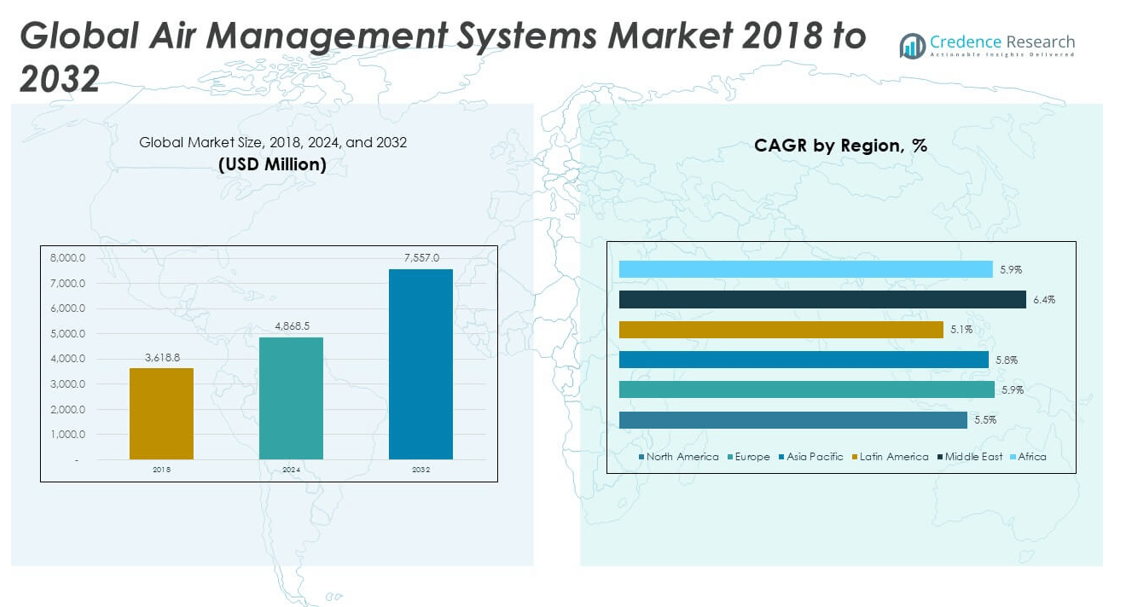
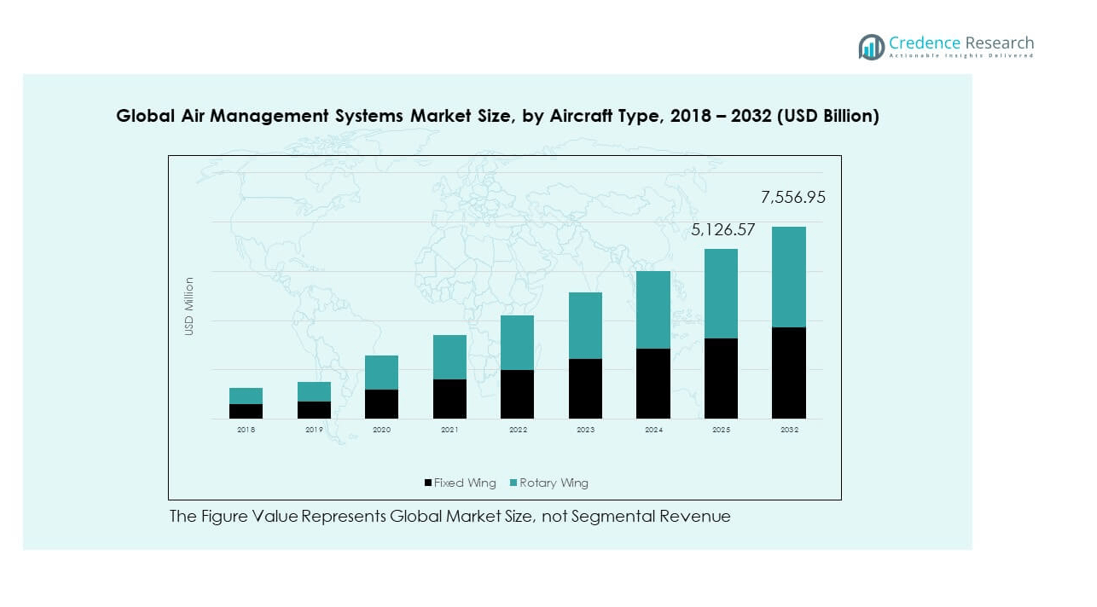
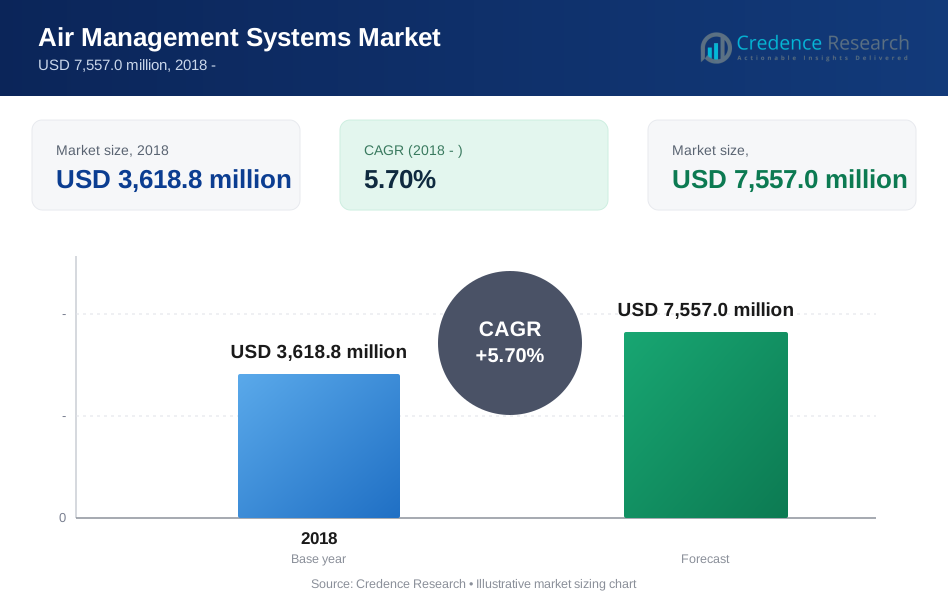
The Global Air Management Systems Market size was valued at USD 3,618.8 million in 2018 to USD 4,868.5 million in 2024 and is anticipated to reach USD 7,557.0 million by 2032, at a CAGR of 5.70% during the forecast period.
| REPORT ATTRIBUTE | DETAILS |
|---|---|
| Historical Period | 2020-2023 |
| Base Year | 2024 |
| Forecast Period | 2025-2032 |
| Air Management Systems Market Size 2024 | USD 4,868.5 million |
| Air Management Systems Market, CAGR | 5.70% |
| Air Management Systems Market Size 2032 | USD 7,557.0 million |
Growing aircraft production, rising demand for fuel-efficient systems, and increasing air passenger traffic are major factors driving the Global Air Management Systems Market. Airlines are focusing on lightweight and energy-efficient components to enhance performance and reduce emissions. Advancements in air circulation, temperature control, and cabin pressurization technologies also support growth. The adoption of next-generation aircraft with advanced environmental control systems further boosts market expansion across both commercial and defense aviation sectors.
North America leads the market due to the presence of major aircraft manufacturers and a strong defense aviation base. Europe follows with technological advancements in sustainable aircraft systems. The Asia-Pacific region is emerging rapidly, driven by expanding airline fleets and increasing investments in domestic manufacturing. Countries like China, India, and Japan are witnessing strong growth owing to rising air traffic, infrastructure development, and regional production expansion.
Market Insights:
- The Global Air Management Systems Market was valued at USD 3,618.8 million in 2018, reached USD 4,868.5 million in 2024, and is projected to reach USD 7,556.9 million by 2032, growing at a CAGR of 5.70%. Continuous aircraft production, efficiency demands, and cabin comfort improvements drive global expansion.
- North America holds the largest share of 32%, supported by strong OEM presence, defense programs, and advanced R&D capabilities. Europe follows with 24% due to sustainable aviation initiatives and high innovation rates. Asia Pacific ranks third with 27%, driven by expanding air travel, domestic manufacturing, and rapid fleet expansion.
- The Middle East is the fastest-growing region with a 6.4% CAGR, driven by new fleet purchases, premium airline demand, and airport modernization projects across the GCC.
- Fixed-wing aircraft dominate with around 75% share due to their extensive use in commercial and defense aviation, ensuring steady demand for air management systems.
- Rotary-wing aircraft account for roughly 25% share, supported by increasing applications in defense, emergency response, and offshore operations that require efficient temperature and pressure control systems.
Market Drivers:
Rising Aircraft Production and Fleet Expansion
The Global Air Management Systems Market is driven by the steady increase in aircraft production and fleet modernization programs. Growing passenger demand and cargo transportation requirements encourage airlines to expand and upgrade fleets. Aircraft manufacturers focus on integrating advanced air management technologies to improve cabin comfort and environmental efficiency. The replacement of aging aircraft with new models featuring energy-efficient systems strengthens market growth. Airframers are partnering with system suppliers to enhance reliability and optimize thermal management. Expansion of low-cost carriers further boosts commercial aircraft deliveries. Increased defense aviation spending in major economies also supports demand for advanced systems. The rising air traffic globally continues to sustain market momentum.
- For instance, Airbus delivered a verified total of 766 commercial aircraft to global customers in 2024, which included deployment of advanced Liebherr-supplied air management modules on new A321XLRs, demonstrating improvements in energy use and reliability for the latest generation of fleets.
Growing Focus on Cabin Comfort and Passenger Experience
Passenger comfort has become a central design consideration for aircraft manufacturers, driving innovation in cabin air quality and temperature regulation systems. Airlines demand solutions that maintain optimal humidity and pressure levels during long-haul flights. The Global Air Management Systems Market benefits from investments in advanced environmental control systems that improve thermal balance and reduce noise. Improved filtration and ventilation enhance passenger well-being and operational safety. The use of digital sensors and automated controls enables precise climate regulation. Airlines focus on minimizing fatigue and discomfort through consistent cabin conditions. OEMs integrate lightweight composite ducts to reduce vibration and energy use. These developments ensure enhanced comfort and higher passenger satisfaction.
- For instance, Boeing completed flight trials in September 2024 using upgraded ecoDemonstrator cabin management systems and validated the use of humidity sensors and noise mitigation technology that reduced noise by several decibels and measured over 9,500 operational metrics in real-world testing.
Emphasis on Fuel Efficiency and Sustainability Goals
Stringent emission regulations and sustainability goals drive innovation in air management systems across commercial and military aviation. OEMs develop lightweight, energy-efficient solutions that optimize airflow and minimize power consumption. The Global Air Management Systems Market benefits from the adoption of electric and hybrid systems replacing traditional pneumatic designs. Such systems reduce environmental impact and operational costs. Airlines increasingly adopt systems that recover waste energy and use variable speed compressors. Manufacturers also prioritize recyclable materials and eco-friendly refrigerants. These advancements align with global carbon reduction strategies and sustainable aviation initiatives.
Technological Integration and Digital Optimization
Rapid digital transformation is reshaping the design and operation of aircraft air management systems. Integration of IoT and AI-based controls enables real-time performance monitoring and predictive maintenance. The Global Air Management Systems Market gains momentum as manufacturers adopt smart sensors and automation for airflow, temperature, and pressure control. Digital twins and advanced analytics improve diagnostics and operational reliability. Automated control units enhance fuel economy and reduce mechanical wear. Cloud-based data platforms allow seamless communication between onboard systems and ground maintenance teams. These technologies improve system efficiency, reduce downtime, and extend component life. Growing adoption of next-generation digital aircraft architectures further boosts system advancement.
Market Trends:
Shift Toward Electrification of Air Management Components
The aviation sector is gradually transitioning toward electric-based systems to replace pneumatic and hydraulic operations. The Global Air Management Systems Market experiences this shift due to the rise of more-electric and hybrid aircraft. Electric compressors, pumps, and valves are increasingly used to improve energy efficiency. This shift reduces dependency on bleed air systems, enhancing power management and lowering emissions. Integration of electric architectures supports modularity and scalability across aircraft models. Manufacturers invest in power-optimized systems to align with sustainable aviation targets. Electrification helps reduce mechanical losses and maintenance frequency. It also prepares the industry for the next phase of fully electric aviation platforms.
- For instance, Pipistrel’s Velis Electro, approved for flight training worldwide in 2024, operates on a 345 VDC electric system with zero emissions, quiet operations at only 60 dB, and demonstrated easy maintenance and charging cycles, showcasing the tangible progress towards more-electric aviation.
Adoption of Smart and Connected Air Management Systems
The integration of intelligent controls and connectivity is reshaping operational efficiency in aviation. The Global Air Management Systems Market is witnessing increased adoption of smart solutions capable of real-time adjustment and self-diagnosis. These systems use embedded sensors and data analytics to monitor airflow, temperature, and humidity precisely. Predictive maintenance powered by AI enhances reliability and reduces unscheduled downtime. Connected systems communicate with onboard computers for better coordination between subsystems. Airlines use performance data to optimize energy consumption and improve sustainability. Smart features enhance passenger comfort through adaptive environmental settings. This trend supports the evolution of intelligent, responsive cabin ecosystems.
- For instance, Liebherr-Aerospace and Airbus, under the Clean Sky 2 and subsequent Clean Aviation initiatives, developed an Electrical Environmental Control System (eECS). Initial flight tests for key eECS technologies took place in 2016 on an Airbus A320 Flight Lab, with positive results. By the end of 2023, the core eECS technologies had achieved Technical Readiness Level (TRL) 5 through ground-based tests, not TRL 6 from flight tests.
Growing Use of Lightweight and Composite Materials
Weight reduction remains a key trend in aerospace manufacturing. The Global Air Management Systems Market benefits from increased use of advanced composites, titanium, and high-strength polymers. These materials offer durability and resistance to extreme thermal and pressure conditions. Lightweight components help improve fuel efficiency and aircraft range. Manufacturers design compact ducting and optimized airflow channels using 3D modeling and simulation tools. Composite structures provide corrosion resistance and longer service life. The shift toward modular assemblies simplifies maintenance and reduces replacement time. Lightweight innovation aligns with sustainability goals and enhances overall system performance.
Increasing Adoption of Environmental and Energy Efficiency Standards
Regulatory frameworks focused on emission control and energy optimization influence system design and manufacturing. The Global Air Management Systems Market aligns with stringent aviation standards emphasizing clean operations and thermal management. OEMs incorporate energy recovery mechanisms and eco-friendly refrigerants to comply with evolving policies. The industry is moving toward zero-leakage, high-efficiency air cycle machines to reduce operational losses. Continuous R&D investments focus on improving compressor efficiency and minimizing ozone-depleting substances. Certification bodies and aviation authorities encourage cleaner designs through global compliance initiatives. This trend promotes sustainable manufacturing practices and supports green aviation goals.
Market Challenges Analysis:
High Cost of Development and System Integration Complexity
Developing advanced air management systems involves significant design, testing, and certification expenses. The Global Air Management Systems Market faces cost pressures due to stringent safety and reliability standards. System integration within modern aircraft architectures requires precise calibration and complex software controls. Balancing performance, weight, and energy efficiency adds to engineering challenges. Small and medium component manufacturers often face financial limitations in adopting next-generation technologies. The requirement for multi-system compatibility with avionics and power management platforms increases design time. Delays in certification and long product life cycles hinder faster innovation. Cost-sensitive airlines and OEMs must balance budget constraints with performance needs.
Maintenance, Reliability, and Environmental Challenges
Ensuring consistent performance of air management systems in diverse flight conditions is technically demanding. The Global Air Management Systems Market faces challenges in maintaining reliability under high pressure, temperature, and humidity variations. Component wear and contamination can impact airflow efficiency and cabin comfort. Maintenance schedules and spare part costs increase operational burdens for airlines. Environmental concerns related to refrigerant disposal and carbon footprint create additional regulatory hurdles. Older fleets face difficulties retrofitting advanced systems due to structural limitations. Continuous monitoring and upgrades require skilled technical personnel and increased maintenance budgets. Managing system durability while meeting sustainability standards remains a persistent issue.
Market Opportunities:
Emergence of Sustainable and Electric Aircraft Platforms
The push toward eco-friendly aviation creates strong growth potential for system manufacturers. The Global Air Management Systems Market is positioned to benefit from rising investment in electric and hybrid aircraft. New platforms require compact, energy-efficient air management architectures. Companies focusing on lightweight, low-emission solutions gain early mover advantages. Partnerships between OEMs and environmental technology firms accelerate product innovation. Electrified systems provide opportunities for long-term cost reduction and environmental compliance. Growing support for green aviation programs enhances the commercial potential of sustainable system technologies.
Expansion in Emerging Aerospace Manufacturing Regions
Rapid industrial growth in Asia-Pacific, the Middle East, and parts of Latin America presents major opportunities for expansion. The Global Air Management Systems Market benefits from increasing aircraft assembly, component production, and maintenance activities in these regions. Governments promote local manufacturing through favorable policies and infrastructure investments. New entrants and regional suppliers contribute to competitive pricing and faster innovation. Rising domestic air travel and expanding fleets drive demand for modern systems. Collaborations between international OEMs and regional suppliers strengthen supply chains. This regional diversification supports long-term market stability and growth.
Market Segmentation Analysis:
By Product Segment
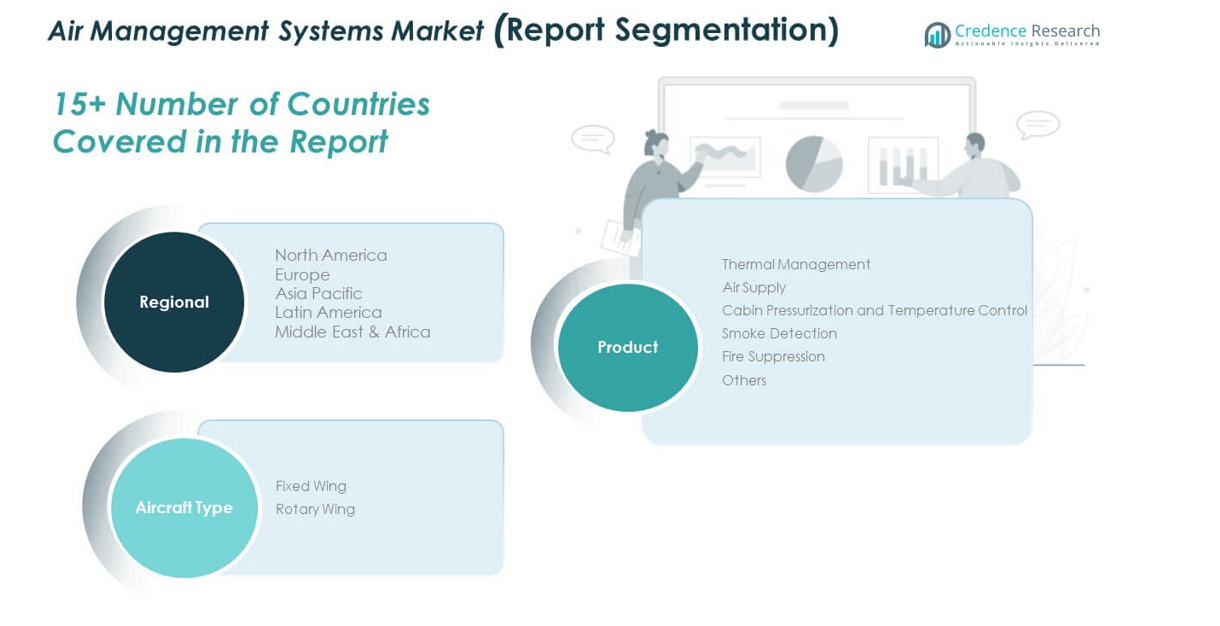
The Global Air Management Systems Market is segmented into thermal management, air supply, cabin pressurization and temperature control, smoke detection, fire suppression, and others. Thermal management holds a significant share due to rising demand for efficient cooling solutions that maintain optimal aircraft performance and fuel efficiency. Air supply systems are vital for cabin ventilation and engine performance, ensuring consistent airflow and pressure balance. Cabin pressurization and temperature control remain essential for passenger comfort and safety in both commercial and military aircraft. Smoke detection and fire suppression systems are driven by stringent safety regulations and technological innovation in sensors and control units. The “others” category includes emerging solutions such as humidity control and air filtration, gaining traction with the rise of sustainable and next-generation aircraft.
- For instance, Parker Meggitt developed A Microclimate Cooling System (MCS) for the M9 Earthmover combat vehicle, which includes a main air intake filter with up to 96% dust removal efficiency.
By Aircraft Type Segment
Based on aircraft type, the Global Air Management Systems Market is divided into fixed-wing and rotary-wing aircraft. Fixed-wing aircraft dominate the segment due to their extensive use in commercial aviation, cargo transport, and defense operations. Increasing fleet expansion and rising production of next-generation narrow-body and wide-body jets further strengthen this segment. Rotary-wing aircraft show steady growth, supported by demand for advanced air circulation and temperature control in helicopters used for military, emergency, and offshore applications. Both segments benefit from continuous system optimization and integration of lightweight materials to enhance operational efficiency and environmental compliance.
- For instance, Leonardo delivered the latest AW169M rotary-wing helicopters to military customers in 2024, featuring advanced on-board air management, digital avionics, and constantly optimized cabin systems; the AW169 fleet surpassed 135,000 operational flight hours globally and was expanded with new military deliveries in Italy and internationally.
Segmentation:
By Product Segment
- Thermal Management
- Air Supply
- Cabin Pressurization and Temperature Control
- Smoke Detection
- Fire Suppression
- Others
By Aircraft Type Segment
- Fixed Wing
- Rotary Wing
By Region
- North America
- U.S.
- Canada
- Europe
- Germany
- France
- Italy
- U.K.
- Russia
- Rest of Europe
- Asia-Pacific
- India
- China
- Japan
- Rest of Asia-Pacific
- Latin America
- Brazil
- Mexico
- Rest of Latin America
- Middle East and Africa
- GCC Countries
- South Africa
- Rest of Middle East and Africa
Regional Analysis:
North America
The North America Global Air Management Systems Market size was valued at USD 1,162.00 million in 2018 to USD 1,544.93 million in 2024 and is anticipated to reach USD 2,360.04 million by 2032, at a CAGR of 5.5% during the forecast period. North America holds around 32% of the global market share, driven by strong aviation infrastructure and continuous aircraft modernization programs. The presence of major OEMs such as Boeing and Honeywell fosters innovation in thermal and environmental control systems. High defense spending supports the integration of advanced air management technologies in military fleets. The region’s mature aerospace ecosystem encourages partnerships between manufacturers and research institutions. The U.S. dominates regional demand, followed by Canada, due to growing investments in commercial aviation. Focus on fuel efficiency and sustainable aircraft designs drives product innovation. Stringent FAA standards further encourage adoption of next-generation air management systems.
Europe
The Europe Global Air Management Systems Market size was valued at USD 836.31 million in 2018 to USD 1,139.10 million in 2024 and is anticipated to reach USD 1,797.04 million by 2032, at a CAGR of 5.9% during the forecast period. Europe accounts for approximately 24% of the global market share, supported by strong R&D capabilities and established aerospace manufacturing hubs. The region is home to key players such as Airbus, Safran, and Liebherr, driving continuous technological progress. European Union sustainability goals accelerate development of low-emission and energy-efficient systems. Demand for cabin air quality improvement and passenger comfort enhancements is growing. Governments are investing in electrification programs under green aviation initiatives. France, Germany, and the UK remain leading contributors with advanced production facilities. The regional emphasis on clean aviation and collaborative research boosts long-term growth.
Asia Pacific
The Asia Pacific Global Air Management Systems Market size was valued at USD 952.47 million in 2018 to USD 1,291.00 million in 2024 and is anticipated to reach USD 2,023.75 million by 2032, at a CAGR of 5.8% during the forecast period. Asia Pacific commands about 27% of the global market share, fueled by growing air passenger traffic and expanding aircraft production. China, Japan, and India are major contributors to regional demand with increasing investments in domestic aviation manufacturing. Governments are promoting local production capabilities through supportive policies and technology partnerships. Rising demand for efficient cabin air systems aligns with the development of new commercial and regional aircraft programs. Emerging low-cost carriers are expanding fleets, boosting aftermarket opportunities. The focus on hybrid-electric aircraft and digital maintenance platforms strengthens market prospects. Regional suppliers are gaining traction by offering cost-effective and lightweight system components.
Latin America
The Latin America Global Air Management Systems Market size was valued at USD 386.13 million in 2018 to USD 503.20 million in 2024 and is anticipated to reach USD 747.38 million by 2032, at a CAGR of 5.1% during the forecast period. Latin America represents roughly 10% of the global market share, driven by recovering commercial aviation and modernization of regional fleets. Brazil and Mexico are key markets supported by the presence of Embraer and expanding MRO facilities. Increasing regional connectivity and rising air passenger traffic stimulate aircraft procurement. Airlines seek advanced air management systems to enhance operational efficiency and passenger comfort. Economic recovery and tourism growth create favorable market conditions. The growing focus on sustainable aviation practices supports new technology adoption. Local suppliers are strengthening partnerships with international OEMs to expand their production footprint.
Middle East
The Middle East Global Air Management Systems Market size was valued at USD 157.06 million in 2018 to USD 220.48 million in 2024 and is anticipated to reach USD 361.22 million by 2032, at a CAGR of 6.4% during the forecast period. The Middle East holds an estimated 4% market share, supported by expanding airline fleets and strong investments in aviation infrastructure. The region’s leading carriers, such as Emirates and Qatar Airways, drive demand for premium cabin systems. Growing airport modernization projects across the GCC countries enhance regional adoption of air management technologies. Defense aviation expansion contributes to system upgrades in military fleets. The region is focusing on energy-efficient solutions compatible with desert environments. Partnerships with European and U.S. system manufacturers foster technology transfer. Rising tourism and the introduction of next-generation aircraft models strengthen long-term demand.
Africa
The Africa Global Air Management Systems Market size was valued at USD 124.85 million in 2018 to USD 169.84 million in 2024 and is anticipated to reach USD 267.52 million by 2032, at a CAGR of 5.9% during the forecast period. Africa contributes about 3% of the global market share, driven by improving aviation infrastructure and fleet renewal programs. South Africa, Egypt, and Kenya are key markets leading adoption of advanced cabin and environmental systems. Growth in regional airlines and intercontinental routes supports product demand. Governments are prioritizing aviation safety and modernization under public-private partnerships. Increasing maintenance and repair capabilities within the continent enhance system replacement opportunities. OEM collaborations with African aviation firms promote skill development and technology adoption. The market is gradually expanding due to rising air travel demand and infrastructure development across emerging economies.
Key Player Analysis:
- Liebherr Group
- United Technologies Corporation
- Honeywell International, Inc.
- Safran SA
- Meggitt PLC
- CTT Systems AB
- Aeronamic BV
- Tristar Aerodynamics
- Collins Aerospace
- Systemair
Competitive Analysis:
The Global Air Management Systems Market is highly competitive, driven by technological innovation and extensive OEM partnerships. Leading companies such as Liebherr Group, Honeywell International, Safran SA, and Collins Aerospace dominate through strong portfolios in thermal management, air circulation, and cabin control systems. It is defined by strategic mergers, R&D investments, and sustainability initiatives aimed at reducing emissions and weight. Market players emphasize digital integration, predictive maintenance, and energy-efficient components. Continuous expansion in emerging aviation hubs enhances their global reach. Competitive intensity remains high, with firms focusing on long-term contracts and system reliability to maintain leadership.
Recent Developments:
- In October 2025, Liebherr Group unveiled its next generation HVAC solution for metro applications at the International Railway Equipment Exhibition in New Delhi, India, designed specifically for the challenging climatic conditions in India, with advanced energy efficiency features and digital control platforms.
- In October 2025, Honeywell International, Inc. announced the successful launch of its Alternative Navigation Architecture (HANA), a software solution aimed at resilient navigation for commercial and military aircraft facing GPS jamming, reinforcing Honeywell’s position as a technological leader in air management and avionics systems.
- For Safran SA, October 2025 saw the launch of a major LEAP engine maintenance and assembly site, as well as a new production line for LEAP-1A engines, in Casablanca, Morocco, both of which aim to ramp up output, support CFM International’s fleet, and utilize renewable energy in line with CO2 reduction goals. Safran also completed the acquisition of Collins Aerospace’s flight control and actuation activities in July 2025, integrating new expertise in commercial aircraft systems.
- In January 2024, Aeronamic BV advanced sustainable aviation with the testing of its proprietary e-compressor for cooling and pressurization, marking a significant stride towards eco-friendly air management. The company intensified collaboration on projects like TePS, dedicated to developing air and thermal management systems for more electric aircraft, involving partners from TU Delft, University of Twente, and Collins Aerospace.
Report Coverage:
The research report offers an in-depth analysis based on Product Segment and Aircraft Type Segment. It details leading market players, providing an overview of their business, product offerings, investments, revenue streams, and key applications. Additionally, the report includes insights into the competitive environment, SWOT analysis, current market trends, as well as the primary drivers and constraints. Furthermore, it discusses various factors that have driven market expansion in recent years. The report also explores market dynamics, regulatory scenarios, and technological advancements that are shaping the industry. It assesses the impact of external factors and global economic changes on market growth. Lastly, it provides strategic recommendations for new entrants and established companies to navigate the complexities of the market.
Future Outlook:
- Advancements in lightweight materials will enhance system efficiency and reduce emissions.
- Increasing adoption of hybrid and electric aircraft will create new system design opportunities.
- Digital air management platforms will enable predictive maintenance and performance tracking.
- OEMs will focus on integrating modular, scalable systems for various aircraft platforms.
- The aftermarket segment will expand with growing fleet modernization programs.
- Asia-Pacific will emerge as a manufacturing hub due to regional production expansion.
- Collaborations between aerospace and energy firms will accelerate green technology adoption.
- Demand for real-time monitoring and automated controls will shape next-generation systems.
- Regulatory frameworks promoting sustainability will guide product innovation and testing.
- Rising air travel and defense investments will sustain long-term global demand.
Request a Free Sample
Fill in your details and we'll send you a free sample report.
- Sample data tables & charts
- Research methodology
Need a Custom Version of This Report?
Tailor the scope, geography, or segments to your exact requirements.
- Custom geography or segment scope
- Direct access to our analyst team
Frequently Asked Questions
What is the current market size for Global Air Management Systems Market, and what is its projected size in 2032?
At what Compound Annual Growth Rate is the Global Air Management Systems Market projected to grow between 2025 and 2032?
Which Global Air Management Systems Market segment held the largest share in 2024?
What are the primary factors fueling the growth of the Global Air Management Systems Market?
Who are the leading companies in the Global Air Management Systems Market?
Which region commanded the largest share of the Global Air Management Systems Market in 2024?
Table of Content
Chapter 1. Report Introduction
- 1.1 Report Description & Purpose
- 1.1.1 Report Title & Market Definition
- 1.1.2 Unique Selling Propositions (USP) & Key Differentiators
- 1.1.3 Value Proposition for Stakeholders
- 1.2 Research Objectives
- 1.2.1 Market Sizing Objectives (Volume & Revenue)
- 1.2.2 Segmentation Objectives
- 1.2.3 Competitive Intelligence Objectives
- 1.2.4 Forecast & Scenario Objectives
- 1.3 Report Scope
- 1.3.1 Air Management Systems Scope – Types & Subtypes Covered
- 1.3.2 Geographic Scope – Regions & Countries Covered
- 1.3.3 Historical Period, Base Year & Forecast Period (2018; forecast to the forecast period)
- 1.3.4 Inclusions & Exclusions
- 1.4 HS Code & Classification Framework
- 1.5 Currency, Units & Pricing Basis
- 1.6 Target Stakeholders
- 1.7 Limitations & Assumptions
Chapter 2. Executive Summary
- 2.1 Global Air Management Systems Market Snapshot
- 2.1.1 Market Size – Historical (2018) & Forecast (the forecast period) (2018: USD 3,618.8 million → forecast year: USD 7,557.0 million)
- 2.1.2 Volume & Revenue – Global Totals
- 2.1.3 Key Market Highlights – Top Five Facts
- 2.2 Air Management Systems Market Segmentation Snapshot
- 2.2.1 Market Split by Region – 2018 vs.
- 2.3 Competitive Snapshot
- 2.3.1 Top 10 Players by Revenue Share – 2018
- 2.3.2 Top 10 Players by Volume Share – 2018
- 2.3.3 Recent Strategic Developments (18-Month Summary)
- 2.4 Key Investment Highlights & Strategic Conclusions
Chapter 3. Air Management Systems Market Dynamics & Industry Analysis
- 3.1 Market Overview & Context
- 3.1.1 Air Management Systems Market Position in the Broader Automotive Value Chain
- 3.1.2 OEM vs. Replacement Market Dynamics
- 3.1.3 Market Maturity & Development Stage by Region
- 3.2 Air Management Systems Market Drivers
- 3.3 Air Management Systems Market Restraints & Challenges
- 3.4 Air Management Systems Market Opportunities
- 3.5 Porter's Five Forces Analysis
- 3.5.1 Threat of New Entrants
- 3.5.2 Bargaining Power of Suppliers
- 3.5.3 Bargaining Power of Buyers
- 3.5.4 Threat of Substitutes
- 3.5.5 Competitive Rivalry – Intensity Assessment
- 3.6 Air Management Systems Value Chain Analysis
- 3.6.1 Upstream – Raw Material/Input Suppliers
- 3.6.1.1 Raw Material/Input 1
- 3.6.1.2 Raw Material/Input 2
- 3.6.1.3 Raw Material/Input 3
- 3.6.2 Midstream – Production/Manufacturing/Service Delivery
- 3.6.2.1 Production/Process Overview
- 3.6.2.2 Key Facility Locations & Capacity by Manufacturer
- 3.6.3 Downstream – Distribution & End Consumer
- 3.6.3.1 Primary Channel – B2B/OEM
- 3.6.3.2 Secondary Channels – Dealer, Retail, Online, Direct
- 3.6.4 Value Chain Profitability Analysis
- 3.6.1 Upstream – Raw Material/Input Suppliers
- 3.7 PESTEL Analysis
- 3.7.1 Political Factors
- 3.7.2 Economic Factors
- 3.7.3 Social Factors
- 3.7.4 Technological Factors
- 3.7.5 Environmental Factors
- 3.7.6 Legal Factors
- 3.8 Air Management Systems Supply Chain Analysis
- 3.8.1 Raw Material/Input Supply Risk Assessment
- 3.8.2 Manufacturing Concentration Risk (Geographic Exposure)
- 3.8.3 Trade Disruption Impact Analysis
- 3.9 Regulatory & Policy Landscape
Note: The regulatory and policy landscape section covers regulations based on their applicability to the market, Air Management Systems category, geography, and scope of the study. Only regulatory frameworks with a material impact on operations, compliance, trade, sustainability, or market access are analyzed in detail.
Chapter 4. Key Investment Pockets & Opportunity Analysis
- 4.1 Air Management Systems Market Attractiveness Analysis
- 4.1.1 By Region – Investment Attractiveness Matrix (Volume × CAGR)
- 4.2 Absolute Revenue Growth Opportunity
- 4.2.1 By Region – Absolute USD Growth Through the forecast period
- 4.3 Incremental Volume Opportunity
- 4.3.1 By Region – Incremental Volume Through the forecast period
- 4.3.2 Segment – Incremental Volume
- 4.4 Emerging Submarket Opportunity Deep Dive (Subject to Applicability)
- 4.5 Emerging Market Opportunity Scorecards
- 4.5.1 United States
- 4.5.2 Europe
- 4.5.3 Asia
- 4.5.4 Middle East & Africa
Note: Emerging Market Opportunity Scorecards will be included based on relevance and strategic importance. Regions listed are indicative and may vary depending on data availability and market dynamics.
Chapter 5. Air Management Systems Import-Export Analysis & Trade Flows
- 5.1 Global Trade Overview
- 5.1.1 Global Export Value by Country (2018)
- 5.1.2 Global Export Volume by Country (2018)
- 5.1.3 Global Import Value by Country (2018)
- 5.1.4 Global Import Volume by Country (2018)
- 5.1.5 Net Trade Balance by Country (2018)
- 5.2 Export Analysis – Segment
- 5.2.1 Type 1 (HS Code)
- 5.2.2 Type 2 (HS Code)
- 5.2.3 Type 3 (HS Code)
- 5.2.4 Type 4 (HS Code)
- 5.2.5 Type 5 (HS Code)
- 5.3 Import Analysis – Segment
- 5.3.1 Type 1 (HS Code)
- 5.3.2 Type 2 (HS Code)
- 5.3.3 Type 3 (HS Code)
- 5.3.4 Type 4 (HS Code)
- 5.3.5 Type 5 (HS Code)
- 5.4 Average Unit Trade Prices
- 5.4.1 Average Export Price – Segment & Country
- 5.4.2 Average Import Price – Segment & Source Country
- 5.4.3 Price Trends (2018)
- 5.5 Key Trade Route Analysis
- 5.5.1 Trade Route 1
- 5.5.2 Trade Route 2
- 5.5.3 Trade Route 3
- 5.5.4 Trade Route 4
- 5.5.5 Trade Route 5
- 5.6 Trade Policy Impact Assessment
- 5.6.1 US Anti-Dumping & Section 301 Tariffs
- 5.6.2 EU Customs Union Impact
- 5.6.3 Major Free Trade Agreements
- 5.6.4 USMCA Rules of Origin
Note: Trade policy analysis will be included only where relevant to the Air Management Systems market.
Chapter 6. Competitive Landscape & Company Benchmarking
- 6.1 Air Management Systems Market Concentration & Structure
- 6.1.1 Herfindahl-Hirschman Index (HHI) – vs. 2018
- 6.1.2 Tier 1, Tier 2 & Tier 3 Market Structure
- 6.1.3 Global, Regional & Local Player Dynamics
- 6.2 Air Management Systems Market Share Analysis – 2018
- 6.2.1 Global Revenue Share by Company
- 6.2.2 Global Volume Share by Company
- 6.2.3 Regional Revenue Share
- 6.2.4 Market Share Evolution ( vs. 2018)
- 6.2.5 OEM Segment Share by Company
- 6.2.6 Replacement Segment Share by Company
- 6.3 Production/Delivery Capacity & Facility Analysis
- 6.3.1 Global Installed Capacity
- 6.3.2 Capacity Utilization Rates
- 6.3.3 Production/Output Volume
- 6.3.4 Facility Locations & Capacity Map
- 6.3.5 Planned Capacity Additions
- 6.4 Air Management Systems Competitive Benchmarking Matrix
- 6.4.1 Revenue, Volume, CAGR & Profitability Comparison
- 6.4.2 Channel Revenue Mix
- 6.4.3 Geographic Revenue Exposure
- 6.4.4 R&D Intensity
- 6.4.5 Sustainability Maturity
- 6.5 Strategic Developments in Air Management Systems (Last 24 Months)
- 6.5.1 Mergers, Acquisitions & Divestments
- 6.5.2 New Air Management Systems Launches
- 6.5.3 Facility Expansions
- 6.5.4 Strategic Alliances, Joint Ventures & Partnerships
- 6.5.5 Distribution Expansion & Market Entry
- 6.5.6 Sustainability & ESG Initiatives
- 6.6 Competitive Strategy Mapping
- 6.6.1 Leader, Challenger, Follower & Niche Classification
- 6.6.2 Pricing Strategy Comparison
- 6.6.3 Channel Strategy Matrix
Note: Strategic developments are included based on their materiality and the availability of reliable information.
Chapter 7. Global Air Management Systems Market – By Distribution Channel
- 7.1 Segment Overview
- 7.1.1 Volume & Revenue Split by Channel (2018 & )
- 7.1.2 Channel Mix Evolution (the forecast period)
Chapter 8. Regional Market Analysis – Global Overview
- 8.1 Global Regional Overview
- 8.1.1 Regional Volume Share
- 8.1.2 Regional Revenue Share
- 8.1.3 Regional Volume by Region
- 8.1.4 Regional Revenue by Region
- 8.1.5 Regional Forecast Through the forecast period
- 8.2 Cross-Regional Segment Analysis
- 8.2.1 By Distribution Channel
- 8.2.2 By Brand/Price Tier
Chapter 9. North America Air Management Systems Market
- 9.1 United States
- 9.2 Canada
- 9.3 Mexico
Chapter 10. Europe Air Management Systems Market
- 10.1 Germany
- 10.2 France
- 10.3 Italy
- 10.4 United Kingdom
- 10.5 Spain
- 10.6 Poland
- 10.7 Russia
- 10.8 Netherlands
- 10.9 Belgium
- 10.10 Sweden
- 10.11 Denmark
- 10.12 Norway
- 10.13 Rest of Europe
Chapter 11. Asia Pacific Air Management Systems Market
- 11.1 China
- 11.2 India
- 11.3 Japan
- 11.4 South Korea
- 11.5 Thailand
- 11.6 Indonesia
- 11.7 Vietnam
- 11.8 Malaysia
- 11.9 Australia
- 11.10 Rest of Asia Pacific
Chapter 12. Latin America Air Management Systems Market
- 12.1 Brazil
- 12.2 Argentina
- 12.3 Colombia
- 12.4 Chile
- 12.5 Rest of Latin America
Chapter 13. Middle East Air Management Systems Market
- 13.1 Saudi Arabia
- 13.2 United Arab Emirates
- 13.3 Turkey
- 13.4 Israel
- 13.5 Iran
- 13.6 Rest of the Middle East
Chapter 14. Africa Air Management Systems Market
- 14.1 South Africa
- 14.2 Egypt
- 14.3 Nigeria
- 14.4 Morocco
- 14.5 Rest of Africa
Chapter 15. Air Management Systems Company Profiles
- 15.1 [Company 01]
- 15.1.1 Company Overview
- 15.1.2 Key Management Personnel
- 15.1.3 Products & Services Portfolio
- 15.1.4 Financial Performance
- 15.1.5 Key Market Focus & Geographic Presence
- 15.1.6 Recent Developments & Strategic Initiatives
Note: The company profile list is preliminary and may change based on research findings, market developments, data availability, and client requirements.
Chapter 16. Appendices
- Appendix A – List of Abbreviations & Acronyms
- Appendix B – Industry Classification Code Reference – Full Series
- Appendix C – Production & Capacity Data Tables
- Appendix D – End-Use & Demand Base Tables
- Appendix E – Consumption & Replacement Rate Assumptions
- Appendix F – ASP Reference Tables
- Appendix G – Manufacturing & Facility Database
- Appendix H – Import-Export Data Tables
- Appendix I – Regulatory Summary Tables
- Appendix J – Primary Research Participant List (Anonymized)
- Appendix K – Primary Research Questionnaire Framework
- Appendix L – Data Sources & Bibliography
- Appendix M – Market Size Divergence & Source Comparison
Chapter 17. Research Methodology
- 17.1 Research Framework & Philosophy
- 17.2 Secondary Research – Sources, Hierarchy & Data Extraction
- 17.3 Data Modeling – Bottom-Up & Top-Down Market Sizing
- 17.4 Primary Research – Stakeholder Framework, LOI & Sample Sizes
- 17.5 Forecast Methodology – Regression, Scenario & Sensitivity Analysis
- 17.6 Quality Control – Four-Layer Validation Framework
- 17.7 Limitations & Standard Assumptions
- 17.8 Disclaimer
