Market Overview:
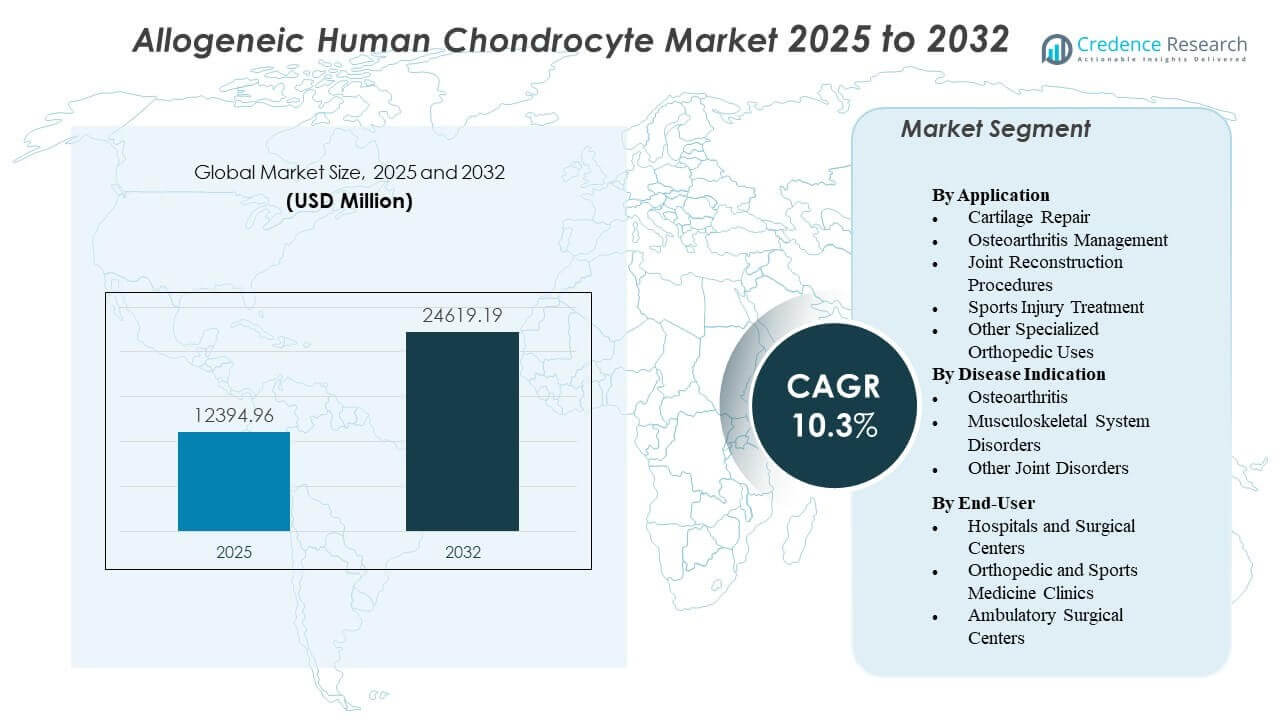
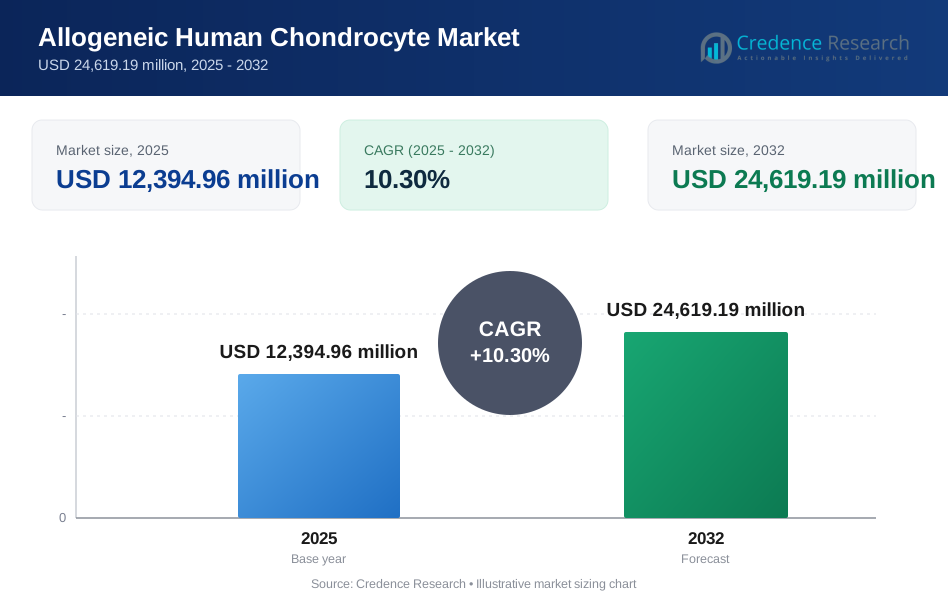
The Allogeneic Human Chondrocyte Market is projected to grow from USD 12,394.96 million in 2025 to an estimated USD 24,619.19 million by 2032, with a compound annual growth rate (CAGR) of 10.3% from 2025 to 2032.
| REPORT ATTRIBUTE | DETAILS |
|---|---|
| Historical Period | 2020-2023 |
| Base Year | 2024 |
| Forecast Period | 2025-2032 |
| Allogeneic Human Chondrocyte Market Size 2024 | USD 12,394.96 million |
| Allogeneic Human Chondrocyte Market, CAGR | 10.3% |
| Allogeneic Human Chondrocyte Market Size 2032 | USD 24,619.19 million |
Growth in the market is driven by rising osteoarthritis incidence, increasing sports-related joint injuries, and stronger clinical confidence in regenerative cell therapies. Surgeons prefer allogeneic approaches because they eliminate donor-site complications and offer consistent cell quality. Hospitals value shorter procedure times and lower recovery burdens associated with biologic repair techniques. Advancements in cell expansion, scaffold design, and imaging-guided precision strengthen treatment outcomes. Expanding research programs also support the transition from experimental use to standardized orthopedic care.
Regionally, North America leads the market due to advanced clinical infrastructure, high procedure volumes, and strong adoption of biologic joint preservation strategies. Europe follows with steady uptake supported by supportive regulatory frameworks and active orthopedic research networks. Asia-Pacific emerges as the fastest-growing region due to increasing access to regenerative therapies and expanding sports medicine practices. Countries such as Japan, South Korea, and China integrate these treatments into early-stage cartilage care. Latin America and the Middle East & Africa show gradual progress as awareness and clinical capabilities expand
Market Insights:
- The Allogeneic Human Chondrocyte Market is projected to grow from USD 12,394.96 million in 2025 to USD 24,619.19 million by 2032, registering a 10.3% CAGR driven by expanding clinical adoption.
- Rising osteoarthritis cases, growing sports injuries, and stronger clinical confidence in biologic repair therapies continue to accelerate market demand.
- Limited reimbursement structures, high manufacturing costs, and regulatory complexity restrict broader accessibility in several regions.
- North America leads market growth due to advanced infrastructure, while Europe maintains steady adoption through strong clinical research networks.
- Asia-Pacific emerges as the fastest-growing region supported by expanding orthopedic capabilities and rising awareness of early-stage regenerative care.
Market Drivers
Growing Need for Advanced Regenerative Therapies for Cartilage Repair
Demand for regenerative therapies grows due to rising joint injuries and early-stage cartilage degeneration. Patients seek options that support natural tissue restoration. Surgeons adopt allogeneic cell products to reduce procedure time and avoid donor-site morbidity. Hospitals focus on solutions that support faster recovery pathways. Clinicians prefer standardized products with consistent cell quality. Research teams highlight the value of scalable cell expansion methods. Payers track outcomes linked to functional improvement. The Allogeneic Human Chondrocyte Market gains momentum through broader adoption across orthopedic care settings.
- For instance, Zimmer Biomet’s DeNovo® NT Natural Tissue Graft is an FDA-regulated minced juvenile cartilage allograft used in a single-stage implantation procedure. Published clinical studies confirm that juvenile cartilage used in DeNovo NT contains approximately 2.5 million chondrocytes per cubic centimeter (cm³), significantly higher than adult cartilage cell density. This higher metabolic activity supports stronger matrix formation during cartilage repair.
Higher Prevalence of Osteoarthritis Fueling Cell-Based Treatment Adoption
Osteoarthritis burden expands with aging populations and active lifestyles. Many individuals pursue alternatives to joint replacement. Health systems evaluate cell-based solutions that delay invasive surgeries. Providers integrate cartilage restoration methods into early intervention programs. Researchers explore strategies that support durable tissue regeneration. Clinics deploy treatment pathways that enhance long-term mobility. Payers study real-world outcomes to guide reimbursement growth. This trend pushes steady uptake within the Allogeneic Human Chondrocyte Market.
Improved Manufacturing Capabilities Strengthening Product Availability
Cell processing technologies advance to deliver higher consistency and reliability. Automated bioreactors support stable expansion cycles. Quality control tools give precise screening of phenotype and viability. Manufacturers streamline distribution networks to reduce lead times. Hospitals value predictable turnaround for scheduled procedures. Developers scale production to meet rising clinical demand. Regulatory clarity supports faster progression from trials to commercial access. This progress supports broader traction for the Allogeneic Human Chondrocyte Market.
- For instance, Kolon TissueGene’s TG-C therapy is manufactured using a defined mixture of primary allogeneic chondrocytes and GP2-293 cells, a ratio disclosed in its regulatory filings. The company uses controlled bioprocess methods to maintain consistent therapeutic protein expression across production batches. This standardized composition supports predictable biological activity during cartilage repair.
Growing Preference for Minimally Invasive Orthopedic Procedures
Patients prefer treatment paths that reduce downtime and discomfort. Providers integrate cartilage preservation approaches into sports medicine. Surgeons evaluate cell implants that support joint function with minimal structural change. Hospitals invest in tools that modernize arthroscopic procedures. Rehabilitation teams build programs aligned with accelerated recovery protocols. Demand rises for therapies that restore mobility across younger patient groups. Industry innovators introduce implants that enhance surgical workflow. The Allogeneic Human Chondrocyte Market benefits from this shift toward less invasive orthopedic care.
Market Trends
Shift Toward Off-the-Shelf Cell Products Supporting Scalable Treatment Models
Clinicians move toward ready-to-use cell solutions that streamline therapy delivery. Off-the-shelf formats reduce preparation burdens. Providers adopt standardized constructs that maintain predictable outcomes. Manufacturers develop preservation techniques that extend product viability. Health systems evaluate procurement models that support high-volume usage. Research pipelines expand to include allogeneic cell platforms for early-stage injuries. Sports medicine centers test fast-deployment products for active individuals. This direction influences new product strategies within the Allogeneic Human Chondrocyte Market.
Integration of Biomaterial-Enhanced Scaffolds for Superior Cell Functionality
Developers design scaffolds that improve cell retention and matrix formation. New biomaterials support stronger attachment and controlled nutrient flow. Surgeons seek implants that match native cartilage structure. Research groups test novel hydrogel systems for better tissue remodeling. Hospitals monitor clinical outcomes linked to hybrid constructs. Engineers optimize scaffold porosity to support regeneration. Laboratories validate biomechanical performance through extended trials. This movement drives design innovation across the Allogeneic Human Chondrocyte Market.
Growing Use of Imaging and Digital Tools to Personalize Cartilage Treatment Plans
Clinicians rely on digital imaging to assess lesion depth and structural quality. Platforms guide surgeons with precise defect mapping. Sports clinics adopt 3D planning tools that enhance treatment accuracy. Providers predict recovery pathways with data-driven algorithms. Health systems monitor progress through remote tools. Digital workflows support improved communication between specialists. Imaging software supports selection of patients suited for cell-based repair. This evolution strengthens clinical precision across the Allogeneic Human Chondrocyte Market.
- For instance, clinical evaluations of Zimmer Biomet’s Signature™ MRI-based planning system demonstrate that it achieves postoperative alignment accuracy within 2° of the planned trajectory, a validated metric published in orthopedic surgical studies and widely used to improve precision during joint-related procedures.
Expansion of Clinical Trials Targeting Younger, Active Patient Groups
Trials explore outcomes among athletes and active adults with focal cartilage damage. Researchers test performance metrics aligned with high mobility needs. Trial designs emphasize durability over long follow-up periods. Clinics assess functional return timelines. Regulators review evidence linked to mid-term structural improvement. Sponsors broaden enrollment criteria to capture diverse activity levels. Sports medicine units track patient-reported outcomes across extended cycles. This trend shapes clinical evidence within the Allogeneic Human Chondrocyte Market.
- For instance, the U.S. FDA Investigational New Drug (IND) database confirms that Vericel’s autologous cartilage repair therapy trials enrolled over 144 active patients across its pivotal study cohorts, providing validated functional outcome data often used as a benchmark for designing newer allogeneic chondrocyte studies in athletic populations.
Market Challenges Analysis
Regulatory Complexity and Standardization Barriers Across Global Pathways
Approval requirements differ across regions and slow commercialization. Developers navigate varied guidelines for cell sourcing and manipulation. Consistent characterization of donor cells remains difficult. Hospitals evaluate protocols to confirm long-term safety. Manufacturers must comply with strict sterility and traceability standards. Clinicians seek clearer frameworks for integrating new therapies. Payers look for robust evidence before supporting reimbursement. The Allogeneic Human Chondrocyte Market faces obstacles while aligning with evolving regulatory expectations.
High Production Costs and Limited Reimbursement Structures Impacting Accessibility
Cell expansion and quality testing raise operational expenses. Facilities invest in advanced clean-room infrastructure. Health systems face budget constraints when reviewing new technologies. Many patients rely on coverage pathways that remain narrow. Surgeons face adoption challenges linked to cost-benefit justification. Providers require long-term outcomes to defend expenditure. Manufacturers balance pricing strategies with scale pressures. This environment slows broad adoption within the Allogeneic Human Chondrocyte Market.
Market Opportunities
Rising Investment in Regenerative Orthopedics Supporting Pipeline Expansion
Investors fund new platforms that refine cell function. Researchers explore combination therapy models that strengthen cartilage formation. Hospitals collaborate with biotech teams to evaluate next-generation implants. Growth in sports medicine supports higher demand for biologic repair tools. Digital tools enhance patient engagement during recovery. Developers use outcome data to accelerate product differentiation. Scaling facilities offer more predictable supply chains. This opens new pathways for innovation within the Allogeneic Human Chondrocyte Market.
Growing Acceptance of Early-Intervention Strategies for Cartilage Preservation
Clinics focus on treating defects before joint deterioration progresses. Surgeons offer biologic repair methods to delay invasive surgeries. Providers promote patient education programs centered on long-term mobility. Active patients prefer approaches that maintain high performance levels. Reimbursement may expand when supported by durable outcomes. Developers create cell formats tailored to mild and moderate lesions. Hospitals evaluate integrated care models that improve treatment continuity. This direction creates new clinical potential for the Allogeneic Human Chondrocyte Market.
Market Segmentation Analysis:
By Applications
Cartilage repair, osteoarthritis management, joint reconstruction, sports injury treatment, and other specialized orthopedic uses influence demand across the Allogeneic Human Chondrocyte Market. Cartilage repair leads adoption because surgeons seek biologic options that restore structure without extensive reconstruction. Osteoarthritis management expands as patients pursue joint-preserving solutions. Joint reconstruction procedures use allogeneic chondrocytes to support defect stability. Sports medicine teams adopt these cells to improve functional return for active patients. Specialized orthopedic uses address smaller joints and traumatic cases. Providers refine protocols to improve tissue integration. This range strengthens traction across orthopedic care pathways.
- For example, Organogenesis ReNu achieved statistically significant WOMAC pain reduction (p=0.0177) at 6 months in Phase 3 trial vs. saline.
By Disease Indication
Osteoarthritis, musculoskeletal disorders, and other joint conditions guide many clinical decisions. Osteoarthritis remains a priority due to early degeneration patterns that require biologic intervention before joint replacement. Musculoskeletal disorders include traumatic lesions and biomechanical defects that weaken cartilage integrity. Providers use imaging and clinical evaluation to select cases suited for allogeneic chondrocytes. Other joint disorders, including congenital abnormalities and rare structural problems, require targeted plans where conventional methods offer limited benefit. It helps clinicians shape individualized pathways that protect long-term mobility. Hospitals and clinics track durability across varied cases. These indications strengthen the clinical relevance of the Allogeneic Human Chondrocyte Market.
- For instance, in clinical trials for Medipost’s CARTISTEM®, patients with Kellgren-Lawrence Grade 3 osteoarthritis showed a 60% improvement in the Western Ontario and McMaster Universities Osteoarthritis Index (WOMAC) score, proving the efficacy of allogeneic stem cell-derived chondrocytes in reversing degenerative symptoms.
By End-Users
Hospitals and surgical centers lead adoption due to advanced infrastructure and multidisciplinary teams. Surgeons integrate allogeneic chondrocytes into arthroscopic and reconstructive procedures that demand precision. Orthopedic and sports medicine clinics manage active individuals who require focused treatment plans. These clinics use digital tools and structured rehabilitation to guide recovery. Ambulatory surgical centers support same-day regenerative procedures with efficient workflows. It offers predictable timelines for outpatient joint repair. Providers across all settings evaluate outcome data to refine treatment pathways. This coordinated structure enhances uptake across the Allogeneic Human Chondrocyte Market.
Segmentation:
By Application
- Cartilage Repair
- Osteoarthritis Management
- Joint Reconstruction Procedures
- Sports Injury Treatment
- Other Specialized Orthopedic Uses
By Disease Indication
- Osteoarthritis
- Musculoskeletal System Disorders
- Other Joint Disorders
By End-User
- Hospitals and Surgical Centers
- Orthopedic and Sports Medicine Clinics
- Ambulatory Surgical Centers
By Region
- North America
- U.S.
- Canada
- Mexico
- Europe
- Germany
- France
- U.K.
- Italy
- Spain
- Rest of Europe
- Asia Pacific
- China
- Japan
- India
- South Korea
- South-east Asia
- Rest of Asia Pacific
- Latin America
- Brazil
- Argentina
- Rest of Latin America
- Middle East & Africa
- GCC Countries
- South Africa
- Rest of the Middle East and Africa
Regional Analysis:
North America holds the largest share of the Allogeneic Human Chondrocyte Market, supported by high adoption of regenerative orthopedic therapies and strong clinical infrastructure. The region accounts for nearly 40% of global revenue, driven by advanced sports medicine centers and early intervention programs for joint preservation. Hospitals deploy these therapies for osteoarthritis and complex cartilage defects with rising confidence. Researchers in the United States lead trial activity focused on long-term durability and functional improvement. It benefits from favorable reimbursement pilots in select states. Industry collaborations strengthen technology transfer and accelerate product development. This leadership position is supported by strong patient demand for minimally invasive biologic repair.
Europe maintains a solid position with roughly 30% market share, supported by growing acceptance of cell-based cartilage restoration. Surgeons in Germany, the UK, and France incorporate allogeneic constructs into joint preservation strategies for younger and active individuals. Hospitals evaluate outcomes across knee, hip, and ankle lesions using structured rehabilitation frameworks. Researchers test scaffold-enhanced formats to support stronger biomechanical performance. It gains traction through expanding clinical guidelines that recognize early biologic intervention. Regulatory bodies encourage data transparency to strengthen clinician confidence. This region sustains steady growth driven by investments in orthopedic innovation.
Asia-Pacific represents the fastest-growing region and captures nearly 20% of global share, driven by rising orthopedic procedure volumes and expanding access to regenerative medicine. Clinics in Japan, South Korea, China, and Australia integrate allogeneic chondrocytes into treatment plans for athletes and early-stage degenerative cases. Hospitals adopt imaging tools that guide precise lesion assessment and improve treatment selection. Researchers explore localized manufacturing and cold-chain optimization to reduce cost burdens. It benefits from government interest in joint preservation programs for aging populations. Demand expands as patients seek alternatives that delay joint replacement. This growth trajectory strengthens long-term regional influence across the Allogeneic Human Chondrocyte Market.
Key Player Analysis:
- Kolon TissueGene, Inc.
- ISTO Technologies Inc.
- Zimmer Biomet
- Genzyme
- CellGenix
- EMD Serono
- Vericel Corporation
- Histogen Inc.
Competitive Analysis:
Competition in the Allogeneic Human Chondrocyte Market centers on technology development, clinical validation, and scalable manufacturing. Companies invest in cell-expansion platforms that deliver consistent phenotype and viability across varied production cycles. Developers refine scaffold-cell combinations to enhance retention and improve matrix formation during repair. Hospitals evaluate performance based on durability, return-to-function timelines, and complication avoidance. It drives suppliers to prioritize quality control and long-term structural outcomes. Leading players strengthen partnerships with orthopedic clinics to accelerate adoption. Research collaborations support new indications and broaden the treatment portfolio. Competitive positioning increasingly depends on evidence-based differentiation and cost-efficient delivery models that support wider accessibility.
Recent Developments:
- In June 2025, a Phase II allogeneic chondroprogenitor therapy project advanced through manufacturing and implantation planning in the UK, aiming to streamline adoption of an allogeneic chondrocyte progenitor advanced therapy medicinal product for cartilage repair.
- In April 2024, Vericel Corporation received a patent grant for a cartilage repair composition that uses cultured allogeneic chondrocytes on a resorbable collagen membrane, strengthening its intellectual property portfolio in cell-based cartilage therapies.
Report Coverage:
The research report offers an in-depth analysis based on Application, Disease Indication, and End-User. It details leading market players, providing an overview of their business, product offerings, investments, revenue streams, and key applications. Additionally, the report includes insights into the competitive environment, SWOT analysis, current market trends, as well as the primary drivers and constraints. Furthermore, it discusses various factors that have driven market expansion in recent years. The report also explores market dynamics, regulatory scenarios, and technological advancements that are shaping the industry. It assesses the impact of external factors and global economic changes on market growth. Lastly, it provides strategic recommendations for new entrants and established companies to navigate the complexities of the market.
Future Outlook:
- Demand for advanced cartilage restoration therapies will strengthen clinical adoption across orthopedic and sports medicine networks.
- Expansion of off-the-shelf allogeneic solutions will support faster procedure planning and broader treatment access.
- Rising use of digital imaging will enhance patient selection and improve accuracy during repair.
- Growth in early-stage osteoarthritis management will increase biologic intervention pathways.
- Surgeons will integrate regenerative components into reconstruction workflows to reduce revision procedures.
- Research programs will expand toward scaffold-enhanced constructs that support stronger biomechanical outcomes.
- Outpatient facilities will adopt streamlined protocols that reduce procedure time and simplify recovery.
- Partnerships between biotech developers and hospitals will accelerate clinical evidence generation.
- Regional uptake will increase with supportive reimbursement pilots and structured care models.
- Continued innovation will strengthen long-term positioning of the Allogeneic Human Chondrocyte Market across regenerative orthopedics.
Request a Free Sample
Fill in your details and we'll send you a free sample report.
- Sample data tables & charts
- Research methodology
Need a Custom Version of This Report?
Tailor the scope, geography, or segments to your exact requirements.
- Custom geography or segment scope
- Direct access to our analyst team
Frequently Asked Questions
What is the current market size for the Allogeneic Human Chondrocyte Market, and what is its projected size in 2032?
At what Compound Annual Growth Rate is the Allogeneic Human Chondrocyte Market projected to grow between 2025 and 2032?
Which Allogeneic Human Chondrocyte Market segment held the largest share in 2025?
What are the primary factors fueling the growth of the Allogeneic Human Chondrocyte Market?
Who are the leading companies in the Allogeneic Human Chondrocyte Market?
Which region commanded the largest share of the Allogeneic Human Chondrocyte Market in 2025?
Table of Content
Chapter 1 Market Segmentation
- 1.1 Segmentation Framework
- 1.1.1 Product and Service Classification
- 1.1.2 Application and End-Use Classification
- 1.1.3 Technology and Solution Classification
- 1.1.4 Customer and Distribution Channel Classification
- 1.1.5 Geographic Segmentation
- 1.1.6 Market Segment Definitions and Boundaries
Chapter 2 Introduction
- 2.1 Report Objectives and Scope
- 2.2 Product Definition and Industry Terminology
- 2.3 Market Inclusions and Exclusions
- 2.4 Research Process
- 2.4.1 Primary Research and Expert Interviews
- 2.4.2 Secondary Research and Source Review
- 2.4.3 Top-Down and Bottom-Up Estimation
- 2.4.4 Data Triangulation and Verification
- 2.5 Market Size Measurement Basis
- 2.5.1 2025: USD 12,394.96 million → 2032: USD 24,619.19 million
- 2.6 Historical and Forecast Reference Periods
- 2.6.1 Base Year: 2025
- 2.6.2 Forecast Period: 2025-2032
- 2.7 Research Assumptions and Limitations
Chapter 3 Executive Summary
- 3.1 Market Snapshot and Key Findings
- 3.2 Base-Year Market Size, 2025
- 3.3 Forecast Market Size, 2032
- 3.4 Revenue and Volume Growth Outlook
- 3.5 Key Demand and Supply Indicators
- 3.6 Leading Market Segments
- 3.7 Fastest-Growing Market Opportunities
- 3.8 Regional Performance Highlights
- 3.9 Technology and Industry Transformation
- 3.10 Competitive Landscape Summary
- 3.11 Analyst View and Strategic Implications
Chapter 4 Global Allogeneic Human Chondrocyte Market Trends and Developments
- 4.1 Historical Industry Development
- 4.2 Recent Market Trends and Developments
- 4.3 Demand and Customer Behavior Trends
- 4.4 Technology and Product Innovation
- 4.5 Artificial Intelligence, Automation and Digitalization
- 4.6 Local Manufacturing and Supply Chain Realignment
- 4.7 Industry Partnerships, Mergers and Acquisitions
- 4.8 Sustainability and Circular Economy Developments
- 4.9 Government and Private Sector Investment Trends
- 4.10 Emerging Business Models and Commercialization
- 4.11 Industry Developments and Announcements
Chapter 5 Global Allogeneic Human Chondrocyte Market Production, Supply and Demand Analysis
- 5.1 Demand Trend and Consumption Analysis
- 5.2 Demand Forecast, 2025-2032
- 5.3 Production and Output Trend
- 5.4 Production and Output Forecast, 2025-2032
- 5.5 Installed Capacity and Capacity Utilization
- 5.6 Company-Wise Production Plants and Statistics
- 5.6.1 Installed Production Capacity
- 5.6.2 Actual Production
- 5.6.3 Planned Capacity and Expansion Targets
- 5.7 Supply Chain Structure and Procurement Trends
- 5.8 Supply-Demand Gap and Bottlenecks
- 5.9 Import Dependence and Sourcing Structure
- 5.10 Contract Manufacturing and Outsourcing
- 5.11 Regional Supply and Demand Concentration
Chapter 6 Global Allogeneic Human Chondrocyte Market Pricing Analysis
- 6.1 Pricing Structure and Measurement
- 6.2 Historical Pricing Trends
- 6.3 Pricing Outlook, 2025-2032
- 6.4 Average Selling Price and Unit Economics
- 6.5 Pricing by Product and Market Segment
- 6.6 Geographic Pricing Differences
- 6.7 Key Input, Energy, Labor and Logistics Costs
- 6.8 Contract Pricing and Purchasing Models
- 6.9 Pricing Sensitivity and Competitive Positioning
- 6.10 Price, Margin and Profitability Implications
Chapter 7 Global Allogeneic Human Chondrocyte Market Dynamics
- 7.1 Market Growth Drivers
- 7.1.1 Demand-Side Drivers
- 7.1.2 Technology and Innovation Drivers
- 7.1.3 Infrastructure and Investment Drivers
- 7.1.4 Regulatory and Policy Drivers
- 7.2 Market Restraints
- 7.2.1 Cost and Affordability Constraints
- 7.2.2 Technology and Adoption Barriers
- 7.2.3 Supply Chain and Operational Constraints
- 7.3 Market Challenges
- 7.3.1 Competitive Pressure and Margin Erosion
- 7.3.2 Skills, Infrastructure and Implementation Gaps
- 7.4 Emerging Market Opportunities
- 7.5 Market Dynamics Impact and Time-Horizon Assessment
Chapter 8 Global Allogeneic Human Chondrocyte Value Chain Analysis
- 8.1 Industry Value Chain Overview
- 8.2 Upstream Suppliers and Critical Inputs
- 8.3 Technology and Component Providers
- 8.4 Manufacturing or Service Delivery
- 8.5 Distribution, Channel Partners and Integrators
- 8.6 Downstream Applications and End Users
- 8.7 Value Addition and Profit Pools
- 8.8 Vertical Integration and Outsourcing
- 8.9 Supplier Concentration and Risk
- 8.10 Supply Chain Localization and Resilience
Chapter 9 Global Allogeneic Human Chondrocyte Market Regulations and Policies
- 9.1 Relevant Laws, Standards and Compliance Frameworks
- 9.2 Product, Service, Safety and Quality Requirements
- 9.3 Government Policies, Incentives and Subsidies
- 9.4 Imports, Exports and Trade Barriers
- 9.5 Public Procurement and Local Content Requirements
- 9.6 Environmental and Sustainability Compliance
- 9.7 Upcoming Policy Changes and Market Implications
Chapter 10 Global Allogeneic Human Chondrocyte Market Hotspots and Opportunities
- 10.1 Market Opportunity Mapping and Growth Hotspots
- 10.2 High-Growth Applications and Customer Groups
- 10.3 Underserved Markets and White-Space Opportunities
- 10.4 Emerging Technology and Product Opportunities
- 10.5 New Capacity and Investment Hotspots
- 10.6 Market Entry and Expansion Opportunities
- 10.7 Distribution and Partnership Opportunities
- 10.8 Near-Term and Long-Term Commercial Potential
- 10.9 Opportunity Attractiveness and Execution Risks
Chapter 11 Global Allogeneic Human Chondrocyte Market Outlook, 2025-2032
- 11.1 Market Size and Analysis
- 11.1.1 Revenue (Market Measurement: 2025: USD 12,394.96 million → 2032: USD 24,619.19 million)
- 11.1.2 Market Volume and Quantity Sold
- 11.1.3 Historical Market Size
- 11.1.4 Base-Year Market Size, 2025
- 11.2 Market Forecast, 2025-2032
- 11.2.1 Revenue Forecast to 2032
- 11.2.2 Volume Forecast to 2032
- 11.2.3 CAGR and Year-on-Year Growth
- 11.2.4 Incremental Revenue Opportunity
- 11.3 Forecast Assumptions and Scenario Analysis
- 11.3.1 Base-Case Forecast
- 11.3.2 Optimistic and Conservative Scenarios
- 11.3.3 Technology, Pricing and Policy Sensitivities
- 11.4 Market Attractiveness and Growth Outlook
Chapter 12 Global Allogeneic Human Chondrocyte Market Segmentation and Outlook
- 12.1 Segmentation Summary and Market Shares, 2025
- 12.2 Largest and Fastest-Growing Segments
- 12.3 Segment Growth Comparison
- 12.4 Segment Attractiveness and Priority Matrix
Chapter 13 Global Allogeneic Human Chondrocyte Geographic Market Outlook, 2025-2032
- 13.1 Regional Market Size and Share, 2025
- 13.2 Regional Market Forecast, 2025-2032
- 13.3 Regional Pricing, Production and Demand Differences
- 13.4 North America
- 13.4.1 United States
- 13.4.2 Canada
- 13.4.3 Mexico
- 13.5 Europe
- 13.5.1 Germany
- 13.5.2 France
- 13.5.3 Italy
- 13.5.4 United Kingdom
- 13.5.5 Spain
- 13.5.6 Poland
- 13.5.7 Russia
- 13.5.8 Netherlands
- 13.5.9 Belgium
- 13.5.10 Sweden
- 13.5.11 Denmark
- 13.5.12 Norway
- 13.5.13 Rest of Europe
- 13.6 Asia Pacific
- 13.6.1 China
- 13.6.2 India
- 13.6.3 Japan
- 13.6.4 South Korea
- 13.6.5 Thailand
- 13.6.6 Indonesia
- 13.6.7 Vietnam
- 13.6.8 Malaysia
- 13.6.9 Australia
- 13.6.10 Rest of Asia Pacific
- 13.7 Latin America
- 13.7.1 Brazil
- 13.7.2 Argentina
- 13.7.3 Colombia
- 13.7.4 Chile
- 13.7.5 Rest of Latin America
- 13.8 Middle East
- 13.8.1 Saudi Arabia
- 13.8.2 United Arab Emirates
- 13.8.3 Turkey
- 13.8.4 Israel
- 13.8.5 Iran
- 13.8.6 Rest of the Middle East
- 13.9 Africa
- 13.9.1 South Africa
- 13.9.2 Egypt
- 13.9.3 Nigeria
- 13.9.4 Morocco
- 13.9.5 Rest of Africa
- 13.10 Regional Investment, Policy and Supply Chain Differences
- 13.11 Regional Competitive Landscape
- 13.12 Geographic Growth Hotspots
Chapter 14 Global Allogeneic Human Chondrocyte Technology, Innovation and Sustainability Outlook
- 14.1 Technology Landscape and Maturity
- 14.2 Product, Process and Service Innovation
- 14.3 AI, Automation and Digital Tools in the Industry
- 14.4 Technology Adoption and Performance Benchmarking
- 14.5 Innovation Pipeline and R&D Investment
- 14.6 Patent and Intellectual Property Trends
- 14.7 Energy Efficiency and Resource Management
- 14.8 Sustainability, Recycling and Circularity
- 14.9 Technology Roadmap, 2025-2032
- 14.10 Risks of Obsolescence and Technology Substitution
Chapter 15 Global Allogeneic Human Chondrocyte Market Key Strategic Imperatives
- 15.1 Growth and Market Entry Priorities
- 15.2 High-Return Products and Segments
- 15.3 Pricing, Profitability and Cost Optimization
- 15.4 Technology Investment and Product Differentiation
- 15.5 Supply Chain Localization and Resilience
- 15.6 Distribution and Customer Acquisition
- 15.7 Partnership, Acquisition and Capacity Strategy
- 15.8 Regional Expansion Priorities
- 15.9 Short-, Medium- and Long-Term Actions
Chapter 16 Competition Outlook
- 16.1 Industry Competition Characteristics
- 16.2 Market Structure and Concentration
- 16.3 Market Share and Competitive Positioning, 2025
- 16.4 Company-Wise Revenue and Product Benchmarking
- 16.5 Production and Service Capacity Benchmarking
- 16.6 Technology, Pricing and Differentiation
- 16.7 Regional Footprint and Distribution Strength
- 16.8 Mergers, Acquisitions and Strategic Alliances
- 16.9 New Entrants and Competitive Threats
- 16.10 Porter's Five Forces and Industry Attractiveness
- 16.11 Competitive Outlook, 2025-2032
Chapter 17 Company Profiles
- 17.1 Company Coverage and Selection Criteria
- 17.2 Leading Market Participants – Standard Profile Structure
- 17.2.1 Business Description
- 17.2.2 Company Ownership and Geographic Presence
- 17.2.3 Product and Service Portfolio
- 17.2.4 Manufacturing and Operating Footprint
- 17.2.5 Production Capacity and Expansion Plans
- 17.2.6 Financial Performance and Investment
- 17.2.7 Market Share and Competitive Position
- 17.2.8 Technology and Innovation Capabilities
- 17.2.9 Strategic Alliances or Partnerships
- 17.2.10 Recent Developments
- 17.2.11 Growth Strategy and Outlook
- 17.3 Other Relevant Market Participants
Note: Every listed company is profiled on the structure shown under the first company. The company list is preliminary and may change based on research findings, market developments, data availability and client requirements.
Chapter 18 Disclaimer
- 18.1 Research and Forecast Disclaimer
- 18.2 Data Source and Estimation Limitations
Note: The depth of individual sections depends on data availability for this market. Volume, capacity, trade and other unit-based metrics are included where applicable.