
Amlodipine Market Overview:
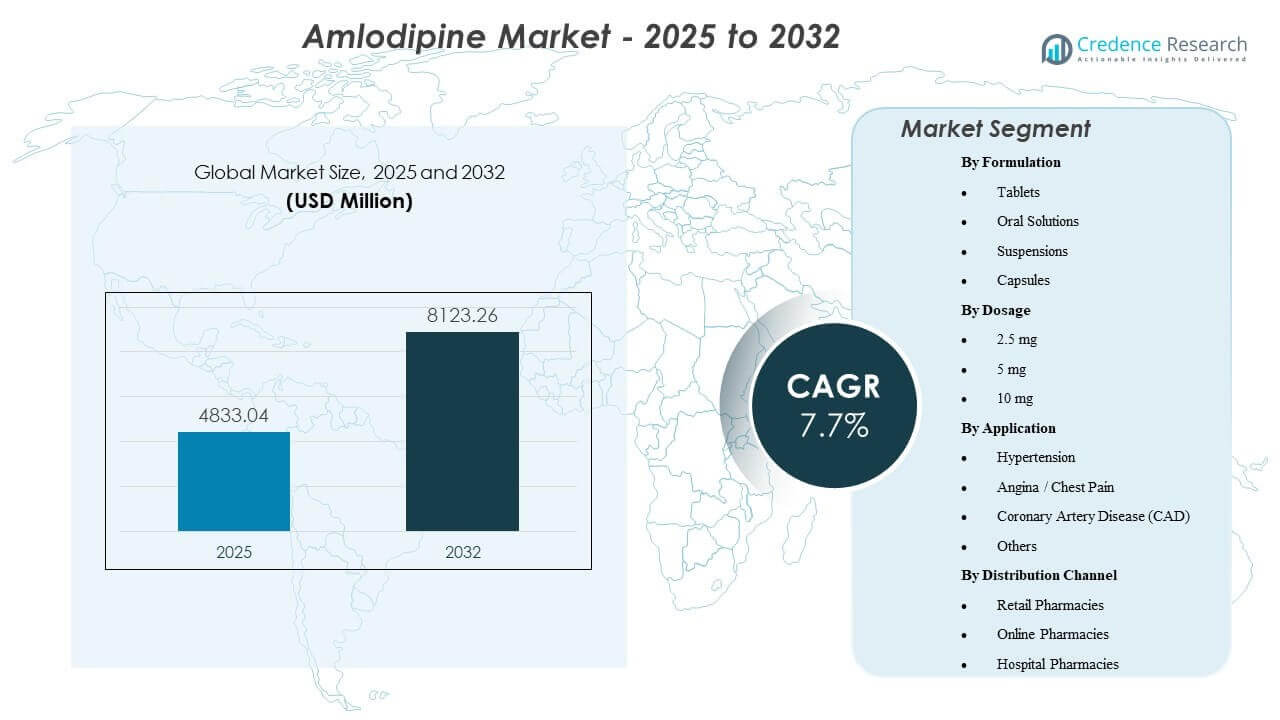
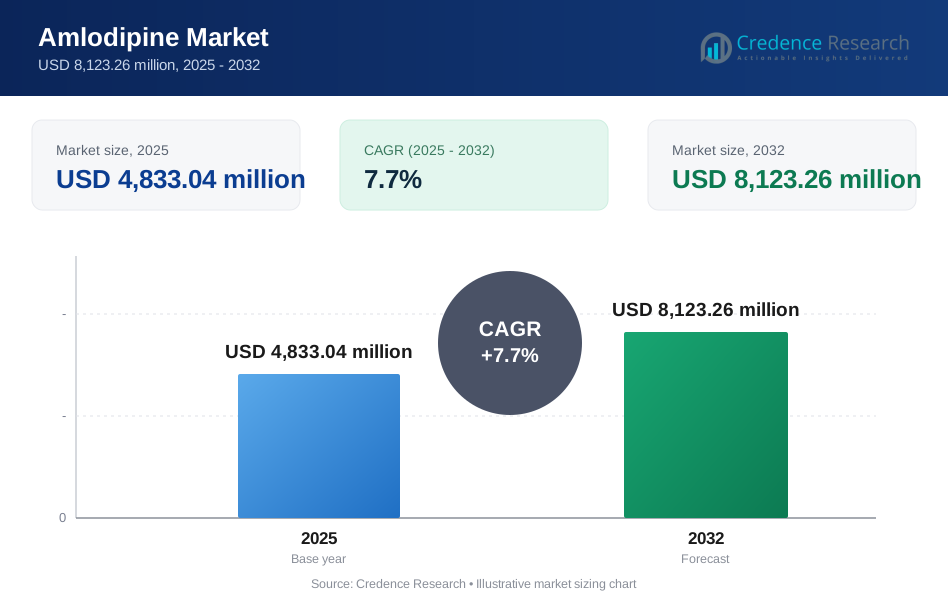
The Amlodipine Market is projected to grow from USD 4,833.04 million in 2025 to an estimated USD 8,123.26 million by 2032, with a compound annual growth rate (CAGR) of 7.7% from 2025 to 2032.
| REPORT ATTRIBUTE | DETAILS |
|---|---|
| Historical Period | 2020-2023 |
| Base Year | 2024 |
| Forecast Period | 2025-2032 |
| Amlodipine Market Size 2025 | 4,833.04 |
| Amlodipine Market, CAGR | 7.7% |
| Amlodipine Market Size 2032 | USD 8,123.26 million |
Growth in the Amlodipine Market is driven by rising hypertension cases and wider acceptance of once-daily calcium channel blockers in long-term cardiovascular therapy. Physicians rely on amlodipine for its strong clinical evidence, stable pharmacokinetic profile, and dose-forgiveness, which improves adherence among chronic patients. Generic penetration supports affordability, enabling broader use in low- and middle-income regions. Demand increases further with preventive healthcare initiatives, routine screening programs, and growing adoption of fixed-dose combinations for simplified treatment.
North America leads the Amlodipine Market due to high awareness, strong diagnostic coverage, and widespread access to cardiovascular therapies. Europe follows with established healthcare systems and consistent hypertension management protocols. Asia-Pacific is the fastest emerging region, supported by expanding patient populations, urbanization, and broader generic availability across China and India. Latin America and the Middle East demonstrate rising uptake driven by improving supply chains and growing investment in essential medicine distribution. Africa shows gradual progression as screening programs and retail pharmacy networks expand.
Amlodipine Market Insights:
- The Amlodipine Market is projected to grow from USD 4,833.04 million in 2025 to USD 8,123.26 million by 2032, supported by a 7.7% CAGR during the forecast period.
- Rising hypertension prevalence, strong physician trust, and adherence-friendly dosing continue to drive steady adoption of amlodipine across global treatment pathways.
- Market restraints include intense generic competition, pricing pressure across emerging economies, and supply chain challenges linked to API sourcing.
- North America leads due to extensive diagnostic coverage and strong therapy access, while Europe maintains stable demand through established cardiovascular care frameworks.
- Asia-Pacific emerges as the fastest-growing region, fueled by rising patient populations, expanding generic manufacturing, and improved distribution networks across China and India.
Amlodipine Market Drivers
Rising Incidence Of Hypertension And Expanding Need For Long-Term Cardiovascular Therapy
Global hypertension growth strengthens therapeutic demand across care settings. Urban lifestyles raise cardiovascular risks for adults and older populations. Poor diet patterns increase salt and fat intake. Sedentary work environments reduce physical activity levels. Physicians prefer stable calcium channel blockers for routine blood pressure control. Once-daily dosing improves adherence and clinical outcomes. Early screening enhances treatment initiation in primary care. The Amlodipine Market gains steady traction through consistent patient need.
- For instance, clinical studies published in the Journal of Clinical Hypertension confirm that amlodipine’s long terminal half-life of 30 to 50 hours provides stable 24-hour plasma concentrations, reducing blood pressure variability throughout the day. This pharmacokinetic profile offers measurable dose-forgiveness, maintaining antihypertensive effect even when a dose is delayed.
Strong Penetration Of Generic Formulations And Wider Affordability Across Regions
Generic manufacturing expands product access for low- and middle-income populations. Competitive pricing improves affordability for long-term therapy users. Public health programs include amlodipine in essential drug lists. Local plants increase production capacity for high-volume demand. Pharmacies maintain broad availability across urban and rural networks. Insurance schemes support regular medicine refills. Hospitals procure large volumes through tender-based systems. It benefits from strong price–volume momentum worldwide.
- For instance, the World Health Organization’s Prequalification Program has approved several generic amlodipine products that meet international bioequivalence criteria, where the 90% Confidence Interval for the Test/Reference ratios of AUC and Cmax must fall within the strict 80.00% to 125.00% range. This certification confirms adherence to globally recognized pharmacokinetic performance standards.
Growing Use Of Fixed-Dose Combinations To Strengthen Adherence And Simplify Care Protocols
Combination medicines reduce pill burden for chronic disease patients. Clinicians adopt dual-therapy regimens involving ARBs and ACE inhibitors. Improved adherence lowers cardiovascular risks in high-risk groups. Pharmaceutical firms expand FDC portfolios to enhance therapeutic value. Regulatory bodies approve new combinations for broader use. Hospitals follow streamlined prescribing guidelines. Patients prefer simplified dosing routines for long-term treatment. The Amlodipine Market gains from continuous adoption of modern FDC options.
Increasing Emphasis On Preventive Healthcare And Early Cardiovascular Risk Detection
Governments promote community screening for blood pressure control. Primary care centers expand preventive check-up programs. Workplaces focus on employee heart health initiatives. Pharmacies conduct awareness camps for lifestyle risk reduction. Digital tools help track daily blood pressure trends. Physicians encourage early intervention for at-risk adults. Public education campaigns reduce treatment delays. It aligns with rising focus on preventive cardiovascular management.
Amlodipine Market Trends
Expansion Of E-Pharmacy Platforms And Digital Prescription Channels Across Urban Markets
Online pharmacies increase reach for chronic disease medicines. Users adopt digital refill systems for monthly therapy needs. Teleconsultation platforms support remote prescription renewal. Retail chains integrate app-based delivery models. Electronic records improve dosing accuracy in follow-up visits. Home delivery services attract elderly patients seeking convenience. Digital interfaces enhance patient–provider communication. The Amlodipine Market reflects growing preference for seamless digital access.
Shift Toward High-Quality Branded Generics Through Stronger Compliance Standards
Manufacturers invest in quality upgrades to meet global norms. Regulatory audits encourage consistent manufacturing processes. Branded generics gain trust across prescribing physicians. Hospitals prefer suppliers with proven compliance records. Packaging improvements enhance medicine identification for patients. Firms strengthen reputation through strict quality certifications. Export-ready batches meet documentation requirements across markets. It promotes stronger brand differentiation in crowded generic segments.
- For instance, Sun Pharmaceutical Industries’ Mohali manufacturing facility successfully cleared a U.S. FDA inspection in July 2024 with zero Form 483 observations, reinforcing its strong CGMP compliance for amlodipine production. The company also reports that over 90% of its global revenue now comes from facilities free of OAI status, reflecting significant quality improvements across its manufacturing network.
Rising Importance Of Strategic Distribution Agreements In Emerging Regions
Pharmaceutical firms secure partnerships with regional wholesalers. Distribution networks expand into tier-two and tier-three cities. Local supply hubs improve stock reliability for pharmacies. Hospitals lock long-term supply deals with bulk providers. Logistics improvements support uninterrupted medicine flow. Cold-chain independence simplifies transport needs. Wider rural penetration strengthens retail presence. The Amlodipine Market benefits from structured and scalable distribution models.
- For instance, Zydus Lifesciences strengthened its cardiovascular portfolio through its widespread presence in India’s branded generics market, supported by a large field force and established national distribution network cited across its annual reports. The company consistently highlights improved market coverage and logistics efficiency, enabling reliable supply of high-demand therapies such as amlodipine across urban and semi-urban regions.
Growing Integration Of Data Analytics In Demand Forecasting And Inventory Optimization
Manufacturers use analytics tools to predict prescription cycles. Pharmacies adjust procurement based on real-time demand insights. Hospitals refine order schedules to reduce stockouts. Forecasting tools guide inventory planning during seasonal peaks. Data systems help control wastage from excess stock. Regional sales trends shape supply decisions for distributors. Companies track prescription behavior to align production volumes. It improves overall operational efficiency across supply chains.
Amlodipine Market Challenges Analysis
High Pricing Pressure From Intense Generic Competition Across Global Markets
Generic players dominate production across regulated and unregulated regions. Price erosion affects revenue stability for manufacturers. Hospitals negotiate aggressive tender prices to manage budgets. Retail pharmacies demand deep discounts on long-term supplies. Regulatory price caps limit profitability in several economies. Branded players struggle to maintain differentiation in crowded markets. Market entry barriers remain low for new producers. The Amlodipine Market must navigate strong downward pricing forces.
Supply Chain Vulnerabilities And Dependency On Concentrated API Sources
Active ingredient sourcing remains heavily concentrated in select countries. Trade restrictions disrupt production planning for several firms. Logistics delays affect timely delivery during peak demand cycles. Compliance issues may lead to batch rejections and recalls. Smaller firms face difficulty securing stable raw material contracts. Currency fluctuations impact procurement costs for import-dependent regions. Regulatory inspections add pressure to maintain strict quality standards. It requires strong risk mitigation strategies to ensure product stability.
Amlodipine Market Opportunities
Rising Demand In Underserved Rural Regions And Expansion Of Primary Healthcare Access
Governments invest in rural healthcare systems to increase diagnosis rates. Community clinics extend regular screening services for at-risk patients. Mobile health units reach distant areas with poor medical access. Pharmacy expansion boosts availability of chronic disease medicines. Insurance coverage encourages consistent therapy adherence. NGOs support education programs on cardiovascular risk control. Local distributors widen supply presence beyond urban hubs. The Amlodipine Market can capture new volume growth through deeper rural penetration.
Strengthening Innovation In Fixed-Dose Combinations And Lifecycle Management Programs
Pharmaceutical companies develop advanced FDC therapies for simplified care. New formulations support improved tolerance for sensitive patient groups. Lifecycle strategies extend product relevance through incremental upgrades. Research teams explore novel delivery systems with better adherence profiles. Physicians adopt evolved treatment protocols favoring combination drugs. Stronger clinical evidence supports wider therapeutic acceptance. Partnerships accelerate global distribution expansion. It can leverage innovation-driven strategies to sustain long-term competitive growth.
Amlodipine Market Segmentation Analysis:
By Formulation
Tablets dominate the Amlodipine Market because physicians prefer stable and easy-to-administer oral forms for long-term hypertension management. Oral solutions support patients with swallowing difficulties and pediatric needs. Suspensions provide flexible dosing for specific clinical requirements. Capsules offer an alternative for patients seeking smoother intake. Hospitals and retail pharmacies maintain broad stocking for all forms. Generic production strengthens affordability across regions. Patient adherence remains higher with tablet and capsule formats. It continues to benefit from strong demand for convenient oral therapies.
- For instance, peer-reviewed stability-indicating HPLC studies for amlodipine tablets have reported assay recovery results within 99.7% to 100.7%, with a Relative Standard Deviation of 0.59%. These validated analytical parameters confirm the high structural integrity and reliability of amlodipine formulations during long-term stability testing.
By Dosage
The 5 mg dose holds the highest use because it fits standard hypertension therapy for adults. The 10 mg dose supports patients needing stronger blood pressure control. The 2.5 mg dose helps elderly and sensitive patients who require careful titration. Physicians adjust doses to match comorbidity patterns and risk levels. Pharmacies maintain all strengths for consistent outpatient demand. Hospitals use varied doses for acute and chronic cases. Dose flexibility improves long-term adherence for diverse patient groups. The Amlodipine Market grows with wider adoption of tailored dosage plans.
By Application
Hypertension remains the dominant application due to its high global prevalence. Angina and chest pain treatments rely on amlodipine to improve blood flow and reduce cardiac strain. Coronary artery disease management includes long-term therapy to stabilize vascular function. Other uses cover off-label prescriptions for patients with combined cardiovascular risks. Physicians trust amlodipine for its proven safety and broad clinical evidence. Hospitals prescribe it for both acute and chronic care settings. Retail channels support ongoing refill needs for chronic patients. It serves a wide therapeutic base across cardiovascular conditions.
- For instance, the ASCOT clinical trial demonstrated that an amlodipine-based regimen reduced the risk of fatal and non-fatal strokes by 23% and lowered the risk of developing new-onset diabetes by 34% compared to traditional beta-blocker therapies.
By Distribution Channel
Retail pharmacies lead distribution because patients depend on routine refills for long-term therapy. Online pharmacies gain traction through convenient ordering and home delivery services. Hospital pharmacies manage inpatient and post-discharge prescriptions. Digital platforms expand access for younger and urban populations. Regional distributors strengthen supply reach into remote areas. Insurance coverage supports consistent pharmacy engagements. Stock reliability influences physician prescribing patterns. The Amlodipine Market benefits from multi-channel availability across all regions.
Amlodipine Market Segmentation:
By Formulation
- Tablets
- Oral Solutions
- Suspensions
- Capsules
By Dosage
- 2.5 mg
- 5 mg
- 10 mg
By Application
- Hypertension
- Angina / Chest Pain
- Coronary Artery Disease (CAD)
- Others
By Distribution Channel
- Retail Pharmacies
- Online Pharmacies
- Hospital Pharmacies
By Regional Coverage
- North America
- U.S.
- Canada
- Mexico
- Europe
- Germany
- France
- U.K.
- Italy
- Spain
- Rest of Europe
- Asia Pacific
- China
- Japan
- India
- South Korea
- South-east Asia
- Rest of Asia Pacific
- Latin America
- Brazil
- Argentina
- Rest of Latin America
- Middle East & Africa
- GCC Countries
- South Africa
- Rest of the Middle East and Africa
Regional Analysis:
North America holds the largest share of the Amlodipine Market, capturing roughly 32% due to high hypertension prevalence and strong access to prescription drugs. The United States drives most of the regional demand through established treatment guidelines and widespread insurance coverage. Physicians rely on amlodipine for long-term cardiovascular therapy across diverse patient groups. Hospitals maintain consistent purchasing cycles that support stable supply. Retail and online pharmacies strengthen refill convenience. The Amlodipine Market benefits from structured healthcare systems across this region.
Europe accounts for about 27% of global share, supported by aging populations and strong adoption of generic medicines. Countries such as Germany, France, and the UK show high prescription volumes through public and private healthcare channels. Hypertension screening programs encourage early treatment in primary care settings. Hospitals maintain steady demand for all dosage strengths. Market growth aligns with expanding cardiovascular management initiatives across member states. It benefits from well-developed reimbursement systems and strong pharmacy networks.
Asia-Pacific holds nearly 29% share and remains the fastest-growing region due to rising urbanization and lifestyle-driven cardiovascular risks. China and India lead demand through expanding patient populations and strong generic manufacturing bases. Community clinics and public health campaigns improve diagnosis rates in both urban and rural areas. Retail pharmacies widen access for long-term therapy. Local producers support competitive pricing in price-sensitive markets. It gains momentum from widening healthcare coverage and stronger distribution networks.
Key Player Analysis:
- Pfizer
- Cipla Limited
- Lupin Pharmaceuticals
- Teva Pharmaceuticals
- Reddy’s Laboratories
- Zydus Cadila
- Mylan (Viatris)
- Novartis
- Alkem Laboratories
- Wockhardt
- Apotex Inc.
- Sun Pharma
- Macleods Pharmaceuticals
- Lek
- Jubilant Generics
Competitive Analysis:
Competition in the Amlodipine Market remains intense due to a high number of generic manufacturers offering similar formulations. Companies focus on production efficiency, regulatory compliance, and distribution reach to secure contracts with hospitals and pharmacies. Leading players strengthen quality certifications to maintain credibility in regulated markets. Firms invest in packaging improvements and brand positioning to differentiate products despite limited innovation scope. Price competition remains strong in emerging economies where buyers prioritize affordability. The Amlodipine Market reflects consolidated supply dynamics in mature markets and fragmented competition in regions with expanding generic manufacturing. It encourages firms to optimize supply chains, widen geographic presence, and pursue long-term procurement agreements to sustain their market position.
Recent Developments:
- In June 2025, George Medicines received FDA approval for Widaplik, a triple-combination polypill containing telmisartan, amlodipine, and indapamide, with a commercial launch planned for Q4 2025. This innovation aims to simplify multidrug regimens for hypertension patients, supporting premium pricing in targeted market segments.
Report Coverage:
The research report offers an in-depth analysis based on Formulation, Dosage, Application, Distribution Channel and Regional. It details leading market players, providing an overview of their business, product offerings, investments, revenue streams, and key applications. Additionally, the report includes insights into the competitive environment, SWOT analysis, current market trends, as well as the primary drivers and constraints. Furthermore, it discusses various factors that have driven market expansion in recent years. The report also explores market dynamics, regulatory scenarios, and technological advancements that are shaping the industry. It assesses the impact of external factors and global economic changes on market growth. Lastly, it provides strategic recommendations for new entrants and established companies to navigate the complexities of the market.
Future Outlook:
- Demand is set to rise as hypertension management expands across primary healthcare systems and screening programs improve detection rates.
- Growing use of fixed-dose combinations will strengthen long-term therapy adherence and widen clinical adoption across diverse patient groups.
- Wider acceptance of branded generics will push manufacturers to enhance quality standards and pursue regulatory approvals in new regions.
- Digital pharmacies and teleconsultation platforms will improve access for chronic patients who require routine refills and consistent therapy support.
- Hospitals will continue prioritizing reliable supply chains, encouraging long-term procurement partnerships with established generic manufacturers.
- Rising cardiovascular risks in emerging economies will unlock new demand pockets driven by urbanization and lifestyle changes.
- Production efficiency improvements will help manufacturers maintain competitiveness despite strong price pressure from generic players.
- Community-level awareness programs will encourage early diagnosis and expand prescription volumes in low- and middle-income regions.
- Technology-driven forecasting tools will improve inventory management and reduce stock disruptions across retail and hospital pharmacies.
- Expansion of rural healthcare networks will create sustained opportunities for market penetration where access gaps remain high.
Request a Free Sample
Fill in your details and we'll send you a free sample report.
- Sample data tables & charts
- Research methodology
Need a Custom Version of This Report?
Tailor the scope, geography, or segments to your exact requirements.
- Custom geography or segment scope
- Direct access to our analyst team
Frequently Asked Questions
What is the current market size for the Amlodipine Market, and what is its projected size in 2032?
At what Compound Annual Growth Rate is the Amlodipine Market projected to grow between 2025 and 2032?
Which Amlodipine Market segment held the largest share in 2025?
What are the primary factors fueling the growth of the Amlodipine Market?
Who are the leading companies in the Amlodipine Market?
Which region commanded the largest share of the Amlodipine Market in 2025?
Table of Content
Chapter 1. Report Introduction
- 1.1 Report Description & Purpose
- 1.1.1 Report Title & Market Definition
- 1.1.2 Unique Selling Propositions (USP) & Key Differentiators
- 1.1.3 Value Proposition for Stakeholders
- 1.2 Research Objectives
- 1.2.1 Market Sizing Objectives (Volume & Revenue)
- 1.2.2 Segmentation Objectives
- 1.2.3 Competitive Intelligence Objectives
- 1.2.4 Forecast & Scenario Objectives
- 1.3 Report Scope
- 1.3.1 Amlodipine Scope – Types & Subtypes Covered
- 1.3.2 Geographic Scope – Regions & Countries Covered
- 1.3.3 Historical Period, Base Year & Forecast Period (2025; forecast to 2032)
- 1.3.4 Inclusions & Exclusions
- 1.4 HS Code & Classification Framework
- 1.5 Currency, Units & Pricing Basis
- 1.6 Target Stakeholders
- 1.7 Limitations & Assumptions
Chapter 2. Executive Summary
- 2.1 Global Amlodipine Market Snapshot
- 2.1.1 Market Size – Historical (2025) & Forecast (2025-2032) (2025: USD 4,833.04 million → 2032: USD 8,123.26 million)
- 2.1.2 Volume & Revenue – Global Totals
- 2.1.3 Key Market Highlights – Top Five Facts
- 2.2 Amlodipine Market Segmentation Snapshot
- 2.2.1 Market Split by Region – 2025 vs. 2032
- 2.3 Competitive Snapshot
- 2.3.1 Top 10 Players by Revenue Share – 2025
- 2.3.2 Top 10 Players by Volume Share – 2025
- 2.3.3 Recent Strategic Developments (18-Month Summary)
- 2.4 Key Investment Highlights & Strategic Conclusions
Chapter 3. Amlodipine Market Dynamics & Industry Analysis
- 3.1 Market Overview & Context
- 3.1.1 Amlodipine Market Position in the Broader Automotive Value Chain
- 3.1.2 OEM vs. Replacement Market Dynamics
- 3.1.3 Market Maturity & Development Stage by Region
- 3.2 Amlodipine Market Drivers
- 3.3 Amlodipine Market Restraints & Challenges
- 3.4 Amlodipine Market Opportunities
- 3.5 Porter's Five Forces Analysis
- 3.5.1 Threat of New Entrants
- 3.5.2 Bargaining Power of Suppliers
- 3.5.3 Bargaining Power of Buyers
- 3.5.4 Threat of Substitutes
- 3.5.5 Competitive Rivalry – Intensity Assessment
- 3.6 Amlodipine Value Chain Analysis
- 3.6.1 Upstream – Raw Material/Input Suppliers
- 3.6.1.1 Raw Material/Input 1
- 3.6.1.2 Raw Material/Input 2
- 3.6.1.3 Raw Material/Input 3
- 3.6.2 Midstream – Production/Manufacturing/Service Delivery
- 3.6.2.1 Production/Process Overview
- 3.6.2.2 Key Facility Locations & Capacity by Manufacturer
- 3.6.3 Downstream – Distribution & End Consumer
- 3.6.3.1 Primary Channel – B2B/OEM
- 3.6.3.2 Secondary Channels – Dealer, Retail, Online, Direct
- 3.6.4 Value Chain Profitability Analysis
- 3.6.1 Upstream – Raw Material/Input Suppliers
- 3.7 PESTEL Analysis
- 3.7.1 Political Factors
- 3.7.2 Economic Factors
- 3.7.3 Social Factors
- 3.7.4 Technological Factors
- 3.7.5 Environmental Factors
- 3.7.6 Legal Factors
- 3.8 Amlodipine Supply Chain Analysis
- 3.8.1 Raw Material/Input Supply Risk Assessment
- 3.8.2 Manufacturing Concentration Risk (Geographic Exposure)
- 3.8.3 Trade Disruption Impact Analysis
- 3.9 Regulatory & Policy Landscape
Note: The regulatory and policy landscape section covers regulations based on their applicability to the market, Amlodipine category, geography, and scope of the study. Only regulatory frameworks with a material impact on operations, compliance, trade, sustainability, or market access are analyzed in detail.
Chapter 4. Key Investment Pockets & Opportunity Analysis
- 4.1 Amlodipine Market Attractiveness Analysis
- 4.1.1 By Region – Investment Attractiveness Matrix (Volume × CAGR)
- 4.2 Absolute Revenue Growth Opportunity
- 4.2.1 By Region – Absolute USD Growth Through 2032
- 4.3 Incremental Volume Opportunity
- 4.3.1 By Region – Incremental Volume Through 2032
- 4.3.2 Segment – Incremental Volume
- 4.4 Emerging Submarket Opportunity Deep Dive (Subject to Applicability)
- 4.5 Emerging Market Opportunity Scorecards
- 4.5.1 United States
- 4.5.2 Europe
- 4.5.3 Asia
- 4.5.4 Middle East & Africa
Note: Emerging Market Opportunity Scorecards will be included based on relevance and strategic importance. Regions listed are indicative and may vary depending on data availability and market dynamics.
Chapter 5. Amlodipine Import-Export Analysis & Trade Flows
- 5.1 Global Trade Overview
- 5.1.1 Global Export Value by Country (2025)
- 5.1.2 Global Export Volume by Country (2025)
- 5.1.3 Global Import Value by Country (2025)
- 5.1.4 Global Import Volume by Country (2025)
- 5.1.5 Net Trade Balance by Country (2025)
- 5.2 Export Analysis – Segment
- 5.2.1 Type 1 (HS Code)
- 5.2.2 Type 2 (HS Code)
- 5.2.3 Type 3 (HS Code)
- 5.2.4 Type 4 (HS Code)
- 5.2.5 Type 5 (HS Code)
- 5.3 Import Analysis – Segment
- 5.3.1 Type 1 (HS Code)
- 5.3.2 Type 2 (HS Code)
- 5.3.3 Type 3 (HS Code)
- 5.3.4 Type 4 (HS Code)
- 5.3.5 Type 5 (HS Code)
- 5.4 Average Unit Trade Prices
- 5.4.1 Average Export Price – Segment & Country
- 5.4.2 Average Import Price – Segment & Source Country
- 5.4.3 Price Trends (2025)
- 5.5 Key Trade Route Analysis
- 5.5.1 Trade Route 1
- 5.5.2 Trade Route 2
- 5.5.3 Trade Route 3
- 5.5.4 Trade Route 4
- 5.5.5 Trade Route 5
- 5.6 Trade Policy Impact Assessment
- 5.6.1 US Anti-Dumping & Section 301 Tariffs
- 5.6.2 EU Customs Union Impact
- 5.6.3 Major Free Trade Agreements
- 5.6.4 USMCA Rules of Origin
Note: Trade policy analysis will be included only where relevant to the Amlodipine market.
Chapter 6. Competitive Landscape & Company Benchmarking
- 6.1 Amlodipine Market Concentration & Structure
- 6.1.1 Herfindahl-Hirschman Index (HHI) – vs. 2025
- 6.1.2 Tier 1, Tier 2 & Tier 3 Market Structure
- 6.1.3 Global, Regional & Local Player Dynamics
- 6.2 Amlodipine Market Share Analysis – 2025
- 6.2.1 Global Revenue Share by Company
- 6.2.2 Global Volume Share by Company
- 6.2.3 Regional Revenue Share
- 6.2.4 Market Share Evolution ( vs. 2025)
- 6.2.5 OEM Segment Share by Company
- 6.2.6 Replacement Segment Share by Company
- 6.3 Production/Delivery Capacity & Facility Analysis
- 6.3.1 Global Installed Capacity
- 6.3.2 Capacity Utilization Rates
- 6.3.3 Production/Output Volume
- 6.3.4 Facility Locations & Capacity Map
- 6.3.5 Planned Capacity Additions
- 6.4 Amlodipine Competitive Benchmarking Matrix
- 6.4.1 Revenue, Volume, CAGR & Profitability Comparison
- 6.4.2 Channel Revenue Mix
- 6.4.3 Geographic Revenue Exposure
- 6.4.4 R&D Intensity
- 6.4.5 Sustainability Maturity
- 6.5 Strategic Developments in Amlodipine (Last 24 Months)
- 6.5.1 Mergers, Acquisitions & Divestments
- 6.5.2 New Amlodipine Launches
- 6.5.3 Facility Expansions
- 6.5.4 Strategic Alliances, Joint Ventures & Partnerships
- 6.5.5 Distribution Expansion & Market Entry
- 6.5.6 Sustainability & ESG Initiatives
- 6.6 Competitive Strategy Mapping
- 6.6.1 Leader, Challenger, Follower & Niche Classification
- 6.6.2 Pricing Strategy Comparison
- 6.6.3 Channel Strategy Matrix
Note: Strategic developments are included based on their materiality and the availability of reliable information.
Chapter 7. Global Amlodipine Market – By Distribution Channel
- 7.1 Segment Overview
- 7.1.1 Volume & Revenue Split by Channel (2025 & 2032)
- 7.1.2 Channel Mix Evolution (2025-2032)
Chapter 8. Regional Market Analysis – Global Overview
- 8.1 Global Regional Overview
- 8.1.1 Regional Volume Share
- 8.1.2 Regional Revenue Share
- 8.1.3 Regional Volume by Region
- 8.1.4 Regional Revenue by Region
- 8.1.5 Regional Forecast Through 2032
- 8.2 Cross-Regional Segment Analysis
- 8.2.1 By Distribution Channel
- 8.2.2 By Brand/Price Tier
Chapter 9. North America Amlodipine Market
- 9.1 United States
- 9.2 Canada
- 9.3 Mexico
Chapter 10. Europe Amlodipine Market
- 10.1 Germany
- 10.2 France
- 10.3 Italy
- 10.4 United Kingdom
- 10.5 Spain
- 10.6 Poland
- 10.7 Russia
- 10.8 Netherlands
- 10.9 Belgium
- 10.10 Sweden
- 10.11 Denmark
- 10.12 Norway
- 10.13 Rest of Europe
Chapter 11. Asia Pacific Amlodipine Market
- 11.1 China
- 11.2 India
- 11.3 Japan
- 11.4 South Korea
- 11.5 Thailand
- 11.6 Indonesia
- 11.7 Vietnam
- 11.8 Malaysia
- 11.9 Australia
- 11.10 Rest of Asia Pacific
Chapter 12. Latin America Amlodipine Market
- 12.1 Brazil
- 12.2 Argentina
- 12.3 Colombia
- 12.4 Chile
- 12.5 Rest of Latin America
Chapter 13. Middle East Amlodipine Market
- 13.1 Saudi Arabia
- 13.2 United Arab Emirates
- 13.3 Turkey
- 13.4 Israel
- 13.5 Iran
- 13.6 Rest of the Middle East
Chapter 14. Africa Amlodipine Market
- 14.1 South Africa
- 14.2 Egypt
- 14.3 Nigeria
- 14.4 Morocco
- 14.5 Rest of Africa
Chapter 15. Amlodipine Company Profiles
- 15.1 [Company 01]
- 15.1.1 Company Overview
- 15.1.2 Key Management Personnel
- 15.1.3 Products & Services Portfolio
- 15.1.4 Financial Performance
- 15.1.5 Key Market Focus & Geographic Presence
- 15.1.6 Recent Developments & Strategic Initiatives
Note: The company profile list is preliminary and may change based on research findings, market developments, data availability, and client requirements.
Chapter 16. Appendices
- Appendix A – List of Abbreviations & Acronyms
- Appendix B – Industry Classification Code Reference – Full Series
- Appendix C – Production & Capacity Data Tables
- Appendix D – End-Use & Demand Base Tables
- Appendix E – Consumption & Replacement Rate Assumptions
- Appendix F – ASP Reference Tables
- Appendix G – Manufacturing & Facility Database
- Appendix H – Import-Export Data Tables
- Appendix I – Regulatory Summary Tables
- Appendix J – Primary Research Participant List (Anonymized)
- Appendix K – Primary Research Questionnaire Framework
- Appendix L – Data Sources & Bibliography
- Appendix M – Market Size Divergence & Source Comparison
Chapter 17. Research Methodology
- 17.1 Research Framework & Philosophy
- 17.2 Secondary Research – Sources, Hierarchy & Data Extraction
- 17.3 Data Modeling – Bottom-Up & Top-Down Market Sizing
- 17.4 Primary Research – Stakeholder Framework, LOI & Sample Sizes
- 17.5 Forecast Methodology – Regression, Scenario & Sensitivity Analysis
- 17.6 Quality Control – Four-Layer Validation Framework
- 17.7 Limitations & Standard Assumptions
- 17.8 Disclaimer
