Angola Oil and Gas Upstream Market Overview:
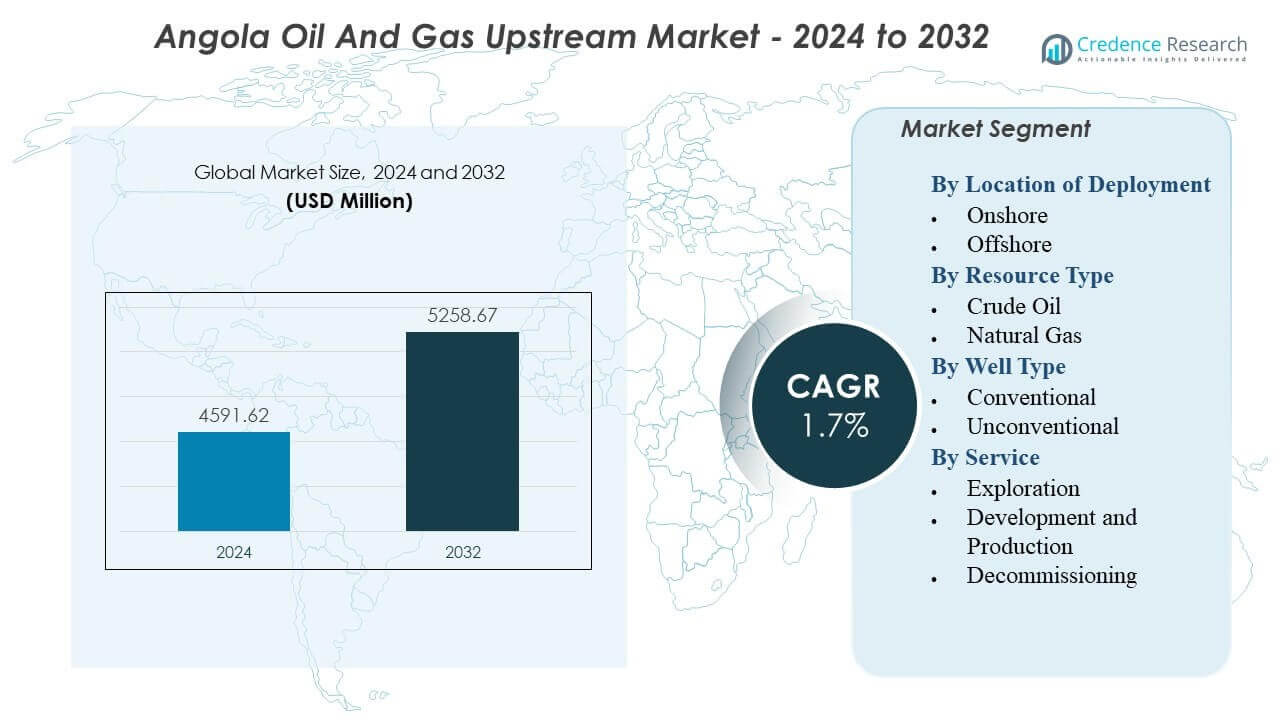
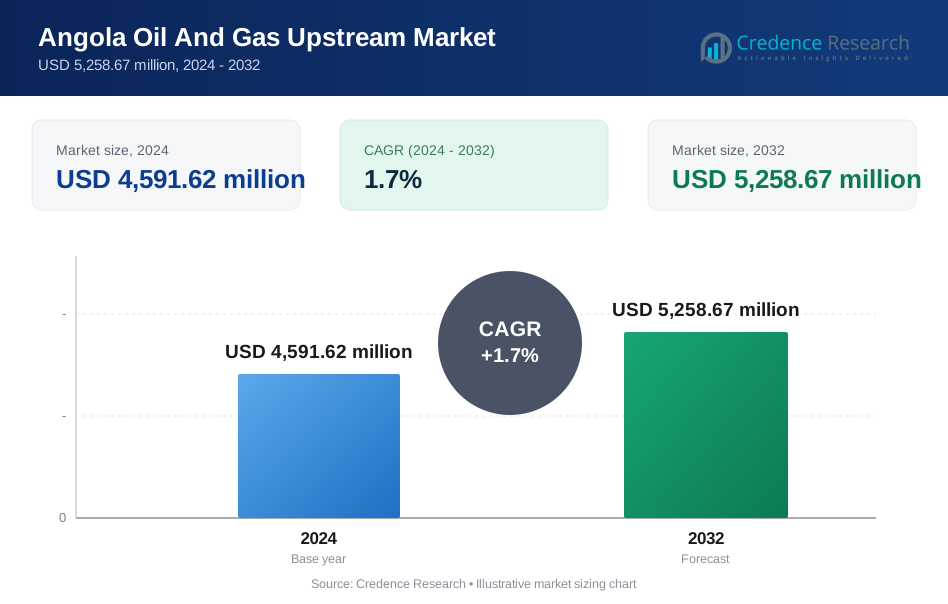
The Angola Oil and Gas Upstream Market is projected to grow from USD 4,591.62 million in 2024 to an estimated USD 5,258.67 million by 2032, with a compound annual growth rate (CAGR) of 1.7% from 2024 to 2032.
| REPORT ATTRIBUTE | DETAILS |
|---|---|
| Historical Period | 2020-2023 |
| Base Year | 2024 |
| Forecast Period | 2025-2032 |
| Angola Oil and Gas Upstream Market Size 2024 | USD 4,591.62 million |
| Angola Oil and Gas Upstream Market, CAGR | 1.7% |
| Angola Oil and Gas Upstream Market Size 2032 | USD 5,258.67 million |
Market expansion is driven by rising investments in offshore blocks, first-oil achievements from new FPSOs, and redevelopment programs across mature assets. The government supports upstream activity through improved licensing terms and faster approvals that encourage foreign participation. Operators adopt advanced subsea systems, digital monitoring, and enhanced recovery techniques to sustain production. Growing attention toward gas monetization and flare reduction improves long-term planning. These factors strengthen operational efficiency and build confidence among global investors.
Regional growth is dominated by offshore areas, which benefit from established infrastructure, high-producing reservoirs, and strong participation from major operators. Leading basins continue to deliver stable output and attract sustained capital expenditure due to favorable geology. Emerging regions offer new exploration prospects driven by improved seismic mapping and renewed investor interest. Onshore zones contribute smaller volumes but provide opportunities for lower-cost developments. This distribution highlights Angola’s strong offshore foundation and growing exploration momentum across selected frontier areas.
Angola Oil and Gas Upstream Market Insights:
- The Angola Oil and Gas Upstream Market is projected to grow from USD 4,591.62 million in 2024 to USD 5,258.67 million by 2032, reflecting a 1.7% CAGR during the forecast period.
- Rising offshore investment, new FPSO deployments, improved licensing terms, and stronger deepwater activity drive steady market expansion across key basins.
- Declining output from mature fields, high development costs, regulatory delays, and operational complexity in deepwater environments remain key restraints.
- Offshore regions dominate the market due to stronger reservoir potential, long-life assets, and major operator presence across deepwater and ultra-deepwater zones.
- Emerging frontier areas support new exploration interest, while onshore regions offer lower-cost opportunities for smaller operators seeking shorter project cycles.
Angola Oil and Gas Upstream Market Drivers
Growing Offshore Investments and Redevelopment of Mature Deepwater Assets
The Angola Oil And Gas Upstream Market gains strength from steady offshore spending across deepwater and ultra-deepwater fields. Operators focus on redevelopment plans that lift recovery from aging reservoirs. Companies use subsea upgrades and reservoir modeling to improve well output. The government supports investment through stable licensing terms and faster project approvals. International players expand drilling programs to secure long-term production. Enhanced recovery methods extend field life across strategic offshore clusters. New exploration blocks draw interest from established operators. The market benefits from a robust pipeline of redevelopment work that supports national production goals.
- For instance, TotalEnergies launched the Begonia project in Block 17/06, a five-well subsea tie-back to the Pazflor FPSO, which is engineered to add 30,000 barrels of oil per day to existing production by utilizing enhanced subsea multiphase pumping technology.
Supportive Policy Reforms and Improved Fiscal Framework for Investors
Revised petroleum laws help the upstream segment attract new capital. The government offers flexible contract terms that reduce entry barriers for global companies. Investors show stronger interest in marginal fields where development costs remain lower. Policy clarity helps operators plan multi-year drilling cycles. It creates confidence among consortiums pursuing high-potential offshore targets. Streamlined approvals reduce delays in project execution. Competitive tax structures help drive participation in new bidding rounds. Reforms strengthen investor sentiment and support long-term production stability.
- For instance, following the Presidential Decree 6/18 on marginal fields, Somoil (the largest private Angolan oil company) successfully increased production at the FS and FST onshore associations in the Congo Basin by 25% through a low-cost, multi-well workover program supported by reduced tax royalties.
Rising Exploration Success Across Key Basins Including Kwanza and Lower Congo
Recent exploration results create momentum across frontier zones and proven basins. Operators identify new geological prospects through seismic mapping. Deepwater blocks show higher discovery potential due to favorable reservoir structures. Companies expand appraisal programs to confirm recoverable reserves. Stronger exploration outcomes build confidence among global investors. It supports continued spending across licensed blocks. Multi-client seismic surveys improve basin understanding. Exploration gains help secure future production streams for national output.
Growing Use of Advanced Drilling Technologies and Subsea Production Systems
Technology adoption drives efficiency across complex offshore fields. Operators deploy high-spec rigs to cut drilling time and lower operational risks. Subsea tiebacks help monetize smaller discoveries at competitive cost. Digital tools support reservoir modeling and real-time well monitoring. It improves decision speed across drilling operations. High-pressure systems enhance performance in deeper formations. Remote operations centers guide field optimization. Technology strength raises production reliability and extends uptime across offshore clusters.
Angola Oil and Gas Upstream Market Trends
Shift Toward Deepwater Optimization and Life-Extension Strategies
The Angola Oil And Gas Upstream Market shows growing interest in maximizing output from mature deepwater hubs. Operators invest in asset integrity programs that maintain safe operations. Life-extension plans help delay decommissioning across costly offshore units. Companies improve subsea networks to raise flow efficiency. Digital twins track equipment health and guide maintenance schedules. Optimization programs cut production interruptions across high-value blocks. It supports stable offshore output in competitive market conditions. Long-term rehabilitation programs remain a core trend across mature reservoirs.
- For instance, TotalEnergies implemented a subsea multiphase pumping system at the CLOV field in Block 17, which successfully enabled the tie-back of the Cravo, Lirio, Orquidea, and Violeta fields to a single FPSO, maintaining a production plateau of 160,000 barrels of oil per day.
Expansion of Local Content Programs and Workforce Development
Local content policies shape procurement and workforce strategies. Training centers expand capacity for engineering and marine services. Companies allocate more work to local suppliers in fabrication and logistics. Stronger local engagement helps reduce operating costs for long-cycle projects. Workforce development programs support safer operations offshore. It builds national capabilities in drilling and field support. Local vendors take larger roles in inspection and maintenance activities. Increased participation strengthens domestic industry growth.
- For instance, Sonangol and its partners achieved a significant local content milestone during the Lifua-A project, where 100% of the 1,500-ton wellhead platform jacket was fabricated domestically at the Sonamet yard in Lobito, involving over 1 million man-hours of local labor.
Rising Adoption of Digital Tools for Production Optimization and Asset Monitoring
Digital transformation gains speed across upstream operations. Operators use real-time monitoring tools to guide field decisions. Predictive analytics reduce equipment downtime across remote assets. Digital well planning improves drilling accuracy and cost control. Remote operating centers support safe operations in deepwater blocks. It boosts efficiency in reservoir management. Sensors enhance subsea equipment reliability. Automation improves workflow coordination across complex upstream systems.
Growing Interest in Gas Development and Monetization Pathways
Gas-focused strategies gain traction due to diversification goals. Operators move toward flare reduction programs and gas gathering networks. New gas hubs support future LNG supply options. Appraisal programs target underdeveloped gas-rich structures. Smaller gas fields draw attention due to lower development risks. It supports broader energy transition plans within the sector. Gas reinjection helps stabilize reservoir pressure in producing oil fields. A clear shift toward gas value creation shapes long-term investment trends.
Angola Oil and Gas Upstream Market Challenges Analysis
Declining Production from Mature Fields and Rising Operational Complexity
The Angola Oil And Gas Upstream Market faces production declines across aging offshore wells. Operators struggle with higher water cuts and reduced reservoir pressure. Complex deepwater operations raise maintenance needs and technical risks. High costs hinder rapid redevelopment in marginal fields. It creates pressure on operators to manage resources efficiently. Limited new discoveries slow replacement of depleted reserves. Harsh offshore conditions add to supply chain challenges. Production declines require continuous investment to sustain national output.
Regulatory Delays, Cost Pressures, and Limited Infrastructure Expansion
Operators experience slower progress due to long approval cycles. Delays affect drilling timelines and field redevelopment planning. Cost pressure limits investment appetite in frontier zones. Infrastructure gaps impact efficient movement of equipment and personnel. Skilled workforce shortages raise operational risks during complex tasks. It increases dependency on external service providers. Volatile crude prices challenge long-term project funding. These hurdles reduce the pace of upstream expansion across strategic basins.
Angola Oil and Gas Upstream Market Opportunities
New Licensing Rounds, Frontier Basin Exploration, and Fresh Deepwater Potential
The Angola Oil And Gas Upstream Market sees strong opportunity from new bid rounds targeting fresh acreage. Frontier basins show higher exploration interest due to improved geological data. Operators evaluate new deepwater zones with competitive potential. Successful discoveries can strengthen national reserves and future output. It helps attract investment from leading global companies. Integrated seismic data supports more efficient exploration planning. Partnerships create shared risk across high-cost blocks. Expanding exploration can reshape long-term production prospects.
Gas Commercialization, Subsea Tieback Projects, and Low-Cost Marginal Field Development
Gas development creates gains for energy diversification efforts. Smaller gas discoveries can link to existing infrastructure through tieback routes. Operators use subsea tiebacks to lower development costs for remote fields. Marginal fields offer scope for rapid development with lighter investment. It supports new revenue streams in a stable regulatory environment. Gas-based projects reduce flaring volumes and enhance environmental compliance. Partnerships with global players help accelerate project execution. Strong potential exists for integrated gas value chains across key basins.
Angola Oil and Gas Upstream Market Segmentation Analysis:
By Location of Deployment
The Angola Oil And Gas Upstream Market shows strong activity in offshore zones where deepwater and ultra-deepwater fields drive national output. Offshore blocks attract major operators due to higher reserves and proven production systems. Onshore areas hold smaller reserves yet offer lower development costs and shorter project cycles. It supports balanced growth across mature and emerging reserves.
- For instance, Azule Energy (the BP-Eni joint venture) is currently executing the Agogo Integrated West Hub Development in Block 15/06, which utilizes 23 subsea wells and a massive FPSO to tap into deepwater reserves located at depths of approximately 1,700 meters.
By Resource Type
Crude oil production dominates the Angola Oil And Gas Upstream Market, supported by established offshore fields and continuous redevelopment programs. Operators invest in advanced technologies to sustain crude output from aging reservoirs. Natural gas gains attention due to rising demand for cleaner fuels and national plans to expand gas monetization. It creates long-term opportunities across gathering, processing, and export-focused projects.
- For instance, Chevron, through its subsidiary CABGOC, successfully commissioned the Sanha Lean Gas Connection (SLGC) project, which is designed to provide 480 million standard cubic feet of gas per day to the Angola LNG plant, significantly reducing routine flaring.
By Well Type
Conventional wells maintain the leading share in the Angola Oil And Gas Upstream Market, driven by strong offshore geology and favorable reservoir characteristics. Operators focus on interventions and improved recovery to extend well life. Unconventional prospects remain limited but draw growing interest from smaller players testing new basins. It offers future potential as technology adoption improves.
By Service
Exploration activities support reserve growth in the Angola Oil And Gas Upstream Market, driven by new licensing rounds and improved seismic mapping. Development and production services hold the largest share due to active offshore projects and long-term field programs. Decommissioning grows slowly as mature assets near end-of-life requirements. It encourages planning efforts that balance safety, cost, and regulatory compliance.
Segmentation:
By Location of Deployment
- Onshore
- Offshore
By Resource Type
- Crude Oil
- Natural Gas
By Well Type
- Conventional
- Unconventional
By Service
- Exploration
- Development and Production
- Decommissioning
By Region
- North America
- U.S.
- Canada
- Mexico
- Europe
- Germany
- France
- U.K.
- Italy
- Spain
- Rest of Europe
- Asia Pacific
- China
- Japan
- India
- South Korea
- South-east Asia
- Rest of Asia Pacific
- Latin America
- Brazil
- Argentina
- Rest of Latin America
- Middle East & Africa
- GCC Countries
- South Africa
- Rest of the Middle East and Africa
Regional Analysis:
The Angola Oil And Gas Upstream Market is dominated by offshore regions, holding nearly 75% of total production share due to strong deepwater and ultra-deepwater activity. These offshore zones attract global operators that deploy high-capacity FPSOs and advanced subsea systems. Strong well productivity and long reservoir life raise investment confidence across key offshore basins. It supports steady output despite natural declines in mature wells. Offshore regions remain the core engine of national hydrocarbon production and continue to secure the bulk of upcoming exploration spending.
Onshore regions account for roughly 15% of the market and focus on lower-cost developments across mature fields. Smaller operators lead most onshore programs where shorter drilling cycles support efficient project planning. Limited reserve size slows large-scale investment, yet new seismic surveys help identify pockets of untapped potential. The government encourages onshore interest through flexible terms for marginal fields. It creates opportunities for operators that target faster turnaround and reduced operational complexity.
Emerging basins, including select frontier zones, represent nearly 10% of the market and hold long-term strategic value. These areas attract attention due to evolving geological insights supported by modern seismic data. Frontier regions carry higher risk yet offer potential to diversify future production beyond mature offshore assets. Investors monitor resource estimates and regulatory clarity before entering early-stage blocks. It positions emerging basins as a future growth pillar when proven reserves expand and development costs stabilize.
Key Player Analysis:
- TotalEnergies SE
- Chevron Corporation
- ExxonMobil Corporation
- Azule Energy (BP / Eni Joint Venture)
- Sonangol Pesquisa & Produção (Sonangol P&P)
- Eni SpA
- BP Plc
- Petronas
- Sinopec (E&P Angola)
- Somoil SA
Competitive Analysis:
The Angola Oil And Gas Upstream Market features strong participation from international oil companies that lead major deepwater and ultra-deepwater developments. TotalEnergies, Chevron, ExxonMobil, Azule Energy, and Eni dominate production due to long-term block ownership and strong technical capabilities. These operators focus on high-return offshore zones where engineering strength and capital depth support complex field operations. It drives consistent investment across redevelopment, optimization, and infill drilling programs. National oil company Sonangol P&P maintains a growing role through partnerships and selective asset restructuring. Local companies such as Somoil expand their footprint in marginal fields where operational costs remain manageable. Global players compete through technology, drilling efficiency, subsea expertise, and robust project execution records. New licensing rounds encourage broader participation across exploration blocks. The competitive landscape reflects a blend of established majors, new joint ventures, and domestic operators shaping Angola’s long-term upstream trajectory.
Recent Developments:
- In July 2025, Azule Energy achieved first oil from the Agogo FPSO in Block 15/06 marking a significant new production milestone ahead of schedule and initiating a 15-year contract valued over USD 5 billion with Yinson Production.
- In July 2025, TotalEnergies started production from the BEGONIA offshore project in Angola, marking the first inter-block development with partners including Sonangol E&P and ANPG, adding significant capacity to existing FPSOs.
- In May 2024, Afentra completed its acquisition of a 12% non-operating interest in Block 3/05 and 16% in Block 3/05A from Azule Energy boosting its stakes to 30% and 21.33% respectively, including inherited crude oil stocks.
Report Coverage:
The research report offers an in-depth analysis based on Location of Deployment, Resource Type, Well Type, and Service. It details leading market players, providing an overview of their business, product offerings, investments, revenue streams, and key applications. Additionally, the report includes insights into the competitive environment, SWOT analysis, current market trends, as well as the primary drivers and constraints. Furthermore, it discusses various factors that have driven market expansion in recent years. The report also explores market dynamics, regulatory scenarios, and technological advancements that are shaping the industry. It assesses the impact of external factors and global economic changes on market growth. Lastly, it provides strategic recommendations for new entrants and established companies to navigate the complexities of the market.
Future Outlook:
- Deepwater and ultra-deepwater assets will guide long-term expansion in the Angola Oil And Gas Upstream Market, supported by sustained operator commitment.
- New licensing rounds will draw stronger interest from global players seeking exploratory potential across key offshore and frontier basins.
- Redevelopment of mature fields will strengthen output stability, aided by improved subsea systems and digital monitoring tools.
- Gas-focused programs will expand as Angola advances monetization plans to diversify its upstream portfolio.
- Local content initiatives will push operators to increase domestic participation in engineering, fabrication, and logistics activities.
- Technology adoption, including predictive analytics and automation, will enhance drilling accuracy and reduce operational interruptions.
- Partnerships between national and international operators will help unlock complex reservoirs and extend field life.
- Onshore opportunities will grow slowly, offering short-cycle developments for smaller operators targeting cost-efficient assets.
- Decommissioning demand will rise as select mature fields approach end-of-life stages, creating a new service segment.
- Emerging basins will gain attention as seismic data improves and investors evaluate prospects for future production streams.
Request a Free Sample
Fill in your details and we'll send you a free sample report.
- Sample data tables & charts
- Research methodology
Need a Custom Version of This Report?
Tailor the scope, geography, or segments to your exact requirements.
- Custom geography or segment scope
- Direct access to our analyst team
Frequently Asked Questions
What is the current market size for the Angola Oil And Gas Upstream Market, and what is its projected size in 2032?
At what Compound Annual Growth Rate is the Angola Oil And Gas Upstream Market projected to grow between 2024 and 2032?
Which Angola Oil And Gas Upstream Market segment held the largest share in 2024?
What are the primary factors fueling the growth of the Angola Oil And Gas Upstream Market?
Who are the leading companies in the Angola Oil And Gas Upstream Market?
Which region commanded the largest share of the Angola Oil And Gas Upstream Market in 2024?
Table of Content
Chapter 1 Market Segmentation
- 1.1 Segmentation Framework
- 1.1.1 Product and Service Classification
- 1.1.2 Application and End-Use Classification
- 1.1.3 Technology and Solution Classification
- 1.1.4 Customer and Distribution Channel Classification
- 1.1.5 Geographic Segmentation
- 1.1.6 Market Segment Definitions and Boundaries
Chapter 2 Introduction
- 2.1 Report Objectives and Scope
- 2.2 Product Definition and Industry Terminology
- 2.3 Market Inclusions and Exclusions
- 2.4 Research Process
- 2.4.1 Primary Research and Expert Interviews
- 2.4.2 Secondary Research and Source Review
- 2.4.3 Top-Down and Bottom-Up Estimation
- 2.4.4 Data Triangulation and Verification
- 2.5 Market Size Measurement Basis
- 2.5.1 2024: USD 4,591.62 million → 2032: USD 5,258.67 million
- 2.6 Historical and Forecast Reference Periods
- 2.6.1 Base Year: 2024
- 2.6.2 Forecast Period: 2024-2032
- 2.7 Research Assumptions and Limitations
Chapter 3 Executive Summary
- 3.1 Market Snapshot and Key Findings
- 3.2 Base-Year Market Size, 2024
- 3.3 Forecast Market Size, 2032
- 3.4 Revenue and Volume Growth Outlook
- 3.5 Key Demand and Supply Indicators
- 3.6 Leading Market Segments
- 3.7 Fastest-Growing Market Opportunities
- 3.8 Regional Performance Highlights
- 3.9 Technology and Industry Transformation
- 3.10 Competitive Landscape Summary
- 3.11 Analyst View and Strategic Implications
Chapter 4 Global Angola Oil And Gas Upstream Market Trends and Developments
- 4.1 Historical Industry Development
- 4.2 Recent Market Trends and Developments
- 4.3 Demand and Customer Behavior Trends
- 4.4 Technology and Product Innovation
- 4.5 Artificial Intelligence, Automation and Digitalization
- 4.6 Local Manufacturing and Supply Chain Realignment
- 4.7 Industry Partnerships, Mergers and Acquisitions
- 4.8 Sustainability and Circular Economy Developments
- 4.9 Government and Private Sector Investment Trends
- 4.10 Emerging Business Models and Commercialization
- 4.11 Industry Developments and Announcements
Chapter 5 Global Angola Oil And Gas Upstream Market Production, Supply and Demand Analysis
- 5.1 Demand Trend and Consumption Analysis
- 5.2 Demand Forecast, 2024-2032
- 5.3 Production and Output Trend
- 5.4 Production and Output Forecast, 2024-2032
- 5.5 Installed Capacity and Capacity Utilization
- 5.6 Company-Wise Production Plants and Statistics
- 5.6.1 Installed Production Capacity
- 5.6.2 Actual Production
- 5.6.3 Planned Capacity and Expansion Targets
- 5.7 Supply Chain Structure and Procurement Trends
- 5.8 Supply-Demand Gap and Bottlenecks
- 5.9 Import Dependence and Sourcing Structure
- 5.10 Contract Manufacturing and Outsourcing
- 5.11 Regional Supply and Demand Concentration
Chapter 6 Global Angola Oil And Gas Upstream Market Pricing Analysis
- 6.1 Pricing Structure and Measurement
- 6.2 Historical Pricing Trends
- 6.3 Pricing Outlook, 2024-2032
- 6.4 Average Selling Price and Unit Economics
- 6.5 Pricing by Product and Market Segment
- 6.6 Geographic Pricing Differences
- 6.7 Key Input, Energy, Labor and Logistics Costs
- 6.8 Contract Pricing and Purchasing Models
- 6.9 Pricing Sensitivity and Competitive Positioning
- 6.10 Price, Margin and Profitability Implications
Chapter 7 Global Angola Oil And Gas Upstream Market Dynamics
- 7.1 Market Growth Drivers
- 7.1.1 Demand-Side Drivers
- 7.1.2 Technology and Innovation Drivers
- 7.1.3 Infrastructure and Investment Drivers
- 7.1.4 Regulatory and Policy Drivers
- 7.2 Market Restraints
- 7.2.1 Cost and Affordability Constraints
- 7.2.2 Technology and Adoption Barriers
- 7.2.3 Supply Chain and Operational Constraints
- 7.3 Market Challenges
- 7.3.1 Competitive Pressure and Margin Erosion
- 7.3.2 Skills, Infrastructure and Implementation Gaps
- 7.4 Emerging Market Opportunities
- 7.5 Market Dynamics Impact and Time-Horizon Assessment
Chapter 8 Global Angola Oil And Gas Upstream Value Chain Analysis
- 8.1 Industry Value Chain Overview
- 8.2 Upstream Suppliers and Critical Inputs
- 8.3 Technology and Component Providers
- 8.4 Manufacturing or Service Delivery
- 8.5 Distribution, Channel Partners and Integrators
- 8.6 Downstream Applications and End Users
- 8.7 Value Addition and Profit Pools
- 8.8 Vertical Integration and Outsourcing
- 8.9 Supplier Concentration and Risk
- 8.10 Supply Chain Localization and Resilience
Chapter 9 Global Angola Oil And Gas Upstream Market Regulations and Policies
- 9.1 Relevant Laws, Standards and Compliance Frameworks
- 9.2 Product, Service, Safety and Quality Requirements
- 9.3 Government Policies, Incentives and Subsidies
- 9.4 Imports, Exports and Trade Barriers
- 9.5 Public Procurement and Local Content Requirements
- 9.6 Environmental and Sustainability Compliance
- 9.7 Upcoming Policy Changes and Market Implications
Chapter 10 Global Angola Oil And Gas Upstream Market Hotspots and Opportunities
- 10.1 Market Opportunity Mapping and Growth Hotspots
- 10.2 High-Growth Applications and Customer Groups
- 10.3 Underserved Markets and White-Space Opportunities
- 10.4 Emerging Technology and Product Opportunities
- 10.5 New Capacity and Investment Hotspots
- 10.6 Market Entry and Expansion Opportunities
- 10.7 Distribution and Partnership Opportunities
- 10.8 Near-Term and Long-Term Commercial Potential
- 10.9 Opportunity Attractiveness and Execution Risks
Chapter 11 Global Angola Oil And Gas Upstream Market Outlook, 2024-2032
- 11.1 Market Size and Analysis
- 11.1.1 Revenue (Market Measurement: 2024: USD 4,591.62 million → 2032: USD 5,258.67 million)
- 11.1.2 Market Volume and Quantity Sold
- 11.1.3 Historical Market Size
- 11.1.4 Base-Year Market Size, 2024
- 11.2 Market Forecast, 2024-2032
- 11.2.1 Revenue Forecast to 2032
- 11.2.2 Volume Forecast to 2032
- 11.2.3 CAGR and Year-on-Year Growth
- 11.2.4 Incremental Revenue Opportunity
- 11.3 Forecast Assumptions and Scenario Analysis
- 11.3.1 Base-Case Forecast
- 11.3.2 Optimistic and Conservative Scenarios
- 11.3.3 Technology, Pricing and Policy Sensitivities
- 11.4 Market Attractiveness and Growth Outlook
Chapter 12 Global Angola Oil And Gas Upstream Market Segmentation and Outlook
- 12.1 Segmentation Summary and Market Shares, 2024
- 12.2 Largest and Fastest-Growing Segments
- 12.3 Segment Growth Comparison
- 12.4 Segment Attractiveness and Priority Matrix
Chapter 13 Global Angola Oil And Gas Upstream Geographic Market Outlook, 2024-2032
- 13.1 Regional Market Size and Share, 2024
- 13.2 Regional Market Forecast, 2024-2032
- 13.3 Regional Pricing, Production and Demand Differences
- 13.4 North America
- 13.4.1 United States
- 13.4.2 Canada
- 13.4.3 Mexico
- 13.5 Europe
- 13.5.1 Germany
- 13.5.2 France
- 13.5.3 Italy
- 13.5.4 United Kingdom
- 13.5.5 Spain
- 13.5.6 Poland
- 13.5.7 Russia
- 13.5.8 Netherlands
- 13.5.9 Belgium
- 13.5.10 Sweden
- 13.5.11 Denmark
- 13.5.12 Norway
- 13.5.13 Rest of Europe
- 13.6 Asia Pacific
- 13.6.1 China
- 13.6.2 India
- 13.6.3 Japan
- 13.6.4 South Korea
- 13.6.5 Thailand
- 13.6.6 Indonesia
- 13.6.7 Vietnam
- 13.6.8 Malaysia
- 13.6.9 Australia
- 13.6.10 Rest of Asia Pacific
- 13.7 Latin America
- 13.7.1 Brazil
- 13.7.2 Argentina
- 13.7.3 Colombia
- 13.7.4 Chile
- 13.7.5 Rest of Latin America
- 13.8 Middle East
- 13.8.1 Saudi Arabia
- 13.8.2 United Arab Emirates
- 13.8.3 Turkey
- 13.8.4 Israel
- 13.8.5 Iran
- 13.8.6 Rest of the Middle East
- 13.9 Africa
- 13.9.1 South Africa
- 13.9.2 Egypt
- 13.9.3 Nigeria
- 13.9.4 Morocco
- 13.9.5 Rest of Africa
- 13.10 Regional Investment, Policy and Supply Chain Differences
- 13.11 Regional Competitive Landscape
- 13.12 Geographic Growth Hotspots
Chapter 14 Global Angola Oil And Gas Upstream Technology, Innovation and Sustainability Outlook
- 14.1 Technology Landscape and Maturity
- 14.2 Product, Process and Service Innovation
- 14.3 AI, Automation and Digital Tools in the Industry
- 14.4 Technology Adoption and Performance Benchmarking
- 14.5 Innovation Pipeline and R&D Investment
- 14.6 Patent and Intellectual Property Trends
- 14.7 Energy Efficiency and Resource Management
- 14.8 Sustainability, Recycling and Circularity
- 14.9 Technology Roadmap, 2024-2032
- 14.10 Risks of Obsolescence and Technology Substitution
Chapter 15 Global Angola Oil And Gas Upstream Market Key Strategic Imperatives
- 15.1 Growth and Market Entry Priorities
- 15.2 High-Return Products and Segments
- 15.3 Pricing, Profitability and Cost Optimization
- 15.4 Technology Investment and Product Differentiation
- 15.5 Supply Chain Localization and Resilience
- 15.6 Distribution and Customer Acquisition
- 15.7 Partnership, Acquisition and Capacity Strategy
- 15.8 Regional Expansion Priorities
- 15.9 Short-, Medium- and Long-Term Actions
Chapter 16 Competition Outlook
- 16.1 Industry Competition Characteristics
- 16.2 Market Structure and Concentration
- 16.3 Market Share and Competitive Positioning, 2024
- 16.4 Company-Wise Revenue and Product Benchmarking
- 16.5 Production and Service Capacity Benchmarking
- 16.6 Technology, Pricing and Differentiation
- 16.7 Regional Footprint and Distribution Strength
- 16.8 Mergers, Acquisitions and Strategic Alliances
- 16.9 New Entrants and Competitive Threats
- 16.10 Porter's Five Forces and Industry Attractiveness
- 16.11 Competitive Outlook, 2024-2032
Chapter 17 Company Profiles
- 17.1 Company Coverage and Selection Criteria
- 17.2 Leading Market Participants – Standard Profile Structure
- 17.2.1 Business Description
- 17.2.2 Company Ownership and Geographic Presence
- 17.2.3 Product and Service Portfolio
- 17.2.4 Manufacturing and Operating Footprint
- 17.2.5 Production Capacity and Expansion Plans
- 17.2.6 Financial Performance and Investment
- 17.2.7 Market Share and Competitive Position
- 17.2.8 Technology and Innovation Capabilities
- 17.2.9 Strategic Alliances or Partnerships
- 17.2.10 Recent Developments
- 17.2.11 Growth Strategy and Outlook
- 17.3 Other Relevant Market Participants
Note: Every listed company is profiled on the structure shown under the first company. The company list is preliminary and may change based on research findings, market developments, data availability and client requirements.
Chapter 18 Disclaimer
- 18.1 Research and Forecast Disclaimer
- 18.2 Data Source and Estimation Limitations
Note: The depth of individual sections depends on data availability for this market. Volume, capacity, trade and other unit-based metrics are included where applicable.