Market Overview
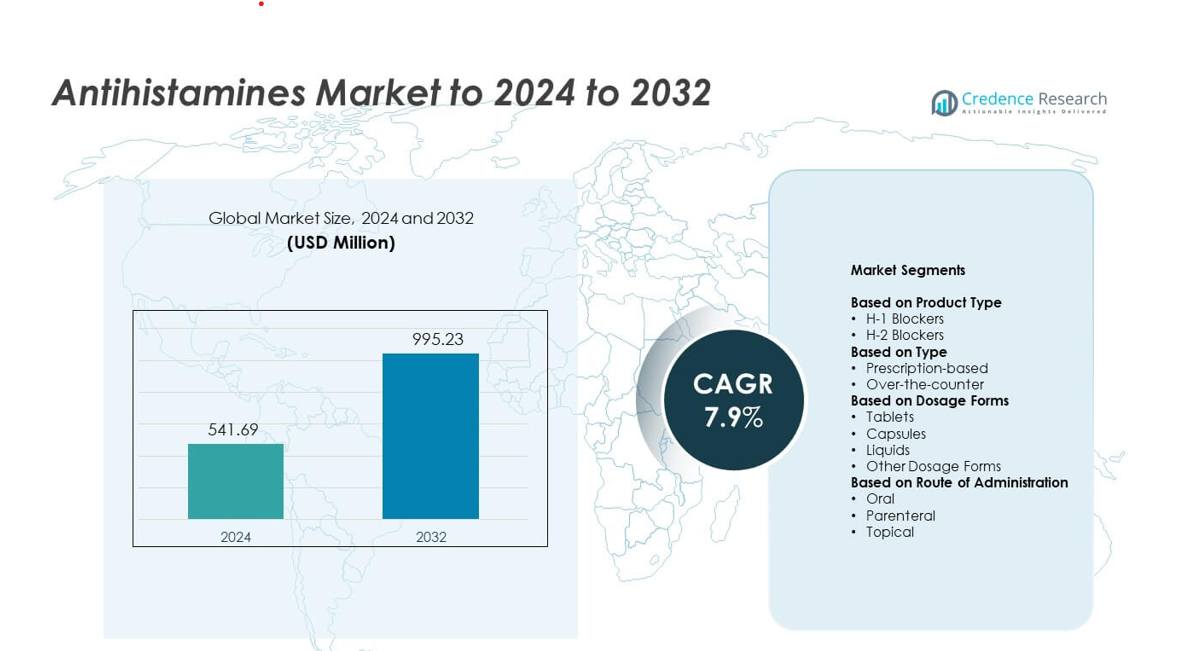
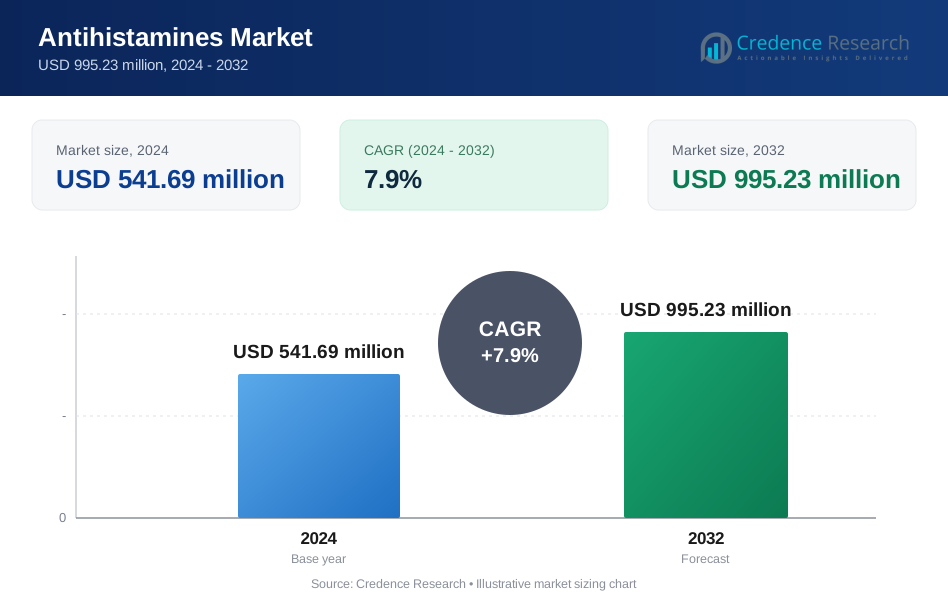
Antihistamines Market size was valued USD 541.69 million in 2024 and is anticipated to reach USD 995.23 million by 2032, at a CAGR of 7.9% during the forecast period.
| REPORT ATTRIBUTE | DETAILS |
|---|---|
| Historical Period | 2020-2023 |
| Base Year | 2024 |
| Forecast Period | 2025-2032 |
| Antihistamines Market Size 2024 | USD 541.69 million |
| Antihistamines Market, CAGR | 7.9% |
| Antihistamines Market Size 2032 | USD 995.23 million |
The Antihistamines Market is shaped by major global pharmaceutical and consumer health companies that offer wide OTC ranges, prescription options, and advanced non-sedating formulations. These players strengthen their positions through strong pharmacy networks, digital retail expansion, and consistent product innovation aimed at improving safety and daily usability. North America led the market in 2024 with a 38% share, supported by high allergy prevalence and strong access to OTC drugs. Europe followed with about 30% share due to established healthcare systems and rising seasonal allergy cases, while Asia Pacific held nearly 22% share and remained the fastest-growing region.
Market Insights
- The Antihistamines Market reached USD 541.69 million in 2024 and is projected to reach USD 995.23 million by 2032, growing at a CAGR of 7.9%.
- Growing allergy prevalence and strong demand for non-sedating antihistamines drive steady expansion across OTC and prescription channels.
- Extended-release formulations and rising adoption of pediatric-friendly liquids shape key market trends, supported by wider e-commerce accessibility.
- Competition intensifies as major firms expand OTC portfolios, strengthen distribution, and focus on safer second-generation drugs, while generics gain traction in cost-sensitive regions.
- North America held 38% share in 2024, Europe accounted for 30%, and Asia Pacific captured 22%, while H-1 blockers dominated by product type with 72% share.
Market Segmentation Analysis:
By Product Type
H-1 blockers dominated the Antihistamines Market in 2024 with nearly 72% share. Strong adoption came from their role in treating allergic rhinitis, urticaria, and seasonal allergies. Rising cases of pollen allergies and greater demand for non-sedating second-generation drugs supported wider use. H-2 blockers held a smaller share due to their focused use in gastric acid control rather than broad allergy treatment. Growing awareness of long-term acid-related conditions kept demand steady but lower than H-1 agents.
- For instance, Sanofi’s Allegra (fexofenadine), a second-generation H-1 blocker, is approved for adults and children 12 years and older at a dose of 60 mg twice daily for seasonal allergic rhinitis or 180 mg once daily for chronic idiopathic urticaria.
By Type
Over-the-counter antihistamines led the market in 2024 with about 63% share. Easy access, wide retail availability, and strong demand for self-medication boosted growth. Non-sedating OTC drugs such as cetirizine, loratadine, and fexofenadine gained steady traction. Prescription-based antihistamines held a moderate share, driven by severe allergy cases and chronic urticaria management. Physician-led therapy remained essential for patients requiring higher-strength or combination treatment options.
- For instance, Johnson & Johnson’s OTC brand Zyrtec Allergy recommends one 10 mg cetirizine tablet once daily for adults and children 6 years and over, with a clear limit of not more than one 10 mg tablet in 24 hours.
By Dosage Forms
Tablets dominated the market in 2024 with roughly 58% share. Strong preference came from ease of use, long shelf life, and wide availability across retail and online channels. Tablets offered consistent dosing and supported strong patient adherence. Liquid forms grew in pediatric and geriatric groups due to easier swallowing and flexible dosing. Capsules and other forms maintained niche demand for users seeking alternative delivery formats or rapid-release options.
Key Growth Drivers
Rising Allergy Prevalence
Global allergy cases continue to rise due to pollution, climate shifts, and urban lifestyles. This increase expands demand for fast-acting antihistamines across all age groups. Growing diagnoses of allergic rhinitis and chronic urticaria further strengthen product uptake. Wider access to both OTC and prescription drugs supports steady growth across pharmacies and online platforms.
- For instance, the U.S. FDA reported that more than 60 million packages of oral allergy medicines such as cetirizine products (including Johnson & Johnson’s Zyrtec) and levocetirizine products were sold in 2022, while over 200 global cases of severe itching after stopping these drugs were identified between April 2017 and July 2023, indicating very high real-world use.
Shift Toward Non-Sedating Antihistamines
Second-generation antihistamines gain strong traction due to fewer side effects and better safety. Consumers prefer non-sedating options for daily use, especially during peak allergy seasons. Broader physician endorsement and strong clinical support also drive adoption. Market players expand non-drowsy formulations to meet high demand in retail and e-commerce channels.
- For instance, Opella’s Xyzal Allergy 24HR tablets contain 5 mg levocetirizine, and OTC Drug Facts and professional dosing guides specify one 5 mg tablet once daily in the evening for adults and children 12–64 years, with the option of 2.5 mg once daily for milder symptoms, reflecting once-daily, low-sedation regimens.
Expansion of OTC Availability
OTC antihistamines remain a major growth engine due to easy access and high self-medication rates. Retail chains, supermarkets, and online pharmacies enhance reach for leading brands. Growing consumer awareness encourages early symptom management. This shift reduces dependence on prescriptions and boosts overall market volume.
Key Trends & Opportunities
Growth of Combination and Extended-Release Formulations
Pharmaceutical firms invest in advanced formulations that offer longer relief and multi-symptom control. Extended-release products improve patient convenience and reduce dosing frequency. Combination options addressing nasal congestion and seasonal triggers gain wider interest. These innovations open strong opportunities for differentiation in a competitive market.
- For instance, Bayer’s extended-release Claritin-D / equivalent loratadine–pseudoephedrine tablets contain 5 mg loratadine and 120 mg pseudoephedrine in each 12-hour tablet, with dosing guidance for adults and children 12 years and older of one tablet every 12 hours, and a maximum of two tablets in 24 hours.
Expansion in Pediatric and Geriatric Demand
Rising allergy awareness among caregivers boosts demand for child-friendly liquids and dissolvable formats. Aging populations also require safer antihistamines due to comorbidities and sensitivity to sedation. Companies expand dosing options to meet diverse patient needs. This trend supports higher market penetration across both age-specific segments.
- For instance, Zuventus Healthcare’s Elriz Syrup (levocetirizine) pediatric labeling recommends a total daily dose of 2.5 mg for young children, given as 1.25 mg (2.5 mL) twice daily, directly addressing pediatric dosing needs with an age-tailored liquid format.
Key Challenges
Adverse Effects and Safety Concerns
Some antihistamines pose risks of drowsiness, cognitive impairment, and interactions with existing therapies. Older first-generation drugs face scrutiny due to sedation effects. These concerns push consumers and physicians to seek safer alternatives. Regulatory bodies monitor labeling and restrict certain formulations, limiting wider adoption.
Competition from Alternative Therapies
Allergy immunotherapy, nasal corticosteroids, and biologics present strong alternatives for chronic conditions. These treatments reduce reliance on antihistamines in severe cases. Growing use of long-term desensitization therapies shifts demand patterns. Market players must innovate to stay competitive against advanced and targeted options.
Regional Analysis
North America
North America held the largest share of the antihistamines market in 2024 with nearly 38%. Strong allergy prevalence, widespread OTC adoption, and a mature retail pharmacy network supported high demand. Seasonal pollen surges and rising chronic allergy cases further expanded product use. The region also benefits from strong awareness campaigns and rapid access to newer non-sedating formulations. Broad insurance coverage for prescription products and strong e-commerce growth strengthened the overall market position.
Europe
Europe accounted for about 30% share of the antihistamines market in 2024. High rates of allergic rhinitis, strict clinical standards, and increased preference for second-generation antihistamines drove wider adoption. The region’s strong healthcare infrastructure enabled consistent diagnosis and treatment. Growth in self-care and pharmacy-led guidance further boosted OTC sales. Expanding demand across Germany, the U.K., France, and Italy supported stable market expansion during the period.
Asia Pacific
Asia Pacific held roughly 22% share in 2024 and remained the fastest-growing region. Rising pollution levels, expanding urban populations, and increasing allergy awareness contributed to higher antihistamine use. Affordable OTC access and a growing middle-income group supported strong product uptake. Countries such as China, India, and Japan saw notable demand for both tablet and liquid formats. Rapid e-commerce penetration further strengthened sales across this region.
Latin America
Latin America captured nearly 6% share of the market in 2024. Increasing diagnoses of seasonal allergies and expanding access to OTC medicines supported gradual growth. Urbanization and rising exposure to environmental triggers created stronger demand for daily-use antihistamines. Brazil and Mexico led market expansion due to broader retail pharmacy networks. Economic constraints limited premium product adoption but sustained demand for affordable generic formulations.
Middle East and Africa
The Middle East and Africa accounted for about 4% share in 2024. Growth came from improving healthcare access, rising awareness of allergy conditions, and expanding pharmacy chains. Warmer climates and dust exposure contributed to higher cases of allergic rhinitis. Countries such as Saudi Arabia, the UAE, and South Africa showed steady uptake of OTC antihistamines. Limited specialist access in some areas slowed prescription demand but drove wider reliance on retail channels.
Market Segmentations:
By Product Type
- H-1 Blockers
- H-2 Blockers
By Type
- Prescription-based
- Over-the-counter
By Dosage Forms
- Tablets
- Capsules
- Liquids
- Other Dosage Forms
By Route of Administration
- Oral
- Parenteral
- Topical
By Geography
- North America
- U.S.
- Canada
- Mexico
- Europe
- Germany
- France
- U.K.
- Italy
- Spain
- Rest of Europe
- Asia Pacific
- China
- Japan
- India
- South Korea
- South-east Asia
- Rest of Asia Pacific
- Latin America
- Brazil
- Argentina
- Rest of Latin America
- Middle East & Africa
- GCC Countries
- South Africa
- Rest of the Middle East and Africa
Competitive Landscape
The Antihistamines Market features major companies such as Sun Pharmaceutical Industries Inc., Novartis AG, Himalaya Wellness Company, GlaxoSmithKline PLC, Bayer AG, and Sanofi Consumer Healthcare. These players compete through strong retail presence, expanded OTC portfolios, and steady development of safer second-generation formulations. Manufacturers focus on wider availability across pharmacies and e-commerce channels to reach broader consumer groups. Product innovation centers on non-sedating options, extended-release formats, and pediatric-friendly solutions to strengthen brand preference. Companies also invest in awareness programs that support early allergy management and boost repeat purchases. Rising demand for daily-use products encourages firms to enhance supply chains and improve global distribution efficiency.
Key Player Analysis
- Sun Pharmaceutical Industries Inc.
- Novartis AG
- Himalaya Wellness Company
- GlaxoSmithKline PLC
- Bayer AG
- Sanofi Consumer Healthcare
Recent Developments
- In 2025, GlaxoSmithKline PLC launched an upgraded Claritin-equivalent antihistamine in Asia-Pacific markets.
- In 2025, Sanofi Consumer Healthcare India Limited launched Allegra-D in India.
- In 2025, Novartis received FDA approval for Rhapsido (remibrutinib), the first oral targeted BTKi for chronic spontaneous urticaria (CSU) in patients symptomatic on H1 antihistamines
Report Coverage
The research report offers an in-depth analysis based on Product Type, Type, Dosage Forms, Route of Administration and Geography. It details leading market players, providing an overview of their business, product offerings, investments, revenue streams, and key applications. Additionally, the report includes insights into the competitive environment, SWOT analysis, current market trends, as well as the primary drivers and constraints. Furthermore, it discusses various factors that have driven market expansion in recent years. The report also explores market dynamics, regulatory scenarios, and technological advancements that are shaping the industry. It assesses the impact of external factors and global economic changes on market growth. Lastly, it provides strategic recommendations for new entrants and established companies to navigate the complexities of the market.
Future Outlook
- Demand for non-sedating antihistamines will grow as consumers seek safer daily use options.
- OTC sales will rise due to strong self-medication habits and wider digital pharmacy access.
- Extended-release and multi-symptom formulations will gain traction for longer relief.
- Allergy cases will increase with pollution and climate shifts, driving steady market expansion.
- Pediatric-friendly liquids and dissolvable formats will see higher adoption across key markets.
- Digital allergy management tools will support better treatment adherence and product selection.
- Biologics and immunotherapy will pressure antihistamines but expand combination treatment opportunities.
- Generic antihistamines will strengthen share in cost-sensitive regions.
- E-commerce platforms will boost product visibility and accelerate repeat purchases.
- Manufacturers will increase investment in safer, targeted, and faster-acting formulations.
Request a Free Sample
Fill in your details and we'll send you a free sample report.
- Sample data tables & charts
- Research methodology
Market Dynamics
Rising Allergy Prevalence
Increasing rates of allergic rhinitis, urticaria, and seasonal allergies due to pollution, urbanization, and climate change are expanding the patient pool and driving demand for antihistamines across all age groups.
Shift Toward Non-Sedating Antihistamines
Consumer and physician preference for second-generation, non-sedating antihistamines is fueling market growth, as these products offer improved safety profiles and are suitable for daily use without impairing cognitive function.
Expansion of OTC Availability
Wider over-the-counter access through retail chains, supermarkets, and online pharmacies is making antihistamines more accessible, encouraging self-medication and boosting overall market volume.
Growth of Pediatric and Geriatric Formulations
Rising awareness among caregivers and the aging population is increasing demand for child-friendly liquids and safer formulations for older adults, prompting manufacturers to diversify dosage forms and expand their reach.
Product Innovation in Extended-Release and Combination Formulations
Pharmaceutical companies are investing in extended-release and multi-symptom antihistamine products, which offer longer-lasting relief and address multiple allergy symptoms, creating new opportunities for differentiation and market expansion.
Need a Custom Version of This Report?
Tailor the scope, geography, or segments to your exact requirements.
- Custom geography or segment scope
- Direct access to our analyst team
Frequently Asked Questions
What is the current market size for Antihistamines Market, and what is its projected size in 2032?
At what Compound Annual Growth Rate is the Antihistamines Market projected to grow between 2025 and 2032?
Which Antihistamines Market segment held the largest share in 2024?
What are the primary factors fueling the growth of the Antihistamines Market?
Who are the leading companies in the Antihistamines Market?
Which region commanded the largest share of the Antihistamines Market in 2024?
Table of Content
Chapter 1 Market Segmentation
- 1.1 Segmentation Framework
- 1.1.1 Product and Service Classification
- 1.1.2 Application and End-Use Classification
- 1.1.3 Technology and Solution Classification
- 1.1.4 Customer and Distribution Channel Classification
- 1.1.5 Geographic Segmentation
- 1.1.6 Market Segment Definitions and Boundaries
- 1.2 By Type
- 1.2.1 Prescription-based
- 1.2.2 Over-the-counter
- 1.3 By Dosage Forms
- 1.3.1 Tablets
- 1.3.2 Capsules
- 1.3.3 Liquids
- 1.3.4 Other Dosage Forms
- 1.4 By Product Type
- 1.4.1 H-1 Blockers
- 1.4.2 H-2 Blockers
- 1.5 By Route of Administration
- 1.5.1 Oral
- 1.5.2 Parenteral
- 1.5.3 Topical
Chapter 2 Introduction
- 2.1 Report Objectives and Scope
- 2.2 Product Definition and Industry Terminology
- 2.3 Market Inclusions and Exclusions
- 2.4 Research Process
- 2.4.1 Primary Research and Expert Interviews
- 2.4.2 Secondary Research and Source Review
- 2.4.3 Top-Down and Bottom-Up Estimation
- 2.4.4 Data Triangulation and Verification
- 2.5 Market Size Measurement Basis
- 2.5.1 2024: USD 541.69 million → 2032: USD 995.23 million
- 2.6 Historical and Forecast Reference Periods
- 2.6.1 Base Year: 2024
- 2.6.2 Forecast Period: 2024-2032
- 2.7 Research Assumptions and Limitations
Chapter 3 Executive Summary
- 3.1 Market Snapshot and Key Findings
- 3.2 Base-Year Market Size, 2024
- 3.3 Forecast Market Size, 2032
- 3.4 Revenue and Volume Growth Outlook
- 3.5 Key Demand and Supply Indicators
- 3.6 Leading Market Segments
- 3.7 Fastest-Growing Market Opportunities
- 3.8 Regional Performance Highlights
- 3.9 Technology and Industry Transformation
- 3.10 Competitive Landscape Summary
- 3.11 Analyst View and Strategic Implications
Chapter 4 Global Antihistamines Market Trends and Developments
- 4.1 Historical Industry Development
- 4.2 Recent Market Trends and Developments
- 4.3 Demand and Customer Behavior Trends
- 4.4 Technology and Product Innovation
- 4.5 Artificial Intelligence, Automation and Digitalization
- 4.6 Local Manufacturing and Supply Chain Realignment
- 4.7 Industry Partnerships, Mergers and Acquisitions
- 4.8 Sustainability and Circular Economy Developments
- 4.9 Government and Private Sector Investment Trends
- 4.10 Emerging Business Models and Commercialization
- 4.11 Industry Developments and Announcements
Chapter 5 Global Antihistamines Market Production, Supply and Demand Analysis
- 5.1 Demand Trend and Consumption Analysis
- 5.2 Demand Forecast, 2024-2032
- 5.3 Production and Output Trend
- 5.4 Production and Output Forecast, 2024-2032
- 5.5 Installed Capacity and Capacity Utilization
- 5.6 Company-Wise Production Plants and Statistics
- 5.6.1 Installed Production Capacity
- 5.6.2 Actual Production
- 5.6.3 Planned Capacity and Expansion Targets
- 5.7 Supply Chain Structure and Procurement Trends
- 5.8 Supply-Demand Gap and Bottlenecks
- 5.9 Import Dependence and Sourcing Structure
- 5.10 Contract Manufacturing and Outsourcing
- 5.11 Regional Supply and Demand Concentration
Chapter 6 Global Antihistamines Market Pricing Analysis
- 6.1 Pricing Structure and Measurement
- 6.2 Historical Pricing Trends
- 6.3 Pricing Outlook, 2024-2032
- 6.4 Average Selling Price and Unit Economics
- 6.5 Pricing by Product and Market Segment
- 6.6 Geographic Pricing Differences
- 6.7 Key Input, Energy, Labor and Logistics Costs
- 6.8 Contract Pricing and Purchasing Models
- 6.9 Pricing Sensitivity and Competitive Positioning
- 6.10 Price, Margin and Profitability Implications
Chapter 7 Global Antihistamines Market Dynamics
- 7.1 Market Growth Drivers
- 7.1.1 Demand-Side Drivers
- 7.1.2 Technology and Innovation Drivers
- 7.1.3 Infrastructure and Investment Drivers
- 7.1.4 Regulatory and Policy Drivers
- 7.2 Market Restraints
- 7.2.1 Cost and Affordability Constraints
- 7.2.2 Technology and Adoption Barriers
- 7.2.3 Supply Chain and Operational Constraints
- 7.3 Market Challenges
- 7.3.1 Competitive Pressure and Margin Erosion
- 7.3.2 Skills, Infrastructure and Implementation Gaps
- 7.4 Emerging Market Opportunities
- 7.5 Market Dynamics Impact and Time-Horizon Assessment
Chapter 8 Global Antihistamines Value Chain Analysis
- 8.1 Industry Value Chain Overview
- 8.2 Upstream Suppliers and Critical Inputs
- 8.3 Technology and Component Providers
- 8.4 Manufacturing or Service Delivery
- 8.5 Distribution, Channel Partners and Integrators
- 8.6 Downstream Applications and End Users
- 8.7 Value Addition and Profit Pools
- 8.8 Vertical Integration and Outsourcing
- 8.9 Supplier Concentration and Risk
- 8.10 Supply Chain Localization and Resilience
Chapter 9 Global Antihistamines Market Regulations and Policies
- 9.1 Relevant Laws, Standards and Compliance Frameworks
- 9.2 Product, Service, Safety and Quality Requirements
- 9.3 Government Policies, Incentives and Subsidies
- 9.4 Imports, Exports and Trade Barriers
- 9.5 Public Procurement and Local Content Requirements
- 9.6 Environmental and Sustainability Compliance
- 9.7 Upcoming Policy Changes and Market Implications
Chapter 10 Global Antihistamines Market Hotspots and Opportunities
- 10.1 Market Opportunity Mapping and Growth Hotspots
- 10.2 High-Growth Applications and Customer Groups
- 10.3 Underserved Markets and White-Space Opportunities
- 10.4 Emerging Technology and Product Opportunities
- 10.5 New Capacity and Investment Hotspots
- 10.6 Market Entry and Expansion Opportunities
- 10.7 Distribution and Partnership Opportunities
- 10.8 Near-Term and Long-Term Commercial Potential
- 10.9 Opportunity Attractiveness and Execution Risks
Chapter 11 Global Antihistamines Market Outlook, 2024-2032
- 11.1 Market Size and Analysis
- 11.1.1 Revenue (Market Measurement: 2024: USD 541.69 million → 2032: USD 995.23 million)
- 11.1.2 Market Volume and Quantity Sold
- 11.1.3 Historical Market Size
- 11.1.4 Base-Year Market Size, 2024
- 11.2 Market Forecast, 2024-2032
- 11.2.1 Revenue Forecast to 2032
- 11.2.2 Volume Forecast to 2032
- 11.2.3 CAGR and Year-on-Year Growth
- 11.2.4 Incremental Revenue Opportunity
- 11.3 Forecast Assumptions and Scenario Analysis
- 11.3.1 Base-Case Forecast
- 11.3.2 Optimistic and Conservative Scenarios
- 11.3.3 Technology, Pricing and Policy Sensitivities
- 11.4 Market Attractiveness and Growth Outlook
Chapter 12 Global Antihistamines Market Segmentation and Outlook
- 12.1 Segmentation Summary and Market Shares, 2024
- 12.2 Largest and Fastest-Growing Segments
- 12.3 By Type - Market Size and Forecast, 2024-2032
- 12.3.1 Segment Definition and Scope
- 12.3.2 Historical Market Size
- 12.3.3 Revenue Forecast, 2024-2032
- 12.3.4 Volume Forecast, 2024-2032
- 12.3.5 Base-Year Market Share, 2024
- 12.3.6 Segment CAGR and Growth Drivers
- 12.3.7 Subsegment Market Size and Forecast
- 12.3.7.1 Prescription-based
- 12.3.7.2 Over-the-counter
- 12.3.8 Subsegment Pricing and Adoption Trends
- 12.3.9 Leading Suppliers and Competition
- 12.3.10 Regional Demand and Opportunities
- 12.4 By Dosage Forms - Market Size and Forecast, 2024-2032
- 12.4.1 Segment Definition and Scope
- 12.4.2 Historical Market Size
- 12.4.3 Revenue Forecast, 2024-2032
- 12.4.4 Volume Forecast, 2024-2032
- 12.4.5 Base-Year Market Share, 2024
- 12.4.6 Segment CAGR and Growth Drivers
- 12.4.7 Subsegment Market Size and Forecast
- 12.4.7.1 Tablets
- 12.4.7.2 Capsules
- 12.4.7.3 Liquids
- 12.4.7.4 Other Dosage Forms
- 12.4.8 Subsegment Pricing and Adoption Trends
- 12.4.9 Leading Suppliers and Competition
- 12.4.10 Regional Demand and Opportunities
- 12.5 By Product Type - Market Size and Forecast, 2024-2032
- 12.5.1 Segment Definition and Scope
- 12.5.2 Historical Market Size
- 12.5.3 Revenue Forecast, 2024-2032
- 12.5.4 Volume Forecast, 2024-2032
- 12.5.5 Base-Year Market Share, 2024
- 12.5.6 Segment CAGR and Growth Drivers
- 12.5.7 Subsegment Market Size and Forecast
- 12.5.7.1 H-1 Blockers
- 12.5.7.2 H-2 Blockers
- 12.5.8 Subsegment Pricing and Adoption Trends
- 12.5.9 Leading Suppliers and Competition
- 12.5.10 Regional Demand and Opportunities
- 12.6 By Route of Administration - Market Size and Forecast, 2024-2032
- 12.6.1 Segment Definition and Scope
- 12.6.2 Historical Market Size
- 12.6.3 Revenue Forecast, 2024-2032
- 12.6.4 Volume Forecast, 2024-2032
- 12.6.5 Base-Year Market Share, 2024
- 12.6.6 Segment CAGR and Growth Drivers
- 12.6.7 Subsegment Market Size and Forecast
- 12.6.7.1 Oral
- 12.6.7.2 Parenteral
- 12.6.7.3 Topical
- 12.6.8 Subsegment Pricing and Adoption Trends
- 12.6.9 Leading Suppliers and Competition
- 12.6.10 Regional Demand and Opportunities
- 12.7 Segment Growth Comparison
- 12.8 Segment Attractiveness and Priority Matrix
Chapter 13 Global Antihistamines Geographic Market Outlook, 2024-2032
- 13.1 Regional Market Size and Share, 2024
- 13.2 Regional Market Forecast, 2024-2032
- 13.3 Regional Pricing, Production and Demand Differences
- 13.4 North America
- 13.4.1 United States
- 13.4.2 Canada
- 13.4.3 Mexico
- 13.5 Europe
- 13.5.1 Germany
- 13.5.2 France
- 13.5.3 Italy
- 13.5.4 United Kingdom
- 13.5.5 Spain
- 13.5.6 Poland
- 13.5.7 Russia
- 13.5.8 Netherlands
- 13.5.9 Belgium
- 13.5.10 Sweden
- 13.5.11 Denmark
- 13.5.12 Norway
- 13.5.13 Rest of Europe
- 13.6 Asia Pacific
- 13.6.1 China
- 13.6.2 India
- 13.6.3 Japan
- 13.6.4 South Korea
- 13.6.5 Thailand
- 13.6.6 Indonesia
- 13.6.7 Vietnam
- 13.6.8 Malaysia
- 13.6.9 Australia
- 13.6.10 Rest of Asia Pacific
- 13.7 Latin America
- 13.7.1 Brazil
- 13.7.2 Argentina
- 13.7.3 Colombia
- 13.7.4 Chile
- 13.7.5 Rest of Latin America
- 13.8 Middle East
- 13.8.1 Saudi Arabia
- 13.8.2 United Arab Emirates
- 13.8.3 Turkey
- 13.8.4 Israel
- 13.8.5 Iran
- 13.8.6 Rest of the Middle East
- 13.9 Africa
- 13.9.1 South Africa
- 13.9.2 Egypt
- 13.9.3 Nigeria
- 13.9.4 Morocco
- 13.9.5 Rest of Africa
- 13.10 Regional Investment, Policy and Supply Chain Differences
- 13.11 Regional Competitive Landscape
- 13.12 Geographic Growth Hotspots
Chapter 14 Global Antihistamines Technology, Innovation and Sustainability Outlook
- 14.1 Technology Landscape and Maturity
- 14.2 Product, Process and Service Innovation
- 14.3 AI, Automation and Digital Tools in the Industry
- 14.4 Technology Adoption and Performance Benchmarking
- 14.5 Innovation Pipeline and R&D Investment
- 14.6 Patent and Intellectual Property Trends
- 14.7 Energy Efficiency and Resource Management
- 14.8 Sustainability, Recycling and Circularity
- 14.9 Technology Roadmap, 2024-2032
- 14.10 Risks of Obsolescence and Technology Substitution
Chapter 15 Global Antihistamines Market Key Strategic Imperatives
- 15.1 Growth and Market Entry Priorities
- 15.2 High-Return Products and Segments
- 15.3 Pricing, Profitability and Cost Optimization
- 15.4 Technology Investment and Product Differentiation
- 15.5 Supply Chain Localization and Resilience
- 15.6 Distribution and Customer Acquisition
- 15.7 Partnership, Acquisition and Capacity Strategy
- 15.8 Regional Expansion Priorities
- 15.9 Short-, Medium- and Long-Term Actions
Chapter 16 Competition Outlook
- 16.1 Industry Competition Characteristics
- 16.2 Market Structure and Concentration
- 16.3 Market Share and Competitive Positioning, 2024
- 16.4 Company-Wise Revenue and Product Benchmarking
- 16.5 Production and Service Capacity Benchmarking
- 16.6 Technology, Pricing and Differentiation
- 16.7 Regional Footprint and Distribution Strength
- 16.8 Mergers, Acquisitions and Strategic Alliances
- 16.9 New Entrants and Competitive Threats
- 16.10 Porter's Five Forces and Industry Attractiveness
- 16.11 Competitive Outlook, 2024-2032
Chapter 17 Company Profiles
- 17.1 Company Coverage and Selection Criteria
- 17.2 Sun Pharmaceutical Industries Inc.
- 17.2.1 Business Description
- 17.2.2 Company Ownership and Geographic Presence
- 17.2.3 Product and Service Portfolio
- 17.2.4 Manufacturing and Operating Footprint
- 17.2.5 Production Capacity and Expansion Plans
- 17.2.6 Financial Performance and Investment
- 17.2.7 Market Share and Competitive Position
- 17.2.8 Technology and Innovation Capabilities
- 17.2.9 Strategic Alliances or Partnerships
- 17.2.10 Recent Developments
- 17.2.11 Growth Strategy and Outlook
- 17.3 Novartis AG
- 17.4 Himalaya Wellness Company
- 17.5 GlaxoSmithKline PLC
- 17.6 Bayer AG
- 17.7 Sanofi Consumer Healthcare
- 17.8 Johnson & Johnson
- 17.9 Pfizer Inc.
- 17.10 Teva Pharmaceutical Industries Ltd.
- 17.11 Mylan N.V.
- 17.12 Other Relevant Market Participants
Note: Every listed company is profiled on the structure shown under the first company. The company list is preliminary and may change based on research findings, market developments, data availability and client requirements.
Chapter 18 Disclaimer
- 18.1 Research and Forecast Disclaimer
- 18.2 Data Source and Estimation Limitations
Note: The depth of individual sections depends on data availability for this market. Volume, capacity, trade and other unit-based metrics are included where applicable.