
| REPORT ATTRIBUTE | DETAILS |
|---|---|
| Historical Period | 2020-2023 |
| Base Year | 2024 |
| Forecast Period | 2025-2032 |
| Applied Behavior Analysis Market Size 2024 | USD 7,598.51 Million |
| Applied Behavior Analysis Market, CAGR | 4.36% |
| Applied Behavior Analysis Market Size 2032 | USD 10,690.6 Million |
Market Overview
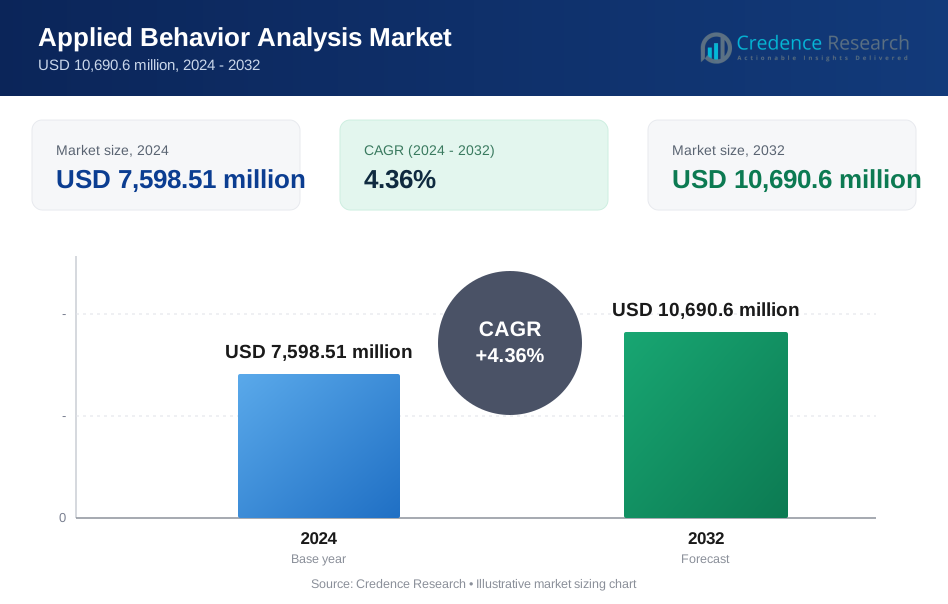
The Applied Behavior Analysis Market is projected to grow from USD 7,598.51 million in 2024 to USD 10,690.6 million by 2032, reflecting a compound annual growth rate (CAGR) of 4.36%.
The Applied Behavior Analysis (ABA) Market is primarily driven by the increasing prevalence of autism spectrum disorder (ASD) and other developmental disabilities, leading to greater demand for ABA therapies. The growing awareness of the benefits of early intervention and the effectiveness of ABA techniques in improving communication, social skills, and behavioral development further boosts market growth. Additionally, the rising acceptance of ABA as a standard treatment modality in both clinical and home settings has expanded its reach. Technological advancements, such as digital tools and mobile applications for therapy delivery, are also reshaping the market by improving accessibility and treatment customization. Increasing support from government bodies and healthcare organizations, coupled with higher healthcare spending in developed and emerging markets, is expected to accelerate market expansion. Trends include the integration of ABA with other therapeutic approaches, the development of personalized treatment plans, and the growing availability of telehealth options for ABA therapy delivery.
The Applied Behavior Analysis (ABA) Market is witnessing significant growth across multiple regions, with North America leading at 40% market share, driven by high autism prevalence and strong healthcare infrastructure. Europe follows with a 30% market share, where growing awareness and government initiatives enhance ABA adoption. The Asia-Pacific region holds 20% of the market, with rising demand for early intervention services in countries like China, Japan, and India. Key players driving the market include ABA Centers of America, Florida Autism Center, Butterfly Effects, CentralReach, LLC, and Rethink First, which offer a range of therapy services across different regions. Smaller regional players, such as Spectrum of Hope and Indigo Kids Behavioral Learning, are also expanding their presence in local markets, capitalizing on increasing demand for personalized and home-based therapy services.
Market Insights
- The Applied Behavior Analysis (ABA) Market is projected to grow from USD 7,598.51 million in 2024 to USD 10,690.6 million by 2032, reflecting a CAGR of 4.36%.
- The rising prevalence of Autism Spectrum Disorder (ASD) and developmental disabilities is a primary driver, increasing demand for ABA therapies, particularly in early intervention settings.
- Growing awareness of ABA's benefits, especially in improving communication and social skills, is propelling market growth, leading to early adoption of ABA services.
- Technological advancements, such as digital tools and mobile applications, are reshaping ABA therapy delivery, enhancing accessibility and treatment customization.
- North America leads the market with a 40% share, driven by high ASD prevalence, strong healthcare infrastructure, and the presence of ABA professionals and institutions.
- Europe follows with a 30% share, supported by growing adoption, government initiatives, and increasing demand for home-based therapy services.
- The Asia-Pacific region holds 20% of the market, fueled by increasing awareness, rising autism diagnoses, and expanding access to ABA services, particularly in urban areas.
Market Drivers
Increasing Prevalence of Autism Spectrum Disorder (ASD)
The rising incidence of Autism Spectrum Disorder (ASD) is a significant driver for the Applied Behavior Analysis (ABA) Market. With early diagnosis and intervention being crucial for optimal developmental outcomes, ABA therapies are increasingly being recognized for their effectiveness in managing ASD symptoms. The growing number of children diagnosed with ASD fuels demand for ABA therapy services. This trend is particularly evident in both developed and emerging economies, where healthcare accessibility is expanding.
- For instance, the World Health Organization (WHO) reports that globally, about 1 in 100 children is estimated to have autism, reflecting the widespread need for effective ASD management strategies and supporting the expansion of ABA therapy access in both developed and emerging healthcare systems.
Rising Awareness of ABA Therapy Benefits
The growing awareness surrounding the positive impacts of ABA therapy on individuals with autism and other developmental disabilities is propelling the Applied Behavior Analysis Market forward. Families, caregivers, and healthcare providers are becoming more informed about the therapy’s ability to improve critical life skills, communication, and social interaction. This heightened awareness encourages early adoption, improving outcomes for children and adults alike. Such knowledge has bolstered the demand for ABA-trained professionals and services globally.
- For instance, a case managed by ABA Psychological Services involved Alexandra, a young woman with autism who, after tailored ABA interventions, showed significant reductions in challenging behaviors and improved her ability to participate in daily activitie.
Technological Advancements in Therapy Delivery
Technological advancements are transforming the Applied Behavior Analysis Market, making therapies more accessible and customizable. Digital platforms and mobile applications for remote ABA therapy delivery allow practitioners to reach a wider audience. These innovations enhance the effectiveness of treatment by offering real-time tracking, personalized treatment plans, and video-based therapy sessions. Technology also facilitates the incorporation of ABA methods into non-clinical settings, making therapy more flexible and adaptable to individual needs.
Government Support and Healthcare Investments
Government policies and increased healthcare investments are playing a key role in the growth of the Applied Behavior Analysis Market. Various governments are recognizing ABA as a highly effective therapy for treating autism, leading to increased funding and reimbursement for services. The push for accessible mental health care services in both developed and emerging markets has resulted in greater integration of ABA therapy into national healthcare systems. As awareness and support continue to grow, so too will the market for ABA services.
Market Trends
Expansion of Telehealth and Remote Therapy Options
The rise of telehealth services is a prominent trend within the Applied Behavior Analysis (ABA) Market. Remote ABA therapy allows clients to access treatment from the comfort of their homes, especially for those in underserved or rural areas. Virtual platforms enable therapists to monitor progress and provide real-time feedback, increasing accessibility and convenience. This trend has become even more pronounced due to the COVID-19 pandemic, highlighting the necessity for flexible, digital solutions in healthcare delivery.
For instance, Advanced Autism Services uses telehealth platforms to provide real-time behavior support, allowing Board Certified Behavior Analysts (BCBAs) to observe clients in their home environments and deliver immediate, context-specific interventions through video conferencing.
Integration of ABA with Other Therapeutic Approaches
Another notable trend in the Applied Behavior Analysis Market is the growing integration of ABA with other therapeutic modalities. Combining ABA with speech therapy, occupational therapy, and cognitive behavioral therapy offers a more holistic approach to treating developmental disorders. This integrated model ensures a comprehensive treatment plan that addresses multiple areas of development. Healthcare professionals are adopting this approach to provide more well-rounded support for individuals, especially those with complex needs.
- For instance, Unyte Integrated Listening has documented the case of a nine-year-old boy with autism who received a combined treatment of ABA and Integrated Listening Systems (iLs) therapy.
Personalization and Data-Driven Treatment Plans
Personalized treatment plans are becoming increasingly prevalent in the Applied Behavior Analysis Market. ABA therapy is moving away from a one-size-fits-all approach and focusing more on individualized care. Advances in data analytics are enabling practitioners to tailor interventions to each client’s unique needs, optimizing therapeutic outcomes. This trend towards customization ensures that therapy is more efficient and effective in achieving desired behavioral improvements, fostering long-term success for clients.
Increasing Demand for ABA Professionals and Training Programs
The growing demand for Applied Behavior Analysis services is leading to an increased need for trained professionals in the field. The shortage of certified ABA therapists is being addressed by the expansion of training programs and educational pathways. Universities and institutions are offering more specialized ABA courses to meet this demand. As more individuals pursue ABA certification, the market is expected to see an influx of qualified professionals, further driving the accessibility and quality of services provided.
Market Challenges Analysis
Shortage of Trained ABA Professionals
One of the key challenges facing the Applied Behavior Analysis (ABA) Market is the shortage of trained and certified professionals. The increasing demand for ABA therapy, driven by the growing prevalence of autism and other developmental disorders, has created a gap between the supply of qualified therapists and the need for services. This shortage limits access to high-quality care, particularly in underserved regions, and hinders the market’s ability to scale. To meet the growing demand, there is a need for more educational and certification programs to train professionals in the field.
- For instance, BlueSprig Pediatrics, which operates over 140 locations in the United States, launched the Attend Behavior app in 2023 to support families remotely, in part to address gaps in direct service caused by therapist shortages.
High Cost of ABA Therapy and Insurance Coverage Limitations
The high cost of Applied Behavior Analysis therapy remains a significant challenge for widespread adoption. ABA services often require long-term treatment, which can become financially burdensome for families, particularly in countries without comprehensive insurance coverage for such therapies. Many insurance providers limit the scope of coverage for ABA therapy, leading to out-of-pocket expenses for families seeking consistent care. This financial barrier can restrict access to necessary treatment, hindering market growth and the ability to meet the needs of individuals with autism and developmental disabilities.
Market Opportunities
Expansion of Telehealth and Digital Solutions
The growing adoption of telehealth services presents significant opportunities for the Applied Behavior Analysis (ABA) Market. Remote therapy options are becoming increasingly popular, allowing individuals to access treatment from anywhere, regardless of location. This trend is particularly beneficial for individuals in rural or underserved areas where access to in-person ABA services is limited. By leveraging digital platforms and mobile applications, therapy delivery can be expanded, making it more flexible and accessible. This opportunity offers the potential to scale the market and address the needs of a broader population.
Integration of ABA into Schools and Community Programs
Another promising opportunity for the Applied Behavior Analysis Market lies in the integration of ABA therapy into educational and community settings. Schools are increasingly adopting ABA techniques to support students with autism and behavioral challenges. By incorporating ABA into the classroom, teachers and educators can provide more tailored interventions to improve student outcomes. Expanding ABA programs into community centers, recreational programs, and other social environments further supports the inclusion of individuals with autism in everyday activities, enhancing social integration and quality of life.
Market Segmentation Analysis:
By Age Group
The Applied Behavior Analysis (ABA) Market is significantly segmented by age group, with children representing the largest demographic. ABA therapy is most commonly used to treat autism spectrum disorders (ASD) in children, with early intervention proving critical in improving developmental outcomes. Adult therapy is gaining traction as the understanding of ABA’s benefits expands beyond childhood treatment. The adult segment is primarily focused on behavioral health issues such as anxiety and stress management, offering opportunities for ABA practices to cater to a broader population.
- For instance, the University of Washington's research on adult behavioral health found that ABA techniques were effective in treating anxiety and stress in adults, demonstrating the therapy's expanding reach.
By Provider
In the Applied Behavior Analysis Market, therapy delivery is categorized by provider type: home-based, center-based, and community-based therapy. Home-based therapy has grown popular due to its convenience and personalized care, allowing patients to receive treatment in their natural environment. Center-based therapy, on the other hand, provides more intensive treatment in a controlled setting, often recommended for individuals requiring comprehensive intervention. Community-based therapy, often involving school and community integration, allows for social skills development in everyday settings, offering a balanced approach for clients.
By Application
The Applied Behavior Analysis Market is further divided based on application, including autism spectrum disorders (ASD), education/training, and anxiety. ABA is most widely used in treating autism, where it focuses on improving communication, social skills, and reducing problematic behaviors. The education and training segment is growing as schools adopt ABA techniques to support students with learning difficulties. In the mental health space, ABA is increasingly applied to treat anxiety and related behavioral issues, expanding its therapeutic scope across various conditions.
Segments:
Based on Age Group
- Children
- Adult
Based on Provider
- Home-based Therapy
- Center-based Therapy
- Community-based Therapy
Based on Application
- Autism Spectrum Disorders
- Education/Training
- Anxiety
Based on the Geography:
- North America
- U.S.
- Canada
- Mexico
- Europe
- Germany
- France
- U.K.
- Italy
- Spain
- Rest of Europe
- Asia Pacific
- China
- Japan
- India
- South Korea
- South-east Asia
- Rest of Asia Pacific
- Latin America
- Brazil
- Argentina
- Rest of Latin America
- Middle East & Africa
- GCC Countries
- South Africa
- Rest of the Middle East and Africa
Regional Analysis
North America
North America dominates the Applied Behavior Analysis (ABA) Market, holding a market share of 40%. The region's leadership can be attributed to the high prevalence of autism spectrum disorder (ASD) and the robust healthcare infrastructure supporting ABA therapy. The United States, in particular, is a key driver of this growth, with substantial investments in autism research and healthcare services. A growing awareness of the benefits of ABA therapy further fuels market demand. The presence of well-established institutions and professionals specializing in ABA therapy contributes to the region's significant share. Public and private insurance programs also enhance access to ABA services, encouraging more families to seek early intervention.
Europe
Europe holds a market share of 30% in the Applied Behavior Analysis Market, with countries like the UK, Germany, and France leading the way in adopting ABA therapies. The region’s increasing focus on mental health and developmental disorders has contributed to the steady growth of ABA services. Rising awareness and the integration of ABA into educational systems also drive market expansion. Government initiatives to fund autism care and behavioral health services further boost the demand for ABA therapy. The demand for home-based therapy services is growing in several European countries, where more families seek personalized care options. As the region embraces more inclusive approaches to autism, the market for ABA therapy is poised for growth.
Asia-Pacific
The Asia-Pacific region is witnessing rapid growth in the Applied Behavior Analysis Market, accounting for 20% of the global share. The increasing prevalence of autism and other behavioral disorders in countries like China, Japan, and India is driving market expansion. As awareness about autism improves, more families are seeking ABA therapy for early intervention. The region's diverse healthcare needs and growing adoption of digital health platforms provide significant opportunities for the ABA market. The expanding middle class in these countries also contributes to higher healthcare spending, allowing families to access specialized services. This growing demand for ABA services, particularly in urban areas, will likely accelerate market growth in the coming years.
Key Player Analysis
- Mosaic Pediatric Therapy
- Butterfly Effects
- ABA Centers of America
- Florida Autism Center
- CentralReach, LLC
- Rethink First
- Stepping Stones Behavioral Support
- Spectrum of Hope
- Indigo Kids Behavioral Learning
- Behavior Analysis Inc.
- Center for Autism & Behavior Analysis, LLC
- Developmental & Behavioral Specialists
Competitive Analysis
The Applied Behavior Analysis (ABA) Market is highly competitive, with several key players offering diverse services to meet the growing demand for autism and behavioral disorder therapies. Companies such as ABA Centers of America, Florida Autism Center, and Butterfly Effects lead the market with extensive networks and specialized treatment options. These companies provide both in-home and center-based therapy, capitalizing on the increasing demand for personalized care. CentralReach, LLC and Rethink First stand out by integrating technology into therapy delivery, offering digital platforms for remote services. The market also features smaller regional players like Spectrum of Hope and Indigo Kids Behavioral Learning, which provide specialized care within local communities. Competition is intensifying as companies expand service offerings and invest in training and technology. Firms are striving to differentiate themselves through improved therapy outcomes, accessibility, and customer experience, all while adapting to the rising demand for early intervention and personalized treatment solutions.
Recent Developments
- In May 2024, Autism Analytica, a neurodevelopmental assessment software company, partnered with Rethink Behavioral Health, a provider of comprehensive clinical and practice management solutions, as well as pediatric therapy providers from RethinkFirst. This collaboration aims to offer ABA service providers fully integrated access to Autism Analytica's Virtual IPM assessment tools.
- In May 2023, BlueSprig Pediatrics, a leading autism therapy provider in the United States, launched the Attend Behavior app. This mobile technology solution is designed to provide individualized and effective behavioral strategies for children, helping them succeed across more than 140 locations served by the company.
- In October 2023, ABA Centers of America opened a new autism care center in Worcester, offering children a vibrant and engaging environment for therapy. The center is dedicated to helping children on the spectrum learn essential tools for leading a more robust and fulfilling life.
Market Concentration & Characteristics
The Applied Behavior Analysis (ABA) Market is moderately concentrated, with a mix of established players and regional service providers. Large companies such as ABA Centers of America, Florida Autism Center, and Butterfly Effects dominate the market, offering comprehensive ABA therapy services across multiple regions. Smaller regional players, including Spectrum of Hope and Indigo Kids Behavioral Learning, cater to local demands by providing personalized therapy and expanding into underserved areas. The market is characterized by a high level of specialization, with many companies focusing on home-based and center-based services tailored to individuals with autism and developmental disabilities. Technological integration, including digital tools and mobile platforms, is also emerging as a key factor for differentiation. The market benefits from government support and healthcare funding, ensuring a stable demand for ABA services across both developed and emerging economies. Despite competition, market growth remains strong, driven by increasing awareness and therapy adoption.
Report Coverage
The research report offers an in-depth analysis based on Age Group, Provider, Application, End-User and Geography. It details leading market players, providing an overview of their business, product offerings, investments, revenue streams, and key applications. Additionally, the report includes insights into the competitive environment, SWOT analysis, current market trends, as well as the primary drivers and constraints. Furthermore, it discusses various factors that have driven market expansion in recent years. The report also explores market dynamics, regulatory scenarios, and technological advancements that are shaping the industry. It assesses the impact of external factors and global economic changes on market growth. Lastly, it provides strategic recommendations for new entrants and established companies to navigate the complexities of the market.
Future Outlook
- The demand for Applied Behavior Analysis (ABA) therapy will continue to rise due to the increasing prevalence of autism spectrum disorder (ASD) and other developmental disorders.
- Technological advancements will drive the integration of digital tools and mobile applications into ABA therapy, improving treatment accessibility and customization.
- The adoption of telehealth and remote therapy services will expand, offering more flexibility for clients and improving access to therapy, especially in underserved regions.
- Government support and healthcare funding will play a critical role in the market's expansion, with more policies focusing on the reimbursement of ABA therapy.
- The growing awareness of the benefits of early intervention in autism will lead to increased demand for ABA services across different age groups.
- More educational institutions and community programs will integrate ABA techniques to support children with behavioral challenges, creating new market opportunities.
- The shortage of trained ABA professionals will continue to challenge the market, prompting more investments in training and certification programs.
- Increased emphasis on personalized treatment plans will drive demand for customized ABA services tailored to individual needs.
- Regional expansion, especially in the Asia-Pacific and Latin American markets, will lead to growth as awareness of autism increases.
- The trend toward combining ABA with other therapeutic approaches will gain momentum, offering a holistic model of care for individuals with complex needs.
Request a Free Sample
Fill in your details and we'll send you a free sample report.
- Sample data tables & charts
- Research methodology
Market Dynamics
Increasing Prevalence of Autism Spectrum Disorder (ASD)
The rising incidence of ASD globally is fueling demand for ABA therapies, as early intervention is recognized as critical for optimal developmental outcomes. This trend is especially pronounced in both developed and emerging economies where healthcare access is expanding.
Growing Awareness of ABA Therapy Benefits
Families, caregivers, and healthcare providers are increasingly informed about ABA's effectiveness in improving communication, social skills, and behavioral development, leading to earlier adoption and higher demand for ABA-trained professionals.
Technological Advancements in Therapy Delivery
Digital tools and mobile applications are making ABA therapy more accessible and customizable, enabling remote delivery, real-time tracking, and personalized treatment plans, which expand the reach and effectiveness of ABA services.
Government Support and Healthcare Investments
Increased government recognition of ABA as an effective therapy for autism has led to greater funding, reimbursement, and integration into national healthcare systems, making ABA services more accessible and affordable.
Expansion of Telehealth and Remote Therapy Options
The adoption of telehealth platforms allows ABA therapy to reach underserved and rural populations, providing flexibility and convenience for families and practitioners, and accelerating market growth especially post-pandemic.
Need a Custom Version of This Report?
Tailor the scope, geography, or segments to your exact requirements.
- Custom geography or segment scope
- Direct access to our analyst team
Frequently Asked Questions
What is the current size of the Applied Behavior Analysis Market?
What factors are driving the growth of the Applied Behavior Analysis Market?
What are the key segments within the Applied Behavior Analysis Market?
What are some challenges faced by the Applied Behavior Analysis Market?
Who are the major players in the Applied Behavior Analysis Market?
Table of Content
Chapter 1 Market Segmentation
- 1.1 Segmentation Framework
- 1.1.1 Product and Service Classification
- 1.1.2 Application and End-Use Classification
- 1.1.3 Technology and Solution Classification
- 1.1.4 Customer and Distribution Channel Classification
- 1.1.5 Geographic Segmentation
- 1.1.6 Market Segment Definitions and Boundaries
- 1.2 By Provider
- 1.2.1 Home-based Therapy
- 1.2.2 Center-based Therapy
- 1.2.3 Community-based Therapy
- 1.3 By Age Group
- 1.3.1 Children
- 1.3.2 Adult
- 1.4 By Application
- 1.4.1 Autism Spectrum Disorders
- 1.4.2 Education/Training
- 1.4.3 Anxiety
Chapter 2 Introduction
- 2.1 Report Objectives and Scope
- 2.2 Product Definition and Industry Terminology
- 2.3 Market Inclusions and Exclusions
- 2.4 Research Process
- 2.4.1 Primary Research and Expert Interviews
- 2.4.2 Secondary Research and Source Review
- 2.4.3 Top-Down and Bottom-Up Estimation
- 2.4.4 Data Triangulation and Verification
- 2.5 Market Size Measurement Basis
- 2.5.1 2024: USD 7,598.51 million → 2032: USD 10,690.6 million
- 2.6 Historical and Forecast Reference Periods
- 2.6.1 Base Year: 2024
- 2.6.2 Forecast Period: 2024-2032
- 2.7 Research Assumptions and Limitations
Chapter 3 Executive Summary
- 3.1 Market Snapshot and Key Findings
- 3.2 Base-Year Market Size, 2024
- 3.3 Forecast Market Size, 2032
- 3.4 Revenue and Volume Growth Outlook
- 3.5 Key Demand and Supply Indicators
- 3.6 Leading Market Segments
- 3.7 Fastest-Growing Market Opportunities
- 3.8 Regional Performance Highlights
- 3.9 Technology and Industry Transformation
- 3.10 Competitive Landscape Summary
- 3.11 Analyst View and Strategic Implications
Chapter 4 Global Applied Behavior Analysis Market Trends and Developments
- 4.1 Historical Industry Development
- 4.2 Recent Market Trends and Developments
- 4.3 Demand and Customer Behavior Trends
- 4.4 Technology and Product Innovation
- 4.5 Artificial Intelligence, Automation and Digitalization
- 4.6 Local Manufacturing and Supply Chain Realignment
- 4.7 Industry Partnerships, Mergers and Acquisitions
- 4.8 Sustainability and Circular Economy Developments
- 4.9 Government and Private Sector Investment Trends
- 4.10 Emerging Business Models and Commercialization
- 4.11 Industry Developments and Announcements
Chapter 5 Global Applied Behavior Analysis Market Production, Supply and Demand Analysis
- 5.1 Demand Trend and Consumption Analysis
- 5.2 Demand Forecast, 2024-2032
- 5.3 Production and Output Trend
- 5.4 Production and Output Forecast, 2024-2032
- 5.5 Installed Capacity and Capacity Utilization
- 5.6 Company-Wise Production Plants and Statistics
- 5.6.1 Installed Production Capacity
- 5.6.2 Actual Production
- 5.6.3 Planned Capacity and Expansion Targets
- 5.7 Supply Chain Structure and Procurement Trends
- 5.8 Supply-Demand Gap and Bottlenecks
- 5.9 Import Dependence and Sourcing Structure
- 5.10 Contract Manufacturing and Outsourcing
- 5.11 Regional Supply and Demand Concentration
Chapter 6 Global Applied Behavior Analysis Market Pricing Analysis
- 6.1 Pricing Structure and Measurement
- 6.2 Historical Pricing Trends
- 6.3 Pricing Outlook, 2024-2032
- 6.4 Average Selling Price and Unit Economics
- 6.5 Pricing by Product and Market Segment
- 6.6 Geographic Pricing Differences
- 6.7 Key Input, Energy, Labor and Logistics Costs
- 6.8 Contract Pricing and Purchasing Models
- 6.9 Pricing Sensitivity and Competitive Positioning
- 6.10 Price, Margin and Profitability Implications
Chapter 7 Global Applied Behavior Analysis Market Dynamics
- 7.1 Market Growth Drivers
- 7.1.1 Demand-Side Drivers
- 7.1.2 Technology and Innovation Drivers
- 7.1.3 Infrastructure and Investment Drivers
- 7.1.4 Regulatory and Policy Drivers
- 7.2 Market Restraints
- 7.2.1 Cost and Affordability Constraints
- 7.2.2 Technology and Adoption Barriers
- 7.2.3 Supply Chain and Operational Constraints
- 7.3 Market Challenges
- 7.3.1 Competitive Pressure and Margin Erosion
- 7.3.2 Skills, Infrastructure and Implementation Gaps
- 7.4 Emerging Market Opportunities
- 7.5 Market Dynamics Impact and Time-Horizon Assessment
Chapter 8 Global Applied Behavior Analysis Value Chain Analysis
- 8.1 Industry Value Chain Overview
- 8.2 Upstream Suppliers and Critical Inputs
- 8.3 Technology and Component Providers
- 8.4 Manufacturing or Service Delivery
- 8.5 Distribution, Channel Partners and Integrators
- 8.6 Downstream Applications and End Users
- 8.7 Value Addition and Profit Pools
- 8.8 Vertical Integration and Outsourcing
- 8.9 Supplier Concentration and Risk
- 8.10 Supply Chain Localization and Resilience
Chapter 9 Global Applied Behavior Analysis Market Regulations and Policies
- 9.1 Relevant Laws, Standards and Compliance Frameworks
- 9.2 Product, Service, Safety and Quality Requirements
- 9.3 Government Policies, Incentives and Subsidies
- 9.4 Imports, Exports and Trade Barriers
- 9.5 Public Procurement and Local Content Requirements
- 9.6 Environmental and Sustainability Compliance
- 9.7 Upcoming Policy Changes and Market Implications
Chapter 10 Global Applied Behavior Analysis Market Hotspots and Opportunities
- 10.1 Market Opportunity Mapping and Growth Hotspots
- 10.2 High-Growth Applications and Customer Groups
- 10.3 Underserved Markets and White-Space Opportunities
- 10.4 Emerging Technology and Product Opportunities
- 10.5 New Capacity and Investment Hotspots
- 10.6 Market Entry and Expansion Opportunities
- 10.7 Distribution and Partnership Opportunities
- 10.8 Near-Term and Long-Term Commercial Potential
- 10.9 Opportunity Attractiveness and Execution Risks
Chapter 11 Global Applied Behavior Analysis Market Outlook, 2024-2032
- 11.1 Market Size and Analysis
- 11.1.1 Revenue (Market Measurement: 2024: USD 7,598.51 million → 2032: USD 10,690.6 million)
- 11.1.2 Market Volume and Quantity Sold
- 11.1.3 Historical Market Size
- 11.1.4 Base-Year Market Size, 2024
- 11.2 Market Forecast, 2024-2032
- 11.2.1 Revenue Forecast to 2032
- 11.2.2 Volume Forecast to 2032
- 11.2.3 CAGR and Year-on-Year Growth
- 11.2.4 Incremental Revenue Opportunity
- 11.3 Forecast Assumptions and Scenario Analysis
- 11.3.1 Base-Case Forecast
- 11.3.2 Optimistic and Conservative Scenarios
- 11.3.3 Technology, Pricing and Policy Sensitivities
- 11.4 Market Attractiveness and Growth Outlook
Chapter 12 Global Applied Behavior Analysis Market Segmentation and Outlook
- 12.1 Segmentation Summary and Market Shares, 2024
- 12.2 Largest and Fastest-Growing Segments
- 12.3 By Provider - Market Size and Forecast, 2024-2032
- 12.3.1 Segment Definition and Scope
- 12.3.2 Historical Market Size
- 12.3.3 Revenue Forecast, 2024-2032
- 12.3.4 Volume Forecast, 2024-2032
- 12.3.5 Base-Year Market Share, 2024
- 12.3.6 Segment CAGR and Growth Drivers
- 12.3.7 Subsegment Market Size and Forecast
- 12.3.7.1 Home-based Therapy
- 12.3.7.2 Center-based Therapy
- 12.3.7.3 Community-based Therapy
- 12.3.8 Subsegment Pricing and Adoption Trends
- 12.3.9 Leading Suppliers and Competition
- 12.3.10 Regional Demand and Opportunities
- 12.4 By Age Group - Market Size and Forecast, 2024-2032
- 12.4.1 Segment Definition and Scope
- 12.4.2 Historical Market Size
- 12.4.3 Revenue Forecast, 2024-2032
- 12.4.4 Volume Forecast, 2024-2032
- 12.4.5 Base-Year Market Share, 2024
- 12.4.6 Segment CAGR and Growth Drivers
- 12.4.7 Subsegment Market Size and Forecast
- 12.4.7.1 Children
- 12.4.7.2 Adult
- 12.4.8 Subsegment Pricing and Adoption Trends
- 12.4.9 Leading Suppliers and Competition
- 12.4.10 Regional Demand and Opportunities
- 12.5 By Application - Market Size and Forecast, 2024-2032
- 12.5.1 Segment Definition and Scope
- 12.5.2 Historical Market Size
- 12.5.3 Revenue Forecast, 2024-2032
- 12.5.4 Volume Forecast, 2024-2032
- 12.5.5 Base-Year Market Share, 2024
- 12.5.6 Segment CAGR and Growth Drivers
- 12.5.7 Subsegment Market Size and Forecast
- 12.5.7.1 Autism Spectrum Disorders
- 12.5.7.2 Education/Training
- 12.5.7.3 Anxiety
- 12.5.8 Subsegment Pricing and Adoption Trends
- 12.5.9 Leading Suppliers and Competition
- 12.5.10 Regional Demand and Opportunities
- 12.6 Segment Growth Comparison
- 12.7 Segment Attractiveness and Priority Matrix
Chapter 13 Global Applied Behavior Analysis End-Use and Application Market Outlook
- 13.1 End-Use Industry and Customer Demand Structure
- 13.2 Leading Applications and Customer Groups
- 13.3 End-Use Market Size, Share and Forecast
- 13.4 Major End-Use Industry Deep Dives
- 13.4.1 Customer Requirements and Use Cases
- 13.4.2 Demand and Replacement Cycles
- 13.4.3 Technical and Regulatory Considerations
- 13.4.4 Purchasing and Procurement Models
- 13.4.5 Leading Vendors and Distribution Channels
- 13.4.6 Forecast and Commercial Opportunities
- 13.5 Emerging Applications and Cross-Segment Demand
- 13.6 End-Use Industry Investment Priorities
Chapter 14 Global Applied Behavior Analysis Geographic Market Outlook, 2024-2032
- 14.1 Regional Market Size and Share, 2024
- 14.2 Regional Market Forecast, 2024-2032
- 14.3 Regional Pricing, Production and Demand Differences
- 14.4 North America
- 14.4.1 United States
- 14.4.2 Canada
- 14.4.3 Mexico
- 14.5 Europe
- 14.5.1 Germany
- 14.5.2 France
- 14.5.3 Italy
- 14.5.4 United Kingdom
- 14.5.5 Spain
- 14.5.6 Poland
- 14.5.7 Russia
- 14.5.8 Netherlands
- 14.5.9 Belgium
- 14.5.10 Sweden
- 14.5.11 Denmark
- 14.5.12 Norway
- 14.5.13 Rest of Europe
- 14.6 Asia Pacific
- 14.6.1 China
- 14.6.2 India
- 14.6.3 Japan
- 14.6.4 South Korea
- 14.6.5 Thailand
- 14.6.6 Indonesia
- 14.6.7 Vietnam
- 14.6.8 Malaysia
- 14.6.9 Australia
- 14.6.10 Rest of Asia Pacific
- 14.7 Latin America
- 14.7.1 Brazil
- 14.7.2 Argentina
- 14.7.3 Colombia
- 14.7.4 Chile
- 14.7.5 Rest of Latin America
- 14.8 Middle East
- 14.8.1 Saudi Arabia
- 14.8.2 United Arab Emirates
- 14.8.3 Turkey
- 14.8.4 Israel
- 14.8.5 Iran
- 14.8.6 Rest of the Middle East
- 14.9 Africa
- 14.9.1 South Africa
- 14.9.2 Egypt
- 14.9.3 Nigeria
- 14.9.4 Morocco
- 14.9.5 Rest of Africa
- 14.10 Regional Investment, Policy and Supply Chain Differences
- 14.11 Regional Competitive Landscape
- 14.12 Geographic Growth Hotspots
Chapter 15 Global Applied Behavior Analysis Technology, Innovation and Sustainability Outlook
- 15.1 Technology Landscape and Maturity
- 15.2 Product, Process and Service Innovation
- 15.3 AI, Automation and Digital Tools in the Industry
- 15.4 Technology Adoption and Performance Benchmarking
- 15.5 Innovation Pipeline and R&D Investment
- 15.6 Patent and Intellectual Property Trends
- 15.7 Energy Efficiency and Resource Management
- 15.8 Sustainability, Recycling and Circularity
- 15.9 Technology Roadmap, 2024-2032
- 15.10 Risks of Obsolescence and Technology Substitution
Chapter 16 Global Applied Behavior Analysis Market Key Strategic Imperatives
- 16.1 Growth and Market Entry Priorities
- 16.2 High-Return Products and Segments
- 16.3 Pricing, Profitability and Cost Optimization
- 16.4 Technology Investment and Product Differentiation
- 16.5 Supply Chain Localization and Resilience
- 16.6 Distribution and Customer Acquisition
- 16.7 Partnership, Acquisition and Capacity Strategy
- 16.8 Regional Expansion Priorities
- 16.9 Short-, Medium- and Long-Term Actions
Chapter 17 Competition Outlook
- 17.1 Industry Competition Characteristics
- 17.2 Market Structure and Concentration
- 17.3 Market Share and Competitive Positioning, 2024
- 17.4 Company-Wise Revenue and Product Benchmarking
- 17.5 Production and Service Capacity Benchmarking
- 17.6 Technology, Pricing and Differentiation
- 17.7 Regional Footprint and Distribution Strength
- 17.8 Mergers, Acquisitions and Strategic Alliances
- 17.9 New Entrants and Competitive Threats
- 17.10 Porter's Five Forces and Industry Attractiveness
- 17.11 Competitive Outlook, 2024-2032
Chapter 18 Company Profiles
- 18.1 Company Coverage and Selection Criteria
- 18.2 ABA Centers of America
- 18.2.1 Business Description
- 18.2.2 Company Ownership and Geographic Presence
- 18.2.3 Product and Service Portfolio
- 18.2.4 Manufacturing and Operating Footprint
- 18.2.5 Production Capacity and Expansion Plans
- 18.2.6 Financial Performance and Investment
- 18.2.7 Market Share and Competitive Position
- 18.2.8 Technology and Innovation Capabilities
- 18.2.9 Strategic Alliances or Partnerships
- 18.2.10 Recent Developments
- 18.2.11 Growth Strategy and Outlook
- 18.3 Florida Autism Center
- 18.4 Butterfly Effects
- 18.5 CentralReach, LLC
- 18.6 Rethink First
- 18.7 Mosaic Pediatric Therapy
- 18.8 Spectrum of Hope
- 18.9 Indigo Kids Behavioral Learning
- 18.10 Behavior Analysis Inc.
- 18.11 Stepping Stones Behavioral Support
- 18.12 Other Relevant Market Participants
Note: Every listed company is profiled on the structure shown under the first company. The company list is preliminary and may change based on research findings, market developments, data availability and client requirements.
Chapter 19 Disclaimer
- 19.1 Research and Forecast Disclaimer
- 19.2 Data Source and Estimation Limitations
Note: The depth of individual sections depends on data availability for this market. Volume, capacity, trade and other unit-based metrics are included where applicable.

