
| REPORT ATTRIBUTE | DETAILS |
|---|---|
| Historical Period | 2020-2023 |
| Base Year | 2024 |
| Forecast Period | 2025-2032 |
| Asia Pacific Water Pump Market Size 2023 | USD 16,297.93 Million |
| Asia Pacific Water Pump Market, CAGR | 5.39% |
| Asia Pacific Water Pump Market Size 2032 | USD 26,167.37 Million |
Market Overview:
Asia Pacific Water Pump Market size was valued at USD 16,297.93 million in 2023 and is anticipated to reach USD 26,167.37 million by 2032, at a CAGR of 5.39% during the forecast period (2023-2032).
Several factors are propelling the growth of the Asia Pacific water pump market. Rapid industrialization and urbanization have led to increased demand for efficient water management systems. The agricultural sector's reliance on groundwater due to irregular rainfall patterns has further amplified the need for water pumps. Additionally, the substitution of electric water pumps for diesel ones, owing to their lower carbon emissions, is influencing market dynamics. Technological advancements, such as the integration of smart technologies like IoT-enabled pumps, are enhancing operational efficiency and energy savings, thereby driving market growth. Governments across the region are introducing policies to improve rural water access, further stimulating pump adoption. Moreover, the rising emphasis on wastewater treatment and recycling is creating additional opportunities for advanced pump systems.
Regionally, China held a significant share of the Asia Pacific water pump market in 2021 and is projected to continue its dominance through 2028. India is expected to register the highest CAGR during the forecast period, driven by rapid urbanization and increased investments in water infrastructure. Southeast Asian countries, including Thailand, Indonesia, and Malaysia, are also witnessing growth due to supportive government policies promoting investments in natural resource extraction and infrastructure development. Japan's emphasis on technological innovation and energy efficiency is fostering the adoption of smart pumping systems. South Korea is also advancing in the market, supported by its strong manufacturing base and smart city projects. Additionally, Australia’s initiatives for sustainable water solutions in agriculture and mining are contributing to regional market expansion.
Market Insights:
- The Asia Pacific Water Pump Market is projected to grow steadily from USD 16,297.93 million in 2023 to USD 26,167.37 million by 2032, driven by a 5.39% CAGR.
- The global water pump market was valued at USD 55,454.00 million in 2023 and is projected to reach USD 80,304.96 million by 2032, growing at a CAGR of 4.2% during the forecast period.
- Agricultural demand remains a dominant growth driver as farmers increasingly depend on groundwater due to irregular rainfall and unreliable irrigation systems.
- Rapid industrialization and urban infrastructure development across India, China, and Southeast Asia are creating consistent demand for water pumps in construction and manufacturing.
- Technological innovation, including IoT integration and energy-efficient designs, is reshaping the market by enhancing pump performance and reducing operational costs.
- Government policies promoting solar-powered and electric pumps are supporting sustainability goals and expanding access in rural and off-grid regions.
- Market growth faces restraints due to high initial investment, inconsistent power supply in remote areas, and a shortage of skilled technicians for modern systems.
- Regionally, China leads the market, while India is expected to exhibit the fastest growth; Southeast Asia, Japan, South Korea, and Australia also show strong development potential.
Market Drivers:
Growing Demand from Agriculture and Irrigation Sectors The Asia Pacific water pump market is significantly driven by the rising demand from the agricultural sector, particularly in countries where agriculture plays a dominant role in the economy. For instance, countries like India and China are investing significantly in irrigation infrastructure to address water scarcity and improve crop yields. With increasing water scarcity and unpredictable monsoon patterns, farmers are increasingly turning to groundwater sources for irrigation. This shift has accelerated the adoption of water pumps, especially in rural areas where canal irrigation remains inadequate. Moreover, governments across the region are offering subsidies and financial incentives to encourage the use of energy-efficient electric pumps, replacing traditional diesel-powered systems. These efforts aim to improve agricultural productivity and ensure a stable water supply for farming activities, thereby strengthening the market’s growth trajectory.
Industrialization and Urban Infrastructure Expansion Rapid industrialization and urban expansion across emerging economies such as India, China, Indonesia, and Vietnam are contributing substantially to the demand for water pumps. Expanding industrial zones, manufacturing hubs, and construction activities have increased the need for water circulation, drainage, and wastewater management solutions. In parallel, the development of urban infrastructure, including residential buildings, commercial complexes, and public utilities, requires a reliable water supply system supported by efficient pump technologies. Investments in smart cities and urban renewal programs have also led to a surge in the adoption of automated and remote-controlled pumping systems. As industries seek sustainable and reliable water solutions, the demand for innovative and energy-efficient pumps is rising across the Asia Pacific region.
Technological Advancements in Pumping Systems Innovation in pump technology is playing a crucial role in enhancing the performance, efficiency, and adaptability of water pumps across diverse end-use sectors. Manufacturers are integrating smart technologies such as Internet of Things (IoT), cloud-based monitoring, and variable frequency drives (VFDs) into pumping systems to reduce energy consumption and operational costs. These advancements allow for real-time performance tracking and predictive maintenance, which extend the lifespan of the equipment and reduce downtime. Furthermore, compact and modular pump designs are gaining popularity due to their space-saving benefits and ease of installation in both residential and industrial settings. As digital transformation gains momentum across the water management industry, these advancements are creating new growth avenues for pump manufacturers in the Asia Pacific region.
Government Initiatives and Sustainability Goals Supportive government initiatives focused on water conservation and energy efficiency are also acting as key growth enablers for the Asia Pacific water pump market. National water policies, rural electrification programs, and renewable energy integration projects are encouraging the shift from conventional pumps to electric and solar-powered alternatives. For instance, China's initiatives to promote smart water management systems aim to reduce water wastage while improving efficiency. Additionally, rising environmental concerns and the implementation of stringent regulations regarding carbon emissions are pushing industries and municipalities to adopt eco-friendly pumping solutions. In countries like China and India, large-scale infrastructure programs such as river-linking projects, water recycling initiatives, and urban sanitation missions further enhance the deployment of advanced pump systems. As sustainability becomes a core objective for public and private sectors alike, the transition toward smart, green pumping solutions is expected to accelerate across the region.
Market Trends:
Rising Integration of Smart and Remote Monitoring Technologies One of the most prominent trends in the Asia Pacific water pump market is the growing integration of smart and remote monitoring technologies into pumping systems. Industrial and municipal users are increasingly adopting pumps equipped with sensors, data analytics, and automation features that enable predictive maintenance and performance optimization. These smart pumps reduce operational downtime, minimize energy consumption, and improve reliability, particularly in large-scale water distribution and wastewater management systems. For instance, companies like Grundfos and Sulzer are leveraging IoT-enabled platforms to offer real-time monitoring, predictive maintenance, and data-driven decision-making for water management systems. Companies are investing in cloud-connected pumps that allow operators to monitor usage patterns and detect anomalies in real time, enhancing operational control and efficiency. This technological shift is transforming traditional pumping operations into intelligent, data-driven systems that align with the broader goals of Industry 4.0.
Surge in Renewable Energy-Powered Pump Installations
The adoption of solar-powered water pumps is gaining momentum across rural and off-grid areas in Asia Pacific, driven by rising energy costs and a growing emphasis on clean energy alternatives. Governments in countries such as India, Bangladesh, and the Philippines are launching schemes to promote solar irrigation and reduce reliance on grid electricity or fossil fuels. For instance, India has distributed nearly 80,000 solar water pumps in the past year under rural electrification schemes, while China has installed over 1.2 million kilowatts of solar-powered pumping systems to support its green energy initiatives. These solar pumps are particularly beneficial in agricultural settings, where daytime operations align well with solar energy availability. The affordability of photovoltaic technology and falling installation costs have further accelerated adoption, especially among small and medium-scale farmers. This trend not only supports environmental sustainability but also addresses the challenge of inconsistent power supply in remote locations.
Expanding Application in Wastewater and Flood Control Systems
The Asia Pacific region is witnessing increased use of water pumps in wastewater treatment and flood control applications due to rapid urbanization and climate variability. Cities are upgrading their drainage infrastructure to mitigate urban flooding, particularly in coastal and low-lying areas that are vulnerable to heavy rainfall and rising sea levels. Submersible pumps and high-capacity dewatering pumps are in high demand to manage stormwater and support emergency response mechanisms. Additionally, as governments invest in wastewater recycling and treatment facilities to address water scarcity and pollution, the need for specialized pumping systems is expanding. This trend highlights the market’s shift toward more complex and purpose-specific pump applications.
Focus on Product Customization and Localization
Manufacturers are increasingly focusing on product customization and localization to meet the diverse requirements of end-users across different Asia Pacific countries. Variations in water availability, power infrastructure, and regulatory standards demand tailored solutions for specific regional markets. Companies are offering pumps designed for particular applications such as chemical handling, slurry movement, or high-head irrigation. Localization strategies also include setting up regional manufacturing and service centers to reduce delivery times and enhance after-sales support. This trend underscores the importance of agility and customer-centric approaches in a highly competitive and geographically diverse market landscape.
Market Challenges Analysis:
High Initial Investment and Maintenance Costs
One of the primary restraints in the Asia Pacific water pump market is the high initial cost associated with advanced and energy-efficient pumping systems. Although smart powered pumps offer long-term savings, their upfront costs remain a barrier for small-scale farmers and enterprises, especially in developing economies. For instance, solar-powered pumps, despite their long-term benefits, require substantial initial investment in photovoltaic panels and installation infrastructure. Additionally, maintenance costs for high-end pumps with integrated digital technologies can be substantial, requiring skilled technicians and regular servicing. This cost sensitivity often leads end-users to opt for low-cost, less efficient alternatives, thereby limiting the adoption of advanced pump technologies.
Power Supply Limitations in Remote Areas
In many rural and semi-urban regions across Asia Pacific, inconsistent or limited access to electricity significantly hinders the effective use of electric water pumps. Despite the growing push for electrification and renewable energy integration, grid reliability remains a challenge in several countries. These limitations restrict the deployment of electric or automated pumping systems, particularly in agriculture and small-scale industrial applications. While solar pumps offer a partial solution, their efficiency depends on weather conditions and initial infrastructure support, which may not be feasible for all users.
Lack of Standardization and Skilled Workforce
The absence of standardized manufacturing and installation practices across the region creates operational inefficiencies and quality discrepancies in pump systems. Inconsistencies in technical specifications and installation procedures often result in suboptimal performance or equipment failure. Furthermore, the limited availability of skilled labor capable of operating and maintaining sophisticated pumping technologies poses an additional challenge. This skills gap slows down the widespread implementation of modern pump systems, particularly in rural areas where technical expertise is scarce.
Environmental and Regulatory Constraints
Stringent environmental regulations aimed at reducing water extraction and managing industrial discharge also present compliance challenges for pump users. Companies must adapt their systems to meet evolving regulatory frameworks, which may require costly upgrades or operational adjustments, affecting profitability and market growth.
Market Opportunities:
The Asia Pacific water pump market presents substantial opportunities driven by ongoing infrastructure development, increasing urban population, and heightened focus on sustainable water management. Governments across the region are investing heavily in water supply networks, irrigation systems, and sanitation infrastructure to support growing residential and industrial demand. These investments open avenues for manufacturers to offer high-capacity and energy-efficient pumps tailored for large-scale public utilities and smart cities. Moreover, rising awareness of water conservation and resource optimization is pushing municipalities and industries to adopt advanced pumping solutions equipped with automation and control features. As smart infrastructure continues to expand, the demand for digitally integrated and remotely monitored pumps is expected to grow significantly.
Another key opportunity lies in the untapped potential of rural and agricultural markets. Many areas in South and Southeast Asia still rely on traditional water extraction methods, indicating a strong demand for cost-effective and reliable pumping systems. The increasing adoption of solar-powered pumps offers dual benefits-reducing dependency on grid electricity and promoting green energy use. In addition, local pump manufacturers can capitalize on demand by offering customized solutions aligned with regional water challenges, such as variable water tables and inconsistent rainfall. As environmental regulations become more stringent, the need for eco-friendly and compliant pump technologies will increase, further stimulating innovation and market penetration. With supportive policy frameworks and financing options becoming more accessible, the Asia Pacific water pump market stands well-positioned to harness these emerging growth opportunities.
Market Segmentation Analysis:
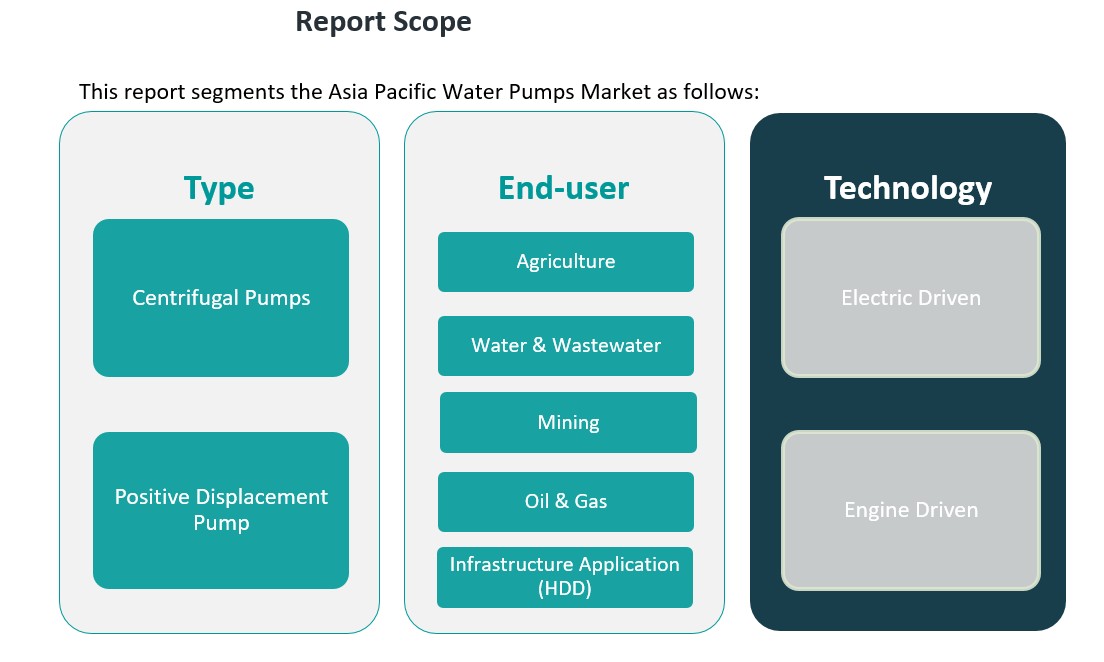
The Asia Pacific water pump market is segmented by type, end-user, and technology, each contributing uniquely to the market’s growth and diversification.
By type, centrifugal pumps dominate the market owing to their wide application across domestic, agricultural, and industrial sectors. Their high efficiency in handling large volumes of water makes them suitable for municipal water supply and irrigation. Positive displacement pumps, while holding a smaller share, are gaining traction in applications requiring precise fluid handling, such as chemical processing and oil & gas operations, due to their ability to maintain consistent flow under varying pressure conditions.
By end-users, the agriculture segment accounts for a significant portion of the demand, driven by the sector’s reliance on groundwater for irrigation, especially in regions with erratic rainfall. The water and wastewater segment is witnessing increased adoption as urban centers expand and governments invest in sanitation and water recycling infrastructure. Mining and oil & gas industries also contribute notably, requiring robust pumping systems to manage dewatering and fluid transport under harsh conditions. Infrastructure applications, particularly in horizontal directional drilling (HDD), are emerging as a niche but growing segment due to ongoing development projects.
By technology, electric-driven pumps lead the market due to their operational efficiency and growing availability of electricity in rural areas. However, engine-driven pumps remain essential in off-grid or remote locations where electricity access is limited, particularly in agricultural and emergency flood control scenarios. These segment trends reflect the diverse and evolving needs shaping the Asia Pacific water pump market.
Segmentation:
By Type Segment:
- Centrifugal Pumps
- Positive Displacement Pumps
By End-User Segment:
- Agriculture
- Water & Wastewater
- Mining
- Oil & Gas
- Infrastructure Application (HDD)
By Technology Segment:
- Electric Driven
- Engine Driven
Regional Analysis:
The Asia Pacific water pump market demonstrates strong regional diversification, driven by the varied economic landscapes, industrial capacities, and water management needs of individual countries. The region has emerged as a key hub for water pump production and consumption, supported by expanding infrastructure projects, agricultural reliance on groundwater, and ongoing investments in water and wastewater management systems. The collective push for sustainable development and efficient resource utilization continues to influence regional growth patterns, with each country contributing uniquely to the market’s evolution.
China holds the largest share of the Asia Pacific water pump market due to its broad industrial base and extensive infrastructure development programs. The country’s investments in urban expansion, manufacturing, and water conservation projects have significantly boosted the demand for high-performance pumps in sectors ranging from residential water supply to industrial processing. Additionally, China’s technological advancements and government support for domestic manufacturing have reinforced its dominance in the regional landscape.
India is another key contributor to the market, with rising demand driven by its growing urban population and agricultural dependence on irrigation. Water scarcity issues and increased government focus on rural electrification and water infrastructure have created favorable conditions for pump adoption across multiple sectors. India also benefits from a growing local manufacturing base that supplies a diverse range of pumps suited for both rural and industrial applications.
Southeast Asian countries such as Indonesia, Thailand, and Malaysia are witnessing steady growth in water pump deployment, supported by active infrastructure development and efforts to modernize water utilities. These countries are also emphasizing flood control and wastewater treatment solutions, increasing the demand for submersible and high-capacity pumps.
Japan and South Korea are at the forefront of adopting smart and energy-efficient pumping systems, driven by technological innovation and strong regulatory frameworks. Their focus on automation, system integration, and sustainable design enhances the regional market’s shift toward intelligent pumping solutions. Meanwhile, Australia’s emphasis on water conservation in agriculture and mining contributes to steady demand for reliable and durable pumping equipment.
Key Player Analysis:
- SLB
- Ingersoll Rand
- The Weir Group PLC
- Vaughan Company
- KSB SE & Co. KGaA
- Pentair
- Grundfos Holding A/S
- Xylem
- Flowserve Corporation
- ITT Inc.
- EBARA Corporation
Competitive Analysis:
The Asia Pacific water pump market features a competitive landscape characterized by the presence of both global and regional manufacturers striving to expand their market footprint. Leading players such as Grundfos, Xylem Inc., KSB SE & Co. KGaA, and Ebara Corporation dominate with a strong portfolio of technologically advanced and energy-efficient products. These companies invest heavily in research and development to introduce smart pumping solutions and strengthen their distribution networks across emerging economies. Regional manufacturers, particularly in China and India, compete by offering cost-effective products tailored to local needs and regulatory standards. Strategic initiatives such as mergers, acquisitions, and partnerships are increasingly common as firms seek to enhance their operational capabilities and customer reach. Additionally, companies are focusing on after-sales services and localized manufacturing to gain a competitive edge. This dynamic environment encourages continuous innovation, driving the evolution of the water pump market across diverse applications in the Asia Pacific region.
Recent Developments:
- Servotech Power Systems Ltd.launched solar pump controllers on October 28, 2024, designed for 2HP to 10HP water pumps. This aligns with initiatives like PM-KUSUM to promote sustainable farming practices through water-efficient solutions.
- Roto Pumps Ltd.announced the launch of its subsidiary, Roto Energy Systems Ltd., in Feb 2024. This new division focuses on solar-powered water pumping solutions, including submersible and surface pumps, catering to eco-friendly water management needs.
- Grundfos' commitment to the Water Resilience Coalition in March 2025 aligns with the water pump market's focus on sustainability and efficient water management. The coalition’s goals include measurable improvements in global water sustainability by 2030.
- On February 28, 2025, KSB launched the MultiTec Plus pump series, specifically optimized for drinking water transport. This product integrates energy-saving technologies and real-time monitoring capabilities, emphasizing advancements in smart and sustainable water pumping solutions.
Market Concentration & Characteristics:
The Asia Pacific water pump market exhibits a moderate level of concentration, characterized by the presence of both global and regional players. Leading multinational companies such as Grundfos Holding A/S, Flowserve Corporation, Sulzer Ltd., and Ebara Corporation dominate the landscape with extensive product portfolios and strong regional presence. These key players invest significantly in technological advancements, offering energy-efficient and smart pumping solutions to meet the evolving demands across various industries, including oil and gas, water and wastewater treatment, chemicals, and power generation. Their focus on innovation and customer-centric solutions contributes to their substantial market shares. In addition to these global corporations, regional companies like Kirloskar Brothers Limited play a vital role in addressing local market needs. This blend of global expertise and regional understanding fosters a competitive environment that drives continuous improvement and diversification of industrial pump offerings across the Asia Pacific region. The market is also characterized by a diverse range of applications, from agricultural irrigation and municipal water supply to industrial processes and infrastructure development. This diversity necessitates a wide array of pump types and technologies, encouraging manufacturers to develop specialized solutions tailored to specific end-user requirements. Furthermore, the increasing emphasis on sustainability and energy efficiency is prompting companies to innovate and offer environmentally friendly pumping solutions, aligning with the region's growing environmental regulations and standards.
Report Coverage:
The research report offers an in-depth analysis based on Type Segment, End-User Segment and Technology Segment. It details leading market players, providing an overview of their business, product offerings, investments, revenue streams, and key applications. Additionally, the report includes insights into the competitive environment, SWOT analysis, current market trends, as well as the primary drivers and constraints. Furthermore, it discusses various factors that have driven market expansion in recent years. The report also explores market dynamics, regulatory scenarios, and technological advancements that are shaping the industry. It assesses the impact of external factors and global economic changes on market growth. Lastly, it provides strategic recommendations for new entrants and established companies to navigate the complexities of the market.
Future Outlook:
- Demand for energy-efficient and smart water pumps will accelerate due to increasing focus on sustainable infrastructure.
- Rural electrification and solar initiatives will boost pump adoption in off-grid agricultural regions.
- Urban population growth will drive investments in municipal water and wastewater systems.
- Industrial expansion in Southeast Asia will create sustained demand for high-capacity pumping solutions.
- Technological advancements in automation and IoT integration will redefine operational efficiency.
- Local manufacturing will gain traction as companies focus on cost competitiveness and regional customization.
- Regulatory emphasis on water conservation and emissions control will shape product development.
- Increased government spending on irrigation and sanitation will expand public sector opportunities.
- Natural disaster preparedness and flood control systems will drive demand for dewatering pumps.
- Mergers and strategic alliances will intensify as companies aim to enhance market presence and innovation.

Request a Free Sample
Fill in your details and we'll send you a free sample report.
- Sample data tables & charts
- Research methodology
Market Dynamics
Agricultural Dependence on Groundwater
Irregular rainfall and unreliable irrigation systems in countries like India and China have led to increased reliance on groundwater, driving strong demand for water pumps to support agricultural productivity.
Rapid Industrialization and Urbanization
Expanding industrial zones, manufacturing hubs, and urban infrastructure projects across Asia Pacific are fueling the need for efficient water management and pumping solutions in both construction and municipal sectors.
Technological Advancements and Smart Pump Adoption
Integration of IoT, automation, and energy-efficient designs into water pumps is enhancing operational efficiency, reducing costs, and enabling predictive maintenance, which is accelerating market growth.
Government Policies and Sustainability Initiatives
Supportive government programs promoting solar-powered and electric pumps, along with stricter environmental regulations, are encouraging the adoption of sustainable and eco-friendly pumping solutions across the region.
Expansion of Water and Wastewater Infrastructure
Growing investments in municipal water supply, wastewater treatment, and flood control systems - especially in rapidly urbanizing and climate-vulnerable areas - are boosting demand for advanced and high-capacity water pumps.
Need a Custom Version of This Report?
Tailor the scope, geography, or segments to your exact requirements.
- Custom geography or segment scope
- Direct access to our analyst team
Frequently Asked Questions
What is the current size of the Asia Pacific Water Pump Market?
What factors are driving the growth of the Asia Pacific Water Pump Market?
What are the key segments within the Asia Pacific Water Pump Market?
What are some challenges faced by the Asia Pacific Water Pump Market?
Who are the major players in the Asia Pacific Water Pump Market?
Table of Content
Chapter 1 Market Segmentation
- 1.1 Segmentation Framework
- 1.1.1 Product and Service Classification
- 1.1.2 Application and End-Use Classification
- 1.1.3 Technology and Solution Classification
- 1.1.4 Customer and Distribution Channel Classification
- 1.1.5 Geographic Segmentation
- 1.1.6 Market Segment Definitions and Boundaries
- 1.2 By Type
- 1.2.1 Centrifugal Pumps
- 1.2.2 Positive Displacement Pumps
- 1.3 By End-User
- 1.3.1 Agriculture
- 1.3.2 Water & Wastewater
- 1.3.3 Mining
- 1.3.4 Oil & Gas
- 1.3.5 Infrastructure Application (HDD)
- 1.4 By Technology
- 1.4.1 Electric Driven
- 1.4.2 Engine Driven
- 1.5 By Application
- 1.5.1 Irrigation
- 1.5.2 Municipal Water Supply
- 1.5.3 Industrial Processes
- 1.5.4 Flood Control & Dewatering
- 1.5.5 Wastewater Treatment
Chapter 2 Introduction
- 2.1 Report Objectives and Scope
- 2.2 Product Definition and Industry Terminology
- 2.3 Market Inclusions and Exclusions
- 2.4 Research Process
- 2.4.1 Primary Research and Expert Interviews
- 2.4.2 Secondary Research and Source Review
- 2.4.3 Top-Down and Bottom-Up Estimation
- 2.4.4 Data Triangulation and Verification
- 2.5 Market Size Measurement Basis
- 2.5.1 2023: USD 16,297.93 million → 2032: USD 26,167.37 million
- 2.6 Historical and Forecast Reference Periods
- 2.6.1 Base Year: 2023
- 2.6.2 Forecast Period: 2023-2032
- 2.7 Research Assumptions and Limitations
Chapter 3 Executive Summary
- 3.1 Market Snapshot and Key Findings
- 3.2 Base-Year Market Size, 2023
- 3.3 Forecast Market Size, 2032
- 3.4 Revenue and Volume Growth Outlook
- 3.5 Key Demand and Supply Indicators
- 3.6 Leading Market Segments
- 3.7 Fastest-Growing Market Opportunities
- 3.8 Regional Performance Highlights
- 3.9 Technology and Industry Transformation
- 3.10 Competitive Landscape Summary
- 3.11 Analyst View and Strategic Implications
Chapter 4 Asia Pacific Water Pump Market Trends and Developments
- 4.1 Historical Industry Development
- 4.2 Recent Market Trends and Developments
- 4.3 Demand and Customer Behavior Trends
- 4.4 Technology and Product Innovation
- 4.5 Artificial Intelligence, Automation and Digitalization
- 4.6 Local Manufacturing and Supply Chain Realignment
- 4.7 Industry Partnerships, Mergers and Acquisitions
- 4.8 Sustainability and Circular Economy Developments
- 4.9 Government and Private Sector Investment Trends
- 4.10 Emerging Business Models and Commercialization
- 4.11 Industry Developments and Announcements
Chapter 5 Asia Pacific Water Pump Market Production, Supply and Demand Analysis
- 5.1 Demand Trend and Consumption Analysis
- 5.2 Demand Forecast, 2023-2032
- 5.3 Production and Output Trend
- 5.4 Production and Output Forecast, 2023-2032
- 5.5 Installed Capacity and Capacity Utilization
- 5.6 Company-Wise Production Plants and Statistics
- 5.6.1 Installed Production Capacity
- 5.6.2 Actual Production
- 5.6.3 Planned Capacity and Expansion Targets
- 5.7 Supply Chain Structure and Procurement Trends
- 5.8 Supply-Demand Gap and Bottlenecks
- 5.9 Import Dependence and Sourcing Structure
- 5.10 Contract Manufacturing and Outsourcing
- 5.11 Regional Supply and Demand Concentration
Chapter 6 Asia Pacific Water Pump Market Pricing Analysis
- 6.1 Pricing Structure and Measurement
- 6.2 Historical Pricing Trends
- 6.3 Pricing Outlook, 2023-2032
- 6.4 Average Selling Price and Unit Economics
- 6.5 Pricing by Product and Market Segment
- 6.6 Geographic Pricing Differences
- 6.7 Key Input, Energy, Labor and Logistics Costs
- 6.8 Contract Pricing and Purchasing Models
- 6.9 Pricing Sensitivity and Competitive Positioning
- 6.10 Price, Margin and Profitability Implications
Chapter 7 Asia Pacific Water Pump Market Dynamics
- 7.1 Market Growth Drivers
- 7.1.1 Demand-Side Drivers
- 7.1.2 Technology and Innovation Drivers
- 7.1.3 Infrastructure and Investment Drivers
- 7.1.4 Regulatory and Policy Drivers
- 7.2 Market Restraints
- 7.2.1 Cost and Affordability Constraints
- 7.2.2 Technology and Adoption Barriers
- 7.2.3 Supply Chain and Operational Constraints
- 7.3 Market Challenges
- 7.3.1 Competitive Pressure and Margin Erosion
- 7.3.2 Skills, Infrastructure and Implementation Gaps
- 7.4 Emerging Market Opportunities
- 7.5 Market Dynamics Impact and Time-Horizon Assessment
Chapter 8 Asia Pacific Water Pump Value Chain Analysis
- 8.1 Industry Value Chain Overview
- 8.2 Upstream Suppliers and Critical Inputs
- 8.3 Technology and Component Providers
- 8.4 Manufacturing or Service Delivery
- 8.5 Distribution, Channel Partners and Integrators
- 8.6 Downstream Applications and End Users
- 8.7 Value Addition and Profit Pools
- 8.8 Vertical Integration and Outsourcing
- 8.9 Supplier Concentration and Risk
- 8.10 Supply Chain Localization and Resilience
Chapter 9 Asia Pacific Water Pump Market Regulations and Policies
- 9.1 Relevant Laws, Standards and Compliance Frameworks
- 9.2 Product, Service, Safety and Quality Requirements
- 9.3 Government Policies, Incentives and Subsidies
- 9.4 Imports, Exports and Trade Barriers
- 9.5 Public Procurement and Local Content Requirements
- 9.6 Environmental and Sustainability Compliance
- 9.7 Upcoming Policy Changes and Market Implications
Chapter 10 Asia Pacific Water Pump Market Hotspots and Opportunities
- 10.1 Market Opportunity Mapping and Growth Hotspots
- 10.2 High-Growth Applications and Customer Groups
- 10.3 Underserved Markets and White-Space Opportunities
- 10.4 Emerging Technology and Product Opportunities
- 10.5 New Capacity and Investment Hotspots
- 10.6 Market Entry and Expansion Opportunities
- 10.7 Distribution and Partnership Opportunities
- 10.8 Near-Term and Long-Term Commercial Potential
- 10.9 Opportunity Attractiveness and Execution Risks
Chapter 11 Asia Pacific Water Pump Market Outlook, 2023-2032
- 11.1 Market Size and Analysis
- 11.1.1 Revenue (Market Measurement: 2023: USD 16,297.93 million → 2032: USD 26,167.37 million)
- 11.1.2 Market Volume and Quantity Sold
- 11.1.3 Historical Market Size
- 11.1.4 Base-Year Market Size, 2023
- 11.2 Market Forecast, 2023-2032
- 11.2.1 Revenue Forecast to 2032
- 11.2.2 Volume Forecast to 2032
- 11.2.3 CAGR and Year-on-Year Growth
- 11.2.4 Incremental Revenue Opportunity
- 11.3 Forecast Assumptions and Scenario Analysis
- 11.3.1 Base-Case Forecast
- 11.3.2 Optimistic and Conservative Scenarios
- 11.3.3 Technology, Pricing and Policy Sensitivities
- 11.4 Market Attractiveness and Growth Outlook
Chapter 12 Asia Pacific Water Pump Market Segmentation and Outlook
- 12.1 Segmentation Summary and Market Shares, 2023
- 12.2 Largest and Fastest-Growing Segments
- 12.3 By Type - Market Size and Forecast, 2023-2032
- 12.3.1 Segment Definition and Scope
- 12.3.2 Historical Market Size
- 12.3.3 Revenue Forecast, 2023-2032
- 12.3.4 Volume Forecast, 2023-2032
- 12.3.5 Base-Year Market Share, 2023
- 12.3.6 Segment CAGR and Growth Drivers
- 12.3.7 Subsegment Market Size and Forecast
- 12.3.7.1 Centrifugal Pumps
- 12.3.7.2 Positive Displacement Pumps
- 12.3.8 Subsegment Pricing and Adoption Trends
- 12.3.9 Leading Suppliers and Competition
- 12.3.10 Regional Demand and Opportunities
- 12.4 By End-User - Market Size and Forecast, 2023-2032
- 12.4.1 Segment Definition and Scope
- 12.4.2 Historical Market Size
- 12.4.3 Revenue Forecast, 2023-2032
- 12.4.4 Volume Forecast, 2023-2032
- 12.4.5 Base-Year Market Share, 2023
- 12.4.6 Segment CAGR and Growth Drivers
- 12.4.7 Subsegment Market Size and Forecast
- 12.4.7.1 Agriculture
- 12.4.7.2 Water & Wastewater
- 12.4.7.3 Mining
- 12.4.7.4 Oil & Gas
- 12.4.7.5 Infrastructure Application (HDD)
- 12.4.8 Subsegment Pricing and Adoption Trends
- 12.4.9 Leading Suppliers and Competition
- 12.4.10 Regional Demand and Opportunities
- 12.5 By Technology - Market Size and Forecast, 2023-2032
- 12.5.1 Segment Definition and Scope
- 12.5.2 Historical Market Size
- 12.5.3 Revenue Forecast, 2023-2032
- 12.5.4 Volume Forecast, 2023-2032
- 12.5.5 Base-Year Market Share, 2023
- 12.5.6 Segment CAGR and Growth Drivers
- 12.5.7 Subsegment Market Size and Forecast
- 12.5.7.1 Electric Driven
- 12.5.7.2 Engine Driven
- 12.5.8 Subsegment Pricing and Adoption Trends
- 12.5.9 Leading Suppliers and Competition
- 12.5.10 Regional Demand and Opportunities
- 12.6 By Application - Market Size and Forecast, 2023-2032
- 12.6.1 Segment Definition and Scope
- 12.6.2 Historical Market Size
- 12.6.3 Revenue Forecast, 2023-2032
- 12.6.4 Volume Forecast, 2023-2032
- 12.6.5 Base-Year Market Share, 2023
- 12.6.6 Segment CAGR and Growth Drivers
- 12.6.7 Subsegment Market Size and Forecast
- 12.6.7.1 Irrigation
- 12.6.7.2 Municipal Water Supply
- 12.6.7.3 Industrial Processes
- 12.6.7.4 Flood Control & Dewatering
- 12.6.7.5 Wastewater Treatment
- 12.6.8 Subsegment Pricing and Adoption Trends
- 12.6.9 Leading Suppliers and Competition
- 12.6.10 Regional Demand and Opportunities
- 12.7 Segment Growth Comparison
- 12.8 Segment Attractiveness and Priority Matrix
Chapter 13 Asia Pacific Water Pump End-Use and Application Market Outlook
- 13.1 End-Use Industry and Customer Demand Structure
- 13.2 Leading Applications and Customer Groups
- 13.3 End-Use Market Size, Share and Forecast
- 13.4 Major End-Use Industry Deep Dives
- 13.4.1 Customer Requirements and Use Cases
- 13.4.2 Demand and Replacement Cycles
- 13.4.3 Technical and Regulatory Considerations
- 13.4.4 Purchasing and Procurement Models
- 13.4.5 Leading Vendors and Distribution Channels
- 13.4.6 Forecast and Commercial Opportunities
- 13.5 Emerging Applications and Cross-Segment Demand
- 13.6 End-Use Industry Investment Priorities
Chapter 14 Asia Pacific Water Pump Geographic Market Outlook, 2023-2032
- 14.1 Regional Market Size and Country-Level Shares, 2023
- 14.2 Country Market Size Comparison, 2023
- 14.3 Country Market Forecasts, 2023-2032
- 14.4 Subregional Industrial and Demand Clusters
- 14.5 Intra-Regional Pricing and Cost Differences
- 14.6 Cross-Border Trade and Supply Networks
- 14.7 Regional Supply and Demand Balances
- 14.8 Country Opportunity Comparison and Prioritization
Note: Every listed country is covered on the structure shown under the first country.
Chapter 15 Asia Pacific Water Pump Technology, Innovation and Sustainability Outlook
- 15.1 Technology Landscape and Maturity
- 15.2 Product, Process and Service Innovation
- 15.3 AI, Automation and Digital Tools in the Industry
- 15.4 Technology Adoption and Performance Benchmarking
- 15.5 Innovation Pipeline and R&D Investment
- 15.6 Patent and Intellectual Property Trends
- 15.7 Energy Efficiency and Resource Management
- 15.8 Sustainability, Recycling and Circularity
- 15.9 Technology Roadmap, 2023-2032
- 15.10 Risks of Obsolescence and Technology Substitution
Chapter 16 Asia Pacific Water Pump Market Key Strategic Imperatives
- 16.1 Growth and Market Entry Priorities
- 16.2 High-Return Products and Segments
- 16.3 Pricing, Profitability and Cost Optimization
- 16.4 Technology Investment and Product Differentiation
- 16.5 Supply Chain Localization and Resilience
- 16.6 Distribution and Customer Acquisition
- 16.7 Partnership, Acquisition and Capacity Strategy
- 16.8 Regional Expansion Priorities
- 16.9 Short-, Medium- and Long-Term Actions
Chapter 17 Competition Outlook
- 17.1 Industry Competition Characteristics
- 17.2 Market Structure and Concentration
- 17.3 Market Share and Competitive Positioning, 2023
- 17.4 Company-Wise Revenue and Product Benchmarking
- 17.5 Production and Service Capacity Benchmarking
- 17.6 Technology, Pricing and Differentiation
- 17.7 Regional Footprint and Distribution Strength
- 17.8 Mergers, Acquisitions and Strategic Alliances
- 17.9 New Entrants and Competitive Threats
- 17.10 Porter's Five Forces and Industry Attractiveness
- 17.11 Competitive Outlook, 2023-2032
Chapter 18 Company Profiles
- 18.1 Company Coverage and Selection Criteria
- 18.2 Grundfos Holding A/S
- 18.2.1 Business Description
- 18.2.2 Company Ownership and Geographic Presence
- 18.2.3 Product and Service Portfolio
- 18.2.4 Manufacturing and Operating Footprint
- 18.2.5 Production Capacity and Expansion Plans
- 18.2.6 Financial Performance and Investment
- 18.2.7 Market Share and Competitive Position
- 18.2.8 Technology and Innovation Capabilities
- 18.2.9 Strategic Alliances or Partnerships
- 18.2.10 Recent Developments
- 18.2.11 Growth Strategy and Outlook
- 18.3 Xylem Inc.
- 18.4 KSB SE & Co. KGaA
- 18.5 Ebara Corporation
- 18.6 Flowserve Corporation
- 18.7 ITT Inc.
- 18.8 Pentair
- 18.9 The Weir Group PLC
- 18.10 Ingersoll Rand
- 18.11 SLB
- 18.12 Other Relevant Market Participants
Note: Every listed company is profiled on the structure shown under the first company. The company list is preliminary and may change based on research findings, market developments, data availability and client requirements.
Chapter 19 Disclaimer
- 19.1 Research and Forecast Disclaimer
- 19.2 Data Source and Estimation Limitations
Note: The depth of individual sections depends on data availability for this market. Volume, capacity, trade and other unit-based metrics are included where applicable.

