
| REPORT ATTRIBUTE | DETAILS |
|---|---|
| Historical Period | 2019-2022 |
| Base Year | 2023 |
| Forecast Period | 2024-2032 |
| Australia Artificial Hair Integration Market Size 2023 | USD 20.92 million |
| Australia Artificial Hair Integration Market, CAGR | 8.10% |
| Australia Artificial Hair Integration Market Size 2032 | USD 42.29 million |
Market Overview
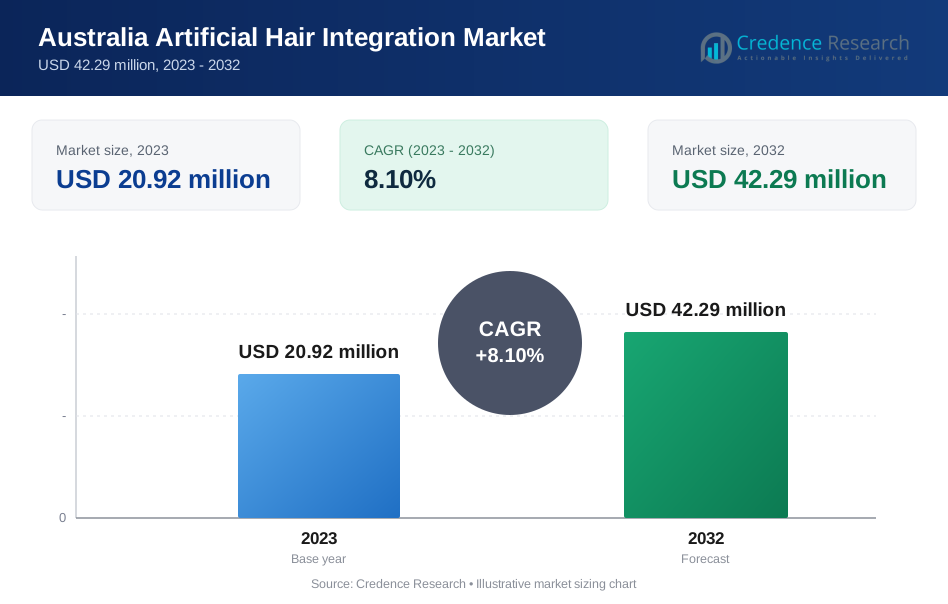
The Australia Artificial Hair Integration Market is projected to grow from USD 20.92 million in 2023 to an estimated USD 42.29 million by 2032, with a compound annual growth rate (CAGR) of 8.10% from 2024 to 2032. This significant growth reflects the increasing demand for high-quality hair integration solutions, driven by rising consumer awareness and acceptance of artificial hair products for aesthetic and functional purposes.
Key drivers of the Australia Artificial Hair Integration Market include the growing trend of personal grooming and beauty consciousness among consumers, as well as the influence of social media and celebrity endorsements. Additionally, the increasing incidence of hair loss due to various factors, such as genetics, aging, and medical conditions, has led to a higher demand for hair integration solutions. Innovations in artificial hair technologies, including more natural-looking and durable products, are also driving market growth.
Geographically, the market is primarily concentrated in major urban centers such as Sydney, Melbourne, and Brisbane, where higher disposable incomes and greater fashion awareness prevail. Key players in the market include companies like Great Lengths, Hairdreams, and Hairlocs, which are recognized for their extensive product ranges and strong distribution networks. These companies are continuously investing in research and development to introduce innovative products that cater to the diverse needs of Australian consumers, thereby maintaining their competitive edge in the market.
Market Drivers
Rising Beauty and Grooming Consciousness
One of the primary drivers of the Australia Artificial Hair Integration Market is the increasing consciousness regarding beauty and grooming among consumers. Over the past decade, there has been a marked shift in societal attitudes towards personal appearance, with a growing emphasis on maintaining a well-groomed and stylish image. This trend is not limited to any specific age group or gender but spans across demographics, driven by a combination of social, cultural, and media influences. The widespread use of social media platforms has amplified the importance of personal aesthetics, as individuals are more frequently exposed to beauty trends and standards. Influencers and celebrities often showcase artificial hair integration as a viable solution for enhancing one's appearance, thereby driving consumer interest and acceptance. The desire to achieve a youthful, trendy, and polished look has led to an increased demand for high-quality hair integration products, contributing significantly to market growth.
Advances in Hair Integration Technologies
Technological advancements in the field of hair integration have been pivotal in propelling the market forward. Innovations in materials and application techniques have resulted in more natural-looking, comfortable, and durable hair integration solutions. For instance, modern technologies like Follicular Unit Extraction (FUE) and Direct Hair Implantation (DHI) have improved the precision and effectiveness of treatments. Modern artificial hair products are designed to mimic the texture, color, and movement of natural hair, making them nearly indistinguishable from the real thing. This has alleviated many of the concerns that consumers previously had regarding the artificiality of hair integration solutions. Additionally, advancements in application methods, such as seamless bonding techniques and more secure attachment systems, have improved the overall user experience. These technological improvements have expanded the appeal of artificial hair integration to a broader audience, including those who were previously hesitant due to quality concerns. The ongoing investment in research and development by leading companies in the market ensures a continuous stream of innovative products, further fueling market growth.
Increasing Incidence of Hair Loss
The rising incidence of hair loss among the population is another significant driver of the Australia Artificial Hair Integration Market. For instance, about half of Australian men show signs of visible baldness at age 50 and over a quarter of Australian women report hair thinning by the same age. Hair loss can result from a variety of factors, including genetics, aging, hormonal changes, and medical conditions such as alopecia. The psychological impact of hair loss can be profound, affecting an individual's self-esteem and confidence. As a result, there is a growing demand for effective and aesthetically pleasing solutions to address this issue. Artificial hair integration offers a non-invasive and versatile option for individuals seeking to regain a full head of hair. Unlike surgical hair restoration methods, which can be costly and carry potential risks, artificial hair integration provides an immediate and customizable solution. The availability of a wide range of products tailored to different hair types, colors, and styles ensures that consumers can find a suitable match for their needs. This increasing demand from individuals experiencing hair loss has significantly contributed to the expansion of the market.
Social Media and Celebrity Endorsements
The influence of social media and celebrity endorsements cannot be overstated as a driving force behind the growth of the Australia Artificial Hair Integration Market. Platforms such as Instagram, YouTube, and TikTok have become powerful marketing tools for beauty and grooming products, including artificial hair integration. Influencers and celebrities often share their experiences with hair integration products, showcasing their effectiveness and aesthetic appeal. These endorsements resonate with a wide audience, enhancing the credibility and desirability of the products. Social media also allows for targeted marketing campaigns, reaching potential customers more effectively. The visual nature of these platforms makes them ideal for demonstrating the transformative impact of hair integration solutions, thereby driving consumer interest and purchase decisions. Furthermore, the interactive nature of social media enables consumers to engage with brands, ask questions, and share their own experiences, fostering a sense of community and trust. This direct engagement between brands and consumers enhances brand loyalty and encourages repeat purchases, contributing to sustained market growth.
Market Trends
Increasing Adoption of Sustainable and Ethical Practices
One of the most notable trends in the Australia Artificial Hair Integration Market is the growing emphasis on sustainable and ethical practices. Consumers today are more environmentally conscious and ethically aware than ever before, prompting companies to adopt more responsible production methods. This trend is reflected in the increasing use of eco-friendly materials and sustainable sourcing practices in the manufacturing of artificial hair products. For instance, many companies are now opting for biodegradable materials or recycling synthetic fibers to reduce their environmental footprint. Additionally, there is a heightened focus on ensuring fair labor practices and ethical sourcing of raw materials. Consumers are actively seeking products that align with their values, favoring brands that demonstrate a commitment to sustainability and ethical responsibility. This shift is driving innovation in product development, as companies strive to meet the demand for high-quality, ethically produced hair integration solutions. The trend towards sustainability is not only enhancing brand loyalty but also setting new industry standards, encouraging other players in the market to follow suit.
Customization and Personalization of Hair Integration Solutions
Another significant trend in the Australia Artificial Hair Integration Market is the increasing demand for customized and personalized hair integration solutions. Consumers are looking for products that cater specifically to their unique needs and preferences, driving companies to offer a more tailored approach. Customization options include a wide range of colors, textures, lengths, and styles, allowing consumers to achieve a look that closely matches their natural hair or desired appearance. Advances in technology have facilitated this trend, with companies leveraging 3D printing, digital imaging, and AI-driven solutions to create bespoke hair integration products. This personalized approach extends beyond the product itself to encompass the entire customer experience. Brands are offering personalized consultations, both online and in-store, to better understand individual customer needs and recommend suitable products. Additionally, subscription services that provide regular updates and new product deliveries tailored to the customer's preferences are gaining popularity. This trend towards customization is enhancing customer satisfaction and loyalty, as consumers feel more valued and understood. By offering personalized solutions, companies are not only meeting consumer demand but also differentiating themselves in a competitive market.
Market Restraints and Challenges
High Cost and Affordability Issues
One of the primary restraints in the Australia Artificial Hair Integration Market is the high cost associated with high-quality hair integration solutions. Premium products, which offer the most natural look and durability, often come with a significant price tag. This high cost can be prohibitive for a large segment of potential consumers, limiting the market’s growth. The expense is not just limited to the initial purchase; maintenance and regular upkeep of artificial hair integrations can also be costly. This includes periodic professional adjustments, specialized hair care products, and potential replacements, which add to the overall expenditure. For consumers seeking affordable solutions, the lower-cost alternatives may not meet their expectations in terms of appearance and longevity, leading to dissatisfaction and reluctance to invest further. This price sensitivity is particularly pronounced among younger consumers and those with lower disposable incomes, posing a significant challenge for market penetration. Companies must find a balance between maintaining high product quality and making their offerings more accessible to a broader audience.
Competition from Alternative Solutions
Another major challenge facing the Australia Artificial Hair Integration Market is the competition from alternative hair restoration solutions. Surgical options, such as hair transplants, although more invasive and expensive, are perceived as permanent solutions and attract consumers willing to invest in long-term results. Additionally, non-surgical treatments like hair growth medications, laser therapy, and scalp micropigmentation are gaining popularity due to their non-invasive nature and varying degrees of effectiveness. These alternatives often promise natural regrowth and restoration of hair, appealing to those who prefer a more natural solution over artificial integrations. The availability and marketing of these alternative treatments can divert potential customers away from artificial hair integration products. To address this challenge, companies in the artificial hair integration market need to emphasize the unique benefits of their products, such as immediate results, customization options, and the ability to change hairstyles frequently. Educating consumers about the advancements in artificial hair technology and the advantages of these solutions over alternative treatments is crucial to maintaining and growing market share.
Market Segmentation Analysis
By Material Type
Acrylic hair extensions are popular due to their affordability and versatility, but they are less durable and natural-looking compared to other materials, which can limit their appeal among discerning consumers. Polyester fibers, known for their durability and resistance to damage, offer a good balance between cost and quality, making them a preferred choice for many consumers due to their easy maintenance and natural hair-like appearance. PVC hair extensions, while durable and shape-retaining, may not provide the most natural look, which can be a drawback for some users. Kanekalon is highly regarded for its natural look and feel, being flame-retardant and heat-stylable, though its high quality often comes at a higher price point. The "Others" category includes various synthetic and natural blends, each offering unique benefits such as improved texture, durability, and appearance, with continual innovations enhancing product offerings in this segment.
By Colour
Black hair extensions remain popular due to the natural prevalence of dark hair among Australians of diverse ethnic backgrounds, offering a versatile choice that blends seamlessly with natural hair. Blond extensions cater to consumers seeking a lighter hair color, with high demand from those looking to make a bold fashion statement. Grey extensions are gaining traction, especially among older consumers and those embracing the grey hair trend, providing a sophisticated appearance. The market also includes a variety of other colors, from natural shades like brown and red to vibrant, unconventional hues, catering to a wide range of consumer preferences and fashion-forward individuals.
Segments
Based on Material Type
- Acrylic
- Polyester
- Polyvinyl Chloride (PVC)
- Kanekalon
- Others
Based on Colour
- Black
- Blond
- Grey
- Others
Based on End User
- Male
- Female
- Children
Based on Extension Type
- Weft Hair Extension
- Clip-in Hair Extension
- Strand by Strand Method
- Others
Based on Sales Channel
- Hypermarket/Supermarket
- Direct Sales
- Specialty Stores
- Online Retailing
- Others Sales Channel
Based on Region
- Sydney
- Melbourne
- Brisban
Regional Analysis
Sydney (30%):
Sydney holds the largest market share in the Australia Artificial Hair Integration Market, representing approximately 30% of the total market. The city's diverse and cosmopolitan population, coupled with high disposable incomes and a strong emphasis on fashion and personal grooming, drives substantial demand for high-quality hair integration products. Sydney's vibrant beauty industry, numerous salons, and specialty stores contribute to the widespread availability and adoption of these products. Additionally, the city's robust online retail infrastructure facilitates easy access to a wide range of hair integration solutions, further bolstering market growth.
Melbourne (25%):
Melbourne follows closely, accounting for around 25% of the market share. Known for its cultural diversity and strong fashion scene, Melbourne sees a high demand for innovative and customized hair integration solutions. The city's consumers are trend-conscious and willing to invest in premium products that enhance their personal style. Melbourne's extensive network of beauty salons, specialty stores, and direct sales channels supports the growing market. Furthermore, the city's active participation in beauty and fashion events helps promote the latest trends and products, driving consumer interest and market expansion.
Key players
- Great Lengths
- Hairdreams
- Hairlocs
- Easihair Pro
- Balmain Hair Couture
- Cinderella Hair
- Donna Bella Hair
- Bellami Hair
- Luxy Hair
- Halo Couture
Competitive Analysis
The Australia Artificial Hair Integration Market is highly competitive, with key players such as Great Lengths, Hairdreams, and Hairlocs leading the market through their extensive product portfolios and strong brand reputation. These companies are renowned for their high-quality hair integration solutions that offer natural looks and durability. Easihair Pro and Balmain Hair Couture also hold significant market shares, known for their innovative products and robust distribution networks. Companies like Cinderella Hair, Donna Bella Hair, and Bellami Hair leverage advanced technologies and offer customized solutions to meet diverse consumer needs. Luxy Hair and Halo Couture are prominent in the online retail space, attracting a tech-savvy customer base with their user-friendly platforms and strong social media presence. Continuous innovation, strategic marketing, and customer-centric approaches are crucial for these companies to maintain their competitive edge and expand their market share.
Recent Developments
February 2023 - Diva Divine Hair Extensions and Wigs, an Indian hair extension supplier, launched a new salon in Mumbai, India. The company is renowned for providing professional assistance to its customers and has expanded its presence by opening physical stores in various locations across India. This strategic expansion aims to enhance customer accessibility and offer personalized services, reinforcing Diva Divine’s commitment to customer satisfaction and high-quality hair extension solutions.
September 2023 - Angel Remy Hair Extensions, a U.K.-based hair extension company, announced plans to introduce products designed to add length and volume to the user’s hair while remaining invisible to the naked eye. This innovation aims to provide a more natural appearance, addressing a key concern for many users. By enhancing the aesthetics and functionality of their extensions, Angel Remy Hair Extensions seeks to capture a larger market share and meet the growing demand for high-quality, discreet hair solutions.
In October 2022, Hair Originals, an Indian brand specializing in natural hair extensions, launched experience centers in Bengaluru and Gurugram. These centers offer customers free trials and consultations, allowing them to experience the product firsthand before making a purchase. This initiative aims to enhance customer engagement and trust, providing personalized experiences that cater to individual hair needs and preferences. Hair Originals’ focus on customer interaction and product transparency is a strategic move to solidify its presence in the competitive hair extension market.
Market Concentration and Characteristics
The Australia Artificial Hair Integration Market is characterized by moderate to high market concentration, with a few key players dominating the landscape. Companies like Great Lengths, Hairdreams, and Hairlocs lead the market due to their extensive product offerings, strong brand recognition, and robust distribution networks. These major players invest heavily in research and development to innovate and improve the quality and durability of their hair integration solutions, ensuring a competitive edge. The market is also defined by its diversity in product types and customization options, catering to a wide range of consumer preferences and needs. While larger companies hold significant market shares, smaller and emerging brands are increasingly gaining traction by offering niche products and personalized services, contributing to the dynamic and competitive nature of the market.
Report Coverage
The research report offers an in-depth analysis based on Material Type, Colour, End User, Extension Type, Sales Channel and Region. It details leading market players, providing an overview of their business, product offerings, investments, revenue streams, and key applications. Additionally, the report includes insights into the competitive environment, SWOT analysis, current market trends, as well as the primary drivers and constraints. Furthermore, it discusses various factors that have driven market expansion in recent years. The report also explores market dynamics, regulatory scenarios, and technological advancements that are shaping the industry. It assesses the impact of external factors and global economic changes on market growth. Lastly, it provides strategic recommendations for new entrants and established companies to navigate the complexities of the market.
Future Outlook
- The Australia Artificial Hair Integration Market is projected to continue growing robustly, driven by increasing consumer demand for high-quality and natural-looking hair solutions.
- Continuous advancements in hair integration technologies will enhance product quality and appeal, making artificial hair solutions more natural and durable.
- The market will see a surge in demand for personalized and customized hair integration solutions, catering to individual preferences and unique hair types.
- There will be a growing emphasis on sustainable and ethically sourced materials, as consumers become more environmentally conscious and demand eco-friendly products.
- The market will expand its reach among male consumers, who are increasingly seeking hair integration solutions for both aesthetic and hair loss-related reasons.
- Online retailing will play a pivotal role in market growth, providing consumers with convenient access to a wide range of products and customization options.
- Direct sales through salons and beauty specialists will grow, offering personalized consultations and professional application services to enhance customer satisfaction.
- New and improved application methods will emerge, making the hair integration process easier, faster, and more comfortable for users.
- Market penetration will increase in regional and rural areas, driven by enhanced online accessibility and targeted marketing efforts.
- The competitive landscape will intensify, with established players continuing to innovate and new entrants introducing niche products, fostering a dynamic and vibrant market environment.
Request a Free Sample
Fill in your details and we'll send you a free sample report.
- Sample data tables & charts
- Research methodology
Market Dynamics
Rising Beauty and Grooming Consciousness
Australian consumers are increasingly focused on personal appearance and grooming, influenced by social media and celebrity trends, which is boosting demand for artificial hair integration products across all demographics.
Advances in Hair Integration Technologies
Innovations in materials and application techniques have made artificial hair solutions more natural-looking, comfortable, and durable, attracting a broader customer base and reducing concerns about artificiality.
Increasing Incidence of Hair Loss
A significant portion of the Australian population experiences hair loss due to genetics, aging, and medical conditions, driving demand for non-invasive, customizable hair integration solutions as alternatives to surgical procedures.
Social Media and Celebrity Endorsements
Influencers and celebrities actively promote artificial hair integration products on platforms like Instagram and TikTok, increasing product visibility, credibility, and consumer acceptance, which accelerates market growth.
Customization and Personalization Trends
Consumers are seeking hair integration solutions tailored to their unique hair types, colors, and styles, prompting companies to offer more personalized products and services, thereby enhancing customer satisfaction and loyalty.
Need a Custom Version of This Report?
Tailor the scope, geography, or segments to your exact requirements.
- Custom geography or segment scope
- Direct access to our analyst team
Frequently Asked Questions
What is the projected market growth for the Australia Artificial Hair Integration Market?
What are the key drivers of market growth?
Which regions in Australia have the highest market concentration?
What trends are shaping the future of the market?
Who are the leading players in the Australia Artificial Hair Integration Market?
Table of Content
Chapter 1 Market Segmentation
- 1.1 Segmentation Framework
- 1.1.1 Product and Service Classification
- 1.1.2 Application and End-Use Classification
- 1.1.3 Technology and Solution Classification
- 1.1.4 Customer and Distribution Channel Classification
- 1.1.5 Geographic Segmentation
- 1.1.6 Market Segment Definitions and Boundaries
- 1.2 By Colour
- 1.2.1 Black
- 1.2.2 Blond
- 1.2.3 Grey
- 1.2.4 Others
- 1.3 By End User
- 1.3.1 Male
- 1.3.2 Female
- 1.3.3 Children
- 1.4 By Material Type
- 1.4.1 Acrylic
- 1.4.2 Polyester
- 1.4.3 Polyvinyl Chloride (PVC)
- 1.4.4 Kanekalon
- 1.4.5 Others
- 1.5 By Extension Type
- 1.5.1 Weft Hair Extension
- 1.5.2 Clip-in Hair Extension
- 1.5.3 Strand by Strand Method
- 1.5.4 Others
Chapter 2 Introduction
- 2.1 Report Objectives and Scope
- 2.2 Product Definition and Industry Terminology
- 2.3 Market Inclusions and Exclusions
- 2.4 Research Process
- 2.4.1 Primary Research and Expert Interviews
- 2.4.2 Secondary Research and Source Review
- 2.4.3 Top-Down and Bottom-Up Estimation
- 2.4.4 Data Triangulation and Verification
- 2.5 Market Size Measurement Basis
- 2.5.1 2023: USD 20.92 million → 2032: USD 42.29 million
- 2.6 Historical and Forecast Reference Periods
- 2.6.1 Base Year: 2023
- 2.6.2 Forecast Period: 2023-2032
- 2.7 Research Assumptions and Limitations
Chapter 3 Executive Summary
- 3.1 Market Snapshot and Key Findings
- 3.2 Base-Year Market Size, 2023
- 3.3 Forecast Market Size, 2032
- 3.4 Revenue and Volume Growth Outlook
- 3.5 Key Demand and Supply Indicators
- 3.6 Leading Market Segments
- 3.7 Fastest-Growing Market Opportunities
- 3.8 Regional Performance Highlights
- 3.9 Technology and Industry Transformation
- 3.10 Competitive Landscape Summary
- 3.11 Analyst View and Strategic Implications
Chapter 4 Australia Artificial Hair Integration Market Trends and Developments
- 4.1 Historical Industry Development
- 4.2 Recent Market Trends and Developments
- 4.3 Demand and Customer Behavior Trends
- 4.4 Technology and Product Innovation
- 4.5 Artificial Intelligence, Automation and Digitalization
- 4.6 Local Manufacturing and Supply Chain Realignment
- 4.7 Industry Partnerships, Mergers and Acquisitions
- 4.8 Sustainability and Circular Economy Developments
- 4.9 Government and Private Sector Investment Trends
- 4.10 Emerging Business Models and Commercialization
- 4.11 Industry Developments and Announcements
Chapter 5 Australia Artificial Hair Integration Market Production, Supply and Demand Analysis
- 5.1 Demand Trend and Consumption Analysis
- 5.2 Demand Forecast, 2023-2032
- 5.3 Production and Output Trend
- 5.4 Production and Output Forecast, 2023-2032
- 5.5 Installed Capacity and Capacity Utilization
- 5.6 Company-Wise Production Plants and Statistics
- 5.6.1 Installed Production Capacity
- 5.6.2 Actual Production
- 5.6.3 Planned Capacity and Expansion Targets
- 5.7 Supply Chain Structure and Procurement Trends
- 5.8 Supply-Demand Gap and Bottlenecks
- 5.9 Import Dependence and Sourcing Structure
- 5.10 Contract Manufacturing and Outsourcing
- 5.11 Regional Supply and Demand Concentration
Chapter 6 Australia Artificial Hair Integration Market Pricing Analysis
- 6.1 Pricing Structure and Measurement
- 6.2 Historical Pricing Trends
- 6.3 Pricing Outlook, 2023-2032
- 6.4 Average Selling Price and Unit Economics
- 6.5 Pricing by Product and Market Segment
- 6.6 Geographic Pricing Differences
- 6.7 Key Input, Energy, Labor and Logistics Costs
- 6.8 Contract Pricing and Purchasing Models
- 6.9 Pricing Sensitivity and Competitive Positioning
- 6.10 Price, Margin and Profitability Implications
Chapter 7 Australia Artificial Hair Integration Market Dynamics
- 7.1 Market Growth Drivers
- 7.1.1 Demand-Side Drivers
- 7.1.2 Technology and Innovation Drivers
- 7.1.3 Infrastructure and Investment Drivers
- 7.1.4 Regulatory and Policy Drivers
- 7.2 Market Restraints
- 7.2.1 Cost and Affordability Constraints
- 7.2.2 Technology and Adoption Barriers
- 7.2.3 Supply Chain and Operational Constraints
- 7.3 Market Challenges
- 7.3.1 Competitive Pressure and Margin Erosion
- 7.3.2 Skills, Infrastructure and Implementation Gaps
- 7.4 Emerging Market Opportunities
- 7.5 Market Dynamics Impact and Time-Horizon Assessment
Chapter 8 Australia Artificial Hair Integration Value Chain Analysis
- 8.1 Industry Value Chain Overview
- 8.2 Upstream Suppliers and Critical Inputs
- 8.3 Technology and Component Providers
- 8.4 Manufacturing or Service Delivery
- 8.5 Distribution, Channel Partners and Integrators
- 8.6 Downstream Applications and End Users
- 8.7 Value Addition and Profit Pools
- 8.8 Vertical Integration and Outsourcing
- 8.9 Supplier Concentration and Risk
- 8.10 Supply Chain Localization and Resilience
Chapter 9 Australia Artificial Hair Integration Market Regulations and Policies
- 9.1 Relevant Laws, Standards and Compliance Frameworks
- 9.2 Product, Service, Safety and Quality Requirements
- 9.3 Government Policies, Incentives and Subsidies
- 9.4 Imports, Exports and Trade Barriers
- 9.5 Public Procurement and Local Content Requirements
- 9.6 Environmental and Sustainability Compliance
- 9.7 Upcoming Policy Changes and Market Implications
Chapter 10 Australia Artificial Hair Integration Market Hotspots and Opportunities
- 10.1 Market Opportunity Mapping and Growth Hotspots
- 10.2 High-Growth Applications and Customer Groups
- 10.3 Underserved Markets and White-Space Opportunities
- 10.4 Emerging Technology and Product Opportunities
- 10.5 New Capacity and Investment Hotspots
- 10.6 Market Entry and Expansion Opportunities
- 10.7 Distribution and Partnership Opportunities
- 10.8 Near-Term and Long-Term Commercial Potential
- 10.9 Opportunity Attractiveness and Execution Risks
Chapter 11 Australia Artificial Hair Integration Market Outlook, 2023-2032
- 11.1 Market Size and Analysis
- 11.1.1 Revenue (Market Measurement: 2023: USD 20.92 million → 2032: USD 42.29 million)
- 11.1.2 Market Volume and Quantity Sold
- 11.1.3 Historical Market Size
- 11.1.4 Base-Year Market Size, 2023
- 11.2 Market Forecast, 2023-2032
- 11.2.1 Revenue Forecast to 2032
- 11.2.2 Volume Forecast to 2032
- 11.2.3 CAGR and Year-on-Year Growth
- 11.2.4 Incremental Revenue Opportunity
- 11.3 Forecast Assumptions and Scenario Analysis
- 11.3.1 Base-Case Forecast
- 11.3.2 Optimistic and Conservative Scenarios
- 11.3.3 Technology, Pricing and Policy Sensitivities
- 11.4 Market Attractiveness and Growth Outlook
Chapter 12 Australia Artificial Hair Integration Market Segmentation and Outlook
- 12.1 Segmentation Summary and Market Shares, 2023
- 12.2 Largest and Fastest-Growing Segments
- 12.3 By Colour - Market Size and Forecast, 2023-2032
- 12.3.1 Segment Definition and Scope
- 12.3.2 Historical Market Size
- 12.3.3 Revenue Forecast, 2023-2032
- 12.3.4 Volume Forecast, 2023-2032
- 12.3.5 Base-Year Market Share, 2023
- 12.3.6 Segment CAGR and Growth Drivers
- 12.3.7 Subsegment Market Size and Forecast
- 12.3.7.1 Black
- 12.3.7.2 Blond
- 12.3.7.3 Grey
- 12.3.7.4 Others
- 12.3.8 Subsegment Pricing and Adoption Trends
- 12.3.9 Leading Suppliers and Competition
- 12.3.10 Regional Demand and Opportunities
- 12.4 By End User - Market Size and Forecast, 2023-2032
- 12.4.1 Segment Definition and Scope
- 12.4.2 Historical Market Size
- 12.4.3 Revenue Forecast, 2023-2032
- 12.4.4 Volume Forecast, 2023-2032
- 12.4.5 Base-Year Market Share, 2023
- 12.4.6 Segment CAGR and Growth Drivers
- 12.4.7 Subsegment Market Size and Forecast
- 12.4.7.1 Male
- 12.4.7.2 Female
- 12.4.7.3 Children
- 12.4.8 Subsegment Pricing and Adoption Trends
- 12.4.9 Leading Suppliers and Competition
- 12.4.10 Regional Demand and Opportunities
- 12.5 By Material Type - Market Size and Forecast, 2023-2032
- 12.5.1 Segment Definition and Scope
- 12.5.2 Historical Market Size
- 12.5.3 Revenue Forecast, 2023-2032
- 12.5.4 Volume Forecast, 2023-2032
- 12.5.5 Base-Year Market Share, 2023
- 12.5.6 Segment CAGR and Growth Drivers
- 12.5.7 Subsegment Market Size and Forecast
- 12.5.7.1 Acrylic
- 12.5.7.2 Polyester
- 12.5.7.3 Polyvinyl Chloride (PVC)
- 12.5.7.4 Kanekalon
- 12.5.7.5 Others
- 12.5.8 Subsegment Pricing and Adoption Trends
- 12.5.9 Leading Suppliers and Competition
- 12.5.10 Regional Demand and Opportunities
- 12.6 By Extension Type - Market Size and Forecast, 2023-2032
- 12.6.1 Segment Definition and Scope
- 12.6.2 Historical Market Size
- 12.6.3 Revenue Forecast, 2023-2032
- 12.6.4 Volume Forecast, 2023-2032
- 12.6.5 Base-Year Market Share, 2023
- 12.6.6 Segment CAGR and Growth Drivers
- 12.6.7 Subsegment Market Size and Forecast
- 12.6.7.1 Weft Hair Extension
- 12.6.7.2 Clip-in Hair Extension
- 12.6.7.3 Strand by Strand Method
- 12.6.7.4 Others
- 12.6.8 Subsegment Pricing and Adoption Trends
- 12.6.9 Leading Suppliers and Competition
- 12.6.10 Regional Demand and Opportunities
- 12.7 Segment Growth Comparison
- 12.8 Segment Attractiveness and Priority Matrix
Chapter 13 Australia Artificial Hair Integration End-Use and Application Market Outlook
- 13.1 End-Use Industry and Customer Demand Structure
- 13.2 Leading Applications and Customer Groups
- 13.3 End-Use Market Size, Share and Forecast
- 13.4 Major End-Use Industry Deep Dives
- 13.4.1 Customer Requirements and Use Cases
- 13.4.2 Demand and Replacement Cycles
- 13.4.3 Technical and Regulatory Considerations
- 13.4.4 Purchasing and Procurement Models
- 13.4.5 Leading Vendors and Distribution Channels
- 13.4.6 Forecast and Commercial Opportunities
- 13.5 Emerging Applications and Cross-Segment Demand
- 13.6 End-Use Industry Investment Priorities
Chapter 14 Australia Artificial Hair Integration Geographic Market Outlook, 2023-2032
- 14.1 Domestic Market Distribution and Demand Clusters
- 14.2 State- or Province-Wise Market Size and Forecast, 2023-2032
- 14.3 City and Metropolitan Market Outlook
- 14.4 Industrial, Manufacturing and Commercial Clusters
- 14.5 Geographic Concentration of Key End Users
- 14.6 Local Pricing and Purchasing Differences
- 14.7 Domestic Production Facilities and Capacity Map
- 14.8 Local Infrastructure and Project Pipeline
- 14.9 State-Level Policy and Incentive Differences
- 14.10 Subnational Investment Hotspots and Opportunities
- 14.11 Distribution and Logistics Networks
- 14.12 Domestic Competitive Footprint
Chapter 15 Australia Artificial Hair Integration Technology, Innovation and Sustainability Outlook
- 15.1 Technology Landscape and Maturity
- 15.2 Product, Process and Service Innovation
- 15.3 AI, Automation and Digital Tools in the Industry
- 15.4 Technology Adoption and Performance Benchmarking
- 15.5 Innovation Pipeline and R&D Investment
- 15.6 Patent and Intellectual Property Trends
- 15.7 Energy Efficiency and Resource Management
- 15.8 Sustainability, Recycling and Circularity
- 15.9 Technology Roadmap, 2023-2032
- 15.10 Risks of Obsolescence and Technology Substitution
Chapter 16 Australia Artificial Hair Integration Market Key Strategic Imperatives
- 16.1 Growth and Market Entry Priorities
- 16.2 High-Return Products and Segments
- 16.3 Pricing, Profitability and Cost Optimization
- 16.4 Technology Investment and Product Differentiation
- 16.5 Supply Chain Localization and Resilience
- 16.6 Distribution and Customer Acquisition
- 16.7 Partnership, Acquisition and Capacity Strategy
- 16.8 Regional Expansion Priorities
- 16.9 Short-, Medium- and Long-Term Actions
Chapter 17 Competition Outlook
- 17.1 Industry Competition Characteristics
- 17.2 Market Structure and Concentration
- 17.3 Market Share and Competitive Positioning, 2023
- 17.4 Company-Wise Revenue and Product Benchmarking
- 17.5 Production and Service Capacity Benchmarking
- 17.6 Technology, Pricing and Differentiation
- 17.7 Regional Footprint and Distribution Strength
- 17.8 Mergers, Acquisitions and Strategic Alliances
- 17.9 New Entrants and Competitive Threats
- 17.10 Porter's Five Forces and Industry Attractiveness
- 17.11 Competitive Outlook, 2023-2032
Chapter 18 Company Profiles
- 18.1 Company Coverage and Selection Criteria
- 18.2 Great Lengths
- 18.2.1 Business Description
- 18.2.2 Company Ownership and Geographic Presence
- 18.2.3 Product and Service Portfolio
- 18.2.4 Manufacturing and Operating Footprint
- 18.2.5 Production Capacity and Expansion Plans
- 18.2.6 Financial Performance and Investment
- 18.2.7 Market Share and Competitive Position
- 18.2.8 Technology and Innovation Capabilities
- 18.2.9 Strategic Alliances or Partnerships
- 18.2.10 Recent Developments
- 18.2.11 Growth Strategy and Outlook
- 18.3 Hairdreams
- 18.4 Hairlocs
- 18.5 Easihair Pro
- 18.6 Balmain Hair Couture
- 18.7 Cinderella Hair
- 18.8 Donna Bella Hair
- 18.9 Bellami Hair
- 18.10 Luxy Hair
- 18.11 Halo Couture
- 18.12 Other Relevant Market Participants
Note: Every listed company is profiled on the structure shown under the first company. The company list is preliminary and may change based on research findings, market developments, data availability and client requirements.
Chapter 19 Disclaimer
- 19.1 Research and Forecast Disclaimer
- 19.2 Data Source and Estimation Limitations
Note: The depth of individual sections depends on data availability for this market. Volume, capacity, trade and other unit-based metrics are included where applicable.

