Elevator Components Market Overview:
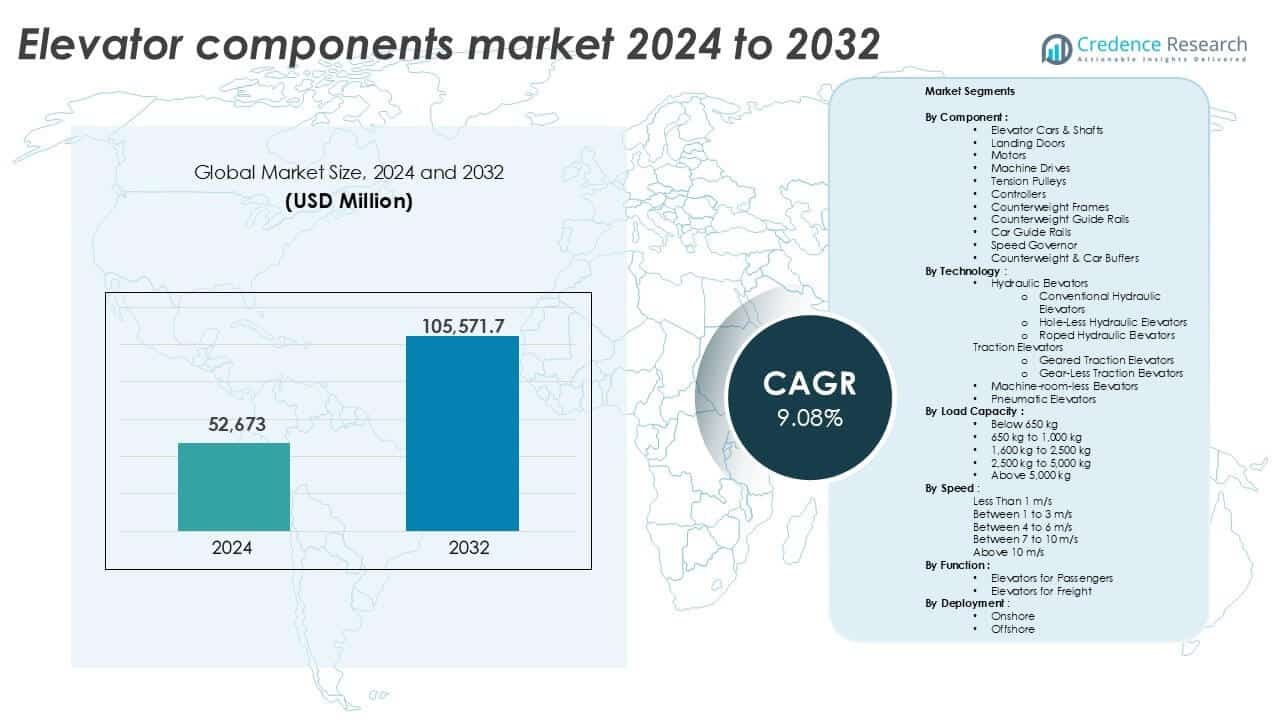
The Elevator Components Market size was valued at USD 52,673 million in 2024 and is anticipated to reach USD 105,571.7 million by 2032, at a CAGR of 9.08% during the forecast period.
| REPORT ATTRIBUTE | DETAILS |
|---|---|
| Historical Period | 2020-2023 |
| Base Year | 2024 |
| Forecast Period | 2025-2032 |
| Elevator Components Market Size 2024 | USD 52,673 million |
| Elevator Components Market, CAGR | 9.08% |
| Elevator Components Market Size 2032 | USD 105,571.7 million |
The global elevator components market is led by companies such as Wittur Group, Fermator Group, GAL Manufacturing Corp., and Nidec Kinetek Elevator Technology (NKET), known for their innovation in doors, safety gear, motors, and control systems. Schindler Holding AG (via Adams Elevator Equipment Company) and Halma Plc. (via Avire Ltd) leverage global networks and smart technology capabilities to remain competitive. Other notable players include Böhnke & Partner GmbH, Elevator Equipment Corporation (EECO), and Hydroware, with strong specialization in retrofitting solutions. Regionally, Asia-Pacific dominates the market with over 40% share in 2024, driven by rapid urbanization and high-rise construction in China, India, and Southeast Asia. North America and Europe follow, with 25% and 22% shares respectively, fueled by modernization projects and regulatory upgrades in aging infrastructure. Competitive intensity is high, with companies focusing on energy-efficient designs, digital integration, and regional expansion to capture emerging opportunities.
Elevator Components Market Insights
- The elevator components market was valued at USD 52,673 million in 2024 and is expected to reach USD 105,571.7 million by 2032, growing at a CAGR of 9.08%.
- Rising urbanization and high-rise construction drive demand for components such as elevator cars, motors, controllers, and safety systems, especially in residential and commercial towers.
- Smart elevators with IoT integration, energy-efficient drives, and touchless control features represent strong trends, prompting innovation across traction and machine-room-less technologies.
- The market remains competitive with major players including Wittur Group, GAL Manufacturing, Schindler (Adams Elevator), and NKET, focusing on modernization, product innovation, and regional expansion.
- Asia-Pacific holds the largest market share at over 40%, followed by North America (25%) and Europe (22%); the 650–1,000 kg load capacity and traction elevator segments dominate due to broad applicability across urban mid- and high-rise buildings.
Elevator Components Market Segmentation Analysis:
By Component
The Elevator Cars & Shafts segment leads the Elevator Components Market, accounting for the highest revenue share in 2024. This dominance stems from its essential role in passenger and freight movement. Growing urban infrastructure and high-rise construction fuel consistent demand for car assemblies and shaft systems. Motors and machine drives follow closely, driven by modernization of aging elevators in commercial buildings. Controllers and speed governors see rising adoption in smart elevators for enhanced safety and ride precision. Increasing focus on energy efficiency and smooth acceleration also boosts investment in high-performance drive systems and motor technology.
- For instance, KONE delivered over 164,000 elevator units globally in 2023, with a major share linked to urban high-rise developments.
By Technology
The Traction Elevators segment holds the largest market share among all technology types, led by gear-less traction elevators. These systems dominate due to their suitability for high-rise and mid-rise structures, offering superior speed, energy efficiency, and ride comfort. Gear-less traction elevators are favored in commercial and residential towers for their lower maintenance and silent operation. Machine-room-less elevators are gaining traction in modern buildings where space-saving and aesthetic integration matter. Hydraulic elevators, including hole-less variants, remain relevant in low-rise buildings. However, pneumatic elevators capture niche demand in premium residential settings.
- For instance, Mitsubishi Electric’s custom ultra-high-speed elevators in the Shanghai Tower achieved a record speed of 1,230 meters per minute (20.5 meters per second). While the tower uses technology from the NexWay series, the specific NexWay-S model is a standardized version typically rated for lower speeds up to 240 meters per minute.
By Load Capacity
The 650 kg to 1,000 kg load capacity segment dominates the market, supported by its wide application in mid-rise residential and commercial buildings. This range suits standard passenger elevators used in apartments, offices, and mixed-use facilities. Rising demand for vertical mobility in urban housing supports volume in this segment. The 1,600 kg to 2,500 kg capacity range follows, driven by installations in shopping malls, hotels, and public infrastructure. Meanwhile, elevators above 5,000 kg cater to industrial and freight applications. Increased focus on mobility access and infrastructure upgrade projects further accelerates demand across multiple capacity brackets.
Elevator Components Market Key Growth Drivers
Urbanization and High-Rise Construction Boom
Rapid urbanization and the vertical expansion of cities continue to drive demand for elevator components. As land becomes scarce in densely populated regions, developers are increasingly investing in high-rise residential and commercial buildings. This shift creates sustained demand for advanced elevator systems and related components such as elevator cars, motors, controllers, and counterweights. Asia-Pacific countries, including China, India, and Southeast Asia, are leading this growth, with smart city initiatives and infrastructure investments accelerating elevator installations. In mature economies, retrofitting and modernization of older buildings also contribute to demand for new components, especially high-efficiency drives and safety systems. The push for space-optimized building designs further increases adoption of machine-room-less and compact elevator systems, ensuring long-term growth across both developed and developing markets.
- For instance, Hitachi Elevator (China) Co., Ltd. maintains a dominant presence in the Chinese market with an annual production capacity of over 75,000 units, having installed the world’s fastest elevator at the Guangzhou CTF Finance Centre, which reaches speeds of 1,260 m/min.
Technological Advancement and Smart Elevator Integration
The evolution of elevator technology significantly boosts component demand. Smart elevators equipped with IoT-enabled systems, predictive maintenance tools, and energy-efficient drives are reshaping the modern vertical transportation landscape. These systems require advanced controllers, sensor-equipped speed governors, efficient motors, and digital displays-driving component innovation. Building automation systems increasingly integrate elevators to enable personalized ride experiences, optimized traffic flow, and energy control. Manufacturers are investing in R&D to produce high-performance, low-noise, and maintenance-light components. For instance, the adoption of regenerative drives and gear-less traction systems enhances energy savings. As the commercial and residential sectors shift toward smart infrastructure, component suppliers benefit from steady product replacement cycles and value-added system upgrades.
- For instance, Toshiba developed a compact gearless traction machine that reduced noise levels to under 55 dB during operation in 2023 trials.
Aging Infrastructure and Modernization Demand
The aging building stock in developed regions has created a massive replacement and upgrade opportunity for elevator components. Many elevators installed over 20 years ago lack modern safety features, energy efficiency standards, and digital controls. This trend fuels demand for new motors, drives, car panels, buffers, and controllers designed for retrofit compatibility. Regulatory pressures further compel property owners to comply with safety and accessibility codes, such as adding emergency alarms, backup drives, or touchless controls. In Europe and North America, building modernization programs have accelerated due to urban renewal and sustainability targets. Component manufacturers offering modular and easy-to-install upgrade kits gain a competitive edge. The aftermarket segment is also expanding, with service providers sourcing components for long-term maintenance contracts. This driver ensures steady demand beyond new installations.
Elevator Components Market Key Trends & Opportunities
Sustainable and Energy-Efficient Component Demand
Sustainability is becoming a central focus for elevator manufacturers and building developers. Components such as regenerative drives, energy-efficient motors, and low-friction guide rails are increasingly adopted to minimize energy usage. Governments and green building certifications (e.g., LEED, BREEAM) encourage eco-friendly elevator systems. Elevator cars with LED lighting, standby modes, and smart control panels reduce operational footprints. There is a clear opportunity for suppliers developing recyclable, low-emission materials and technologies that support energy recovery. Green retrofitting also opens new business avenues in older buildings, where operators seek to align systems with evolving environmental regulations. The market favors component suppliers who can demonstrate lifecycle efficiency and carbon savings.
- For instance, Schindler’s PORT technology and Power Factor 1 drives have helped buildings reduce elevator energy consumption by up to 40% across over 100,000 units.
Touchless Controls and Health-Centric Innovations
Post-pandemic shifts have accelerated interest in health-focused elevator features, creating opportunities for new components. Touchless elevator buttons, mobile app-based access, antimicrobial car interiors, and advanced air filtration systems are being integrated across new and existing elevators. These features rely on updated controllers, sensor systems, and car interiors, pushing demand for component innovation. Buildings with high footfall-like hospitals, malls, and office towers are early adopters. Elevator makers and tech startups are collaborating to introduce voice-activated or gesture-based control systems, requiring precise integration of sensors and digital components. This trend promotes demand for smarter, cleaner, and safer elevator component designs in global markets.
Key Challenges
High Installation and Maintenance Costs
One of the major hurdles in the elevator components market is the high cost associated with installation, integration, and long-term maintenance. Components such as motors, controllers, drives, and shafts involve complex manufacturing, stringent certification, and specialized installation. Building owners face substantial expenses, especially in retrofitting older structures with newer systems. Maintenance costs are high due to the need for skilled technicians and component replacements over time. In price-sensitive markets, these costs hinder adoption, especially in mid-rise residential projects. Manufacturers are under pressure to develop cost-effective, durable components without compromising performance or safety standards. Balancing affordability with technological advancement remains a persistent challenge.
Regulatory Complexity and Compliance Pressure
Elevator components must comply with strict international and local safety standards, which vary by region and application. Components like speed governors, brakes, buffers, and emergency controls are subject to frequent regulatory updates, requiring manufacturers to invest heavily in testing, certification, and design revisions. Inconsistent codes across countries further complicate product standardization. This creates entry barriers for smaller firms and extends time-to-market for innovations. Additionally, compliance with green building codes, accessibility mandates, and digital security guidelines adds layers of complexity. Firms operating globally must maintain a large portfolio of certified variants to meet local requirements, increasing costs and operational burden.
Elevator Components Market Regional Analysis
North America
North America holds a significant share of the elevator components market, accounting for over 25% in 2024. Growth is driven by extensive modernization of existing infrastructure, especially in the U.S. and Canada. The region sees steady demand for smart elevators and machine-room-less systems in commercial and residential towers. Aging elevators in buildings over 20 years old require updated components such as motors, controllers, and buffers. Regulatory compliance with ADA and energy efficiency standards also propels upgrades. Key manufacturers focus on aftersales service and replacement components, supported by a well-established maintenance ecosystem across major cities.
Europe
Europe accounts for around 22% of the global elevator components market in 2024. The region shows strong adoption of energy-efficient and smart elevator systems, influenced by stringent sustainability goals and building regulations. Countries such as Germany, France, Italy, and the UK lead installations across mixed-use urban buildings. Retrofitting projects contribute significantly, especially in older residential and commercial properties. EU initiatives for accessibility and carbon reduction have driven component upgrades, particularly in motors and regenerative drives. OEMs and independent service providers benefit from the rising demand for technologically advanced, compliant elevator components across mid-rise and high-rise urban developments.
Asia-Pacific
Asia-Pacific dominates the elevator components market with over 40% market share in 2024. China, India, Japan, and South Korea are key contributors, fueled by large-scale urbanization and infrastructure projects. High-rise residential and commercial tower construction drives volume demand for elevator cars, motors, guide rails, and counterweights. Rapid metro expansion and smart city developments increase installation of high-speed elevators requiring advanced components. India’s Tier I and Tier II cities present strong growth potential due to ongoing real estate investments. Local manufacturing, cost competitiveness, and policy support in China further boost component exports and regional supply chain strength.
Middle East & Africa (MEA)
MEA holds a smaller share, accounting for approximately 7% of the elevator components market in 2024. Growth is concentrated in the Gulf Cooperation Council (GCC) countries, particularly the UAE and Saudi Arabia, where large-scale commercial, residential, and hospitality developments drive demand. Mega projects like NEOM and Expo-related construction boost elevator installations. The market sees increasing interest in smart elevators and machine-room-less technologies, requiring advanced components such as compact motors and digital controllers. In Africa, urbanization in key cities such as Lagos and Nairobi supports gradual market growth, though high costs and infrastructure gaps limit wider adoption.
Latin America
Latin America represents about 6% of the elevator components market in 2024. Brazil and Mexico lead demand due to rising urban construction and government-led housing initiatives. Modernization of existing elevators in office complexes and healthcare facilities adds to component demand, particularly for controllers, motors, and safety devices. Economic volatility, however, limits large-scale commercial investments in some regions. Nonetheless, growing focus on vertical mobility in dense urban zones and rising consumer expectations around energy efficiency and safety drive gradual adoption of modern elevator systems and components across residential and mixed-use developments.
Elevator Components Market Segmentations:
By Component
- Elevator Cars & Shafts
- Landing Doors
- Motors
- Machine Drives
- Tension Pulleys
- Controllers
- Counterweight Frames
- Counterweight Guide Rails
- Car Guide Rails
- Speed Governor
- Counterweight & Car Buffers
By Technology
- Hydraulic Elevators
-
-
- Conventional Hydraulic Elevators
- Hole-Less Hydraulic Elevators
- Roped Hydraulic Elevators
-
- Traction Elevators
-
-
- Geared Traction Elevators
- Gear-Less Traction Elevators
-
- Machine-room-less Elevators
- Pneumatic Elevators
By Load Capacity
- Below 650 kg
- 650 kg to 1,000 kg
- 1,600 kg to 2,500 kg
- 2,500 kg to 5,000 kg
- Above 5,000 kg
By Speed
- Less Than 1 m/s
- Between 1 to 3 m/s
- Between 4 to 6 m/s
- Between 7 to 10 m/s
- Above 10 m/s
By Function
- Elevators for Passengers
- Elevators for Freight
By Deployment
- Onshore
- Offshore
By Geography
- North America
- U.S.
- Canada
- Mexico
- Europe
- Germany
- France
- U.K.
- Italy
- Spain
- Rest of Europe
- Asia Pacific
- China
- Japan
- India
- South Korea
- South-east Asia
- Rest of Asia Pacific
- Latin America
- Brazil
- Argentina
- Rest of Latin America
- Middle East & Africa
- GCC Countries
- South Africa
- Rest of the Middle East and Africa
Competitive Landscape
The elevator components market features a mix of global OEMs, specialized component suppliers, and regional players competing across innovation, reliability, and cost-efficiency. Key companies such as Wittur Group, Fermator Group, and GAL Manufacturing Corp. dominate in doors, safety gear, and controller systems. Schindler Holding AG (via Adams Elevator Equipment Company) and Halma Plc. (via Avire Ltd) leverage strong R&D to deliver smart, IoT-integrated solutions. Players like Hydroware and Böhnke & Partner GmbH focus on modernization kits for retrofitting. Strategic partnerships, product innovation, and regional expansion are common growth strategies. Nidec Kinetek Elevator Technology (NKET) leads in energy-efficient motors, while Hissmekano AB and Kinds Elteknik AB target niche segments. Competition intensifies as demand for smart, sustainable, and touchless elevator solutions rises. Firms that deliver safety compliance, modularity, and lifecycle support gain an edge in this evolving market. Consolidation and service integration continue to shape the competitive dynamics across regions.
Key Player Analysis
- GAL Manufacturing Corp.
- Elevator Products Corporation
- Hydroware
- Böhnke & Partner GmbH
- Hans & Jos. Kronenberg GmbH
- Avire Ltd (Halma Plc.)
- Elevator Equipment Corporation (EECO)
- Kinds Elteknik AB
- EMI / Porta Inc.
- DMG
- Nidec Kinetek Elevator Technology (NKET)
- Fermator Group
- Wittur Group
- Hissmekano AB
- Adams Elevator Equipment Company (Schindler Holding AG)
Recent Developments
- In May 2025, Hyundai Elevator and Samsung C&T formalized an MOU to advance third-generation modular elevator technology, specifically designed for skyscrapers reaching heights of up to 500 meters. This innovative modular system, with over 70% of its components prefabricated, is engineered to significantly reduce construction timelines, enhance safety standards, and drive the adoption of off-site construction practices.
- In November 2024, Hitachi's Taiwan subsidiary achieved a milestone by securing its largest order to date, comprising 147 elevators and escalators. These installations are planned for 13 stations in the second phase of the Taipei MRT Wanda-Zhonghe-Shulin Line, which is projected to be completed by 2031.
- In August 2024, Otis launched its Gen3 connected elevator platform at the 'Platform for Possibility' event in Bangkok. This cutting-edge platform combines the proven technology of Otis' renowned Gen2 elevator with the advanced capabilities of the Otis ONE IoT digital platform. It offers an upgraded passenger experience with features such as Ambiance aesthetics, Pure fixtures, eView infotainment, and air purification technology.
- In January 2024, TK Elevator introduced its innovative home elevator concept, ‘enta villa.’ Designed specifically for multi-floor residences and villas, this product caters to the growing demand for luxury housing and lifestyle solutions in India, the company’s primary market.
Report Coverage
The research report offers an in-depth analysis based on Component, Technology, Load Capacity, Speed, Function, Deployment and Geography. It details leading market players, providing an overview of their business, product offerings, investments, revenue streams, and key applications. Additionally, the report includes insights into the competitive environment, SWOT analysis, current market trends, as well as the primary drivers and constraints. Furthermore, it discusses various factors that have driven market expansion in recent years. The report also explores market dynamics, regulatory scenarios, and technological advancements that are shaping the industry. It assesses the impact of external factors and global economic changes on market growth. Lastly, it provides strategic recommendations for new entrants and established companies to navigate the complexities of the market.
Future Outlook
- The market will continue to grow with strong demand from high-rise residential and commercial projects.
- Urbanization in Asia-Pacific and Middle East will drive new installations and component demand.
- Retrofit and modernization projects in Europe and North America will boost aftermarket component sales.
- Energy-efficient motors and regenerative drives will gain more adoption due to sustainability goals.
- Touchless controls, voice activation, and sensor-based systems will see higher integration in elevators.
- Smart elevators with IoT-enabled monitoring and predictive maintenance will become standard offerings.
- Machine-room-less and compact systems will be preferred for space-constrained buildings.
- Local manufacturing in emerging markets will increase to reduce costs and improve supply chains.
- Safety and compliance regulations will lead to rising demand for certified and tested components.
- Competition will intensify as global and regional players invest in innovation and service expansion.

Request a Free Sample
Fill in your details and we'll send you a free sample report.
- Sample data tables & charts
- Research methodology
Need a Custom Version of This Report?
Tailor the scope, geography, or segments to your exact requirements.
- Custom geography or segment scope
- Direct access to our analyst team
Frequently Asked Questions
What is the current market size for the Elevator components market, and what is its projected size in 2032?
At what Compound Annual Growth Rate is the Elevator components market projected to grow between 2024 and 2032?
Which Elevator components market segment held the largest share in 2024?
What are the primary factors fueling the growth of the Elevator components market?
Who are the leading companies in the Elevator components market?
Which region commanded the largest share of the Elevator components market in 2024?
Table of Content
Chapter 1 Market Segmentation
- 1.1 Segmentation Framework
- 1.1.1 Product and Service Classification
- 1.1.2 Application and End-Use Classification
- 1.1.3 Technology and Solution Classification
- 1.1.4 Customer and Distribution Channel Classification
- 1.1.5 Geographic Segmentation
- 1.1.6 Market Segment Definitions and Boundaries
Chapter 2 Introduction
- 2.1 Report Objectives and Scope
- 2.2 Product Definition and Industry Terminology
- 2.3 Market Inclusions and Exclusions
- 2.4 Research Process
- 2.4.1 Primary Research and Expert Interviews
- 2.4.2 Secondary Research and Source Review
- 2.4.3 Top-Down and Bottom-Up Estimation
- 2.4.4 Data Triangulation and Verification
- 2.5 Market Size Measurement Basis
- 2.5.1 2024: USD 52,673 million → 2032: USD 105,571.7 million
- 2.6 Historical and Forecast Reference Periods
- 2.6.1 Base Year: 2024
- 2.6.2 Forecast Period: 2024-2032
- 2.7 Research Assumptions and Limitations
Chapter 3 Executive Summary
- 3.1 Market Snapshot and Key Findings
- 3.2 Base-Year Market Size, 2024
- 3.3 Forecast Market Size, 2032
- 3.4 Revenue and Volume Growth Outlook
- 3.5 Key Demand and Supply Indicators
- 3.6 Leading Market Segments
- 3.7 Fastest-Growing Market Opportunities
- 3.8 Regional Performance Highlights
- 3.9 Technology and Industry Transformation
- 3.10 Competitive Landscape Summary
- 3.11 Analyst View and Strategic Implications
Chapter 4 Global Elevator Components Market Trends and Developments
- 4.1 Historical Industry Development
- 4.2 Recent Market Trends and Developments
- 4.3 Demand and Customer Behavior Trends
- 4.4 Technology and Product Innovation
- 4.5 Artificial Intelligence, Automation and Digitalization
- 4.6 Local Manufacturing and Supply Chain Realignment
- 4.7 Industry Partnerships, Mergers and Acquisitions
- 4.8 Sustainability and Circular Economy Developments
- 4.9 Government and Private Sector Investment Trends
- 4.10 Emerging Business Models and Commercialization
- 4.11 Industry Developments and Announcements
Chapter 5 Global Elevator Components Market Production, Supply and Demand Analysis
- 5.1 Demand Trend and Consumption Analysis
- 5.2 Demand Forecast, 2024-2032
- 5.3 Production and Output Trend
- 5.4 Production and Output Forecast, 2024-2032
- 5.5 Installed Capacity and Capacity Utilization
- 5.6 Company-Wise Production Plants and Statistics
- 5.6.1 Installed Production Capacity
- 5.6.2 Actual Production
- 5.6.3 Planned Capacity and Expansion Targets
- 5.7 Supply Chain Structure and Procurement Trends
- 5.8 Supply-Demand Gap and Bottlenecks
- 5.9 Import Dependence and Sourcing Structure
- 5.10 Contract Manufacturing and Outsourcing
- 5.11 Regional Supply and Demand Concentration
Chapter 6 Global Elevator Components Market Pricing Analysis
- 6.1 Pricing Structure and Measurement
- 6.2 Historical Pricing Trends
- 6.3 Pricing Outlook, 2024-2032
- 6.4 Average Selling Price and Unit Economics
- 6.5 Pricing by Product and Market Segment
- 6.6 Geographic Pricing Differences
- 6.7 Key Input, Energy, Labor and Logistics Costs
- 6.8 Contract Pricing and Purchasing Models
- 6.9 Pricing Sensitivity and Competitive Positioning
- 6.10 Price, Margin and Profitability Implications
Chapter 7 Global Elevator Components Market Dynamics
- 7.1 Market Growth Drivers
- 7.1.1 Demand-Side Drivers
- 7.1.2 Technology and Innovation Drivers
- 7.1.3 Infrastructure and Investment Drivers
- 7.1.4 Regulatory and Policy Drivers
- 7.2 Market Restraints
- 7.2.1 Cost and Affordability Constraints
- 7.2.2 Technology and Adoption Barriers
- 7.2.3 Supply Chain and Operational Constraints
- 7.3 Market Challenges
- 7.3.1 Competitive Pressure and Margin Erosion
- 7.3.2 Skills, Infrastructure and Implementation Gaps
- 7.4 Emerging Market Opportunities
- 7.5 Market Dynamics Impact and Time-Horizon Assessment
Chapter 8 Global Elevator Components Value Chain Analysis
- 8.1 Industry Value Chain Overview
- 8.2 Upstream Suppliers and Critical Inputs
- 8.3 Technology and Component Providers
- 8.4 Manufacturing or Service Delivery
- 8.5 Distribution, Channel Partners and Integrators
- 8.6 Downstream Applications and End Users
- 8.7 Value Addition and Profit Pools
- 8.8 Vertical Integration and Outsourcing
- 8.9 Supplier Concentration and Risk
- 8.10 Supply Chain Localization and Resilience
Chapter 9 Global Elevator Components Market Regulations and Policies
- 9.1 Relevant Laws, Standards and Compliance Frameworks
- 9.2 Product, Service, Safety and Quality Requirements
- 9.3 Government Policies, Incentives and Subsidies
- 9.4 Imports, Exports and Trade Barriers
- 9.5 Public Procurement and Local Content Requirements
- 9.6 Environmental and Sustainability Compliance
- 9.7 Upcoming Policy Changes and Market Implications
Chapter 10 Global Elevator Components Market Hotspots and Opportunities
- 10.1 Market Opportunity Mapping and Growth Hotspots
- 10.2 High-Growth Applications and Customer Groups
- 10.3 Underserved Markets and White-Space Opportunities
- 10.4 Emerging Technology and Product Opportunities
- 10.5 New Capacity and Investment Hotspots
- 10.6 Market Entry and Expansion Opportunities
- 10.7 Distribution and Partnership Opportunities
- 10.8 Near-Term and Long-Term Commercial Potential
- 10.9 Opportunity Attractiveness and Execution Risks
Chapter 11 Global Elevator Components Market Outlook, 2024-2032
- 11.1 Market Size and Analysis
- 11.1.1 Revenue (Market Measurement: 2024: USD 52,673 million → 2032: USD 105,571.7 million)
- 11.1.2 Market Volume and Quantity Sold
- 11.1.3 Historical Market Size
- 11.1.4 Base-Year Market Size, 2024
- 11.2 Market Forecast, 2024-2032
- 11.2.1 Revenue Forecast to 2032
- 11.2.2 Volume Forecast to 2032
- 11.2.3 CAGR and Year-on-Year Growth
- 11.2.4 Incremental Revenue Opportunity
- 11.3 Forecast Assumptions and Scenario Analysis
- 11.3.1 Base-Case Forecast
- 11.3.2 Optimistic and Conservative Scenarios
- 11.3.3 Technology, Pricing and Policy Sensitivities
- 11.4 Market Attractiveness and Growth Outlook
Chapter 12 Global Elevator Components Market Segmentation and Outlook
- 12.1 Segmentation Summary and Market Shares, 2024
- 12.2 Largest and Fastest-Growing Segments
- 12.3 Segment Growth Comparison
- 12.4 Segment Attractiveness and Priority Matrix
Chapter 13 Global Elevator Components Geographic Market Outlook, 2024-2032
- 13.1 Regional Market Size and Share, 2024
- 13.2 Regional Market Forecast, 2024-2032
- 13.3 Regional Pricing, Production and Demand Differences
- 13.4 North America
- 13.4.1 United States
- 13.4.2 Canada
- 13.4.3 Mexico
- 13.5 Europe
- 13.5.1 Germany
- 13.5.2 France
- 13.5.3 Italy
- 13.5.4 United Kingdom
- 13.5.5 Spain
- 13.5.6 Poland
- 13.5.7 Russia
- 13.5.8 Netherlands
- 13.5.9 Belgium
- 13.5.10 Sweden
- 13.5.11 Denmark
- 13.5.12 Norway
- 13.5.13 Rest of Europe
- 13.6 Asia Pacific
- 13.6.1 China
- 13.6.2 India
- 13.6.3 Japan
- 13.6.4 South Korea
- 13.6.5 Thailand
- 13.6.6 Indonesia
- 13.6.7 Vietnam
- 13.6.8 Malaysia
- 13.6.9 Australia
- 13.6.10 Rest of Asia Pacific
- 13.7 Latin America
- 13.7.1 Brazil
- 13.7.2 Argentina
- 13.7.3 Colombia
- 13.7.4 Chile
- 13.7.5 Rest of Latin America
- 13.8 Middle East
- 13.8.1 Saudi Arabia
- 13.8.2 United Arab Emirates
- 13.8.3 Turkey
- 13.8.4 Israel
- 13.8.5 Iran
- 13.8.6 Rest of the Middle East
- 13.9 Africa
- 13.9.1 South Africa
- 13.9.2 Egypt
- 13.9.3 Nigeria
- 13.9.4 Morocco
- 13.9.5 Rest of Africa
- 13.10 Regional Investment, Policy and Supply Chain Differences
- 13.11 Regional Competitive Landscape
- 13.12 Geographic Growth Hotspots
Chapter 14 Global Elevator Components Technology, Innovation and Sustainability Outlook
- 14.1 Technology Landscape and Maturity
- 14.2 Product, Process and Service Innovation
- 14.3 AI, Automation and Digital Tools in the Industry
- 14.4 Technology Adoption and Performance Benchmarking
- 14.5 Innovation Pipeline and R&D Investment
- 14.6 Patent and Intellectual Property Trends
- 14.7 Energy Efficiency and Resource Management
- 14.8 Sustainability, Recycling and Circularity
- 14.9 Technology Roadmap, 2024-2032
- 14.10 Risks of Obsolescence and Technology Substitution
Chapter 15 Global Elevator Components Market Key Strategic Imperatives
- 15.1 Growth and Market Entry Priorities
- 15.2 High-Return Products and Segments
- 15.3 Pricing, Profitability and Cost Optimization
- 15.4 Technology Investment and Product Differentiation
- 15.5 Supply Chain Localization and Resilience
- 15.6 Distribution and Customer Acquisition
- 15.7 Partnership, Acquisition and Capacity Strategy
- 15.8 Regional Expansion Priorities
- 15.9 Short-, Medium- and Long-Term Actions
Chapter 16 Competition Outlook
- 16.1 Industry Competition Characteristics
- 16.2 Market Structure and Concentration
- 16.3 Market Share and Competitive Positioning, 2024
- 16.4 Company-Wise Revenue and Product Benchmarking
- 16.5 Production and Service Capacity Benchmarking
- 16.6 Technology, Pricing and Differentiation
- 16.7 Regional Footprint and Distribution Strength
- 16.8 Mergers, Acquisitions and Strategic Alliances
- 16.9 New Entrants and Competitive Threats
- 16.10 Porter's Five Forces and Industry Attractiveness
- 16.11 Competitive Outlook, 2024-2032
Chapter 17 Company Profiles
- 17.1 Company Coverage and Selection Criteria
- 17.2 Leading Market Participants – Standard Profile Structure
- 17.2.1 Business Description
- 17.2.2 Company Ownership and Geographic Presence
- 17.2.3 Product and Service Portfolio
- 17.2.4 Manufacturing and Operating Footprint
- 17.2.5 Production Capacity and Expansion Plans
- 17.2.6 Financial Performance and Investment
- 17.2.7 Market Share and Competitive Position
- 17.2.8 Technology and Innovation Capabilities
- 17.2.9 Strategic Alliances or Partnerships
- 17.2.10 Recent Developments
- 17.2.11 Growth Strategy and Outlook
- 17.3 Other Relevant Market Participants
Note: Every listed company is profiled on the structure shown under the first company. The company list is preliminary and may change based on research findings, market developments, data availability and client requirements.
Chapter 18 Disclaimer
- 18.1 Research and Forecast Disclaimer
- 18.2 Data Source and Estimation Limitations
Note: The depth of individual sections depends on data availability for this market. Volume, capacity, trade and other unit-based metrics are included where applicable.