Spinning Machinery Market Overview:
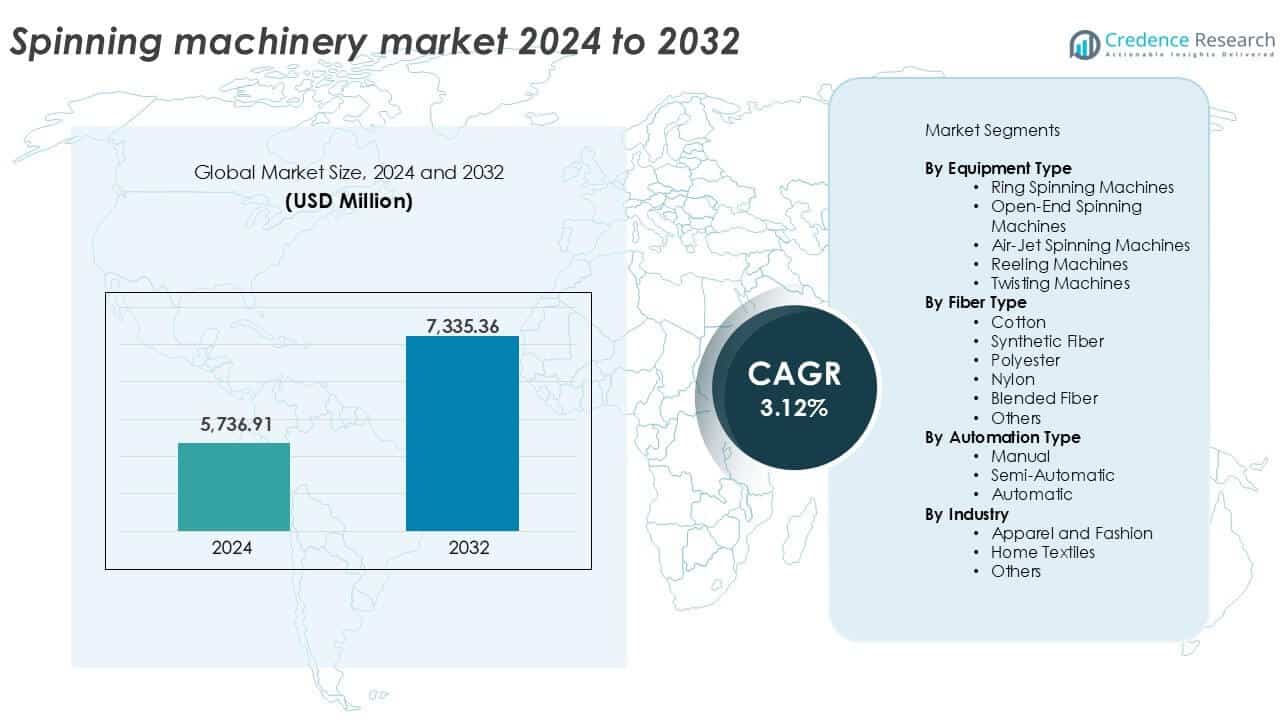
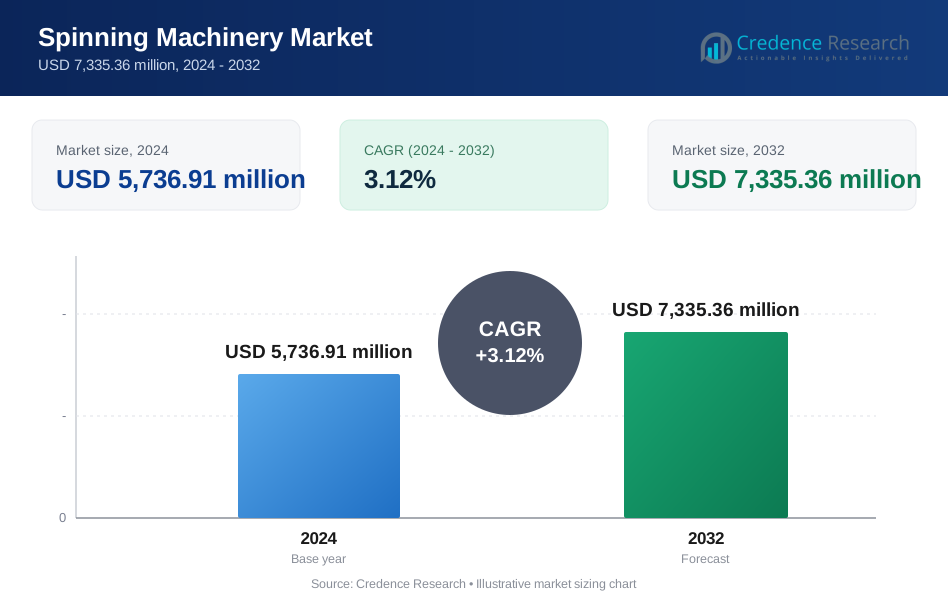
The spinning machinery market size was valued at USD 5,736.91 million in 2024 and is anticipated to reach USD 7,335.36 million by 2032, at a CAGR of 3.12% during the forecast period.
| REPORT ATTRIBUTE | DETAILS |
|---|---|
| Historical Period | 2020-2023 |
| Base Year | 2024 |
| Forecast Period | 2025-2032 |
| Spinning Machinery Market Size 2024 | USD 5,736.91 million |
| Spinning Machinery Market , CAGR | 3.12% |
| Spinning Machinery Market Size 2032 | USD 7,335.36million |
The spinning machinery market is led by key players such as Toyota Industries Corporation, Rieter Holding Ltd., Trützschler Group, Lakshmi Machine Works Ltd. (LMW), and Jingwei Textile Machinery Co., Ltd. These companies dominate through advanced automation, energy-efficient designs, and broad product portfolios. Rieter and Toyota maintain strong positions globally due to their high-performance ring and air-jet spinning systems. LMW and Jingwei cater extensively to Asia’s growing textile sector with scalable and cost-effective solutions. Trützschler and Marzoli emphasize fiber preparation and sustainability-driven innovations. Asia-Pacific emerges as the dominant region, capturing over 65% of the global market share in 2024, driven by strong textile manufacturing hubs in China, India, and Vietnam. These regions benefit from labor availability, expanding export markets, and rising demand for synthetic and blended yarns, making them key contributors to machinery installations and capacity expansion.
Spinning Machinery Market Insights
- The spinning machinery market was valued at USD 5,736.91 million in 2024 and is projected to reach USD 7,335.36 million by 2032, growing at a CAGR of 3.12% during the forecast period.
- Rising global demand for textiles and apparel, especially in emerging economies, is a key driver for machinery sales, with manufacturers investing in automated and high-capacity systems.
- Market trends include increased adoption of sustainable, energy-efficient machinery and rising use of synthetic and blended fiber-capable systems to meet shifting consumer preferences.
- Asia-Pacific leads with over 65% share, followed by Europe (14%) and North America (9%), driven by strong production hubs in China, India, and Vietnam; cotton remains the dominant fiber type with over 38% share.
- High capital investment and shortage of skilled labor for advanced systems remain key restraints, limiting modernization efforts in price-sensitive and developing markets.
Spinning Machinery Market Segmentation Analysis:
By Equipment Type
Ring spinning machines dominate the equipment type segment with over 45% market share in 2024. Their stronghold is due to superior yarn quality, high tensile strength, and fine thread production. These machines are widely used in cotton and blended yarn manufacturing. Open-end spinning machines follow due to faster production rates and low energy consumption. Air-jet spinning machines see growing adoption in high-volume synthetic yarn manufacturing. Reeling and twisting machines maintain niche demand for specialized yarn applications and finishing processes.
- For instance, Rieter’s G 38 ring spinning machine operates at spindle speeds up to 28,000 rpm and supports a wide range of yarn counts from Ne 4.5 to Ne 160, enabling consistent high-strength yarn production and maximum flexibility in large-scale mills.
By Fiber Type
Cotton leads the fiber type segment, accounting for more than 38% of the global share. Strong demand from apparel and home textile industries supports consistent machine utilization for cotton spinning. Cotton’s comfort, breathability, and ease of processing make it a preferred fiber. Blended fibers hold the second-largest share due to the rising popularity of mixed synthetic-natural fabrics. Polyester and synthetic fiber segments are growing steadily with expanding use in sportswear, technical textiles, and industrial fabric applications. Nylon remains limited to specific end-uses.
- For instance, Trützschler’s TC 15 card processes cotton fibers at a delivery speed of 500 meters per minute with sliver weights down to 3.0 ktex, supporting high-throughput cotton spinning operations.
By Automation Type
Automatic spinning machines dominate this segment with over 52% share in 2024. Demand is driven by labor cost reduction, improved production efficiency, and real-time process control. These machines support high-speed, continuous operations, making them ideal for large-scale mills. Semi-automatic machines hold a considerable share in developing regions due to lower capital investment. Manual equipment continues to decline, retained only in small-scale or legacy operations with limited automation budgets. The automation trend reflects the industry's shift toward smart, connected manufacturing environments.
Spinning Machinery Market Key Growth Drivers
Rising Demand from the Textile and Apparel Industry
The rapid expansion of the global textile and apparel industry remains a major driver for spinning machinery demand. Countries like India, China, Bangladesh, and Vietnam are witnessing strong export and domestic consumption growth. Global fashion brands continue to outsource yarn production to these regions, creating sustained demand for high-capacity spinning systems. The rise of fast fashion, coupled with shifting consumer preferences for natural and blended fabrics, boosts the need for continuous yarn output. Furthermore, increasing per capita textile consumption and population growth in emerging economies support long-term investment in new machinery. Government incentives, textile parks, and foreign direct investments in textile manufacturing also accelerate spinning machinery sales. Manufacturers increasingly replace legacy systems with modern, efficient machines to meet the demand for consistent yarn quality and faster turnaround times.
- For instance, Vardhman Textiles operates ring spinning units using Lakshmi Machine Works LRJ frames with spindle speeds reaching 25,000 rpm, supporting fine cotton yarn production for export-focused apparel supply chains.
Technological Advancements in Automation and Yarn Quality
Technological innovations have significantly improved the performance, efficiency, and reliability of spinning machinery. Automated spinning lines now offer real-time monitoring, predictive maintenance, and quality control systems, minimizing human error and downtime. Advanced sensors, IoT integration, and data analytics are transforming traditional spinning into smart manufacturing. Machines equipped with energy-saving features and adjustable yarn parameters are gaining preference. The development of high-speed air-jet and compact ring spinning machines supports faster throughput and consistent yarn properties. These improvements also reduce waste and enhance energy efficiency. As manufacturers aim to meet strict quality specifications, they increasingly invest in next-gen machines with integrated controls.
- For instance, Murata Machinery’s MVS 870 air-jet spinning machine runs at delivery speeds up to 500 meters per minute and uses electronic yarn clearers to monitor defects continuously during operation.
Growing Popularity of Synthetic and Blended Fibers
The shift from natural fibers to synthetic and blended variants is reshaping spinning machinery needs. Polyester, viscose, and nylon fibers are gaining popularity due to their affordability, durability, and adaptability to technical applications. Blended fabrics that combine comfort, wrinkle resistance, and moisture-wicking properties are now favored across sportswear, functional apparel, and home furnishings. As a result, spinning machinery must handle diverse fiber inputs and deliver yarns with stable performance characteristics. Machines with flexible feed systems, high-speed processing, and minimal fiber damage are in demand. Furthermore, the rise of recycled fibers, especially rPET-based polyester, encourages investment in specialized spinning systems. Sustainability concerns and circular economy goals are prompting textile firms to adapt their machinery to accommodate non-traditional fibers. This diversification broadens the application base for spinning machines across multiple industry verticals.
Spinning Machinery Market Key Trends and Opportunities
Shift Toward Energy-Efficient and Sustainable Machinery
Energy efficiency and sustainability are becoming central to machinery procurement decisions in the textile sector. With electricity costs and carbon regulations increasing globally, manufacturers prioritize machines that reduce energy consumption per kilogram of yarn. Spinning systems now integrate variable frequency drives, low-friction components, and optimized airflow designs to minimize power usage. Moreover, demand is growing for machines compatible with eco-friendly fibers and biodegradable lubricants. Manufacturers also explore closed-loop processes to reduce fiber waste and water use. Sustainability certifications and lifecycle impact assessments influence investment decisions, particularly for exporters targeting markets with strict environmental standards like the EU. This trend creates opportunities for companies offering green-certified, low-emission spinning machinery. Partnerships between OEMs and energy solution providers to develop intelligent control platforms further enhance machine adoption in eco-conscious mills.
- For instance, Rieter’s G 38 ring spinning machine reduces energy consumption by up to 10% overall (or by specific component savings like 4% with LENA spindles and another 4% with IE4 motors) compared to previous or competitor models, through optimized drive systems and improved suction efficiency (double-sided ECOrized suction), supporting lower-emission yarn production in certified mills.
Expansion of Spinning Capacity in Emerging Economies
Emerging markets across Asia and Africa are witnessing rapid growth in spinning capacity. Governments in India, Vietnam, Uzbekistan, and Ethiopia are offering subsidies, textile park schemes, and infrastructure support to attract spinning investments. Rising domestic demand, low labor costs, and proximity to raw material sources such as cotton make these countries favorable for establishing new spinning units. Export-oriented policies and trade agreements also encourage yarn production in these regions. As a result, global machinery suppliers find strong sales potential in supplying entry-level and mid-range systems tailored to local production scales. Some vendors offer modular solutions to scale up capacity incrementally. The entry of local machinery manufacturers, often through joint ventures with international firms, enhances equipment accessibility and after-sales service. This regional expansion diversifies global spinning capacity and creates long-term machinery replacement cycles.
Spinning Machinery Market Key Challenges
High Capital Investment and Operational Costs
The high upfront cost of modern spinning machinery is a significant barrier, especially for small and medium-sized enterprises (SMEs). Fully automated systems with integrated control panels, precision sensors, and quality management modules require substantial investment. Alongside capital expenditure, operational costs such as maintenance, spare parts, and skilled labor training add financial pressure. In markets where margins are low, firms hesitate to upgrade legacy equipment despite the long-term benefits. Fluctuations in raw material prices and energy costs further impact cash flows, limiting the ability to invest in new technology. Financial constraints also slow adoption of energy-efficient or sustainable systems, especially when immediate cost savings are unclear. Access to affordable financing, leasing models, and government subsidies plays a crucial role in overcoming this challenge.
Shortage of Skilled Workforce for Advanced Systems
The spinning machinery industry increasingly relies on digital tools, automation, and complex electromechanical systems. However, there is a growing skills gap in operating, maintaining, and troubleshooting advanced machines. Many regions with rising textile production-particularly in South Asia and Africa-struggle to supply adequately trained technicians. The lack of formal training programs for modern spinning technologies results in underutilization of features and frequent machine downtime. This issue affects product quality, efficiency, and return on investment. Machinery suppliers must provide comprehensive training and user-friendly interfaces to bridge this gap. Partnerships with technical institutions, remote support services, and simulation-based training platforms are emerging solutions, but scaling them remains a challenge in fragmented manufacturing hubs.
Spinning Machinery Market Regional Analysis
Asia-Pacific
Asia-Pacific dominates the spinning machinery market, accounting for over 65% of the global share in 2024. China, India, Bangladesh, and Vietnam are key contributors due to their massive textile manufacturing bases. Favorable government policies, skilled labor availability, and growing domestic and export textile demand support strong machinery uptake. India’s textile parks and China’s automation upgrades fuel replacement and expansion cycles. The rising adoption of synthetic and blended fibers further boosts regional equipment demand. Rapid urbanization and apparel consumption trends across Southeast Asia enhance long-term market prospects, making Asia-Pacific the primary growth hub for global spinning machinery suppliers.
Europe
Europe holds around 14% share of the spinning machinery market, led by Germany, Italy, and Turkey. The region emphasizes high-precision, energy-efficient machines tailored for quality-conscious applications. European manufacturers invest in R&D to produce advanced ring and air-jet spinning systems, often exported globally. Sustainability mandates and eco-label requirements drive replacement of outdated equipment with green-certified alternatives. Turkey acts as a major regional production and export base for yarn, supporting steady machinery demand. Although mature, the European market benefits from continuous innovation, automation upgrades, and growing use of recycled fibers across fashion and home textile sectors.
North America
North America contributes approximately 9% to the global spinning machinery market, primarily driven by the U.S. and Mexico. The region focuses on advanced spinning technologies for technical textiles, nonwovens, and niche apparel applications. Automation and smart factory solutions are widely adopted to offset high labor costs. Growing demand for sustainable and locally produced textiles supports re-shoring initiatives in select U.S. states. While overall yarn manufacturing volume is lower than in Asia, investments in specialty yarns and recycled fiber processing sustain equipment demand. Mexico benefits from trade agreements and proximity to the U.S. market, supporting regional machinery growth.
Latin America
Latin America holds a modest 6% market share, with Brazil and Peru as major contributors. The region shows gradual expansion in spinning capacity, supported by growing apparel and home textile industries. Brazil’s strong cotton production base encourages vertical integration by local textile firms. Investments in semi-automatic and entry-level machines are rising as manufacturers modernize aging facilities. Currency fluctuations and import dependency affect high-end machinery adoption, limiting penetration of fully automated systems. Nonetheless, regional trade pacts and increasing fiber exports create long-term potential for machinery suppliers to tap into growing demand from yarn producers in the region.
Middle East & Africa (MEA)
The MEA region accounts for about 6% of the global spinning machinery market. Egypt, Turkey, and South Africa lead demand due to their textile industry presence and fiber processing infrastructure. In North Africa, government-backed industrial zones and FDI inflows support textile manufacturing expansion, fueling machinery needs. Turkey serves both as a regional consumer and manufacturer of spinning equipment. In sub-Saharan Africa, Ethiopia is emerging as a spinning hub due to low labor costs and textile export ambitions. However, infrastructure gaps, limited technical skills, and financing barriers still hinder large-scale machinery adoption across several MEA countries.
Spinning Machinery Market Segmentations:
By Equipment Type
- Ring Spinning Machines
- Open-End Spinning Machines
- Air-Jet Spinning Machines
- Reeling Machines
- Twisting Machines
By Fiber Type
- Cotton
- Synthetic Fiber
- Polyester
- Nylon
- Blended Fiber
- Others
By Automation Type
- Manual
- Semi-Automatic
- Automatic
By Industry
- Apparel and Fashion
- Home Textiles
- Others
By Geography
- North America
- U.S.
- Canada
- Mexico
- Europe
- Germany
- France
- U.K.
- Italy
- Spain
- Rest of Europe
- Asia Pacific
- China
- Japan
- India
- South Korea
- South-east Asia
- Rest of Asia Pacific
- Latin America
- Brazil
- Argentina
- Rest of Latin America
- Middle East & Africa
- GCC Countries
- South Africa
- Rest of the Middle East and Africa
Competitive Landscape
The spinning machinery market features a mix of established global players and regionally strong manufacturers, each competing on innovation, product range, and after-sales support. Key players include Toyota Industries Corporation, Rieter Holding Ltd., Trützschler Group, Lakshmi Machine Works Ltd. (LMW), and Jingwei Textile Machinery Co., Ltd. These companies invest in automation, energy efficiency, and digital integration to meet evolving mill requirements. European brands like Marzoli and Savio Macchine Tessili focus on precision engineering and sustainable solutions, while Chinese firms such as STMC and Rifa offer cost-competitive options for emerging markets. Switzerland’s Saurer Group emphasizes innovation in rotor spinning and digital monitoring systems. The competitive landscape is shaped by regional expansion, strategic partnerships, and technology upgrades. Players also differentiate through modular designs, fiber adaptability, and integrated quality control systems. In price-sensitive markets, local partnerships and financing options enhance competitiveness. Continuous innovation and regional customization remain central to sustaining leadership in this capital-intensive industry.
Key Player Analysis
- Toyota Industries Corporation (Japan)
- Trützschler Group (Germany)
- Rieter Holding Ltd. (Switzerland)
- Marzoli SpA (Italy)
- Shanghai Textile Machinery Co., Ltd. (STMC) (China)
- Savio Macchine Tessili S.p.A. (Italy)
- Zhejiang Rifa Textile Machinery Co., Ltd. (China)
- LMW (Lakshmi Machine Works Ltd.) (India)
- Saurer Group (Switzerland)
- Jingwei Textile Machinery Co., Ltd. (China)
Recent Developments
- In February 2024, Murata Machinery launched its intelligent spinning machines featuring automation and real-time performance monitoring. These machines are customized to suit the needs of smart factories; thus, they contribute immensely to the improvement of efficiency, with greatly reduced manual intervention. The launch will further cement the position of Murata in the offer of intelligent manufacturing technology.
- In January 2024, Saurer reported further developments toward the new eco product line, which will help to conserve energy and curtail waste. In proceeding with the sustainability project, the environment-friendly yet economically viable project targets the fast-growing market for greener solutions in textile production. A strategic alignment with manufacturing trends, with a green vision.
Report Coverage
The research report offers an in-depth analysis based on Equipment Type, Fiber Type, Automation Type, Industry and Geography. It details leading market players, providing an overview of their business, product offerings, investments, revenue streams, and key applications. Additionally, the report includes insights into the competitive environment, SWOT analysis, current market trends, as well as the primary drivers and constraints. Furthermore, it discusses various factors that have driven market expansion in recent years. The report also explores market dynamics, regulatory scenarios, and technological advancements that are shaping the industry. It assesses the impact of external factors and global economic changes on market growth. Lastly, it provides strategic recommendations for new entrants and established companies to navigate the complexities of the market.
Future Outlook
- Automation will continue to drive spinning machinery upgrades across large-scale textile mills.
- Adoption of energy-efficient and sustainable machines will rise due to regulatory pressure and cost savings.
- Demand for machinery compatible with synthetic and blended fibers will increase in functional apparel production.
- Asia-Pacific will retain its leadership position due to strong export-led textile manufacturing.
- Emerging economies in Africa and South Asia will witness capacity expansion in yarn production.
- Investment in predictive maintenance and IoT-enabled spinning machines will gain momentum.
- Compact and modular machines will be favored by small and medium textile units.
- Digital integration for real-time quality control and process monitoring will become standard.
- Partnerships between machinery manufacturers and textile companies will enhance localized support.
- Replacement of manual and semi-automatic systems will accelerate in developing markets.
Request a Free Sample
Fill in your details and we'll send you a free sample report.
- Sample data tables & charts
- Research methodology
Need a Custom Version of This Report?
Tailor the scope, geography, or segments to your exact requirements.
- Custom geography or segment scope
- Direct access to our analyst team
Frequently Asked Questions
What is the current market size for the Spinning machinery market, and what is its projected size in 2032?
At what Compound Annual Growth Rate is the Spinning machinery market projected to grow between 2024 and 2032?
Which Spinning machinery market segment held the largest share in 2024?
What are the primary factors fueling the growth of the Spinning machinery market?
Who are the leading companies in the Spinning machinery market?
Which region commanded the largest share of the Spinning machinery market in 2024?
Table of Content
Chapter 1 Market Segmentation
- 1.1 Segmentation Framework
- 1.1.1 Product and Service Classification
- 1.1.2 Application and End-Use Classification
- 1.1.3 Technology and Solution Classification
- 1.1.4 Customer and Distribution Channel Classification
- 1.1.5 Geographic Segmentation
- 1.1.6 Market Segment Definitions and Boundaries
Chapter 2 Introduction
- 2.1 Report Objectives and Scope
- 2.2 Product Definition and Industry Terminology
- 2.3 Market Inclusions and Exclusions
- 2.4 Research Process
- 2.4.1 Primary Research and Expert Interviews
- 2.4.2 Secondary Research and Source Review
- 2.4.3 Top-Down and Bottom-Up Estimation
- 2.4.4 Data Triangulation and Verification
- 2.5 Market Size Measurement Basis
- 2.5.1 2024: USD 5,736.91 million → 2032: USD 7,335.36 million
- 2.6 Historical and Forecast Reference Periods
- 2.6.1 Base Year: 2024
- 2.6.2 Forecast Period: 2024-2032
- 2.7 Research Assumptions and Limitations
Chapter 3 Executive Summary
- 3.1 Market Snapshot and Key Findings
- 3.2 Base-Year Market Size, 2024
- 3.3 Forecast Market Size, 2032
- 3.4 Revenue and Volume Growth Outlook
- 3.5 Key Demand and Supply Indicators
- 3.6 Leading Market Segments
- 3.7 Fastest-Growing Market Opportunities
- 3.8 Regional Performance Highlights
- 3.9 Technology and Industry Transformation
- 3.10 Competitive Landscape Summary
- 3.11 Analyst View and Strategic Implications
Chapter 4 Global Spinning Machinery Market Trends and Developments
- 4.1 Historical Industry Development
- 4.2 Recent Market Trends and Developments
- 4.3 Demand and Customer Behavior Trends
- 4.4 Technology and Product Innovation
- 4.5 Artificial Intelligence, Automation and Digitalization
- 4.6 Local Manufacturing and Supply Chain Realignment
- 4.7 Industry Partnerships, Mergers and Acquisitions
- 4.8 Sustainability and Circular Economy Developments
- 4.9 Government and Private Sector Investment Trends
- 4.10 Emerging Business Models and Commercialization
- 4.11 Industry Developments and Announcements
Chapter 5 Global Spinning Machinery Market Production, Supply and Demand Analysis
- 5.1 Demand Trend and Consumption Analysis
- 5.2 Demand Forecast, 2024-2032
- 5.3 Production and Output Trend
- 5.4 Production and Output Forecast, 2024-2032
- 5.5 Installed Capacity and Capacity Utilization
- 5.6 Company-Wise Production Plants and Statistics
- 5.6.1 Installed Production Capacity
- 5.6.2 Actual Production
- 5.6.3 Planned Capacity and Expansion Targets
- 5.7 Supply Chain Structure and Procurement Trends
- 5.8 Supply-Demand Gap and Bottlenecks
- 5.9 Import Dependence and Sourcing Structure
- 5.10 Contract Manufacturing and Outsourcing
- 5.11 Regional Supply and Demand Concentration
Chapter 6 Global Spinning Machinery Market Pricing Analysis
- 6.1 Pricing Structure and Measurement
- 6.2 Historical Pricing Trends
- 6.3 Pricing Outlook, 2024-2032
- 6.4 Average Selling Price and Unit Economics
- 6.5 Pricing by Product and Market Segment
- 6.6 Geographic Pricing Differences
- 6.7 Key Input, Energy, Labor and Logistics Costs
- 6.8 Contract Pricing and Purchasing Models
- 6.9 Pricing Sensitivity and Competitive Positioning
- 6.10 Price, Margin and Profitability Implications
Chapter 7 Global Spinning Machinery Market Dynamics
- 7.1 Market Growth Drivers
- 7.1.1 Demand-Side Drivers
- 7.1.2 Technology and Innovation Drivers
- 7.1.3 Infrastructure and Investment Drivers
- 7.1.4 Regulatory and Policy Drivers
- 7.2 Market Restraints
- 7.2.1 Cost and Affordability Constraints
- 7.2.2 Technology and Adoption Barriers
- 7.2.3 Supply Chain and Operational Constraints
- 7.3 Market Challenges
- 7.3.1 Competitive Pressure and Margin Erosion
- 7.3.2 Skills, Infrastructure and Implementation Gaps
- 7.4 Emerging Market Opportunities
- 7.5 Market Dynamics Impact and Time-Horizon Assessment
Chapter 8 Global Spinning Machinery Value Chain Analysis
- 8.1 Industry Value Chain Overview
- 8.2 Upstream Suppliers and Critical Inputs
- 8.3 Technology and Component Providers
- 8.4 Manufacturing or Service Delivery
- 8.5 Distribution, Channel Partners and Integrators
- 8.6 Downstream Applications and End Users
- 8.7 Value Addition and Profit Pools
- 8.8 Vertical Integration and Outsourcing
- 8.9 Supplier Concentration and Risk
- 8.10 Supply Chain Localization and Resilience
Chapter 9 Global Spinning Machinery Market Regulations and Policies
- 9.1 Relevant Laws, Standards and Compliance Frameworks
- 9.2 Product, Service, Safety and Quality Requirements
- 9.3 Government Policies, Incentives and Subsidies
- 9.4 Imports, Exports and Trade Barriers
- 9.5 Public Procurement and Local Content Requirements
- 9.6 Environmental and Sustainability Compliance
- 9.7 Upcoming Policy Changes and Market Implications
Chapter 10 Global Spinning Machinery Market Hotspots and Opportunities
- 10.1 Market Opportunity Mapping and Growth Hotspots
- 10.2 High-Growth Applications and Customer Groups
- 10.3 Underserved Markets and White-Space Opportunities
- 10.4 Emerging Technology and Product Opportunities
- 10.5 New Capacity and Investment Hotspots
- 10.6 Market Entry and Expansion Opportunities
- 10.7 Distribution and Partnership Opportunities
- 10.8 Near-Term and Long-Term Commercial Potential
- 10.9 Opportunity Attractiveness and Execution Risks
Chapter 11 Global Spinning Machinery Market Outlook, 2024-2032
- 11.1 Market Size and Analysis
- 11.1.1 Revenue (Market Measurement: 2024: USD 5,736.91 million → 2032: USD 7,335.36 million)
- 11.1.2 Market Volume and Quantity Sold
- 11.1.3 Historical Market Size
- 11.1.4 Base-Year Market Size, 2024
- 11.2 Market Forecast, 2024-2032
- 11.2.1 Revenue Forecast to 2032
- 11.2.2 Volume Forecast to 2032
- 11.2.3 CAGR and Year-on-Year Growth
- 11.2.4 Incremental Revenue Opportunity
- 11.3 Forecast Assumptions and Scenario Analysis
- 11.3.1 Base-Case Forecast
- 11.3.2 Optimistic and Conservative Scenarios
- 11.3.3 Technology, Pricing and Policy Sensitivities
- 11.4 Market Attractiveness and Growth Outlook
Chapter 12 Global Spinning Machinery Market Segmentation and Outlook
- 12.1 Segmentation Summary and Market Shares, 2024
- 12.2 Largest and Fastest-Growing Segments
- 12.3 Segment Growth Comparison
- 12.4 Segment Attractiveness and Priority Matrix
Chapter 13 Global Spinning Machinery Geographic Market Outlook, 2024-2032
- 13.1 Regional Market Size and Share, 2024
- 13.2 Regional Market Forecast, 2024-2032
- 13.3 Regional Pricing, Production and Demand Differences
- 13.4 North America
- 13.4.1 United States
- 13.4.2 Canada
- 13.4.3 Mexico
- 13.5 Europe
- 13.5.1 Germany
- 13.5.2 France
- 13.5.3 Italy
- 13.5.4 United Kingdom
- 13.5.5 Spain
- 13.5.6 Poland
- 13.5.7 Russia
- 13.5.8 Netherlands
- 13.5.9 Belgium
- 13.5.10 Sweden
- 13.5.11 Denmark
- 13.5.12 Norway
- 13.5.13 Rest of Europe
- 13.6 Asia Pacific
- 13.6.1 China
- 13.6.2 India
- 13.6.3 Japan
- 13.6.4 South Korea
- 13.6.5 Thailand
- 13.6.6 Indonesia
- 13.6.7 Vietnam
- 13.6.8 Malaysia
- 13.6.9 Australia
- 13.6.10 Rest of Asia Pacific
- 13.7 Latin America
- 13.7.1 Brazil
- 13.7.2 Argentina
- 13.7.3 Colombia
- 13.7.4 Chile
- 13.7.5 Rest of Latin America
- 13.8 Middle East
- 13.8.1 Saudi Arabia
- 13.8.2 United Arab Emirates
- 13.8.3 Turkey
- 13.8.4 Israel
- 13.8.5 Iran
- 13.8.6 Rest of the Middle East
- 13.9 Africa
- 13.9.1 South Africa
- 13.9.2 Egypt
- 13.9.3 Nigeria
- 13.9.4 Morocco
- 13.9.5 Rest of Africa
- 13.10 Regional Investment, Policy and Supply Chain Differences
- 13.11 Regional Competitive Landscape
- 13.12 Geographic Growth Hotspots
Chapter 14 Global Spinning Machinery Technology, Innovation and Sustainability Outlook
- 14.1 Technology Landscape and Maturity
- 14.2 Product, Process and Service Innovation
- 14.3 AI, Automation and Digital Tools in the Industry
- 14.4 Technology Adoption and Performance Benchmarking
- 14.5 Innovation Pipeline and R&D Investment
- 14.6 Patent and Intellectual Property Trends
- 14.7 Energy Efficiency and Resource Management
- 14.8 Sustainability, Recycling and Circularity
- 14.9 Technology Roadmap, 2024-2032
- 14.10 Risks of Obsolescence and Technology Substitution
Chapter 15 Global Spinning Machinery Market Key Strategic Imperatives
- 15.1 Growth and Market Entry Priorities
- 15.2 High-Return Products and Segments
- 15.3 Pricing, Profitability and Cost Optimization
- 15.4 Technology Investment and Product Differentiation
- 15.5 Supply Chain Localization and Resilience
- 15.6 Distribution and Customer Acquisition
- 15.7 Partnership, Acquisition and Capacity Strategy
- 15.8 Regional Expansion Priorities
- 15.9 Short-, Medium- and Long-Term Actions
Chapter 16 Competition Outlook
- 16.1 Industry Competition Characteristics
- 16.2 Market Structure and Concentration
- 16.3 Market Share and Competitive Positioning, 2024
- 16.4 Company-Wise Revenue and Product Benchmarking
- 16.5 Production and Service Capacity Benchmarking
- 16.6 Technology, Pricing and Differentiation
- 16.7 Regional Footprint and Distribution Strength
- 16.8 Mergers, Acquisitions and Strategic Alliances
- 16.9 New Entrants and Competitive Threats
- 16.10 Porter's Five Forces and Industry Attractiveness
- 16.11 Competitive Outlook, 2024-2032
Chapter 17 Company Profiles
- 17.1 Company Coverage and Selection Criteria
- 17.2 Leading Market Participants – Standard Profile Structure
- 17.2.1 Business Description
- 17.2.2 Company Ownership and Geographic Presence
- 17.2.3 Product and Service Portfolio
- 17.2.4 Manufacturing and Operating Footprint
- 17.2.5 Production Capacity and Expansion Plans
- 17.2.6 Financial Performance and Investment
- 17.2.7 Market Share and Competitive Position
- 17.2.8 Technology and Innovation Capabilities
- 17.2.9 Strategic Alliances or Partnerships
- 17.2.10 Recent Developments
- 17.2.11 Growth Strategy and Outlook
- 17.3 Other Relevant Market Participants
Note: Every listed company is profiled on the structure shown under the first company. The company list is preliminary and may change based on research findings, market developments, data availability and client requirements.
Chapter 18 Disclaimer
- 18.1 Research and Forecast Disclaimer
- 18.2 Data Source and Estimation Limitations
Note: The depth of individual sections depends on data availability for this market. Volume, capacity, trade and other unit-based metrics are included where applicable.