
Market Overview
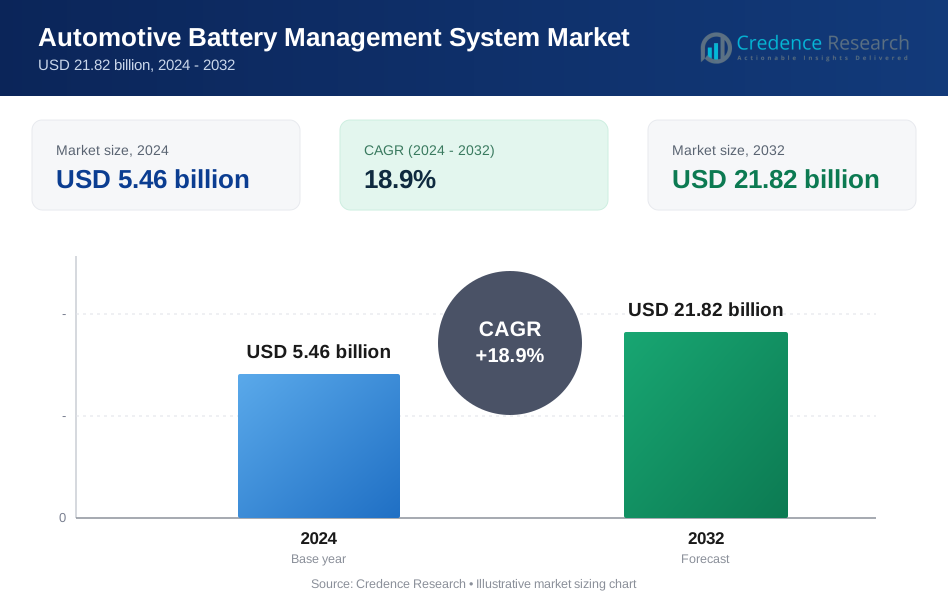
The Automotive Battery Management System (BMS) Market was valued at USD 5.46 billion in 2024 and is projected to reach USD 21.82 billion by 2032, reflecting a robust CAGR of 18.9% during the forecast period.
| REPORT ATTRIBUTE | DETAILS |
|---|---|
| Historical Period | 2020-2023 |
| Base Year | 2024 |
| Forecast Period | 2025-2032 |
| Automotive Battery Management System (BMS) Market Size 2024 | USD 5.46 Billion |
| Automotive Battery Management System (BMS) Market, CAGR | 18.9% |
| Automotive Battery Management System (BMS) Market Size 2032 | USD 21.82 Billion |
The automotive battery management system market is shaped by strong competition among global leaders such as LG Chem, Analog Devices, Continental AG, Midtronics, Robert Bosch, NXP Semiconductors, Johnson Matthey, Intel, Denso, and Toshiba, each advancing high-precision sensing, thermal control, and software-defined BMS architectures. These companies collaborate extensively with automakers to support high-voltage EV platforms, solid-state battery programs, and predictive battery analytics. Asia-Pacific leads the market with a 34% share, driven by large-scale EV production in China, Japan, and South Korea, followed by Europe at 32% and North America at 28%, reflecting strong regulatory pressure and rapid electrification across major automotive hubs.
Market Insights:
- The automotive battery management system market was valued at USD 5.46 billion in 2024 and is projected to reach USD 21.82 billion by 2032, registering a CAGR of 18.9%, driven by accelerating global EV adoption.
- Market growth is propelled by rising electrification across passenger cars and commercial fleets, increasing deployment of lithium-ion and high-voltage battery platforms, and stronger regulatory emphasis on thermal safety, cell balancing accuracy, and real-time diagnostics.
- Key trends include the shift toward wireless and distributed BMS architectures, integration of cloud-connected analytics, and growing adoption of fast-charging systems requiring precise thermal and current control.
- Competition intensifies as players such as LG Chem, Continental, Bosch, Analog Devices, NXP, Denso, Intel, and Toshiba expand advanced BMS solutions, while cost pressures, sensor complexity, and system integration challenges act as restraints.
- Asia-Pacific leads the market with 34% share, followed by Europe at 32% and North America at 28%; by propulsion type, BEVs dominate, while passenger cars hold the largest vehicle-type share.
Market Segmentation Analysis:
By Propulsion Type
Battery Electric Vehicles (BEVs) form the dominant propulsion segment in the automotive battery management system market, driven by the substantial battery capacities and higher energy densities these vehicles require. BEVs depend on advanced BMS solutions to manage thermal stability, ensure accurate state-of-charge and state-of-health calculations, and maintain cell balancing across large multi-module packs. The rise in long-range EV development and the implementation of fast-charging infrastructure further increase the need for highly efficient BMS architectures. While PHEVs and HEVs also contribute to demand, their smaller battery packs make them secondary to the rapidly expanding BEV segment.
- For instance, Tesla’s Model S uses a BMS that monitors more than 7,000 individual 18650-format cells, enabling precise voltage and temperature tracking for every parallel group, while Hyundai’s E-GMP platform integrates an 800-volt architecture that supports up to 350 kW charging controlled through high-speed BMS algorithms.
By Vehicle Type
Passenger cars account for the largest share of BMS deployment due to their high production volumes, accelerated electrification across global markets, and rapid consumer adoption of EV models. This segment benefits from OEM investments in next-generation battery platforms that require precise monitoring, fault detection, and improved energy efficiency to meet performance and warranty expectations. Commercial vehicles, including electric buses, delivery vans, and trucks, are growing steadily as fleet operators shift toward low-emission mobility. However, passenger cars remain the leading contributor as manufacturers prioritize enhanced BMS integration to support range improvement, durability, and safety.
- For instance, the Volkswagen ID.4 employs a BMS that oversees an 82-kWh pack comprising 288 cells arranged into 24 modules, with thermal and voltage monitoring executed across every module to safeguard cycle life, while Toyota’s bZ4X integrates a BMS that manages a 355-volt lithium-ion pack with cell-voltage accuracy within ±2 mV to ensure long-term degradation control.

Key Growth Drivers:
Rising Global Electrification of Passenger and Commercial Vehicles
The rapid electrification of mobility remains the most significant growth driver for the automotive BMS market. Automakers are accelerating EV production across passenger cars, SUVs, buses, and heavy-duty trucks to meet tightening emission norms and sustainability targets. Larger battery capacities, higher voltage platforms, and the expansion of long-range EVs demand sophisticated BMS solutions capable of maintaining cell safety, balancing performance, and ensuring extended battery life. Governments worldwide continue to incentivize EV adoption through tax rebates, charging infrastructure expansion, and manufacturing subsidies, which indirectly elevate BMS demand. Additionally, next-generation EV architectures—supporting advanced driver-assistance systems, over-the-air updates, and integrated energy management—require more precise monitoring of temperature, voltage, and current at cell, module, and pack levels. As electrification becomes mainstream across segments, BMS technologies evolve into a mission-critical component for enabling safety compliance, performance optimization, and thermal reliability in high-powered electric vehicles.
- For instance, BYD’s Blade Battery in its passenger EV lineup uses a BMS that manages a 96-cell LFP pack with thermally stable cell spacing designed to limit runaway propagation, while Volvo’s 7900 Electric Bus uses a BMS to supervise up to 396 kWh of installed battery capacity, monitoring voltage and temperature across every module to support fleet-level durability.
Advancements in Lithium-Ion and Solid-State Battery Technologies
Rapid improvements in battery technologies are strengthening the need for more intelligent and efficient BMS platforms. Lithium-ion chemistries, including NMC, NCA, and emerging LFP/LTO variants, require precise control of charge cycles, cell balancing, and thermal management to maximize safety and longevity. The global shift toward solid-state batteries further intensifies BMS requirements, as these next-generation systems demand real-time monitoring to manage higher energy densities, mitigate dendrite formation, and support fast-charging readiness. Innovations in high-voltage EV architectures (400V to 800V systems) also elevate the sophistication of BMS electronics and software. Automakers are investing in predictive analytics, early fault detection, and high-accuracy sensors to enhance battery performance and reduce warranty claims. As the industry transitions toward high-capacity, fast-charging, and long-cycle battery platforms, advanced BMS solutions become essential for protecting battery packs, ensuring regulatory compliance, and enabling long-term reliability for diverse vehicle categories.
- For instance, Panasonic and Tesla collaborated to develop customized 2170-type NCA lithium-ion battery cells that provide high energy density and are optimized for electric vehicle quality and life. These cells are integrated by Tesla into battery packs, which have contributed to an industry-leading driving range for their vehicles. Panasonic has publicly stated its focus is on improving the energy density and thermal stability of these cells through composition adjustments, rather than confirming the exact, proprietary operational parameters of Tesla's Battery Management System (BMS).
Increasing Safety Requirements and Regulatory Mandates
Safety standards across global automotive markets are becoming more stringent, driving the adoption of high-precision BMS solutions that mitigate thermal runaway, short circuits, and degradation-induced failures. Regulators continue to push for standardized performance testing, battery certification frameworks, and compliance with functional safety norms such as ISO 26262. These mandates require automakers to integrate BMS architectures with robust fault detection algorithms, cell redundancy mechanisms, and intelligent shutdown protocols to prevent hazardous operating conditions. As battery sizes grow and Evs transition to high-voltage platforms, the risk of thermal instability increases, putting greater emphasis on accurate monitoring of voltage, current, and temperature across thousands of cells. Automakers also rely on BMS analytics to meet warranty obligations and reduce battery replacement costs. The combined effect of regulations, consumer safety expectations, and OEM quality standards strongly accelerates the advancement and integration of reliable BMS platforms across all propulsion types.
Key Trends & Opportunities:
Expansion of Connected, Cloud-Enabled, and Over-the-Air BMS Platforms
A major trend shaping the automotive BMS landscape is the emergence of connected, software-driven architectures that enable remote diagnostics, predictive maintenance, and real-time fleet optimization. Cloud-linked BMS systems allow OEMs to analyze battery health patterns across millions of vehicles, improving performance calibration through over-the-air (OTA) updates. These platforms help predict module degradation, optimize charging patterns, and enhance energy efficiency while reducing downtime. Growing adoption of vehicle telematics, edge computing, and digital twins opens new opportunities to integrate AI-driven health forecasting, fault prediction, and lifecycle analytics. Fleet operators—especially in logistics, ride-hailing, and public transport—benefit from centralized battery monitoring dashboards that improve operational planning. As automakers shift toward software-defined vehicles, cloud-enabled BMS ecosystems offer long-term revenue opportunities through subscription-based energy optimization, diagnostics services, and remote performance tuning.
- For instance, Tesla’s OTA infrastructure delivers around 12 to 24 software updates per vehicle annuallyacross its global fleet. These updates often modify parameters like BMS charge limits, thermal profiles, and regen-braking battery thresholds to enhance performance and safety."
Growing Adoption of Fast-Charging and High-Voltage EV Architectures
The move toward ultra-fast charging and high-voltage EV systems presents strong opportunities for BMS innovation. Modern EV platforms increasingly utilize 400V and 800V architectures to support rapid charging sessions, reduce energy losses, and improve vehicle performance. This shift requires advanced BMS technologies capable of precisely managing high-current flows, thermal spikes, and accelerated charge cycles without compromising battery health. As public and private entities expand fast-charging networks, demand rises for BMS systems optimized for heat dissipation, cell balancing, and cycle life extension under fast-charge conditions. High-voltage systems also enable better power delivery to electric motors, further heightening the importance of robust battery monitoring and protective functions. The transformation toward rapid charging infrastructure creates opportunities for BMS providers to develop high-resolution sensors, AI-based charge management, and next-generation thermal modeling tools.
- For instance, Hyundai’s E-GMP platform supports 800-volt charging that delivers up to 239 kW of peak power, enabling a 10–80% recharge in 18 minutes, a capability made possible through high-speed BMS-controlled current modulation and multi-zone thermal balancing.
Key Challenges:
High Cost of Advanced BMS Hardware, Software, and Sensor Integration
Despite market growth, cost remains a major challenge for manufacturers and consumers. Advanced BMS platforms require high-accuracy sensors, microcontrollers, communication ICs, and thermal management modules, all of which significantly increase EV production expenses. The complexity of testing, validation, and safety certification further elevates development costs for OEMs. For cost-sensitive markets, achieving an optimal balance between battery performance, safety features, and affordability becomes difficult. Additionally, supply chain constraints related to semiconductors and specialized electronic components may cause production delays and price volatility. As automakers scale EV production, minimizing BMS cost without compromising reliability or regulatory compliance becomes a critical challenge for ensuring mass-market adoption of electric vehicles.
Scalability and Compatibility Across Diverse Battery Chemistries and Platforms
The growing diversity of battery chemistries, pack configurations, and high-voltage architectures creates challenges in designing scalable BMS platforms. Automakers are developing multiple EV models with varying cell formats (pouch, prismatic, cylindrical), chemistries (NMC, LFP, NCA, solid-state), and module architectures, making universal BMS standardization difficult. Ensuring compatibility across these systems requires highly flexible software algorithms, adaptable communication protocols, and modular hardware designs. Integration complexity increases further with the rise of distributed BMS, wireless BMS configurations, and autonomous safety functions. Each configuration demands rigorous validation to ensure accuracy and reliability, often extending development timelines. This challenge becomes more pronounced as OEMs aim to scale EV portfolios while maintaining consistent performance and safety benchmarks across product lines.
Regional Analysis:
North America
North America holds around 28% of the automotive BMS market, supported by strong EV adoption in the United States and Canada, expanding charging infrastructure, and accelerated investments by OEMs in high-voltage EV platforms. Regulatory mandates promoting zero-emission vehicles drive the integration of advanced BMS architectures capable of meeting stringent safety and performance requirements. The region benefits from technological leadership in battery analytics, OTA-enabled BMS platforms, and thermal management innovations. Growing electrification of commercial fleets—including logistics vans and buses—further amplifies demand, positioning North America as a key hub for premium, software-driven BMS solutions.
Europe
Europe accounts for approximately 32% of the global market, making it the leading region due to aggressive decarbonization goals, strict vehicle emission standards, and rapid EV penetration across Germany, France, the UK, and Nordic countries. Strong government incentives and a mature charging ecosystem support OEM investments in next-generation BMS with enhanced safety algorithms, module-level monitoring, and predictive maintenance features. European automakers increasingly adopt 800V platforms and solid-state battery programs, requiring highly sophisticated BMS architectures. Commercial EV uptake—especially in municipal transport and last-mile delivery—also strengthens Europe's position as a frontrunner in BMS deployment.
Asia-Pacific
Asia-Pacific leads with about 34% market share, driven by China’s dominant EV production capacity, rapid adoption across Japan and South Korea, and expanding domestic manufacturing ecosystems for batteries, EVs, and power electronics. China’s large-scale deployment of lithium-ion and LFP-based EVs drives high-volume demand for cost-efficient yet intelligent BMS platforms. Government-backed incentives, strong local supply chains, and the rise of EV-centric automakers accelerate innovation in thermal safety, cell balancing, and wireless BMS solutions. Growing electrification of two-wheelers, buses, and commercial fleets further reinforces Asia-Pacific’s role as the global epicenter for scalable, high-volume BMS production.
Rest of the World (RoW)
The Rest of the World captures roughly 6% of the market, with early-stage EV adoption in Latin America, the Middle East, and parts of Africa gradually driving demand for basic to mid-tier BMS technologies. Governments are initiating pilot programs for electric buses, charging station deployment, and fleet electrification to reduce fuel dependency, supporting incremental market growth. Although EV penetration remains limited, rising interest in hybrid vehicles, improving infrastructure, and OEM expansions into emerging markets are creating opportunities. As these regions strengthen regulatory frameworks and shift toward cleaner mobility, BMS adoption is expected to accelerate steadily.
Market Segmentations:
By Propulsion Type
- Battery Electric Vehicles (BEV)
- Plug-in Hybrid Electric Vehicles (PHEV)
- Hybrid Electric Vehicles (HEV)
By Vehicle Type
- Passenger Cars
- Commercial Vehicles
By Geography
- North America
- U.S.
- Canada
- Mexico
- Europe
- Germany
- France
- U.K.
- Italy
- Spain
- Rest of Europe
- Asia Pacific
- China
- Japan
- India
- South Korea
- South-east Asia
- Rest of Asia Pacific
- Latin America
- Brazil
- Argentina
- Rest of Latin America
- Middle East & Africa
- GCC Countries
- South Africa
- Rest of the Middle East and Africa
Competitive Landscape:
The competitive landscape of the automotive battery management system market is defined by intense innovation, strategic partnerships, and rapid technological upgrades as OEMs transition toward high-voltage EV platforms and advanced lithium-ion chemistries. Leading companies focus on integrated hardware–software architectures, high-precision sensing, and AI-driven analytics to enhance battery safety, thermal performance, and lifecycle reliability. Major players are expanding their portfolios with distributed and wireless BMS designs, supporting modular scalability across diverse vehicle classes. Collaborations between automakers, battery manufacturers, and semiconductor suppliers accelerate development of next-generation control units optimized for solid-state batteries and ultra-fast charging systems. Continuous investments in functional safety certification, cybersecurity, and over-the-air update capabilities strengthen competitive advantage. At the same time, emerging suppliers from Asia-Pacific intensify competition by offering cost-efficient, high-volume BMS solutions tailored for mass-market EVs. As global EV production grows, manufacturers compete on intelligence, accuracy, and long-term durability of BMS platforms, shaping a highly dynamic market environment.
Key Player Analysis
- LG Chem, Ltd. (South Korea)
- Analog Devices, Inc. (U.S.)
- Continental AG (Germany)
- Midtronics, Inc. (U.S.)
- Robert Bosch GmbH (Germany)
- NXP Semiconductors NV (Netherlands)
- Johnson Matthey, Inc. (U.K.)
- Intel Corporation (U.S.)
- Denso Corporation (Japan)
- Toshiba Corporation (Japan)
Recent Developments:
- In October 2025, NXP Semiconductors announced its industry-first Electrochemical Impedance Spectroscopy (EIS) battery management chipset with hardware-based nanosecond-level synchronization of all devices. The new system solution, announced on October 29, 2025, is designed to enhance safety, longevity, and performance in electric vehicles and energy storage systems. The chipset integrates EIS measurement directly into three battery management system units, enabling carmakers to gain deeper insights into battery health and behavior. In November 2024, NXP unveiled its industry-first wireless battery management system solution with Ultra-Wideband (UWB) capabilities. The new UWB BMS solution marks a significant step in overcoming development challenges including costly and complex manufacturing processes while accelerating EV adoption. The solution is part of NXP's FlexCom chipset that supports wired and wireless BMS configurations using common software architecture and safety libraries, with availability for OEMs to start evaluation and development in Q2 2025.
- In August 2025, Midtronics unveiled next-generation battery testing innovations specifically designed for India's growing electric vehicle landscape. The company is accelerating its presence in the EV sector through strategic partnerships with major OEMs including Hyundai, Toyota, JLR, Volvo, Mahindra, and Tata Motors, with each partnership involving the development of bespoke battery testing solutions tailored to specific OEM EV model architectures and requirements. In May 2023, Midtronics and MAHLE announced a strategic partnership to jointly develop service equipment for battery electric vehicles by signing a Memorandum of Understanding. The collaboration aims to empower workshops with safe, easy-to-use, and effective services for lithium-ion batteries, covering diagnostics to maintenance regardless of brand and throughout the entire lifecycle of batteries and vehicles. Midtronics' contributions to the partnership include its leadership position in both low and high voltage battery monitoring, inspection, diagnostics, and service.
- In September 2024, LG Chem, Ltd. / LG Energy Solution (South Korea) Launched a new brand “B.around” offering a full battery-management total solution, combining hardware, software, and SDV-platform-optimized services to enhance safety, diagnostics, and battery-condition monitoring.
- In October 2023: Infineon Technologies AG collaborated with Neutron Controls to develop the ECU8 system platform, which accelerates the development of a battery management system based on Infineon's chipsets. The ECU8 energy control unit comprises a microcontroller module featuring the AURIX TC3xx & TC4xx, TLE9015 ISO UART Transceiver, TLF35584 Hypersonic PMIC, and TLE9012 ISO UART Battery Interface Card.
Report Coverage:
The research report offers an in-depth analysis based on Propulsion type, Vehicle type and Geography. It details leading market players, providing an overview of their business, product offerings, investments, revenue streams, and key applications. Additionally, the report includes insights into the competitive environment, SWOT analysis, current market trends, as well as the primary drivers and constraints. Furthermore, it discusses various factors that have driven market expansion in recent years. The report also explores market dynamics, regulatory scenarios, and technological advancements that are shaping the industry. It assesses the impact of external factors and global economic changes on market growth. Lastly, it provides strategic recommendations for new entrants and established companies to navigate the complexities of the market.
Future Outlook:
- Automakers will increasingly adopt advanced BMS platforms to support high-voltage EV architectures and long-range battery designs.
- Solid-state battery commercialization will accelerate demand for next-generation BMS with enhanced thermal and charge-control precision.
- AI-driven predictive analytics will become standard for monitoring battery health and optimizing lifecycle performance.
- Wireless and distributed BMS solutions will gain prominence to reduce wiring complexity and improve scalability.
- Fast-charging compatibility will drive innovations in heat management, current control, and real-time protection algorithms.
- Over-the-air BMS updates will expand, enabling continuous performance refinement and remote diagnostics.
- Cybersecurity functions will strengthen as BMS platforms integrate deeper into software-defined vehicle architectures.
- Commercial fleets and logistics operators will increasingly rely on centralized BMS dashboards for operational optimization.
- Regulatory tightening around battery safety will accelerate adoption of high-accuracy sensing and fault-detection systems.
- Global production of EVs across passenger and commercial segments will sustain long-term growth in BMS demand.
Request a Free Sample
Fill in your details and we'll send you a free sample report.
- Sample data tables & charts
- Research methodology
Need a Custom Version of This Report?
Tailor the scope, geography, or segments to your exact requirements.
- Custom geography or segment scope
- Direct access to our analyst team
Frequently Asked Questions
What is the current market size for the Automotive Battery Management System market, and what is its projected size in 2032?
At what Compound Annual Growth Rate is the Automotive Battery Management System market projected to grow between 2024 and 2032?
Which Automotive Battery Management System segment held the largest share in 2024?
What are the primary factors fueling the growth of the Automotive Battery Management System market?
Who are the leading companies in the Automotive Battery Management System market?
Which region commanded the largest share of the Automotive Battery Management System market in 2024?
Table of Content
Chapter 1. Report Introduction
- 1.1 Report Description & Purpose
- 1.1.1 Report Title & Market Definition
- 1.1.2 Unique Selling Propositions (USP) & Key Differentiators
- 1.1.3 Value Proposition for Stakeholders
- 1.2 Research Objectives
- 1.2.1 Market Sizing Objectives (Volume & Revenue)
- 1.2.2 Segmentation Objectives
- 1.2.3 Competitive Intelligence Objectives
- 1.2.4 Forecast & Scenario Objectives
- 1.3 Report Scope
- 1.3.1 Automotive Battery Management System Scope – Types & Subtypes Covered
- 1.3.2 Geographic Scope – Regions & Countries Covered
- 1.3.3 Historical Period, Base Year & Forecast Period (2024; forecast to 2032)
- 1.3.4 Inclusions & Exclusions
- 1.4 HS Code & Classification Framework
- 1.5 Currency, Units & Pricing Basis
- 1.6 Target Stakeholders
- 1.7 Limitations & Assumptions
Chapter 2. Executive Summary
- 2.1 Global Automotive Battery Management System Market Snapshot
- 2.1.1 Market Size – Historical (2024) & Forecast (2024-2032) (2024: USD 5.46 billion → 2032: USD 21.82 billion)
- 2.1.2 Volume & Revenue – Global Totals
- 2.1.3 Key Market Highlights – Top Five Facts
- 2.2 Automotive Battery Management System Market Segmentation Snapshot
- 2.2.1 Market Split by Region – 2024 vs. 2032
- 2.3 Competitive Snapshot
- 2.3.1 Top 10 Players by Revenue Share – 2024
- 2.3.2 Top 10 Players by Volume Share – 2024
- 2.3.3 Recent Strategic Developments (18-Month Summary)
- 2.4 Key Investment Highlights & Strategic Conclusions
Chapter 3. Automotive Battery Management System Market Dynamics & Industry Analysis
- 3.1 Market Overview & Context
- 3.1.1 Automotive Battery Management System Market Position in the Broader Automotive Value Chain
- 3.1.2 OEM vs. Replacement Market Dynamics
- 3.1.3 Market Maturity & Development Stage by Region
- 3.2 Automotive Battery Management System Market Drivers
- 3.3 Automotive Battery Management System Market Restraints & Challenges
- 3.4 Automotive Battery Management System Market Opportunities
- 3.5 Porter's Five Forces Analysis
- 3.5.1 Threat of New Entrants
- 3.5.2 Bargaining Power of Suppliers
- 3.5.3 Bargaining Power of Buyers
- 3.5.4 Threat of Substitutes
- 3.5.5 Competitive Rivalry – Intensity Assessment
- 3.6 Automotive Battery Management System Value Chain Analysis
- 3.6.1 Upstream – Raw Material/Input Suppliers
- 3.6.1.1 Raw Material/Input 1
- 3.6.1.2 Raw Material/Input 2
- 3.6.1.3 Raw Material/Input 3
- 3.6.2 Midstream – Production/Manufacturing/Service Delivery
- 3.6.2.1 Production/Process Overview
- 3.6.2.2 Key Facility Locations & Capacity by Manufacturer
- 3.6.3 Downstream – Distribution & End Consumer
- 3.6.3.1 Primary Channel – B2B/OEM
- 3.6.3.2 Secondary Channels – Dealer, Retail, Online, Direct
- 3.6.4 Value Chain Profitability Analysis
- 3.6.1 Upstream – Raw Material/Input Suppliers
- 3.7 PESTEL Analysis
- 3.7.1 Political Factors
- 3.7.2 Economic Factors
- 3.7.3 Social Factors
- 3.7.4 Technological Factors
- 3.7.5 Environmental Factors
- 3.7.6 Legal Factors
- 3.8 Automotive Battery Management System Supply Chain Analysis
- 3.8.1 Raw Material/Input Supply Risk Assessment
- 3.8.2 Manufacturing Concentration Risk (Geographic Exposure)
- 3.8.3 Trade Disruption Impact Analysis
- 3.9 Regulatory & Policy Landscape
Note: The regulatory and policy landscape section covers regulations based on their applicability to the market, Automotive Battery Management System category, geography, and scope of the study. Only regulatory frameworks with a material impact on operations, compliance, trade, sustainability, or market access are analyzed in detail.
Chapter 4. Key Investment Pockets & Opportunity Analysis
- 4.1 Automotive Battery Management System Market Attractiveness Analysis
- 4.1.1 By Region – Investment Attractiveness Matrix (Volume × CAGR)
- 4.2 Absolute Revenue Growth Opportunity
- 4.2.1 By Region – Absolute USD Growth Through 2032
- 4.3 Incremental Volume Opportunity
- 4.3.1 By Region – Incremental Volume Through 2032
- 4.3.2 Segment – Incremental Volume
- 4.4 Emerging Submarket Opportunity Deep Dive (Subject to Applicability)
- 4.5 Emerging Market Opportunity Scorecards
- 4.5.1 United States
- 4.5.2 Europe
- 4.5.3 Asia
- 4.5.4 Middle East & Africa
Note: Emerging Market Opportunity Scorecards will be included based on relevance and strategic importance. Regions listed are indicative and may vary depending on data availability and market dynamics.
Chapter 5. Automotive Battery Management System Import-Export Analysis & Trade Flows
- 5.1 Global Trade Overview
- 5.1.1 Global Export Value by Country (2024)
- 5.1.2 Global Export Volume by Country (2024)
- 5.1.3 Global Import Value by Country (2024)
- 5.1.4 Global Import Volume by Country (2024)
- 5.1.5 Net Trade Balance by Country (2024)
- 5.2 Export Analysis – Segment
- 5.2.1 Type 1 (HS Code)
- 5.2.2 Type 2 (HS Code)
- 5.2.3 Type 3 (HS Code)
- 5.2.4 Type 4 (HS Code)
- 5.2.5 Type 5 (HS Code)
- 5.3 Import Analysis – Segment
- 5.3.1 Type 1 (HS Code)
- 5.3.2 Type 2 (HS Code)
- 5.3.3 Type 3 (HS Code)
- 5.3.4 Type 4 (HS Code)
- 5.3.5 Type 5 (HS Code)
- 5.4 Average Unit Trade Prices
- 5.4.1 Average Export Price – Segment & Country
- 5.4.2 Average Import Price – Segment & Source Country
- 5.4.3 Price Trends (2024)
- 5.5 Key Trade Route Analysis
- 5.5.1 Trade Route 1
- 5.5.2 Trade Route 2
- 5.5.3 Trade Route 3
- 5.5.4 Trade Route 4
- 5.5.5 Trade Route 5
- 5.6 Trade Policy Impact Assessment
- 5.6.1 US Anti-Dumping & Section 301 Tariffs
- 5.6.2 EU Customs Union Impact
- 5.6.3 Major Free Trade Agreements
- 5.6.4 USMCA Rules of Origin
Note: Trade policy analysis will be included only where relevant to the Automotive Battery Management System market.
Chapter 6. Competitive Landscape & Company Benchmarking
- 6.1 Automotive Battery Management System Market Concentration & Structure
- 6.1.1 Herfindahl-Hirschman Index (HHI) – vs. 2024
- 6.1.2 Tier 1, Tier 2 & Tier 3 Market Structure
- 6.1.3 Global, Regional & Local Player Dynamics
- 6.2 Automotive Battery Management System Market Share Analysis – 2024
- 6.2.1 Global Revenue Share by Company
- 6.2.2 Global Volume Share by Company
- 6.2.3 Regional Revenue Share
- 6.2.4 Market Share Evolution ( vs. 2024)
- 6.2.5 OEM Segment Share by Company
- 6.2.6 Replacement Segment Share by Company
- 6.3 Production/Delivery Capacity & Facility Analysis
- 6.3.1 Global Installed Capacity
- 6.3.2 Capacity Utilization Rates
- 6.3.3 Production/Output Volume
- 6.3.4 Facility Locations & Capacity Map
- 6.3.5 Planned Capacity Additions
- 6.4 Automotive Battery Management System Competitive Benchmarking Matrix
- 6.4.1 Revenue, Volume, CAGR & Profitability Comparison
- 6.4.2 Channel Revenue Mix
- 6.4.3 Geographic Revenue Exposure
- 6.4.4 R&D Intensity
- 6.4.5 Sustainability Maturity
- 6.5 Strategic Developments in Automotive Battery Management System (Last 24 Months)
- 6.5.1 Mergers, Acquisitions & Divestments
- 6.5.2 New Automotive Battery Management System Launches
- 6.5.3 Facility Expansions
- 6.5.4 Strategic Alliances, Joint Ventures & Partnerships
- 6.5.5 Distribution Expansion & Market Entry
- 6.5.6 Sustainability & ESG Initiatives
- 6.6 Competitive Strategy Mapping
- 6.6.1 Leader, Challenger, Follower & Niche Classification
- 6.6.2 Pricing Strategy Comparison
- 6.6.3 Channel Strategy Matrix
Note: Strategic developments are included based on their materiality and the availability of reliable information.
Chapter 7. Global Automotive Battery Management System Market – By Distribution Channel
- 7.1 Segment Overview
- 7.1.1 Volume & Revenue Split by Channel (2024 & 2032)
- 7.1.2 Channel Mix Evolution (2024-2032)
Chapter 8. Regional Market Analysis – Global Overview
- 8.1 Global Regional Overview
- 8.1.1 Regional Volume Share
- 8.1.2 Regional Revenue Share
- 8.1.3 Regional Volume by Region
- 8.1.4 Regional Revenue by Region
- 8.1.5 Regional Forecast Through 2032
- 8.2 Cross-Regional Segment Analysis
- 8.2.1 By Distribution Channel
- 8.2.2 By Brand/Price Tier
Chapter 9. North America Automotive Battery Management System Market
- 9.1 United States
- 9.2 Canada
- 9.3 Mexico
Chapter 10. Europe Automotive Battery Management System Market
- 10.1 Germany
- 10.2 France
- 10.3 Italy
- 10.4 United Kingdom
- 10.5 Spain
- 10.6 Poland
- 10.7 Russia
- 10.8 Netherlands
- 10.9 Belgium
- 10.10 Sweden
- 10.11 Denmark
- 10.12 Norway
- 10.13 Rest of Europe
Chapter 11. Asia Pacific Automotive Battery Management System Market
- 11.1 China
- 11.2 India
- 11.3 Japan
- 11.4 South Korea
- 11.5 Thailand
- 11.6 Indonesia
- 11.7 Vietnam
- 11.8 Malaysia
- 11.9 Australia
- 11.10 Rest of Asia Pacific
Chapter 12. Latin America Automotive Battery Management System Market
- 12.1 Brazil
- 12.2 Argentina
- 12.3 Colombia
- 12.4 Chile
- 12.5 Rest of Latin America
Chapter 13. Middle East Automotive Battery Management System Market
- 13.1 Saudi Arabia
- 13.2 United Arab Emirates
- 13.3 Turkey
- 13.4 Israel
- 13.5 Iran
- 13.6 Rest of the Middle East
Chapter 14. Africa Automotive Battery Management System Market
- 14.1 South Africa
- 14.2 Egypt
- 14.3 Nigeria
- 14.4 Morocco
- 14.5 Rest of Africa
Chapter 15. Automotive Battery Management System Company Profiles
- 15.1 [Company 01]
- 15.1.1 Company Overview
- 15.1.2 Key Management Personnel
- 15.1.3 Products & Services Portfolio
- 15.1.4 Financial Performance
- 15.1.5 Key Market Focus & Geographic Presence
- 15.1.6 Recent Developments & Strategic Initiatives
Note: The company profile list is preliminary and may change based on research findings, market developments, data availability, and client requirements.
Chapter 16. Appendices
- Appendix A – List of Abbreviations & Acronyms
- Appendix B – Industry Classification Code Reference – Full Series
- Appendix C – Production & Capacity Data Tables
- Appendix D – End-Use & Demand Base Tables
- Appendix E – Consumption & Replacement Rate Assumptions
- Appendix F – ASP Reference Tables
- Appendix G – Manufacturing & Facility Database
- Appendix H – Import-Export Data Tables
- Appendix I – Regulatory Summary Tables
- Appendix J – Primary Research Participant List (Anonymized)
- Appendix K – Primary Research Questionnaire Framework
- Appendix L – Data Sources & Bibliography
- Appendix M – Market Size Divergence & Source Comparison
Chapter 17. Research Methodology
- 17.1 Research Framework & Philosophy
- 17.2 Secondary Research – Sources, Hierarchy & Data Extraction
- 17.3 Data Modeling – Bottom-Up & Top-Down Market Sizing
- 17.4 Primary Research – Stakeholder Framework, LOI & Sample Sizes
- 17.5 Forecast Methodology – Regression, Scenario & Sensitivity Analysis
- 17.6 Quality Control – Four-Layer Validation Framework
- 17.7 Limitations & Standard Assumptions
- 17.8 Disclaimer
