Market Overview
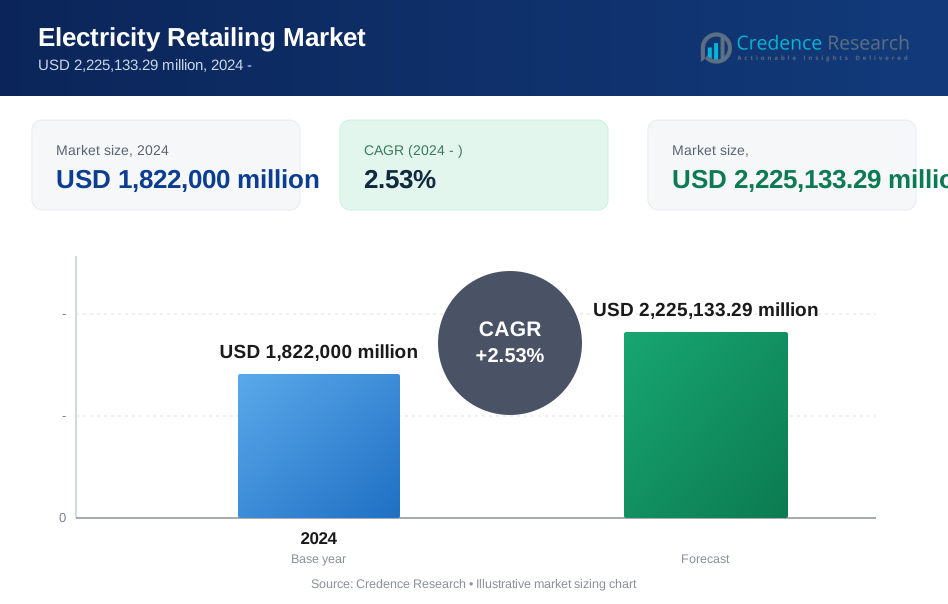
The global electricity retailing market was valued at USD 1,822,000 million in 2024 and is projected to reach approximately USD 2,225,133.29 million by 2032, reflecting a steady CAGR of 2.53% throughout the forecast period.
| REPORT ATTRIBUTE | DETAILS |
|---|---|
| Historical Period | 2020-2023 |
| Base Year | 2024 |
| Forecast Period | 2025-2032 |
| Electricity Retailing Market Size 2024 | USD 1,822,000 million |
| Electricity Retailing Market, CAGR | 2.53% |
| Electricity Retailing Market Size 2032 | USD 2,225,133.29 million |
The electricity retailing market features a diverse competitive landscape led by major global players including ENGIE SA, Tata Power Co. Ltd., Duke Energy Corp., Keppel Electric Pte. Ltd., AGL Energy Ltd., Electricite de France SA, Korea Electric Power Corp., Enel SpA, Centrica Plc, and China Huadian Corporation Ltd. These companies strengthen their positions through renewable procurement strategies, smart grid investments, flexible tariff structures, and digital platforms for customer engagement. Asia Pacific holds the largest regional share at approximately 34%, driven by rapid urbanization, industrial demand, and expanding grid infrastructure, followed by North America and Europe, where deregulated markets and sustainability policies shape competitive dynamics and consumer choice.

Market Insights
- The global electricity retailing market was valued at USD 1,822,000 million in 2024 and is projected to reach USD 2,225,133.29 million by 2032, growing at a CAGR of 2.53% during the forecast period.
- Increasing demand from residential consumers, the dominant segment with the largest share, along with smart grid deployment and rising electrification, continue to drive consistent market expansion globally.
- Key trends include digital billing platforms, time-of-use pricing, renewable energy retailing, and consumer-centric tariff customization supported by advanced metering infrastructure.
- Competitive strategies revolve around renewable procurement, deregulation-led customer switching, and bundled service offerings, while price volatility and aging grid infrastructure remain primary restraints.
- Asia Pacific leads with nearly 34% share, followed by North America at 32% and Europe at 28%, supported by rapid industrialization, decarbonization policies, and expanding grid modernization initiatives.
Market Segmentation Analysis:
By Consumer Segments
Residential consumers represent the dominant share in the electricity retailing market, driven by population growth, urban expansion, and widespread adoption of energy-efficient home appliances. Increasing penetration of smart meters and government-backed household electrification programs continue to expand residential demand. Consumption patterns are rising further with electric heating, cooling systems, and the growing adoption of electric vehicles that require home charging infrastructure. Retailers are prioritizing tailored billing plans, digital billing platforms, and prepaid options to enhance transparency and affordability, making residential consumers the primary revenue contributor in the consumer segment portfolio.
- For instance, Enedis, France’s main power grid operator, has deployed around 35 million Linky smart meters The program enables remote meter reading, faster billing, and time-based electricity tariffs.
By Energy Sources
Conventional energy sources hold the largest share in the electricity retailing sector due to the extensive installed base of thermal and fossil-fuel power plants. Existing grid infrastructure and long-term supply contracts keep conventional electricity cost-competitive for large-scale retail distribution. Despite the growing momentum of renewable energy, coal and natural gas generation continue to support grid reliability and load balancing. However, regulatory mandates for decarbonization and increasing corporate clean energy procurement are accelerating the integration of renewables, prompting retailers to expand hybrid and green procurement portfolios to align with environmental and sustainability goals.
- For instance, Duke Energy operates about 55,000 MW of total generation capacity across all fuels. Coal and natural gas assets still provide dispatchable power for base load and peak demand support, even as the company retires legacy coal units and expands cleaner capacity.
By Tariff Structures
Fixed-rate plans dominate the tariff structure segment, supported by consumer preference for predictable monthly expenses and insulation from wholesale price volatility. Residential and small commercial users favor fixed billing due to long-term budgeting benefits and contract-based price security. Retailers leverage these plans for customer acquisition and retention, particularly in deregulated markets with competitive switching. While variable and time-of-use tariffs gain traction with smart-grid adoption, fixed-rate offerings remain the prevailing choice until real-time pricing and advanced energy participation mechanisms, such as demand response and distributed storage, achieve broader consumer adoption.
Key Growth Driver
Expansion of Smart Grid and Advanced Metering Infrastructure
The deployment of smart grids and advanced metering infrastructure is a major growth catalyst for the electricity retailing market. Utilities and retailers are transitioning from traditional analog systems to real-time data-enabled, two-way communication networks that improve supply reliability and consumer engagement. Smart meters provide near-instant consumption analytics, enabling consumers to track usage and retailers to generate tailored tariffs, peak-time premiums, and energy-saving incentives. Load forecasting becomes more accurate, minimizing outages and grid stress during demand spikes. Additionally, these systems support integration of distributed energy resources, enabling retailers to facilitate rooftop solar, microgrid participation, and residential battery storage within retail programs, expanding revenue opportunities and improving operational efficiency.
- For instance, Enel SpA has deployed over 45 million second-generation smart meters in Italy and Spain. These meters support remote firmware updates and 15-minute consumption data collection, enabling automated retail billing and grid operations.
Regulatory Liberalization and Competitive Retail Markets
Electricity market deregulation and the rise of competitive retail frameworks are accelerating industry expansion. Many regions allow multiple suppliers to provide electricity services, giving consumers the flexibility to switch retailers based on pricing, contract terms, or renewable energy offerings. This shift encourages service innovation, transparent pricing structures, and customer-centric solutions. Retailers increasingly differentiate through digital platforms, sustainable sourcing portfolios, and flexible payment models. Governments are also promoting energy transition policies, incentivizing retailers to adopt green energy procurement and emission-aligned pricing models. As competition intensifies, marketing strategies, loyalty programs, and bundled value-added services such as home energy management solutions strengthen retailer-consumer relationships and sustain long-term revenue generation.
- For instance, Centrica Plc serves over 10 million residential and business customers in the U.K. and Ireland through British Gas and Bord Gáis Energy. The company manages more than 1 million connected devices, including smart meters and Hive smart thermostats, supporting digital retail energy services.
Rising Demand for Renewable and Clean Energy Integration
The accelerating transition toward cleaner energy sources significantly drives the electricity retailing market. Consumers, corporations, and public authorities are prioritizing low-carbon procurement strategies, expanding demand for green electricity plans. Retailers increasingly integrate wind, solar, biomass, and hydropower into their portfolios to meet clean energy targets and build brand differentiation. The rise of net metering, peer-to-peer energy trading models, and renewable energy certificates enhances consumer participation and monetization. Businesses adopting ESG-aligned energy procurement further fuel this trend, especially in manufacturing, logistics, and commercial real estate. As utilities modernize grids for variable renewable energy, retailers gain broader opportunities to introduce specialized plans that align with sustainability expectations.
Key Trends & Opportunities
Growth of Time-of-Use and Dynamic Tariff Programs
Time-of-use (TOU) pricing and dynamic tariff models present significant future opportunities, enabled by smart metering and real-time grid monitoring. As consumers become more energy-conscious, demand-shifting incentives encourage off-peak usage, reducing grid congestion and supporting cost-effective distribution. Retailers capitalize on these programs by creating adaptable pricing schemes for electric vehicle charging, HVAC loads, and household appliances. As grid decentralization increases, dynamic tariffs align with distributed generation and storage, allowing households with solar panels or batteries to monetize surplus power. These programs foster grid flexibility while expanding retailer innovation in digital platforms and energy-as-a-service offerings.
- For instance, Duke Energy has installed more than 2 million smart meters across its regulated service territories. The company runs Time-of-Use rates and demand response programs that measurably reduce peak-hour load and improve grid reliability.
Digital Platforms, AI Analytics, and Customer Personalization
Digital transformation is reshaping electricity retailing through AI-driven analytics, automated billing, and predictive consumption modeling. Retailers use machine learning algorithms to forecast demand, assess risk exposure to wholesale prices, and optimize procurement strategies. Customer-facing platforms improve transparency and build trust through usage insights, personalized recommendations, and savings alerts. Virtual customer support and self-service apps enhance service efficiency. Opportunities are expanding around bundling energy supply with smart-home devices, subscription plans, and carbon-tracking dashboards. These digital solutions strengthen customer loyalty and reduce operational cost, positioning technology-driven retailers to outperform in competitive markets.
- For instance, Electricité de France (EDF) manages over 35 million customer accounts and receives automated data from more than 30 million Linky smart meters.The digital platform enables real-time usage alerts and personalized energy-saving insights through EDF’s mobile applications.
Key Challenge
Price Volatility and Wholesale Market Exposure
Electricity retailers face significant challenges from fluctuating wholesale energy prices driven by fuel cost instability, geopolitical tensions, and changing supply-demand dynamics. Retailers offering fixed-rate plans risk absorbing cost increases unless hedging strategies and long-term supply contracts are well structured. Renewable intermittency also adds variability, creating procurement complexity when balancing clean energy commitments with grid reliability. Additionally, sudden regulatory changes and carbon pricing frameworks impact purchasing strategies. Managing risk, maintaining profitability, and ensuring cost transparency remain critical obstacles, requiring advanced forecasting and portfolio diversification.
Aging Grid Infrastructure and Integration Constraints
Outdated transmission and distribution networks limit the pace of market evolution and renewable adoption. Many grids were designed for centralized generation and struggle to accommodate bidirectional energy flows from rooftop solar, storage systems, and electric vehicle charging stations. Infrastructure upgrades demand extensive capital investment and long permitting cycles, slowing modernization. Retailers depend on grid operators to improve resilience and reduce outage frequency, yet investment responsibility and cost recovery remain complex topics. Without robust infrastructure, service reliability risks increase, potentially undermining customer confidence and slowing growth in decentralized energy models.
Regional Analysi
North America
North America holds around 32% of the electricity retailing market, supported by well-established deregulated power markets in the United States and rising investments in grid modernization. Retail competition enables consumers to switch retailers based on renewable sourcing, pricing, and contract terms. High adoption of smart meters, electrification of transport, and robust commercial sector consumption contribute significantly to demand growth. Regulatory incentives encouraging carbon-neutral procurement and integration of distributed energy resources further support innovation. However, grid resilience challenges linked to aging infrastructure and extreme weather events continue to influence reliability and pricing dynamics across the region.
Europe
Europe accounts for nearly 28% of the global market, driven by strong policy alignment toward decarbonization and integration of renewable electricity into retail portfolios. Countries such as Germany, the U.K., and the Nordic region have advanced frameworks for consumer choice and green energy contracting. Time-of-use tariffs and energy efficiency mandates support reduced peak consumption and encourage sustainable demand management. Corporate renewable power purchase agreements continue to scale as industries commit to emissions reduction targets. Despite progress, volatile wholesale pricing and geopolitical pressure on energy imports drive regulatory adjustments to stabilize consumer affordability.
Asia Pacific
Asia Pacific holds the largest share at around 34%, fueled by population expansion, rapid industrialization, and infrastructure electrification in developing economies. China, India, Japan, and South Korea represent major demand centers, with growing energy needs from manufacturing, logistics, and digital infrastructure. Continued rollout of transmission networks, rural electrification strategies, and urbanization accelerate consumption growth. Gradual liberalization of electricity retailing in select markets opens opportunities for private retailers and renewable procurement initiatives. However, disparities in grid reliability and regulatory maturity pose challenges for uniform market competitiveness across the region.
Latin America
Latin America represents about 4% of the electricity retailing market, driven by commercial sector demand and government-led grid expansion programs. Brazil, Chile, and Mexico are among the most active markets transitioning toward partial deregulation and renewable energy procurement models. Hydropower remains a dominant supply source, reducing reliance on imports in several nations. Opportunities for private retailers are emerging, particularly in industrial clusters and commercial contracts. However, political uncertainty, fluctuating investment environments, and regional economic volatility influence long-term planning and infrastructure modernization timelines.
Middle East & Africa
The Middle East & Africa region captures nearly 2% of the global market, primarily influenced by industrial and public sector consumption in energy-intensive economies. Gulf nations are increasing investments in grid digitization and solar-powered generation aligned with diversification agendas. In Africa, electrification initiatives and cross-border power pool development are important drivers, though affordability gaps and infrastructure deficits remain major constraints. Utility subsidies affect retail competition, limiting private sector participation in several markets. As renewable capacity expands, opportunities for flexible retail models and prepaid consumer billing systems are expected to grow.
Market Segmentations:
By Consumer Segments
- Residential Consumers
- Commercial Consumers
- Industrial Consumers
By Energy Sources
- Renewable Energy
- Conventional Sources
By Tariff Structures
- Fixed-Rate Plans
- Variable-Rate Plans
- Time-of-Use Plans
By Geography
- North America
- U.S.
- Canada
- Mexico
- Europe
- Germany
- France
- U.K.
- Italy
- Spain
- Rest of Europe
- Asia Pacific
- China
- Japan
- India
- South Korea
- South-east Asia
- Rest of Asia Pacific
- Latin America
- Brazil
- Argentina
- Rest of Latin America
- Middle East & Africa
- GCC Countries
- South Africa
- Rest of the Middle East and Africa
Competitive Landscape
The competitive landscape of the electricity retailing market is shaped by the presence of traditional utility providers, independent power retailers, and emerging technology-driven service providers offering differentiated pricing models and renewable energy packages. Competition intensifies in deregulated markets, where customer acquisition strategies prioritize flexible tariffs, loyalty programs, digital self-service platforms, and green energy contracting to appeal to residential and commercial users. Retailers increasingly expand their portfolios with time-of-use plans, energy management tools, and bundled offerings such as home solar installation, backup storage solutions, or electric vehicle charging subscriptions. Strategic partnerships with renewable energy developers, battery storage companies, and smart grid technology firms enable retailers to optimize procurement, improve resilience, and enhance sustainability commitment. Data analytics, AI forecasting, and customer personalization platforms are becoming core competitive capabilities, allowing retailers to forecast consumption patterns, mitigate wholesale market risks, and strengthen long-term customer retention in a price-sensitive environment.
Key Player Analysis
- ENGIE SA
- Tata Power Co. Ltd.
- Duke Energy Corp.
- Keppel Electric Pte. Ltd.
- AGL Energy Ltd.
- Electricite de France SA
- Korea Electric Power Corp.
- Enel Spa
- Centrica Plc
- China Huadian Corporation LTD. (CHD)
Recent Developments
- In October 2025, Tata Power Co. Ltd. the government of India proposed opening up the retail electricity market to private firms. This could allow companies such as Tata Power to expand their retail footprint and compete in previously state-dominated territories, potentially reshaping the retail electricity landscape.
- In February 2025, AGL announced that it aims to make a Financial Investment Decision (FID) on 1.4 gigawatts (GW) of battery capacity within the next 12–18 months, expanding its storage portfolio as part of its energy transition strategy.
- In October 2024, Keppel Electric Pte. Ltd. (via partnership with Tata Power’s trading arm) entered the Indian market by launching a “Cooling-as-a-Service” (CaaS) offering marking its first major foray into India’s energy solutions market.
Report Coverage
The research report offers an in-depth analysis based on Consumer Segments, Energy Sources, Tariff Structures and Geography. It details leading market players, providing an overview of their business, product offerings, investments, revenue streams, and key applications. Additionally, the report includes insights into the competitive environment, SWOT analysis, current market trends, as well as the primary drivers and constraints. Furthermore, it discusses various factors that have driven market expansion in recent years. The report also explores market dynamics, regulatory scenarios, and technological advancements that are shaping the industry. It assesses the impact of external factors and global economic changes on market growth. Lastly, it provides strategic recommendations for new entrants and established companies to navigate the complexities of the market.
Future Outlook
- Electricity retailing will increasingly transition toward renewable energy–driven supply portfolios supported by grid decarbonization targets.
- Digital platforms and AI-enabled analytics will enhance consumption visibility and personalization for residential and commercial users.
- Time-of-use and real-time pricing models will expand as smart meters and demand-response programs scale.
- Retailers will integrate battery storage and distributed energy resources to improve flexibility and reliability.
- EV charging services and mobility energy solutions will emerge as key value-added offerings.
- Peer-to-peer energy trading will gain traction as blockchain platforms mature.
- Retail competition will intensify in deregulated markets, promoting tariff innovation and customer switching.
- Hybrid energy plans combining grid power, solar rooftop, and storage leasing options will become mainstream.
- Retailers will adopt carbon-tracking dashboards and green certification programs to meet ESG expectations.
- Infrastructure investments and public-private partnerships will accelerate modernization of aging grids.
Request a Free Sample
Fill in your details and we'll send you a free sample report.
- Sample data tables & charts
- Research methodology
Market Dynamics
Expansion of Smart Grid and Advanced Metering Infrastructure
The deployment of smart grids and advanced metering infrastructure enables real-time data collection, improves supply reliability, and allows for tailored tariffs and energy-saving incentives. This modernization supports integration of distributed energy resources and enhances operational efficiency for retailers.
Regulatory Liberalization and Competitive Retail Markets
Deregulation and the introduction of competitive retail frameworks allow consumers to choose among multiple suppliers, fostering innovation in pricing, digital platforms, and green energy offerings. This competition drives service differentiation and expands the market.
Rising Demand for Renewable and Clean Energy Integration
Growing consumer and corporate preference for low-carbon electricity is pushing retailers to expand renewable energy portfolios, offer green tariffs, and support net metering and peer-to-peer trading, aligning with global sustainability goals.
Growth of Time-of-Use and Dynamic Tariff Programs
Smart metering and real-time grid monitoring enable time-of-use and dynamic pricing models, encouraging off-peak consumption and supporting grid flexibility. These programs help retailers manage demand, reduce congestion, and introduce innovative pricing schemes.
Digital Platforms, AI Analytics, and Customer Personalization
The adoption of digital platforms and AI-driven analytics allows retailers to forecast demand, optimize procurement, and offer personalized billing and energy management solutions, enhancing customer engagement and loyalty while reducing operational costs.
Need a Custom Version of This Report?
Tailor the scope, geography, or segments to your exact requirements.
- Custom geography or segment scope
- Direct access to our analyst team
Frequently Asked Questions
What is the current market size for the electricity retailing market, and what is its projected size in 2032?
At what Compound Annual Growth Rate is the electricity retailing market projected to grow between 2024 and 2032?
Which Technology Integration segment governs the market demand for Electricity Retailing?
Which Services and Offerings segment is predicted to grow at the fastest growing segment over the forecast period?
Who are the leading companies in the electricity retailing market?
Table of Content
Chapter 1 Market Segmentation
- 1.1 Segmentation Framework
- 1.1.1 Product and Service Classification
- 1.1.2 Application and End-Use Classification
- 1.1.3 Technology and Solution Classification
- 1.1.4 Customer and Distribution Channel Classification
- 1.1.5 Geographic Segmentation
- 1.1.6 Market Segment Definitions and Boundaries
- 1.2 By Energy Sources
- 1.2.1 Renewable Energy
- 1.2.2 Conventional Sources
- 1.3 By Consumer Segments
- 1.3.1 Residential Consumers
- 1.3.2 Commercial Consumers
- 1.3.3 Industrial Consumers
- 1.4 By Tariff Structures
- 1.4.1 Fixed-Rate Plans
- 1.4.2 Variable-Rate Plans
- 1.4.3 Time-of-Use Plans
Chapter 2 Introduction
- 2.1 Report Objectives and Scope
- 2.2 Product Definition and Industry Terminology
- 2.3 Market Inclusions and Exclusions
- 2.4 Research Process
- 2.4.1 Primary Research and Expert Interviews
- 2.4.2 Secondary Research and Source Review
- 2.4.3 Top-Down and Bottom-Up Estimation
- 2.4.4 Data Triangulation and Verification
- 2.5 Market Size Measurement Basis
- 2.5.1 2024: USD 1,822,000 million → 2032: USD 2,225,133.29 million
- 2.6 Historical and Forecast Reference Periods
- 2.6.1 Base Year: 2024
- 2.6.2 Forecast Period: 2024-2032
- 2.7 Research Assumptions and Limitations
Chapter 3 Executive Summary
- 3.1 Market Snapshot and Key Findings
- 3.2 Base-Year Market Size, 2024
- 3.3 Forecast Market Size, 2032
- 3.4 Revenue and Volume Growth Outlook
- 3.5 Key Demand and Supply Indicators
- 3.6 Leading Market Segments
- 3.7 Fastest-Growing Market Opportunities
- 3.8 Regional Performance Highlights
- 3.9 Technology and Industry Transformation
- 3.10 Competitive Landscape Summary
- 3.11 Analyst View and Strategic Implications
Chapter 4 Global Electricity Retailing Market Trends and Developments
- 4.1 Historical Industry Development
- 4.2 Recent Market Trends and Developments
- 4.3 Demand and Customer Behavior Trends
- 4.4 Technology and Product Innovation
- 4.5 Artificial Intelligence, Automation and Digitalization
- 4.6 Local Manufacturing and Supply Chain Realignment
- 4.7 Industry Partnerships, Mergers and Acquisitions
- 4.8 Sustainability and Circular Economy Developments
- 4.9 Government and Private Sector Investment Trends
- 4.10 Emerging Business Models and Commercialization
- 4.11 Industry Developments and Announcements
Chapter 5 Global Electricity Retailing Market Production, Supply and Demand Analysis
- 5.1 Demand Trend and Consumption Analysis
- 5.2 Demand Forecast, 2024-2032
- 5.3 Production and Output Trend
- 5.4 Production and Output Forecast, 2024-2032
- 5.5 Installed Capacity and Capacity Utilization
- 5.6 Company-Wise Production Plants and Statistics
- 5.6.1 Installed Production Capacity
- 5.6.2 Actual Production
- 5.6.3 Planned Capacity and Expansion Targets
- 5.7 Supply Chain Structure and Procurement Trends
- 5.8 Supply-Demand Gap and Bottlenecks
- 5.9 Import Dependence and Sourcing Structure
- 5.10 Contract Manufacturing and Outsourcing
- 5.11 Regional Supply and Demand Concentration
Chapter 6 Global Electricity Retailing Market Pricing Analysis
- 6.1 Pricing Structure and Measurement
- 6.2 Historical Pricing Trends
- 6.3 Pricing Outlook, 2024-2032
- 6.4 Average Selling Price and Unit Economics
- 6.5 Pricing by Product and Market Segment
- 6.6 Geographic Pricing Differences
- 6.7 Key Input, Energy, Labor and Logistics Costs
- 6.8 Contract Pricing and Purchasing Models
- 6.9 Pricing Sensitivity and Competitive Positioning
- 6.10 Price, Margin and Profitability Implications
Chapter 7 Global Electricity Retailing Market Dynamics
- 7.1 Market Growth Drivers
- 7.1.1 Demand-Side Drivers
- 7.1.2 Technology and Innovation Drivers
- 7.1.3 Infrastructure and Investment Drivers
- 7.1.4 Regulatory and Policy Drivers
- 7.2 Market Restraints
- 7.2.1 Cost and Affordability Constraints
- 7.2.2 Technology and Adoption Barriers
- 7.2.3 Supply Chain and Operational Constraints
- 7.3 Market Challenges
- 7.3.1 Competitive Pressure and Margin Erosion
- 7.3.2 Skills, Infrastructure and Implementation Gaps
- 7.4 Emerging Market Opportunities
- 7.5 Market Dynamics Impact and Time-Horizon Assessment
Chapter 8 Global Electricity Retailing Value Chain Analysis
- 8.1 Industry Value Chain Overview
- 8.2 Upstream Suppliers and Critical Inputs
- 8.3 Technology and Component Providers
- 8.4 Manufacturing or Service Delivery
- 8.5 Distribution, Channel Partners and Integrators
- 8.6 Downstream Applications and End Users
- 8.7 Value Addition and Profit Pools
- 8.8 Vertical Integration and Outsourcing
- 8.9 Supplier Concentration and Risk
- 8.10 Supply Chain Localization and Resilience
Chapter 9 Global Electricity Retailing Market Regulations and Policies
- 9.1 Relevant Laws, Standards and Compliance Frameworks
- 9.2 Product, Service, Safety and Quality Requirements
- 9.3 Government Policies, Incentives and Subsidies
- 9.4 Imports, Exports and Trade Barriers
- 9.5 Public Procurement and Local Content Requirements
- 9.6 Environmental and Sustainability Compliance
- 9.7 Upcoming Policy Changes and Market Implications
Chapter 10 Global Electricity Retailing Market Hotspots and Opportunities
- 10.1 Market Opportunity Mapping and Growth Hotspots
- 10.2 High-Growth Applications and Customer Groups
- 10.3 Underserved Markets and White-Space Opportunities
- 10.4 Emerging Technology and Product Opportunities
- 10.5 New Capacity and Investment Hotspots
- 10.6 Market Entry and Expansion Opportunities
- 10.7 Distribution and Partnership Opportunities
- 10.8 Near-Term and Long-Term Commercial Potential
- 10.9 Opportunity Attractiveness and Execution Risks
Chapter 11 Global Electricity Retailing Market Outlook, 2024-2032
- 11.1 Market Size and Analysis
- 11.1.1 Revenue (Market Measurement: 2024: USD 1,822,000 million → 2032: USD 2,225,133.29 million)
- 11.1.2 Market Volume and Quantity Sold
- 11.1.3 Historical Market Size
- 11.1.4 Base-Year Market Size, 2024
- 11.2 Market Forecast, 2024-2032
- 11.2.1 Revenue Forecast to 2032
- 11.2.2 Volume Forecast to 2032
- 11.2.3 CAGR and Year-on-Year Growth
- 11.2.4 Incremental Revenue Opportunity
- 11.3 Forecast Assumptions and Scenario Analysis
- 11.3.1 Base-Case Forecast
- 11.3.2 Optimistic and Conservative Scenarios
- 11.3.3 Technology, Pricing and Policy Sensitivities
- 11.4 Market Attractiveness and Growth Outlook
Chapter 12 Global Electricity Retailing Market Segmentation and Outlook
- 12.1 Segmentation Summary and Market Shares, 2024
- 12.2 Largest and Fastest-Growing Segments
- 12.3 By Energy Sources - Market Size and Forecast, 2024-2032
- 12.3.1 Segment Definition and Scope
- 12.3.2 Historical Market Size
- 12.3.3 Revenue Forecast, 2024-2032
- 12.3.4 Volume Forecast, 2024-2032
- 12.3.5 Base-Year Market Share, 2024
- 12.3.6 Segment CAGR and Growth Drivers
- 12.3.7 Subsegment Market Size and Forecast
- 12.3.7.1 Renewable Energy
- 12.3.7.2 Conventional Sources
- 12.3.8 Subsegment Pricing and Adoption Trends
- 12.3.9 Leading Suppliers and Competition
- 12.3.10 Regional Demand and Opportunities
- 12.4 By Consumer Segments - Market Size and Forecast, 2024-2032
- 12.4.1 Segment Definition and Scope
- 12.4.2 Historical Market Size
- 12.4.3 Revenue Forecast, 2024-2032
- 12.4.4 Volume Forecast, 2024-2032
- 12.4.5 Base-Year Market Share, 2024
- 12.4.6 Segment CAGR and Growth Drivers
- 12.4.7 Subsegment Market Size and Forecast
- 12.4.7.1 Residential Consumers
- 12.4.7.2 Commercial Consumers
- 12.4.7.3 Industrial Consumers
- 12.4.8 Subsegment Pricing and Adoption Trends
- 12.4.9 Leading Suppliers and Competition
- 12.4.10 Regional Demand and Opportunities
- 12.5 By Tariff Structures - Market Size and Forecast, 2024-2032
- 12.5.1 Segment Definition and Scope
- 12.5.2 Historical Market Size
- 12.5.3 Revenue Forecast, 2024-2032
- 12.5.4 Volume Forecast, 2024-2032
- 12.5.5 Base-Year Market Share, 2024
- 12.5.6 Segment CAGR and Growth Drivers
- 12.5.7 Subsegment Market Size and Forecast
- 12.5.7.1 Fixed-Rate Plans
- 12.5.7.2 Variable-Rate Plans
- 12.5.7.3 Time-of-Use Plans
- 12.5.8 Subsegment Pricing and Adoption Trends
- 12.5.9 Leading Suppliers and Competition
- 12.5.10 Regional Demand and Opportunities
- 12.6 Segment Growth Comparison
- 12.7 Segment Attractiveness and Priority Matrix
Chapter 13 Global Electricity Retailing Geographic Market Outlook, 2024-2032
- 13.1 Regional Market Size and Share, 2024
- 13.2 Regional Market Forecast, 2024-2032
- 13.3 Regional Pricing, Production and Demand Differences
- 13.4 North America
- 13.4.1 United States
- 13.4.2 Canada
- 13.4.3 Mexico
- 13.5 Europe
- 13.5.1 Germany
- 13.5.2 France
- 13.5.3 Italy
- 13.5.4 United Kingdom
- 13.5.5 Spain
- 13.5.6 Poland
- 13.5.7 Russia
- 13.5.8 Netherlands
- 13.5.9 Belgium
- 13.5.10 Sweden
- 13.5.11 Denmark
- 13.5.12 Norway
- 13.5.13 Rest of Europe
- 13.6 Asia Pacific
- 13.6.1 China
- 13.6.2 India
- 13.6.3 Japan
- 13.6.4 South Korea
- 13.6.5 Thailand
- 13.6.6 Indonesia
- 13.6.7 Vietnam
- 13.6.8 Malaysia
- 13.6.9 Australia
- 13.6.10 Rest of Asia Pacific
- 13.7 Latin America
- 13.7.1 Brazil
- 13.7.2 Argentina
- 13.7.3 Colombia
- 13.7.4 Chile
- 13.7.5 Rest of Latin America
- 13.8 Middle East
- 13.8.1 Saudi Arabia
- 13.8.2 United Arab Emirates
- 13.8.3 Turkey
- 13.8.4 Israel
- 13.8.5 Iran
- 13.8.6 Rest of the Middle East
- 13.9 Africa
- 13.9.1 South Africa
- 13.9.2 Egypt
- 13.9.3 Nigeria
- 13.9.4 Morocco
- 13.9.5 Rest of Africa
- 13.10 Regional Investment, Policy and Supply Chain Differences
- 13.11 Regional Competitive Landscape
- 13.12 Geographic Growth Hotspots
Chapter 14 Global Electricity Retailing Technology, Innovation and Sustainability Outlook
- 14.1 Technology Landscape and Maturity
- 14.2 Product, Process and Service Innovation
- 14.3 AI, Automation and Digital Tools in the Industry
- 14.4 Technology Adoption and Performance Benchmarking
- 14.5 Innovation Pipeline and R&D Investment
- 14.6 Patent and Intellectual Property Trends
- 14.7 Energy Efficiency and Resource Management
- 14.8 Sustainability, Recycling and Circularity
- 14.9 Technology Roadmap, 2024-2032
- 14.10 Risks of Obsolescence and Technology Substitution
Chapter 15 Global Electricity Retailing Market Key Strategic Imperatives
- 15.1 Growth and Market Entry Priorities
- 15.2 High-Return Products and Segments
- 15.3 Pricing, Profitability and Cost Optimization
- 15.4 Technology Investment and Product Differentiation
- 15.5 Supply Chain Localization and Resilience
- 15.6 Distribution and Customer Acquisition
- 15.7 Partnership, Acquisition and Capacity Strategy
- 15.8 Regional Expansion Priorities
- 15.9 Short-, Medium- and Long-Term Actions
Chapter 16 Competition Outlook
- 16.1 Industry Competition Characteristics
- 16.2 Market Structure and Concentration
- 16.3 Market Share and Competitive Positioning, 2024
- 16.4 Company-Wise Revenue and Product Benchmarking
- 16.5 Production and Service Capacity Benchmarking
- 16.6 Technology, Pricing and Differentiation
- 16.7 Regional Footprint and Distribution Strength
- 16.8 Mergers, Acquisitions and Strategic Alliances
- 16.9 New Entrants and Competitive Threats
- 16.10 Porter's Five Forces and Industry Attractiveness
- 16.11 Competitive Outlook, 2024-2032
Chapter 17 Company Profiles
- 17.1 Company Coverage and Selection Criteria
- 17.2 ENGIE SA
- 17.2.1 Business Description
- 17.2.2 Company Ownership and Geographic Presence
- 17.2.3 Product and Service Portfolio
- 17.2.4 Manufacturing and Operating Footprint
- 17.2.5 Production Capacity and Expansion Plans
- 17.2.6 Financial Performance and Investment
- 17.2.7 Market Share and Competitive Position
- 17.2.8 Technology and Innovation Capabilities
- 17.2.9 Strategic Alliances or Partnerships
- 17.2.10 Recent Developments
- 17.2.11 Growth Strategy and Outlook
- 17.3 Tata Power Co. Ltd.
- 17.4 Duke Energy Corp.
- 17.5 Keppel Electric Pte. Ltd.
- 17.6 AGL Energy Ltd.
- 17.7 Electricite de France SA
- 17.8 Korea Electric Power Corp.
- 17.9 Enel SpA
- 17.10 Centrica Plc
- 17.11 China Huadian Corporation Ltd.
- 17.12 Other Relevant Market Participants
Note: Every listed company is profiled on the structure shown under the first company. The company list is preliminary and may change based on research findings, market developments, data availability and client requirements.
Chapter 18 Disclaimer
- 18.1 Research and Forecast Disclaimer
- 18.2 Data Source and Estimation Limitations
Note: The depth of individual sections depends on data availability for this market. Volume, capacity, trade and other unit-based metrics are included where applicable.