
Market Overview
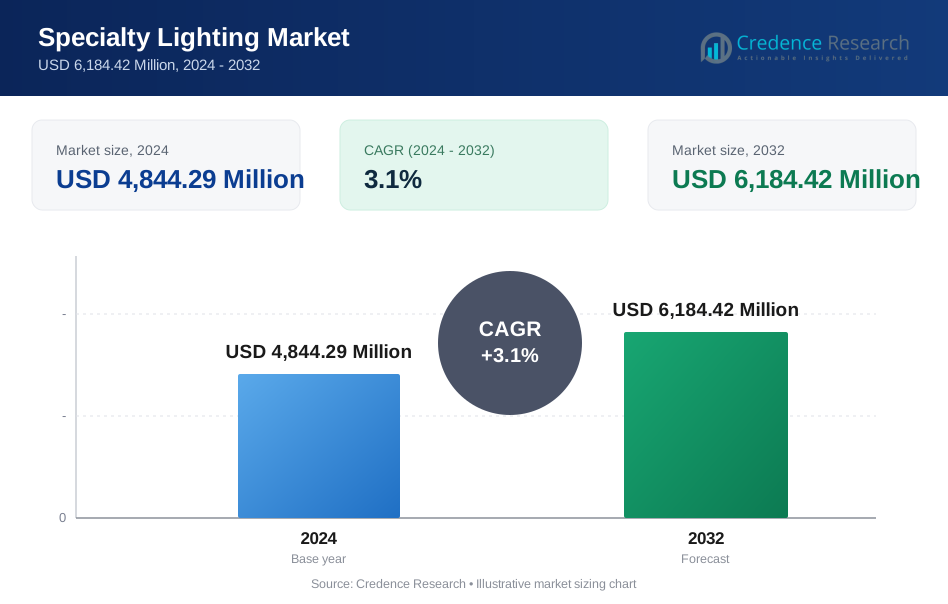
Specialty Lighting Market size was valued at USD 4,844.29 Million in 2024 and is anticipated to reach USD 6,184.42 Million by 2032, at a CAGR of 3.1% during the forecast period.
| REPORT ATTRIBUTE | DETAILS |
|---|---|
| Historical Period | 2020-2023 |
| Base Year | 2024 |
| Forecast Period | 2025-2032 |
| Specialty Lighting Market Size 2024 | USD 4,844.29 Million |
| Specialty Lighting Market, CAGR | 3.1% |
| Specialty Lighting Market Size 2032 | USD 6,184.42 Million |
Specialty Lighting Market features major players such as Color Imagination LED Lighting, Herbert Waldmann, Crystal IS, Integra Lifesciences, Advanced UV, OSRAM GmbH, Brandon Medical, Getinge AB, CREE (IDEAL INDUSTRIES, INC.), and Advanced Stage Lights, all actively advancing LED, UV-C, medical, and entertainment lighting technologies. These companies focus on enhancing energy efficiency, optical precision, and smart control integration to meet diverse industry needs. North America led the market in 2024 with a 33.4% share, supported by strong adoption in entertainment, healthcare, and architectural applications. Europe followed with 29.1%, driven by automotive lighting innovation and advanced regulatory standards.
Market Insights
- The Specialty Lighting Market reached USD 4,844.29 Million in 2024 and will grow at a CAGR of 3.1% through 2032.
- Strong demand for LED-based specialty lighting drives market expansion, supported by its 62.7% segment share and rising usage in entertainment, medical, and automotive applications.
- Smart lighting, IoT integration, and UV-C disinfection solutions continue shaping market trends as industries prioritize efficiency, automation, and precision illumination.
- Key players strengthen their presence by advancing optical technologies, enhancing product durability, and expanding portfolios across medical, architectural, and stage lighting segments, creating strong innovation momentum.
- North America leads with a 33.4% regional share, followed by Europe at 29.1% and Asia-Pacific at 27.8%, with APAC emerging as the fastest-growing region due to expanding urban infrastructure and automotive production.
Market Segmentation Analysis:
By Light Source:
In the Specialty Lighting Market, LED lighting dominated the light source segment in 2024 with a 62.7% market share, driven by its energy efficiency, long operational life, and superior illumination quality across commercial, medical, and entertainment applications. LEDs continue to replace halogen, xenon, incandescent, and metal halide lamps due to declining costs, enhanced lumen output, and reduced maintenance requirements. Advancements in smart dimming, color-tunable capabilities, and heat management further strengthen LED adoption. Halogen and xenon lamps maintain relevance in niche automotive and stage lighting, while metal halide solutions support high-intensity industrial environments.
- For instance, GE Lighting (Current) offers LED high‑bay replacement lamps such as the 150 W LED150ED28/750, which delivers around 23,500 lumens (about 156 lm/W), giving industrial facilities a high-output, energy‑efficient alternative to traditional metal halide high‑bay lamps.
By Technology:
Wired lighting led the technology segment in 2024 with a 71.4% market share, supported by its reliability, stable power delivery, and widespread compatibility with legacy and advanced lighting infrastructures. It remains critical in hospitals, studios, laboratories, and mission-critical facilities where uninterrupted illumination is essential. Growth in building automation systems and integration with DMX, DALI, and other control protocols strengthens wired installations. Wireless lighting is expanding steadily as Bluetooth Mesh, Wi-Fi, and IoT-enabled platforms gain adoption in entertainment and architectural lighting, offering flexible installation and energy management benefits.
- For instance, ERCO has deployed DALI‑based track lighting in office and educational buildings to enable daylight‑responsive dimming and to reduce screen glare while maintaining visual comfort.
By Application:
The entertainment sector emerged as the leading application segment in 2024 with a 38.6% market share, driven by rising demand for dynamic stage lighting, studio illumination, architectural effects, and immersive experience technologies. Concert venues, theme parks, film production houses, and live events increasingly adopt high-brightness LEDs, intelligent moving lights, and programmable systems to enhance visual impact. Medical lighting follows with strong uptake in surgical, diagnostic, and examination environments, supported by precision illumination requirements. Automotive specialty lighting continues to expand with innovations in adaptive headlights and interior ambience solutions, while other applications benefit from customized illumination needs.

Key Growth Drivers
Rising Adoption of LED-Based Specialty Lighting
The rapid transition toward LED-based specialty lighting acts as a major growth driver, supported by its energy efficiency, long service life, and superior illumination control compared to traditional sources. Industries such as entertainment, automotive, and healthcare increasingly adopt LEDs for their high brightness, design flexibility, and integration with smart controls. Advancements in tunable white and RGBW systems, along with falling component costs, accelerate LED penetration. Regulatory pressures promoting energy-efficient lighting further strengthen demand across commercial, medical, and industrial environments.
- For instance, BMW’s Matrix LED headlamps use individually controlled LED segments that automatically adapt the beam pattern to traffic and road conditions, improving visibility while consuming less power than conventional halogen systems.
Increasing Demand in Medical and Healthcare Applications
Growth in medical imaging, diagnostics, surgical procedures, and examination environments significantly boosts the demand for specialty lighting solutions. High-precision illumination, minimal heat emission, and enhanced color rendering drive adoption of specialized LEDs and fiber-optic systems in operating rooms, dental care, and laboratory applications. Rising healthcare infrastructure investments, particularly in emerging markets, contribute to strong market expansion. The push for infection-resistant, glare-free, and shadow-controlled lighting technologies underscores the increasing preference for advanced specialty solutions that improve clinical accuracy and patient outcomes.
- For instance, the A‑dec 500 LED dental light offers a high color rendering index of 94 and adjustable intensity up to about 30,000 lux, enabling accurate differentiation of soft and hard tissue shades and minimizing shadowing in the oral cavity.
Expansion of Entertainment, Events, and Architectural Lighting
The global rise in concerts, theme parks, film production, and architectural enhancement projects fuels growth in dynamic specialty lighting. Demand for intelligent lighting systems, moving heads, color-changing fixtures, and immersive visual effects is increasing as venues strive to deliver engaging experiences. Advancements in DMX-controlled systems, 3D mapping, and programmable LED arrays support greater creative flexibility. Urban development projects also incorporate façade lighting and landscape illumination, further elevating demand for high-performance specialty lighting solutions tailored for design-driven environments.
Key Trends & Opportunities
Integration of IoT and Smart Control Platforms
Smart specialty lighting is emerging as a transformative trend, driven by IoT connectivity, automation, and real-time monitoring capabilities. Wireless protocols such as Bluetooth Mesh and Wi-Fi enable flexible control, while cloud-based platforms support remote diagnostics, energy optimization, and automated scene settings. Entertainment venues, medical facilities, and industrial plants increasingly adopt smart lighting to enhance precision, operational efficiency, and energy management. This shift creates strong opportunities for manufacturers offering intelligent, sensor-enabled solutions with interoperability across digital ecosystems.
- For instance, MESHLE deployed Bluetooth Mesh LED drivers for scalable wireless control, enabling smartphone-based commissioning over ~40m indoor ranges per hop. The secure, device-to-device network suits large commercial spaces without Wi-Fi gateways.
Growing Demand for Custom and High-Precision Lighting Solutions
Market opportunities are expanding for customized specialty lighting that meets specific illumination requirements in automotive, aerospace, medical, and entertainment sectors. High-precision lighting such as surgical lights, adaptive headlights, and stage spotlights continues to gain traction as industries prioritize accuracy, safety, and performance. Manufacturers leveraging advanced optics, miniaturized LED modules, and specialized beam-shaping technologies can capture significant demand. Growth in personalized and application-specific lighting solutions positions specialty lighting as a critical enabler of next-generation design and innovation.
- For instance, Excelitas designs fully customizable Chip-on-Board LED solutions for surgical lighting applications, enabling precise control over power consumption, heat reduction, and color rendering index to meet unique medical needs.
Key Challenges
High Initial Costs and Complex Integration Requirements
Despite steady adoption, the high initial cost of specialized LED systems, intelligent controllers, and advanced optics presents a significant challenge for cost-sensitive industries. Integrating complex lighting architectures such as DMX, DALI, and IoT platforms often requires skilled labor, raising installation and maintenance expenses. Smaller entertainment venues, clinics, and small-scale automotive shops may delay upgrades due to budget constraints. This cost barrier slows adoption in developing regions and limits market penetration for premium specialty lighting solutions.
Thermal Management and Durability Limitations
As specialty lighting applications demand high brightness and continuous operation, managing heat and ensuring long-term durability remain critical challenges. LEDs used in medical, entertainment, and automotive environments must withstand intense thermal loads, vibration, and environmental exposure. Inadequate heat dissipation can reduce lumen output, shorten lifespan, and increase system failures. Manufacturers must invest in advanced cooling technologies, robust housings, and improved materials to meet performance standards. These engineering complexities increase manufacturing costs and slow product development cycles.
Regional Analysis
North America
North America led the Specialty Lighting Market in 2024 with a 33.4% market share, driven by strong adoption across entertainment, automotive, and advanced medical facilities. The U.S. dominates due to high spending on stage lighting, film production technologies, and surgical illumination systems. Growth in smart buildings and architectural lighting further supports demand for LED-based specialty solutions. Technological innovation, sustainability regulations, and rapid upgrades in healthcare infrastructure also strengthen market expansion. Canada contributes through investments in commercial lighting modernization and energy-efficient solutions, reinforcing the region’s leadership in premium specialty lighting applications.
Europe
Europe accounted for a 29.1% market share in 2024, supported by robust demand from the automotive, entertainment, and architectural lighting sectors. Germany, France, and the U.K. lead the region due to strong automotive manufacturing capabilities and widespread adoption of adaptive and aesthetic lighting technologies. The region benefits from stringent EU energy-efficiency regulations, which accelerate LED retrofitting across industrial and public spaces. Growth in cultural events, museum lighting upgrades, and infrastructure renovation projects also boosts adoption of precision specialty lighting. Advancements in smart and wireless control systems further enhance Europe's market momentum.
Asia-Pacific
Asia-Pacific captured a 27.8% market share in 2024, emerging as the fastest-growing region due to expanding entertainment industries, rapid urbanization, and strong automotive production. China, Japan, South Korea, and India drive significant demand for LED stage lights, medical illumination, and specialty vehicle lighting solutions. Government initiatives promoting smart cities and energy-efficient lighting accelerate adoption across commercial and industrial sectors. Healthcare expansion and rising surgical procedure volumes further fuel demand for high-precision lighting. The presence of major manufacturing hubs and cost-efficient production capabilities positions Asia-Pacific as a key driver of global market growth.
Latin America
Latin America held a 5.6% market share in 2024, with steady growth supported by increasing investments in entertainment venues, healthcare facilities, and infrastructure modernization. Brazil and Mexico lead demand due to expanding film and event production industries and rising vehicle customization trends. Adoption of LED-based specialty lighting grows as commercial spaces focus on energy savings and operational efficiency. Government incentives for efficient lighting solutions also influence market expansion. The region’s rising focus on architectural enhancement and façade illumination provides additional opportunities for manufacturers targeting emerging urban development projects.
Middle East & Africa
The Middle East & Africa region accounted for a 4.1% market share in 2024, driven by large-scale construction projects, hospitality sector growth, and rising adoption of architectural and outdoor specialty lighting. Countries such as the UAE, Saudi Arabia, and South Africa invest heavily in smart buildings, entertainment venues, and medical infrastructure, strengthening demand for advanced lighting solutions. High-end façade lighting, landscape illumination, and event lighting technologies gain traction in premium urban developments. Growing healthcare modernization and increasing usage of specialty automotive lighting further support market growth across the region.
Market Segmentations:
By Light Source
- LED
- Halogen lamp
- Xenon bulb
- Incandescent lamp
- Metal halide lamp
By Technology
- Wired lighting
- Wireless lighting
By Application
- Entertainment
- Medical
- Automotive
- Others
By Distribution Channel
- Offline sales
- Online sales
By Geography
- North America
- U.S.
- Canada
- Mexico
- Europe
- Germany
- France
- U.K.
- Italy
- Spain
- Rest of Europe
- Asia Pacific
- China
- Japan
- India
- South Korea
- South-east Asia
- Rest of Asia Pacific
- Latin America
- Brazil
- Argentina
- Rest of Latin America
- Middle East & Africa
- GCC Countries
- South Africa
- Rest of the Middle East and Africa
Competitive Landscape
Competitive landscape in the Specialty Lighting Market features key players such as Color Imagination LED Lighting, Herbert Waldmann, Crystal IS, Integra Lifesciences, Advanced UV, OSRAM GmbH, Brandon Medical, Getinge AB, CREE (IDEAL INDUSTRIES, INC.), and Advanced Stage Lights driving innovation, product diversification, and technological advancement. These companies invest heavily in LED optimization, UV-C purification lighting, surgical illumination systems, and high-performance entertainment lighting to meet evolving industry requirements. Market leaders focus on expanding smart lighting capabilities, enhancing optical precision, and improving thermal management to strengthen performance across medical, automotive, and entertainment applications. Strategic partnerships, product launches, and R&D investments accelerate their ability to address specialized illumination needs. Additionally, manufacturers increasingly adopt sustainability-focused designs, integrating energy-efficient LEDs and recyclable components to comply with global efficiency standards. Competitive pressure remains high as companies prioritize miniaturization, wireless control integration, and customized lighting solutions tailored to niche applications. This innovation-driven environment reinforces continuous market evolution.
Key Player Analysis
- Color Imagination LED Lighting
- Herbert Waldmann
- Crystal IS
- Integra Lifesciences
- Advanced UV
- OSRAM GmbH
- Brandon Medical
- Getinge AB
- CREE (IDEAL INDUSTRIES, INC.)
- Advanced Stage Lights
Recent Developments
- In October 2025, Fulham acquired Nualight to strengthen its position in refrigeration and display case lighting, combining engineering expertise for reliable low-temperature solutions.
- In November 2025, Cooper Lighting Solutions completed the acquisition of Nemalux, enhancing its industrial lighting portfolio with specialized hazardous location LED products.
- In July 2025, Fagerhult Group acquired Capelon to advance smart lighting capabilities, integrating IoT platforms for energy-efficient street lighting and connected city applications.
Report Coverage
The research report offers an in-depth analysis based on Light Source, Technology, Application, Distribution Channel and Geography. It details leading market players, providing an overview of their business, product offerings, investments, revenue streams, and key applications. Additionally, the report includes insights into the competitive environment, SWOT analysis, current market trends, as well as the primary drivers and constraints. Furthermore, it discusses various factors that have driven market expansion in recent years. The report also explores market dynamics, regulatory scenarios, and technological advancements that are shaping the industry. It assesses the impact of external factors and global economic changes on market growth. Lastly, it provides strategic recommendations for new entrants and established companies to navigate the complexities of the market.
Future Outlook
- The Specialty Lighting Market will experience strong growth driven by increasing adoption of LED-based systems across medical, entertainment, and automotive applications.
- Smart and connected lighting solutions will gain traction as IoT integration, automation, and wireless controls become standard requirements.
- Surgical and diagnostic lighting will advance with improved color rendering, shadow reduction, and precision illumination technologies.
- UV-C and disinfection lighting will expand in healthcare, laboratories, and industrial environments due to rising hygiene and safety standards.
- Entertainment and stage lighting will evolve with higher brightness, programmable effects, and advanced optical designs.
- Automotive specialty lighting will grow with innovations in adaptive headlights, ambient interior lighting, and safety-enhancing illumination systems.
- Architectural and façade lighting will see increasing adoption in smart city projects and modern infrastructure development.
- Miniaturized and high-efficiency LED modules will support customized specialty lighting solutions across niche applications.
- Sustainability-focused lighting designs will advance as global regulations emphasize energy efficiency and reduced environmental impact.
- Manufacturers will prioritize modular, durable, and maintenance-friendly lighting solutions to support long-term operational efficiency.
Request a Free Sample
Fill in your details and we'll send you a free sample report.
- Sample data tables & charts
- Research methodology
Need a Custom Version of This Report?
Tailor the scope, geography, or segments to your exact requirements.
- Custom geography or segment scope
- Direct access to our analyst team
Frequently Asked Questions
What is the current market size for Specialty Lighting Market, and what is its projected size in 2032?
At what Compound Annual Growth Rate is the Specialty Lighting Market projected to grow between 2024 and 2032?
Which Specialty Lighting Market segment held the largest share in 2024?
What are the primary factors fueling the growth of the Specialty Lighting Market?
Who are the leading companies in the Specialty Lighting Market?
Which region commanded the largest share of the Specialty Lighting Market in 2024?
Table of Content
Chapter 1. Report Introduction
- 1.1 Report Description & Purpose
- 1.1.1 Report Title & Market Definition
- 1.1.2 Unique Selling Propositions (USP) & Key Differentiators
- 1.1.3 Value Proposition for Stakeholders
- 1.2 Research Objectives
- 1.2.1 Market Sizing Objectives (Volume & Revenue)
- 1.2.2 Segmentation Objectives
- 1.2.3 Competitive Intelligence Objectives
- 1.2.4 Forecast & Scenario Objectives
- 1.3 Report Scope
- 1.3.1 Specialty Lighting Scope – Types & Subtypes Covered
- 1.3.2 Geographic Scope – Regions & Countries Covered
- 1.3.3 Historical Period, Base Year & Forecast Period (2024; forecast to 2032)
- 1.3.4 Inclusions & Exclusions
- 1.4 HS Code & Classification Framework
- 1.5 Currency, Units & Pricing Basis
- 1.6 Target Stakeholders
- 1.7 Limitations & Assumptions
Chapter 2. Executive Summary
- 2.1 Global Specialty Lighting Market Snapshot
- 2.1.1 Market Size – Historical (2024) & Forecast (2024-2032) (2024: USD 4,844.29 Million → 2032: USD 6,184.42 Million)
- 2.1.2 Volume & Revenue – Global Totals
- 2.1.3 Key Market Highlights – Top Five Facts
- 2.2 Specialty Lighting Market Segmentation Snapshot
- 2.2.1 Market Split by Region – 2024 vs. 2032
- 2.3 Competitive Snapshot
- 2.3.1 Top 10 Players by Revenue Share – 2024
- 2.3.2 Top 10 Players by Volume Share – 2024
- 2.3.3 Recent Strategic Developments (18-Month Summary)
- 2.4 Key Investment Highlights & Strategic Conclusions
Chapter 3. Specialty Lighting Market Dynamics & Industry Analysis
- 3.1 Market Overview & Context
- 3.1.1 Specialty Lighting Market Position in the Broader Automotive Value Chain
- 3.1.2 OEM vs. Replacement Market Dynamics
- 3.1.3 Market Maturity & Development Stage by Region
- 3.2 Specialty Lighting Market Drivers
- 3.3 Specialty Lighting Market Restraints & Challenges
- 3.4 Specialty Lighting Market Opportunities
- 3.5 Porter's Five Forces Analysis
- 3.5.1 Threat of New Entrants
- 3.5.2 Bargaining Power of Suppliers
- 3.5.3 Bargaining Power of Buyers
- 3.5.4 Threat of Substitutes
- 3.5.5 Competitive Rivalry – Intensity Assessment
- 3.6 Specialty Lighting Value Chain Analysis
- 3.6.1 Upstream – Raw Material/Input Suppliers
- 3.6.1.1 Raw Material/Input 1
- 3.6.1.2 Raw Material/Input 2
- 3.6.1.3 Raw Material/Input 3
- 3.6.2 Midstream – Production/Manufacturing/Service Delivery
- 3.6.2.1 Production/Process Overview
- 3.6.2.2 Key Facility Locations & Capacity by Manufacturer
- 3.6.3 Downstream – Distribution & End Consumer
- 3.6.3.1 Primary Channel – B2B/OEM
- 3.6.3.2 Secondary Channels – Dealer, Retail, Online, Direct
- 3.6.4 Value Chain Profitability Analysis
- 3.6.1 Upstream – Raw Material/Input Suppliers
- 3.7 PESTEL Analysis
- 3.7.1 Political Factors
- 3.7.2 Economic Factors
- 3.7.3 Social Factors
- 3.7.4 Technological Factors
- 3.7.5 Environmental Factors
- 3.7.6 Legal Factors
- 3.8 Specialty Lighting Supply Chain Analysis
- 3.8.1 Raw Material/Input Supply Risk Assessment
- 3.8.2 Manufacturing Concentration Risk (Geographic Exposure)
- 3.8.3 Trade Disruption Impact Analysis
- 3.9 Regulatory & Policy Landscape
Note: The regulatory and policy landscape section covers regulations based on their applicability to the market, Specialty Lighting category, geography, and scope of the study. Only regulatory frameworks with a material impact on operations, compliance, trade, sustainability, or market access are analyzed in detail.
Chapter 4. Key Investment Pockets & Opportunity Analysis
- 4.1 Specialty Lighting Market Attractiveness Analysis
- 4.1.1 By Region – Investment Attractiveness Matrix (Volume × CAGR)
- 4.2 Absolute Revenue Growth Opportunity
- 4.2.1 By Region – Absolute USD Growth Through 2032
- 4.3 Incremental Volume Opportunity
- 4.3.1 By Region – Incremental Volume Through 2032
- 4.3.2 Segment – Incremental Volume
- 4.4 Emerging Submarket Opportunity Deep Dive (Subject to Applicability)
- 4.5 Emerging Market Opportunity Scorecards
- 4.5.1 United States
- 4.5.2 Europe
- 4.5.3 Asia
- 4.5.4 Middle East & Africa
Note: Emerging Market Opportunity Scorecards will be included based on relevance and strategic importance. Regions listed are indicative and may vary depending on data availability and market dynamics.
Chapter 5. Specialty Lighting Import-Export Analysis & Trade Flows
- 5.1 Global Trade Overview
- 5.1.1 Global Export Value by Country (2024)
- 5.1.2 Global Export Volume by Country (2024)
- 5.1.3 Global Import Value by Country (2024)
- 5.1.4 Global Import Volume by Country (2024)
- 5.1.5 Net Trade Balance by Country (2024)
- 5.2 Export Analysis – Segment
- 5.2.1 Type 1 (HS Code)
- 5.2.2 Type 2 (HS Code)
- 5.2.3 Type 3 (HS Code)
- 5.2.4 Type 4 (HS Code)
- 5.2.5 Type 5 (HS Code)
- 5.3 Import Analysis – Segment
- 5.3.1 Type 1 (HS Code)
- 5.3.2 Type 2 (HS Code)
- 5.3.3 Type 3 (HS Code)
- 5.3.4 Type 4 (HS Code)
- 5.3.5 Type 5 (HS Code)
- 5.4 Average Unit Trade Prices
- 5.4.1 Average Export Price – Segment & Country
- 5.4.2 Average Import Price – Segment & Source Country
- 5.4.3 Price Trends (2024)
- 5.5 Key Trade Route Analysis
- 5.5.1 Trade Route 1
- 5.5.2 Trade Route 2
- 5.5.3 Trade Route 3
- 5.5.4 Trade Route 4
- 5.5.5 Trade Route 5
- 5.6 Trade Policy Impact Assessment
- 5.6.1 US Anti-Dumping & Section 301 Tariffs
- 5.6.2 EU Customs Union Impact
- 5.6.3 Major Free Trade Agreements
- 5.6.4 USMCA Rules of Origin
Note: Trade policy analysis will be included only where relevant to the Specialty Lighting market.
Chapter 6. Competitive Landscape & Company Benchmarking
- 6.1 Specialty Lighting Market Concentration & Structure
- 6.1.1 Herfindahl-Hirschman Index (HHI) – vs. 2024
- 6.1.2 Tier 1, Tier 2 & Tier 3 Market Structure
- 6.1.3 Global, Regional & Local Player Dynamics
- 6.2 Specialty Lighting Market Share Analysis – 2024
- 6.2.1 Global Revenue Share by Company
- 6.2.2 Global Volume Share by Company
- 6.2.3 Regional Revenue Share
- 6.2.4 Market Share Evolution ( vs. 2024)
- 6.2.5 OEM Segment Share by Company
- 6.2.6 Replacement Segment Share by Company
- 6.3 Production/Delivery Capacity & Facility Analysis
- 6.3.1 Global Installed Capacity
- 6.3.2 Capacity Utilization Rates
- 6.3.3 Production/Output Volume
- 6.3.4 Facility Locations & Capacity Map
- 6.3.5 Planned Capacity Additions
- 6.4 Specialty Lighting Competitive Benchmarking Matrix
- 6.4.1 Revenue, Volume, CAGR & Profitability Comparison
- 6.4.2 Channel Revenue Mix
- 6.4.3 Geographic Revenue Exposure
- 6.4.4 R&D Intensity
- 6.4.5 Sustainability Maturity
- 6.5 Strategic Developments in Specialty Lighting (Last 24 Months)
- 6.5.1 Mergers, Acquisitions & Divestments
- 6.5.2 New Specialty Lighting Launches
- 6.5.3 Facility Expansions
- 6.5.4 Strategic Alliances, Joint Ventures & Partnerships
- 6.5.5 Distribution Expansion & Market Entry
- 6.5.6 Sustainability & ESG Initiatives
- 6.6 Competitive Strategy Mapping
- 6.6.1 Leader, Challenger, Follower & Niche Classification
- 6.6.2 Pricing Strategy Comparison
- 6.6.3 Channel Strategy Matrix
Note: Strategic developments are included based on their materiality and the availability of reliable information.
Chapter 7. Global Specialty Lighting Market – By Distribution Channel
- 7.1 Segment Overview
- 7.1.1 Volume & Revenue Split by Channel (2024 & 2032)
- 7.1.2 Channel Mix Evolution (2024-2032)
Chapter 8. Regional Market Analysis – Global Overview
- 8.1 Global Regional Overview
- 8.1.1 Regional Volume Share
- 8.1.2 Regional Revenue Share
- 8.1.3 Regional Volume by Region
- 8.1.4 Regional Revenue by Region
- 8.1.5 Regional Forecast Through 2032
- 8.2 Cross-Regional Segment Analysis
- 8.2.1 By Distribution Channel
- 8.2.2 By Brand/Price Tier
Chapter 9. North America Specialty Lighting Market
- 9.1 United States
- 9.2 Canada
- 9.3 Mexico
Chapter 10. Europe Specialty Lighting Market
- 10.1 Germany
- 10.2 France
- 10.3 Italy
- 10.4 United Kingdom
- 10.5 Spain
- 10.6 Poland
- 10.7 Russia
- 10.8 Netherlands
- 10.9 Belgium
- 10.10 Sweden
- 10.11 Denmark
- 10.12 Norway
- 10.13 Rest of Europe
Chapter 11. Asia Pacific Specialty Lighting Market
- 11.1 China
- 11.2 India
- 11.3 Japan
- 11.4 South Korea
- 11.5 Thailand
- 11.6 Indonesia
- 11.7 Vietnam
- 11.8 Malaysia
- 11.9 Australia
- 11.10 Rest of Asia Pacific
Chapter 12. Latin America Specialty Lighting Market
- 12.1 Brazil
- 12.2 Argentina
- 12.3 Colombia
- 12.4 Chile
- 12.5 Rest of Latin America
Chapter 13. Middle East Specialty Lighting Market
- 13.1 Saudi Arabia
- 13.2 United Arab Emirates
- 13.3 Turkey
- 13.4 Israel
- 13.5 Iran
- 13.6 Rest of the Middle East
Chapter 14. Africa Specialty Lighting Market
- 14.1 South Africa
- 14.2 Egypt
- 14.3 Nigeria
- 14.4 Morocco
- 14.5 Rest of Africa
Chapter 15. Specialty Lighting Company Profiles
- 15.1 [Company 01]
- 15.1.1 Company Overview
- 15.1.2 Key Management Personnel
- 15.1.3 Products & Services Portfolio
- 15.1.4 Financial Performance
- 15.1.5 Key Market Focus & Geographic Presence
- 15.1.6 Recent Developments & Strategic Initiatives
Note: The company profile list is preliminary and may change based on research findings, market developments, data availability, and client requirements.
Chapter 16. Appendices
- Appendix A – List of Abbreviations & Acronyms
- Appendix B – Industry Classification Code Reference – Full Series
- Appendix C – Production & Capacity Data Tables
- Appendix D – End-Use & Demand Base Tables
- Appendix E – Consumption & Replacement Rate Assumptions
- Appendix F – ASP Reference Tables
- Appendix G – Manufacturing & Facility Database
- Appendix H – Import-Export Data Tables
- Appendix I – Regulatory Summary Tables
- Appendix J – Primary Research Participant List (Anonymized)
- Appendix K – Primary Research Questionnaire Framework
- Appendix L – Data Sources & Bibliography
- Appendix M – Market Size Divergence & Source Comparison
Chapter 17. Research Methodology
- 17.1 Research Framework & Philosophy
- 17.2 Secondary Research – Sources, Hierarchy & Data Extraction
- 17.3 Data Modeling – Bottom-Up & Top-Down Market Sizing
- 17.4 Primary Research – Stakeholder Framework, LOI & Sample Sizes
- 17.5 Forecast Methodology – Regression, Scenario & Sensitivity Analysis
- 17.6 Quality Control – Four-Layer Validation Framework
- 17.7 Limitations & Standard Assumptions
- 17.8 Disclaimer
