
Market Overview:
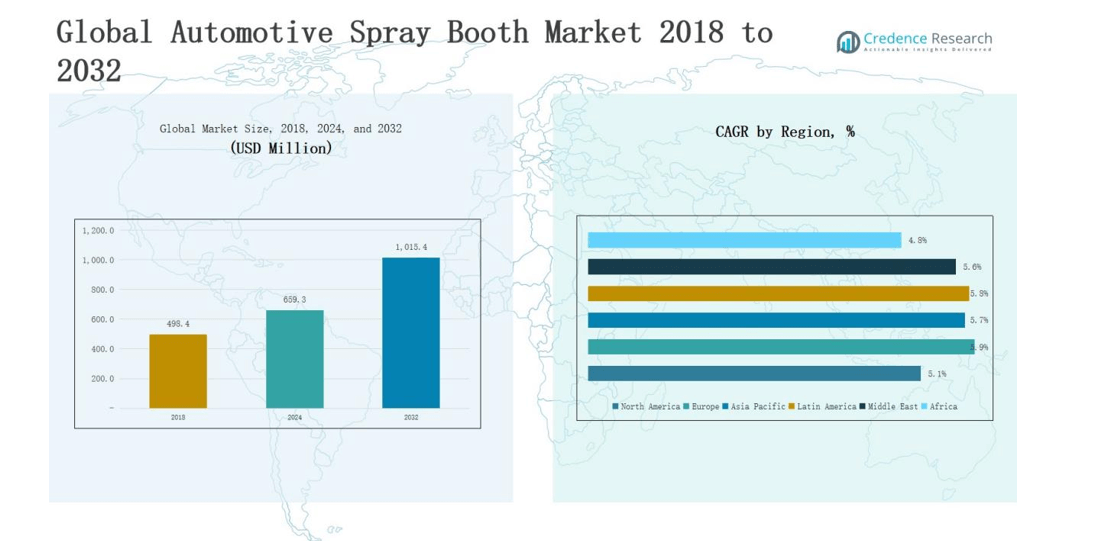
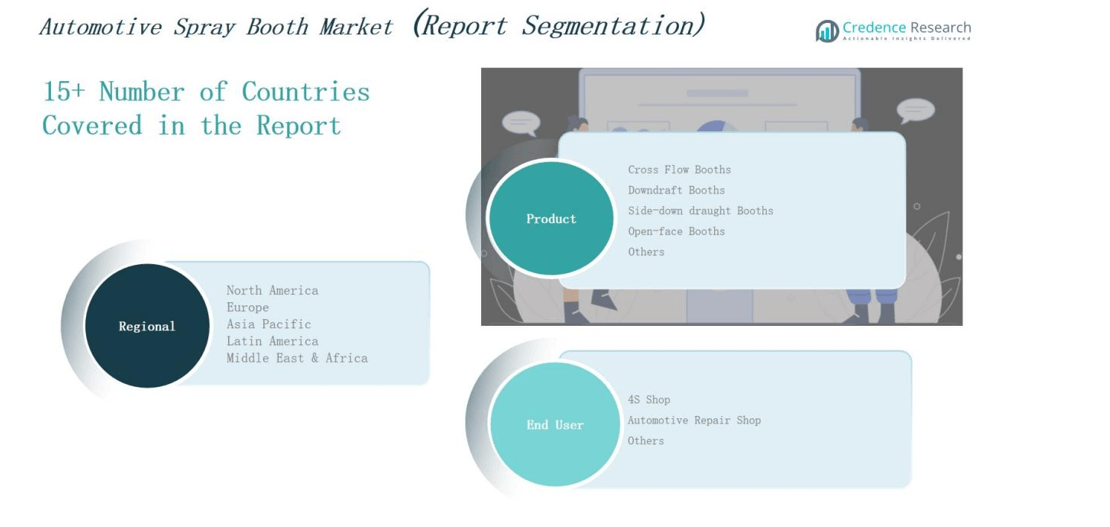
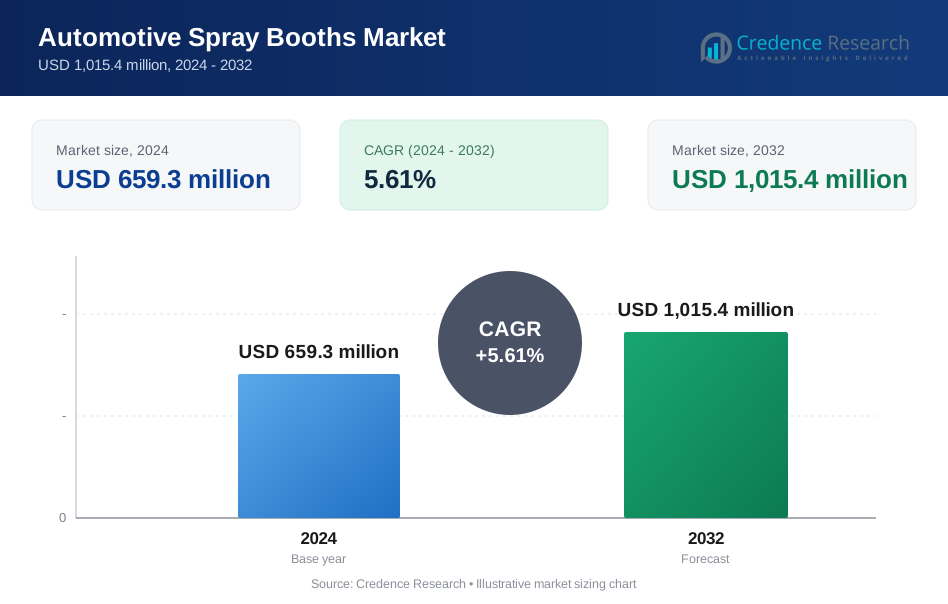
Global Automotive Spray Booth Market size was valued at USD 498.4 million in 2018 to USD 659.3million in 2024 and is anticipated to reach USD 1,015.4 million by 2032, at a CAGR of 5.61% during the forecast period.
| REPORT ATTRIBUTE | DETAILS |
|---|---|
| Historical Period | 2020-2023 |
| Base Year | 2024 |
| Forecast Period | 2025-2032 |
| Automotive Spray Booth Market Size 2024 | USD 659.3million |
| Automotive Spray Booth Market, CAGR | 5.61% |
| Automotive Spray Booth Market Size 2032 | USD 1,015.4 million |
The Global Automotive Spray Booth Market is shaped by leading companies such as Global Finishing Solutions LLC, Dalby Engineering Ltd., Blowtherm USA, Usi Italia, Nova Verta, Fujitoronics K.K., Spray Tech/Junair, Guangdong Jingzhongjing Industrial Painting Equipment Co., Ltd., Col-Met Engineered Finishing Solutions, Spraybooth Technology Limited, and Spray Systems, Inc. These players strengthen their positions through advanced airflow technologies, eco-friendly filtration systems, and strong after-sales service networks. Asia Pacific emerged as the leading region in 2024, commanding 38% market share, driven by its robust automotive manufacturing base, rising vehicle ownership, and growing demand for high-quality refinishing solutions.
Market Insights
- The Global Automotive Spray Booth Market grew from USD 498.4 million in 2018 to USD 659.3 million in 2024 and is projected to reach USD 1,015.4 million by 2032.
- Downdraft booths dominated the product segment with 38% share in 2024, supported by superior airflow, reduced overspray, and high-quality finishing demanded by OEMs and repair facilities.
- Among end users, 4S shops led with 46% share in 2024, driven by integrated service offerings and growing demand for reliable refinishing in high-volume urban markets.
- Asia Pacific held the largest regional share at 38% in 2024, fueled by strong automotive manufacturing in China, Japan, South Korea, and India, alongside rising vehicle ownership.
- Europe followed with 25.4% share in 2024, supported by strict emission regulations, premium vehicle production, and innovation in sustainable and energy-efficient spray booth designs
Market Segment Insights
By Product
The product segment of the Global Automotive Spray Booth Market is dominated by downdraft booths, holding 38% share in 2024. Their ability to provide superior airflow, minimize overspray, and ensure high-quality finishing drives adoption among automotive OEMs and repair facilities. Cross flow booths follow with steady demand, supported by cost-effectiveness and ease of installation. Side-down draught booths and open-face booths serve niche applications where space optimization and flexibility are crucial. The “others” category, including customized and hybrid solutions, continues to grow as manufacturers seek advanced booth designs tailored to energy efficiency and sustainability.
- For instance, Dürr AG has introduced EcoReBooth technology, enabling energy recovery and reduced VOC emissions across customized hybrid spray booth installations for major EV manufacturers.
By End User
Among end users, 4S shops lead the market with 46% share in 2024, driven by their integrated service offerings that combine sales, spare parts, service, and surveys under one roof. These facilities require reliable spray booths to maintain consistent vehicle refinishing standards, especially in urban and high-volume markets. Automotive repair shops account for a significant share, propelled by rising accident repair demand and growing aftermarket services. The “others” segment, including fleet maintenance centers and custom paint workshops, adds to market diversity with specialized refinishing needs.
- For instance, UPS runs dedicated fleet maintenance hubs in the U.S. where enclosed spray booths are used to repaint delivery trucks as part of lifecycle refurbishment.
Market Overview
Rising Demand for Vehicle Customization and Refinishing
The market is fueled by growing consumer interest in vehicle personalization and aesthetics. Spray booths ensure controlled environments for high-quality paint jobs, which boosts their use in custom modifications. Increasing accident repair demand and replacement painting needs also push adoption. Automotive OEMs and aftermarket service centers are expanding refinishing capabilities to meet customer expectations. This rising preference for advanced finishing technologies continues to drive the need for efficient spray booth installations worldwide.
- For instance, Tesla’s Fremont Factory upgraded its paint shop with new spray booth installations for improved color depth and durability, directly supporting the growing demand for individualized vehicle finishes such as multi-coat metallics
Stringent Environmental and Safety Regulations
Governments across North America, Europe, and Asia Pacific enforce strict emissions and workplace safety standards. Spray booths with advanced filtration systems and airflow designs help automotive service providers comply with volatile organic compound (VOC) limits. Regulatory emphasis on reducing hazardous emissions compels repair shops and OEM facilities to replace outdated booths with modern, eco-friendly solutions. This regulatory push is a strong growth driver as it promotes technological upgrades and accelerates the demand for energy-efficient, compliant spray booths.
- For instance, in California, the Air Resources Board (CARB) has established VOC emission limits for different types of automotive refinishing products, with some products like clear coatings and primer surfacers limited to 250 g/L.
Expanding Automotive Production and Aftermarket Services
Global automotive production growth, particularly in Asia Pacific, directly strengthens the spray booth market. Rising vehicle ownership creates steady demand for refinishing and repair services, boosting booth installations in 4S shops and repair centers. Expanding dealership networks and aftermarket facilities integrate spray booths to meet repair standards. The aftermarket’s focus on quick turnaround times further enhances booth demand. Combined, these factors make automotive production and aftermarket services central to market expansion, ensuring consistent long-term growth.
Key Trends & Opportunities
Integration of Advanced Automation and Digital Controls
Automation in spray booths is becoming a critical trend, driven by the need for precision and efficiency. Digital control systems allow operators to monitor airflow, temperature, and paint curing in real time. These innovations enhance quality consistency, reduce paint wastage, and improve worker safety. The opportunity lies in deploying smart, automated spray booths that align with Industry 4.0 adoption in automotive manufacturing. Companies leveraging automation stand to gain competitive advantage through increased efficiency and reduced operational costs.
- For instance, Dürr’s EcoInCure system, which has been adopted by BMW for use in its paint shops, utilizes precise temperature control through an innovative inside-out curing process, which helps to improve paint surface quality while reducing energy consumption.
Growing Focus on Eco-Friendly and Energy-Efficient Solutions
Environmental sustainability drives new opportunities in the market. Manufacturers are developing booths with advanced filtration systems, waterborne paint compatibility, and reduced energy consumption. Demand for green solutions is especially strong in Europe and North America, where emission reduction is prioritized. Asia Pacific is also seeing growing adoption due to regulatory tightening. This trend positions eco-friendly spray booths as a strategic opportunity for manufacturers, enabling them to align with customer expectations and regulatory standards while achieving long-term growth.
- For instance, Garmat USA offers waterborne-compatible booths using advanced air movement systems that lower operational energy demands in automotive refinishing.
Key Challenges
High Initial Investment and Installation Costs
One of the biggest challenges is the high capital required for advanced spray booth installation. Small repair shops and emerging market players often struggle with the upfront cost of modern, eco-compliant booths. While these booths deliver long-term savings through efficiency and compliance, the initial financial barrier slows adoption. This cost-sensitive nature of the industry limits penetration in developing regions where budget-friendly solutions dominate, creating a persistent challenge for market expansion.
Skilled Workforce Shortages
The effective operation of advanced spray booths requires skilled technicians trained in airflow dynamics, paint curing, and safety protocols. Many regions face shortages of such skilled labor, which hampers booth performance and limits widespread adoption. Service centers without trained operators often face reduced efficiency and increased maintenance costs. This skill gap poses a significant barrier to maximizing booth utilization and achieving high-quality outcomes. Bridging this challenge requires investment in training and workforce development across key markets.
Intense Competition and Price Pressure
The market faces growing competition from both established players and regional manufacturers offering low-cost booths. While premium brands emphasize advanced features, smaller manufacturers capture share with budget-friendly models. This competition creates price pressure, especially in emerging economies where affordability drives buying decisions. Companies struggle to balance innovation and cost competitiveness, often compromising margins. Intense rivalry makes differentiation through technology, sustainability, and after-sales support essential to overcoming this persistent challenge.
Regional Analysis
North America
North America held a 22.6% share in 2024, valued at USD 147.26 million, and is projected to reach USD 217.81 million by 2032 at a CAGR of 5.1%. Growth is supported by strong automotive aftermarket services, high adoption of eco-friendly spray booths, and advanced repair infrastructure. The U.S. leads the region, driven by stringent environmental regulations and consumer demand for high-quality refinishing. Canada and Mexico contribute through expanding dealership networks and repair shops. Continuous technological upgrades in booth automation further strengthen the market outlook in North America.
Europe
Europe accounted for a 25.4% share in 2024, with market size at USD 165.62 million, expected to reach USD 260.66 million by 2032 at a CAGR of 5.9%. Germany, France, and Italy drive demand with their strong automotive manufacturing bases and emphasis on emission compliance. Strict EU environmental regulations push adoption of advanced, energy-efficient spray booths. Demand is further reinforced by premium vehicle production and extensive repair networks across the region. Europe remains a hub for innovation, with manufacturers focusing on sustainable booth designs and digital integration.
Asia Pacific
Asia Pacific dominated the market with a 38% share in 2024, valued at USD 247.28 million, projected to reach USD 384.74 million by 2032 at a CAGR of 5.7%. China leads with large-scale automotive manufacturing, while Japan, South Korea, and India contribute through advanced OEM facilities and rising vehicle ownership. The region benefits from industrial growth, increasing consumer demand for vehicle refinishing, and expanding service centers. Supportive regulations and investments in eco-friendly technology further enhance adoption. Asia Pacific continues to be the largest and fastest-growing region in terms of volume and market expansion.
Latin America
Latin America captured a 8.1% share in 2024, with the market size at USD 52.61 million, projected to reach USD 82.25 million by 2032 at a CAGR of 5.8%. Brazil dominates due to its automotive manufacturing base and expanding repair facilities. Argentina and other countries contribute through rising aftermarket demand and dealership expansions. The region shows potential for growth, although cost sensitivity among small repair shops creates barriers. Increasing urbanization and adoption of modern refinishing technology support steady growth, positioning Latin America as a promising emerging market.
Middle East
The Middle East represented a 4.4% share in 2024, with a market size of USD 28.61 million, anticipated to reach USD 44.07 million by 2032 at a CAGR of 5.6%. GCC countries drive demand, supported by luxury car ownership and investments in automotive service infrastructure. Israel and Turkey contribute with expanding vehicle sales and repair markets. The focus on high-performance spray booths for premium vehicles sustains regional growth. Environmental regulations are gradually strengthening, creating opportunities for advanced, eco-compliant spray booth solutions.
Africa
Africa accounted for a 2.7% share in 2024, valued at USD 17.90 million, expected to reach USD 25.89 million by 2032 at a CAGR of 4.8%. South Africa leads, driven by established automotive assembly operations and aftermarket services. Egypt and other African nations are witnessing gradual demand through expanding service networks. However, limited infrastructure and high upfront costs slow adoption of advanced spray booths. The market shows steady growth potential as urbanization increases vehicle ownership, creating opportunities for mid-range and cost-effective booth installations across the region.
Market Segmentations:
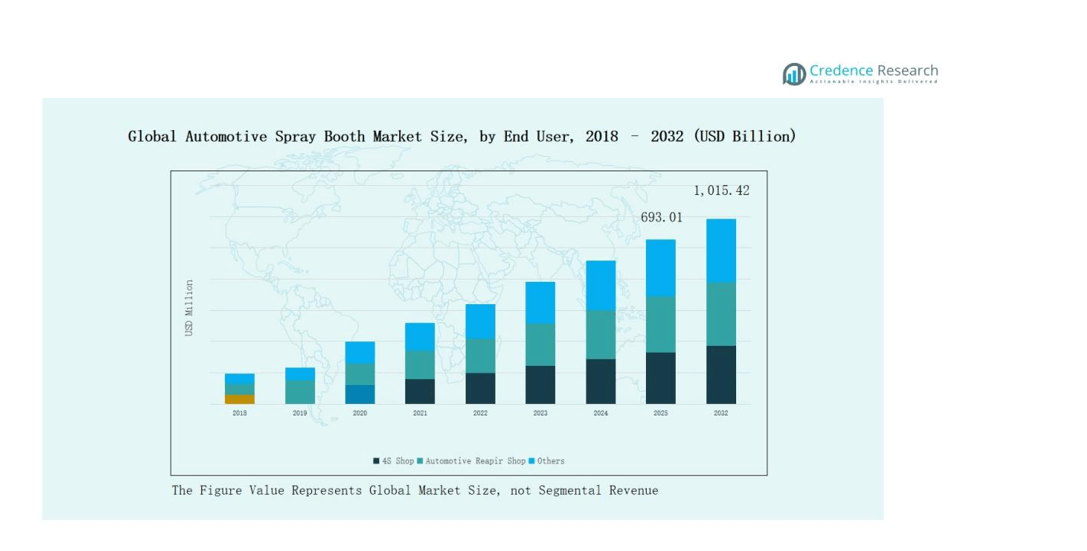
By Product
- Cross Flow Booths
- Downdraft Booths
- Side-down Draught Booths
- Open-face Booths
- Others
By End User
- 4S Shop
- Automotive Repair Shop
- Others
By Region
- North America
- U.S.
- Canada
- Mexico
- Europe
- UK
- France
- Germany
- Italy
- Spain
- Russia
- Belgium
- Netherlands
- Austria
- Sweden
- Poland
- Denmark
- Switzerland
- Rest of Europe
- Asia Pacific
- China
- Japan
- South Korea
- India
- Australia
- Thailand
- Indonesia
- Vietnam
- Malaysia
- Philippines
- Taiwan
- Rest of Asia Pacific
- Latin America
- Brazil
- Argentina
- Peru
- Chile
- Colombia
- Rest of Latin America
- Middle East
- UAE
- KSA
- Israel
- Turkey
- Iran
- Rest of Middle East
- Africa
- Egypt
- Nigeria
- Algeria
- Morocco
- Rest of Africa
Competitive Landscape
The Global Automotive Spray Booth Market is characterized by a mix of established international manufacturers and regional players competing on technology, cost, and service. Leading companies such as Global Finishing Solutions LLC, Dalby Engineering Ltd., Blowtherm USA, Usi Italia, Nova Verta, and Spray Tech/Junair dominate with strong product portfolios, advanced booth technologies, and global distribution networks. These players focus on innovation in airflow systems, automation, and eco-friendly filtration to comply with stringent emission standards and enhance operational efficiency. Regional manufacturers, including Guangdong Jingzhongjing Industrial Painting Equipment Co., Ltd. and Col-Met Engineered Finishing Solutions, strengthen their positions by offering cost-effective and customizable booths suited to local markets. Intense competition fosters continuous product development, strategic partnerships, and geographic expansion. After-sales services and maintenance packages also act as critical differentiators in customer retention. Overall, the competitive landscape remains dynamic, with innovation and regulatory compliance driving sustained market rivalry and consolidation opportunities.
Key Players
- Global Finishing Solutions LLC
- Dalby Engineering Ltd.
- Blowtherm USA
- Usi Italia
- Nova Verta
- Fujitoronics K.K.
- Spray Tech / Junair
- Guangdong Jingzhongjing Industrial Painting Equipment Co., Ltd
- Col-Met Engineered Finishing Solutions
- Spraybooth Technology Limited
- Spray Systems, Inc.
- Other Key Players
Recent Developments
- In June 2025, Solera partnered with AkzoNobel Vehicle Refinishes to enhance sustainability in automotive refinishing. The collaboration integrates process-specific paint and energy data into Solera’s Sustainable Estimatics platform, enabling bodyshops and insurers to calculate CO₂ emissions per repair.
- In May 2025, Clean Air Industries acquired RTT Engineered Solutions, a provider of industrial and automotive paint booth systems. This acquisition strengthens Clean Air’s position in finishing solutions and expands its capabilities in the automotive spray booth segment.
- In October 2023, Global Finishing Solutions LLC introduced the Edge Paint Booth, a modern auto-refinish booth with enhanced features and design.
- In 2025, Global Finishing Solutions LLC appointed Beacon Equipment Resources as its preferred distributor in the Dallas-Fort Worth region, strengthening local access to parts, filters, and service support
Report Coverage
The research report offers an in-depth analysis based on Product, End User and Region. It details leading market players, providing an overview of their business, product offerings, investments, revenue streams, and key applications. Additionally, the report includes insights into the competitive environment, SWOT analysis, current market trends, as well as the primary drivers and constraints. Furthermore, it discusses various factors that have driven market expansion in recent years. The report also explores market dynamics, regulatory scenarios, and technological advancements that are shaping the industry. It assesses the impact of external factors and global economic changes on market growth. Lastly, it provides strategic recommendations for new entrants and established companies to navigate the complexities of the market.
Future Outlook
- Demand for advanced spray booths will rise with growing automotive refinishing needs.
- Asia Pacific will remain the leading region due to strong vehicle production and sales
- Eco-friendly and energy-efficient booth designs will gain higher adoption.
- Automation and digital monitoring systems will become standard in modern spray booths.
- The aftermarket sector will continue to drive booth installations worldwide.
- Strict environmental regulations will accelerate replacement of outdated systems.
- Premium and luxury car sales will boost demand for high-performance spray booths.
- Regional players will expand by offering cost-effective and customizable solutions.
- Strategic partnerships and mergers will shape competitive dynamics in the market.
- Training and workforce development will be critical to maximize booth efficiency.
Request a Free Sample
Fill in your details and we'll send you a free sample report.
- Sample data tables & charts
- Research methodology
Need a Custom Version of This Report?
Tailor the scope, geography, or segments to your exact requirements.
- Custom geography or segment scope
- Direct access to our analyst team
Frequently Asked Questions
What is the current market size for Global Automotive Spray Booth Market, and what is its projected size in 2032?
At what Compound Annual Growth Rate is the Global Automotive Spray Booth Market projected to grow between 2025 and 2032?
Which Global Automotive Spray Booth Market segment held the largest share in 2024?
Who are the leading companies in the Global Automotive Spray Booth Market?
Table of Content
Chapter 1. Report Introduction
- 1.1 Report Description & Purpose
- 1.1.1 Report Title & Market Definition
- 1.1.2 Unique Selling Propositions (USP) & Key Differentiators
- 1.1.3 Value Proposition for Stakeholders
- 1.2 Research Objectives
- 1.2.1 Market Sizing Objectives (Volume & Revenue)
- 1.2.2 Segmentation Objectives
- 1.2.3 Competitive Intelligence Objectives
- 1.2.4 Forecast & Scenario Objectives
- 1.3 Report Scope
- 1.3.1 Automotive Spray Booths Scope – Types & Subtypes Covered
- 1.3.2 Geographic Scope – Regions & Countries Covered
- 1.3.3 Historical Period, Base Year & Forecast Period (2024; forecast to 2032)
- 1.3.4 Inclusions & Exclusions
- 1.4 HS Code & Classification Framework
- 1.5 Currency, Units & Pricing Basis
- 1.6 Target Stakeholders
- 1.7 Limitations & Assumptions
Chapter 2. Executive Summary
- 2.1 Global Automotive Spray Booths Market Snapshot
- 2.1.1 Market Size – Historical (2024) & Forecast (2024-2032) (2024: USD 659.3 million → 2032: USD 1,015.4 million)
- 2.1.2 Volume & Revenue – Global Totals
- 2.1.3 Key Market Highlights – Top Five Facts
- 2.2 Automotive Spray Booths Market Segmentation Snapshot
- 2.2.1 Market Split by Region – 2024 vs. 2032
- 2.3 Competitive Snapshot
- 2.3.1 Top 10 Players by Revenue Share – 2024
- 2.3.2 Top 10 Players by Volume Share – 2024
- 2.3.3 Recent Strategic Developments (18-Month Summary)
- 2.4 Key Investment Highlights & Strategic Conclusions
Chapter 3. Automotive Spray Booths Market Dynamics & Industry Analysis
- 3.1 Market Overview & Context
- 3.1.1 Automotive Spray Booths Market Position in the Broader Automotive Value Chain
- 3.1.2 OEM vs. Replacement Market Dynamics
- 3.1.3 Market Maturity & Development Stage by Region
- 3.2 Automotive Spray Booths Market Drivers
- 3.3 Automotive Spray Booths Market Restraints & Challenges
- 3.4 Automotive Spray Booths Market Opportunities
- 3.5 Porter's Five Forces Analysis
- 3.5.1 Threat of New Entrants
- 3.5.2 Bargaining Power of Suppliers
- 3.5.3 Bargaining Power of Buyers
- 3.5.4 Threat of Substitutes
- 3.5.5 Competitive Rivalry – Intensity Assessment
- 3.6 Automotive Spray Booths Value Chain Analysis
- 3.6.1 Upstream – Raw Material/Input Suppliers
- 3.6.1.1 Raw Material/Input 1
- 3.6.1.2 Raw Material/Input 2
- 3.6.1.3 Raw Material/Input 3
- 3.6.2 Midstream – Production/Manufacturing/Service Delivery
- 3.6.2.1 Production/Process Overview
- 3.6.2.2 Key Facility Locations & Capacity by Manufacturer
- 3.6.3 Downstream – Distribution & End Consumer
- 3.6.3.1 Primary Channel – B2B/OEM
- 3.6.3.2 Secondary Channels – Dealer, Retail, Online, Direct
- 3.6.4 Value Chain Profitability Analysis
- 3.6.1 Upstream – Raw Material/Input Suppliers
- 3.7 PESTEL Analysis
- 3.7.1 Political Factors
- 3.7.2 Economic Factors
- 3.7.3 Social Factors
- 3.7.4 Technological Factors
- 3.7.5 Environmental Factors
- 3.7.6 Legal Factors
- 3.8 Automotive Spray Booths Supply Chain Analysis
- 3.8.1 Raw Material/Input Supply Risk Assessment
- 3.8.2 Manufacturing Concentration Risk (Geographic Exposure)
- 3.8.3 Trade Disruption Impact Analysis
- 3.9 Regulatory & Policy Landscape
Note: The regulatory and policy landscape section covers regulations based on their applicability to the market, Automotive Spray Booths category, geography, and scope of the study. Only regulatory frameworks with a material impact on operations, compliance, trade, sustainability, or market access are analyzed in detail.
Chapter 4. Key Investment Pockets & Opportunity Analysis
- 4.1 Automotive Spray Booths Market Attractiveness Analysis
- 4.1.1 By Region – Investment Attractiveness Matrix (Volume × CAGR)
- 4.2 Absolute Revenue Growth Opportunity
- 4.2.1 By Region – Absolute USD Growth Through 2032
- 4.3 Incremental Volume Opportunity
- 4.3.1 By Region – Incremental Volume Through 2032
- 4.3.2 Segment – Incremental Volume
- 4.4 Emerging Submarket Opportunity Deep Dive (Subject to Applicability)
- 4.5 Emerging Market Opportunity Scorecards
- 4.5.1 United States
- 4.5.2 Europe
- 4.5.3 Asia
- 4.5.4 Middle East & Africa
Note: Emerging Market Opportunity Scorecards will be included based on relevance and strategic importance. Regions listed are indicative and may vary depending on data availability and market dynamics.
Chapter 5. Automotive Spray Booths Import-Export Analysis & Trade Flows
- 5.1 Global Trade Overview
- 5.1.1 Global Export Value by Country (2024)
- 5.1.2 Global Export Volume by Country (2024)
- 5.1.3 Global Import Value by Country (2024)
- 5.1.4 Global Import Volume by Country (2024)
- 5.1.5 Net Trade Balance by Country (2024)
- 5.2 Export Analysis – Segment
- 5.2.1 Type 1 (HS Code)
- 5.2.2 Type 2 (HS Code)
- 5.2.3 Type 3 (HS Code)
- 5.2.4 Type 4 (HS Code)
- 5.2.5 Type 5 (HS Code)
- 5.3 Import Analysis – Segment
- 5.3.1 Type 1 (HS Code)
- 5.3.2 Type 2 (HS Code)
- 5.3.3 Type 3 (HS Code)
- 5.3.4 Type 4 (HS Code)
- 5.3.5 Type 5 (HS Code)
- 5.4 Average Unit Trade Prices
- 5.4.1 Average Export Price – Segment & Country
- 5.4.2 Average Import Price – Segment & Source Country
- 5.4.3 Price Trends (2024)
- 5.5 Key Trade Route Analysis
- 5.5.1 Trade Route 1
- 5.5.2 Trade Route 2
- 5.5.3 Trade Route 3
- 5.5.4 Trade Route 4
- 5.5.5 Trade Route 5
- 5.6 Trade Policy Impact Assessment
- 5.6.1 US Anti-Dumping & Section 301 Tariffs
- 5.6.2 EU Customs Union Impact
- 5.6.3 Major Free Trade Agreements
- 5.6.4 USMCA Rules of Origin
Note: Trade policy analysis will be included only where relevant to the Automotive Spray Booths market.
Chapter 6. Competitive Landscape & Company Benchmarking
- 6.1 Automotive Spray Booths Market Concentration & Structure
- 6.1.1 Herfindahl-Hirschman Index (HHI) – vs. 2024
- 6.1.2 Tier 1, Tier 2 & Tier 3 Market Structure
- 6.1.3 Global, Regional & Local Player Dynamics
- 6.2 Automotive Spray Booths Market Share Analysis – 2024
- 6.2.1 Global Revenue Share by Company
- 6.2.2 Global Volume Share by Company
- 6.2.3 Regional Revenue Share
- 6.2.4 Market Share Evolution ( vs. 2024)
- 6.2.5 OEM Segment Share by Company
- 6.2.6 Replacement Segment Share by Company
- 6.3 Production/Delivery Capacity & Facility Analysis
- 6.3.1 Global Installed Capacity
- 6.3.2 Capacity Utilization Rates
- 6.3.3 Production/Output Volume
- 6.3.4 Facility Locations & Capacity Map
- 6.3.5 Planned Capacity Additions
- 6.4 Automotive Spray Booths Competitive Benchmarking Matrix
- 6.4.1 Revenue, Volume, CAGR & Profitability Comparison
- 6.4.2 Channel Revenue Mix
- 6.4.3 Geographic Revenue Exposure
- 6.4.4 R&D Intensity
- 6.4.5 Sustainability Maturity
- 6.5 Strategic Developments in Automotive Spray Booths (Last 24 Months)
- 6.5.1 Mergers, Acquisitions & Divestments
- 6.5.2 New Automotive Spray Booths Launches
- 6.5.3 Facility Expansions
- 6.5.4 Strategic Alliances, Joint Ventures & Partnerships
- 6.5.5 Distribution Expansion & Market Entry
- 6.5.6 Sustainability & ESG Initiatives
- 6.6 Competitive Strategy Mapping
- 6.6.1 Leader, Challenger, Follower & Niche Classification
- 6.6.2 Pricing Strategy Comparison
- 6.6.3 Channel Strategy Matrix
Note: Strategic developments are included based on their materiality and the availability of reliable information.
Chapter 7. Global Automotive Spray Booths Market – By Distribution Channel
- 7.1 Segment Overview
- 7.1.1 Volume & Revenue Split by Channel (2024 & 2032)
- 7.1.2 Channel Mix Evolution (2024-2032)
Chapter 8. Regional Market Analysis – Global Overview
- 8.1 Global Regional Overview
- 8.1.1 Regional Volume Share
- 8.1.2 Regional Revenue Share
- 8.1.3 Regional Volume by Region
- 8.1.4 Regional Revenue by Region
- 8.1.5 Regional Forecast Through 2032
- 8.2 Cross-Regional Segment Analysis
- 8.2.1 By Distribution Channel
- 8.2.2 By Brand/Price Tier
Chapter 9. North America Automotive Spray Booths Market
- 9.1 United States
- 9.2 Canada
- 9.3 Mexico
Chapter 10. Europe Automotive Spray Booths Market
- 10.1 Germany
- 10.2 France
- 10.3 Italy
- 10.4 United Kingdom
- 10.5 Spain
- 10.6 Poland
- 10.7 Russia
- 10.8 Netherlands
- 10.9 Belgium
- 10.10 Sweden
- 10.11 Denmark
- 10.12 Norway
- 10.13 Rest of Europe
Chapter 11. Asia Pacific Automotive Spray Booths Market
- 11.1 China
- 11.2 India
- 11.3 Japan
- 11.4 South Korea
- 11.5 Thailand
- 11.6 Indonesia
- 11.7 Vietnam
- 11.8 Malaysia
- 11.9 Australia
- 11.10 Rest of Asia Pacific
Chapter 12. Latin America Automotive Spray Booths Market
- 12.1 Brazil
- 12.2 Argentina
- 12.3 Colombia
- 12.4 Chile
- 12.5 Rest of Latin America
Chapter 13. Middle East Automotive Spray Booths Market
- 13.1 Saudi Arabia
- 13.2 United Arab Emirates
- 13.3 Turkey
- 13.4 Israel
- 13.5 Iran
- 13.6 Rest of the Middle East
Chapter 14. Africa Automotive Spray Booths Market
- 14.1 South Africa
- 14.2 Egypt
- 14.3 Nigeria
- 14.4 Morocco
- 14.5 Rest of Africa
Chapter 15. Automotive Spray Booths Company Profiles
- 15.1 [Company 01]
- 15.1.1 Company Overview
- 15.1.2 Key Management Personnel
- 15.1.3 Products & Services Portfolio
- 15.1.4 Financial Performance
- 15.1.5 Key Market Focus & Geographic Presence
- 15.1.6 Recent Developments & Strategic Initiatives
Note: The company profile list is preliminary and may change based on research findings, market developments, data availability, and client requirements.
Chapter 16. Appendices
- Appendix A – List of Abbreviations & Acronyms
- Appendix B – Industry Classification Code Reference – Full Series
- Appendix C – Production & Capacity Data Tables
- Appendix D – End-Use & Demand Base Tables
- Appendix E – Consumption & Replacement Rate Assumptions
- Appendix F – ASP Reference Tables
- Appendix G – Manufacturing & Facility Database
- Appendix H – Import-Export Data Tables
- Appendix I – Regulatory Summary Tables
- Appendix J – Primary Research Participant List (Anonymized)
- Appendix K – Primary Research Questionnaire Framework
- Appendix L – Data Sources & Bibliography
- Appendix M – Market Size Divergence & Source Comparison
Chapter 17. Research Methodology
- 17.1 Research Framework & Philosophy
- 17.2 Secondary Research – Sources, Hierarchy & Data Extraction
- 17.3 Data Modeling – Bottom-Up & Top-Down Market Sizing
- 17.4 Primary Research – Stakeholder Framework, LOI & Sample Sizes
- 17.5 Forecast Methodology – Regression, Scenario & Sensitivity Analysis
- 17.6 Quality Control – Four-Layer Validation Framework
- 17.7 Limitations & Standard Assumptions
- 17.8 Disclaimer
