
| REPORT ATTRIBUTE | DETAILS |
|---|---|
| Historical Period | 2019-2022 |
| Base Year | 2023 |
| Forecast Period | 2024-2032 |
| Automotive Test Equipment Market Size 2023 | USD 3512.2 Million |
| Automotive Test Equipment Market, CAGR | 4.50% |
| Automotive Test Equipment Market Size 2032 | USD 5219.4 Million |
Market Insights
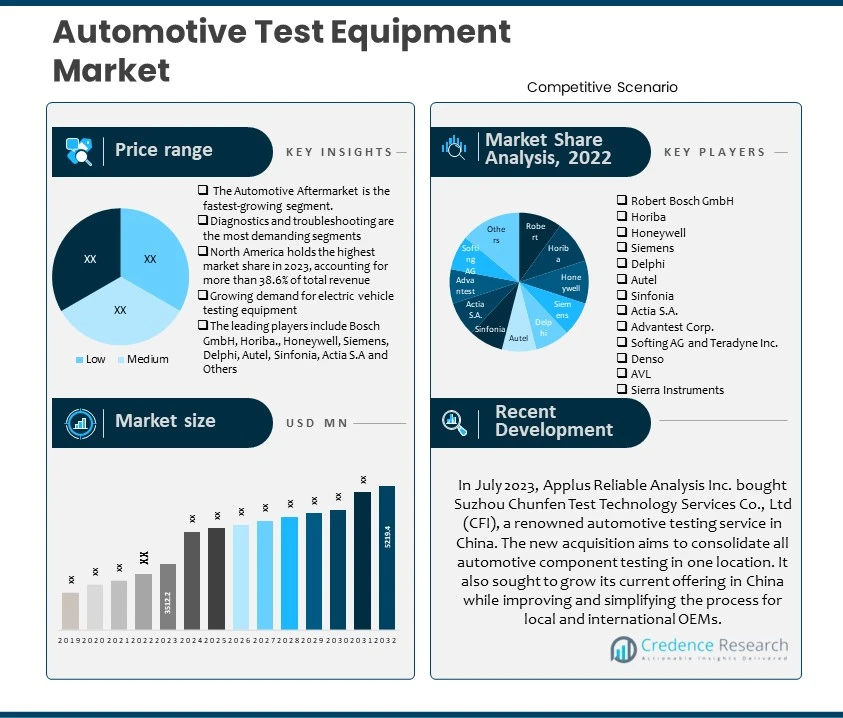
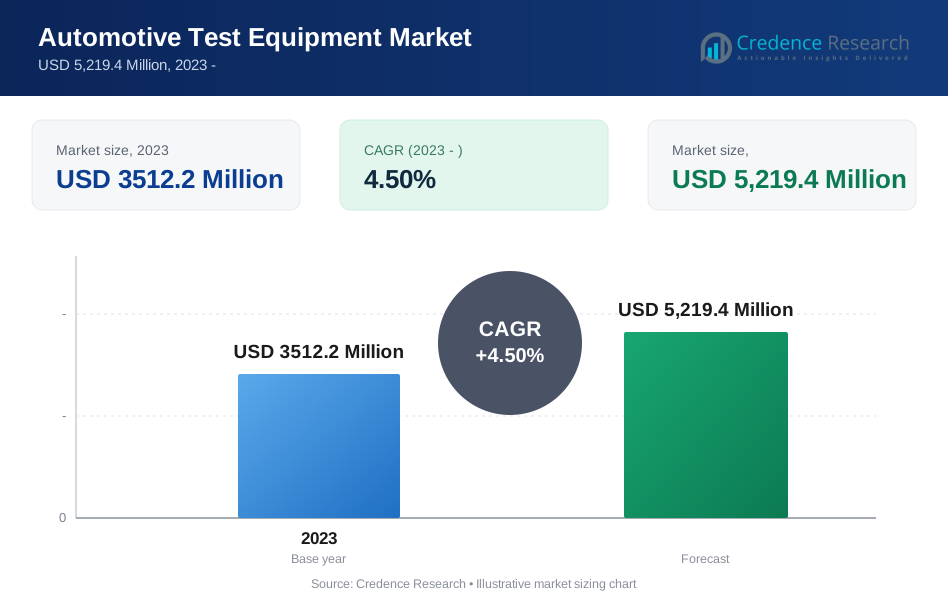
- The global demand for Automotive Test Equipment was valued at USD 3512.2 Million in 2023 and is expected to reach USD 5219.4 Million in 2032, growing at a CAGR of 4.50% between 2024 and 2032.
- In 2023, the chassis dynamometer had the most revenue share, and the vehicle emission test system is predicted to be the fastest-growing segment of the automotive test equipment market by 2032.
- In 2023, passenger cars had the largest market share.
- The Automotive Aftermarket is the fastest growing segment.
- The popular segment is On-Board Diagnostics (OBD) Test Equipment, and Portable Test Equipment is another important portion of the automotive test equipment market.
- Diagnostics and troubleshooting are the most demanding categories, while vehicle inspection and certification are important components of the automotive test equipment industry.
- North America has the largest market share in 2023, accounting for more than 38.6% of total revenue, followed by Europe. Asia-Pacific Automotive Test Equipment Market is expected to grow at the fastest CAGR between 2024 and 2032.
- The growing need for electric cars (EVs) and autonomous vehicles (AVs) is predicted to dramatically boost market demand.
- The high cost of automobile test equipment restricts industry growth.
Executive Summary
Market Definition
The Automotive Test Equipment Market is the industry that manufactures specialized tools and equipment used to test and diagnose automobile systems and components. Diagnostic scanners, emission testers, engine analyzers, oscilloscopes, and wheel alignment systems are examples of the equipment available in this sector. automobile test equipment is required by automobile technicians, mechanics, and manufacturers to guarantee the proper operation and performance of vehicles. It aids in finding and fixing problems, doing performance testing, and assuring regulatory compliance. The increasing complexity of vehicle systems is pushing the automotive test equipment market, the requirement for precise diagnostics, and the growing need for vehicle safety and efficiency.
Market Overview
The global Automotive Test Equipment Market has witnessed steady growth in recent years and is expected to grow at a CAGR of 4.50% between 2024 and 2032. The market was valued at USD 3512.2 million in 2023 and is expected to reach USD 5219.4 million in 2032.
The Automotive Test Equipment Market is a competitive and fast-growing business that supplies critical tools and equipment for testing and diagnosing automotive systems. The requirement for reliable diagnostics and quick testing solutions has increased dramatically as modern automobiles have become more sophisticated. Diagnostic scanners, emission tests, engine analyzers, oscilloscopes, and wheel alignment systems are among the several tools used in automotive testing. Automotive workers, mechanics, and manufacturers utilize these instruments to guarantee that vehicles run smoothly and perform properly. The market is being pushed by factors such as the demand for better diagnostic capabilities, regulatory compliance, and the increased emphasis on vehicle safety and efficiency. Furthermore, technical improvements, such as the incorporation of artificial intelligence and connection elements into test equipment, are driving market expansion. The Automotive Test Equipment Market is predicted to increase more as the automotive sector evolves and wants more complex testing solutions.
Segmentation by Testing Type
- In 2023, the chassis dynamometer had the largest revenue share. This is due to low-cost production and a growth in the number of automotive manufacturing facilities in emerging countries. It also helps to determine the general operation of a vehicle's drivetrain and is commonly used for pollution testing and mileage accumulation.
- However, the vehicle emission test system is expected to become the fastest-growing area of the automotive test equipment market by 2032.
Segmentation by End-Use Application
- In 2023, the passenger car category had the highest market share. By 2032, the category is predicted to maintain its dominance as the market for automotive test equipment grows at the quickest rate. Customers' increasing spending power, combined with rising demand for passenger vehicles in developed and emerging markets, have all contributed to category growth.
Segmentation by Power Source
- The Automotive Aftermarket is the fastest-growing segment. It is the market for automotive parts, accessories, and services sold after the vehicle has been sold by the original equipment manufacturer (OEM).
Segmentation by Technology
- The popular segment is On-Board Diagnostics (OBD) Test Equipment. OBD test equipment is commonly used to diagnose and troubleshoot automobile problems by connecting to the vehicle's onboard computer system. It enables technicians to diagnose and resolve issues with engine performance, emissions, and other vehicle systems.
- Portable Test Equipment is another key part of the automotive test equipment industry. Portable test equipment provides the benefit of mobility and flexibility, allowing personnel to conduct tests and diagnostics on cars in a variety of places.
Segmentation by Application
- Diagnostics and troubleshooting are the most demanding segments. Diagnostics and troubleshooting equipment are critical for finding and addressing problems with vehicle systems, resulting in maximum performance and safety. As vehicles become more modern and complex, there is an increasing requirement for precise and efficient diagnostic technologies.
- Vehicle Inspection and Certification is an important component of the automotive test equipment market. This section includes equipment for performing comprehensive inspections and certifications to guarantee that vehicles satisfy regulatory standards and criteria.
Segmentation by Region
- North America holds the highest market share in 2023, accounting for more than 38.6% of total revenue.
- The Europe Automotive Test Equipment Market has the second-largest market share, and the Asia-Pacific Automotive Test Equipment Market is projected to grow at the fastest CAGR between 2024 and 2032.
- The rest of the world, including Latin America, the Middle East, and Africa, supplies the remaining demand for Automotive Test Equipment.
North America is the largest market for automotive test equipment, accounting for a sizable share of the global market. The region has several major automakers and automotive testing businesses, and there is a strong emphasis on vehicle safety and emissions regulations. As a result, there is a high need for both traditional and new automotive testing equipment.
The Europe Automotive Test Equipment Market has the second-largest market share due to the acceptance of safety certifications. Furthermore, the German Automotive Test Equipment Market had the biggest market share, while the UK Automotive Test Equipment Market was the fastest expanding market in Europe.
The Asia-Pacific Automotive Test Equipment Market is estimated to develop at the quickest CAGR between 2024 and 2032. This is owing to low production costs and the availability of cheap manpower. Furthermore, China's Automotive Test Equipment Market had the highest market share, while India's Automotive Test Equipment Market was the fastest expanding market in the Asia-Pacific region.
Key Highlights of the Report
Testing Type, End-Use Application, Form, Technology, Technology, and region segment of the global Automotive Test Equipment Market. In 2023, passenger cars had the largest market share and chassis dynamometer. In addition, the popular segment is On-Board Diagnostics (OBD) Test Equipment, with Vehicle Inspection and Certification being a key component. Also, diagnostics and troubleshooting are the most demanding sectors, with North America leading the market growth.
The primary market drivers are increasing vehicle system complexity, a growing focus on vehicle safety and efficiency, and technological breakthroughs driving innovation in test equipment. Furthermore, the market's significant limitations include the high cost of modern test equipment, a lack of experienced personnel to operate and interpret test findings, and potential issues in adapting to fast-evolving automotive technology.
Nonetheless, North America is the largest market for automotive test equipment, accounting for a sizable share of the global market. The Europe Automotive Test Equipment Market has the second-largest market share, and the Asia-Pacific Automotive Test Equipment Market is expected to develop at the fastest CAGR between 2024 and 2032.
What Are The Main Drivers Of The Global Automotive Test Equipment Market?
Several factors drive the Automotive Test Equipment Market. The increasing complexity of vehicle systems has created a need for accurate diagnostics. With advanced technologies and intricate components, automotive technicians rely on sophisticated test equipment to identify and troubleshoot issues effectively. Additionally growing focus on vehicle safety and efficiency. As automotive manufacturers strive to meet regulatory standards and customer expectations, the demand for reliable testing solutions has surged.
What Are The Major Challenges Faced By The Global Automotive Test Equipment Market?
While the Automotive Test Equipment Market shows promising growth, it also faces certain restraints. One major restraint is the high cost of advanced test equipment. The development and implementation of cutting-edge technologies in test equipment can be expensive, making it challenging for small-scale businesses or independent technicians to invest in such equipment. Additionally, there is a shortage of skilled technicians who can operate and interpret test results accurately. The complexity of modern vehicle systems requires specialized knowledge and training, and the industry needs to address this skill gap to leverage the potential of automotive test equipment fully.
What Are The Growth Opportunities In The Global Automotive Test Equipment Market?
The Automotive Test Equipment Market presents several opportunities for growth and innovation. One significant opportunity lies in the rising demand for electric vehicle testing equipment. With the increasing adoption of electric vehicles, there is a need for specialized test equipment to diagnose and evaluate the unique components and systems of these vehicles. Another opportunity arises from the integration of artificial intelligence and connectivity features in automotive test equipment. AI-powered diagnostics and real-time data analysis can enhance the accuracy and efficiency of testing processes.
Market Drivers
Several factors drive the global Automotive Test Equipment Market. The following are the key drivers of the global Automotive Test Equipment Market:
Increasing Need for Electric Vehicles (EVs) and Autonomous Vehicles (AVs)
Equipment testing is critical for evaluating the performance of electric and hybrid vehicles, which includes battery systems, electric motors, charging infrastructure, and powertrain integration. Electric vehicles rely on batteries to provide power. Testing automotive equipment is critical for determining the performance, capacity, and safety of batteries. This includes evaluations of battery range, charging efficiency, thermal management, and durability.
As battery technology for electric vehicles advances, testing equipment must also evolve to keep up. Original Equipment Manufacturers (OEMs) are introducing turnkey solutions for testing strong batteries. For instance, in September 2023, E.A. Elektro introduced a compact automated battery cycler and test equipment to improve the testing of higher-powered EV batteries. The test system uses a CANbus interface to control an environmental chamber and connect with a battery management system. It also includes drag-and-drop software.
Market Restraints
The global Automotive Test Equipment Market faces some challenges that may hinder its growth. These include the following:
High Cost of Automotive Test Equipment
Automotive equipment testing can be prohibitively expensive, making it difficult for small and medium-sized enterprises to enter the market. This is a pretty intricate process. It must be tested on a wide range of components and systems in a variety of environments, necessitating the employment of expensive technologies and materials, increasing the cost of the equipment.
Furthermore, it must be capable of accurately measuring and recording data. This precision necessitates the use of high-quality components and assembly procedures, which raises the overall manufacturing cost of automobile test equipment. All these factors are hindering the expansion of the automotive test equipment market.
Opportunities
The global Automotive Test Equipment Market offers significant growth opportunities. These include the following:
Increased Adoption of Advanced Technologies in the Automotive Industry
Identifying the source of emissions and creating means to detect and analyze them are critical in the automotive sector. Developing a sensor technology to match these requirements and collect data on various gases is critical for avoiding losses caused by accidental emissions. The Internet of Things (IoT) is expected to play a crucial role in addressing the issue of reliable car emission detection. Emission sensors and other equipment that communicate over IoT networks can alarm when dangerous emissions are detected in a moving vehicle. With the improved capabilities of IoT technology, emission testing equipment in the automotive industry is likely to increase in the coming years.
Competitive Landscape
Key Players
The global Automotive Test Equipment Market is highly competitive, with several key players. Some of the major players in the market and their market share are as follows:
- Robert Bosch GmbH
- Horiba
- Honeywell
- Siemens
- Delphi
- Autel
- Sinfonia
- Actia S.A.
- Advantest Corp.
- Softing AG and Teradyne Inc.
- Denso
- AVL
- Sierra Instruments and others.
These organizations prioritize product innovation, Form expansion, and mergers and acquisitions to stay competitive.
The global Automotive Test Equipment Market's key players continually seek to stay ahead by offering new products and developments.
In June 2022, HORIBA UK collaborated with Sentronics to launch HORIBA RealFlow, an ultrasonic fuel usage sensor for the vehicle market. The sensor measures gasoline usage in real time for automotive validation and verification test applications.
In July 2022, Softing Automotive Electronics, a wholly owned subsidiary of Softing AG, secured a contract from a luxury car manufacturer in southern Germany to develop and supply a manufacturing system for diagnosing and parameterizing automobiles in production.
In February 2021, HORIBA announced the extension of its automation capabilities, STARS VETS, for electrified vehicles and real-world emissions testing. STARS VETS is part of HORIBA's STARS Automation platform, which improves test cell efficiency and usability.
In November 2021, Continental announced the availability of its Qualification Lab services to external partners. Continental's US-based Qualification Labs, located in Deer Park, Illinois, and Detroit, Michigan, offer testing and analytical services for product development. Companies can collaborate with Continental on testing in research, development, and production.
Summary of Key Findings
- Increased adoption of advanced technologies in the automobile industry.
- Testing Type, End-Use Application, form, Technology, technology, and region segment of the market.
- The popular segment is On-Board Diagnostics (OBD) Test Equipment,
- The Automotive Aftermarket is the fastest growing segment.
- North America is leading market growth; the market is highly competitive with key players Robert Bosch GmbH, Horiba., Honeywell, Siemens, Delphi, Autel, Sinfonia, Actia S.A and Others.
Future Outlook
- Increasing adoption of advanced diagnostic technologies
- Growing demand for electric vehicle testing equipment
- Integration of artificial intelligence and connectivity features in test equipment
- Rising focus on vehicle safety and efficiency
- Expansion of the automotive industry in emerging markets
- Technological advancements driving innovation in test equipment
How CXOs Can Benefit from the Credence Research Automotive Test Equipment Market Report
The Credence Research Automotive Test Equipment Market Report provides CXOs with a comprehensive overview of the market, including:
- Market size and growth forecast: The report provides detailed estimates of the global Automotive Test Equipment Market size, segmented by Testing Type, End-Use Application, Form, Technology, Technology, and Region. It also includes forecasts for the market through 2032 based on key trends and drivers.
- Market segmentation: The report segments the Automotive Test Equipment Market by Testing Type, End-Use Application, Form, Technology, Technology, and Region. This segmentation provides CXOs with a granular understanding of the market and the opportunities in each segment.
- Competitive Landscape: The report profiles the key players in the Automotive Test Equipment Market and provides insights into their strategies, product offerings, and financial performance. This information can help CXOs to identify and assess their competition.
- Key trends and drivers: The report identifies and analyzes the key trends and drivers shaping the Automotive Test Equipment Market. This information can help CXOs make informed decisions about their investments and strategies.
CXOs can use the insights from the Credence Research Automotive Test Equipment Market Report to:
- Identify growth opportunities: The report can help CXOs identify new growth opportunities in the Automotive Test Equipment Market. For example, it may provide insights into emerging technologies and trends in automotive testing, allowing companies to invest in innovative test equipment or expand their services to meet the changing demands of the market.
- Make informed investment decisions: The report can help CXOs to make informed investment decisions about Automotive Test Equipment. For example, it can provide valuable insights into market trends, growth potential, and key players in the industry.
- Develop competitive strategies: The report can help CXOs to develop competitive strategies for their Automotive Test Equipment businesses. For example, the report may highlight the growing demand for electric vehicle testing equipment, allowing CXOs to focus their efforts on developing and marketing innovative solutions in this specific segment.
- Track market developments: The report can help CXOs to track market developments and stay ahead of the curve. For example, the report provides insights into the latest trends and innovations in the Automotive Test Equipment Market.
Overall, the Credence Research Automotive Test Equipment Market Report is a valuable resource for CXOs who are looking to gain a deeper understanding of the market and identify opportunities for growth.
Segmentation
By Testing Type:
- Engine Test Equipment
- Chassis Dynamometers
- Vehicle Emissions Testing Equipment
- Transmission Test Equipment
- Vehicle Dynamics Test Equipment
- Powertrain Test Equipment
- Fuel System Test Equipment
By Vehicle Type:
- Passenger Cars
- Commercial Vehicles
By End-Use Application:
- Automotive OEMs (Original Equipment Manufacturers)
- Automotive Aftermarket
By Technology:
- On-Board Diagnostics (OBD) Test Equipment
- Portable Test Equipment
- Portable Test Equipment
- Manual Test Equipment
By Application:
- Vehicle Inspection and Certification
- Performance Testing
- Diagnostics and Troubleshooting
- Environmental Testing
By Region
- North America
- The U.S.
- Canada
- Mexico
- Europe
- Germany
- France
- The U.K.
- Italy
- Spain
- Rest of Europe
- Asia Pacific
- China
- Japan
- India
- South Korea
- South-east Asia
- Rest of Asia Pacific
- Latin America
- Brazil
- Argentina
- Rest of Latin America
- Middle East & Africa
- GCC Countries
- South Africa
- Rest of Middle East and Africa
Request a Free Sample
Fill in your details and we'll send you a free sample report.
- Sample data tables & charts
- Research methodology
Need a Custom Version of This Report?
Tailor the scope, geography, or segments to your exact requirements.
- Custom geography or segment scope
- Direct access to our analyst team
Frequently Asked Questions
What is the current size of the global Automotive Test Equipment Market?
What is the expected growth rate of the Automotive Test Equipment Market between 2024 and 2032?
Which segment is leading the market share in terms of Testing Type?
Which Application segment governs the demand for Automotive Test Equipment in the world?
What are the major market restraints of the Automotive Test Equipment industry?
Table of Content
Chapter 1. Report Introduction
- 1.1 Report Description & Purpose
- 1.1.1 Report Title & Market Definition
- 1.1.2 Unique Selling Propositions (USP) & Key Differentiators
- 1.1.3 Value Proposition for Stakeholders
- 1.2 Research Objectives
- 1.2.1 Market Sizing Objectives (Volume & Revenue)
- 1.2.2 Segmentation Objectives
- 1.2.3 Competitive Intelligence Objectives
- 1.2.4 Forecast & Scenario Objectives
- 1.3 Report Scope
- 1.3.1 Automotive Test Equipment Scope – Types & Subtypes Covered
- 1.3.2 Geographic Scope – Regions & Countries Covered
- 1.3.3 Historical Period, Base Year & Forecast Period (2023; forecast to the forecast period)
- 1.3.4 Inclusions & Exclusions
- 1.4 HS Code & Classification Framework
- 1.5 Currency, Units & Pricing Basis
- 1.6 Target Stakeholders
- 1.7 Limitations & Assumptions
Chapter 2. Executive Summary
- 2.1 Global Automotive Test Equipment Market Snapshot
- 2.1.1 Market Size – Historical (2023) & Forecast (the forecast period) (2023: USD 3512.2 Million → forecast year: USD 5,219.4 Million)
- 2.1.2 Volume & Revenue – Global Totals
- 2.1.3 Key Market Highlights – Top Five Facts
- 2.2 Automotive Test Equipment Market Segmentation Snapshot
- 2.2.1 Market Split by Region – 2023 vs.
- 2.3 Competitive Snapshot
- 2.3.1 Top 10 Players by Revenue Share – 2023
- 2.3.2 Top 10 Players by Volume Share – 2023
- 2.3.3 Recent Strategic Developments (18-Month Summary)
- 2.4 Key Investment Highlights & Strategic Conclusions
Chapter 3. Automotive Test Equipment Market Dynamics & Industry Analysis
- 3.1 Market Overview & Context
- 3.1.1 Automotive Test Equipment Market Position in the Broader Automotive Value Chain
- 3.1.2 OEM vs. Replacement Market Dynamics
- 3.1.3 Market Maturity & Development Stage by Region
- 3.2 Automotive Test Equipment Market Drivers
- 3.3 Automotive Test Equipment Market Restraints & Challenges
- 3.4 Automotive Test Equipment Market Opportunities
- 3.5 Porter's Five Forces Analysis
- 3.5.1 Threat of New Entrants
- 3.5.2 Bargaining Power of Suppliers
- 3.5.3 Bargaining Power of Buyers
- 3.5.4 Threat of Substitutes
- 3.5.5 Competitive Rivalry – Intensity Assessment
- 3.6 Automotive Test Equipment Value Chain Analysis
- 3.6.1 Upstream – Raw Material/Input Suppliers
- 3.6.1.1 Raw Material/Input 1
- 3.6.1.2 Raw Material/Input 2
- 3.6.1.3 Raw Material/Input 3
- 3.6.2 Midstream – Production/Manufacturing/Service Delivery
- 3.6.2.1 Production/Process Overview
- 3.6.2.2 Key Facility Locations & Capacity by Manufacturer
- 3.6.3 Downstream – Distribution & End Consumer
- 3.6.3.1 Primary Channel – B2B/OEM
- 3.6.3.2 Secondary Channels – Dealer, Retail, Online, Direct
- 3.6.4 Value Chain Profitability Analysis
- 3.6.1 Upstream – Raw Material/Input Suppliers
- 3.7 PESTEL Analysis
- 3.7.1 Political Factors
- 3.7.2 Economic Factors
- 3.7.3 Social Factors
- 3.7.4 Technological Factors
- 3.7.5 Environmental Factors
- 3.7.6 Legal Factors
- 3.8 Automotive Test Equipment Supply Chain Analysis
- 3.8.1 Raw Material/Input Supply Risk Assessment
- 3.8.2 Manufacturing Concentration Risk (Geographic Exposure)
- 3.8.3 Trade Disruption Impact Analysis
- 3.9 Regulatory & Policy Landscape
Note: The regulatory and policy landscape section covers regulations based on their applicability to the market, Automotive Test Equipment category, geography, and scope of the study. Only regulatory frameworks with a material impact on operations, compliance, trade, sustainability, or market access are analyzed in detail.
Chapter 4. Key Investment Pockets & Opportunity Analysis
- 4.1 Automotive Test Equipment Market Attractiveness Analysis
- 4.1.1 By Region – Investment Attractiveness Matrix (Volume × CAGR)
- 4.2 Absolute Revenue Growth Opportunity
- 4.2.1 By Region – Absolute USD Growth Through the forecast period
- 4.3 Incremental Volume Opportunity
- 4.3.1 By Region – Incremental Volume Through the forecast period
- 4.3.2 Segment – Incremental Volume
- 4.4 Emerging Submarket Opportunity Deep Dive (Subject to Applicability)
- 4.5 Emerging Market Opportunity Scorecards
- 4.5.1 United States
- 4.5.2 Europe
- 4.5.3 Asia
- 4.5.4 Middle East & Africa
Note: Emerging Market Opportunity Scorecards will be included based on relevance and strategic importance. Regions listed are indicative and may vary depending on data availability and market dynamics.
Chapter 5. Automotive Test Equipment Import-Export Analysis & Trade Flows
- 5.1 Global Trade Overview
- 5.1.1 Global Export Value by Country (2023)
- 5.1.2 Global Export Volume by Country (2023)
- 5.1.3 Global Import Value by Country (2023)
- 5.1.4 Global Import Volume by Country (2023)
- 5.1.5 Net Trade Balance by Country (2023)
- 5.2 Export Analysis – Segment
- 5.2.1 Type 1 (HS Code)
- 5.2.2 Type 2 (HS Code)
- 5.2.3 Type 3 (HS Code)
- 5.2.4 Type 4 (HS Code)
- 5.2.5 Type 5 (HS Code)
- 5.3 Import Analysis – Segment
- 5.3.1 Type 1 (HS Code)
- 5.3.2 Type 2 (HS Code)
- 5.3.3 Type 3 (HS Code)
- 5.3.4 Type 4 (HS Code)
- 5.3.5 Type 5 (HS Code)
- 5.4 Average Unit Trade Prices
- 5.4.1 Average Export Price – Segment & Country
- 5.4.2 Average Import Price – Segment & Source Country
- 5.4.3 Price Trends (2023)
- 5.5 Key Trade Route Analysis
- 5.5.1 Trade Route 1
- 5.5.2 Trade Route 2
- 5.5.3 Trade Route 3
- 5.5.4 Trade Route 4
- 5.5.5 Trade Route 5
- 5.6 Trade Policy Impact Assessment
- 5.6.1 US Anti-Dumping & Section 301 Tariffs
- 5.6.2 EU Customs Union Impact
- 5.6.3 Major Free Trade Agreements
- 5.6.4 USMCA Rules of Origin
Note: Trade policy analysis will be included only where relevant to the Automotive Test Equipment market.
Chapter 6. Competitive Landscape & Company Benchmarking
- 6.1 Automotive Test Equipment Market Concentration & Structure
- 6.1.1 Herfindahl-Hirschman Index (HHI) – vs. 2023
- 6.1.2 Tier 1, Tier 2 & Tier 3 Market Structure
- 6.1.3 Global, Regional & Local Player Dynamics
- 6.2 Automotive Test Equipment Market Share Analysis – 2023
- 6.2.1 Global Revenue Share by Company
- 6.2.2 Global Volume Share by Company
- 6.2.3 Regional Revenue Share
- 6.2.4 Market Share Evolution ( vs. 2023)
- 6.2.5 OEM Segment Share by Company
- 6.2.6 Replacement Segment Share by Company
- 6.3 Production/Delivery Capacity & Facility Analysis
- 6.3.1 Global Installed Capacity
- 6.3.2 Capacity Utilization Rates
- 6.3.3 Production/Output Volume
- 6.3.4 Facility Locations & Capacity Map
- 6.3.5 Planned Capacity Additions
- 6.4 Automotive Test Equipment Competitive Benchmarking Matrix
- 6.4.1 Revenue, Volume, CAGR & Profitability Comparison
- 6.4.2 Channel Revenue Mix
- 6.4.3 Geographic Revenue Exposure
- 6.4.4 R&D Intensity
- 6.4.5 Sustainability Maturity
- 6.5 Strategic Developments in Automotive Test Equipment (Last 24 Months)
- 6.5.1 Mergers, Acquisitions & Divestments
- 6.5.2 New Automotive Test Equipment Launches
- 6.5.3 Facility Expansions
- 6.5.4 Strategic Alliances, Joint Ventures & Partnerships
- 6.5.5 Distribution Expansion & Market Entry
- 6.5.6 Sustainability & ESG Initiatives
- 6.6 Competitive Strategy Mapping
- 6.6.1 Leader, Challenger, Follower & Niche Classification
- 6.6.2 Pricing Strategy Comparison
- 6.6.3 Channel Strategy Matrix
Note: Strategic developments are included based on their materiality and the availability of reliable information.
Chapter 7. Global Automotive Test Equipment Market – By Distribution Channel
- 7.1 Segment Overview
- 7.1.1 Volume & Revenue Split by Channel (2023 & )
- 7.1.2 Channel Mix Evolution (the forecast period)
Chapter 8. Regional Market Analysis – Global Overview
- 8.1 Global Regional Overview
- 8.1.1 Regional Volume Share
- 8.1.2 Regional Revenue Share
- 8.1.3 Regional Volume by Region
- 8.1.4 Regional Revenue by Region
- 8.1.5 Regional Forecast Through the forecast period
- 8.2 Cross-Regional Segment Analysis
- 8.2.1 By Distribution Channel
- 8.2.2 By Brand/Price Tier
Chapter 9. North America Automotive Test Equipment Market
- 9.1 United States
- 9.2 Canada
- 9.3 Mexico
Chapter 10. Europe Automotive Test Equipment Market
- 10.1 Germany
- 10.2 France
- 10.3 Italy
- 10.4 United Kingdom
- 10.5 Spain
- 10.6 Poland
- 10.7 Russia
- 10.8 Netherlands
- 10.9 Belgium
- 10.10 Sweden
- 10.11 Denmark
- 10.12 Norway
- 10.13 Rest of Europe
Chapter 11. Asia Pacific Automotive Test Equipment Market
- 11.1 China
- 11.2 India
- 11.3 Japan
- 11.4 South Korea
- 11.5 Thailand
- 11.6 Indonesia
- 11.7 Vietnam
- 11.8 Malaysia
- 11.9 Australia
- 11.10 Rest of Asia Pacific
Chapter 12. Latin America Automotive Test Equipment Market
- 12.1 Brazil
- 12.2 Argentina
- 12.3 Colombia
- 12.4 Chile
- 12.5 Rest of Latin America
Chapter 13. Middle East Automotive Test Equipment Market
- 13.1 Saudi Arabia
- 13.2 United Arab Emirates
- 13.3 Turkey
- 13.4 Israel
- 13.5 Iran
- 13.6 Rest of the Middle East
Chapter 14. Africa Automotive Test Equipment Market
- 14.1 South Africa
- 14.2 Egypt
- 14.3 Nigeria
- 14.4 Morocco
- 14.5 Rest of Africa
Chapter 15. Automotive Test Equipment Company Profiles
- 15.1 [Company 01]
- 15.1.1 Company Overview
- 15.1.2 Key Management Personnel
- 15.1.3 Products & Services Portfolio
- 15.1.4 Financial Performance
- 15.1.5 Key Market Focus & Geographic Presence
- 15.1.6 Recent Developments & Strategic Initiatives
Note: The company profile list is preliminary and may change based on research findings, market developments, data availability, and client requirements.
Chapter 16. Appendices
- Appendix A – List of Abbreviations & Acronyms
- Appendix B – Industry Classification Code Reference – Full Series
- Appendix C – Production & Capacity Data Tables
- Appendix D – End-Use & Demand Base Tables
- Appendix E – Consumption & Replacement Rate Assumptions
- Appendix F – ASP Reference Tables
- Appendix G – Manufacturing & Facility Database
- Appendix H – Import-Export Data Tables
- Appendix I – Regulatory Summary Tables
- Appendix J – Primary Research Participant List (Anonymized)
- Appendix K – Primary Research Questionnaire Framework
- Appendix L – Data Sources & Bibliography
- Appendix M – Market Size Divergence & Source Comparison
Chapter 17. Research Methodology
- 17.1 Research Framework & Philosophy
- 17.2 Secondary Research – Sources, Hierarchy & Data Extraction
- 17.3 Data Modeling – Bottom-Up & Top-Down Market Sizing
- 17.4 Primary Research – Stakeholder Framework, LOI & Sample Sizes
- 17.5 Forecast Methodology – Regression, Scenario & Sensitivity Analysis
- 17.6 Quality Control – Four-Layer Validation Framework
- 17.7 Limitations & Standard Assumptions
- 17.8 Disclaimer
