| REPORT ATTRIBUTE | DETAILS |
|---|---|
| Historical Period | 2019-2022 |
| Base Year | 2023 |
| Forecast Period | 2024-2032 |
| Bicycle Tire Market Price Market Size 2023 | USD 6,587.12 Million |
| Bicycle Tire Market Price Market , CAGR | 6.00% |
| Bicycle Tire Market Price Market Size 2032 | USD 11,128.80 Million |
Market Overview
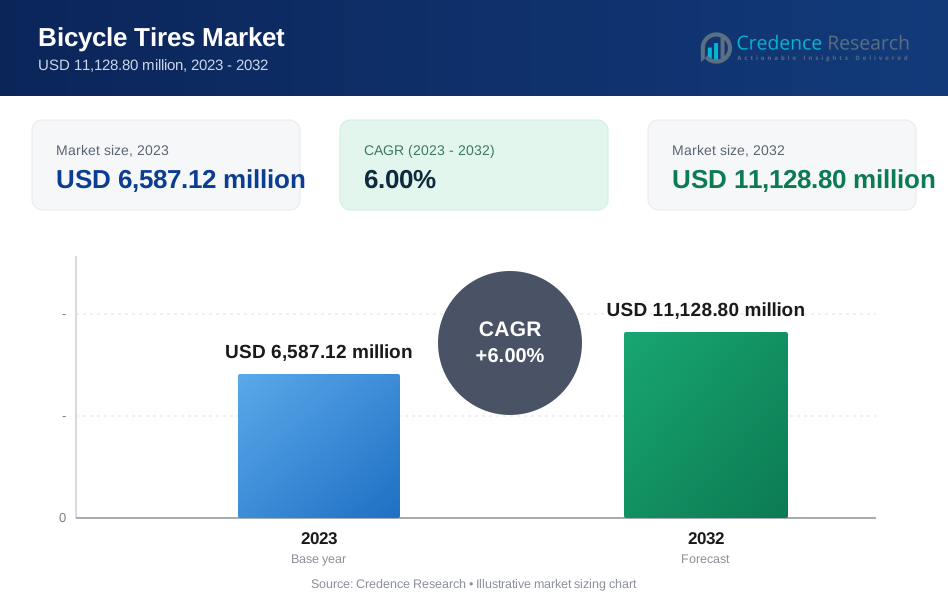
The bicycle tire market is projected to grow from USD 6,587.12 million in 2023 to an estimated USD 11,128.80 million by 2032, with a compound annual growth rate (CAGR) of 6.00% from 2024 to 2032. This robust growth is driven by the increasing popularity of cycling as a recreational activity, coupled with the rising awareness of health and environmental benefits associated with cycling.
Key market drivers include the growing trend of e-bikes, which require specialized tires, and the expanding urban cycling infrastructure across many cities worldwide. The demand for high-performance tires for competitive cycling and off-road biking is also on the rise, contributing to market expansion. Additionally, the increasing focus on sustainability is pushing manufacturers to develop eco-friendly and recyclable tire materials, further influencing market dynamics.
Geographically, the Asia-Pacific region dominates the market, driven by high bicycle usage in countries like China and India. Europe and North America are also significant markets, with strong growth potential due to the rising adoption of cycling for fitness and commuting. Key players in the bicycle tire market include Continental AG, Michelin, Vittoria, Maxxis International, and Kenda Rubber Industrial Co. Ltd., all of whom are focusing on innovation and expanding their product portfolios to cater to the diverse needs of cyclists.
Market Drivers
Rising Popularity of Cycling as a Health and Fitness Activity
Surveys conducted by health organizations and fitness trackers have shown a significant increase in the number of people taking up cycling for exercise and recreation in recent years. For instance, data from popular cycling apps indicates a surge in new users and ride tracking, especially since the onset of the COVID-19 pandemic. Government health departments in several countries have reported an uptick in bicycle sales and usage, correlating with increased interest in outdoor activities and personal fitness. Fitness industry reports highlight cycling as one of the fastest-growing exercise trends, with many gyms and fitness centers adding indoor cycling classes to meet demand. Additionally, bicycle manufacturers have noted a rise in sales of entry-level and mid-range bicycles, suggesting an influx of new cyclists. This trend is further supported by data from bicycle-sharing programs in major cities, which have experienced substantial growth in ridership. The increasing adoption of cycling for health and fitness is driving demand for a wide range of bicycle tires, from those designed for casual riders to more specialized options for enthusiasts.
Growth in Urbanization and Infrastructure Development
Urban planning reports from cities worldwide showcase a growing emphasis on cycling infrastructure development. For instance, transportation departments in numerous metropolitan areas have documented significant increases in the total length of dedicated bike lanes and paths constructed annually. Bicycle advocacy groups have compiled data showing a correlation between improved cycling infrastructure and increased bicycle usage in urban areas. City-sponsored surveys reveal rising numbers of residents using bicycles for daily commutes, particularly in areas with newly developed cycling routes. Public transportation authorities have reported growing integration of bicycle facilities with mass transit systems, including bike parking at stations and bike racks on buses. Environmental impact studies conducted by local governments highlight the positive effects of increased cycling on air quality and traffic congestion in urban centers. Additionally, real estate market analyses indicate that proximity to cycling infrastructure is becoming a desirable feature for urban property buyers, reflecting the growing importance of cycling in urban lifestyles. These trends collectively demonstrate the impact of urbanization and infrastructure development on the bicycle tire market.
Technological Advancements and Innovation in Tire Manufacturing
Industry reports from bicycle component manufacturers highlight substantial investments in research and development for tire technology. Patent databases show an increase in filings related to innovative tire materials and designs, indicating active innovation in the sector. Consumer surveys conducted by cycling publications reveal growing interest in and adoption of advanced tire technologies, such as tubeless systems and puncture-resistant compounds. Professional cycling teams and events have reported performance improvements attributed to new tire technologies, influencing consumer preferences in the broader market. Bicycle retailers have noted shifts in sales patterns, with higher-end, technologically advanced tires gaining market share. Environmental organizations have recognized efforts by tire manufacturers to develop more sustainable and eco-friendly products, responding to consumer demand for greener options. Additionally, tech industry reports indicate emerging collaborations between tire manufacturers and technology companies to integrate smart features into bicycle tires. These trends collectively demonstrate how technological advancements and innovation are shaping the bicycle tire market and driving consumer demand for more sophisticated products.
Increasing Adoption of E-Bikes and Specialized Tires
The rising popularity of electric bikes (e-bikes) is significantly contributing to the growth of the bicycle tire market. E-bikes, which combine traditional pedaling with an electric motor, are becoming increasingly popular, especially in urban areas where they offer a convenient and efficient mode of transportation. E-bikes require specialized tires that can handle the additional weight and higher speeds associated with electric assistance. These tires are typically designed with reinforced sidewalls, stronger casings, and improved tread patterns to ensure safety and durability under different riding conditions. As the e-bike market continues to expand, particularly in Europe and Asia, the demand for these specialized tires is expected to grow. Moreover, the trend towards e-bikes is also driving innovation in tire technology, as manufacturers seek to develop products that cater specifically to the unique requirements of electric-assisted cycling. The increasing adoption of e-bikes is thus a key driver of growth in the bicycle tire market, as it creates new opportunities for manufacturers to offer differentiated products that meet the evolving needs of cyclists.
Market Trends
Growing Demand for Sustainable and Eco-Friendly Tires
One of the most prominent trends in the global bicycle tire market is the increasing demand for sustainable and eco-friendly products. As environmental awareness rises among consumers, there is a growing preference for bicycle tires made from sustainable materials and processes. Manufacturers are responding to this trend by developing tires that use natural rubber, recycled materials, and biodegradable components. For instance, Continental has introduced its Urban Taraxagum bicycle tire, made from dandelion rubber as an alternative to traditional rubber trees. Michelin has also launched a concept tire made from 100% sustainable materials. Additionally, the shift towards more sustainable manufacturing processes, such as reducing water and energy consumption during production, is gaining momentum. This trend is not only driven by consumer preferences but also by regulatory pressures in various regions, where governments are encouraging the adoption of environmentally friendly practices. The European Tyre and Rubber Manufacturers' Association reports that the tire industry in Europe has reduced its carbon dioxide emissions by over 25% since 1990. As sustainability continues to be a key focus, manufacturers offering eco-friendly tire options are likely to gain a competitive advantage.
Rising Popularity of Tubeless and Puncture-Resistant Tires
Another significant trend in the global bicycle tire market is the increasing popularity of tubeless and puncture-resistant tires. Tubeless tires, which eliminate the need for an inner tube, offer several advantages, including reduced risk of punctures, lower rolling resistance, and a smoother ride. These tires are particularly favored by mountain bikers and competitive cyclists who require reliable performance on challenging terrains. The demand for puncture-resistant tires is also on the rise, especially among urban commuters who encounter various road hazards. For example, Schwalbe's Marathon Plus tire, known for its exceptional puncture resistance, has become increasingly popular among commuters. Manufacturers are developing advanced tire technologies, such as integrating Kevlar belts and other protective layers, to enhance puncture resistance while maintaining tire flexibility and performance. According to a survey conducted by Cycling UK, over 60% of regular cyclists consider puncture resistance as a crucial factor when choosing bicycle tires. This trend is indicative of a broader consumer shift towards durability and reliability in bicycle tires, as cyclists seek products that offer longevity and reduce the need for frequent replacements.
Market Restraints and Challenges
Fluctuating Raw Material Prices and Supply Chain Disruptions
One of the major challenges facing the global bicycle tire market is the volatility in raw material prices, particularly rubber, which is a primary component in tire manufacturing. The prices of natural and synthetic rubber are subject to fluctuations due to factors such as changes in global demand, weather conditions affecting rubber plantations, and geopolitical tensions. For instance, data from the Association of Natural Rubber Producing Countries has shown significant price volatility in recent years, impacting production costs for manufacturers. Additionally, the bicycle tire industry has been affected by supply chain disruptions, particularly in the wake of the COVID-19 pandemic. A survey by the National Bicycle Dealers Association found that many retailers experienced inventory shortages and delayed shipments during this period. These disruptions have been exacerbated by global logistics challenges, including container shortages and increased shipping costs. The World Container Index reported record-high container freight rates in 2021, further straining supply chains. The combination of fluctuating raw material prices and supply chain uncertainties poses a significant restraint on the market's growth, as manufacturers struggle to maintain cost efficiency while meeting demand.
Intense Competition and Market Saturation
The global bicycle tire market is highly competitive, with a large number of established players and new entrants vying for market share. This intense competition has led to market saturation in certain regions, particularly in developed markets like North America and Europe, where bicycle ownership rates are already high. For instance, data from the European Cyclists' Federation shows that countries like the Netherlands and Denmark have bicycle ownership rates exceeding 100%, indicating market maturity. In these saturated markets, manufacturers face the challenge of differentiating their products in an environment where price competition is fierce. A study by Bicycle Retailer and Industry News highlighted the increasing pressure on profit margins for both manufacturers and retailers. Moreover, the rapid pace of technological advancements means that companies must continuously innovate to stay ahead. The Bicycle Product Suppliers Association reports that research and development spending in the industry has been steadily increasing. Smaller manufacturers, in particular, may find it challenging to compete with larger, well-established brands that have greater resources and economies of scale. This competitive pressure, coupled with market saturation in key regions, poses a significant challenge for manufacturers looking to expand their market presence and maintain profitability.
Market Segmentation Analysis
By Type
The global bicycle tire market is segmented into various types catering to different cycling needs. Mountain bike tires lead the segment due to the rising popularity of mountain biking as both a recreational and competitive sport. For instance, a survey by the Outdoor Foundation found that mountain biking participation has grown steadily in recent years, with millions of Americans engaging in the activity annually. These tires offer enhanced grip and durability for rugged terrains. Hybrid bike tires are also gaining traction, balancing speed and comfort for both on-road and off-road cycling. The rapid adoption of electric bikes (e-bikes) is driving growth in the e-bike tire segment. For example, the European Cyclists' Federation reported significant increases in e-bike sales across multiple European countries. E-bike tires are designed to handle additional weight and speed with reinforced sidewalls and improved tread patterns. Comfort bike tires, providing smooth rides with better shock absorption, are increasingly popular among casual cyclists. Niche segments like BMX, folding bike, and road racing bike tires continue to see steady demand, particularly in regions with established cycling cultures like the Netherlands and Denmark.
By Product
The bicycle tire market is segmented by product into tube tires, tubeless tires, and solid tires. Traditional tube tires continue to dominate the market due to their cost-effectiveness and widespread availability. A study by the National Bicycle Dealers Association showed that tube tires remain the most common type sold in bike shops across North America. However, tubeless tires are gaining significant traction, particularly among serious cyclists who value performance and puncture resistance. For example, a survey conducted by a leading cycling magazine found that a growing number of professional cyclists and enthusiasts are switching to tubeless setups for both road and mountain biking. Tubeless tires offer benefits like lower rolling resistance and the ability to run at lower pressures, making them ideal for mountain biking and competitive cycling. Solid tires, while a niche product, are essential for specific applications where puncture resistance is paramount. For instance, bike-sharing programs in several major cities have adopted solid tires to reduce maintenance costs and improve reliability for urban riders.
Segments
Based on Type
- Mountain Bike Tires
- Hybrid Bike Tires
- Electric Bike Tire
- Comfort Bike Tires
- Others
Based on Product
- Tube Tires
- Tubeless Tires
- Solid Tires
Based on Tire Size
- Up to 12 Inches
- 12 to 22 Inches
- Above 22 Inches
Based on Distribution Channel
- OEM (Original Equipment Manufacturer)
- Aftermarket
Based on Region
- North America
- The U.S
- Canada
- Mexico
- Europe
- Germany
- France
- The U.K.
- Italy
- Spain
- Rest of Europe
- Asia Pacific
- China
- Japan
- India
- South Korea
- South-east Asia
- Rest of Asia Pacific
- Latin America
- Brazil
- Argentina
- Rest of Latin America
- Middle East & Africa
- GCC Countries
- South Africa
- Rest of Middle East and Africa
Regional Analysis
Asia-Pacific (45%):
Asia-Pacific is the largest and fastest-growing region in the global bicycle tire market, holding approximately 45% of the total market share. This dominance is primarily driven by the high usage of bicycles in countries like China, India, and Japan. For instance, government surveys indicate that bicycles remain a common mode of transportation in many Asian cities. China, as the world's largest bicycle producer and consumer, shows robust demand for bicycle tires due to widespread use for daily commuting and growing e-bike popularity. India also contributes significantly, supported by its large population and increasing urbanization. Government initiatives promoting cycling as sustainable transportation further propel growth in the region.
Europe (25%):
Europe accounts for approximately 25% of the global bicycle tire market. The region has a well-established cycling culture, particularly in countries like the Netherlands, Denmark, and Germany. For instance, studies show that cycling is a primary mode of transportation in many European cities. Growing awareness of health and environmental benefits associated with cycling, coupled with extensive infrastructure, drives demand for high-quality bicycle tires. European surveys indicate a surge in e-bike adoption, requiring specialized tires. Government data reveals active promotion of cycling through policies and infrastructure investments across Europe, supporting continued expansion of the bicycle tire market in this region.
Key players
- Cheng Shin Rubber Ind Co., Ltd.
- HUTCHINSON
- Trek Bicycle Corporation
- The Goodyear Tire & Rubber Company
- Specialized Bicycle Components
- MICHELIN
- Mitas
- Pirelli & C. S.p.A.
- Sales Footprint
- Giant Bicycles
- Sales Footprint
- Continental AG
Competitive Analysis
The global bicycle tire market is highly competitive, with key players such as Cheng Shin Rubber Ind Co., Ltd., Continental AG, and MICHELIN leading the market through innovation, extensive product portfolios, and strong global distribution networks. Companies like HUTCHINSON and Specialized Bicycle Components focus on high-performance tires catering to professional and recreational cyclists, enhancing their market position. The Goodyear Tire & Rubber Company and Pirelli & C. S.p.A. leverage their expertise in automotive tires to expand into the bicycle segment, offering advanced tire technologies. Trek Bicycle Corporation and Giant Bicycles, known for their complete bicycle solutions, also dominate the tire market by integrating tire development with their bicycle offerings. With a strong emphasis on research and development, these companies are continuously innovating to meet the evolving demands of cyclists, which positions them competitively in the market.
Recent Developments
- In May 2023, Cheng Shin Rubber Ind. Co., Ltd. announced changes to its board, with Lo, Tsai-Jen appointed as the new vice chairman, effective May 31, 2023.
- On July 19, 2024, Hutchinson acquired Midé Technology Corporation. Midé is an advanced engineering company specializing in smart material technology and mechatronics, serving various markets including automotive and aerospace.
- In August 2024, Goodyear launched a new summer tire called EfficientGrip Compact 2, aimed at serving specific market segments.
- In April 2024, Mitas announced a global price increase of up to 5% across all tire segments, effective from May 2024. This decision was made in response to significant inflation and rising costs of raw materials and logistics.
- In 2023, Pirelli launched 6 new High Value products, including 4 global lines focusing on EV, SUV, and racing tires, and 2 All-Season tires dedicated to North American customers.
Market Concentration and Characteristics
The global bicycle tire market is moderately concentrated, with a mix of well-established multinational corporations and specialized regional players. Market leaders such as Continental AG, Cheng Shin Rubber Ind Co., Ltd., and MICHELIN dominate through extensive product lines, advanced tire technologies, and strong global distribution networks. These key players hold significant market shares, leveraging their brand reputation, innovation, and economies of scale to maintain competitive advantages. The market is characterized by intense competition, particularly in the high-performance and e-bike segments, where innovation and technological advancements are critical. Despite the presence of these dominant players, the market also accommodates smaller, niche companies that cater to specific regional demands or specialized tire types, contributing to a diverse and dynamic competitive landscape.
Report Coverage
The research report offers an in-depth analysis based on Type, Product, Tire Size, Distribution Channel and Region. It details leading market players, providing an overview of their business, product offerings, investments, revenue streams, and key applications. Additionally, the report includes insights into the competitive environment, SWOT analysis, current market trends, as well as the primary drivers and constraints. Furthermore, it discusses various factors that have driven market expansion in recent years. The report also explores market dynamics, regulatory scenarios, and technological advancements that are shaping the industry. It assesses the impact of external factors and global economic changes on market growth. Lastly, it provides strategic recommendations for new entrants and established companies to navigate the complexities of the market.
Future Outlook
- The global bicycle tire market is expected to maintain steady growth, driven by increasing adoption of cycling for health, recreation, and commuting across the globe.
- As the popularity of electric bikes (e-bikes) continues to surge, the demand for specialized tires designed to handle the higher speeds and weights of e-bikes will significantly increase.
- Ongoing advancements in tire materials, such as the use of sustainable and lightweight composites, will enhance tire performance, durability, and environmental impact, pushing market growth.
- The continued investment in urban cycling infrastructure worldwide will promote bicycle use, particularly in metropolitan areas, thereby boosting demand for durable and versatile tires.
- Growing environmental awareness will drive the development and adoption of eco-friendly bicycle tires made from recyclable and biodegradable materials, catering to the green consumer segment.
- Emerging economies in Asia, Latin America, and Africa are expected to contribute significantly to market expansion as urbanization, disposable incomes, and cycling adoption rates rise.
- Premium brands offering high-performance and technologically advanced tires are likely to expand their market share, especially in developed regions where cycling culture is well-established.
- Future bicycle tires will increasingly incorporate safety features such as enhanced puncture resistance and reflective sidewalls, responding to the growing consumer demand for safer cycling experiences.
- As consumers seek more personalized cycling experiences, manufacturers will offer a wider range of customizable tire options tailored to specific riding conditions and preferences.
- In response to past disruptions, companies will focus on optimizing global supply chains to ensure the steady availability of raw materials and finished products, stabilizing prices and meeting rising demand.
Request a Free Sample
Fill in your details and we'll send you a free sample report.
- Sample data tables & charts
- Research methodology
Market Dynamics
Rising Popularity of Cycling as a Health and Fitness Activity
The increasing number of people taking up cycling for exercise and recreation, supported by health trends and fitness industry growth, is driving demand for a wide range of bicycle tires for both casual and enthusiast riders.
Growth in Urbanization and Infrastructure Development
Expanding urban cycling infrastructure, such as dedicated bike lanes and integration with public transit, is making cycling a more viable commuting option, thereby boosting the need for durable and specialized bicycle tires.
Technological Advancements and Innovation in Tire Manufacturing
Investments in R&D have led to the development of advanced tire technologies, including tubeless systems and puncture-resistant compounds, which are attracting both professional and recreational cyclists seeking higher performance and reliability.
Increasing Adoption of E-Bikes and Specialized Tires
The surge in e-bike popularity, especially in urban areas, is creating demand for tires specifically designed to handle the higher speeds and weights of electric bikes, prompting manufacturers to innovate and expand their product offerings.
Growing Demand for Sustainable and Eco-Friendly Tires
Rising environmental awareness among consumers and regulatory pressures are encouraging manufacturers to develop bicycle tires using sustainable materials and processes, leading to increased adoption of eco-friendly tire options.
Need a Custom Version of This Report?
Tailor the scope, geography, or segments to your exact requirements.
- Custom geography or segment scope
- Direct access to our analyst team
Frequently Asked Questions
What is the projected growth of the global bicycle tire market?
What are the key drivers of growth in the bicycle tire market?
Which region dominates the global bicycle tire market?
What are the major trends in the bicycle tire market?
Who are the leading players in the global bicycle tire market?
Table of Content
Chapter 1 Market Segmentation
- 1.1 Segmentation Framework
- 1.1.1 Product and Service Classification
- 1.1.2 Application and End-Use Classification
- 1.1.3 Technology and Solution Classification
- 1.1.4 Customer and Distribution Channel Classification
- 1.1.5 Geographic Segmentation
- 1.1.6 Market Segment Definitions and Boundaries
- 1.2 By Type
- 1.2.1 Mountain Bike Tires
- 1.2.2 Hybrid Bike Tires
- 1.2.3 Electric Bike Tire
- 1.2.4 Comfort Bike Tires
- 1.2.5 Others
- 1.3 By Product
- 1.3.1 Tube Tires
- 1.3.2 Tubeless Tires
- 1.3.3 Solid Tires
- 1.4 By Tire Size
- 1.4.1 Up to 12 Inches
- 1.4.2 12 to 22 Inches
- 1.4.3 Above 22 Inches
Chapter 2 Introduction
- 2.1 Report Objectives and Scope
- 2.2 Product Definition and Industry Terminology
- 2.3 Market Inclusions and Exclusions
- 2.4 Research Process
- 2.4.1 Primary Research and Expert Interviews
- 2.4.2 Secondary Research and Source Review
- 2.4.3 Top-Down and Bottom-Up Estimation
- 2.4.4 Data Triangulation and Verification
- 2.5 Market Size Measurement Basis
- 2.5.1 2023: USD 6,587.12 million → 2032: USD 11,128.80 million
- 2.6 Historical and Forecast Reference Periods
- 2.6.1 Base Year: 2023
- 2.6.2 Forecast Period: 2023-2032
- 2.7 Research Assumptions and Limitations
Chapter 3 Executive Summary
- 3.1 Market Snapshot and Key Findings
- 3.2 Base-Year Market Size, 2023
- 3.3 Forecast Market Size, 2032
- 3.4 Revenue and Volume Growth Outlook
- 3.5 Key Demand and Supply Indicators
- 3.6 Leading Market Segments
- 3.7 Fastest-Growing Market Opportunities
- 3.8 Regional Performance Highlights
- 3.9 Technology and Industry Transformation
- 3.10 Competitive Landscape Summary
- 3.11 Analyst View and Strategic Implications
Chapter 4 Global Bicycle Tires Market Trends and Developments
- 4.1 Historical Industry Development
- 4.2 Recent Market Trends and Developments
- 4.3 Demand and Customer Behavior Trends
- 4.4 Technology and Product Innovation
- 4.5 Artificial Intelligence, Automation and Digitalization
- 4.6 Local Manufacturing and Supply Chain Realignment
- 4.7 Industry Partnerships, Mergers and Acquisitions
- 4.8 Sustainability and Circular Economy Developments
- 4.9 Government and Private Sector Investment Trends
- 4.10 Emerging Business Models and Commercialization
- 4.11 Industry Developments and Announcements
Chapter 5 Global Bicycle Tires Market Production, Supply and Demand Analysis
- 5.1 Demand Trend and Consumption Analysis
- 5.2 Demand Forecast, 2023-2032
- 5.3 Production and Output Trend
- 5.4 Production and Output Forecast, 2023-2032
- 5.5 Installed Capacity and Capacity Utilization
- 5.6 Company-Wise Production Plants and Statistics
- 5.6.1 Installed Production Capacity
- 5.6.2 Actual Production
- 5.6.3 Planned Capacity and Expansion Targets
- 5.7 Supply Chain Structure and Procurement Trends
- 5.8 Supply-Demand Gap and Bottlenecks
- 5.9 Import Dependence and Sourcing Structure
- 5.10 Contract Manufacturing and Outsourcing
- 5.11 Regional Supply and Demand Concentration
Chapter 6 Global Bicycle Tires Market Pricing Analysis
- 6.1 Pricing Structure and Measurement
- 6.2 Historical Pricing Trends
- 6.3 Pricing Outlook, 2023-2032
- 6.4 Average Selling Price and Unit Economics
- 6.5 Pricing by Product and Market Segment
- 6.6 Geographic Pricing Differences
- 6.7 Key Input, Energy, Labor and Logistics Costs
- 6.8 Contract Pricing and Purchasing Models
- 6.9 Pricing Sensitivity and Competitive Positioning
- 6.10 Price, Margin and Profitability Implications
Chapter 7 Global Bicycle Tires Market Dynamics
- 7.1 Market Growth Drivers
- 7.1.1 Demand-Side Drivers
- 7.1.2 Technology and Innovation Drivers
- 7.1.3 Infrastructure and Investment Drivers
- 7.1.4 Regulatory and Policy Drivers
- 7.2 Market Restraints
- 7.2.1 Cost and Affordability Constraints
- 7.2.2 Technology and Adoption Barriers
- 7.2.3 Supply Chain and Operational Constraints
- 7.3 Market Challenges
- 7.3.1 Competitive Pressure and Margin Erosion
- 7.3.2 Skills, Infrastructure and Implementation Gaps
- 7.4 Emerging Market Opportunities
- 7.5 Market Dynamics Impact and Time-Horizon Assessment
Chapter 8 Global Bicycle Tires Value Chain Analysis
- 8.1 Industry Value Chain Overview
- 8.2 Upstream Suppliers and Critical Inputs
- 8.3 Technology and Component Providers
- 8.4 Manufacturing or Service Delivery
- 8.5 Distribution, Channel Partners and Integrators
- 8.6 Downstream Applications and End Users
- 8.7 Value Addition and Profit Pools
- 8.8 Vertical Integration and Outsourcing
- 8.9 Supplier Concentration and Risk
- 8.10 Supply Chain Localization and Resilience
Chapter 9 Global Bicycle Tires Market Regulations and Policies
- 9.1 Relevant Laws, Standards and Compliance Frameworks
- 9.2 Product, Service, Safety and Quality Requirements
- 9.3 Government Policies, Incentives and Subsidies
- 9.4 Imports, Exports and Trade Barriers
- 9.5 Public Procurement and Local Content Requirements
- 9.6 Environmental and Sustainability Compliance
- 9.7 Upcoming Policy Changes and Market Implications
Chapter 10 Global Bicycle Tires Market Hotspots and Opportunities
- 10.1 Market Opportunity Mapping and Growth Hotspots
- 10.2 High-Growth Applications and Customer Groups
- 10.3 Underserved Markets and White-Space Opportunities
- 10.4 Emerging Technology and Product Opportunities
- 10.5 New Capacity and Investment Hotspots
- 10.6 Market Entry and Expansion Opportunities
- 10.7 Distribution and Partnership Opportunities
- 10.8 Near-Term and Long-Term Commercial Potential
- 10.9 Opportunity Attractiveness and Execution Risks
Chapter 11 Global Bicycle Tires Market Outlook, 2023-2032
- 11.1 Market Size and Analysis
- 11.1.1 Revenue (Market Measurement: 2023: USD 6,587.12 million → 2032: USD 11,128.80 million)
- 11.1.2 Market Volume and Quantity Sold
- 11.1.3 Historical Market Size
- 11.1.4 Base-Year Market Size, 2023
- 11.2 Market Forecast, 2023-2032
- 11.2.1 Revenue Forecast to 2032
- 11.2.2 Volume Forecast to 2032
- 11.2.3 CAGR and Year-on-Year Growth
- 11.2.4 Incremental Revenue Opportunity
- 11.3 Forecast Assumptions and Scenario Analysis
- 11.3.1 Base-Case Forecast
- 11.3.2 Optimistic and Conservative Scenarios
- 11.3.3 Technology, Pricing and Policy Sensitivities
- 11.4 Market Attractiveness and Growth Outlook
Chapter 12 Global Bicycle Tires Market Segmentation and Outlook
- 12.1 Segmentation Summary and Market Shares, 2023
- 12.2 Largest and Fastest-Growing Segments
- 12.3 By Type - Market Size and Forecast, 2023-2032
- 12.3.1 Segment Definition and Scope
- 12.3.2 Historical Market Size
- 12.3.3 Revenue Forecast, 2023-2032
- 12.3.4 Volume Forecast, 2023-2032
- 12.3.5 Base-Year Market Share, 2023
- 12.3.6 Segment CAGR and Growth Drivers
- 12.3.7 Subsegment Market Size and Forecast
- 12.3.7.1 Mountain Bike Tires
- 12.3.7.2 Hybrid Bike Tires
- 12.3.7.3 Electric Bike Tire
- 12.3.7.4 Comfort Bike Tires
- 12.3.7.5 Others
- 12.3.8 Subsegment Pricing and Adoption Trends
- 12.3.9 Leading Suppliers and Competition
- 12.3.10 Regional Demand and Opportunities
- 12.4 By Product - Market Size and Forecast, 2023-2032
- 12.4.1 Segment Definition and Scope
- 12.4.2 Historical Market Size
- 12.4.3 Revenue Forecast, 2023-2032
- 12.4.4 Volume Forecast, 2023-2032
- 12.4.5 Base-Year Market Share, 2023
- 12.4.6 Segment CAGR and Growth Drivers
- 12.4.7 Subsegment Market Size and Forecast
- 12.4.7.1 Tube Tires
- 12.4.7.2 Tubeless Tires
- 12.4.7.3 Solid Tires
- 12.4.8 Subsegment Pricing and Adoption Trends
- 12.4.9 Leading Suppliers and Competition
- 12.4.10 Regional Demand and Opportunities
- 12.5 By Tire Size - Market Size and Forecast, 2023-2032
- 12.5.1 Segment Definition and Scope
- 12.5.2 Historical Market Size
- 12.5.3 Revenue Forecast, 2023-2032
- 12.5.4 Volume Forecast, 2023-2032
- 12.5.5 Base-Year Market Share, 2023
- 12.5.6 Segment CAGR and Growth Drivers
- 12.5.7 Subsegment Market Size and Forecast
- 12.5.7.1 Up to 12 Inches
- 12.5.7.2 12 to 22 Inches
- 12.5.7.3 Above 22 Inches
- 12.5.8 Subsegment Pricing and Adoption Trends
- 12.5.9 Leading Suppliers and Competition
- 12.5.10 Regional Demand and Opportunities
- 12.6 Segment Growth Comparison
- 12.7 Segment Attractiveness and Priority Matrix
Chapter 13 Global Bicycle Tires Geographic Market Outlook, 2023-2032
- 13.1 Regional Market Size and Share, 2023
- 13.2 Regional Market Forecast, 2023-2032
- 13.3 Regional Pricing, Production and Demand Differences
- 13.4 North America
- 13.4.1 United States
- 13.4.2 Canada
- 13.4.3 Mexico
- 13.5 Europe
- 13.5.1 Germany
- 13.5.2 France
- 13.5.3 Italy
- 13.5.4 United Kingdom
- 13.5.5 Spain
- 13.5.6 Poland
- 13.5.7 Russia
- 13.5.8 Netherlands
- 13.5.9 Belgium
- 13.5.10 Sweden
- 13.5.11 Denmark
- 13.5.12 Norway
- 13.5.13 Rest of Europe
- 13.6 Asia Pacific
- 13.6.1 China
- 13.6.2 India
- 13.6.3 Japan
- 13.6.4 South Korea
- 13.6.5 Thailand
- 13.6.6 Indonesia
- 13.6.7 Vietnam
- 13.6.8 Malaysia
- 13.6.9 Australia
- 13.6.10 Rest of Asia Pacific
- 13.7 Latin America
- 13.7.1 Brazil
- 13.7.2 Argentina
- 13.7.3 Colombia
- 13.7.4 Chile
- 13.7.5 Rest of Latin America
- 13.8 Middle East
- 13.8.1 Saudi Arabia
- 13.8.2 United Arab Emirates
- 13.8.3 Turkey
- 13.8.4 Israel
- 13.8.5 Iran
- 13.8.6 Rest of the Middle East
- 13.9 Africa
- 13.9.1 South Africa
- 13.9.2 Egypt
- 13.9.3 Nigeria
- 13.9.4 Morocco
- 13.9.5 Rest of Africa
- 13.10 Regional Investment, Policy and Supply Chain Differences
- 13.11 Regional Competitive Landscape
- 13.12 Geographic Growth Hotspots
Chapter 14 Global Bicycle Tires Technology, Innovation and Sustainability Outlook
- 14.1 Technology Landscape and Maturity
- 14.2 Product, Process and Service Innovation
- 14.3 AI, Automation and Digital Tools in the Industry
- 14.4 Technology Adoption and Performance Benchmarking
- 14.5 Innovation Pipeline and R&D Investment
- 14.6 Patent and Intellectual Property Trends
- 14.7 Energy Efficiency and Resource Management
- 14.8 Sustainability, Recycling and Circularity
- 14.9 Technology Roadmap, 2023-2032
- 14.10 Risks of Obsolescence and Technology Substitution
Chapter 15 Global Bicycle Tires Market Key Strategic Imperatives
- 15.1 Growth and Market Entry Priorities
- 15.2 High-Return Products and Segments
- 15.3 Pricing, Profitability and Cost Optimization
- 15.4 Technology Investment and Product Differentiation
- 15.5 Supply Chain Localization and Resilience
- 15.6 Distribution and Customer Acquisition
- 15.7 Partnership, Acquisition and Capacity Strategy
- 15.8 Regional Expansion Priorities
- 15.9 Short-, Medium- and Long-Term Actions
Chapter 16 Competition Outlook
- 16.1 Industry Competition Characteristics
- 16.2 Market Structure and Concentration
- 16.3 Market Share and Competitive Positioning, 2023
- 16.4 Company-Wise Revenue and Product Benchmarking
- 16.5 Production and Service Capacity Benchmarking
- 16.6 Technology, Pricing and Differentiation
- 16.7 Regional Footprint and Distribution Strength
- 16.8 Mergers, Acquisitions and Strategic Alliances
- 16.9 New Entrants and Competitive Threats
- 16.10 Porter's Five Forces and Industry Attractiveness
- 16.11 Competitive Outlook, 2023-2032
Chapter 17 Company Profiles
- 17.1 Company Coverage and Selection Criteria
- 17.2 Continental AG
- 17.2.1 Business Description
- 17.2.2 Company Ownership and Geographic Presence
- 17.2.3 Product and Service Portfolio
- 17.2.4 Manufacturing and Operating Footprint
- 17.2.5 Production Capacity and Expansion Plans
- 17.2.6 Financial Performance and Investment
- 17.2.7 Market Share and Competitive Position
- 17.2.8 Technology and Innovation Capabilities
- 17.2.9 Strategic Alliances or Partnerships
- 17.2.10 Recent Developments
- 17.2.11 Growth Strategy and Outlook
- 17.3 MICHELIN
- 17.4 Cheng Shin Rubber Ind Co., Ltd.
- 17.5 HUTCHINSON
- 17.6 The Goodyear Tire & Rubber Company
- 17.7 Specialized Bicycle Components
- 17.8 Pirelli & C. S.p.A.
- 17.9 Mitas
- 17.10 Trek Bicycle Corporation
- 17.11 Giant Bicycles
- 17.12 Other Relevant Market Participants
Note: Every listed company is profiled on the structure shown under the first company. The company list is preliminary and may change based on research findings, market developments, data availability and client requirements.
Chapter 18 Disclaimer
- 18.1 Research and Forecast Disclaimer
- 18.2 Data Source and Estimation Limitations
Note: The depth of individual sections depends on data availability for this market. Volume, capacity, trade and other unit-based metrics are included where applicable.