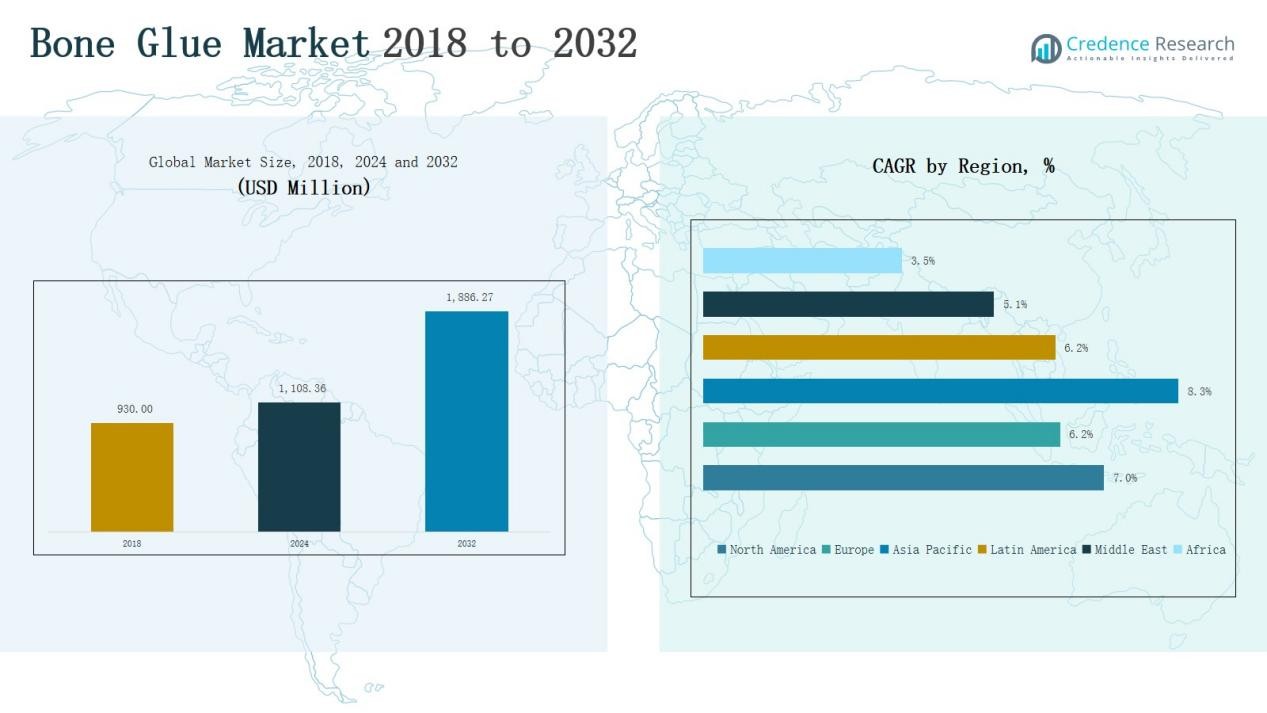
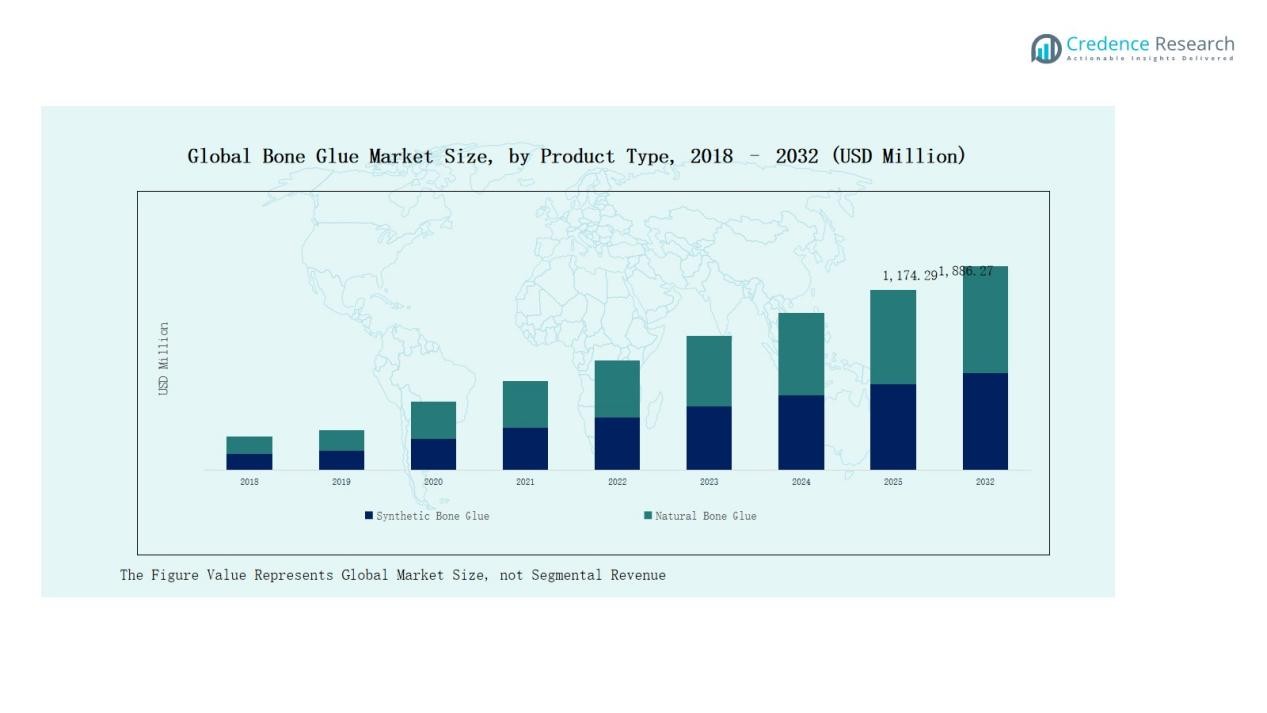
Bone Glue Market size was valued at USD 930.00 million in 2018, reached USD 1,108.36 million in 2024, and is anticipated to reach USD 1,886.27 million by 2032, at a CAGR of 7.01% during the forecast period.
| REPORT ATTRIBUTE | DETAILS |
|---|---|
| Historical Period | 2020-2023 |
| Base Year | 2024 |
| Forecast Period | 2025-2032 |
| Bone Glue Market Size 2024 | USD 1,108.36 Million |
| Bone Glue Market, CAGR | 7.01% |
| Bone Glue Market Size 2032 | USD 1,886.27 Million |
The Bone Glue Market is shaped by prominent players such as Cryolife, St. Jude Medical, Integra Lifesciences Corporation, Johnson & Johnson, B. Braun Melsungen AG, Cohera Medical Inc., LaunchPad Medical, Chemence Medical Inc., DENTSPLY SIRONA Inc., Baxter International Inc., and Tissuemed Ltd. These companies compete through product innovation, strategic partnerships, and advancements in biomaterials to strengthen their market presence. Among regions, North America led the market in 2024 with a 37.9% share, driven by advanced healthcare infrastructure, strong adoption of synthetic adhesives, and favorable reimbursement policies.
Market Insights
- The Bone Glue Market grew from USD 930.00 million in 2018 to USD 1,108.36 million in 2024 and is projected to reach USD 1,886.27 million by 2032 at a 7.01% CAGR.
- Synthetic bone glue held over 60% share in 2024, driven by strong biocompatibility, adhesive strength, reduced infection risks, and rising adoption in orthopedic and trauma surgeries.
- The orthopedic application segment led with 35% share in 2024, supported by aging populations, fracture cases, and demand for minimally invasive bone fixation procedures globally.
- Hospitals accounted for nearly 50% share in 2024, benefiting from advanced surgical infrastructure, large patient inflow, and greater access to innovative adhesive solutions.
- North America led with 37.9% share in 2024, valued at USD 420.73 million, supported by advanced healthcare systems, high orthopedic cases, and strong adoption of synthetic adhesives.
Market Segment Insights
By Product Type
Synthetic bone glue accounted for the dominant share of over 60% in 2024 due to its superior adhesive strength, biocompatibility, and consistent performance in surgical applications. Surgeons prefer synthetic formulations as they reduce infection risks and offer faster recovery. Growing investments in biomaterial innovations and rising adoption in advanced orthopedic and trauma surgeries further strengthen this segment’s position. Natural bone glue continues to serve niche uses but faces challenges in scalability and long-term stability.
- For instance, Johnson & Johnson’s Ethicon division expanded its lineup of synthetic adhesive technologies, focusing on formulations designed to improve wound closure and postoperative recovery.
By Application
The orthopedic segment held the largest share at 35% in 2024, supported by the growing burden of bone fractures, degenerative disorders, and an aging population. Increasing demand for minimally invasive procedures drives greater use of bone glue in fracture fixation and bone grafting. Arthroplasty and trauma applications follow closely, reflecting rising hip and knee replacements and accident-related injuries. Expanding sports medicine and spine surgeries also contribute to demand, but orthopedic procedures remain the leading revenue generator.
- For instance, Medtronic utilizes its StealthStation surgical navigation system to improve minimally invasive spine and vertebral compression fracture treatments performed with its Kyphon bone cement delivery systems.
By End-user
Hospitals captured nearly 50% of the market share in 2024, driven by advanced surgical infrastructure, skilled orthopedic surgeons, and higher patient inflow for complex procedures. Hospitals dominate adoption due to their access to innovative bone adhesives and capacity for large-volume surgeries, including trauma and arthroplasty cases. Specialty clinics are expanding steadily with outpatient services and targeted treatments, while ASCs gain momentum as cost-effective care providers, particularly in developed markets, offering quicker turnaround and reduced hospitalization costs.
Key Growth Drivers
Rising Prevalence of Bone-Related Disorders
The increasing incidence of bone fractures, osteoporosis, and degenerative bone diseases fuels demand for bone glue. Aging populations in developed and emerging regions are especially prone to fractures and joint conditions requiring surgical intervention. This rising patient base boosts adoption of bone adhesives as an alternative to traditional fixation methods. Improved clinical outcomes and reduced recovery times further accelerate the shift toward bone glue in orthopedic and trauma care settings worldwide.
- For instance, RevBio Inc. initiated a clinical trial in the U.S. for its bone adhesive, Tetranite®, to evaluate its safety and effectiveness in cranial bone defect repairs.
Advancements in Biomaterials and Surgical Technology
Continuous improvements in biomaterial engineering enhance the effectiveness and safety of bone adhesives. Synthetic formulations now offer higher bonding strength, biocompatibility, and faster resorption, making them suitable for complex surgical cases. Surgeons adopt these innovations as they simplify procedures and minimize complications. In addition, robotic and minimally invasive surgeries increasingly incorporate bone glue for precision fixation, widening the application scope. These advancements provide manufacturers with strong opportunities to expand their product portfolios and penetrate new markets.
- For instance, PBC Biomed is leading a consortium to develop a bone adhesive aimed at treating osteoporotic fractures, focusing on reducing operating times and infection risks while promoting tissue regeneration.
Growth in Sports Injuries and Arthroplasty Procedures
Rising participation in sports and physical activities has increased the occurrence of injuries, particularly ligament and bone fractures. Similarly, arthroplasty procedures for hip and knee replacements are expanding rapidly due to lifestyle-related joint disorders. Bone glue plays a vital role in stabilizing implants and repairing injuries in these treatments. Hospitals and specialty clinics prefer adhesives for their ability to speed up patient recovery. The growing demand in these applications establishes a robust driver for market growth.
Key Trends & Opportunities
Shift Toward Minimally Invasive Procedures
Healthcare systems are prioritizing minimally invasive surgeries to reduce hospital stays and recovery periods. Bone glue integrates well into these procedures by offering rapid fixation without bulky hardware. This trend opens opportunities for adhesive-based solutions across orthopedics, arthroplasty, and spine surgeries. Companies investing in minimally invasive compatible adhesives are likely to gain competitive advantage, especially as patients increasingly demand faster healing and less invasive treatment options.
- For instance, Baxter International received FDA clearance for its PerClot absorbable hemostatic powder, intended to support effective blood management during minimally invasive operations.
Expansion in Emerging Healthcare Markets
Rapid growth in healthcare infrastructure across Asia Pacific, Latin America, and the Middle East creates significant opportunities. Rising disposable incomes, improving access to advanced surgeries, and government focus on modernizing hospitals boost adoption of bone glue. Local and international manufacturers benefit from establishing partnerships, expanding distribution networks, and launching cost-effective solutions. These regions are expected to emerge as high-growth markets, with unmet needs in trauma and orthopedic surgeries driving long-term demand.
- For instance, B. Braun Medical cooperated with the Indonesian Ministry of Health to identify training needs for healthcare professionals, following its investments in a new manufacturing facility to boost the local supply of medical products like sterile injections.
Key Challenges
High Cost of Advanced Bone Adhesives
Despite their benefits, synthetic bone glues remain expensive compared to conventional fixation techniques such as screws or plates. Limited reimbursement coverage in several regions further restricts adoption. Smaller hospitals and clinics in cost-sensitive markets often avoid using advanced adhesives due to budget constraints. This price barrier continues to challenge broader market penetration and slows down uptake among developing economies.
Stringent Regulatory Approval Processes
Bone glue products must undergo rigorous safety and efficacy testing before commercialization. Regulatory pathways are lengthy and costly, often delaying product launches. Stringent compliance requirements across regions like the U.S. and Europe also add complexity for manufacturers. These regulatory hurdles increase development timelines and costs, limiting innovation speed and affecting smaller players’ ability to compete with established companies.
Limited Awareness Among Surgeons and Patients
In many regions, surgeons and patients still prefer traditional fixation methods over adhesives due to familiarity and trust. Lack of awareness about the benefits of bone glue, such as reduced recovery time and improved biocompatibility, hampers adoption. Educational efforts, clinical training, and evidence-based demonstrations are needed to overcome this challenge. Without targeted initiatives, the market may experience slower acceptance outside major hospitals and advanced healthcare centers.
Regional Analysis
North America
North America led the Bone Glue Market with a 37.9% share in 2024, valued at USD 420.73 million. The market was worth USD 357.12 million in 2018 and is projected to reach USD 715.09 million by 2032, growing at a CAGR of 7.0%. Strong healthcare infrastructure, high incidence of orthopedic conditions, and rapid adoption of synthetic bone adhesives drive regional growth. The U.S. dominates demand due to advanced surgical procedures and favorable reimbursement policies, consolidating North America’s leadership position in the global market.
Europe
Europe accounted for a 24.6% share in 2024, with market value rising from USD 238.45 million in 2018 to USD 272.85 million in 2024. It is expected to reach USD 437.90 million by 2032 at a CAGR of 6.2%. Growth is supported by an aging population, high rates of hip and knee replacements, and strong presence of medical device manufacturers. Germany, France, and the UK are the leading contributors, driven by robust healthcare systems and growing demand for minimally invasive orthopedic procedures across the region.
Asia Pacific
Asia Pacific captured a 26.0% share in 2024, with market size expanding from USD 229.25 million in 2018 to USD 285.23 million in 2024. By 2032, it is projected to reach USD 535.33 million, advancing at the fastest CAGR of 8.3%. Rising healthcare investments, increasing incidence of sports injuries, and growing access to advanced surgical treatments drive strong demand. China, India, and Japan are key contributors, supported by expanding hospital networks, medical tourism, and higher adoption of innovative biomaterials, positioning Asia Pacific as the fastest-growing region.
Latin America
Latin America held a 7.4% share in 2024, valued at USD 79.13 million, up from USD 66.96 million in 2018. The market is expected to reach USD 126.14 million by 2032 at a CAGR of 6.2%. Growth is driven by expanding healthcare coverage, rising trauma cases, and increased demand for cost-effective surgical solutions. Brazil leads the region, supported by its advanced medical infrastructure, while Mexico and Argentina show growing adoption due to improving access to orthopedic treatments and government-led healthcare initiatives.
Middle East
The Middle East represented a 2.6% share in 2024, valued at USD 28.37 million, compared to USD 26.04 million in 2018. It is projected to reach USD 41.70 million by 2032 with a CAGR of 5.1%. Demand is fueled by healthcare modernization efforts, rising cases of road traffic accidents, and adoption of advanced adhesives in trauma care. GCC countries, especially Saudi Arabia and the UAE, dominate the market due to high healthcare spending, while Turkey shows notable growth supported by expanding orthopedic procedure volumes.
Africa
Africa accounted for a 1.5% share in 2024, valued at USD 22.06 million, up from USD 12.18 million in 2018. The market is projected to reach USD 30.12 million by 2032, recording the slowest CAGR of 3.5%. Limited healthcare access and lower affordability restrict faster adoption. However, increasing awareness of advanced surgical solutions and improving healthcare investments in South Africa and Egypt are driving gradual growth. Demand remains centered in urban hospitals, with rural areas still reliant on traditional treatment methods.
Market Segmentations:
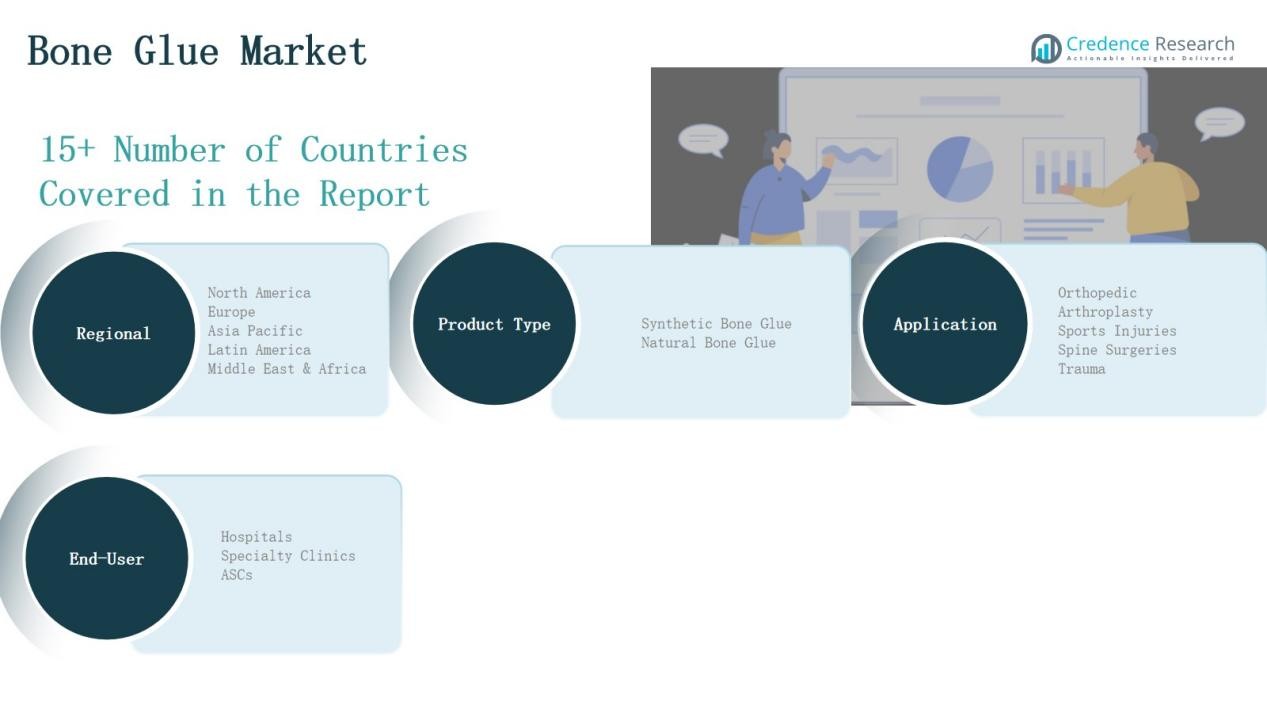
By Product Type
- Synthetic Bone Glue
- Natural Bone Glue
By Application
- Orthopedic
- Arthroplasty
- Sports Injuries
- Spine Surgeries
- Trauma
By End-user
- Hospitals
- Specialty Clinics
- Ambulatory Surgical Centers (ASCs)
By Region
North America
- U.S.
- Canada
- Mexico
Europe
- UK
- France
- Germany
- Italy
- Spain
- Russia
- Rest of Europe
Asia Pacific
- China
- Japan
- South Korea
- India
- Australia
- Southeast Asia
- Rest of Asia Pacific
Latin America
- Brazil
- Argentina
- Rest of Latin America
Middle East
- GCC Countries
- Israel
- Turkey
- Rest of Middle East
Africa
- South Africa
- Egypt
- Rest of Africa
Competitive Landscape
The Bone Glue Market is moderately consolidated, with global and regional players competing through product innovation, partnerships, and portfolio expansion. Leading companies such as Cryolife, St. Jude Medical, Integra Lifesciences, Johnson & Johnson, and B. Braun Melsungen AG dominate with strong brand presence, advanced biomaterial technologies, and broad distribution networks. Emerging players like LaunchPad Medical and Cohera Medical are focusing on specialized adhesives designed for minimally invasive and orthopedic procedures, enhancing competition. Continuous R&D investment remains central, as firms aim to improve bonding strength, biocompatibility, and surgical outcomes. Strategic mergers and acquisitions, such as collaborations with hospitals and research institutions, support market expansion and clinical validation. Meanwhile, cost competitiveness and regulatory compliance shape differentiation, especially for regional firms in Asia Pacific and Latin America. With growing demand in trauma, sports injuries, and arthroplasty, the market remains attractive for both established leaders and innovative startups pursuing high-growth opportunities.
Key Players
- Cryolife
- Jude Medical, Inc.
- Luna Innovations Incorporated
- Integra Lifesciences Corporation
- Johnson & Johnson
- Cohera Medical Inc.
- Braun Melsungen AG
- R. Bard Inc.
- LaunchPad Medical
- Chemence Medical Inc.
- DENTSPLY SIRONA Inc.
- Baxter International Inc.
- Tissuemed Ltd.
Recent Developments
- In 2024, the bone adhesive OsStic®, developed through a collaboration between Dublin City University (DCU) and PBC Biomed, received a Breakthrough Device Designation from the U.S. Food and Drug Administration (FDA).
- In January 2024, Biomimetic Innovations received FDA Breakthrough Device designation for its injectable bone filler.
- In September 2023, HippoFi partnered with Zimmer Biomet to launch a synthetic biomaterial under PUR Biologics.
- In January 2024, Enovis acquired LimaCorporate S.p.A., boosting its footprint in orthopedic biomaterials (which may intersect with adhesive / fixation segments).
Report Coverage
The research report offers an in-depth analysis based on Product Type, Application, End User and Region. It details leading market players, providing an overview of their business, product offerings, investments, revenue streams, and key applications. Additionally, the report includes insights into the competitive environment, SWOT analysis, current market trends, as well as the primary drivers and constraints. Furthermore, it discusses various factors that have driven market expansion in recent years. The report also explores market dynamics, regulatory scenarios, and technological advancements that are shaping the industry. It assesses the impact of external factors and global economic changes on market growth. Lastly, it provides strategic recommendations for new entrants and established companies to navigate the complexities of the market.
Future Outlook
- Demand will rise with the increasing prevalence of orthopedic disorders worldwide.
- Synthetic bone glue will continue to dominate due to improved biocompatibility and strength.
- Adoption will grow in minimally invasive surgeries across developed and emerging regions.
- Sports medicine applications will expand as injury cases increase with active lifestyles.
- Hospitals will remain the leading end-users, supported by advanced surgical facilities.
- Asia Pacific will emerge as the fastest-growing region due to expanding healthcare access.
- Partnerships between manufacturers and healthcare providers will drive product innovation.
- Regulatory approvals will remain critical for global market expansion and new product launches.
- Education and awareness programs will enhance acceptance among surgeons and patients.
- Competitive intensity will increase as startups and established players focus on biomaterial advancements.

Request a Free Sample
Fill in your details and we'll send you a free sample report.
- Sample data tables & charts
- Research methodology
Market Dynamics
Rising Prevalence of Bone-Related Disorders
The increasing incidence of bone fractures, osteoporosis, and degenerative bone diseases, especially among aging populations, is driving the need for advanced bone fixation solutions like bone glue. This trend is boosting adoption in both developed and emerging healthcare markets.
Advancements in Biomaterials and Surgical Technology
Continuous innovation in biomaterial engineering has led to synthetic bone glues with superior adhesive strength, biocompatibility, and faster resorption, making them more attractive for complex orthopedic and trauma surgeries. These advancements are expanding the application scope and improving clinical outcomes.
Growth in Sports Injuries and Arthroplasty Procedures
The rise in sports participation and lifestyle-related joint disorders has increased the number of ligament and bone injuries, as well as hip and knee replacements. Bone glue is increasingly used in these procedures for its ability to stabilize implants and speed up recovery.
Shift Toward Minimally Invasive Procedures
Healthcare providers are prioritizing minimally invasive surgeries to reduce recovery times and hospital stays. Bone glue is well-suited for these procedures, offering rapid fixation without bulky hardware, which is driving its adoption in orthopedic, arthroplasty, and spine surgeries.
Expansion in Emerging Healthcare Markets
Rapid improvements in healthcare infrastructure and access to advanced surgical treatments in regions like Asia Pacific and Latin America are creating significant opportunities for bone glue manufacturers. Local partnerships and cost-effective product launches are accelerating market penetration in these high-growth regions.
Need a Custom Version of This Report?
Tailor the scope, geography, or segments to your exact requirements.
- Custom geography or segment scope
- Direct access to our analyst team
Frequently Asked Questions
What is the current market size for Bone Glue Market, and what is its projected size in 2032?
At what Compound Annual Growth Rate is the Bone Glue Market projected to grow between 2025 and 2032?
Which Bone Glue Market segment held the largest share in 2024?
What are the primary factors fueling the growth of the Bone Glue Market?
Who are the leading companies in the Bone Glue Market?
Which region commanded the largest share of the Bone Glue Market in 2024?
Table of Content
Chapter 1 Market Segmentation
- 1.1 Segmentation Framework
- 1.1.1 Product and Service Classification
- 1.1.2 Application and End-Use Classification
- 1.1.3 Technology and Solution Classification
- 1.1.4 Customer and Distribution Channel Classification
- 1.1.5 Geographic Segmentation
- 1.1.6 Market Segment Definitions and Boundaries
- 1.2 By End-user
- 1.2.1 Hospitals
- 1.2.2 Specialty Clinics
- 1.2.3 Ambulatory Surgical Centers (ASCs)
- 1.3 By Application
- 1.3.1 Orthopedic
- 1.3.2 Arthroplasty
- 1.3.3 Sports Injuries
- 1.3.4 Spine Surgeries
- 1.3.5 Trauma
- 1.4 By Product Type
- 1.4.1 Synthetic Bone Glue
- 1.4.2 Natural Bone Glue
Chapter 2 Introduction
- 2.1 Report Objectives and Scope
- 2.2 Product Definition and Industry Terminology
- 2.3 Market Inclusions and Exclusions
- 2.4 Research Process
- 2.4.1 Primary Research and Expert Interviews
- 2.4.2 Secondary Research and Source Review
- 2.4.3 Top-Down and Bottom-Up Estimation
- 2.4.4 Data Triangulation and Verification
- 2.5 Market Size Measurement Basis
- 2.5.1 2024: USD 1,108.36 million → 2032: USD 1,886.27 million
- 2.6 Historical and Forecast Reference Periods
- 2.6.1 Base Year: 2024
- 2.6.2 Forecast Period: 2024-2032
- 2.7 Research Assumptions and Limitations
Chapter 3 Executive Summary
- 3.1 Market Snapshot and Key Findings
- 3.2 Base-Year Market Size, 2024
- 3.3 Forecast Market Size, 2032
- 3.4 Revenue and Volume Growth Outlook
- 3.5 Key Demand and Supply Indicators
- 3.6 Leading Market Segments
- 3.7 Fastest-Growing Market Opportunities
- 3.8 Regional Performance Highlights
- 3.9 Technology and Industry Transformation
- 3.10 Competitive Landscape Summary
- 3.11 Analyst View and Strategic Implications
Chapter 4 Global Bone Glue Market Trends and Developments
- 4.1 Historical Industry Development
- 4.2 Recent Market Trends and Developments
- 4.3 Demand and Customer Behavior Trends
- 4.4 Technology and Product Innovation
- 4.5 Artificial Intelligence, Automation and Digitalization
- 4.6 Local Manufacturing and Supply Chain Realignment
- 4.7 Industry Partnerships, Mergers and Acquisitions
- 4.8 Sustainability and Circular Economy Developments
- 4.9 Government and Private Sector Investment Trends
- 4.10 Emerging Business Models and Commercialization
- 4.11 Industry Developments and Announcements
Chapter 5 Global Bone Glue Market Production, Supply and Demand Analysis
- 5.1 Demand Trend and Consumption Analysis
- 5.2 Demand Forecast, 2024-2032
- 5.3 Production and Output Trend
- 5.4 Production and Output Forecast, 2024-2032
- 5.5 Installed Capacity and Capacity Utilization
- 5.6 Company-Wise Production Plants and Statistics
- 5.6.1 Installed Production Capacity
- 5.6.2 Actual Production
- 5.6.3 Planned Capacity and Expansion Targets
- 5.7 Supply Chain Structure and Procurement Trends
- 5.8 Supply-Demand Gap and Bottlenecks
- 5.9 Import Dependence and Sourcing Structure
- 5.10 Contract Manufacturing and Outsourcing
- 5.11 Regional Supply and Demand Concentration
Chapter 6 Global Bone Glue Market Pricing Analysis
- 6.1 Pricing Structure and Measurement
- 6.2 Historical Pricing Trends
- 6.3 Pricing Outlook, 2024-2032
- 6.4 Average Selling Price and Unit Economics
- 6.5 Pricing by Product and Market Segment
- 6.6 Geographic Pricing Differences
- 6.7 Key Input, Energy, Labor and Logistics Costs
- 6.8 Contract Pricing and Purchasing Models
- 6.9 Pricing Sensitivity and Competitive Positioning
- 6.10 Price, Margin and Profitability Implications
Chapter 7 Global Bone Glue Market Dynamics
- 7.1 Market Growth Drivers
- 7.1.1 Demand-Side Drivers
- 7.1.2 Technology and Innovation Drivers
- 7.1.3 Infrastructure and Investment Drivers
- 7.1.4 Regulatory and Policy Drivers
- 7.2 Market Restraints
- 7.2.1 Cost and Affordability Constraints
- 7.2.2 Technology and Adoption Barriers
- 7.2.3 Supply Chain and Operational Constraints
- 7.3 Market Challenges
- 7.3.1 Competitive Pressure and Margin Erosion
- 7.3.2 Skills, Infrastructure and Implementation Gaps
- 7.4 Emerging Market Opportunities
- 7.5 Market Dynamics Impact and Time-Horizon Assessment
Chapter 8 Global Bone Glue Value Chain Analysis
- 8.1 Industry Value Chain Overview
- 8.2 Upstream Suppliers and Critical Inputs
- 8.3 Technology and Component Providers
- 8.4 Manufacturing or Service Delivery
- 8.5 Distribution, Channel Partners and Integrators
- 8.6 Downstream Applications and End Users
- 8.7 Value Addition and Profit Pools
- 8.8 Vertical Integration and Outsourcing
- 8.9 Supplier Concentration and Risk
- 8.10 Supply Chain Localization and Resilience
Chapter 9 Global Bone Glue Market Regulations and Policies
- 9.1 Relevant Laws, Standards and Compliance Frameworks
- 9.2 Product, Service, Safety and Quality Requirements
- 9.3 Government Policies, Incentives and Subsidies
- 9.4 Imports, Exports and Trade Barriers
- 9.5 Public Procurement and Local Content Requirements
- 9.6 Environmental and Sustainability Compliance
- 9.7 Upcoming Policy Changes and Market Implications
Chapter 10 Global Bone Glue Market Hotspots and Opportunities
- 10.1 Market Opportunity Mapping and Growth Hotspots
- 10.2 High-Growth Applications and Customer Groups
- 10.3 Underserved Markets and White-Space Opportunities
- 10.4 Emerging Technology and Product Opportunities
- 10.5 New Capacity and Investment Hotspots
- 10.6 Market Entry and Expansion Opportunities
- 10.7 Distribution and Partnership Opportunities
- 10.8 Near-Term and Long-Term Commercial Potential
- 10.9 Opportunity Attractiveness and Execution Risks
Chapter 11 Global Bone Glue Market Outlook, 2024-2032
- 11.1 Market Size and Analysis
- 11.1.1 Revenue (Market Measurement: 2024: USD 1,108.36 million → 2032: USD 1,886.27 million)
- 11.1.2 Market Volume and Quantity Sold
- 11.1.3 Historical Market Size
- 11.1.4 Base-Year Market Size, 2024
- 11.2 Market Forecast, 2024-2032
- 11.2.1 Revenue Forecast to 2032
- 11.2.2 Volume Forecast to 2032
- 11.2.3 CAGR and Year-on-Year Growth
- 11.2.4 Incremental Revenue Opportunity
- 11.3 Forecast Assumptions and Scenario Analysis
- 11.3.1 Base-Case Forecast
- 11.3.2 Optimistic and Conservative Scenarios
- 11.3.3 Technology, Pricing and Policy Sensitivities
- 11.4 Market Attractiveness and Growth Outlook
Chapter 12 Global Bone Glue Market Segmentation and Outlook
- 12.1 Segmentation Summary and Market Shares, 2024
- 12.2 Largest and Fastest-Growing Segments
- 12.3 By End-user - Market Size and Forecast, 2024-2032
- 12.3.1 Segment Definition and Scope
- 12.3.2 Historical Market Size
- 12.3.3 Revenue Forecast, 2024-2032
- 12.3.4 Volume Forecast, 2024-2032
- 12.3.5 Base-Year Market Share, 2024
- 12.3.6 Segment CAGR and Growth Drivers
- 12.3.7 Subsegment Market Size and Forecast
- 12.3.7.1 Hospitals
- 12.3.7.2 Specialty Clinics
- 12.3.7.3 Ambulatory Surgical Centers (ASCs)
- 12.3.8 Subsegment Pricing and Adoption Trends
- 12.3.9 Leading Suppliers and Competition
- 12.3.10 Regional Demand and Opportunities
- 12.4 By Application - Market Size and Forecast, 2024-2032
- 12.4.1 Segment Definition and Scope
- 12.4.2 Historical Market Size
- 12.4.3 Revenue Forecast, 2024-2032
- 12.4.4 Volume Forecast, 2024-2032
- 12.4.5 Base-Year Market Share, 2024
- 12.4.6 Segment CAGR and Growth Drivers
- 12.4.7 Subsegment Market Size and Forecast
- 12.4.7.1 Orthopedic
- 12.4.7.2 Arthroplasty
- 12.4.7.3 Sports Injuries
- 12.4.7.4 Spine Surgeries
- 12.4.7.5 Trauma
- 12.4.8 Subsegment Pricing and Adoption Trends
- 12.4.9 Leading Suppliers and Competition
- 12.4.10 Regional Demand and Opportunities
- 12.5 By Product Type - Market Size and Forecast, 2024-2032
- 12.5.1 Segment Definition and Scope
- 12.5.2 Historical Market Size
- 12.5.3 Revenue Forecast, 2024-2032
- 12.5.4 Volume Forecast, 2024-2032
- 12.5.5 Base-Year Market Share, 2024
- 12.5.6 Segment CAGR and Growth Drivers
- 12.5.7 Subsegment Market Size and Forecast
- 12.5.7.1 Synthetic Bone Glue
- 12.5.7.2 Natural Bone Glue
- 12.5.8 Subsegment Pricing and Adoption Trends
- 12.5.9 Leading Suppliers and Competition
- 12.5.10 Regional Demand and Opportunities
- 12.6 Segment Growth Comparison
- 12.7 Segment Attractiveness and Priority Matrix
Chapter 13 Global Bone Glue End-Use and Application Market Outlook
- 13.1 End-Use Industry and Customer Demand Structure
- 13.2 Leading Applications and Customer Groups
- 13.3 End-Use Market Size, Share and Forecast
- 13.4 Major End-Use Industry Deep Dives
- 13.4.1 Customer Requirements and Use Cases
- 13.4.2 Demand and Replacement Cycles
- 13.4.3 Technical and Regulatory Considerations
- 13.4.4 Purchasing and Procurement Models
- 13.4.5 Leading Vendors and Distribution Channels
- 13.4.6 Forecast and Commercial Opportunities
- 13.5 Emerging Applications and Cross-Segment Demand
- 13.6 End-Use Industry Investment Priorities
Chapter 14 Global Bone Glue Geographic Market Outlook, 2024-2032
- 14.1 Regional Market Size and Share, 2024
- 14.2 Regional Market Forecast, 2024-2032
- 14.3 Regional Pricing, Production and Demand Differences
- 14.4 North America
- 14.4.1 United States
- 14.4.2 Canada
- 14.4.3 Mexico
- 14.5 Europe
- 14.5.1 Germany
- 14.5.2 France
- 14.5.3 Italy
- 14.5.4 United Kingdom
- 14.5.5 Spain
- 14.5.6 Poland
- 14.5.7 Russia
- 14.5.8 Netherlands
- 14.5.9 Belgium
- 14.5.10 Sweden
- 14.5.11 Denmark
- 14.5.12 Norway
- 14.5.13 Rest of Europe
- 14.6 Asia Pacific
- 14.6.1 China
- 14.6.2 India
- 14.6.3 Japan
- 14.6.4 South Korea
- 14.6.5 Thailand
- 14.6.6 Indonesia
- 14.6.7 Vietnam
- 14.6.8 Malaysia
- 14.6.9 Australia
- 14.6.10 Rest of Asia Pacific
- 14.7 Latin America
- 14.7.1 Brazil
- 14.7.2 Argentina
- 14.7.3 Colombia
- 14.7.4 Chile
- 14.7.5 Rest of Latin America
- 14.8 Middle East
- 14.8.1 Saudi Arabia
- 14.8.2 United Arab Emirates
- 14.8.3 Turkey
- 14.8.4 Israel
- 14.8.5 Iran
- 14.8.6 Rest of the Middle East
- 14.9 Africa
- 14.9.1 South Africa
- 14.9.2 Egypt
- 14.9.3 Nigeria
- 14.9.4 Morocco
- 14.9.5 Rest of Africa
- 14.10 Regional Investment, Policy and Supply Chain Differences
- 14.11 Regional Competitive Landscape
- 14.12 Geographic Growth Hotspots
Chapter 15 Global Bone Glue Technology, Innovation and Sustainability Outlook
- 15.1 Technology Landscape and Maturity
- 15.2 Product, Process and Service Innovation
- 15.3 AI, Automation and Digital Tools in the Industry
- 15.4 Technology Adoption and Performance Benchmarking
- 15.5 Innovation Pipeline and R&D Investment
- 15.6 Patent and Intellectual Property Trends
- 15.7 Energy Efficiency and Resource Management
- 15.8 Sustainability, Recycling and Circularity
- 15.9 Technology Roadmap, 2024-2032
- 15.10 Risks of Obsolescence and Technology Substitution
Chapter 16 Global Bone Glue Market Key Strategic Imperatives
- 16.1 Growth and Market Entry Priorities
- 16.2 High-Return Products and Segments
- 16.3 Pricing, Profitability and Cost Optimization
- 16.4 Technology Investment and Product Differentiation
- 16.5 Supply Chain Localization and Resilience
- 16.6 Distribution and Customer Acquisition
- 16.7 Partnership, Acquisition and Capacity Strategy
- 16.8 Regional Expansion Priorities
- 16.9 Short-, Medium- and Long-Term Actions
Chapter 17 Competition Outlook
- 17.1 Industry Competition Characteristics
- 17.2 Market Structure and Concentration
- 17.3 Market Share and Competitive Positioning, 2024
- 17.4 Company-Wise Revenue and Product Benchmarking
- 17.5 Production and Service Capacity Benchmarking
- 17.6 Technology, Pricing and Differentiation
- 17.7 Regional Footprint and Distribution Strength
- 17.8 Mergers, Acquisitions and Strategic Alliances
- 17.9 New Entrants and Competitive Threats
- 17.10 Porter's Five Forces and Industry Attractiveness
- 17.11 Competitive Outlook, 2024-2032
Chapter 18 Company Profiles
- 18.1 Company Coverage and Selection Criteria
- 18.2 Cryolife
- 18.2.1 Business Description
- 18.2.2 Company Ownership and Geographic Presence
- 18.2.3 Product and Service Portfolio
- 18.2.4 Manufacturing and Operating Footprint
- 18.2.5 Production Capacity and Expansion Plans
- 18.2.6 Financial Performance and Investment
- 18.2.7 Market Share and Competitive Position
- 18.2.8 Technology and Innovation Capabilities
- 18.2.9 Strategic Alliances or Partnerships
- 18.2.10 Recent Developments
- 18.2.11 Growth Strategy and Outlook
- 18.3 St. Jude Medical
- 18.4 Integra Lifesciences Corporation
- 18.5 Johnson & Johnson
- 18.6 B. Braun Melsungen AG
- 18.7 Cohera Medical Inc.
- 18.8 LaunchPad Medical
- 18.9 Chemence Medical Inc.
- 18.10 DENTSPLY SIRONA Inc.
- 18.11 Baxter International Inc.
- 18.12 Other Relevant Market Participants
Note: Every listed company is profiled on the structure shown under the first company. The company list is preliminary and may change based on research findings, market developments, data availability and client requirements.
Chapter 19 Disclaimer
- 19.1 Research and Forecast Disclaimer
- 19.2 Data Source and Estimation Limitations
Note: The depth of individual sections depends on data availability for this market. Volume, capacity, trade and other unit-based metrics are included where applicable.