
| REPORT ATTRIBUTE | DETAILS |
|---|---|
| Historical Period | 2020-2023 |
| Base Year | 2024 |
| Forecast Period | 2025-2032 |
| Brush Cleaner Market Size 2024 | USD 6,090.58 million |
| Brush Cleaner Market, CAGR | 4.16% |
| Brush Cleaner Market Size 2032 | USD 8,639.21 million |
Market Overview
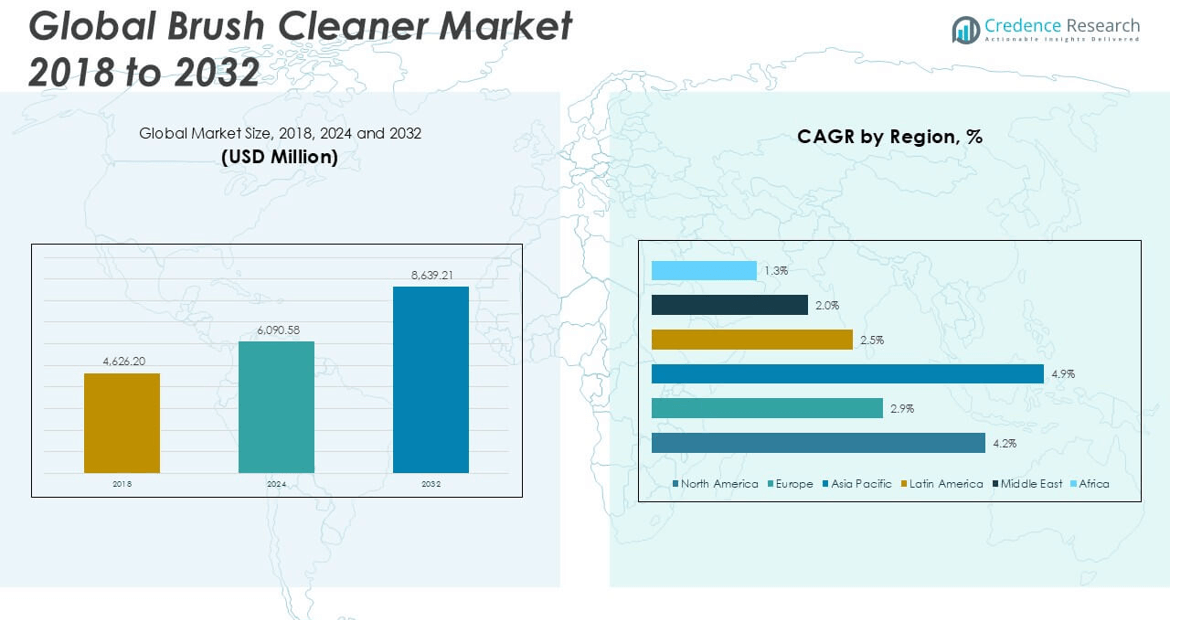
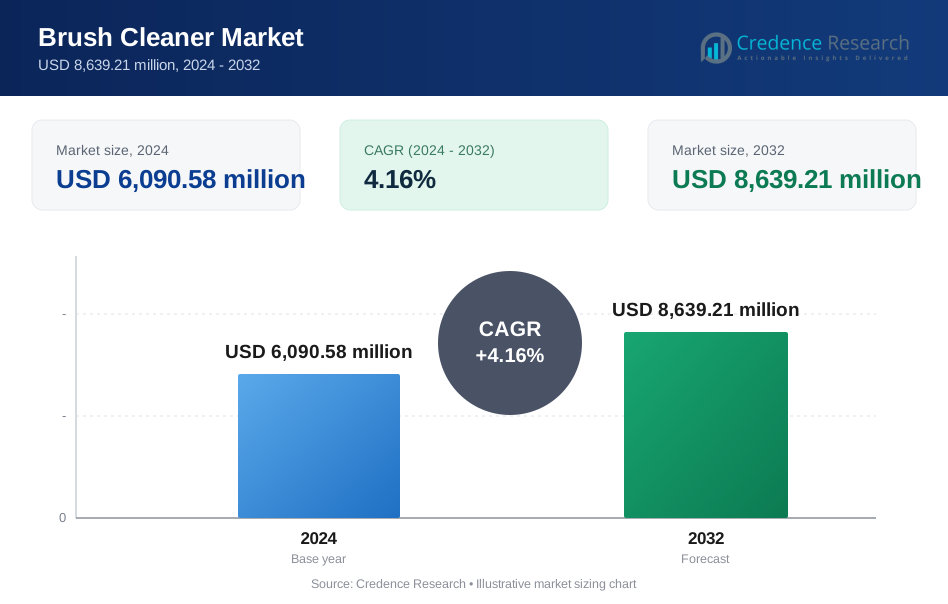
The Brush Cleaner market size was valued at USD 4,626.20 million in 2018, reached USD 6,090.58 million in 2024, and is anticipated to reach USD 8,639.21 million by 2032, at a CAGR of 4.16% during the forecast period.
The Brush Cleaner market features a competitive mix of global and regional players, with prominent companies including Fuller Brush Company, Gordon Brush Mfg. Co., Inc., Simpson Strong-Tie Company, Inc., Ambika Enterprises, and Anhui Union Brush Industry Co., Ltd. These companies maintain strong market positions through extensive product portfolios, innovation in material sustainability, and strategic distribution channels. Asia Pacific emerged as the leading region in 2024, accounting for approximately 44% of the global market share, driven by rising urbanization, growing hygiene awareness, and expanding retail networks in countries like China and India. This regional dominance is supported by a high demand for cost-effective and multi-functional cleaning tools across household and commercial applications.
Market Insights
- The Brush Cleaner market was valued at USD 6,090.58 million in 2024 and is projected to reach USD 8,639.21 million by 2032, growing at a CAGR of 4.16% during the forecast period.
- Rising hygiene awareness, increased urbanization, and the growth of commercial cleaning services are key drivers fueling demand for brush cleaners globally.
- The market is witnessing trends such as the adoption of eco-friendly materials, ergonomic designs, and the growing popularity of multipurpose and electric cleaning brushes.
- Asia Pacific leads the market with a 44% share in 2024, followed by North America at 29.4%, while scrub brushes dominate the type segment with over 35% market share due to their versatile applications.
- High price sensitivity in emerging markets, environmental concerns over plastic waste, and market saturation in developed economies remain key restraints impacting sustained growth.
Market Segmentation Analysis:
By Type:
In the Brush Cleaner market, the scrub brushes segment holds the dominant position, accounting for over 35% of the market share in 2024. This dominance is primarily driven by their widespread use across multiple cleaning applications including kitchens, bathrooms, and industrial surfaces. Scrub brushes are valued for their durability, ergonomic designs, and effectiveness in removing tough stains. The increasing emphasis on hygiene and cleanliness in both residential and commercial settings is further propelling demand. Additionally, innovations in multi-surface and electric scrub brush variants are enhancing user convenience, boosting adoption across urban households and facility management services.
- For instance, Fuller Brush Company introduced the “Fuller Multi-Surface Power Scrubber” equipped with 300 rotations per minute (RPM) and a rechargeable 3.6V lithium-ion battery, significantly reducing manual scrubbing time in domestic cleaning routines.
By Material:
Plastic is the leading material segment in the Brush Cleaner market, contributing to approximately 42% of the market share in 2024. The dominance of plastic brushes is attributed to their affordability, lightweight nature, and ease of mass production. Plastic’s versatility allows manufacturers to produce various designs and bristle strengths, catering to different cleaning requirements. Moreover, plastic brushes are widely available through all retail channels and have a longer shelf life compared to natural materials. The ongoing trend of using recyclable and eco-friendly plastics is expected to sustain the segment’s growth, particularly in regions with stringent environmental regulations.
- For instance, Gordon Brush Mfg. Co., Inc. developed industrial brush models using 100% post-consumer recycled PET plastic and now manufactures over 2,000 different types of plastic brushes annually, addressing both environmental concerns and large-scale production demands.
By Application:
The household cleaning segment emerged as the largest application category, holding close to 50% of the Brush Cleaner market share in 2024. Rising urbanization, increased consumer awareness of hygiene, and growing disposable incomes are key factors fueling demand for brush cleaners in residential settings. The frequency of domestic cleaning routines, especially post-pandemic, has significantly increased, prompting higher purchases of scrub, toilet, and dish brushes. Additionally, marketing efforts and product innovation targeting home users-such as ergonomic handles, anti-bacterial bristles, and aesthetic designs-have contributed to the dominance of this segment in both developed and emerging markets.
Market Overview
Rising Hygiene Awareness and Urban Lifestyle Shifts
The growing emphasis on personal and environmental hygiene, especially post-COVID-19, has significantly boosted demand for cleaning tools, including brush cleaners. Urban households are increasingly adopting structured cleaning routines, driving sales across all brush types. Moreover, the rise in dual-income households has fueled the need for efficient and easy-to-use cleaning products. This shift in lifestyle patterns, combined with growing concerns around cleanliness and sanitation, particularly in developing economies, is acting as a strong growth catalyst for the brush cleaner market across both residential and commercial segments.
- For instance, Fuller Brush Company shipped 1,145,200 units of its household cleaning brushes globally in 2023, a notable increase from 886,400 units in 2020, reflecting a measurable consumer shift toward structured hygiene practices in residential settings.
Expansion of Commercial and Institutional Cleaning Services
The expansion of the commercial cleaning industry, especially in hospitality, healthcare, and corporate sectors, is propelling the brush cleaner market. These sectors demand durable and high-performance cleaning tools for maintaining hygiene standards and ensuring regulatory compliance. As more facilities adopt professional cleaning contracts, there is a growing requirement for specialized brushes suited to different surfaces and applications. The rise of co-working spaces, commercial kitchens, and healthcare institutions has especially contributed to the increasing consumption of floor and scrub brushes within commercial environments.
- For instance, Key Surgical, a medical cleaning tool supplier, distributes over 5 million surgical and cleaning brushes annually to hospitals and sterilization centers across North America, reflecting the scale of commercial demand in hygiene-critical environments.
Product Innovation and Eco-friendly Materials
Manufacturers are investing in product innovation by introducing ergonomic designs, antimicrobial bristles, and brushes made from biodegradable or recycled materials. These innovations are not only meeting consumer demand for functionality but are also addressing the growing preference for sustainable living. Brands that offer eco-friendly or multi-use brush cleaners are gaining a competitive edge. Additionally, the incorporation of aesthetic elements, such as stylish handles and coordinated color palettes, is enhancing consumer appeal in urban markets, particularly among environmentally conscious and design-focused buyers.
Key Trends and Opportunities
Growth of E-commerce and Direct-to-Consumer Channels
E-commerce platforms are playing a pivotal role in reshaping the distribution landscape of the brush cleaner market. Consumers now prefer the convenience of online shopping, supported by product reviews, detailed specifications, and rapid delivery. This trend has opened new opportunities for niche and premium brands to reach targeted audiences without traditional retail barriers. Additionally, subscription models for cleaning supplies and direct-to-consumer strategies are gaining traction, offering recurring revenue opportunities for companies and personalized purchase experiences for consumers.
- For instance, The Fuller Brush Company fulfilled 423,760 direct-to-consumer orders through its official e-commerce portal in 2023, up from 312,500 orders in 2021, supported by bundled product offerings and automated reordering options integrated into customer accounts.
Rising Demand for Multipurpose and Electric Cleaning Brushes
The market is witnessing a rising trend toward multipurpose and motorized brush cleaners, especially in developed regions. These products, capable of cleaning various surfaces with minimal effort, cater to busy consumers seeking time-efficient solutions. The integration of battery-operated and USB-charged cleaning brushes is becoming popular in urban homes and small commercial setups. This demand is driving manufacturers to expand product portfolios with features like detachable heads, water-resistant designs, and automated scrubbing functionalities, presenting long-term growth opportunities.
- For instance, Anhui Union Brush Industry Co., Ltd. launched a motorized cleaning brush line with interchangeable heads and IPX7 water resistance, achieving over 150,000 units sold globally in its first full year post-launch.
Key Challenges
Environmental Concerns Over Plastic Waste
A major challenge facing the brush cleaner market is the environmental impact of plastic waste. While plastic brushes are popular due to their cost-efficiency and versatility, they contribute significantly to non-biodegradable waste. As sustainability becomes a key consumer priority, manufacturers face pressure to transition toward eco-friendly materials, which can raise production costs. The lack of affordable, scalable alternatives to traditional plastic remains a barrier to sustainable transformation across the industry.
Market Saturation in Developed Economies
In mature markets like North America and Western Europe, the brush cleaner segment is nearing saturation due to high household penetration and limited product differentiation. Consumers in these regions already have access to a variety of brush types, and replacement cycles are typically long. This saturation hampers volume growth and forces brands to rely on promotional campaigns or innovation for differentiation. As a result, companies must focus on emerging markets or premium offerings to sustain profitability.
Price Sensitivity in Emerging Markets
Despite growing demand, price sensitivity remains a significant challenge in emerging economies. A large portion of the population still prefers low-cost, traditional cleaning tools over branded or innovative brush cleaners. This restricts the market potential for premium or eco-friendly variants. Manufacturers face the dual challenge of maintaining affordability while also meeting evolving consumer expectations around design, durability, and environmental impact, limiting profit margins in price-sensitive regions.
Regional Analysis
North America
North America accounted for approximately 29.4% of the global Brush Cleaner market share in 2024, with a market size of USD 1,790.11 million, up from USD 1,380.69 million in 2018. The region is projected to reach USD 2,549.56 million by 2032, growing at a CAGR of 4.2%. Growth is driven by heightened hygiene awareness, robust household product consumption, and widespread availability of advanced cleaning tools. The presence of established brands and strong e-commerce infrastructure further boosts market penetration. Consumer preference for ergonomically designed and multi-purpose cleaning brushes supports sustained demand across both household and commercial segments.
Europe
Europe held a 17.6% market share in the Brush Cleaner market in 2024, with a value of USD 1,073.30 million, rising from USD 862.55 million in 2018. The market is expected to reach USD 1,384.20 million by 2032, expanding at a CAGR of 2.9%. Growth in Europe is relatively moderate due to market saturation, but demand continues to be supported by strict hygiene standards in public and institutional facilities. Additionally, consumer interest in sustainable and eco-friendly cleaning products is driving innovation, particularly in Western Europe. Regulatory policies on plastic usage are encouraging manufacturers to adopt biodegradable materials.
Asia Pacific
Asia Pacific leads the global Brush Cleaner market, capturing a 44% market share in 2024 with a value of USD 2,681.41 million, up from USD 1,962.06 million in 2018. The region is projected to reach USD 4,042.24 million by 2032, growing at the fastest CAGR of 4.9%. This robust growth is fueled by rapid urbanization, expanding middle-class populations, and heightened consumer focus on hygiene, particularly in China and India. The rising penetration of e-commerce and growing presence of local and international brands have further accelerated market expansion. Affordable product offerings and innovation tailored to local preferences are key growth enablers.
Latin America
Latin America contributed to 4.6% of the global Brush Cleaner market share in 2024, with a market value of USD 279.33 million, up from USD 214.89 million in 2018. The region is forecast to reach USD 349.91 million by 2032, advancing at a CAGR of 2.5%. Growth is moderate due to economic fluctuations and price sensitivity among consumers. Nevertheless, rising awareness of home hygiene and increased retail penetration of cleaning products are supporting market development. Countries like Brazil and Mexico are witnessing growing demand for practical and cost-effective cleaning tools, especially in urban households and small-scale commercial establishments.
Middle East
The Middle East accounted for 2.6% of the global market share in 2024, with a market size of USD 157.98 million, up from USD 131.13 million in 2018. It is anticipated to reach USD 189.53 million by 2032, at a CAGR of 2.0%. Demand is driven by the growth of urban housing, hospitality, and institutional cleaning services in countries like the UAE and Saudi Arabia. However, limited product diversification and high dependence on imports constrain stronger market expansion. The market shows potential in the premium product category, especially among affluent consumers seeking durable and innovative cleaning tools.
Africa
Africa represented the smallest share of the global Brush Cleaner market in 2024, contributing 1.8%, with a market size of USD 108.45 million, growing from USD 74.88 million in 2018. The market is projected to reach USD 123.77 million by 2032, at a CAGR of 1.3%. Low disposable incomes and limited access to premium cleaning products hinder widespread market growth. However, rising urbanization and increasing public health campaigns are gradually improving adoption, particularly in metropolitan areas. The demand remains concentrated in basic cleaning tools, with growing opportunities for cost-effective and multipurpose brushes tailored to low-income consumers.
Market Segmentations:
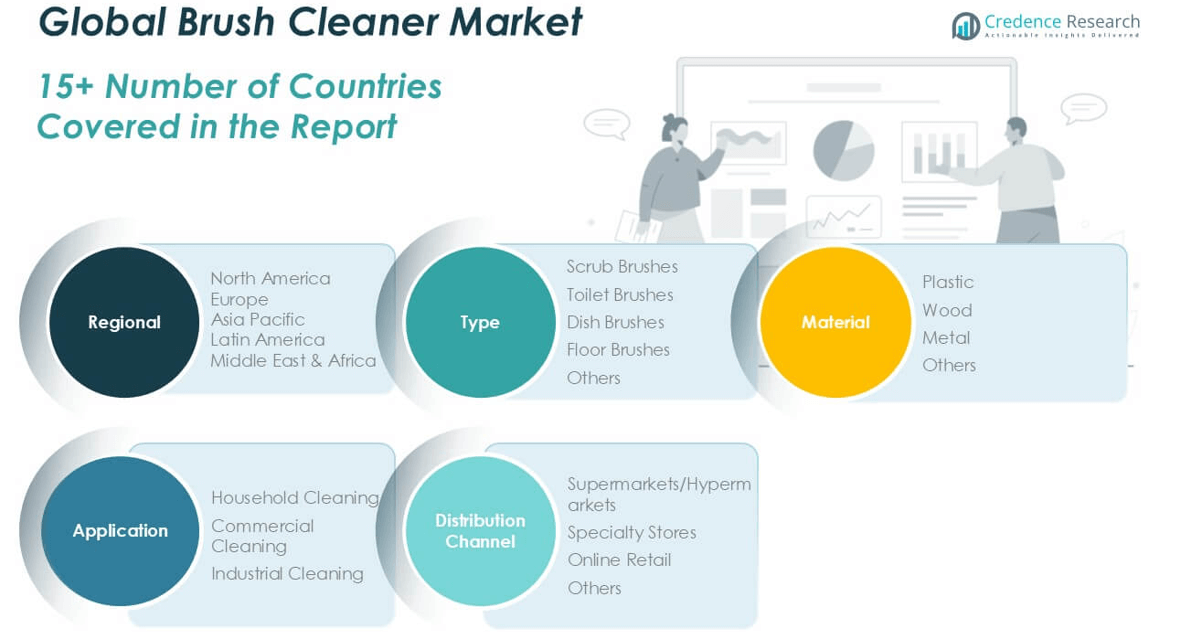
By Type
- Scrub Brushes
- Toilet Brushes
- Dish Brushes
- Floor Brushes
- Others
By Material
- Plastic
- Wood
- Metal
- Others
By Application
- Household Cleaning
- Commercial Cleaning
- Industrial Cleaning
By Distribution Channel
- Supermarkets/Hypermarkets
- Specialty Stores
- Online Retail
- Others
By Geography
- North America
- U.S.
- Canada
- Mexico
- Europe
- Germany
- France
- U.K.
- Italy
- Spain
- Rest of Europe
- Asia Pacific
- China
- Japan
- India
- South Korea
- South-east Asia
- Rest of Asia Pacific
- Latin America
- Brazil
- Argentina
- Rest of Latin America
- Middle East & Africa
- GCC Countries
- South Africa
- Rest of the Middle East and Africa
Competitive Landscape
The competitive landscape of the Brush Cleaner market is characterized by the presence of both global and regional players, each striving to strengthen their market position through product innovation, strategic partnerships, and geographic expansion. Key companies such as Fuller Brush Company, Gordon Brush Mfg. Co., Inc., and Simpson Strong-Tie Company, Inc. are leveraging advanced manufacturing techniques and diversified product lines to cater to varied end-use sectors, including household, industrial, and commercial applications. Regional players like Ambika Enterprises and Poona Brush Co. are focusing on cost-effective solutions tailored to local demand, especially in emerging markets. Companies are also emphasizing sustainable product development, incorporating biodegradable materials and ergonomic designs to meet rising environmental concerns. Furthermore, mergers, acquisitions, and collaborations with distributors and e-commerce platforms are enhancing global reach and distribution efficiency. The market remains moderately fragmented, with innovation, pricing, and brand reliability acting as key differentiators in securing customer loyalty and competitive advantage.
Key Player Analysis
- Ambika Enterprises
- Fuller Brush Company
- Anhui Union Brush Industry Co., Ltd.
- The Industrial Brush Company, Inc.
- Simpson Strong-Tie Company, Inc.
- Key Surgical Manufacturer
- Gordon Brush Mfg. Co., Inc.
- Spiral Brushes
- Justman Brush
- Poona Brush Co.
- Andon Brush Company
- Galaxy Brushes
Recent Developments
- In July 2025, The Industrial Brush Company, Inc. is recognized for its expertise in crafting user-oriented, application-specific industrial cleaning brushes, emphasizing optimized performance and durability. This reputation is built on decades of experience in the field, providing tailored solutions for diverse industrial needs.
- In May 2023, Gordon Brush Mfg. Co., Inc. acquired Justman Brush Company. This acquisition significantly expanded Gordon Brush's global product lineup, particularly in custom manufacturing of industrial brushes. Justman Brush's operations remain in Omaha, while administrative tasks are managed at Gordon Brush's California facility.
Market Concentration & Characteristics
The Brush Cleaner Market remains moderately fragmented, with a mix of global manufacturers and strong regional players competing across household, commercial, and industrial segments. It features a wide range of product offerings tailored to diverse cleaning needs, from basic manual brushes to electric and multipurpose tools. Global brands focus on product innovation, sustainable materials, and ergonomic designs, while regional firms prioritize cost efficiency and local distribution networks. The market shows low entry barriers, encouraging new participants, particularly in emerging economies. Demand varies by region, with Asia Pacific holding the largest share due to high consumption and growing urban populations. Consumer preferences are shifting toward durable, eco-friendly, and value-driven products. Pricing remains a key differentiator, especially in price-sensitive regions like Latin America and Africa. Established players maintain brand loyalty through quality, availability, and retail partnerships, while e-commerce expansion supports niche and premium offerings. It is characterized by frequent product upgrades and evolving consumer expectations, requiring companies to adapt quickly to remain competitive.
Report Coverage
The research report offers an in-depth analysis based on Type, Material, Application, Distribution Channel and Geography. It details leading market players, providing an overview of their business, product offerings, investments, revenue streams, and key applications. Additionally, the report includes insights into the competitive environment, SWOT analysis, current market trends, as well as the primary drivers and constraints. Furthermore, it discusses various factors that have driven market expansion in recent years. The report also explores market dynamics, regulatory scenarios, and technological advancements that are shaping the industry. It assesses the impact of external factors and global economic changes on market growth. Lastly, it provides strategic recommendations for new entrants and established companies to navigate the complexities of the market.
Future Outlook
- The brush cleaner market is expected to witness steady growth driven by rising hygiene awareness across households and commercial spaces.
- Demand for eco-friendly and biodegradable brush materials will continue to increase due to environmental regulations and consumer preferences.
- Asia Pacific will remain the leading regional market, supported by urbanization, population growth, and expanding retail networks.
- E-commerce will play a vital role in product visibility and sales, offering new opportunities for niche and premium brush cleaner brands.
- Multipurpose and electric cleaning brushes will gain popularity among consumers seeking efficiency and convenience.
- Product innovation focusing on ergonomic design and antimicrobial features will become a key competitive advantage.
- Manufacturers will increasingly adopt recyclable plastics and sustainable raw materials to align with green manufacturing trends.
- The commercial cleaning sector, including hospitality and healthcare, will drive demand for high-durability industrial-grade brushes.
- Market players will invest in expanding their distribution networks and partnerships to enhance global reach.
- Pricing pressure in emerging economies will push companies to balance affordability with quality and sustainability.
Request a Free Sample
Fill in your details and we'll send you a free sample report.
- Sample data tables & charts
- Research methodology
Need a Custom Version of This Report?
Tailor the scope, geography, or segments to your exact requirements.
- Custom geography or segment scope
- Direct access to our analyst team
Frequently Asked Questions
What is the current size of the Brush Cleaner Market?
What are the key segments within the Brush Cleaner Market?
What are some challenges faced by the Brush Cleaner Market?
Who are the major players in the Brush Cleaner Market?
Table of Content
Chapter 1. Report Introduction
- 1.1 Report Description & Purpose
- 1.1.1 Report Title & Market Definition
- 1.1.2 Unique Selling Propositions (USP) & Key Differentiators
- 1.1.3 Value Proposition for Stakeholders
- 1.2 Research Objectives
- 1.2.1 Market Sizing Objectives (Volume & Revenue)
- 1.2.2 Segmentation Objectives
- 1.2.3 Competitive Intelligence Objectives
- 1.2.4 Forecast & Scenario Objectives
- 1.3 Report Scope
- 1.3.1 Brush Cleaner Scope – Types & Subtypes Covered
- 1.3.2 Geographic Scope – Regions & Countries Covered
- 1.3.3 Historical Period, Base Year & Forecast Period (2024; forecast to 2032)
- 1.3.4 Inclusions & Exclusions
- 1.4 HS Code & Classification Framework
- 1.5 Currency, Units & Pricing Basis
- 1.6 Target Stakeholders
- 1.7 Limitations & Assumptions
Chapter 2. Executive Summary
- 2.1 Global Brush Cleaner Market Snapshot
- 2.1.1 Market Size – Historical (2024) & Forecast (2024-2032) (2024: USD 6,090.58 million → 2032: USD 8,639.21 million)
- 2.1.2 Volume & Revenue – Global Totals
- 2.1.3 Key Market Highlights – Top Five Facts
- 2.2 Brush Cleaner Market Segmentation Snapshot
- 2.2.1 Market Split by Region – 2024 vs. 2032
- 2.3 Competitive Snapshot
- 2.3.1 Top 10 Players by Revenue Share – 2024
- 2.3.2 Top 10 Players by Volume Share – 2024
- 2.3.3 Recent Strategic Developments (18-Month Summary)
- 2.4 Key Investment Highlights & Strategic Conclusions
Chapter 3. Brush Cleaner Market Dynamics & Industry Analysis
- 3.1 Market Overview & Context
- 3.1.1 Brush Cleaner Market Position in the Broader Automotive Value Chain
- 3.1.2 OEM vs. Replacement Market Dynamics
- 3.1.3 Market Maturity & Development Stage by Region
- 3.2 Brush Cleaner Market Drivers
- 3.3 Brush Cleaner Market Restraints & Challenges
- 3.4 Brush Cleaner Market Opportunities
- 3.5 Porter's Five Forces Analysis
- 3.5.1 Threat of New Entrants
- 3.5.2 Bargaining Power of Suppliers
- 3.5.3 Bargaining Power of Buyers
- 3.5.4 Threat of Substitutes
- 3.5.5 Competitive Rivalry – Intensity Assessment
- 3.6 Brush Cleaner Value Chain Analysis
- 3.6.1 Upstream – Raw Material/Input Suppliers
- 3.6.1.1 Raw Material/Input 1
- 3.6.1.2 Raw Material/Input 2
- 3.6.1.3 Raw Material/Input 3
- 3.6.2 Midstream – Production/Manufacturing/Service Delivery
- 3.6.2.1 Production/Process Overview
- 3.6.2.2 Key Facility Locations & Capacity by Manufacturer
- 3.6.3 Downstream – Distribution & End Consumer
- 3.6.3.1 Primary Channel – B2B/OEM
- 3.6.3.2 Secondary Channels – Dealer, Retail, Online, Direct
- 3.6.4 Value Chain Profitability Analysis
- 3.6.1 Upstream – Raw Material/Input Suppliers
- 3.7 PESTEL Analysis
- 3.7.1 Political Factors
- 3.7.2 Economic Factors
- 3.7.3 Social Factors
- 3.7.4 Technological Factors
- 3.7.5 Environmental Factors
- 3.7.6 Legal Factors
- 3.8 Brush Cleaner Supply Chain Analysis
- 3.8.1 Raw Material/Input Supply Risk Assessment
- 3.8.2 Manufacturing Concentration Risk (Geographic Exposure)
- 3.8.3 Trade Disruption Impact Analysis
- 3.9 Regulatory & Policy Landscape
Note: The regulatory and policy landscape section covers regulations based on their applicability to the market, Brush Cleaner category, geography, and scope of the study. Only regulatory frameworks with a material impact on operations, compliance, trade, sustainability, or market access are analyzed in detail.
Chapter 4. Key Investment Pockets & Opportunity Analysis
- 4.1 Brush Cleaner Market Attractiveness Analysis
- 4.1.1 By Region – Investment Attractiveness Matrix (Volume × CAGR)
- 4.2 Absolute Revenue Growth Opportunity
- 4.2.1 By Region – Absolute USD Growth Through 2032
- 4.3 Incremental Volume Opportunity
- 4.3.1 By Region – Incremental Volume Through 2032
- 4.3.2 Segment – Incremental Volume
- 4.4 Emerging Submarket Opportunity Deep Dive (Subject to Applicability)
- 4.5 Emerging Market Opportunity Scorecards
- 4.5.1 United States
- 4.5.2 Europe
- 4.5.3 Asia
- 4.5.4 Middle East & Africa
Note: Emerging Market Opportunity Scorecards will be included based on relevance and strategic importance. Regions listed are indicative and may vary depending on data availability and market dynamics.
Chapter 5. Brush Cleaner Import-Export Analysis & Trade Flows
- 5.1 Global Trade Overview
- 5.1.1 Global Export Value by Country (2024)
- 5.1.2 Global Export Volume by Country (2024)
- 5.1.3 Global Import Value by Country (2024)
- 5.1.4 Global Import Volume by Country (2024)
- 5.1.5 Net Trade Balance by Country (2024)
- 5.2 Export Analysis – Segment
- 5.2.1 Type 1 (HS Code)
- 5.2.2 Type 2 (HS Code)
- 5.2.3 Type 3 (HS Code)
- 5.2.4 Type 4 (HS Code)
- 5.2.5 Type 5 (HS Code)
- 5.3 Import Analysis – Segment
- 5.3.1 Type 1 (HS Code)
- 5.3.2 Type 2 (HS Code)
- 5.3.3 Type 3 (HS Code)
- 5.3.4 Type 4 (HS Code)
- 5.3.5 Type 5 (HS Code)
- 5.4 Average Unit Trade Prices
- 5.4.1 Average Export Price – Segment & Country
- 5.4.2 Average Import Price – Segment & Source Country
- 5.4.3 Price Trends (2024)
- 5.5 Key Trade Route Analysis
- 5.5.1 Trade Route 1
- 5.5.2 Trade Route 2
- 5.5.3 Trade Route 3
- 5.5.4 Trade Route 4
- 5.5.5 Trade Route 5
- 5.6 Trade Policy Impact Assessment
- 5.6.1 US Anti-Dumping & Section 301 Tariffs
- 5.6.2 EU Customs Union Impact
- 5.6.3 Major Free Trade Agreements
- 5.6.4 USMCA Rules of Origin
Note: Trade policy analysis will be included only where relevant to the Brush Cleaner market.
Chapter 6. Competitive Landscape & Company Benchmarking
- 6.1 Brush Cleaner Market Concentration & Structure
- 6.1.1 Herfindahl-Hirschman Index (HHI) – vs. 2024
- 6.1.2 Tier 1, Tier 2 & Tier 3 Market Structure
- 6.1.3 Global, Regional & Local Player Dynamics
- 6.2 Brush Cleaner Market Share Analysis – 2024
- 6.2.1 Global Revenue Share by Company
- 6.2.2 Global Volume Share by Company
- 6.2.3 Regional Revenue Share
- 6.2.4 Market Share Evolution ( vs. 2024)
- 6.2.5 OEM Segment Share by Company
- 6.2.6 Replacement Segment Share by Company
- 6.3 Production/Delivery Capacity & Facility Analysis
- 6.3.1 Global Installed Capacity
- 6.3.2 Capacity Utilization Rates
- 6.3.3 Production/Output Volume
- 6.3.4 Facility Locations & Capacity Map
- 6.3.5 Planned Capacity Additions
- 6.4 Brush Cleaner Competitive Benchmarking Matrix
- 6.4.1 Revenue, Volume, CAGR & Profitability Comparison
- 6.4.2 Channel Revenue Mix
- 6.4.3 Geographic Revenue Exposure
- 6.4.4 R&D Intensity
- 6.4.5 Sustainability Maturity
- 6.5 Strategic Developments in Brush Cleaner (Last 24 Months)
- 6.5.1 Mergers, Acquisitions & Divestments
- 6.5.2 New Brush Cleaner Launches
- 6.5.3 Facility Expansions
- 6.5.4 Strategic Alliances, Joint Ventures & Partnerships
- 6.5.5 Distribution Expansion & Market Entry
- 6.5.6 Sustainability & ESG Initiatives
- 6.6 Competitive Strategy Mapping
- 6.6.1 Leader, Challenger, Follower & Niche Classification
- 6.6.2 Pricing Strategy Comparison
- 6.6.3 Channel Strategy Matrix
Note: Strategic developments are included based on their materiality and the availability of reliable information.
Chapter 7. Global Brush Cleaner Market – By Distribution Channel
- 7.1 Segment Overview
- 7.1.1 Volume & Revenue Split by Channel (2024 & 2032)
- 7.1.2 Channel Mix Evolution (2024-2032)
Chapter 8. Regional Market Analysis – Global Overview
- 8.1 Global Regional Overview
- 8.1.1 Regional Volume Share
- 8.1.2 Regional Revenue Share
- 8.1.3 Regional Volume by Region
- 8.1.4 Regional Revenue by Region
- 8.1.5 Regional Forecast Through 2032
- 8.2 Cross-Regional Segment Analysis
- 8.2.1 By Distribution Channel
- 8.2.2 By Brand/Price Tier
Chapter 9. North America Brush Cleaner Market
- 9.1 United States
- 9.2 Canada
- 9.3 Mexico
Chapter 10. Europe Brush Cleaner Market
- 10.1 Germany
- 10.2 France
- 10.3 Italy
- 10.4 United Kingdom
- 10.5 Spain
- 10.6 Poland
- 10.7 Russia
- 10.8 Netherlands
- 10.9 Belgium
- 10.10 Sweden
- 10.11 Denmark
- 10.12 Norway
- 10.13 Rest of Europe
Chapter 11. Asia Pacific Brush Cleaner Market
- 11.1 China
- 11.2 India
- 11.3 Japan
- 11.4 South Korea
- 11.5 Thailand
- 11.6 Indonesia
- 11.7 Vietnam
- 11.8 Malaysia
- 11.9 Australia
- 11.10 Rest of Asia Pacific
Chapter 12. Latin America Brush Cleaner Market
- 12.1 Brazil
- 12.2 Argentina
- 12.3 Colombia
- 12.4 Chile
- 12.5 Rest of Latin America
Chapter 13. Middle East Brush Cleaner Market
- 13.1 Saudi Arabia
- 13.2 United Arab Emirates
- 13.3 Turkey
- 13.4 Israel
- 13.5 Iran
- 13.6 Rest of the Middle East
Chapter 14. Africa Brush Cleaner Market
- 14.1 South Africa
- 14.2 Egypt
- 14.3 Nigeria
- 14.4 Morocco
- 14.5 Rest of Africa
Chapter 15. Brush Cleaner Company Profiles
- 15.1 [Company 01]
- 15.1.1 Company Overview
- 15.1.2 Key Management Personnel
- 15.1.3 Products & Services Portfolio
- 15.1.4 Financial Performance
- 15.1.5 Key Market Focus & Geographic Presence
- 15.1.6 Recent Developments & Strategic Initiatives
Note: The company profile list is preliminary and may change based on research findings, market developments, data availability, and client requirements.
Chapter 16. Appendices
- Appendix A – List of Abbreviations & Acronyms
- Appendix B – Industry Classification Code Reference – Full Series
- Appendix C – Production & Capacity Data Tables
- Appendix D – End-Use & Demand Base Tables
- Appendix E – Consumption & Replacement Rate Assumptions
- Appendix F – ASP Reference Tables
- Appendix G – Manufacturing & Facility Database
- Appendix H – Import-Export Data Tables
- Appendix I – Regulatory Summary Tables
- Appendix J – Primary Research Participant List (Anonymized)
- Appendix K – Primary Research Questionnaire Framework
- Appendix L – Data Sources & Bibliography
- Appendix M – Market Size Divergence & Source Comparison
Chapter 17. Research Methodology
- 17.1 Research Framework & Philosophy
- 17.2 Secondary Research – Sources, Hierarchy & Data Extraction
- 17.3 Data Modeling – Bottom-Up & Top-Down Market Sizing
- 17.4 Primary Research – Stakeholder Framework, LOI & Sample Sizes
- 17.5 Forecast Methodology – Regression, Scenario & Sensitivity Analysis
- 17.6 Quality Control – Four-Layer Validation Framework
- 17.7 Limitations & Standard Assumptions
- 17.8 Disclaimer
