
Market Overview:
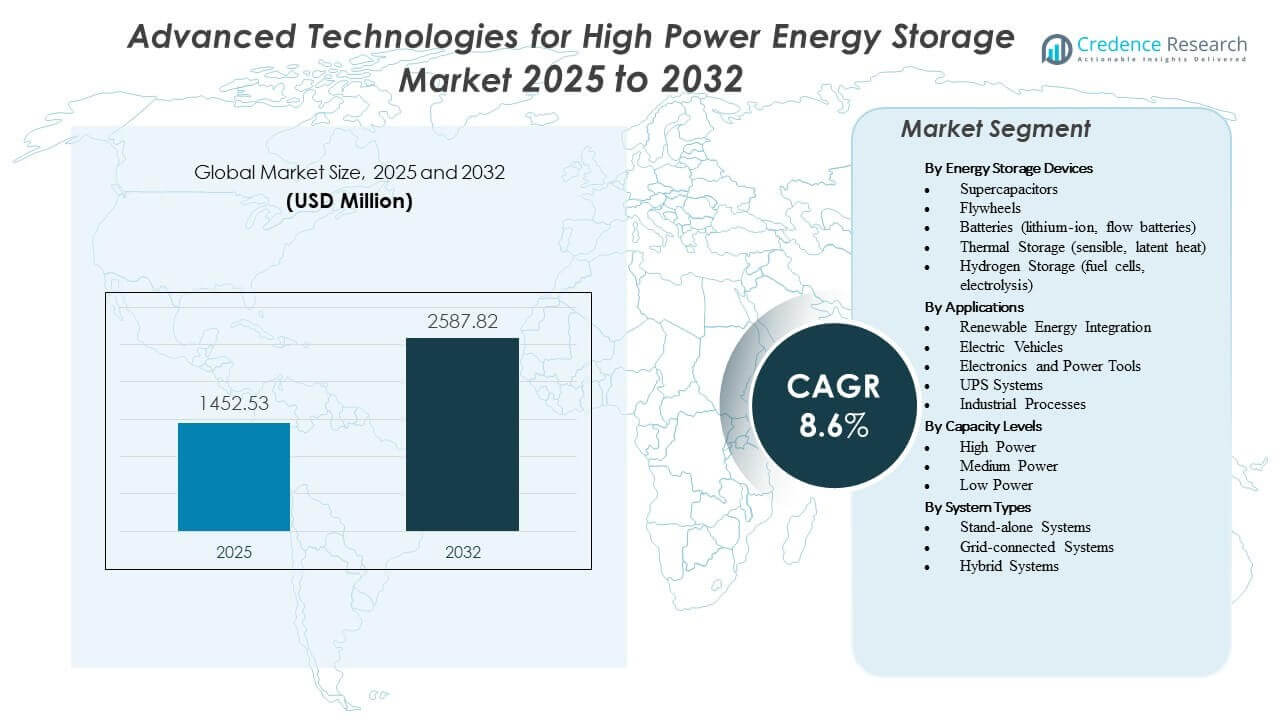
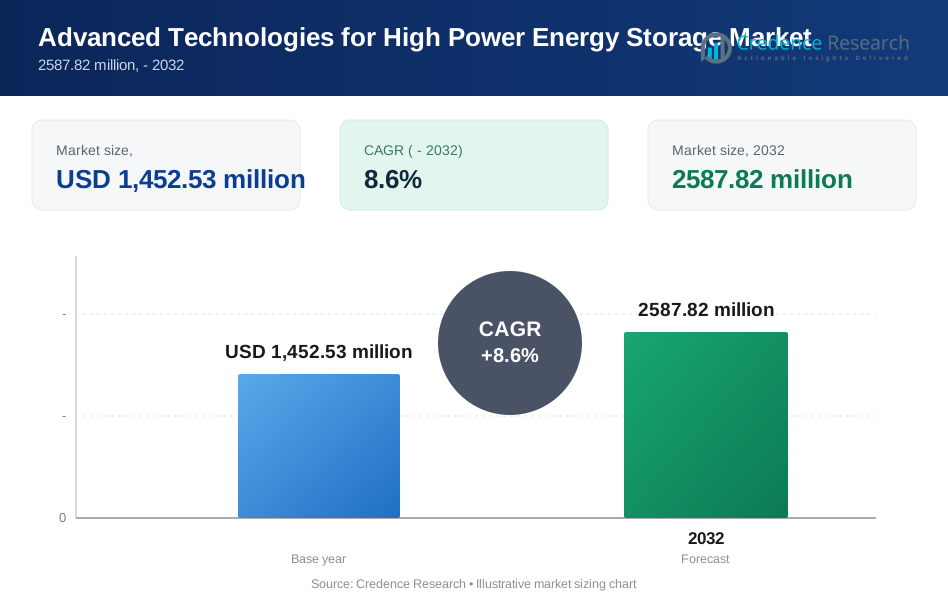
The Advanced Technologies for High Power Energy Storage Market is projected to grow from USD 1452.53 million in 2025 to an estimated USD 2587.82 million by 2032, with a compound annual growth rate (CAGR) of 8.6% from 2025 to 2032.
| REPORT ATTRIBUTE | DETAILS |
|---|---|
| Historical Period | 2020-2023 |
| Base Year | 2024 |
| Forecast Period | 2025-2032 |
| Advanced Technologies for High Power Energy Storage Market Size 2025 | USD 1452.53 million |
| Advanced Technologies for High Power Energy Storage Market, CAGR | 8.6% |
| Advanced Technologies for High Power Energy Storage Market Size 2032 | USD 2587.82 million |
Strong market drivers shape the expansion of high-power storage technologies, with utilities seeking faster balancing systems to support renewable integration and reduce grid volatility. Growing electrification in transportation increases the need for dependable fast-charging infrastructure, while industries adopt high-power solutions to manage peak loads and protect operations from disruptions. Advancements in battery chemistries, control systems, and hybrid architectures continue to elevate performance standards and widen adoption across diverse applications.
Regional adoption varies, with North America leading due to advanced grid modernization programs and strong investment in renewable-linked storage projects. Europe follows with strict sustainability mandates and active deployment of high-power systems to stabilize intermittent wind and solar output. Asia Pacific emerges as a high-growth region driven by expanding manufacturing capabilities, rapid EV penetration, and increasing demand for resilient urban energy systems. Emerging markets in the Middle East, Africa, and South America adopt high-power storage at a steady pace.
Market Insights:
- The Advanced Technologies for High Power Energy Storage Market reached 1452.53 million in 2025 and is projected to hit 2587.82 million by 2032, supported by an 8.6% CAGR driven by strong grid-scale and industrial demand.
- Market drivers focus on fast-response storage needs across utilities, EV charging networks, and automation-heavy industries that require stable and high-power performance.
- Restraints center on high capital costs, strict safety compliance, and complex integration requirements that slow adoption across certain regions.
- North America leads with 32% share, followed by Europe at 28% and Asia Pacific at 27%, driven by grid upgrades, renewable commitments, and rising EV penetration.
- Growing investment in LFP, solid-state, hybrid systems, and AI-enabled controls strengthens technology maturity and widens long-term opportunities across high-power applications.
Market Drivers:
Growing Need for Fast-Response Storage to Stabilize Grid Networks
The Advanced Technologies for High Power Energy Storage Market expands due to rising grid instability linked to renewable penetration. Utilities require fast-response systems to control frequency events and reduce load variation. Power operators deploy high-power batteries and supercapacitors to strengthen voltage support. It improves resilience during peak demand and sudden supply dips. Transmission operators invest in advanced control platforms to improve response speed. Nations upgrade grid codes to mandate faster balancing assets in new projects. Industries adopt high-power storage to avoid production losses during short supply drops. Demand grows in both mature and emerging grids that face reliability concerns.
Rising Electrification of Transportation and Demand for Rapid Charging Infrastructure
High-power solutions gain traction due to the shift toward electric mobility and rapid charging stations. The Advanced Technologies for High Power Energy Storage Market benefits from rising deployment of EV fleets that require stable and fast charging points. Developers use high-power storage to manage demand spikes created by clustered charging. It reduces stress on local grids and lowers upgrade costs. Transit operators integrate storage to improve charging reliability for buses and logistics fleets. Airports and commercial hubs build high-power hubs to support continuous vehicle flow. Energy operators work with EV infrastructure providers to deploy distributed storage units. Demand for controlled charging cycles drives wider adoption in high-traffic zones.
- For instance, LG Energy Solution secured a $4.3 billion contract with Tesla in July 2025 to supply U.S.-made LFP batteries for stationary storage, starting deliveries in August 2027 to support high-capacity charging infrastructure that reduces reliance on external grid peaks.
Industrial Adoption Driven by High-Cycle Requirements and Precision Power Support
Industrial facilities invest in high-power systems to support robotics, automation lines, and sensitive machinery. The Advanced Technologies for High Power Energy Storage Market expands because industries value fast discharge, long cycle life, and stable power. It helps prevent disruptions during micro-outages that damage equipment. Semiconductor plants and data centers prefer high-power units due to strict uptime thresholds. Manufacturers deploy storage for peak shaving that reduces operational costs. Mining and heavy engineering sites use fast-response assets to smooth load variation. Power quality improvements strengthen production continuity. Interest grows across sectors that require instant power availability.
Supportive Policies Promoting Advanced, Clean, and Resilient Power Infrastructure
Government programs accelerate adoption by funding advanced storage technologies and supporting clean energy mandates. The Advanced Technologies for High Power Energy Storage Market benefits from tax credits, pilot grants, and grid modernization schemes. Developers use these frameworks to test hybrid storage and new chemistries. It improves technology maturity and attracts private capital. Standards encourage safer designs and higher reliability. Subsidies lower the cost burden for early adopters. National renewable targets push utilities toward flexible balancing assets. Policy momentum raises confidence among long-term investors.
- For instance, Servotech Renewable Power Systems partnered with Zhuhai Piwin New Energy in September 2025 to manufacture Battery Energy Storage Systems (BESS) in India, specifically leveraging the "Make in India" policy framework to deploy grid-scale units that comply with new national frequency response standards.
Market Trends:
Shift Toward Hybrid Architectures Integrating Batteries, Supercapacitors, and Flywheels
Developers move toward hybrid systems that combine complementary technologies for improved performance. The Advanced Technologies for High Power Energy Storage Market sees rising demand for architectures that balance power and energy features. It enables faster charge recovery and stronger cycle life. Engineers design integrated platforms for EV hubs, industrial plants, and microgrids. Supercapacitors support instant bursts while batteries handle sustained output. Flywheels improve frequency stability in high-demand zones. Vendors deliver modular units that suit different load patterns. Growth in high-precision applications fuels further innovation.
- For instance, Skeleton Technologies deployed its SuperBattery technology, which combines the high power of supercapacitors with the energy of lithium-ion to achieve a charge time of 60 seconds and a lifespan of 50,000 cycles for heavy-duty hybrid applications.
Growing Commercialization of Solid-State and Advanced Lithium Variants
Interest rises in solid-state cells, lithium-titanate, and high-power LFP variants due to their safety and fast-charge potential. The Advanced Technologies for High Power Energy Storage Market gains momentum as labs convert prototypes into commercial systems. It offers higher thermal stability that supports demanding use cases. Manufacturers optimize materials to reduce degradation. Research programs target improved conductivity and low-resistance interfaces. Portable and stationary markets adopt these chemistries for improved reliability. Firms expand production lines to meet rising demand. Long-life characteristics attract industries with continuous operation cycles.
Expansion of AI-Enabled Energy Management and Advanced Control Systems
AI platforms optimize charging patterns and predict short-duration power needs with high accuracy. The Advanced Technologies for High Power Energy Storage Market benefits from smarter algorithms that support real-time balancing. It improves system efficiency and reduces lifecycle costs. Predictive analytics enhance asset scheduling. Grid operators deploy AI-driven tools to detect stress events early. Industrial clients use automated platforms for precision operations. Technology vendors integrate edge analytics for faster response. Broader digitalization raises performance expectations for storage technologies.
- For instance, Tesla's energy division reported that its AI-driven "Autobidder" platform and energy management software contributed to record storage deployments of 14.2 GWh in Q4 2025 by autonomously optimizing the dispatch of Megapack systems across global power markets.
Rising Demand for Modular, Scalable, and High-Durability Storage Units
End users prefer modular and compact systems that scale with changing load patterns. The Advanced Technologies for High Power Energy Storage Market shifts toward rugged units with long service life. It supports flexible deployment in constrained sites. Modular systems simplify maintenance and upgrades. Operators use these designs to optimize investment phases. Portable high-power units enter remote and defense applications. Vendors adjust designs to meet diverse climate conditions. Growth in distributed energy projects supports stronger demand for scalable platforms.
Market Challenges Analysis:
High Capital Costs, Material Constraints, and Complex Integration Requirements
The Advanced Technologies for High Power Energy Storage Market faces cost pressure due to advanced materials, precision manufacturing, and high-performance components. It requires significant investment before commercial scale reduces costs. Supply chains for specialized materials remain vulnerable to global disruptions. Integration with legacy grid assets demands expert engineering and planning. Developers struggle with interoperability across diverse systems. Reliability requirements push vendors to adopt strict testing methods. Utilities hesitate when long-term returns remain uncertain. Cost reduction efforts move slowly for emerging chemistries.
Regulatory Complexity, Safety Compliance, and Long Approval Cycles
Regulatory frameworks vary widely across regions and complicate deployment timelines. The Advanced Technologies for High Power Energy Storage Market must meet strict safety, fire control, and environmental standards. It extends approval cycles and increases project expenses. Urban sites face more compliance hurdles. Storage units require advanced thermal safeguards that raise engineering costs. Insurance requirements add further complexity. Operators struggle to align local, national, and utility-level rules. Regulatory fragmentation slows wider adoption.
Market Opportunities:
Growing Role in Fast-Charging Networks, Industrial Automation, and High-Density Urban Power Systems
The Advanced Technologies for High Power Energy Storage Market gains new opportunities due to expanding EV charging networks and industrial modernization. It supports high-throughput transport hubs and fleet charging points. Industries seek reliable power for robotics and microsecond-precision equipment. Urban centers require compact units for congestion-prone grids. Developers explore new revenue streams in ancillary services markets. Integration in metro rail systems enhances operational stability. Remote sites adopt high-power systems for mission-critical tasks. New business models emerge around subscription-based storage capacity.
Acceleration of Renewable Projects, Resilient Microgrids, and Next-Generation Power Technologies
Growth in renewable portfolios raises demand for fast-response storage. The Advanced Technologies for High Power Energy Storage Market benefits from microgrid investments in campuses, hospitals, and industrial estates. It strengthens resilience during climate-related disruptions. Hybrid renewable-storage systems gain strong traction in remote areas. Technological shifts create room for new chemistries and advanced power electronics. Vendors partner with utilities to deploy demonstration units at scale. Governments promote resilient infrastructure through targeted incentives. Expansion across emerging markets broadens adoption potential.
Market Segmentation Analysis:
By Energy Storage Devices
The Advanced Technologies for High Power Energy Storage Market uses diverse device categories that support high-performance demands across multiple environments. Supercapacitors lead in applications that require rapid discharge and high cycle life, while flywheels deliver strong mechanical stability for instant response. Batteries such as lithium-ion and flow types dominate long-duration and flexible deployments due to strong energy density. Thermal storage systems use sensible and latent heat methods to support peak shifting in industrial and utility settings. Hydrogen storage through fuel cells and electrolysis offers long-duration potential for clean power pathways. Each device type supports distinct operational behavior that strengthens adoption across grid, transport, and industrial uses. The segment benefits from material innovation and efficiency improvements. Technology diversity expands end-user confidence.
- For instance, Blue Current, Inc. successfully closed an $81 million funding round in December 2025 to commercialize its silicon solid-state batteries, which utilize a dry-process composite to achieve high energy density while maintaining compatibility with existing lithium-ion pouch cell manufacturing equipment.
By Applications
The Advanced Technologies for High Power Energy Storage Market supports applications that require fast response, power stability, and high efficiency. Renewable energy integration depends on high-power systems that smooth solar and wind output. Electric vehicles use high-power modules for traction and dependable fast charging. Electronics and power tools rely on compact and portable formats that deliver controlled bursts of power. UPS systems in critical sites depend on instant discharge capability that prevents downtime. Industrial processes apply storage for peak shaving and power quality control. Each application segment strengthens adoption by demonstrating measurable performance gains. Growth in distributed and mobility sectors expands opportunity.
- For instance, Fluence deployed a 100 MW / 400 MWh battery system for the Alamitos project in California, providing fast-response grid support for renewable smoothing.
By Capacity Levels
The Advanced Technologies for High Power Energy Storage Market features capacity tiers that address varied operational demands. High-power systems serve grid-scale applications where rapid response and strong output remain essential. Medium-power units support commercial and industrial operations that require balanced performance. Low-power systems fit residential, portable, and small-scale uses where compact size and quick installation matter. It offers flexibility across deployment types and cost structures. Each capacity tier attracts users with specific performance expectations. Technology improvements continue to raise efficiency across all levels. Rising electrification and renewable expansion support growth across the entire hierarchy.
By System Types
The Advanced Technologies for High Power Energy Storage Market includes system types that support unique deployment environments. Stand-alone systems operate in remote or off-grid sites where sustained independence is required. Grid-connected systems deliver frequency regulation, voltage control, and stability services for utilities. Hybrid systems integrate multiple storage technologies to enhance power quality and reliability. It broadens application suitability for diverse industries and grid operators. Each system type reflects different engineering priorities that shape adoption. Improved controls and power electronics raise overall system performance. Growth in distributed energy projects strengthens demand for flexible system architectures.
Segmentation:
By Energy Storage Devices
- Supercapacitors
- Flywheels
- Batteries (lithium-ion, flow batteries)
- Thermal Storage (sensible, latent heat)
- Hydrogen Storage (fuel cells, electrolysis)
By Applications
- Renewable Energy Integration
- Electric Vehicles
- Electronics and Power Tools
- UPS Systems
- Industrial Processes
By Capacity Levels
- High Power
- Medium Power
- Low Power
By System Types
- Stand-alone Systems
- Grid-connected Systems
- Hybrid Systems
By Regional
- North America
- U.S.
- Canada
- Mexico
- Europe
- Germany
- France
- U.K.
- Italy
- Spain
- Rest of Europe
- Asia Pacific
- China
- Japan
- India
- South Korea
- South-east Asia
- Rest of Asia Pacific
- Latin America
- Brazil
- Argentina
- Rest of Latin America
- Middle East & Africa
- GCC Countries
- South Africa
- Rest of the Middle East and Africa
Regional Analysis:
North America holds the largest share of the Advanced Technologies for High Power Energy Storage Market, accounting for about 32% of total demand. The region benefits from strong deployment of grid-scale projects and rising interest in fast-response systems that support renewable growth. It continues to expand due to investments in EV charging networks and industrial automation. Utilities prioritize advanced storage to improve grid reliability during peak loads. Tech developers strengthen the ecosystem with innovations in lithium-based chemistries and control software. Federal and state programs create favorable conditions for long-term adoption. It remains the leading hub for high-power storage development and commercialization.
Europe captures roughly 28% share driven by strict renewable mandates and rapid transition toward cleaner energy systems. The region deploys high-power solutions to manage wind and solar variability across national grids. It shows strong interest in hybrid architectures that balance power and energy needs. Industrial clusters adopt advanced storage to improve operational stability and reduce energy expenses. EV expansion strengthens demand for fast-charging support infrastructure. Policy frameworks encourage local production and technology partnerships. The Advanced Technologies for High Power Energy Storage Market gains steady momentum through coordinated regional energy strategies.
Asia Pacific holds about 27% share supported by large-scale manufacturing, rapid electrification, and strong EV penetration. The region deploys high-power systems across industrial hubs, urban centers, and renewable-heavy states. Grid operators seek advanced solutions that improve stability during sharp demand swings. It shows rising investment from local and global battery producers that expand regional supply capacity. Urban development projects increase adoption of modular and scalable systems. Southeast Asian markets integrate storage with solar growth to reduce curtailment. The region strengthens its competitive position with expanding production capabilities and rising domestic consumption.
Key Player Analysis:
- Tesla
- LG Energy Solution (LG Chem)
- BYD Company
- Panasonic Corporation
- CATL (Contemporary Amperex Technology Co. Ltd.)
- Samsung SDI
- Siemens AG
- ABB
- Fluence (AES Energy Storage)
- Toshiba Corporation
Competitive Analysis:
The Advanced Technologies for High Power Energy Storage Market features strong competition shaped by technology leadership, scale, and advanced integration. Global battery producers strengthen their positions through high-volume manufacturing and steady improvements in lithium-based chemistries. It pushes rivals to develop safer, faster, and more durable designs for high-power use cases. Supercapacitor and flywheel providers target applications that demand instant discharge and long operating life. System integrators compete by offering sophisticated control platforms, grid-support functions, and complete deployment solutions. Hybrid system developers gain traction by blending device types to achieve balanced performance. Competitors secure advantage through partnerships with utilities, EV charging networks, and industrial operators. Vendors with modular and scalable systems gain stronger appeal in fast-moving markets. AI-driven management tools and predictive analytics further shape differentiation and long-term positioning.
Recent Developments:
- In February 2026, Tesla set a record for battery storage deployments in Q4 2025, driven by booming demand for grid-scale solutions.
- In December 2025, Blue Current, Inc. secured a more than $80M Series D extension funding round anchored by Amazon.com, Inc. to advance high-performance silicon solid-state batteries.
- In September 2025, Servotech Renewable announced a partnership with China-based Zhuhai Piwin New Energy to manufacture advanced battery energy storage systems (BESS).
- In July 2025, LG Energy Solution secured a $4.3 billion contract with Tesla to supply LFP batteries for U.S. energy storage systems from its factories in Ohio, Tennessee, and Michigan, with deliveries beginning August 2027.
- In July 2025, Tesla signed a $4.3 billion deal with LG Energy Solution for U.S.-made LFP batteries tailored for stationary storage, starting deliveries in August 2027 to reduce reliance on Chinese suppliers amid tariffs.
Report Coverage:
The research report offers an in-depth analysis based on Energy Storage Devices, Applications, Capacity Levels, System Types and Regional. It details leading market players, providing an overview of their business, product offerings, investments, revenue streams, and key applications. Additionally, the report includes insights into the competitive environment, SWOT analysis, current market trends, as well as the primary drivers and constraints. Furthermore, it discusses various factors that have driven market expansion in recent years. The report also explores market dynamics, regulatory scenarios, and technological advancements that are shaping the industry. It assesses the impact of external factors and global economic changes on market growth. Lastly, it provides strategic recommendations for new entrants and established companies to navigate the complexities of the market.
Future Outlook:
- Rapid deployment across grids strengthens demand for advanced high-power storage as utilities focus on stability and faster response.
- Expanding EV charging networks push adoption of high-power systems that support peak control and controlled fast-charging operations.
- Industrial automation increases the need for reliable power modules that protect sensitive equipment from short disruptions.
- High-density chemistries gain traction as developers improve safety, thermal behavior, and response efficiency.
- Hybrid architectures combining supercapacitors, lithium systems, and flywheels see rising interest for precision applications.
- AI-enabled control platforms elevate asset performance through predictive scheduling and improved operational insight.
- Renewable energy expansion strengthens the market outlook by driving demand for short-duration balancing solutions.
- Microgrids adopt high-power storage to improve resilience for campuses, hospitals, and industrial clusters.
- Modular and compact designs gain preference in urban areas with space constraints and rising energy loads.
- Investment momentum increases as governments support clean infrastructure that improves long-term system reliability.
Request a Free Sample
Fill in your details and we'll send you a free sample report.
- Sample data tables & charts
- Research methodology
Need a Custom Version of This Report?
Tailor the scope, geography, or segments to your exact requirements.
- Custom geography or segment scope
- Direct access to our analyst team
Frequently Asked Questions
What is the current market size for Advanced Technologies for High Power Energy Storage Market, and what is its projected size in 2032?
At what Compound Annual Growth Rate is the Advanced Technologies for High Power Energy Storage Market projected to grow between 2025 and 2032?
Which Advanced Technologies for High Power Energy Storage Market segment held the largest share in 2025?
What are the primary factors fueling the growth of the Advanced Technologies for High Power Energy Storage Market?
Who are the leading companies in the Advanced Technologies for High Power Energy Storage Market?
Which region commanded the largest share of the Advanced Technologies for High Power Energy Storage Market in 2025?
Table of Content
Chapter 1. Report Introduction
- 1.1 Report Description & Purpose
- 1.1.1 Report Title & Market Definition
- 1.1.2 Unique Selling Propositions (USP) & Key Differentiators
- 1.1.3 Value Proposition for Stakeholders
- 1.2 Research Objectives
- 1.2.1 Market Sizing Objectives (Volume & Revenue)
- 1.2.2 Segmentation Objectives
- 1.2.3 Competitive Intelligence Objectives
- 1.2.4 Forecast & Scenario Objectives
- 1.3 Report Scope
- 1.3.1 Advanced Technologies for High Power Energy Storage Scope – Types & Subtypes Covered
- 1.3.2 Geographic Scope – Regions & Countries Covered
- 1.3.3 Historical Period, Base Year & Forecast Period (the historical period; forecast to 2032)
- 1.3.4 Inclusions & Exclusions
- 1.4 HS Code & Classification Framework
- 1.5 Currency, Units & Pricing Basis
- 1.6 Target Stakeholders
- 1.7 Limitations & Assumptions
Chapter 2. Executive Summary
- 2.1 Global Advanced Technologies for High Power Energy Storage Market Snapshot
- 2.1.1 Market Size – Historical (the historical period) & Forecast (2032) (base year: USD 1,452.53 million → 2032: 2587.82 million)
- 2.1.2 Volume & Revenue – Global Totals
- 2.1.3 Key Market Highlights – Top Five Facts
- 2.2 Advanced Technologies for High Power Energy Storage Market Segmentation Snapshot
- 2.2.1 Market Split by Region – vs. 2032
- 2.3 Competitive Snapshot
- 2.3.1 Top 10 Players by Revenue Share –
- 2.3.2 Top 10 Players by Volume Share –
- 2.3.3 Recent Strategic Developments (18-Month Summary)
- 2.4 Key Investment Highlights & Strategic Conclusions
Chapter 3. Advanced Technologies for High Power Energy Storage Market Dynamics & Industry Analysis
- 3.1 Market Overview & Context
- 3.1.1 Advanced Technologies for High Power Energy Storage Market Position in the Broader Automotive Value Chain
- 3.1.2 OEM vs. Replacement Market Dynamics
- 3.1.3 Market Maturity & Development Stage by Region
- 3.2 Advanced Technologies for High Power Energy Storage Market Drivers
- 3.3 Advanced Technologies for High Power Energy Storage Market Restraints & Challenges
- 3.4 Advanced Technologies for High Power Energy Storage Market Opportunities
- 3.5 Porter's Five Forces Analysis
- 3.5.1 Threat of New Entrants
- 3.5.2 Bargaining Power of Suppliers
- 3.5.3 Bargaining Power of Buyers
- 3.5.4 Threat of Substitutes
- 3.5.5 Competitive Rivalry – Intensity Assessment
- 3.6 Advanced Technologies for High Power Energy Storage Value Chain Analysis
- 3.6.1 Upstream – Raw Material/Input Suppliers
- 3.6.1.1 Raw Material/Input 1
- 3.6.1.2 Raw Material/Input 2
- 3.6.1.3 Raw Material/Input 3
- 3.6.2 Midstream – Production/Manufacturing/Service Delivery
- 3.6.2.1 Production/Process Overview
- 3.6.2.2 Key Facility Locations & Capacity by Manufacturer
- 3.6.3 Downstream – Distribution & End Consumer
- 3.6.3.1 Primary Channel – B2B/OEM
- 3.6.3.2 Secondary Channels – Dealer, Retail, Online, Direct
- 3.6.4 Value Chain Profitability Analysis
- 3.6.1 Upstream – Raw Material/Input Suppliers
- 3.7 PESTEL Analysis
- 3.7.1 Political Factors
- 3.7.2 Economic Factors
- 3.7.3 Social Factors
- 3.7.4 Technological Factors
- 3.7.5 Environmental Factors
- 3.7.6 Legal Factors
- 3.8 Advanced Technologies for High Power Energy Storage Supply Chain Analysis
- 3.8.1 Raw Material/Input Supply Risk Assessment
- 3.8.2 Manufacturing Concentration Risk (Geographic Exposure)
- 3.8.3 Trade Disruption Impact Analysis
- 3.9 Regulatory & Policy Landscape
Note: The regulatory and policy landscape section covers regulations based on their applicability to the market, Advanced Technologies for High Power Energy Storage category, geography, and scope of the study. Only regulatory frameworks with a material impact on operations, compliance, trade, sustainability, or market access are analyzed in detail.
Chapter 4. Key Investment Pockets & Opportunity Analysis
- 4.1 Advanced Technologies for High Power Energy Storage Market Attractiveness Analysis
- 4.1.1 By Region – Investment Attractiveness Matrix (Volume × CAGR)
- 4.2 Absolute Revenue Growth Opportunity
- 4.2.1 By Region – Absolute USD Growth Through 2032
- 4.3 Incremental Volume Opportunity
- 4.3.1 By Region – Incremental Volume Through 2032
- 4.3.2 Segment – Incremental Volume
- 4.4 Emerging Submarket Opportunity Deep Dive (Subject to Applicability)
- 4.5 Emerging Market Opportunity Scorecards
- 4.5.1 United States
- 4.5.2 Europe
- 4.5.3 Asia
- 4.5.4 Middle East & Africa
Note: Emerging Market Opportunity Scorecards will be included based on relevance and strategic importance. Regions listed are indicative and may vary depending on data availability and market dynamics.
Chapter 5. Advanced Technologies for High Power Energy Storage Import-Export Analysis & Trade Flows
- 5.1 Global Trade Overview
- 5.1.1 Global Export Value by Country (the historical period)
- 5.1.2 Global Export Volume by Country (the historical period)
- 5.1.3 Global Import Value by Country (the historical period)
- 5.1.4 Global Import Volume by Country (the historical period)
- 5.1.5 Net Trade Balance by Country (the historical period)
- 5.2 Export Analysis – Segment
- 5.2.1 Type 1 (HS Code)
- 5.2.2 Type 2 (HS Code)
- 5.2.3 Type 3 (HS Code)
- 5.2.4 Type 4 (HS Code)
- 5.2.5 Type 5 (HS Code)
- 5.3 Import Analysis – Segment
- 5.3.1 Type 1 (HS Code)
- 5.3.2 Type 2 (HS Code)
- 5.3.3 Type 3 (HS Code)
- 5.3.4 Type 4 (HS Code)
- 5.3.5 Type 5 (HS Code)
- 5.4 Average Unit Trade Prices
- 5.4.1 Average Export Price – Segment & Country
- 5.4.2 Average Import Price – Segment & Source Country
- 5.4.3 Price Trends (the historical period)
- 5.5 Key Trade Route Analysis
- 5.5.1 Trade Route 1
- 5.5.2 Trade Route 2
- 5.5.3 Trade Route 3
- 5.5.4 Trade Route 4
- 5.5.5 Trade Route 5
- 5.6 Trade Policy Impact Assessment
- 5.6.1 US Anti-Dumping & Section 301 Tariffs
- 5.6.2 EU Customs Union Impact
- 5.6.3 Major Free Trade Agreements
- 5.6.4 USMCA Rules of Origin
Note: Trade policy analysis will be included only where relevant to the Advanced Technologies for High Power Energy Storage market.
Chapter 6. Competitive Landscape & Company Benchmarking
- 6.1 Advanced Technologies for High Power Energy Storage Market Concentration & Structure
- 6.1.1 Herfindahl-Hirschman Index (HHI) – vs.
- 6.1.2 Tier 1, Tier 2 & Tier 3 Market Structure
- 6.1.3 Global, Regional & Local Player Dynamics
- 6.2 Advanced Technologies for High Power Energy Storage Market Share Analysis –
- 6.2.1 Global Revenue Share by Company
- 6.2.2 Global Volume Share by Company
- 6.2.3 Regional Revenue Share
- 6.2.4 Market Share Evolution ( vs. )
- 6.2.5 OEM Segment Share by Company
- 6.2.6 Replacement Segment Share by Company
- 6.3 Production/Delivery Capacity & Facility Analysis
- 6.3.1 Global Installed Capacity
- 6.3.2 Capacity Utilization Rates
- 6.3.3 Production/Output Volume
- 6.3.4 Facility Locations & Capacity Map
- 6.3.5 Planned Capacity Additions
- 6.4 Advanced Technologies for High Power Energy Storage Competitive Benchmarking Matrix
- 6.4.1 Revenue, Volume, CAGR & Profitability Comparison
- 6.4.2 Channel Revenue Mix
- 6.4.3 Geographic Revenue Exposure
- 6.4.4 R&D Intensity
- 6.4.5 Sustainability Maturity
- 6.5 Strategic Developments in Advanced Technologies for High Power Energy Storage (Last 24 Months)
- 6.5.1 Mergers, Acquisitions & Divestments
- 6.5.2 New Advanced Technologies for High Power Energy Storage Launches
- 6.5.3 Facility Expansions
- 6.5.4 Strategic Alliances, Joint Ventures & Partnerships
- 6.5.5 Distribution Expansion & Market Entry
- 6.5.6 Sustainability & ESG Initiatives
- 6.6 Competitive Strategy Mapping
- 6.6.1 Leader, Challenger, Follower & Niche Classification
- 6.6.2 Pricing Strategy Comparison
- 6.6.3 Channel Strategy Matrix
Note: Strategic developments are included based on their materiality and the availability of reliable information.
Chapter 7. Global Advanced Technologies for High Power Energy Storage Market – By Distribution Channel
- 7.1 Segment Overview
- 7.1.1 Volume & Revenue Split by Channel ( & 2032)
- 7.1.2 Channel Mix Evolution (2032)
Chapter 8. Regional Market Analysis – Global Overview
- 8.1 Global Regional Overview
- 8.1.1 Regional Volume Share
- 8.1.2 Regional Revenue Share
- 8.1.3 Regional Volume by Region
- 8.1.4 Regional Revenue by Region
- 8.1.5 Regional Forecast Through 2032
- 8.2 Cross-Regional Segment Analysis
- 8.2.1 By Distribution Channel
- 8.2.2 By Brand/Price Tier
Chapter 9. North America Advanced Technologies for High Power Energy Storage Market
- 9.1 United States
- 9.2 Canada
- 9.3 Mexico
Chapter 10. Europe Advanced Technologies for High Power Energy Storage Market
- 10.1 Germany
- 10.2 France
- 10.3 Italy
- 10.4 United Kingdom
- 10.5 Spain
- 10.6 Poland
- 10.7 Russia
- 10.8 Netherlands
- 10.9 Belgium
- 10.10 Sweden
- 10.11 Denmark
- 10.12 Norway
- 10.13 Rest of Europe
Chapter 11. Asia Pacific Advanced Technologies for High Power Energy Storage Market
- 11.1 China
- 11.2 India
- 11.3 Japan
- 11.4 South Korea
- 11.5 Thailand
- 11.6 Indonesia
- 11.7 Vietnam
- 11.8 Malaysia
- 11.9 Australia
- 11.10 Rest of Asia Pacific
Chapter 12. Latin America Advanced Technologies for High Power Energy Storage Market
- 12.1 Brazil
- 12.2 Argentina
- 12.3 Colombia
- 12.4 Chile
- 12.5 Rest of Latin America
Chapter 13. Middle East Advanced Technologies for High Power Energy Storage Market
- 13.1 Saudi Arabia
- 13.2 United Arab Emirates
- 13.3 Turkey
- 13.4 Israel
- 13.5 Iran
- 13.6 Rest of the Middle East
Chapter 14. Africa Advanced Technologies for High Power Energy Storage Market
- 14.1 South Africa
- 14.2 Egypt
- 14.3 Nigeria
- 14.4 Morocco
- 14.5 Rest of Africa
Chapter 15. Advanced Technologies for High Power Energy Storage Company Profiles
- 15.1 [Company 01]
- 15.1.1 Company Overview
- 15.1.2 Key Management Personnel
- 15.1.3 Products & Services Portfolio
- 15.1.4 Financial Performance
- 15.1.5 Key Market Focus & Geographic Presence
- 15.1.6 Recent Developments & Strategic Initiatives
Note: The company profile list is preliminary and may change based on research findings, market developments, data availability, and client requirements.
Chapter 16. Appendices
- Appendix A – List of Abbreviations & Acronyms
- Appendix B – Industry Classification Code Reference – Full Series
- Appendix C – Production & Capacity Data Tables
- Appendix D – End-Use & Demand Base Tables
- Appendix E – Consumption & Replacement Rate Assumptions
- Appendix F – ASP Reference Tables
- Appendix G – Manufacturing & Facility Database
- Appendix H – Import-Export Data Tables
- Appendix I – Regulatory Summary Tables
- Appendix J – Primary Research Participant List (Anonymized)
- Appendix K – Primary Research Questionnaire Framework
- Appendix L – Data Sources & Bibliography
- Appendix M – Market Size Divergence & Source Comparison
Chapter 17. Research Methodology
- 17.1 Research Framework & Philosophy
- 17.2 Secondary Research – Sources, Hierarchy & Data Extraction
- 17.3 Data Modeling – Bottom-Up & Top-Down Market Sizing
- 17.4 Primary Research – Stakeholder Framework, LOI & Sample Sizes
- 17.5 Forecast Methodology – Regression, Scenario & Sensitivity Analysis
- 17.6 Quality Control – Four-Layer Validation Framework
- 17.7 Limitations & Standard Assumptions
- 17.8 Disclaimer
