
Canary Seeds Market Overview:
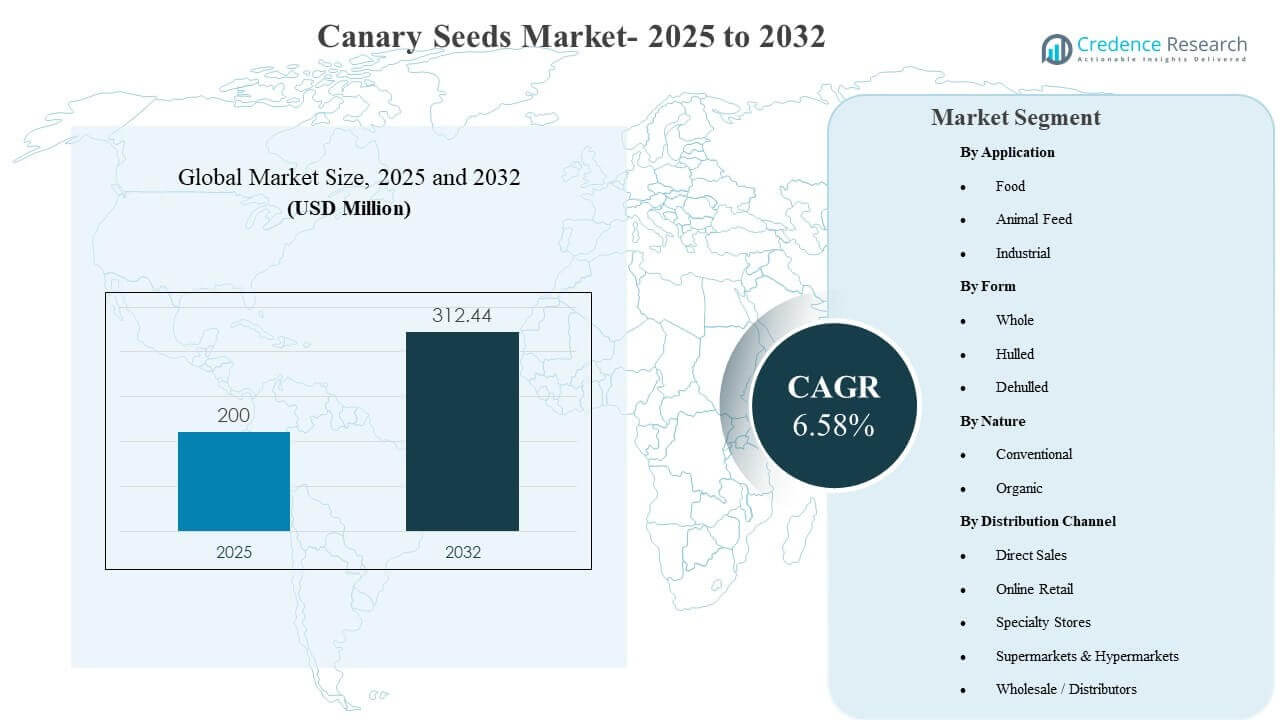
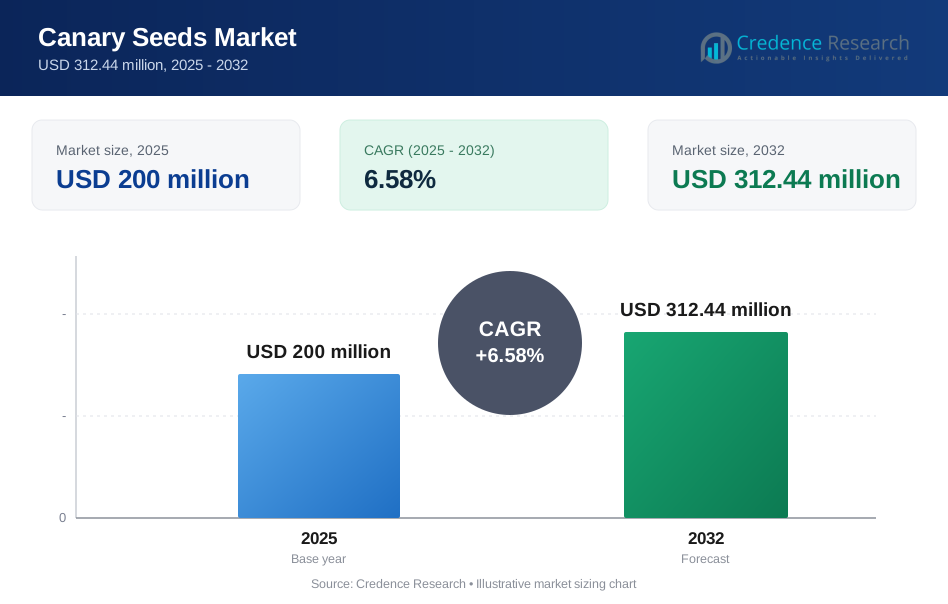
The global Canary Seeds Market size was estimated at USD 200 million in 2025 and is expected to reach USD 312.44 million by 2032, growing at a CAGR of 6.58% from 2025 to 2032. Demand growth is primarily supported by widening adoption of canary seed across food formulations where clean-label positioning, nutrient density, and functional milling potential support repeat purchasing beyond traditional birdseed demand. Supply-side stability from established cultivation and export-led trade flows helps maintain availability for processors and distributors, supporting steady commercialization across packaged food and feed channels.
| REPORT ATTRIBUTE | DETAILS |
|---|---|
| Historical Period | 2020-2024 |
| Base Year | 2025 |
| Forecast Period | 2026-2032 |
| Canary Seeds Market Size 2025 | USD 200 million |
| Canary Seeds Market, CAGR | 6.58% |
| Canary Seeds Market Size 2032 | USD 312.44 million |
Key Market Trends & Insights
- The Canary Seeds Market is projected to expand from USD 200 million in 2025 to USD 312.44 million by 2032, reflecting a 6.58% CAGR during 2025–2032.
- North America accounted for 43.8% of Canary Seeds Market revenue in 2025, supported by strong production, export capacity, and bulk distribution throughput.
- Europe held 24.6% share in 2025, with growth supported by ingredient adoption and increasing retail availability across selected markets.
- Whole canary seed represented 58.6% share in 2025, reflecting strong demand for minimally processed formats in bulk handling and feed-linked use cases.
- Animal feed accounted for 52.3% share in 2025, indicating continued structural demand from bird feed and broader feed applications.
Segment Analysis
The Canary Seeds Market shows a dual-demand structure where traditional animal feed volumes remain foundational, and human food applications are expanding through ingredient adoption. Food-grade positioning benefits from growing interest in plant-based nutrition, baking inclusion, and functional grain alternatives, which increases demand for consistent grading, cleaning, and quality specifications. Market participation often reflects a mix of commodity trading and value-added processing, with differentiation shaped by purity, origin, and supply reliability.
Across the value chain, processing depth and channel strategy determine margin capture. Whole seed formats align with bulk trading and feed distribution, whereas hulled and dehulled formats support broader food integration where texture, digestibility, and usability matter. Distribution increasingly blends large wholesale movement with selective growth in modern retail and online channels, particularly where consumer-facing packaging and health positioning improve discoverability.
By Application Insights
Animal Feed accounted for the largest share of 52.3% in 2025. The leading position is supported by stable, recurring demand in bird feed and feed-grade seed distribution where whole seed remains a preferred format. Bulk logistics, standardized grading, and distributor networks support efficient market clearing for feed applications. Food adoption is rising, but feed demand continues to anchor baseline volumes and purchasing frequency.
By Form Insights
Whole accounted for the largest share of 58.6% in 2025. Whole-seed leadership is reinforced by lower processing requirements, better suitability for bulk handling, and strong alignment with feed and commodity trading flows. The format is widely accepted across traditional demand channels and supports consistent throughput for wholesalers and distributors. Hulled and dehulled forms grow through food use cases, but whole seed remains the dominant traded format.
By Nature Insights
Conventional accounted for the largest share of 83.7% in 2025. Conventional supply benefits from broader cultivation economics, established agronomic practices, and higher availability across exporting regions. Pricing competitiveness and scalable volumes reinforce conventional purchasing for bulk feed and ingredient pipelines. Organic demand is supported by specialty positioning, but certification capacity and segregated handling requirements constrain share expansion.
By Distribution Channel Insights
Wholesale / Distributors accounted for the largest share of 34.8% in 2025. The leading channel reflects trade-led market structure where bulk seed moves through distributors to feed, ingredient, and packaging nodes. Distributor networks provide aggregation, grading alignment, and consistent supply availability for downstream buyers. Direct sales and modern retail channels contribute to diversification, but wholesale movement remains central to volume flow.
Canary Seeds Market Drivers
Expansion Of Food Ingredient Adoption In Mainstream Formulations
Food manufacturers continue to broaden ingredient portfolios toward plant-based and clean-label positioning, supporting higher interest in canary seed as a functional grain input. Product developers prioritize ingredients that offer nutritional density, milling flexibility, and formulation compatibility across baking and blended grain applications. The Canary Seeds Market benefits when processors provide consistent grading, cleaning, and traceability that meets food specifications. Increasing retail visibility for niche grains also improves consumer trial and repeat purchases, strengthening demand consistency.
- For instance, CANTERRA SEEDS markets three glabrous canary seed varieties CDC Lumio, CDC Cibo, and CDC Calvi and Canadian canaryseed nutrition data show that dehulled canaryseed groats contain about 21% protein, 60% starch, 6.5% fat, and 6.5% total dietary fibre, supporting their suitability for food formulation pipelines.
Structural Demand From Bird Feed And Feed Distribution Networks
The Canary Seeds Market continues to be supported by recurring bird feed demand where canary seed remains a well-recognized feed component. Feed-linked demand is reinforced by established distributor channels, stable buying patterns, and bulk movement economics that favor whole seed formats. Commercial buyers value dependable supply, consistent quality, and predictable logistics, which supports repeat contracting and distributor-led purchasing. This structural base demand helps reduce volatility and supports steady market expansion alongside emerging food applications.
Supply Chain Maturity In Export-Oriented Production And Trading
Export-led supply chains support market growth by maintaining availability across importing regions and enabling competitive pricing through scale efficiencies. Mature trading systems improve access for wholesalers, ingredient buyers, and packaged goods brands that rely on dependable sourcing. The Canary Seeds Market gains resilience when growers, aggregators, and exporters maintain quality standards that meet downstream requirements. Strong logistics capabilities and established trade relationships help maintain supply continuity, which supports long-term adoption by industrial and food buyers.
Product Differentiation Through Processing, Grading, And Quality Assurance
Value-added processing such as dehulling, specialized cleaning, and tighter grading enables suppliers to target higher-value food applications. Buyers increasingly prioritize seed purity, uniformity, and functional performance when positioning canary seed in consumer-facing formats. The Canary Seeds Market advances when processors invest in capabilities that reduce impurities and improve consistency for milling and formulation. Clear specification alignment improves buyer confidence and supports broader commercialization across specialty and mainstream channels.
- For instance, Satake states that its optical sorters can process about 5 to 8 tons per hour and identify roughly 0.5% defective material per ton using cameras, electronic sensors, and air-jet rejection, showing how measurable sorting precision can strengthen food-grade quality assurance for seed processors.
Market Challenges
The Canary Seeds Market faces variability risks linked to agricultural production cycles, weather exposure, and supply concentration in key exporting regions. Price movement can influence substitution decisions within feed blends and can affect food ingredient adoption when input costs rise quickly. Quality consistency challenges such as impurities, grading variation, and moisture control can also increase rejection risk for food-grade buyers. Managing these factors requires stronger contracting, quality controls, and diversified sourcing strategies.
Another challenge is the pace of consumer adoption in food channels, where awareness and repeat usage may lag compared to traditional feed demand. Product positioning must compete with established grains and seeds that already hold shelf space and broad recipe familiarity. Regulatory compliance and labeling expectations for food-grade distribution can add operational burden for smaller suppliers. Channel fragmentation across specialty, online, and mass retail can also increase go-to-market complexity.
- For instance, Alpiste Seeds markets de-hulled hairless canary seed for human consumption with 10 grams of protein per five teaspoons, and its product information notes that bread made with about 15% to 25% canary seed flour scored significantly higher in sensory panels than average gluten-free bread, indicating that even with measurable product-performance advantages, suppliers still need stronger education and retail execution to build repeat demand.
Canary Seeds Market Trends and Opportunities
The Canary Seeds Market is seeing rising opportunity in food applications as brands expand into functional grains, better-for-you baking inputs, and plant-based ingredient blends. Processed formats such as hulled and dehulled seed support improved usability, enabling suppliers to target premium segments with tighter specifications. Growth potential improves when suppliers align packaging, labeling, and distribution to reach modern retail and online consumers. Ingredient innovation and product education can accelerate household penetration and improve repeat demand.
- For instance, Ingredion’s exclusive commercial agreement with NorQuin was built around quinoa flours developed from more than two decades of proprietary breeding work on higher-yielding, higher-protein varieties, showing how specialty-grain suppliers can create premium positioning through measurable product differentiation and processing know-how rather than compete only on raw grain availability.
Another opportunity lies in supply chain partnerships that strengthen long-term procurement and stabilize pricing for large buyers. Exporters, distributors, and processors can improve competitiveness through traceability programs, consistency-focused quality systems, and tailored grades for targeted end uses. Expanded distributor coverage in emerging regions can improve access and reduce dependency on limited channels. Market participants that combine reliable bulk supply with food-grade differentiation are positioned to capture higher-value demand growth.
Regional Insights
North America
North America accounted for 43.8% of Canary Seeds Market revenue in 2025. Regional leadership is supported by strong production scale, export orientation, and distributor throughput that enable consistent bulk supply for both feed and ingredient buyers. Processing and grading capabilities support quality-aligned shipments, improving suitability for food-grade applications. Commercial contracting practices and logistics strength reinforce supply reliability for downstream channels.
Europe
Europe held 24.6% share of Canary Seeds Market revenue in 2025. Growth is supported by expanding ingredient adoption and wider availability through modern retail and specialty food channels in selected countries. Food-grade usage benefits from consumer interest in healthier grains and formulation diversity across bakery and blended products. Distribution strength and specification-driven purchasing support steady demand expansion.
Asia Pacific
Asia Pacific accounted for 17.9% of Canary Seeds Market revenue in 2025. Regional demand is supported by growing urban consumption of health-oriented foods and increased interest in alternative grains and seeds. Import reliance elevates the importance of stable trade links and consistent quality standards for processors and distributors. Expansion in online retail and specialty stores improves access for consumer-facing formats.
Latin America
Latin America represented 9.8% share of Canary Seeds Market revenue in 2025. Regional participation is supported by exporter activity and trade connectivity that contributes to global supply availability. Demand is shaped by a combination of feed-linked usage and selective food ingredient adoption, depending on country-level retail development. Channel partnerships and processing investments can improve value capture over time.
Middle East & Africa
Middle East & Africa accounted for 3.9% of Canary Seeds Market revenue in 2025. Market activity is primarily shaped by imports, distributor availability, and niche demand across feed and specialty food channels. Growth potential improves when supply consistency and packaging suitability support broader retail penetration. Targeted distribution expansion can gradually increase addressable demand.
Competitive Landscape
Competition in the Canary Seeds Market is shaped by sourcing reliability, grading and cleaning standards, and the ability to serve both bulk and value-added channels. Market participants differentiate through supply consistency, export relationships, processing depth, and channel reach across wholesale, retail, and online outlets. Strategic priorities commonly include expanding distributor networks, improving quality assurance, and developing processed formats that better serve food applications.
Finseed Ltd. is positioned within a competitive environment where dependable supply, consistent grading, and channel access influence buyer retention and repeat contracting. Market standing improves when Finseed Ltd. supports stable procurement, maintains quality specifications for different end uses, and strengthens distributor relationships for efficient volume movement. Processing-aligned offerings and tailored grades can support broader penetration into food ingredient channels. Commercial competitiveness also depends on maintaining cost efficiency alongside quality consistency.
The industry research and growth report includes detailed analyses of the competitive landscape of the market and information about key companies, including:
- Finseed Ltd.
- Pepef Seeds Corporation
- Globus Seeds S.A.
- Bird City International, Inc.
- True Grass Seeds Ltd.
- Tarquin Seeds Ltd.
- Argus Seeds Ltd.
- Shenstone Seeds Ltd.
- Verneuil Seed Company Limited
- Red Star Seeds Ltd.
Qualitative and quantitative analysis of companies has been conducted to help clients understand the wider business environment as well as the strengths and weaknesses of key industry players. Data is qualitatively analyzed to categorize companies as pure play, category-focused, industry-focused, and diversified; it is quantitatively analyzed to categorize companies as dominant, leading, strong, tentative, and weak.
Recent Developments
- In February 2025, S&W Seed Company successfully completed the voluntary administration of its Australian subsidiary, transitioning it to Avior Asset Management. This strategic move allowed the company to refocus exclusively on its core Americas-based operations, including its high-margin Double Team and Prussic Acid Free specialty seeds.
- In May 2025, Canterra Seeds announced the acquisition of Alliance Seed, a pedigreed seed firm based in Winnipeg. While Alliance continues to operate as a standalone brand, the partnership strengthens Canterra's position in the Western Canadian seed market, which remains the global price setter for canary seed exports.
Report Scope
| Report Attribute | Details |
| Market size value in 2025 | USD 200 million |
| Revenue forecast in 2032 | USD 312.44 million |
| Growth rate (CAGR) | 6.58% (2025–2032) |
| Base year | 2025 |
| Forecast period | 2025–2032 |
| Quantitative units | USD million |
| Segments covered | By Application Outlook: Food, Animal Feed, Industrial; By Form Outlook: Whole, Hulled, Dehulled; By Nature Outlook: Conventional, Organic; By Distribution Channel Outlook: Direct Sales, Online Retail, Specialty Stores, Supermarkets & Hypermarkets, Wholesale / Distributors |
| Regional scope | North America, Europe, Asia Pacific, Latin America, Middle East & Africa |
| Key companies profiled | Finseed Ltd.; Pepef Seeds Corporation; Globus Seeds S.A.; Bird City International, Inc.; True Grass Seeds Ltd.; Tarquin Seeds Ltd.; Argus Seeds Ltd.; Shenstone Seeds Ltd.; Verneuil Seed Company Limited; Red Star Seeds Ltd. |
| No.of Pages | 330 |
Segmentation
By Application
- Food
- Animal Feed
- Industrial
By Form
- Whole
- Hulled
- Dehulled
By Nature
- Conventional
- Organic
By Distribution Channel
- Direct Sales
- Online Retail
- Specialty Stores
- Supermarkets & Hypermarkets
- Wholesale / Distributors
By Region
- North America
- U.S.
- Canada
- Mexico
- Europe
- Germany
- France
- U.K.
- Italy
- Spain
- Rest of Europe
- Asia Pacific
- China
- Japan
- India
- South Korea
- South-east Asia
- Rest of Asia Pacific
- Latin America
- Brazil
- Argentina
- Rest of Latin America
- Middle East & Africa
- GCC Countries
- South Africa
- Rest of the Middle East and Africa
Request a Free Sample
Fill in your details and we'll send you a free sample report.
- Sample data tables & charts
- Research methodology
Need a Custom Version of This Report?
Tailor the scope, geography, or segments to your exact requirements.
- Custom geography or segment scope
- Direct access to our analyst team
Frequently Asked Questions
What is the current size of the Canary Seeds Market?
What is the forecast size of the Canary Seeds Market?
What is the CAGR of the Canary Seeds Market during the forecast period?
Which segment is the largest in the Canary Seeds Market?
Who are the leading companies in the Canary Seeds Market?
Which region leads the Canary Seeds Market?
Table of Content
Chapter 1. Report Introduction
- 1.1 Report Description & Purpose
- 1.1.1 Report Title & Market Definition
- 1.1.2 Unique Selling Propositions (USP) & Key Differentiators
- 1.1.3 Value Proposition for Stakeholders
- 1.2 Research Objectives
- 1.2.1 Market Sizing Objectives (Volume & Revenue)
- 1.2.2 Segmentation Objectives
- 1.2.3 Competitive Intelligence Objectives
- 1.2.4 Forecast & Scenario Objectives
- 1.3 Report Scope
- 1.3.1 Canary Seeds Scope – Types & Subtypes Covered
- 1.3.2 Geographic Scope – Regions & Countries Covered
- 1.3.3 Historical Period, Base Year & Forecast Period (2025; forecast to 2032)
- 1.3.4 Inclusions & Exclusions
- 1.4 HS Code & Classification Framework
- 1.5 Currency, Units & Pricing Basis
- 1.6 Target Stakeholders
- 1.7 Limitations & Assumptions
Chapter 2. Executive Summary
- 2.1 Global Canary Seeds Market Snapshot
- 2.1.1 Market Size – Historical (2025) & Forecast (2025-2032) (2025: USD 200 million → 2032: USD 312.44 million)
- 2.1.2 Volume & Revenue – Global Totals
- 2.1.3 Key Market Highlights – Top Five Facts
- 2.2 Canary Seeds Market Segmentation Snapshot
- 2.2.1 Market Split by Region – 2025 vs. 2032
- 2.3 Competitive Snapshot
- 2.3.1 Top 10 Players by Revenue Share – 2025
- 2.3.2 Top 10 Players by Volume Share – 2025
- 2.3.3 Recent Strategic Developments (18-Month Summary)
- 2.4 Key Investment Highlights & Strategic Conclusions
Chapter 3. Canary Seeds Market Dynamics & Industry Analysis
- 3.1 Market Overview & Context
- 3.1.1 Canary Seeds Market Position in the Broader Automotive Value Chain
- 3.1.2 OEM vs. Replacement Market Dynamics
- 3.1.3 Market Maturity & Development Stage by Region
- 3.2 Canary Seeds Market Drivers
- 3.3 Canary Seeds Market Restraints & Challenges
- 3.4 Canary Seeds Market Opportunities
- 3.5 Porter's Five Forces Analysis
- 3.5.1 Threat of New Entrants
- 3.5.2 Bargaining Power of Suppliers
- 3.5.3 Bargaining Power of Buyers
- 3.5.4 Threat of Substitutes
- 3.5.5 Competitive Rivalry – Intensity Assessment
- 3.6 Canary Seeds Value Chain Analysis
- 3.6.1 Upstream – Raw Material/Input Suppliers
- 3.6.1.1 Raw Material/Input 1
- 3.6.1.2 Raw Material/Input 2
- 3.6.1.3 Raw Material/Input 3
- 3.6.2 Midstream – Production/Manufacturing/Service Delivery
- 3.6.2.1 Production/Process Overview
- 3.6.2.2 Key Facility Locations & Capacity by Manufacturer
- 3.6.3 Downstream – Distribution & End Consumer
- 3.6.3.1 Primary Channel – B2B/OEM
- 3.6.3.2 Secondary Channels – Dealer, Retail, Online, Direct
- 3.6.4 Value Chain Profitability Analysis
- 3.6.1 Upstream – Raw Material/Input Suppliers
- 3.7 PESTEL Analysis
- 3.7.1 Political Factors
- 3.7.2 Economic Factors
- 3.7.3 Social Factors
- 3.7.4 Technological Factors
- 3.7.5 Environmental Factors
- 3.7.6 Legal Factors
- 3.8 Canary Seeds Supply Chain Analysis
- 3.8.1 Raw Material/Input Supply Risk Assessment
- 3.8.2 Manufacturing Concentration Risk (Geographic Exposure)
- 3.8.3 Trade Disruption Impact Analysis
- 3.9 Regulatory & Policy Landscape
Note: The regulatory and policy landscape section covers regulations based on their applicability to the market, Canary Seeds category, geography, and scope of the study. Only regulatory frameworks with a material impact on operations, compliance, trade, sustainability, or market access are analyzed in detail.
Chapter 4. Key Investment Pockets & Opportunity Analysis
- 4.1 Canary Seeds Market Attractiveness Analysis
- 4.1.1 By Region – Investment Attractiveness Matrix (Volume × CAGR)
- 4.2 Absolute Revenue Growth Opportunity
- 4.2.1 By Region – Absolute USD Growth Through 2032
- 4.3 Incremental Volume Opportunity
- 4.3.1 By Region – Incremental Volume Through 2032
- 4.3.2 Segment – Incremental Volume
- 4.4 Emerging Submarket Opportunity Deep Dive (Subject to Applicability)
- 4.5 Emerging Market Opportunity Scorecards
- 4.5.1 United States
- 4.5.2 Europe
- 4.5.3 Asia
- 4.5.4 Middle East & Africa
Note: Emerging Market Opportunity Scorecards will be included based on relevance and strategic importance. Regions listed are indicative and may vary depending on data availability and market dynamics.
Chapter 5. Canary Seeds Import-Export Analysis & Trade Flows
- 5.1 Global Trade Overview
- 5.1.1 Global Export Value by Country (2025)
- 5.1.2 Global Export Volume by Country (2025)
- 5.1.3 Global Import Value by Country (2025)
- 5.1.4 Global Import Volume by Country (2025)
- 5.1.5 Net Trade Balance by Country (2025)
- 5.2 Export Analysis – Segment
- 5.2.1 Type 1 (HS Code)
- 5.2.2 Type 2 (HS Code)
- 5.2.3 Type 3 (HS Code)
- 5.2.4 Type 4 (HS Code)
- 5.2.5 Type 5 (HS Code)
- 5.3 Import Analysis – Segment
- 5.3.1 Type 1 (HS Code)
- 5.3.2 Type 2 (HS Code)
- 5.3.3 Type 3 (HS Code)
- 5.3.4 Type 4 (HS Code)
- 5.3.5 Type 5 (HS Code)
- 5.4 Average Unit Trade Prices
- 5.4.1 Average Export Price – Segment & Country
- 5.4.2 Average Import Price – Segment & Source Country
- 5.4.3 Price Trends (2025)
- 5.5 Key Trade Route Analysis
- 5.5.1 Trade Route 1
- 5.5.2 Trade Route 2
- 5.5.3 Trade Route 3
- 5.5.4 Trade Route 4
- 5.5.5 Trade Route 5
- 5.6 Trade Policy Impact Assessment
- 5.6.1 US Anti-Dumping & Section 301 Tariffs
- 5.6.2 EU Customs Union Impact
- 5.6.3 Major Free Trade Agreements
- 5.6.4 USMCA Rules of Origin
Note: Trade policy analysis will be included only where relevant to the Canary Seeds market.
Chapter 6. Competitive Landscape & Company Benchmarking
- 6.1 Canary Seeds Market Concentration & Structure
- 6.1.1 Herfindahl-Hirschman Index (HHI) – vs. 2025
- 6.1.2 Tier 1, Tier 2 & Tier 3 Market Structure
- 6.1.3 Global, Regional & Local Player Dynamics
- 6.2 Canary Seeds Market Share Analysis – 2025
- 6.2.1 Global Revenue Share by Company
- 6.2.2 Global Volume Share by Company
- 6.2.3 Regional Revenue Share
- 6.2.4 Market Share Evolution ( vs. 2025)
- 6.2.5 OEM Segment Share by Company
- 6.2.6 Replacement Segment Share by Company
- 6.3 Production/Delivery Capacity & Facility Analysis
- 6.3.1 Global Installed Capacity
- 6.3.2 Capacity Utilization Rates
- 6.3.3 Production/Output Volume
- 6.3.4 Facility Locations & Capacity Map
- 6.3.5 Planned Capacity Additions
- 6.4 Canary Seeds Competitive Benchmarking Matrix
- 6.4.1 Revenue, Volume, CAGR & Profitability Comparison
- 6.4.2 Channel Revenue Mix
- 6.4.3 Geographic Revenue Exposure
- 6.4.4 R&D Intensity
- 6.4.5 Sustainability Maturity
- 6.5 Strategic Developments in Canary Seeds (Last 24 Months)
- 6.5.1 Mergers, Acquisitions & Divestments
- 6.5.2 New Canary Seeds Launches
- 6.5.3 Facility Expansions
- 6.5.4 Strategic Alliances, Joint Ventures & Partnerships
- 6.5.5 Distribution Expansion & Market Entry
- 6.5.6 Sustainability & ESG Initiatives
- 6.6 Competitive Strategy Mapping
- 6.6.1 Leader, Challenger, Follower & Niche Classification
- 6.6.2 Pricing Strategy Comparison
- 6.6.3 Channel Strategy Matrix
Note: Strategic developments are included based on their materiality and the availability of reliable information.
Chapter 7. Global Canary Seeds Market – By Distribution Channel
- 7.1 Segment Overview
- 7.1.1 Volume & Revenue Split by Channel (2025 & 2032)
- 7.1.2 Channel Mix Evolution (2025-2032)
Chapter 8. Regional Market Analysis – Global Overview
- 8.1 Global Regional Overview
- 8.1.1 Regional Volume Share
- 8.1.2 Regional Revenue Share
- 8.1.3 Regional Volume by Region
- 8.1.4 Regional Revenue by Region
- 8.1.5 Regional Forecast Through 2032
- 8.2 Cross-Regional Segment Analysis
- 8.2.1 By Distribution Channel
- 8.2.2 By Brand/Price Tier
Chapter 9. North America Canary Seeds Market
- 9.1 United States
- 9.2 Canada
- 9.3 Mexico
Chapter 10. Europe Canary Seeds Market
- 10.1 Germany
- 10.2 France
- 10.3 Italy
- 10.4 United Kingdom
- 10.5 Spain
- 10.6 Poland
- 10.7 Russia
- 10.8 Netherlands
- 10.9 Belgium
- 10.10 Sweden
- 10.11 Denmark
- 10.12 Norway
- 10.13 Rest of Europe
Chapter 11. Asia Pacific Canary Seeds Market
- 11.1 China
- 11.2 India
- 11.3 Japan
- 11.4 South Korea
- 11.5 Thailand
- 11.6 Indonesia
- 11.7 Vietnam
- 11.8 Malaysia
- 11.9 Australia
- 11.10 Rest of Asia Pacific
Chapter 12. Latin America Canary Seeds Market
- 12.1 Brazil
- 12.2 Argentina
- 12.3 Colombia
- 12.4 Chile
- 12.5 Rest of Latin America
Chapter 13. Middle East Canary Seeds Market
- 13.1 Saudi Arabia
- 13.2 United Arab Emirates
- 13.3 Turkey
- 13.4 Israel
- 13.5 Iran
- 13.6 Rest of the Middle East
Chapter 14. Africa Canary Seeds Market
- 14.1 South Africa
- 14.2 Egypt
- 14.3 Nigeria
- 14.4 Morocco
- 14.5 Rest of Africa
Chapter 15. Canary Seeds Company Profiles
- 15.1 [Company 01]
- 15.1.1 Company Overview
- 15.1.2 Key Management Personnel
- 15.1.3 Products & Services Portfolio
- 15.1.4 Financial Performance
- 15.1.5 Key Market Focus & Geographic Presence
- 15.1.6 Recent Developments & Strategic Initiatives
Note: The company profile list is preliminary and may change based on research findings, market developments, data availability, and client requirements.
Chapter 16. Appendices
- Appendix A – List of Abbreviations & Acronyms
- Appendix B – Industry Classification Code Reference – Full Series
- Appendix C – Production & Capacity Data Tables
- Appendix D – End-Use & Demand Base Tables
- Appendix E – Consumption & Replacement Rate Assumptions
- Appendix F – ASP Reference Tables
- Appendix G – Manufacturing & Facility Database
- Appendix H – Import-Export Data Tables
- Appendix I – Regulatory Summary Tables
- Appendix J – Primary Research Participant List (Anonymized)
- Appendix K – Primary Research Questionnaire Framework
- Appendix L – Data Sources & Bibliography
- Appendix M – Market Size Divergence & Source Comparison
Chapter 17. Research Methodology
- 17.1 Research Framework & Philosophy
- 17.2 Secondary Research – Sources, Hierarchy & Data Extraction
- 17.3 Data Modeling – Bottom-Up & Top-Down Market Sizing
- 17.4 Primary Research – Stakeholder Framework, LOI & Sample Sizes
- 17.5 Forecast Methodology – Regression, Scenario & Sensitivity Analysis
- 17.6 Quality Control – Four-Layer Validation Framework
- 17.7 Limitations & Standard Assumptions
- 17.8 Disclaimer
