
Livestock Farm Equipment Market Overview:
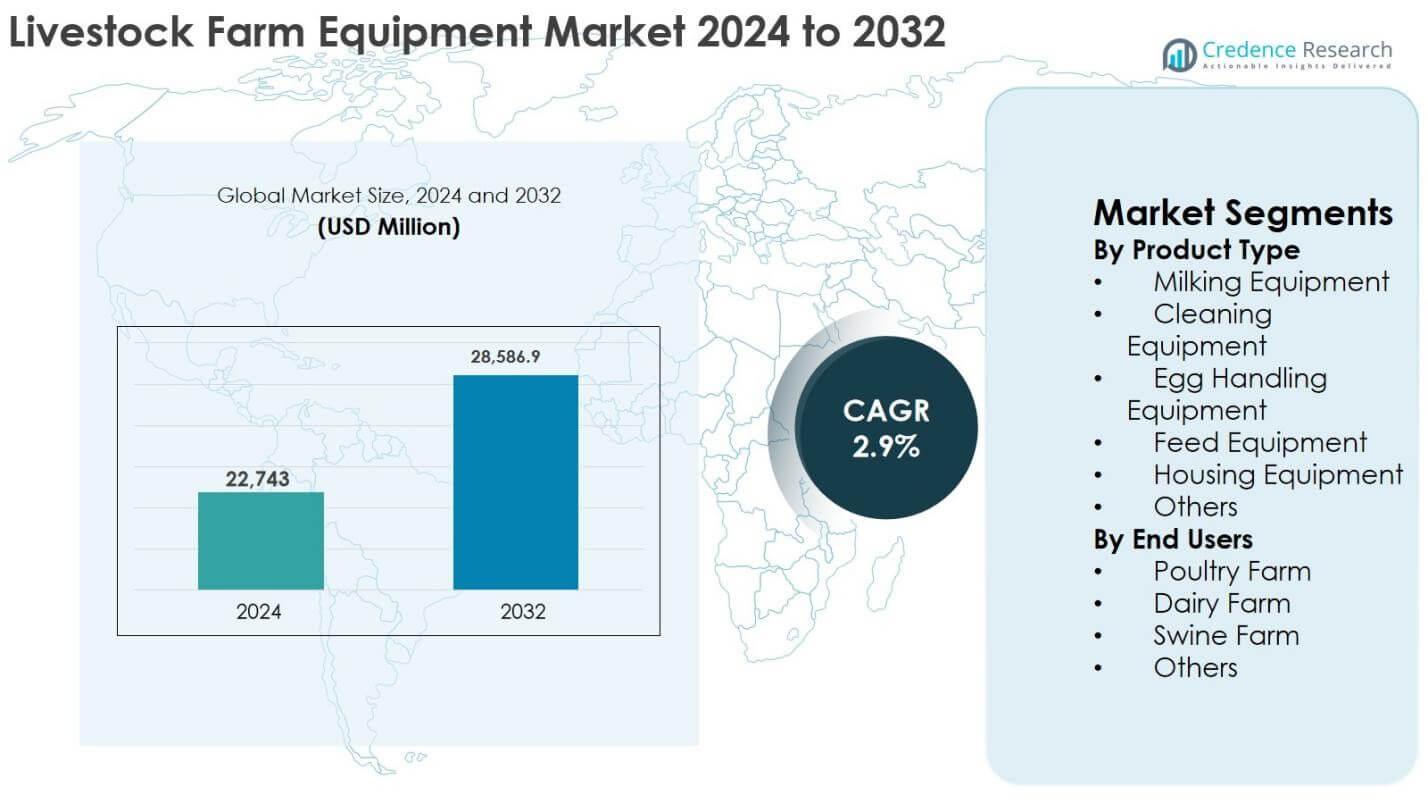
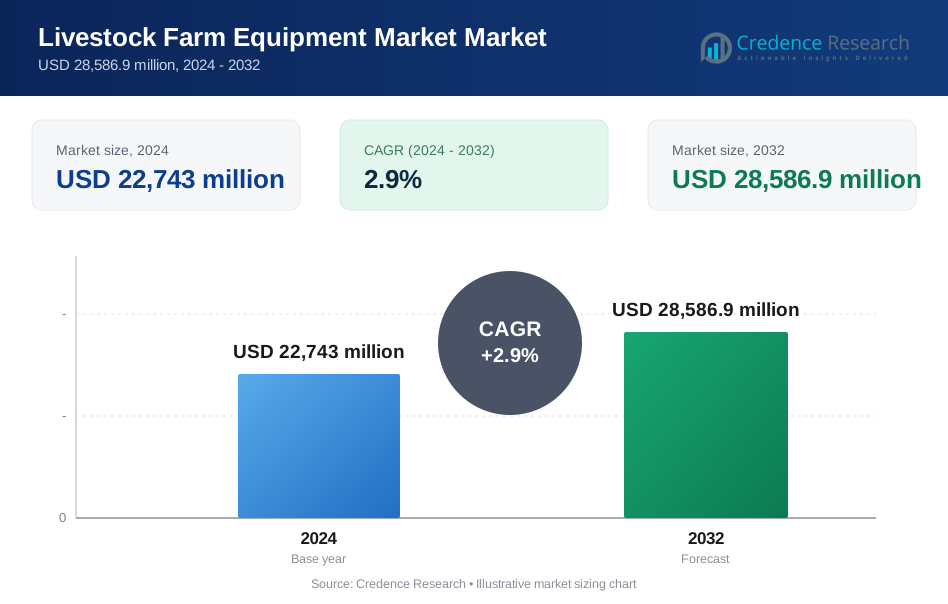
Livestock Farm Equipment market size was valued at USD 22,743 million in 2024 and is anticipated to reach USD 28,586.9 million by 2032, growing at a CAGR of 2.9% during the forecast period.
| REPORT ATTRIBUTE | DETAILS |
|---|---|
| Historical Period | 2020-2023 |
| Base Year | 2024 |
| Forecast Period | 2025-2032 |
| Livestock Farm Equipment Market Size 2024 | USD 22,743 million |
| Livestock Farm Equipment Market, CAGR | 2.9% |
| Livestock Farm Equipment Market Size 2032 | USD 28,586.9 million |
Livestock Farm Equipment Market Insights
- Market growth is driven by rising demand for milk, meat, and eggs, expansion of commercial dairy and poultry farms, and increasing adoption of automated milking, feeding, and housing systems to improve productivity and reduce labor dependency.
- Automation, precision feeding, and smart livestock monitoring systems are key trends, with milking equipment dominating the product segment holding 34.6% share, supported by growing investment in robotic and data-driven farm solutions.
- Competition remains strong with players such as DeLaval, GEA Group AG, Lely Holding S.A.R.L., AGCO Corporation, and Marel HF focusing on innovation, automation, and integrated livestock management solutions.
- North America led the market with 32.8% share in 2024, followed by Europe at 28.4% driven by animal welfare regulations, while Asia Pacific held 24.6% share supported by rapid farm commercialization and government mechanization initiatives.
Livestock Farm Equipment Market Segmentation Analysis:
By Product Type
In the Livestock Farm Equipment market, milking equipment emerged as the dominant product type, accounting for 34.6% market share in 2024, driven by rising dairy consumption, herd size expansion, and increasing adoption of automated milking systems to improve productivity and animal health. Advanced milking robots, automated teat cleaning, and milk monitoring solutions support labor efficiency and yield optimization. Feed equipment followed with 26.8% share, supported by precision feeding demand, while housing and cleaning equipment gained traction due to stricter hygiene standards and animal welfare regulations across large-scale commercial farms.
- For instance, DeLaval’s voluntary milking system VMS V300 is documented to achieve up to around 3,000–3,500 kg milk per day per robot in typical installations, helping large dairies reduce manual milking labor.
By End Users
Dairy farms represented the dominant end-user segment in the Livestock Farm Equipment market, capturing 41.9% market share in 2024, driven by continuous investments in automation, herd management, and milk quality enhancement. Growing demand for efficient milking, feeding, and housing solutions supports strong equipment uptake in this segment. Poultry farms accounted for 29.4% share, supported by rising global poultry meat and egg production, while swine farms witnessed steady growth due to increasing mechanization aimed at improving feed conversion efficiency, biosecurity, and waste management practices.
- For instance, Lely’s Astronaut A5 robotic milking system is widely deployed on large dairies and is designed to enable cow‑driven milking with detailed yield, conductivity, and activity data per cow.
Key Growth Drivers
Rising Demand for Livestock Products and Farm Expansion
The Livestock Farm Equipment market is primarily driven by rising global demand for milk, meat, and eggs, supported by population growth, urbanization, and changing dietary preferences toward protein-rich foods. Commercial livestock farms are expanding herd sizes and production capacities to meet this demand, which increases the need for efficient milking, feeding, housing, and cleaning equipment. Dairy farms, in particular, are investing in advanced milking and herd management systems to improve yield consistency and animal health. Poultry and swine farms are also scaling operations, driving adoption of automated feeding and housing solutions. Farm expansion encourages replacement of manual practices with mechanized equipment, improving productivity, reducing losses, and enabling sustainable large-scale livestock operations across regions.
- For instance, GEA’s DairyNet and DeLaval’s DelPro platforms integrate data from milking, feeding, and activity sensors to support data‑driven decisions on health, reproduction, and performance.
Growing Adoption of Automation and Precision Farming
Automation and precision farming are major growth drivers in the Livestock Farm Equipment market as farmers aim to reduce labor dependency and improve operational efficiency. Rising labor shortages and wage costs push farms toward automated milking systems, precision feeding equipment, and sensor-based monitoring tools. These technologies allow real-time tracking of animal health, feed intake, and production performance, enabling data-driven decisions and early disease detection. Precision systems optimize feed utilization, reduce waste, and enhance yield quality, improving overall farm profitability. Automation also ensures consistent operations and minimizes human error, making it increasingly essential for dairy, poultry, and swine farms seeking higher efficiency, improved animal welfare, and long-term operational sustainability.
- For instance, Big Dutchman’s automated feeding and climate-control systems for poultry and swine monitor feed intake and barn conditions to optimize feed utilization, reduce waste, and improve growth performance.
Supportive Government Policies and Farm Modernization Initiatives
Government initiatives significantly support growth of the Livestock Farm Equipment market through subsidies, grants, and low-interest financing programs aimed at modernizing agriculture. Many countries promote mechanization to enhance food security, improve livestock productivity, and increase rural incomes. Regulations emphasizing animal welfare, hygiene standards, and biosecurity further encourage farms to upgrade equipment. Policies supporting efficient waste management, energy-efficient housing, and sustainable farming practices also boost demand for modern livestock equipment. These initiatives reduce financial barriers for farmers, particularly small and medium operators, and accelerate adoption of advanced technologies. Government-backed modernization programs play a crucial role in driving equipment penetration across developing and developed regions.
Key Trends & Opportunities
Integration of Smart and Connected Farm Equipment
The Livestock Farm Equipment market is witnessing a strong trend toward smart and connected equipment integrated with IoT sensors, automation software, and data analytics platforms. These systems enable continuous monitoring of livestock health, milk yield, feed consumption, and environmental conditions. Smart equipment improves farm visibility, supports predictive maintenance, and reduces operational downtime. Real-time data insights help farmers optimize resource utilization, enhance productivity, and improve animal welfare. This trend creates opportunities for manufacturers to offer value-added digital solutions and for partnerships between equipment providers and technology companies. Adoption of connected systems is expected to grow as farms increasingly prioritize efficiency, traceability, and data-driven management.
- For instance, Lely Horizon links Astronaut milking robots, feeding systems, and sensors in a cloud-based platform that offers data-driven advice on feeding, reproduction, and herd management.
Rising Demand from Emerging Economies
Emerging economies present significant growth opportunities for the Livestock Farm Equipment market due to rapid commercialization of agriculture and increasing consumption of animal-based products. Rising disposable incomes, expanding middle-class populations, and government support for farm mechanization drive demand for modern livestock equipment. Farmers in these regions increasingly seek cost-effective, modular, and scalable solutions suitable for small and mid-sized operations. Investments in organized dairy, poultry, and swine farming further support equipment adoption. Manufacturers can capitalize on these opportunities through localized manufacturing, affordable product offerings, and strong regional distribution networks, enabling wider market penetration across Asia Pacific, Latin America, and Africa.
- For instance, Brazil’s large commercial dairy and poultry sectors, supported by national credit lines for agricultural machinery, have been steadily upgrading to more automated milking, feeding, and climate-control systems
Key Challenges
High Initial Investment and Maintenance Costs
High upfront investment and ongoing maintenance costs remain a major challenge in the Livestock Farm Equipment market. Advanced systems such as automated milking, precision feeding, and smart monitoring equipment require significant capital expenditure, which limits adoption among small and medium farms. Long payback periods and uncertain returns further discourage investment in cost-sensitive regions. Maintenance, repair, and replacement of components add to operational expenses, increasing total ownership costs. In some markets, reliance on imported equipment raises prices due to tariffs and logistics costs. These financial constraints create adoption gaps between large commercial farms and smaller operators, slowing overall market growth.
Limited Technical Expertise and Infrastructure Constraints
Limited availability of skilled labor and inadequate rural infrastructure pose challenges to the Livestock Farm Equipment market. Advanced equipment requires trained operators, regular servicing, reliable electricity, and connectivity, which are often lacking in remote farming areas. Farmers may struggle to fully utilize automated systems due to insufficient technical knowledge, leading to underperformance of equipment. Limited access to after-sales service and spare parts further affects equipment reliability. Poor digital connectivity also restricts adoption of smart and connected solutions. Overcoming these challenges requires investment in farmer training, service networks, and rural infrastructure to ensure effective and sustainable use of modern livestock equipment.
Regional Analysis
North America
North America accounted for 32.8% market share of the Livestock Farm Equipment market in 2024, driven by high mechanization levels, large-scale commercial farms, and strong adoption of automated milking and feeding systems. The United States dominates regional demand due to advanced dairy and poultry farming practices, rising labor costs, and widespread use of precision livestock technologies. Farmers increasingly invest in smart equipment to improve productivity, animal welfare, and operational efficiency. Supportive government programs, strong financing availability, and presence of leading equipment manufacturers further support steady equipment replacement and technology upgrades across the region.
Europe Europe held 28.4% market share in the Livestock Farm Equipment market in 2024, supported by stringent animal welfare regulations, strong dairy production, and emphasis on sustainable farming practices. Countries such as Germany, France, and the Netherlands lead adoption of automated milking, housing, and waste management systems. Rising focus on environmental compliance and energy-efficient farm infrastructure drives equipment modernization. Government incentives for sustainable agriculture and precision farming further boost demand. High technology penetration and replacement of aging equipment sustain steady market growth across Western and Northern Europe.
Asia Pacific Asia Pacific accounted for 24.6% market share in 2024 and represents the fastest-growing region in the Livestock Farm Equipment market. Rapid population growth, rising protein consumption, and increasing commercialization of livestock farming drive equipment demand. China, India, and Southeast Asian countries are investing in dairy and poultry infrastructure to improve productivity and food security. Government initiatives promoting farm mechanization and modernization support adoption. Demand for cost-effective and scalable equipment solutions is strong among small and mid-sized farms, accelerating regional market expansion.
Latin America Latin America captured 8.1% market share of the Livestock Farm Equipment market in 2024, driven by expanding dairy and poultry industries in countries such as Brazil and Argentina. Growth in meat and milk exports encourages investment in modern feeding, housing, and milking equipment. Large farm sizes support gradual mechanization, while improving access to financing aids equipment adoption. However, price sensitivity and uneven technology penetration limit rapid growth. Increasing focus on productivity improvement and biosecurity is expected to support steady equipment demand across the region.
Middle East & Africa The Middle East & Africa region accounted for 6.1% market share in 2024, supported by rising investments in food security and livestock modernization. Gulf countries focus on advanced dairy and poultry farming using automated feeding and climate-controlled housing systems. In Africa, gradual mechanization driven by government-backed agricultural development programs supports equipment adoption. Demand remains concentrated in organized and commercial farms, while small-scale operations show slower uptake due to cost constraints. Improving infrastructure and policy support are expected to drive moderate long-term growth.
Livestock Farm Equipment Market Segmentations:
By Product Type
- Milking Equipment
- Cleaning Equipment
- Egg Handling Equipment
- Feed Equipment
- Housing Equipment
- Others
By End Users
- Poultry Farm
- Dairy Farm
- Swine Farm
- Others
By Geography
- North America
- U.S.
- Canada
- Mexico
- Europe
- Germany
- France
- U.K.
- Italy
- Spain
- Rest of Europe
- Asia Pacific
- China
- Japan
- India
- South Korea
- South-east Asia
- Rest of Asia Pacific
- Latin America
- Brazil
- Argentina
- Rest of Latin America
- Middle East & Africa
- GCC Countries
- South Africa
- Rest of the Middle East and Africa
Competitive Landscape
The competitive landscape of the Livestock Farm Equipment market is characterized by the presence of well-established global manufacturers alongside specialized regional players, focusing on automation, precision farming, and integrated livestock management solutions. Leading companies such as DeLaval, GEA Group AG, and Lely Holding S.A.R.L. dominate the market through advanced milking, feeding, and housing systems that enhance productivity and animal welfare. AGCO Corporation and Marel HF strengthen competition by integrating digital technologies and data-driven solutions. Other notable players, including Afimilk Ltd, Trioliet B.V., Fancom B.V., FarmTek, and Pearson International LLC, focus on niche equipment, smart monitoring, and cost-effective solutions. Continuous product innovation, strategic partnerships, and geographic expansion remain key strategies shaping competition.
Key Player Analysis
- Marel HF
- DeLaval
- Fancom B.V.
- Pearson International LLC
- Afimilk Ltd
- Agco Corporation
- FarmTek
- Trioliet B.V.
- GEA Group AG
- Lely Holding S.A.R.L.
Recent Developments
- In November 2025 Animal Health International acquired Redbook Software, a cloud-based financial operating platform for feedyards, to enhance its livestock software and management offerings.
- In June 2025 Halter raised $100M in Series D funding led by BOND to expand its virtual fencing and digital livestock management system for cattle ranches, valuing the company at about $1 billion.
- In 2025 Farmers Business Network expanded its livestock product line including Ridley feeds, fencing supplies, and equine products while securing new funding to extend its AI-powered agriculture platform.
Report Coverage
The research report offers an in-depth analysis based on Product Type, Application, End-User and Geography. It details leading market players, providing an overview of their business, product offerings, investments, revenue streams, and key applications. Additionally, the report includes insights into the competitive environment, SWOT analysis, current market trends, as well as the primary drivers and constraints. Furthermore, it discusses various factors that have driven market expansion in recent years. The report also explores market dynamics, regulatory scenarios, and technological advancements that are shaping the industry. It assesses the impact of external factors and global economic changes on market growth. Lastly, it provides strategic recommendations for new entrants and established companies to navigate the complexities of the market.
Future Outlook
- Automation and robotics adoption will continue to increase across dairy, poultry, and swine farms to address labor shortages and improve productivity.
- Precision feeding and herd management systems will gain wider acceptance to optimize feed efficiency and enhance animal health outcomes.
- Smart and connected equipment integration will expand, enabling real-time monitoring and data-driven farm management decisions.
- Demand for energy-efficient and environmentally sustainable farm equipment will rise in response to stricter regulations.
- Commercial livestock farm expansion will support steady replacement and upgrade of existing equipment.
- Emerging economies will witness higher equipment adoption due to farm modernization initiatives and rising protein consumption.
- Manufacturers will focus on modular and scalable equipment designs to address diverse farm sizes.
- Strategic partnerships and technology collaborations will strengthen product innovation and market reach.
- After-sales service, training, and digital support will become key differentiators among equipment suppliers.
- Investment in animal welfare–focused equipment will increase to meet evolving regulatory and consumer expectations.
Request a Free Sample
Fill in your details and we'll send you a free sample report.
- Sample data tables & charts
- Research methodology
Need a Custom Version of This Report?
Tailor the scope, geography, or segments to your exact requirements.
- Custom geography or segment scope
- Direct access to our analyst team
Frequently Asked Questions
What is the current market size for Livestock Farm Equipment market, and what is its projected size in 2032?
At what Compound Annual Growth Rate is the Livestock Farm Equipment market projected to grow between 2024 and 2032?
Which Livestock Farm Equipment market segment held the largest share in 2024?
What are the primary factors fueling the growth of the Livestock Farm Equipment market?
Who are the leading companies in the Livestock Farm Equipment market?
Which region commanded the largest share of the Livestock Farm Equipment market in 2024?
Table of Content
Chapter 1. Report Introduction
- 1.1 Report Description & Purpose
- 1.1.1 Report Title & Market Definition
- 1.1.2 Unique Selling Propositions (USP) & Key Differentiators
- 1.1.3 Value Proposition for Stakeholders
- 1.2 Research Objectives
- 1.2.1 Market Sizing Objectives (Volume & Revenue)
- 1.2.2 Segmentation Objectives
- 1.2.3 Competitive Intelligence Objectives
- 1.2.4 Forecast & Scenario Objectives
- 1.3 Report Scope
- 1.3.1 Livestock Farm Equipment Market Scope – Types & Subtypes Covered
- 1.3.2 Geographic Scope – Regions & Countries Covered
- 1.3.3 Historical Period, Base Year & Forecast Period (2024; forecast to 2032)
- 1.3.4 Inclusions & Exclusions
- 1.4 HS Code & Classification Framework
- 1.5 Currency, Units & Pricing Basis
- 1.6 Target Stakeholders
- 1.7 Limitations & Assumptions
Chapter 2. Executive Summary
- 2.1 Global Livestock Farm Equipment Market Market Snapshot
- 2.1.1 Market Size – Historical (2024) & Forecast (2024-2032) (2024: USD 22,743 million → 2032: USD 28,586.9 million)
- 2.1.2 Volume & Revenue – Global Totals
- 2.1.3 Key Market Highlights – Top Five Facts
- 2.2 Livestock Farm Equipment Market Market Segmentation Snapshot
- 2.2.1 Market Split by Region – 2024 vs. 2032
- 2.3 Competitive Snapshot
- 2.3.1 Top 10 Players by Revenue Share – 2024
- 2.3.2 Top 10 Players by Volume Share – 2024
- 2.3.3 Recent Strategic Developments (18-Month Summary)
- 2.4 Key Investment Highlights & Strategic Conclusions
Chapter 3. Livestock Farm Equipment Market Market Dynamics & Industry Analysis
- 3.1 Market Overview & Context
- 3.1.1 Livestock Farm Equipment Market Market Position in the Broader Automotive Value Chain
- 3.1.2 OEM vs. Replacement Market Dynamics
- 3.1.3 Market Maturity & Development Stage by Region
- 3.2 Livestock Farm Equipment Market Market Drivers
- 3.3 Livestock Farm Equipment Market Market Restraints & Challenges
- 3.4 Livestock Farm Equipment Market Market Opportunities
- 3.5 Porter's Five Forces Analysis
- 3.5.1 Threat of New Entrants
- 3.5.2 Bargaining Power of Suppliers
- 3.5.3 Bargaining Power of Buyers
- 3.5.4 Threat of Substitutes
- 3.5.5 Competitive Rivalry – Intensity Assessment
- 3.6 Livestock Farm Equipment Market Value Chain Analysis
- 3.6.1 Upstream – Raw Material/Input Suppliers
- 3.6.1.1 Raw Material/Input 1
- 3.6.1.2 Raw Material/Input 2
- 3.6.1.3 Raw Material/Input 3
- 3.6.2 Midstream – Production/Manufacturing/Service Delivery
- 3.6.2.1 Production/Process Overview
- 3.6.2.2 Key Facility Locations & Capacity by Manufacturer
- 3.6.3 Downstream – Distribution & End Consumer
- 3.6.3.1 Primary Channel – B2B/OEM
- 3.6.3.2 Secondary Channels – Dealer, Retail, Online, Direct
- 3.6.4 Value Chain Profitability Analysis
- 3.6.1 Upstream – Raw Material/Input Suppliers
- 3.7 PESTEL Analysis
- 3.7.1 Political Factors
- 3.7.2 Economic Factors
- 3.7.3 Social Factors
- 3.7.4 Technological Factors
- 3.7.5 Environmental Factors
- 3.7.6 Legal Factors
- 3.8 Livestock Farm Equipment Market Supply Chain Analysis
- 3.8.1 Raw Material/Input Supply Risk Assessment
- 3.8.2 Manufacturing Concentration Risk (Geographic Exposure)
- 3.8.3 Trade Disruption Impact Analysis
- 3.9 Regulatory & Policy Landscape
Note: The regulatory and policy landscape section covers regulations based on their applicability to the market, Livestock Farm Equipment Market category, geography, and scope of the study. Only regulatory frameworks with a material impact on operations, compliance, trade, sustainability, or market access are analyzed in detail.
Chapter 4. Key Investment Pockets & Opportunity Analysis
- 4.1 Livestock Farm Equipment Market Market Attractiveness Analysis
- 4.1.1 By Region – Investment Attractiveness Matrix (Volume × CAGR)
- 4.2 Absolute Revenue Growth Opportunity
- 4.2.1 By Region – Absolute USD Growth Through 2032
- 4.3 Incremental Volume Opportunity
- 4.3.1 By Region – Incremental Volume Through 2032
- 4.3.2 Segment – Incremental Volume
- 4.4 Emerging Submarket Opportunity Deep Dive (Subject to Applicability)
- 4.5 Emerging Market Opportunity Scorecards
- 4.5.1 United States
- 4.5.2 Europe
- 4.5.3 Asia
- 4.5.4 Middle East & Africa
Note: Emerging Market Opportunity Scorecards will be included based on relevance and strategic importance. Regions listed are indicative and may vary depending on data availability and market dynamics.
Chapter 5. Livestock Farm Equipment Market Import-Export Analysis & Trade Flows
- 5.1 Global Trade Overview
- 5.1.1 Global Export Value by Country (2024)
- 5.1.2 Global Export Volume by Country (2024)
- 5.1.3 Global Import Value by Country (2024)
- 5.1.4 Global Import Volume by Country (2024)
- 5.1.5 Net Trade Balance by Country (2024)
- 5.2 Export Analysis – Segment
- 5.2.1 Type 1 (HS Code)
- 5.2.2 Type 2 (HS Code)
- 5.2.3 Type 3 (HS Code)
- 5.2.4 Type 4 (HS Code)
- 5.2.5 Type 5 (HS Code)
- 5.3 Import Analysis – Segment
- 5.3.1 Type 1 (HS Code)
- 5.3.2 Type 2 (HS Code)
- 5.3.3 Type 3 (HS Code)
- 5.3.4 Type 4 (HS Code)
- 5.3.5 Type 5 (HS Code)
- 5.4 Average Unit Trade Prices
- 5.4.1 Average Export Price – Segment & Country
- 5.4.2 Average Import Price – Segment & Source Country
- 5.4.3 Price Trends (2024)
- 5.5 Key Trade Route Analysis
- 5.5.1 Trade Route 1
- 5.5.2 Trade Route 2
- 5.5.3 Trade Route 3
- 5.5.4 Trade Route 4
- 5.5.5 Trade Route 5
- 5.6 Trade Policy Impact Assessment
- 5.6.1 US Anti-Dumping & Section 301 Tariffs
- 5.6.2 EU Customs Union Impact
- 5.6.3 Major Free Trade Agreements
- 5.6.4 USMCA Rules of Origin
Note: Trade policy analysis will be included only where relevant to the Livestock Farm Equipment Market market.
Chapter 6. Competitive Landscape & Company Benchmarking
- 6.1 Livestock Farm Equipment Market Market Concentration & Structure
- 6.1.1 Herfindahl-Hirschman Index (HHI) – vs. 2024
- 6.1.2 Tier 1, Tier 2 & Tier 3 Market Structure
- 6.1.3 Global, Regional & Local Player Dynamics
- 6.2 Livestock Farm Equipment Market Market Share Analysis – 2024
- 6.2.1 Global Revenue Share by Company
- 6.2.2 Global Volume Share by Company
- 6.2.3 Regional Revenue Share
- 6.2.4 Market Share Evolution ( vs. 2024)
- 6.2.5 OEM Segment Share by Company
- 6.2.6 Replacement Segment Share by Company
- 6.3 Production/Delivery Capacity & Facility Analysis
- 6.3.1 Global Installed Capacity
- 6.3.2 Capacity Utilization Rates
- 6.3.3 Production/Output Volume
- 6.3.4 Facility Locations & Capacity Map
- 6.3.5 Planned Capacity Additions
- 6.4 Livestock Farm Equipment Market Competitive Benchmarking Matrix
- 6.4.1 Revenue, Volume, CAGR & Profitability Comparison
- 6.4.2 Channel Revenue Mix
- 6.4.3 Geographic Revenue Exposure
- 6.4.4 R&D Intensity
- 6.4.5 Sustainability Maturity
- 6.5 Strategic Developments in Livestock Farm Equipment Market (Last 24 Months)
- 6.5.1 Mergers, Acquisitions & Divestments
- 6.5.2 New Livestock Farm Equipment Market Launches
- 6.5.3 Facility Expansions
- 6.5.4 Strategic Alliances, Joint Ventures & Partnerships
- 6.5.5 Distribution Expansion & Market Entry
- 6.5.6 Sustainability & ESG Initiatives
- 6.6 Competitive Strategy Mapping
- 6.6.1 Leader, Challenger, Follower & Niche Classification
- 6.6.2 Pricing Strategy Comparison
- 6.6.3 Channel Strategy Matrix
Note: Strategic developments are included based on their materiality and the availability of reliable information.
Chapter 7. Global Livestock Farm Equipment Market Market – By Distribution Channel
- 7.1 Segment Overview
- 7.1.1 Volume & Revenue Split by Channel (2024 & 2032)
- 7.1.2 Channel Mix Evolution (2024-2032)
Chapter 8. Regional Market Analysis – Global Overview
- 8.1 Global Regional Overview
- 8.1.1 Regional Volume Share
- 8.1.2 Regional Revenue Share
- 8.1.3 Regional Volume by Region
- 8.1.4 Regional Revenue by Region
- 8.1.5 Regional Forecast Through 2032
- 8.2 Cross-Regional Segment Analysis
- 8.2.1 By Distribution Channel
- 8.2.2 By Brand/Price Tier
Chapter 9. North America Livestock Farm Equipment Market Market
- 9.1 United States
- 9.2 Canada
- 9.3 Mexico
Chapter 10. Europe Livestock Farm Equipment Market Market
- 10.1 Germany
- 10.2 France
- 10.3 Italy
- 10.4 United Kingdom
- 10.5 Spain
- 10.6 Poland
- 10.7 Russia
- 10.8 Netherlands
- 10.9 Belgium
- 10.10 Sweden
- 10.11 Denmark
- 10.12 Norway
- 10.13 Rest of Europe
Chapter 11. Asia Pacific Livestock Farm Equipment Market Market
- 11.1 China
- 11.2 India
- 11.3 Japan
- 11.4 South Korea
- 11.5 Thailand
- 11.6 Indonesia
- 11.7 Vietnam
- 11.8 Malaysia
- 11.9 Australia
- 11.10 Rest of Asia Pacific
Chapter 12. Latin America Livestock Farm Equipment Market Market
- 12.1 Brazil
- 12.2 Argentina
- 12.3 Colombia
- 12.4 Chile
- 12.5 Rest of Latin America
Chapter 13. Middle East Livestock Farm Equipment Market Market
- 13.1 Saudi Arabia
- 13.2 United Arab Emirates
- 13.3 Turkey
- 13.4 Israel
- 13.5 Iran
- 13.6 Rest of the Middle East
Chapter 14. Africa Livestock Farm Equipment Market Market
- 14.1 South Africa
- 14.2 Egypt
- 14.3 Nigeria
- 14.4 Morocco
- 14.5 Rest of Africa
Chapter 15. Livestock Farm Equipment Market Company Profiles
- 15.1 [Company 01]
- 15.1.1 Company Overview
- 15.1.2 Key Management Personnel
- 15.1.3 Products & Services Portfolio
- 15.1.4 Financial Performance
- 15.1.5 Key Market Focus & Geographic Presence
- 15.1.6 Recent Developments & Strategic Initiatives
Note: The company profile list is preliminary and may change based on research findings, market developments, data availability, and client requirements.
Chapter 16. Appendices
- Appendix A – List of Abbreviations & Acronyms
- Appendix B – Industry Classification Code Reference – Full Series
- Appendix C – Production & Capacity Data Tables
- Appendix D – End-Use & Demand Base Tables
- Appendix E – Consumption & Replacement Rate Assumptions
- Appendix F – ASP Reference Tables
- Appendix G – Manufacturing & Facility Database
- Appendix H – Import-Export Data Tables
- Appendix I – Regulatory Summary Tables
- Appendix J – Primary Research Participant List (Anonymized)
- Appendix K – Primary Research Questionnaire Framework
- Appendix L – Data Sources & Bibliography
- Appendix M – Market Size Divergence & Source Comparison
Chapter 17. Research Methodology
- 17.1 Research Framework & Philosophy
- 17.2 Secondary Research – Sources, Hierarchy & Data Extraction
- 17.3 Data Modeling – Bottom-Up & Top-Down Market Sizing
- 17.4 Primary Research – Stakeholder Framework, LOI & Sample Sizes
- 17.5 Forecast Methodology – Regression, Scenario & Sensitivity Analysis
- 17.6 Quality Control – Four-Layer Validation Framework
- 17.7 Limitations & Standard Assumptions
- 17.8 Disclaimer
