
Market Overview
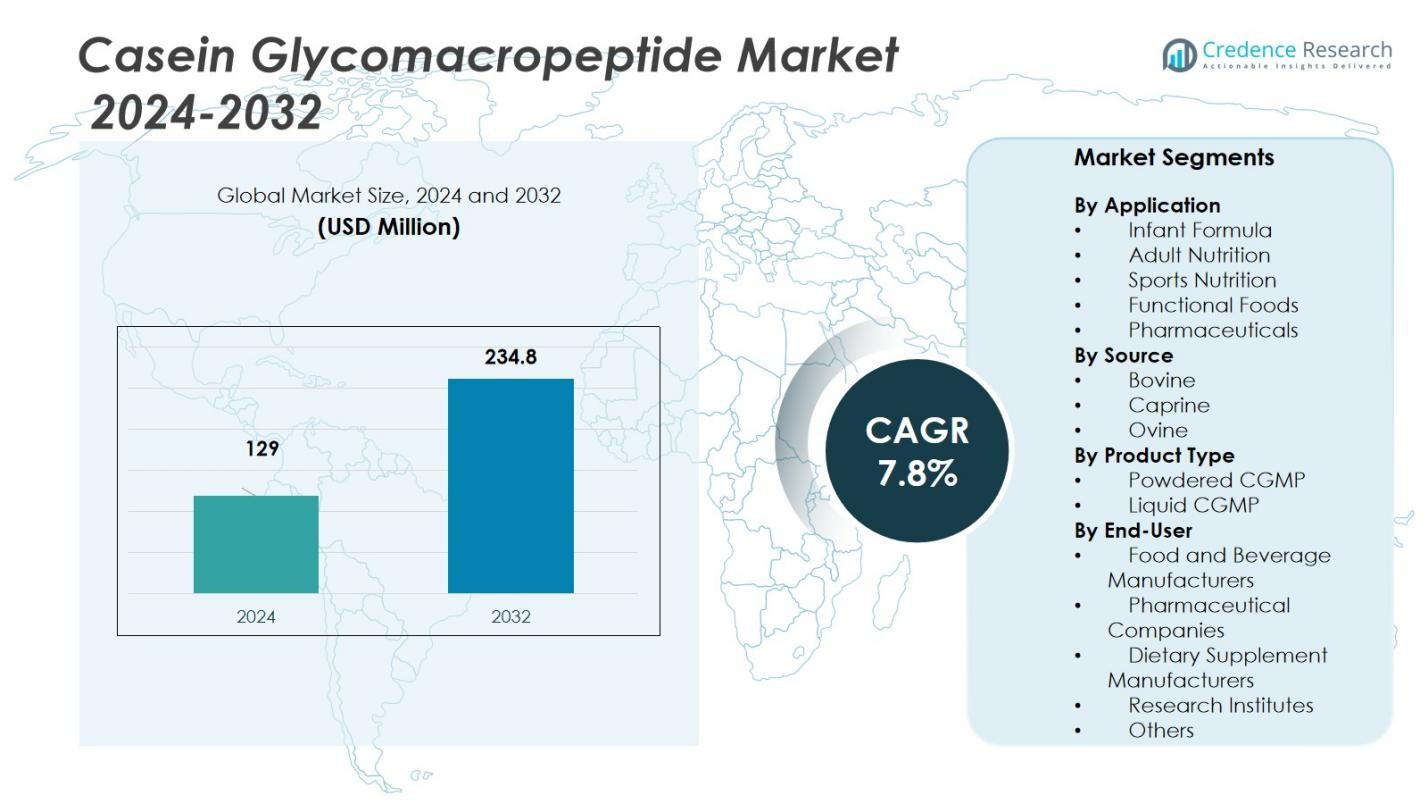
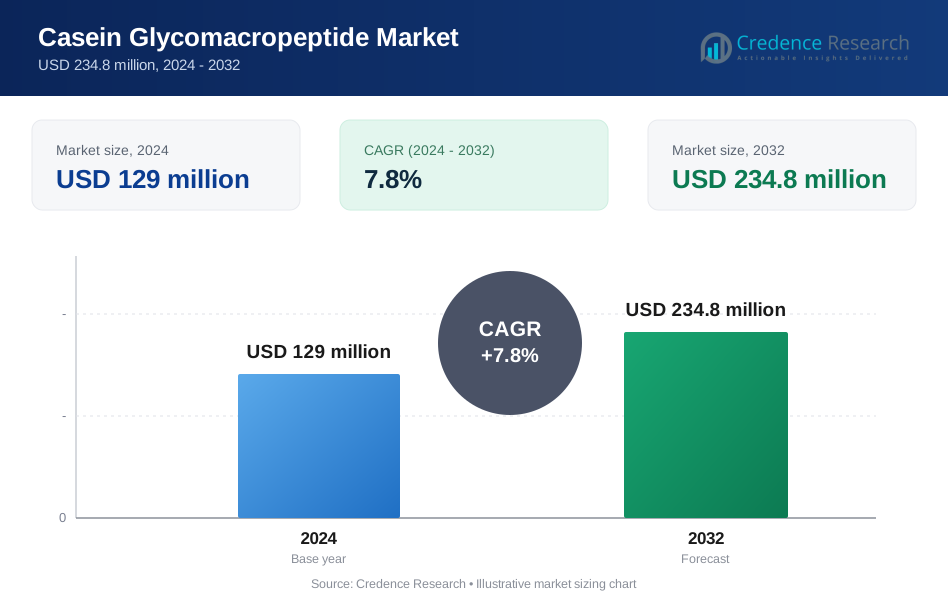
The Casein Glycomacropeptide Market size was valued at USD 129 million in 2024 and is anticipated to reach USD 234.8 million by 2032, at a CAGR of 7.8% during the forecast period.
| REPORT ATTRIBUTE | DETAILS |
|---|---|
| Historical Period | 2020-2023 |
| Base Year | 2024 |
| Forecast Period | 2025-2032 |
| Casein Glycomacropeptide Market Size 2024 | USD 129 Million |
| Casein Glycomacropeptide Market, CAGR | 7.8% |
| Casein Glycomacropeptide Market Size 2032 | USD 234.8 Million |
The Casein Glycomacropeptide (CGMP) market is driven by key players such as New Zealand Milk Products, Saputo Inc., Glanbia Nutritionals, Valio Ltd., Kraft Heinz Company, FrieslandCampina, Dairy Farmers of America, Dairy Crest, and Matthews Canning Company. These companies dominate through strategic investments in R&D, product innovation, and expanding distribution networks globally. North America holds the largest market share of approximately 38%, driven by high consumer demand for protein‑rich functional foods and infant formula. Europe follows with a 30% share, bolstered by strong regulatory frameworks and growing health consciousness. The Asia Pacific region, which accounts for 22%, is rapidly expanding due to rising disposable incomes and increased demand for health supplements and infant nutrition. The market is also experiencing growth in Latin America and the Middle East & Africa, driven by increasing awareness of CGMP's health benefits and the rise of health‑conscious consumers in these regions.
Market Insights
- The Casein Glycomacropeptide (CGMP) market size was valued at USD 129 million in 2024 and is expected to reach USD 234.8 million by 2032, growing at a CAGR of 7.8% during the forecast period.
- The primary driver of market growth is the increasing demand for protein‑enriched infant formula, with a growing preference for specialized nutrition products.
- Key trends include a rising focus on functional foods and adult nutrition, with CGMP gaining popularity for its digestive health benefits and immune‑boosting properties
- The market is highly competitive, with major players like New Zealand Milk Products, Saputo, Glanbia Nutritionals, and FrieslandCampina vying for market share through innovation and strategic partnerships.
- North America leads the market with a share of 38%, followed by Europe at 30% and Asia Pacific at 22%, driven by consumer demand for health supplements and infant nutrition across these regions.
Market Segmentation Analysis:
By Application
\The Casein Glycomacropeptide (CGMP) market is primarily segmented by application into infant formula, adult nutrition, sports nutrition, functional foods, and pharmaceuticals. Among these, infant formula dominates the market with the largest share, driven by the increasing demand for specialized nutrition products for infants, particularly in developing regions. The growth of the infant formula segment is further supported by rising awareness of health benefits and a growing preference for protein-enriched baby food products. Infant formula holds a market share of approximately 40%, followed by adult nutrition and sports nutrition.
- For instance, in adult nutrition, Arla Foods Ingredients offers Lacprodan® CGMP-20, a low-phenylalanine CGMP product used to support patients with phenylketonuria, demonstrating CGMP's specialized dietary role.
By Source
The CGMP market is segmented by source into bovine, caprine, and ovine. Bovine CGMP holds the largest market share, accounting for nearly 60%, driven by the widespread availability of bovine milk and the established dairy industry infrastructure. The use of bovine-derived CGMP in a wide range of applications, including infant formulas and nutritional supplements, propels its dominance. While caprine and ovine CGMP segments hold smaller shares, they are witnessing growth due to rising demand for alternative dairy sources among specific consumer groups with sensitivities to bovine milk proteins.
- For instance, Thermo Fisher Scientific supplies GMP-grade fetal bovine serum (FBS) used extensively in biopharmaceutical cell culture, highlighting the importance of bovine-derived CGMP in pharmaceutical applications.
By Product Type
The product type segment in the Casein Glycomacropeptide market includes powdered CGMP and liquid CGMP. Powdered CGMP is the dominant product type, accounting for approximately 70% of the market share. This segment benefits from its versatility in various applications, particularly in functional foods and nutritional supplements, due to its stability and ease of use. The growing demand for powdered nutritional products, especially in the pharmaceutical and sports nutrition sectors, continues to support the dominance of powdered CGMP. Liquid CGMP, while smaller, is gaining traction in pharmaceutical applications where liquid formulations are preferred for ease of absorption.
Key Growth Drivers
Increasing Demand for Infant Nutrition
The growing global demand for infant formula is a key growth driver for the Casein Glycomacropeptide (CGMP) market. With rising birth rates in emerging economies and an increased focus on infant health and nutrition, CGMP’s presence in infant formula products is expanding. Its beneficial properties, including support for gut health and immunity, make it a preferred choice for formulating infant foods. As parents increasingly seek high-quality, protein-rich formulas, CGMP’s use in infant nutrition continues to see significant growth, propelling the market forward.
- For instance, Mead Johnson Nutrition (a Reckitt company) has incorporated Milk Fat Globule Membrane (MFGM) components similar to those in human milk into their Enfamil infant formulas since 2018, enhancing cognitive development and immune support.
Rising Health Consciousness Among Adults
Adults are becoming more health-conscious, leading to higher demand for nutritional supplements and functional foods that enhance well-being. This has been a significant growth driver for CGMP, particularly in adult nutrition and sports nutrition. CGMP is recognized for its ability to support digestion and immune health, driving its incorporation into functional foods and nutritional supplements. The increasing trend of self-care and the growing popularity of personalized nutrition among adults are fueling the demand for CGMP-based products, contributing to market expansion.
- For instance, SteelFit, a company producing CGMP-containing sports nutrition supplements in an NSF-cGMP certified facility, ensuring product quality and efficacy for fitness enthusiasts.
Growing Popularity of Plant-Based Alternatives
The rise in plant-based diets and alternative dairy products is propelling the CGMP market, especially in regions where lactose intolerance is prevalent. As consumers seek alternatives to traditional dairy products, CGMP derived from sources such as caprine and ovine is gaining traction. These alternatives cater to individuals with dietary restrictions and sensitivities, further expanding the consumer base for CGMP. The shift towards plant-based and dairy-free options, coupled with an increase in consumer awareness about health benefits, is a critical driver for CGMP market growth.
Key Trends & Opportunities
Expanding Application in Pharmaceuticals
One of the notable trends in the CGMP market is its growing application in the pharmaceutical industry. CGMP is increasingly used in the development of therapeutic products due to its potential health benefits, such as its immune-boosting properties and digestive health support. With advancements in pharmaceutical formulations, CGMP is finding applications in managing chronic conditions like irritable bowel syndrome and enhancing drug delivery systems. This trend presents opportunities for CGMP to become a key ingredient in pharmaceutical innovations, expanding its market footprint.
- For instance, the FDA-approved drug linaclotide targets the cyclic guanosine monophosphate (cGMP) pathway to treat adult patients with irritable bowel syndrome with constipation (IBS-C), demonstrating therapeutic applications of CGMP in managing chronic digestive conditions.
Technological Advancements in Production
Technological advancements in dairy processing are creating significant opportunities for the CGMP market. Innovations in extraction methods, such as membrane filtration and enzyme-based processing, are improving the efficiency and cost-effectiveness of CGMP production. These advancements are making CGMP more accessible for use in a wide range of applications, from nutritional supplements to functional foods. As technology continues to evolve, it is expected to drive down production costs and increase the scalability of CGMP, offering new growth prospects for the market.
- For instance, Quintus, a high-pressure processing (HPP) technology manufacturer, introduced the QIF 600L system that increases processing capacity to 4,150 kg per hour, improving efficiency and reducing energy costs while maintaining product quality.
Key Challenges
Price Volatility of Raw Materials
One of the key challenges facing the CGMP market is the volatility in the prices of raw materials, particularly dairy-based sources like bovine and caprine milk. The fluctuating costs of milk, driven by factors such as climate change, feed prices, and supply chain disruptions, pose a significant challenge to CGMP producers. This volatility can impact the overall cost structure and profitability of CGMP-based products, limiting their affordability and accessibility to a broader consumer base. Addressing raw material price fluctuations will be critical to the market’s long-term stability.
Regulatory Hurdles
The CGMP market faces regulatory challenges, especially in regions with stringent food safety and health regulations. As CGMP is primarily used in food and pharmaceutical products, it must comply with various regulatory standards set by health authorities, such as the FDA and EFSA. Any changes in these regulations or delays in approval processes for new applications can impede market growth. Navigating complex and evolving regulatory landscapes is crucial for manufacturers to ensure product safety, quality, and market access.
Regional Analysis
North America
The Casein Glycomacropeptide (CGMP) market in North America holds approximately 38% of the global market share. A strong consumer demand for protein‑rich and specialty nutrition formats drives this region’s dominance. Advanced dairy processing infrastructure and proactive regulatory frameworks further support CGMP adoption. The region also benefits from high awareness of CGMP’s therapeutic potential in conditions like phenylketonuria (PKU). Growth is also fuelled by sports‑nutrition and adult‑wellness trends, which increasingly incorporate CGMP‑based ingredients.
Europe
Europe accounts for around 30% of the CGMP market globally. The region’s share reflects solid demand for functional foods, nutritional supplements, and infant formulas using CGMP. Well‑structured food‑safety regulation and growing health consciousness among consumers further bolster this market. European manufacturers actively innovate CGMP applications, particularly for gut health and immunity. While growth is somewhat tempered by mature markets and regulatory complexity, strong incumbent dairy industries and established ingredient supply chains maintain Europe’s substantial share.
Asia Pacific
In Asia Pacific, the CGMP market holds about 22% of global revenue and is marked by rapid growth. Rising disposable incomes, urbanisation and shifting dietary preferences toward high‑protein and functional foods are key drivers. Markets in China, India and Southeast Asia are expanding their use of CGMP in infant and adult nutrition. Retail modernisation and increasing acceptance of speciality ingredients among Asian consumers further enhance growth. While infrastructure and regulatory systems are evolving, the region presents the most dynamic expansion opportunity for CGMP adoption.
Latin America
Latin America represents approximately 6% of the global CGMP market. The region’s share is supported by emerging interest in dairy‑based supplements and functional foods, particularly in Brazil and Mexico. However, growth is constrained by limited consumer awareness, economic volatility and less developed specialty ingredient supply chains. Opportunities exist as players introduce CGMP‑fortified products aimed at health‑conscious middle‑class consumers. Strategic expansion and local education on CGMP benefits are vital for increasing market penetration in Latin America.
Middle East & Africa
The Middle East & Africa region holds around 4% of the CGMP market share globally. Its smaller share reflects early‑stage development of functional‑nutrition markets and infrastructure constraints. Nonetheless, growing awareness of health and sports nutrition, especially in Gulf countries and South Africa, is creating new demand paths for CGMP‑infused products. Key challenges include regulatory variability and pricing sensitivity, but rising urbanisation and evolving food‑industry standards offer long‑term opportunities for CGMP market growth in the region.
Market Segmentations:
By Application
- Infant Formula
- Adult Nutrition
- Sports Nutrition
- Functional Foods
- Pharmaceuticals
By Source
- Bovine
- Caprine
- Ovine
By Product Type
- Powdered CGMP
- Liquid CGMP
By End-User
- Food and Beverage Manufacturers
- Pharmaceutical Companies
- Dietary Supplement Manufacturers
- Research Institutes
- Others
By Region
- North America
- Europe
- Asia Pacific
- Latin America
- Middle East
- Africa
Competitive Landscape
The global Casein Glycomacropeptide (CGMP) market features major players such as New Zealand Milk Products, Saputo Inc., Glanbia Nutritionals, Valio Ltd., Kraft Heinz Company, FrieslandCampina, Dairy Farmers of America, Dairy Crest, Matthews Canning Company and Synlogic, Inc.. These companies compete intensely through strategic initiatives like R&D investment, quality certifications, and global distribution network expansion. Many firms prioritise formulation innovation to enhance CGMP’s effectiveness in infant formula, sports nutrition and functional food sectors. Firms also focus on acquiring smaller niche players to strengthen their ingredient portfolios and geographic footprints. Increased consumer demand for protein‑rich and functional foods pushes companies to optimise extraction technologies and lower production cost to improve margins. As competition tightens, differentiation through branded ingredients and strong partnerships with food and pharmaceutical manufacturers is increasingly vital.
Key Player Analysis
- Matthews Canning
- Saputo
- Glanbia Nutritionals
- FrieslandCampina
- Synlogic
- Dairy Farmers of America
- Kraft Heinz
- Dairy Crest
- Valio
- New Zealand Milk Products
Recent Developments
- In October 2025, Arla Foods Ingredients launched a new concept (Easy Bite) for high‑protein snacks, which signals innovation in the CGMP/dairy‑derived protein ingredient space.
- In April 2025, Food Standards Australia New Zealand (FSANZ) granted approval for the use of MFGM as a nutritional ingredient in baby formula. The approval will take effect once it is formally accepted by the Food Ministers Meeting of Australia and New Zealand.
- In August 2023, Arla Foods Ingredients and Novozymes announced a partnership to develop advanced protein ingredients (via precision fermentation), including for disease‑specific medical nutrition.
Report Coverage
The research report offers an in-depth analysis based on Application, Source, Product Type, End User and Region. It details leading market players, providing an overview of their business, product offerings, investments, revenue streams, and key applications. Additionally, the report includes insights into the competitive environment, SWOT analysis, current market trends, as well as the primary drivers and constraints. Furthermore, it discusses various factors that have driven market expansion in recent years. The report also explores market dynamics, regulatory scenarios, and technological advancements that are shaping the industry. It assesses the impact of external factors and global economic changes on market growth. Lastly, it provides strategic recommendations for new entrants and established companies to navigate the complexities of the market.
Future Outlook
- Demand for CGMP in functional foods will accelerate as consumers seek ingredients supporting gut health and immunity.
- Growth in the sports nutrition segment will boost CGMP use, driven by its slow‑digesting amino acid profile and muscle recovery benefits.
- The infant nutrition sector will remain a strong growth vector for CGMP, as demand rises for specialized proteins in baby formulas.
- Expansion in pharmaceutical and medical nutrition applications will push CGMP adoption, especially for metabolic disorders like phenylketonuria.
- Emerging‑market growth (Asia‑Pacific, Latin America) will open new CGMP opportunities, thanks to rising income levels and shifting diets.
- Technological advancements in extraction and purification will reduce CGMP production costs and improve ingredient accessibility.
- Manufacturers will increasingly form strategic partnerships and alliances to bring CGMP‑containing products to market faster.
- Clean‑label and dairy‑derived protein trends will favour CGMP as a premium ingredient in the clean‑label movement.
- Producing CGMP from alternative sources (caprine, ovine) will gain traction to cater to niche dairy‑sensitive or specialty groups.
- Cost pressures and regulatory complexity will remain headwinds, but improved manufacturing scale and regulatory clarity will enhance market resilience.
Request a Free Sample
Fill in your details and we'll send you a free sample report.
- Sample data tables & charts
- Research methodology
Need a Custom Version of This Report?
Tailor the scope, geography, or segments to your exact requirements.
- Custom geography or segment scope
- Direct access to our analyst team
Frequently Asked Questions
What is the current market size for Casein Glycomacropeptide Market, and what is its projected size in 2032?
At what Compound Annual Growth Rate is the Casein Glycomacropeptide Market projected to grow between 2025 and 2032?
Which Casein Glycomacropeptide Market segment held the largest share in 2024?
What are the primary factors fueling the growth of the Casein Glycomacropeptide Market?
Who are the leading companies in the Casein Glycomacropeptide Market?
Which region commanded the largest share of the Casein Glycomacropeptide Market in 2024?
Table of Content
Chapter 1. Report Introduction
- 1.1 Report Description & Purpose
- 1.1.1 Report Title & Market Definition
- 1.1.2 Unique Selling Propositions (USP) & Key Differentiators
- 1.1.3 Value Proposition for Stakeholders
- 1.2 Research Objectives
- 1.2.1 Market Sizing Objectives (Volume & Revenue)
- 1.2.2 Segmentation Objectives
- 1.2.3 Competitive Intelligence Objectives
- 1.2.4 Forecast & Scenario Objectives
- 1.3 Report Scope
- 1.3.1 Casein Glycomacropeptide Scope – Types & Subtypes Covered
- 1.3.2 Geographic Scope – Regions & Countries Covered
- 1.3.3 Historical Period, Base Year & Forecast Period (2024; forecast to 2032)
- 1.3.4 Inclusions & Exclusions
- 1.4 HS Code & Classification Framework
- 1.5 Currency, Units & Pricing Basis
- 1.6 Target Stakeholders
- 1.7 Limitations & Assumptions
Chapter 2. Executive Summary
- 2.1 Global Casein Glycomacropeptide Market Snapshot
- 2.1.1 Market Size – Historical (2024) & Forecast (2024-2032) (2024: USD 129 million → 2032: USD 234.8 million)
- 2.1.2 Volume & Revenue – Global Totals
- 2.1.3 Key Market Highlights – Top Five Facts
- 2.2 Casein Glycomacropeptide Market Segmentation Snapshot
- 2.2.1 Market Split by Region – 2024 vs. 2032
- 2.3 Competitive Snapshot
- 2.3.1 Top 10 Players by Revenue Share – 2024
- 2.3.2 Top 10 Players by Volume Share – 2024
- 2.3.3 Recent Strategic Developments (18-Month Summary)
- 2.4 Key Investment Highlights & Strategic Conclusions
Chapter 3. Casein Glycomacropeptide Market Dynamics & Industry Analysis
- 3.1 Market Overview & Context
- 3.1.1 Casein Glycomacropeptide Market Position in the Broader Automotive Value Chain
- 3.1.2 OEM vs. Replacement Market Dynamics
- 3.1.3 Market Maturity & Development Stage by Region
- 3.2 Casein Glycomacropeptide Market Drivers
- 3.3 Casein Glycomacropeptide Market Restraints & Challenges
- 3.4 Casein Glycomacropeptide Market Opportunities
- 3.5 Porter's Five Forces Analysis
- 3.5.1 Threat of New Entrants
- 3.5.2 Bargaining Power of Suppliers
- 3.5.3 Bargaining Power of Buyers
- 3.5.4 Threat of Substitutes
- 3.5.5 Competitive Rivalry – Intensity Assessment
- 3.6 Casein Glycomacropeptide Value Chain Analysis
- 3.6.1 Upstream – Raw Material/Input Suppliers
- 3.6.1.1 Raw Material/Input 1
- 3.6.1.2 Raw Material/Input 2
- 3.6.1.3 Raw Material/Input 3
- 3.6.2 Midstream – Production/Manufacturing/Service Delivery
- 3.6.2.1 Production/Process Overview
- 3.6.2.2 Key Facility Locations & Capacity by Manufacturer
- 3.6.3 Downstream – Distribution & End Consumer
- 3.6.3.1 Primary Channel – B2B/OEM
- 3.6.3.2 Secondary Channels – Dealer, Retail, Online, Direct
- 3.6.4 Value Chain Profitability Analysis
- 3.6.1 Upstream – Raw Material/Input Suppliers
- 3.7 PESTEL Analysis
- 3.7.1 Political Factors
- 3.7.2 Economic Factors
- 3.7.3 Social Factors
- 3.7.4 Technological Factors
- 3.7.5 Environmental Factors
- 3.7.6 Legal Factors
- 3.8 Casein Glycomacropeptide Supply Chain Analysis
- 3.8.1 Raw Material/Input Supply Risk Assessment
- 3.8.2 Manufacturing Concentration Risk (Geographic Exposure)
- 3.8.3 Trade Disruption Impact Analysis
- 3.9 Regulatory & Policy Landscape
Note: The regulatory and policy landscape section covers regulations based on their applicability to the market, Casein Glycomacropeptide category, geography, and scope of the study. Only regulatory frameworks with a material impact on operations, compliance, trade, sustainability, or market access are analyzed in detail.
Chapter 4. Key Investment Pockets & Opportunity Analysis
- 4.1 Casein Glycomacropeptide Market Attractiveness Analysis
- 4.1.1 By Region – Investment Attractiveness Matrix (Volume × CAGR)
- 4.2 Absolute Revenue Growth Opportunity
- 4.2.1 By Region – Absolute USD Growth Through 2032
- 4.3 Incremental Volume Opportunity
- 4.3.1 By Region – Incremental Volume Through 2032
- 4.3.2 Segment – Incremental Volume
- 4.4 Emerging Submarket Opportunity Deep Dive (Subject to Applicability)
- 4.5 Emerging Market Opportunity Scorecards
- 4.5.1 United States
- 4.5.2 Europe
- 4.5.3 Asia
- 4.5.4 Middle East & Africa
Note: Emerging Market Opportunity Scorecards will be included based on relevance and strategic importance. Regions listed are indicative and may vary depending on data availability and market dynamics.
Chapter 5. Casein Glycomacropeptide Import-Export Analysis & Trade Flows
- 5.1 Global Trade Overview
- 5.1.1 Global Export Value by Country (2024)
- 5.1.2 Global Export Volume by Country (2024)
- 5.1.3 Global Import Value by Country (2024)
- 5.1.4 Global Import Volume by Country (2024)
- 5.1.5 Net Trade Balance by Country (2024)
- 5.2 Export Analysis – Segment
- 5.2.1 Type 1 (HS Code)
- 5.2.2 Type 2 (HS Code)
- 5.2.3 Type 3 (HS Code)
- 5.2.4 Type 4 (HS Code)
- 5.2.5 Type 5 (HS Code)
- 5.3 Import Analysis – Segment
- 5.3.1 Type 1 (HS Code)
- 5.3.2 Type 2 (HS Code)
- 5.3.3 Type 3 (HS Code)
- 5.3.4 Type 4 (HS Code)
- 5.3.5 Type 5 (HS Code)
- 5.4 Average Unit Trade Prices
- 5.4.1 Average Export Price – Segment & Country
- 5.4.2 Average Import Price – Segment & Source Country
- 5.4.3 Price Trends (2024)
- 5.5 Key Trade Route Analysis
- 5.5.1 Trade Route 1
- 5.5.2 Trade Route 2
- 5.5.3 Trade Route 3
- 5.5.4 Trade Route 4
- 5.5.5 Trade Route 5
- 5.6 Trade Policy Impact Assessment
- 5.6.1 US Anti-Dumping & Section 301 Tariffs
- 5.6.2 EU Customs Union Impact
- 5.6.3 Major Free Trade Agreements
- 5.6.4 USMCA Rules of Origin
Note: Trade policy analysis will be included only where relevant to the Casein Glycomacropeptide market.
Chapter 6. Competitive Landscape & Company Benchmarking
- 6.1 Casein Glycomacropeptide Market Concentration & Structure
- 6.1.1 Herfindahl-Hirschman Index (HHI) – vs. 2024
- 6.1.2 Tier 1, Tier 2 & Tier 3 Market Structure
- 6.1.3 Global, Regional & Local Player Dynamics
- 6.2 Casein Glycomacropeptide Market Share Analysis – 2024
- 6.2.1 Global Revenue Share by Company
- 6.2.2 Global Volume Share by Company
- 6.2.3 Regional Revenue Share
- 6.2.4 Market Share Evolution ( vs. 2024)
- 6.2.5 OEM Segment Share by Company
- 6.2.6 Replacement Segment Share by Company
- 6.3 Production/Delivery Capacity & Facility Analysis
- 6.3.1 Global Installed Capacity
- 6.3.2 Capacity Utilization Rates
- 6.3.3 Production/Output Volume
- 6.3.4 Facility Locations & Capacity Map
- 6.3.5 Planned Capacity Additions
- 6.4 Casein Glycomacropeptide Competitive Benchmarking Matrix
- 6.4.1 Revenue, Volume, CAGR & Profitability Comparison
- 6.4.2 Channel Revenue Mix
- 6.4.3 Geographic Revenue Exposure
- 6.4.4 R&D Intensity
- 6.4.5 Sustainability Maturity
- 6.5 Strategic Developments in Casein Glycomacropeptide (Last 24 Months)
- 6.5.1 Mergers, Acquisitions & Divestments
- 6.5.2 New Casein Glycomacropeptide Launches
- 6.5.3 Facility Expansions
- 6.5.4 Strategic Alliances, Joint Ventures & Partnerships
- 6.5.5 Distribution Expansion & Market Entry
- 6.5.6 Sustainability & ESG Initiatives
- 6.6 Competitive Strategy Mapping
- 6.6.1 Leader, Challenger, Follower & Niche Classification
- 6.6.2 Pricing Strategy Comparison
- 6.6.3 Channel Strategy Matrix
Note: Strategic developments are included based on their materiality and the availability of reliable information.
Chapter 7. Global Casein Glycomacropeptide Market – By Distribution Channel
- 7.1 Segment Overview
- 7.1.1 Volume & Revenue Split by Channel (2024 & 2032)
- 7.1.2 Channel Mix Evolution (2024-2032)
Chapter 8. Regional Market Analysis – Global Overview
- 8.1 Global Regional Overview
- 8.1.1 Regional Volume Share
- 8.1.2 Regional Revenue Share
- 8.1.3 Regional Volume by Region
- 8.1.4 Regional Revenue by Region
- 8.1.5 Regional Forecast Through 2032
- 8.2 Cross-Regional Segment Analysis
- 8.2.1 By Distribution Channel
- 8.2.2 By Brand/Price Tier
Chapter 9. North America Casein Glycomacropeptide Market
- 9.1 United States
- 9.2 Canada
- 9.3 Mexico
Chapter 10. Europe Casein Glycomacropeptide Market
- 10.1 Germany
- 10.2 France
- 10.3 Italy
- 10.4 United Kingdom
- 10.5 Spain
- 10.6 Poland
- 10.7 Russia
- 10.8 Netherlands
- 10.9 Belgium
- 10.10 Sweden
- 10.11 Denmark
- 10.12 Norway
- 10.13 Rest of Europe
Chapter 11. Asia Pacific Casein Glycomacropeptide Market
- 11.1 China
- 11.2 India
- 11.3 Japan
- 11.4 South Korea
- 11.5 Thailand
- 11.6 Indonesia
- 11.7 Vietnam
- 11.8 Malaysia
- 11.9 Australia
- 11.10 Rest of Asia Pacific
Chapter 12. Latin America Casein Glycomacropeptide Market
- 12.1 Brazil
- 12.2 Argentina
- 12.3 Colombia
- 12.4 Chile
- 12.5 Rest of Latin America
Chapter 13. Middle East Casein Glycomacropeptide Market
- 13.1 Saudi Arabia
- 13.2 United Arab Emirates
- 13.3 Turkey
- 13.4 Israel
- 13.5 Iran
- 13.6 Rest of the Middle East
Chapter 14. Africa Casein Glycomacropeptide Market
- 14.1 South Africa
- 14.2 Egypt
- 14.3 Nigeria
- 14.4 Morocco
- 14.5 Rest of Africa
Chapter 15. Casein Glycomacropeptide Company Profiles
- 15.1 [Company 01]
- 15.1.1 Company Overview
- 15.1.2 Key Management Personnel
- 15.1.3 Products & Services Portfolio
- 15.1.4 Financial Performance
- 15.1.5 Key Market Focus & Geographic Presence
- 15.1.6 Recent Developments & Strategic Initiatives
Note: The company profile list is preliminary and may change based on research findings, market developments, data availability, and client requirements.
Chapter 16. Appendices
- Appendix A – List of Abbreviations & Acronyms
- Appendix B – Industry Classification Code Reference – Full Series
- Appendix C – Production & Capacity Data Tables
- Appendix D – End-Use & Demand Base Tables
- Appendix E – Consumption & Replacement Rate Assumptions
- Appendix F – ASP Reference Tables
- Appendix G – Manufacturing & Facility Database
- Appendix H – Import-Export Data Tables
- Appendix I – Regulatory Summary Tables
- Appendix J – Primary Research Participant List (Anonymized)
- Appendix K – Primary Research Questionnaire Framework
- Appendix L – Data Sources & Bibliography
- Appendix M – Market Size Divergence & Source Comparison
Chapter 17. Research Methodology
- 17.1 Research Framework & Philosophy
- 17.2 Secondary Research – Sources, Hierarchy & Data Extraction
- 17.3 Data Modeling – Bottom-Up & Top-Down Market Sizing
- 17.4 Primary Research – Stakeholder Framework, LOI & Sample Sizes
- 17.5 Forecast Methodology – Regression, Scenario & Sensitivity Analysis
- 17.6 Quality Control – Four-Layer Validation Framework
- 17.7 Limitations & Standard Assumptions
- 17.8 Disclaimer
